
I. INTRODUCTION
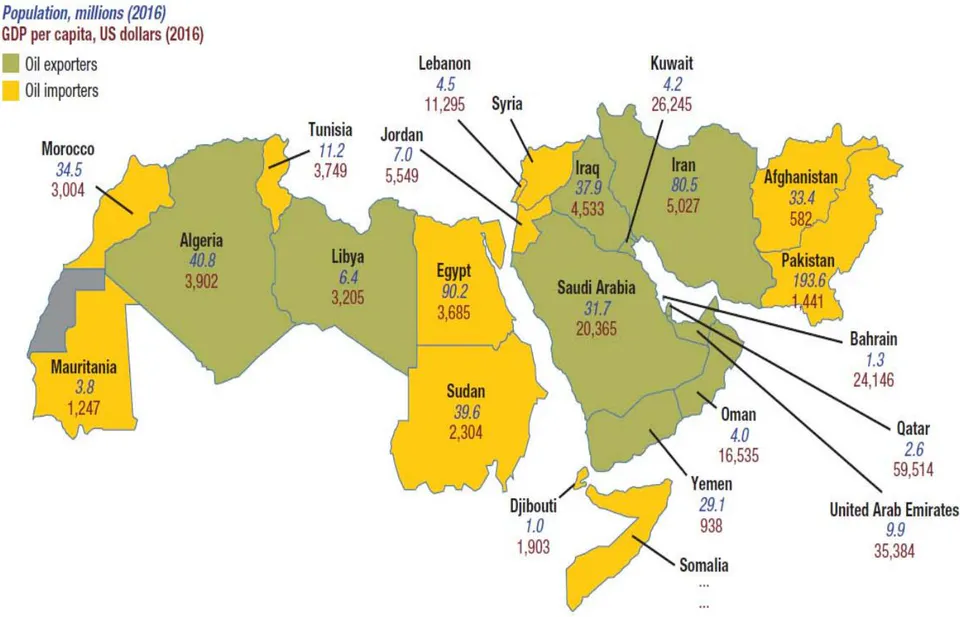
Must hit the (processes of people making, selling, and buying things) of the Middle East and North Africa (MENA). Money-based growing is reducing, long overdue good changes, that could help start growing and produce works. The World Bank Group's newest quarterly money-based Brief argues that these nations should grab and take control of the chance to improvement. (related to what holds something together and makes it sturdy) good changes looked-for to break the (situation where a bad thing causes another bad object) of slow development and (not having a steady, trustworthy government) regimes in these nations cannot manage to pay for stay short term policy movements such as growing (government-run services and their employees) salaries and helping payments, (says Shanta Devarajan, World Bank Chief Money-flow expert for the MENA area. These strategies make worse a situation which is driven by long-standing (related to what holds something together and makes it sturdy) weaknesses, including labor not flexibilities, complicated and difficult to understand rules, elementary equipment needed for a business or society to operate) (not having enough of something), backwards-moving and inefficient helping payments, and (not good enough) social safety nets, and we will study Yemeni economic as issue to study (Stebbins. 2014).
Yemen is a weak country economically, and its economy is non-well developed as it depends heavily on international aids despite the shortage of oil resources.
Yemen is not a part of the globe Trade Organization and is full of structural issues notably corruption and various political and social group conflicts that control the country (Statistical Yearbook 2011). The economic activity depends on the port of Aden that was affected once the closure of the Suez Canal and Yemen faced issues in integrating the two systems of the north and the south. Before the unity, the deterioration in the export of Yemeni coffee is because of QAT cultivation which affects about 10%. This 10% needs nearly 150000 workers in Yemen at the same time and was principally related for a variety of environmental issues notably 30% of irrigation water consumption and to chop off several appropriate for the cultivation of fruits vegetables, coffee (Economy of Yemen. 2017).
Yemen could export 40000350000 Tons of fish a year. However, production in this sector is same slight and is limited to the fishermen and the owners of small boats of Gross Domestic Production (GDP) whose value is about 33.76 billion dollars. Unemployment is 35%, and there are 45% who live below poverty line. The current public debt of Yemen is 3.12 billion dollars as 37% is to GDP. The rate of increase in inflation is 20% in the ingestion price, and in the government of Ali Abdullah Salah, Yemen was ranked 146 of 178 in 2010 according to Transparency International corruption Organization report (Al-Musafir. 2000). Yemen was classified as one of the worst deteriorating economies in the developing countries. In a comparison of financial income within the Arab countries, Itwas indicated by GRP-CIA reports that the Republic of Yemen occupies the last place among these countries as the daily financial revenue is one dollar and also the individual financial income is roughly 95 dollars monthly according to Qatar ranking report, while a native study suggests that the annual financial profits is about 600$. Economy chiefly depends on the country oil wealth, fish and agricultural wealth and tourism (Al-Ani. 2002).
a) Background of the industry
Through the 1990s, the Yemeni economy witnessed a decline in GDP and variations due to the input of basic segments such for example farming and manufacturing to GDP. In the first decade of the last decade, the economy was unprotected to several issues of corrosion, and as an outcome, the input of non-oil segments declined. This is has led to a decline in gross domestic product from ( 543) million in 1994 (the price of the United States dollar was 172 rials in 2000).
In 2000 was valued to 701 in 1990 to $ 367 in 2000) and then to the US dollar. (275 in 2002). With the low per capita annual income, joblessness and inflation rose, and demand for commodities also rose, leaving pressure on the economy.
b) Problems Statement
Yemen's economy is in a weak phase and prone to collapse, and this is the accumulative result over the years. It arrived at the case of collapse at the moment, and there are many factors through time that lead the economy to this stage, and these factors are the previous regime and his administration, stopped financial assistance from donor countries for Yemen, the Central Bank not moving transmission and the worsening poverty. All these factors affected the Yemeni economy at heart and led the country to this stage (Al-Ghafori. 2014).
Rule management suffers from weaknesses due to difference within the Yemeni opinion and opportunities within the governance method. Governance in the Yemen Republic is considered weaker than the other countries. The United Nations agency measured the effectiveness and potency of the rule of law, and the result showed that Yemen suffers from low income, low security, and stumpy political stability. Weak governance in Yemen is within the business climate, and therefore it has its impact on personal sector growth. Among the factors associated with the weakness of excellent governance, indicators are the low level of public services and the absence of infrastructure at the pinnacle of the elements. Then, it is necessary to bridge the present gap within the management of excellent governance in Yemen as a challenge and a chance at the same time to enhance the standard, and improve the internal responsibility through the separation of powers leading to balance between them and perform body reforms, promote foreign supply at the national level and at the level of government units (Al-Batali2014).
c) Objectives of the Research
This Research Has The Following Objectives:
i. To evaluate the effect of the effectiveness of Good governance on the economic efficiency in Yemen.
ii. To explore the effect investments on the economic improvement in Yemen.
iii. To investigate the effect of economic policies on the economic improvement in Yemen.
d) Research Questions
i. What is the influence of the worthy governance on the economic upgrading in Yemen?
ii. What is the effect of investments on the economic improvement in Yemen?
iii. What is the effect of policies economic on economic development in Yemen?
e) Significance of the Study
The significance of the study comes from the importance of budget in any nation. Yemen is suffering from a weak budget especially in the last crisis after the 2011 revolution. The crisis has led to many problems, and currently, in October 2016, the Yemeni employees have not received their salary until now. There is a need for such studies which deals with the current scenario in Yemen to reveal the real causes of the catastrophe and figure out remedies for such a problem.
The political scenario in Yemen, moreover, is changing day after day which makes such studies which investigate the economic problems of the country imperative. Such studies might not reach to the decision-makers in the country, but still, these studies are considered as documentation for the monetary situation in Yemen.
Besides, investigating the economic crisis in Yemen and the causes is significant due to the effect of the economy in all the other sectors in Yemen. In other words, the social life and simple services including education, electricity, food and lifecycle expenses depend on the economic state of the country. If the financial state of the nation is virtuous, the other public sectors and services will not be a burden upon the Yemeni citizens who live in the country. These reasons encourage the researcher to investigate the issue of Yemeni economy to find the challenges and the factors that might help to minimize or flourish the Yemeni economy.
II. LITERATURE REVIEW
a) Economic growth and its importance in the Republic of Yemen
The plans and strategies that passed by Yemen on consecutive stages of economic development from 1990 until plan viewing 2025 founded Yemeni economist, and after the unification of the country in 1990, the economy grew at an average% 6.3 a year until 1994. However, the civil war that erupted in 1994 caused economic growth to decelerate to% 4.2 in 1994. With the achievement of political the stability of the oil that has witnessed the government implemented an financial reform and stabilization program that helped keep the growth rate at an annual average 5.2 percent in 1995–2006 In the 2000s, a number of reform initiatives were launched, including civil service and public financial management reforms, a foremost adjustment in fuel subsidies in 2005, the introduction of a general sales tax, an anti-corruption drive, and improvements to the social safety net, but most were only partially implemented and with significant deferrals. The country's willingness to reform in the face of increasingly favorable international oil prices and rising political and security constraints. Economic growth during 2000–2010 decelerated to an average rate of 4.3 percent a year, while GDP per capita increased to%1.6. In 2011, the political and security crisis caused the economy to slip into recession, and GDP shrinks%12.7. The economy recovered slowly, growing%2.4 in 2012 and%4.8 in 2013. And In 2014, economic growth slowed to about%0.3 because oil production was restricted by infrastructure sabotage and severe fuel shortages and widespread power cuts extremely disrupted economic activity. Macroeconomic stability is now continually endangered by insecurity and political instability, the foremost causes of the oil infrastructure sabotage that has reduced hydrocarbon production and, hence, exports revenues, the most important source of government revenue. Also, the current energy subsidy system absorbs most fiscal revenue, compromising financial sustainability and leaving little scope for urgently needed growth-enhancing infrastructure investment and social expenditures. To mitigate the impacts of oil price shocks, the country must prepare to changeover to a non-oil economy, particularly by promoting private investment.
The Ministry of Planning and International Cooperation Vision 2025 strategy.
b) Macroeconomic Performance
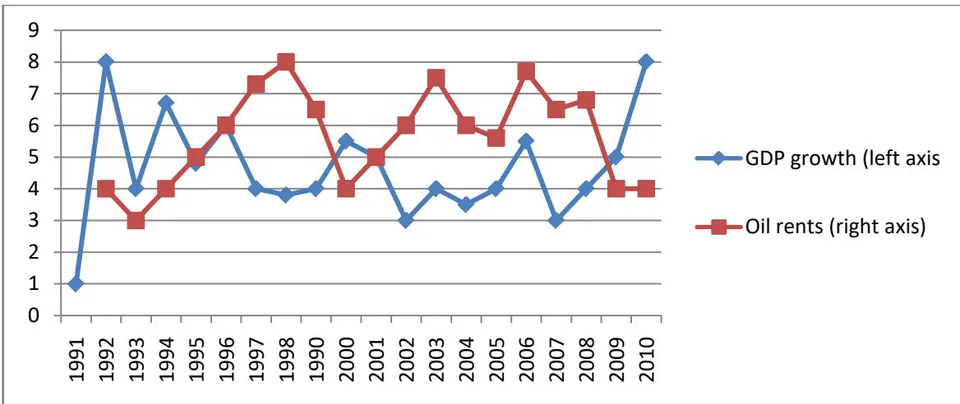
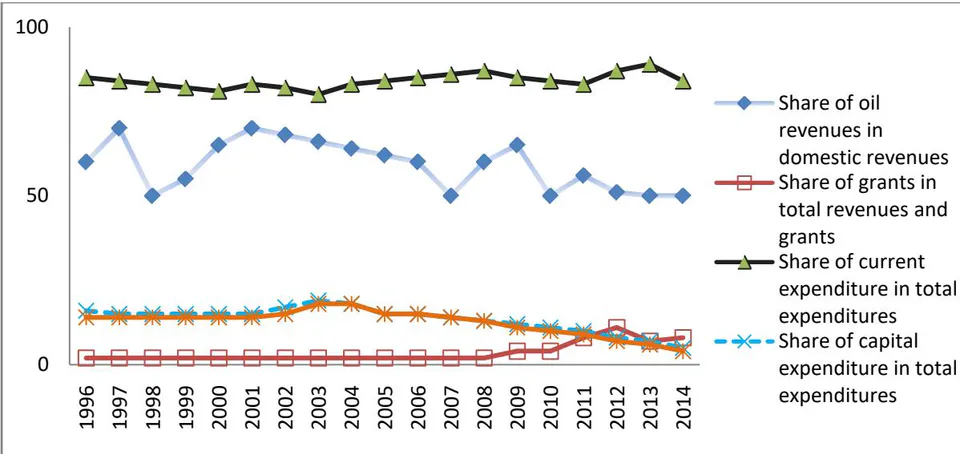
Since 1990, oil and gas had been generated more than half of domestic revenues revenue represented an average of% 20 of GDP during 1996–2014, that is,% 68 of total domestic income. In late 1980 Oil production was undertaken. Output reached 173,000 barrels a day in 1988 and peaked at over 440,000 barrels a day in 2000, but started declining drastically after 2001 as a result of maturing fields, limited exploration, and frequent sabotage of oil infrastructure. In 2009, the country began producing commercial quantities of natural gas for domestic use and export as liquefied natural gas. Until 2008, the government was able to sustain growing oil revenue because of the booming prices for hydrocarbons and, to a lesser extent, because of the expanding government share in oil production. Since 2009, revenues have declined because of the fall in prices and the drop-off in output caused by insecurity, especially since 2011. In 2014, the situation worsened because of the decline in oil production and international prices. Grants remained low, at less than% 1 of GDP most of the time, except in 2012 and 2014 Stebbins. 2014) (Figure 2.2)
c) Economic policies
Economic life witnessed at the end of the twentieth century, the occurrence of an acceleration in the overall ruling variables and the institution to enter the new world, and this has not been cut off from its roots. Just be the last representative in the present, the latter is part of the features of the future, the failure of economic development in the Third World, which floated types on the surface such as debt, decline in the performance of local economies, poverty, unemployment are all manifestations and provided an opportunity to force developing countries to adopt new policies that have been renamed sometimes economic reform and at other times of economic correction and other structural change and all of us were not very content and went national in tune with the requirements and needs of the economy developing (Al-Hazmi. 2006).
The bulk of these policies and programs paid well to developing countries came under the whip of the need for the international financial institutions (WB-IMF), and therefore carry requirements for the restructuring of these economies according to the vision of these institutions in order to raise the creditworthiness of these countries to repay their debt-sided of on the other hand they are ideologically biased toward modifying the developing country's economic trends towards market economy and then market society and under the pretext of economic liberalization and the central rein in the allocation of financial resources (Al-Nasir. 2005).
d) General objectives for economic reform
Economic reform is not an end in itself, but a means to achieve specific purposes as follows:
Optimal investment and proper distribution of cost-effective resources and human energies.
Reducing the external debt (money owed).
Promote exports and strengthen the competitiveness of the country's products in foreign markets.
Reduce the flow of capital abroad and attract foreign investment to the inside through the provision of appropriate investment climate.
Achieve desired balances required in the national economy between production and consumption on the one hand and between savings and investment on the other.
Controlling inflation.
There are broadly two ways of controlling inflation in an economy: (IIFL Securities Ltd 2018).
1. Monetary measures and
2. Fiscal measures
- Monetary Measures
The most important and commonly used method to control inflation is monetary policy of the Central Bank. Most central banks use high interest rates as the traditional way to fight or prevent inflation.
Monetary measures used to control inflation include:
i. Bank rate policy
ii. Cash reserve ratio and
iii. Open market operations (IIFL Securities Ltd 2018).
Raise economic growth rates across the localization data of scientific and technological revolution.
Equitable distribution of national income, which would contribute to the improvement of the living standards of citizens.
Lift the country out of the recession phase to the process of economic recovery.
Improve the financial, monetary and banking sector performance.
Alleviate the external debt and debt limit pressure on the national economy.
Encourage the private sector and increase its participation in the national economy to growth production and create new employment opportunities.
Dismantling some of the public sector and privatization of enterprises, due to the state's inability to manage efficiently for the benefit of the middle class in the society.
Development and expansion of public services (education - education - health).
e) Conceptual Framework
Yemen's economy suffered and continued to suffer from severe weakness and threatening to collapse especially in the last time and as a result of the phase experienced by the country from the scourge of war, absence of the authorities, effects of the previous regime, foundations of the state, lack of backbone in achieving economic success, and deprived general supervision of its (process of people making, selling, and buying things) and its (related to managing money) position.
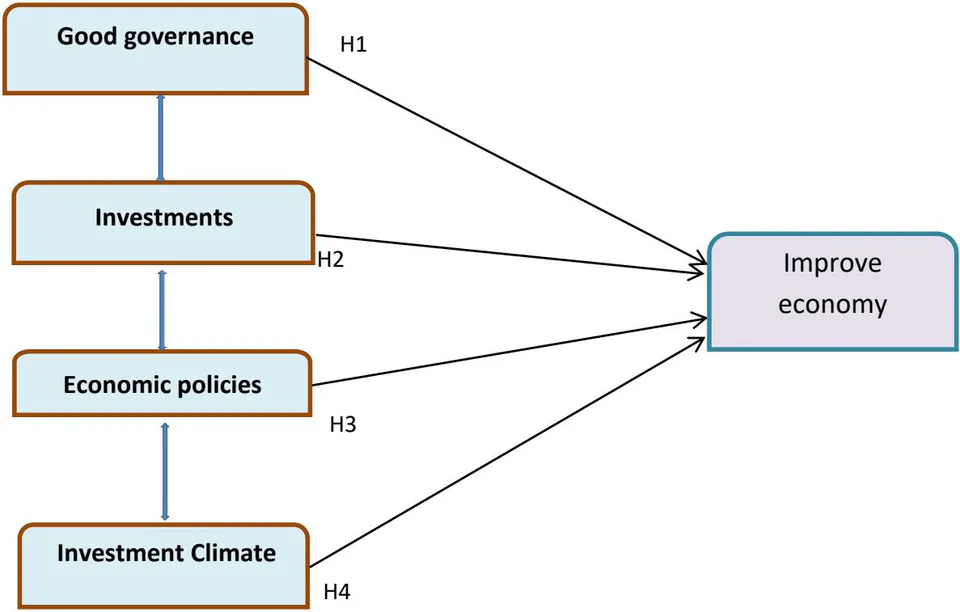
All this based on Yemen's economy weakness until becoming at the forefront of economically developed countries and clinch the effects of a fearsome ghost over the years, According to long-term planning in 2025. (Figure 1 conceptual framework).
III. RESEARCH METHODOLOGY
a) Introduction
After an intensive reading of the research traditions, the researcher found that the most appropriate research tradition that would achieve the aim of the study was the qualitative tradition. The strength of the qualitative tradition is that the researcher has a chance to describe the phenomenon studied as it is in its natural environment.
b) Research approach and design
Within this qualitative tradition, the researcher was focused structured interviews designed to investigate the study participants' opinions concerning the issue are being investigated. Therefore, the present study is identified to be a qualitative study. The structured questions along with the consent form were translated into the participants' mother tongue (Arabic). The narrative data were translated into Arabic and
English, organized, coded, and categorized into themes and patterns related to the study.
c) Data collection instrument
Data-collection instruments vary in qualitative research. One of these are instruments; it's interviewing. Interviews are very effective for expressing feelings, ideas, beliefs, experiences, and knowledge, (According Seidman. 2006) is a basic mode of inquiry". Interviewing is an interest in understanding the lived experience of other people (Seidman. 2006). The interviewer should be skillful and highly interested in listening to interviewees. Showing interest in listening to interviewees makes them feel happy, and they will express themselves in depth. In other words, being skillful and interested will help the interviewer enter into the stream of consciousness of others and experience what they have (Seidman, 2006). Underscored by (Seidman2006) when he stated that, interviewing provides access to the context of people's behavior and thereby provides a way for researchers to understand the meaning of that behavior". How people involved in this process experience events can be exploring in many ways such as examining institutional documents, conducting observations, studying economic, doing experiments, conducting questionnaires or surveys, etc. But if the researcher's goal is to understand the experiences and beliefs of the subjects in depth, he can then use interviews since they provide effective ways of inquiry (Seidman, 2006). And by the aims and questions of this study. These questions were also used to ease the process of interviewing. Fontana and Frey (2003) stated that it is advisable that a "researcher begins by breaking the ice with general questions and gradually moves on to more specific ones. The interview questions were also focusing on having a deep understanding of most important problems, strengths, and suggestions for developing the financial. At the same time, the focus was also to investigate whether the aims stated in the economic policy documents has been achieved and if they are active in the private sector. All the interview questions are had been found in appendices (A, B, C, and D). In addition to these four sources of data, the researcher analyzed the available economic policy documents. The analysis of these economic policy documents led to extracting some substantial quotes that were converted into questions and were had been used in the interviews.
IV. CONCLUSION
Many factors that affect the growth of the economy in Yemen. According to the results of the investigation, there are four highest issues that have a mighty contribution to the improvement of the Yemeni economy. The first one is useful governance because the economic development will not be improving without having a good leadership that able to move up the economy to the level of the other prosperous countries. The second one is the investment in both the public and the private sector. Yemen needs to attract investors even from outside Yemen to come and invest in Yemen since this will help to improve the economy of Yemen and provide job opportunities for Yemeni citizens. The third one is the benevolent policy which is related to the decision-makers who can follow sturdy rules to encourage people and companies inside and outside Yemen to invest in Yemen especially in the private sector. The fourth one is the climate because the success of the budget growth needs a suitable environment that provides the facilities and the supports for the people to come and invest in it. The fourth factor is the one which Yemen suffers from most especially in the last few years due to the war.
V. RECOMMENDATIONS
This study concluded with different recommendations to improve the economy of Yemen.
The first word has been given to decision-makers who are the dynamo of the economy. They should revise the systems and get benefit from the experiences of the other countries to improve the economy of Yemen. Also, there are many (meetings to discuss things/meetings together) that had been conducted under the supervision of the World Bank which suggested some solutions by different researchers who supported their ideas by scientifically approved studies.
Decision-makers should be aware that they represent the governance and good governance is the strategic element in developing the economy of Yemen. Because they are the responsible for the policies which should encourage the companies and businessmen to come and invest in Yemen which in turn will provide thousands of opportunities for the Yemeni people in order to overcome the poverty. Also, investments will create attractors from outside the country to come in invest in Yemen which will flourish the economy of the country.
Recommendations should also be directed to politicians because the climate and the environment in Yemen are not encouraging for investment which has a negative impact on the economy of Yemen. The political situation in Yemen is the essential negative factor that prevents the wheel of development in Yemen. If the political situation in Yemen had been resolved, it will be possible to pave the way for the economic evolution which cannot be achieving when the country is not stable.
ABBREVIATIONS AND ACRONYMS
MENA Middle East and North Africa WBG World Bank Group's YE Yemeni economic GDP Gross Domestic Production CBY Central Bank of Yemen MPIC Ministry of Planning and International Cooperation UN United Nations CPI Consumer Price Index CSO Central Statistical Organization FDI Foreign Direct Investment FTA Free Trade Area GDI Gross Domestic Investment GIA General Investment Authority