
Introduction
Background of the Study
Learning about Philippine Politics and Governance helps Senior High School students get ready to take part in democracy. This subject which is part of the Humanities and Social Sciences strand, covers key topics like political power and ideologies, how government works and the responsibilities of citizens (DepEd, 2023). While lectures are still a common teaching method in higher education, active lectures encourage students to join discussions, interact, and participate in class (Klein et al., 2023). The inquiry approach helps students develop critical thinking and problem-solving skills, making lessons more meaningful. Instead of just listening, students work together to ask questions, explore real-world issues, and learn through guided or independent inquiry (Apor, 2025).
Most of the public secondary schools studied were old nationalized high schools 63.4%, while 19.5% were newly nationalized and 17.1% were newly legislated. Schools with more staff reported higher levels of political intervention in areas like students’ development, curriculum, and physical growth. When political intervention influenced personnel decisions, school performance on the National Achievement Test (NAT) tended to be lower (Pelaez, 2021). When governance in basic education is decentralized, both national and local groups share responsibility, which helps make political education more meaningful for local communities (Laguda et al., 2024). Studying the frameworks on Philippine Politics and Governance helps students learn about government structures and political behavior and this knowledge is important for becoming an active citizen (Morada et al., 2020). Studies also show that Senior High School students are actively involved in the new social and political issues, highlighting how the subject supports political awareness (Ibardeloza et al., 2021; Guyod et al., 2024).
According to Ramos (2021), Philippines Politics and Governance is included as a core subject in Senior High School to help students become informed and take part in nation-building and democratic governance. A development model for K-12 blended learning was proposed to help teacher professional development on teaching methods and behaviors that support building strong learning communities where blended learning can thrive (Villanueva et al., 2023). However, challenges related to educational governance and finance policies continue to impact curriculum implementation and student learning outcomes (Paqueco et al., 2023). Promoting political awareness and civic consciousness among Filipino learners is linked to better educational outcomes and democratic engagement. The senior high school curriculum continues to emphasize governance education as part of holistic academic development (Landig & Landig, 2019).
Finding effective ways to teach Philippine Politics and Governance helps Senior High School Students become more involved in democracy and develop political awareness. Lecture-based teaching still one of the most common methods in social studies and political education. Lectures let teachers present important information clearly and in an organized way. They often use visual aids to help students understand the material (Beigzadeh et al., 2024). Many students still appreciate lectures, especially when they are interesting and relevant, even as interactive learning becomes more popular
Although lectures do not work for every learning style, they are still useful for teaching basic concepts and structured topics (Padilla-Petry et al., 2025).
Lectures in political education have many advantages, it explains key ideas clearly, encourage students to think critically, and help build political awareness. When lectures are interactive and engaging, they make it easier for students to understand complex topics and connect different ideas to stay interested. Lectures are also cost-effective that cover a lot of material in a short time and give students a chance to ask questions and share their views on political issues which helps to create a more informed and active democracy (Aibangbe, 2025).
In Vietnam, secondary schools mainly used traditional and teacher centered approaches like lectures and textbooks to teach political education. These lessons aim to build their national pride and knowledge of political theory. Although this gives students a basic foundation, it often does not connect to real-life situations or encourage critical thinking. Many other countries use similar approaches to promote civic values that match their national goals (Khank, 2024).
Even as education moves toward more active, student-centered learning are still common. As stated by (Mina and Oraiz, 2024), many Filipinos teachers still prefer traditional teaching methods for practical reasons as it found convenient in lesson preparation, low cost and familiarity in the classroom for this choice. Traditional teaching usually means the teacher leads activities like lectures, chalk-and-talk, and using visual aids. Students said that these methods helped them understand the lessons and kept them motivated during discussions and presentations (Ciela et al., 2019).
Recent research reviews point out both the benefits and drawbacks of this approach. For instance, when students are not engaged, passive learning can occur (Tronchoni et al., 2022). In medical and higher education, studies show that lectures are less effective than methods like flipped classrooms or case-based learning for building skills and critical thinking (Kolahdouzan et al., 2020; Liu et al., 2023). Other research finds that combining lectures with group work or hybrid teaching helps students understand and remember concepts better (Gyimah 2022; Bayona et al., 2024).
There is a growing interest in teaching methods that encourages students to take an active part in their own learning. Inquiry-based learning can lead to better academic performance which helps to increase their engagement in areas like social sciences. (Tanaya et al., 2023; Abaniel, 2021; Aliiyu, 2017). Inquiry-based learning has been used in schools in Finland, Australia, Singapore, and United States to support civic and political education. According to Seprie et al. (2025), the country Finland, which had the most flexible curriculum at 90% also achieved the highest success rate with IBL at 85%, Finnish students who participated in IBL showed better academic performance and stronger social skills such as collaboration and empathy which are important for civic engagement. The study suggests that flexible led-curricula help students understand social and political issues more deeply, making them more informed and active citizens (Carniel et al., 2023).
Meta-analyses show that inquiry-based learning (IBL) helps students to improve their critical thinking and problem-solving skills, leading to better academic performance especially in science and social studies (Arafin et al., 2025). In Philippine Social Studies, this approach also helps students build civic values and gain a deeper understanding of history (Anchuda and Kaewurai, 2025; Canuto, 2022). This makes easier to understand political issues and consider different perspectives, which leads to informed citizenship and active participation in decision making, that support democracy and help society move forward (Ghahari et al., 2025).
Inquiry-based learning (IBL) is known to improve critical thinking, engagement, and academic performance in many fields. However, there is a little research comparing inquiry-based learning and lecture-based learning in Philippine Politics and Governance. This study constitutes a contextual; research gap, most studies discuss the pros and cons of lectures in general education, but do not look at how lecture0based learning affects students’ understanding of governance compared to inquiry-based learning, which focus on questioning and deeper analysis.
Although Philippine Politics and Governance is a core subject in Senior High School, there is insufficient local research on its effective teaching in the Philippine context. The DepEd curriculum aims to enhance learners’ understanding of democratic values, human rights, social justice, political ideologies, and governance structures. However, civic education reports reveal gaps in content delivery and emphasis on citizenship, indicating limited exposure to civic topics.
This highlights a disparity between the subject’s inclusion in the curriculum and the lack of instructional support and empirical data to identify effective teaching approaches that enhance students’ academic performance and civic understanding. There is a lack of local research on how each method shapes students’ political awareness and readiness in democratic participation. This gap shows the need to study how inquirybased learning and lecture-based learning affect students’ learning in governance, and which method better supports civic understanding and active citizenship.
Conceptual Framework\
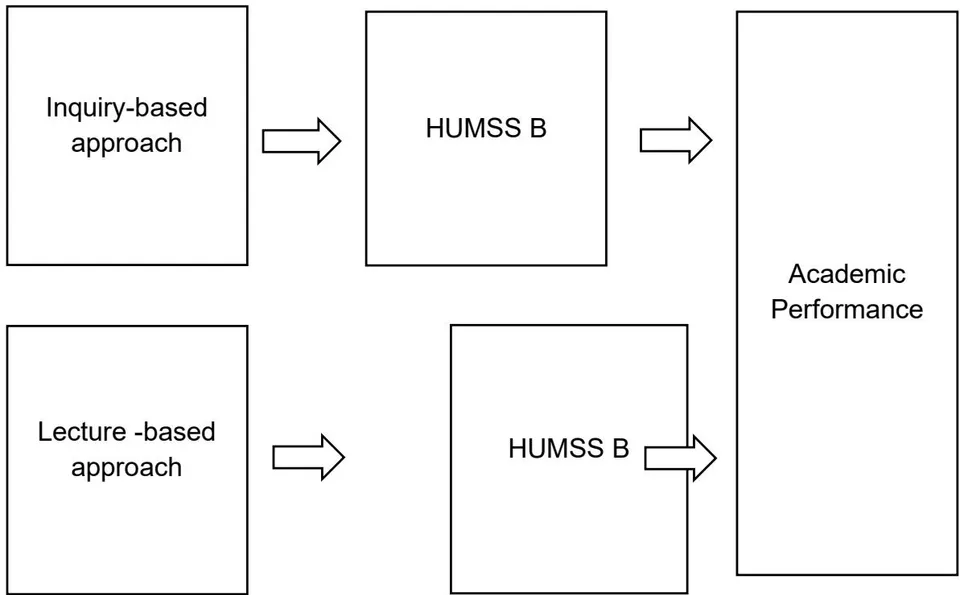
This study uses the Constructivist Learning Theory, it explains that students actively build new knowledge from their experiences and interactions. Here, teachers help students explore, ask questions, and try out new ideas rather than simply giving them information (McLeod, 2025).
The principle of scaffolding (Saye and Brush 2012), is also used, showing how teachers can guide students step by step in lessons, helping their knowledge through their own experiences and interactions. This support helps to breaking down complex political ideas into smaller parts, asking questions, and leading group discussions using visual aids. With this kind of help, students become more independent in their learning and get the support they need to overcome challenges as a result to their performance and interest in the subject improve.
Statement of the Problem
This study examines the impact of the inquiry-based approach on the learning experiences of Grade 11 Senior High School HUMSS students. It aims to answer these questions:
What is the academic performance of the group using inquiry-based approach and lecture-based approach?
Is there a significant difference in the academic performance within the group using lecture-based and inquiry-based approach?
Significance of the Study
This study explores how the inquiry approach influences students’ learning in Philippine Politics and Governance. It aims to provide insights that can improve both motivation and academic performance. The finding benefits several groups. For students, the research shows how different teaching methods, such as lecture and inquiry approach can affect their motivation and success. For teachers, the study offers guidance to review and enhance their teaching methods, helping them find a balance approach that supports student learning in today’s evolving educational environment. School administrators can use the results to develop policies or training programs that promote new and effective teaching strategies suited for student needs. Curriculum developers can also use these insights to update curricula by adding student-centered teaching methods, making lessons more relevant, interactive, and focused on critical thinking and participation Overall, this study aims to help and improve how Philippine Politics and Governance is taught and learned.
Definition of Terms
This section defines the main terms used in the study so that both the researchers and the readers understand them in the same way.
Academic Performance. This refers to the extent to which students demonstrate their knowledge, understanding, and skills through assessments, classroom activities, projects, and examinations. It reflects how effectively students achieve the expected learning standards in a subject or course.
Critical Thinking. This refers to the ability to analyze, evaluate, and interpret information carefully in order to make logical and informed judgments or decisions. It involves examining issues, assessing evidence, and forming reasonable conclusions.
Inquiry-based learning (IBL). This is a student-centered approach in which learners actively participate by asking questions, exploring topics, analyzing information, and drawing conclusions. In this approach, the teacher serves as a guide who supports students in developing understanding and independent thinking skills.
Learning Outcome. This refers to the knowledge, skills, attitudes, or behaviors that students are expected to demonstrate after completing a lesson or educational activity. It indicates what students have learned and are able to apply after instruction.
Philippine Politics and Governance. This is a Senior High School subject that focuses on political concepts, the functions of government, the roles of political institutions, and the responsibilities of citizens in a democratic society in the Philippines.
Chapter 2
Research method
This chapter explains the research methods used in the study. It covers the research design, setting, participants, tools, how data was collected, how it was analyzed and the ethical guidelines followed during the research.
Research design
This study used a quantitative quasi-experimental design using the one-shot posttest two-group design without randomly assigning groups. This approach works well in educational settings where it is not practical or ethical to randomize students’ groups, such as when comparing an inquiry-based approach and a lecture-based approach in classes (Goldfarb et al., 2022). Data were collected through two classes with different interventions, with scores measured to observe outcomes and the effects of the interventions. This helped improved procedures and support data reliability and validity. Quasi-experimental designs are effective for evaluating educational interventions and provide useful insights (Handley et al., 2018). The group was exposed to the lecturebased approach, and a posttest administered to measure the students’ academic performance, also the same group taught by inquiry-based approach and posttest also followed. Furthermore, the posttest results were compared to determine whether there was a significant improvement in students’ academic performance.
Research Environment
This study conducted at a private academic institution in Pagadian City. The school provides several programs, including a Senior High School, which has a structured academic program and a diverse student body. This setting is well-suited for evaluating how different teaching methods work, particularly how lecture-based and inquiry-based learning affect students’ understanding and interest in Philippine Politics and Governance subject.
Research Participants
This study involved Grade 11 Humanities and Social Sciences classes as participants. The target number of students is 24 students in HUMSS B. The strand received the different approaches and students were not randomly assigned to groups, instead the study used their existing class groupings for each teaching method. Student participation was open to any gender within the strands and researchers obtained informed consent to the students.
Research Instrument
The main research tool of this study is a posttest that measured students’ knowledge of Philippine Politics and Governance. The test is self-made that includes a multiple-choice question that match the subject’s learning goals. In this study, two different lesson plans were used, and groups received the different teaching approaches. In addition, a classroom observation checklist tracked how the lecture-based and inquirybased approach were delivered. The Mean Percentage Score (MPS) Scale was used to interpret the level of students’ mastery and academic performance in the assessment Scores ranging from 96%-100% were interpreted as “Mastered,”86%–95% as “Closely Approximating Mastery,” 66%-85% as “Moving Towards Mastery,” 35%-65% as “Average,” 16%–34% as “Low,” 5%–15% as “Very Low,” and 0%—4% as “No Mastery.”
Data Gathering Procedure
The data collection begins with a formal letter addressed to the School Principal requesting permission to conduct the study. After the approval, the researchers coordinated with the Grade 11 HUMSS Adviser to select two classes which the teaching approaches will be implemented. The group will first be administered by using lecturebased approach and after that the inquiry-based approach will take place. The study determined the academic performance of the students by giving a posttest after each intervention. The researchers observed the classes to make sure that the teaching approaches will be applied. Before collecting the data, the researcher explained the study to the students and get their informed consent. After the lesson and posttests, the researchers collected and analyzed the test scores to see how the teaching methods affected the result.
Data analysis
The data used a statistical method in analyzing the scores of the students. Scores from lecture-based approach and inquiry-based approach tests were calculated and compared. Descriptive statistics, such as the mean and standard deviation summarized the results of the group. A paired-sampled t-test used to compare scores between the groups to see if what teaching approach enhances the students’ academic performance. Furthermore, all data were analyzed using SPSS statistical software.
Ethical Considerations in Research
The study followed important ethical guidelines to ensure the students’ rights and wellbeing are protected.
Confidentiality. The researchers ensured confidentiality by keeping all information gathered from the participants during the classroom demonstrations private and secure. The names of the participants were not included in the research paper or in any published results to protect their identities.
Informed Consent. Before conducting the classroom observations, the researchers provided the participants with an informed consent form explaining the purpose, procedures, and nature of the research study. The participants were given the freedom to voluntarily participate and were informed that they could withdraw from the study at any time without penalty.
Right to Privacy. The researchers respected the privacy of the participants by observing only the classroom demonstrations related to the objectives of the study. Only necessary data relevant to the research were collected, and no personal or unrelated information was included in the study.
Chapter 3
Results and discussion
This chapter presents the results and discussion of the study on the Effectiveness of the inquiry and lecture-based approach on the academic performance of Grade 11 HUMSS students in Philippine Politics and Governance.
Academic performance of the groups using inquiry-based approach and lecture-based approach.
Table 1.1 presents the students’ performance of the groups when exposed to the inquiry-based approach, and to the lecture-based approach. The data provides a comparison of the learner’s academic performance under two different teaching strategies.
| Groups | Mean | SD | MPS | Interpretation |
|---|---|---|---|---|
| HUMSS B | 8.67 | 1.76 | 86.70 | Closely Approximating Mastery |
Mean Percentage Score Scale:
Table 1.1 summarizes the academic performance of the group exposed to the inquiry-based approach. The HUMSS B group achieved a mean of 8.67 (SD = 1.76), corresponding to an MPS of 86.70%, interpreted as “Closely Approximating Mastery.” This result indicates a high level of academic performance under the inquiry-based approach.
The study found that students’ performance supports Edillor’s (2024) claim that inquiry-based instruction leads to better learning. By involving students in the 5E learning cycle: Engagement, Exploration, Explanation, Elaboration, and Evaluation, inquiry-based learning helps learners link new knowledge with prior experiences and actively build their understanding into different concepts. School activities like exploration and explanation, highlighted by Santos and Boyon (2020), encourage students to engage actively in the learning process. This fosters deeper cognitive involvement and better retention of concepts, showing that exposure to the inquiry-based approach led to deeper learning and ongoing academic progress.
Moreover, this pattern strengthens the argument that the inquiry-based method supports inclusive learning, helping wider range of students benefit from the instructional strategy. These findings align with Khasawneh et al. (2023), who noted significantly higher math achievement scores among students in inquiry-based learning groups. They also match the meta-analysis by Sam (2024), which found that students exposed to inquirybased approaches showed deeper understanding and higher assessment scores in both knowledge and application.
The findings of the study may be explained through the lens of the Constructivist Learning Theory, which states that students actively construct new knowledge through their experiences and interactions. According to McLeod (2025), teachers in a constructivist classroom guide learners to explore, ask questions, and test new ideas instead of simply delivering information. This supports the result of the study, where the group exposed to the inquiry-based approach demonstrated a high level of academic performance and closely approximated mastery. Through inquiry-based activities such as exploration, explanation, and evaluation, students became more actively involved in the learning process, allowing them to connect prior knowledge with new concepts and develop deeper understanding.
| Groups | Mean | SD | MPS | Interpretation |
|---|---|---|---|---|
| HUMSS B | 7.79 | 2.30 | 77.90 | Moving towards mastery |
Mean Percentage Score Scale:
Table 1.2 presents the academic performance of the group exposed to the lecturebased teaching approach. The HUMSS B had a mean score of 7.79 and a standard deviation (SD) of 2.30, which means that the MPS was 77.90% and interpreted that they were “Moving towards mastery”. The results show that students are proficient in when taught in a lecture-based approach. Their scores are in the “Moving towards mastery” range, indicating that students have built a strong basic understanding through lectures.
Lecture-based instruction often emphasizes direct presentation of content, which can result in more teacher-centered classroom interactions compared with interactive methods. This result shows that lectures promote passive learning, with students in lecture settings describe lower sustained attention and engagement during long presentations and may find it harder to retain material without complementary activities (Murphy et al., 2023). While lecture-based instruction provides a baseline level of academic competence, lectures can be combined with active-learning elements such as brief discussions, questioning, or follow-up tasks—which maintain the efficiency of direct instruction while increasing student engagement (Springer Nature, 2022).
The findings of the study may also be explained through the principle of scaffolding which emphasizes how teachers guide students step by step in the learning process. In the lecture-based approach, teachers provide structured explanations, simplify complex political concepts into smaller and more understandable parts, ask guiding questions, and use discussions and visual aids to support learning. This kind of instructional support helps students gradually build their understanding through their experiences and interactions inside the classroom. As students receive proper guidance and assistance, they become more confident and independent in learning, enabling them to overcome difficulties and improve their performance and interest in the subject.
The significant difference in the academic performance within the groups using lecturebased and inquiry-based approach
Table 2 compares academic performance between students exposed to the inquiry-based approach and those taught using the lecture-based approach, and to determine significant difference exists between the academic performances of the groups.
| Approach | N | Mean | SD | p-value | Remarks |
|---|---|---|---|---|---|
| Inquiry-based approach | 24 | 8.31 | 1.78 | 0.033 | Significant Difference |
| Lecture-based approach | 24 | 7.86 | 1.89 | -- | -- |
*Significant at 0.05 level
Table 2 shows the results of the academic performance of both groups using inquiry-based approach and lecture-based approach. Using the inquiry-based approach
both groups achieved a mean score of 8.31 with a 1.78 standard deviation which obtained a higher mean score compared to the groups using lecture-based approach which scored a mean of 7.86, and standard deviation of 1.89. The p-value of 0.033 is lower than the 0.05 level of significance, indicating a statistically significant difference in academic performance between the two groups. The findings suggest that the inquiry-based approach had a measurable effect on students’ academic performance when compared with the lecture-based approach. This indicates that inquiry-based learning may serve as an effective instructional strategy that can be applied in similar learning settings to enhance students’ academic outcomes. However, the results also show that the lecturebased approach contributed positively to students’ learning, as both approaches supported academic development among the learners.
The statistically significant difference between the two groups further supports the effectiveness of inquiry-based learning in improving student academic performance. This finding is consistent with the study of Malapane et al. (2024), which reported significant differences in student performance between groups exposed to inquiry-based instruction and those taught using conventional teaching methods. Likewise, Furtak et al. (2022) found through a meta-analysis of experimental and quasi-experimental studies that inquiry-based teaching generally produced more favorable academic outcomes compared to conventional instruction.
This increase rests on the theory of scaffolding, Saye and Brush (2012), where teachers guide students through difficult political ideas by asking them questions, having discussions, and using visuals. This helps students connect what they already know to what they are learning. As students become more independent, this support is gradually taken away, which helps them do better and makes them more interested in the subject. Teachers used scaffolding to help understand complicated ideas and by giving a structured guidance which encourages active participation of the students. Therefore, scaffolding makes inquiry-based learning work better in political education by encouraging meaningful and independent learning and motivation, leading to improved interests as students will learn skills without relying too much on the teacher.
Chapter 4
Summary of Findings, Conclusion, and Recommendations
This chapter provides a summary of the findings, draws conclusions, and offers recommendations.
Summary of Findings
- What is the academic performance of the group using inquiry-based and lecturebased approach?
Table 1.1 revealed that the group exposed to the inquiry-based approach demonstrated a high level of academic performance. The students attained an MPS interpreted as “Closely Approximating Mastery”. On the other hand, Table 1.2 revealed that the group exposed to the lecture-based approach demonstrated satisfactory academic performance. The students attained an MPS interpreted as “Moving Towards Mastery”.
- Is there a significant difference in the academic performance within the group using lecture-based and inquiry-based approach?
Table 2 reveals that there is a significant difference in the academic performance within the group using lecture-based and inquiry-based approach
Conclusion
This study examined the effectiveness of the inquiry-based and lecture-based approaches on the academic performance of Grade 11 HUMSS students in Philippine Politics and Governance. The findings revealed that both teaching approaches contributed positively to students’ learning and academic performance. However, the inquiry-based approach demonstrated greater effectiveness in promoting deeper understanding, critical thinking, and higher academic achievement when supported with proper scaffolding and guided learning activities. Using the scaffolding theory as its foundation, the study emphasized that students learn more effectively when teacher provide structured guidance through questioning, exploration, collaboration, and interactive activities that gradually build learners’ independence and confidence.
The study further showed that inquiry-based instruction helps students connect prior knowledge with new political concepts and encourages active participation in the learning process, which aligns with the objectives of the HUMSS curriculum in developing informed, critical, and socially responsible citizens. At the same time, the lecture-based approach also proved beneficial in helping students develop foundational understanding and academic competence through organized presentation of lessons. Based on these findings, the study supports the integration of inquiry-based strategies alongside effective teaching practices in Senior High School instruction
Recommendations
Based on the findings, the researchers recommend the following:
Teachers in Senior High School–Humanities and Social Sciences (HUMSS) may integrate inquiry-based strategies such as guided questioning, group explorations, and collaborative activities to promote deeper understanding, critical thinking, and active participation among students.
Teachers may also enhance lecture-based instruction by incorporating interactive discussions, visual aids, and reflective activities to make lessons more engaging and meaningful for learners.
School administrators may provide professional development programs and workshops that strengthen teachers’ competencies in both inquiry-based and lecture-based instructional approaches.
Curriculum developers may design and implement inquiry-based modules with constructivist elements in HUMSS core subjects while also improving lecturebased learning materials through the inclusion of student-centered and participatory activities.
Future researchers may broaden the scope of the study by examining not only students’ academic performance but also teachers’ efficacy, classroom practices, and integration of both inquiry-based and lecture-based approaches.