Effects of Heat Transfer of Natural Convection Laminar Flow of Fluid’s Velocity Components and Viscous Dissipation through a Circular Heated Plate on a Square Body
This research is on natural convection flow of a fluid through a circular plate on a two-dimensional square body. In this paper heat transfer of laminar flow will be investigated based on mesh modeling and graphs under heat flux and viscosity. Temperatures, thermal conductivity, velocity components, viscous dissipation of fluid with time are used as variables. A flat square surface with circle is considered in the investigation by using COMSOLMULTIPHYSICS. Here square body and circular plate are insulated. As material we have used water. The parameters of the fluid have inlet velocity, outlet velocity, heat flux and thermal conductivity. Using boundary condition and velocity components with temperature, we can solve governing equations numerically. The solution has been expressed as meshes and graphs in the results. Different sectors of science like magneto hydrodynamic, fluid flow, natural convection, Radiation, solar, engineering and medical science will be benefitted by this research. We construct many mesh models through our studied technique which is shown in Figure ̒ a’ to̒ o’. We will also discuss 2D graphical representation through the proposed technique which is shown in Figures ̒ p’ to ‘t’. In future, we may try to apply our results in space heating, domestic hot or cold water processes, heat from electricity and many other related fields.
## I. INTRODUCTION
Natural convection laminar wave takes place in multiple scientific and industrial treatments in nature. Heat transfers take place in a low-velocity, solar receivers exposed breeze currents, nuclear reactors to be cooled during emergency shutdown; electronic devices cooled by fans and many more [1-20]. Fluid mechanics is the study of effects of force on a fluid. If the fluid is at rest, it remains static. When fluid is in motion, the studies are known as fluid dynamics. Fluid is any substance which can flow and relative change of position of particles with respect to time. Fluid has no certain shape which occupies the shape of vessels can flow under its own weight. There are no voids between the molecules of fluid. Different forces act upon fluid as surface force, body force (gravitational force). This force acts on the mass of the fluid that is the quantity of the component of the particular fluid. Due to the conservation of mass, it can't create or destroy. Viscous dissipation occurs by the continuous force on the fluid where the molecule deformation happens. Fluid flows are of two types: laminar flows and turbulent flows. When the fluid flows in infinitesimal parallel layers with no disruption between them. Laminar flow occurs fluid layers flow in parallel and current is normal to the flow itself. This type of flow is also referred to as streamline flow because nature this flow does not cross the streamlines flow. Laminar flow in a straight pipe may be considered as the relative motion of a set of concentric cylinders of fluid, the outside one fixed at the pipe wall. Others movement is approached increasing speed at the center of the pipe. Regarding the smolder rising in a straight path from a burned material is creating laminar flow. With the rising of a small distance, the smoke usually changes to turbulent flow. For the laminar flow channel is relatively small, that is why the fluid moves slowly. So, its viscosity is relatively high. Oil flow through a thin pipe like blood flow is laminar. Turbulent flows are flowing near solid boundaries, where the flow is often laminar, in a thin layer just adjacent to the surface is noticeable. Laminar and turbulent flow takes place depend the velocity of the fluid flow. But viscosity of the fluid when a fluid flow spreads around the heated circular plate. At the lower velocity laminar flow takes place under an edge when the flow turns turbulent. Heat transfer is the phenomena; it conveys energy and entropy from one location to another. If any heated circular plate is placed on a square solid body than heat transfer will occur. Heat transfer has gained considerable attention due to its numerous applications in the area of energy conservations. The applications also include refrigeration of electrical devices, electronic components, design of solar collectors and heat exchangers. The determination of the velocity profile greatly influences the heat transfer process creates the main difficulty in solving natural convection problems. Heat flux is the amount of heat transferred per unit area and per unit time to or from a surface. The heat transfer results from the resulting quantity of the heat flux per unit time and per unit area to or from the surface. Viscosity is the inter frictional force between adjacent layers of fluid relative in motion. The resistance of a fluid from deformation at a definite rate is viscosity- for example syrup and water.
The continuous process like electromagnetic fields. Fluid dynamics and deformable bodies cause Navier-Stokes equations for the fluids flow. The nature of the fluid can be described by using Navier-Stoke's partial differential equation based on continuity, momentum and conservation of energy. Effects of viscous dissipation have an important role to play in free convection in various gadgets subjected to large deceleration that operates at high rotational speeds. It is also a strong gravitational field processes on large scales in geological processes. MHD is the fluid dynamics of conducting fluid. A typical feature of MHD leads to forming a singular current density. Current sheets are associated with the breaking and reconnecting magnetic field lines due to presence of viscous dissipation. Study of heat transfer, temperature, MHD fluid flow, natural convection and viscous dissipation are very important because these are used in many branches of science. Some researchers have also showed that both the flows are affected by geometrical parameters.
Circular cavity with various heated isothermal wall has received the devotion because of it has wide application, cooling of electric devices, fire control in a building, extraction of oil from container, the construction of stars, planet and blood flow. The density and viscous dissipation effect play a vital role in free convection flow over a circular heated plate or various gadgets in geological system. Dissipation is the output for formulating a viscous material that is converted into energy. The discussion of process of free convection flows, viscosity, density and viscous dissipation on the heated circular plate on a rectangular body are usually ignored. In this work, it is considered the effect of heat transfer through a circular heated plate on natural convection flow with time. To solve extraction one or more components of a liquid mixture are extracted by solution in a selective solvent. In humidification water is transferred from the liquid to air. The biological applications include oxygenation of blood, food and drug and respiration mechanism. In the process of analogous or digital heat diffusion resulting from temperature gradient when the fluid is in motion heat transfer take in place by molecular diffusion. Hence velocity component field is needed to the heat transfer process. So, the heat transfers equation and the coefficient of thermal conductivity obtained by COMSOL MULTIPHYSICS.
Meanwhile we considered heat transferred in forced convection in which the fluid flow imposed external by surface pressure, fan, blower and pump. Convection flow is set up within the fluid without a force where velocity 'u' is the free convection.
The wave velocity in free convection is much smaller than in forced convection. So, heat transfer by free convection is much smaller than forced convection.
Meshing means mesh generation which is the procedure of two-dimensional and three-dimensional grid. These divided compound geometries into elements then it can be used to discretize a domain. The most important steps of meshing procedure in performance model using finite element analysis. A mesh is the last presentation of elements. The coordinate sites in space which can vary on element nature belong to nodes that represent the contour of the geometry. The performance of mesh is to divide the model into cells in sequence behavior a simulation analysis or concentrate a digital model. Meshing is the collective of coordinates, boundaries, and faces which describe the form of aim in two or three dimensions.
Steady laminar free convection in air-filled 2D rectangular enclosures heated from below and cooled from above is studied numerically for a wide variety of thermal boundary conditions at the walls [1]. Another study shows that, complex interactions between Nano fluids and the walls of cavity. This complexity may increase with a change of geometry or orientation of the cavity. So, study of natural convection fluid flow and heat transfer in a trapezoidal geometry is more difficult than that of square or rectangular enclosures due to the presence of sloping walls [3]. A good number of investigations on natural convection fluid flows and heat transfers in trapezoidal cavities have already been published. A complete study of the laminar solution of the problem (Ra up to 105) was given by MacGregor and Emery' together with experimental results covering a wide range of Prandtl numbers. Many correlations of Nusselt number (Nu) and Ra concerning experimental results can also be found in this paper. Jaluria and Gebhart have worked on vertical natural convection flows. Their studies expressed the process occurring during the transition from laminar to turbulent flow near a vertical flat plate when the surface heat flux is uniform. The interaction of the velocity and temperature fields during the transition and the effect on $\mathrm{Nu}$ were also investigated. Mallinson and De Vahl Davis presented detailed three-dimensional calculations for laminar flow. The calculations were performed for different values of Prandtl number and aspect ratio of cavity dimensions. Natural convection flow in a square cavity revisited: laminar and turbulent models with wall functions [2, 9]. They found that the flow and temperature fields are obstructed by the presence of the body. Oztop et al. analyzed the effects of the surface of the insulated body for partially heated enclosure [10]. Natural convection in porous triangular enclosure with a circular obstacle in presence of heat generation [11]. Compared to other study, this study includes the velocity profile of fluid particles and temperature with respect to time. The purpose of this research is the exploration of the effect of heat transfer of natural convection laminar flow of a fluid's velocity components and viscous dissipation through a circular heated plate on a square body with time.
## II. AIM, FINDINGS, FUTURE SCOPE
### a) Aim
The aim of the study is to investigate the effects of heat transfer on natural convection laminar flow of fluid's velocity components and viscous dissipation through a circular heated plate on a square body. Specifically, the study aims to understand how the velocity and temperature fields of the fluid are affected by the presence of the circular heated plate and how the viscous dissipation affects the heat transfer characteristics. This information is important for understanding, optimizing heat transfer processes in several industrial and engineering uses, such as in heat exchangers, cooling process, and energy production policy. The study also aims to contribute to the scientific understanding of natural convection laminar flow and its relationship with heat transfer in flat media.
1. Investigation of the heat transfer characteristics of natural convection laminar flow over a circular heated plate on a square body.
2. To analysis the effects of fluid's velocity components and viscous dissipation on the heat transfer rate.
3. To determine the optimal conditions for improving the heat transfer rate in the method, such as the best area for the circular heated plate, the optimal size of the square body and the optimal properties of the fluid flow.
4. Comparing the results in the present study compare to earlier studies on related systems and authenticate the requirement.
Overall, the research improve our understanding of the natural convection laminar flow over a circular heated plate on a square body, which has practical uses in many fields like energy, environmental science and engineering.
### b) Findings
1. Mesh Type Impact: The choice of mesh type significantly affects the simulation results, particularly the temperature distribution and fluid flow patterns. Different types of meshes, such as triangular and free triangular meshes, yield distinct temperature profiles and flow characteristics. This highlights the importance of mesh selection in accurately capturing the physics of the problem and obtaining reliable results.
2. Shaded Area: The simulation identifies certain shaded area in the domain where fluid particles exhibit more frequent movement. These regions high correspond to regions of high turbines, vortices, or areas with intense convective heat transfer. Understanding these shaded areas is crucial as they can indicate regions of higher thermal efficiency or potential challenges in the design of heat transfer systems.
3. Fluid Particle Heating and Interactions: The incorporation of fluid particles on the square body, particularly when heated by the circular plate, leads to an increase in their intermolecular distance due to heat transfer. This phenomenon is related to the expansion of the fluid as it absorbs heat. Such thermal expansion indicates the fluid flow dynamics and heat transfer rate in the process.
4. Formation of Triangular Shape: The simulation results indicate the heat is generated in the square body at the same time a triangular mesh is used then the
particles of water tend to arrange themselves in a triangular pattern. This organization might be influenced by the boundary conditions and the convective flow patterns arising cause of the heated circular plate.
5. Non-Uniform Heating: If the circular heated plate does not cover the entire square body, the area near the circular plate experiences more intense heating relative to the distant regions. This non-uniform heating distribution introduces complexities in the flow field, leading to variations in temperature and velocity profiles.
Overall, the study focuses on the complex interaction among heat transfer, fluid dynamics and mesh characteristics in conduct of a heated circular plate on a square body. The findings provide valuable insights for optimizing heat transfer producing and learning flow behavior. However, it is no table that these findings are based on simulation results and further experimental confirmation is necessary for the accuracy and applicability of the observed phenomena in real-world scenarios. Additionally, conducting sensitivity analyses on various parameters would allow for a more comprehensive understanding of the system's behavior.
### c) Future Scope
1. Thermal energy storage involves technologies for collecting and storing energy for later use. It can be used for the stability of energy demand between day and night. Temperature above or below that of the ambient environment is required to maintain the thermal reservoir. Its usage takes in space heating, domestic or processing warm water process.
2. Efficient energy use is the goal to decrease the quantity of energy necessary for heating or cooling. In architecture, condensation and air wind can cause of cosmetic or structural deformation. A power audit may help to measure the implementation of recommended correct procedure. For example, insulation improvements, air shutting of mechanical leaks, the addition of energy-efficient windows and doors can be learned.
3. Smart meter is used to record electric energy consumption during intervals.
4. Thermal transition is the rate of transfer of heat through a model divided by the difference in temperature across the structure. It is measured in watts per square meter per kelvin, or W/ (m2K).
5. Thermostat is a device that automatically regulates the temperature.
6. Greenhouse effect is the representation of the exchanges of energy among the heat source, Earth's surface, Earth's atmosphere and the eventual sink outer space. The greenhouse is the natural rule to give benefits the animal and the human by recycle temperature. Heat emitted by the Earth surface is the defining characteristic of the greenhouse effect. This process ensures the thermal radiation from a planetary surface is absorbed by atmospheric greenhouse gases and clouds are re-radiated in all directions. As a results reduction in the amount of thermal radiation reaching space relative to reach space in the absence of absorbing materials. This reduction of outgoing radiation leads to rise in the temperature of the surface and troposphere. The rate of outgoing radiation again and again equals to the rate of heat arrives from the sun.
7. To find out how the body transfers heat? Principles of heat transfer in engineering systems can be applied to the human body. Continuous metabolism of nutrients which provides energy of the body produces heat in the animal and human body. A consistent internal temperature in human body is necessary for smooth physical
functions. Therefore, excess heat must be removed from the body. At the same time keep the internal temperature at a healthy level.
Finally, heat transfer by convection is driven by the movement of fluids over the surface body. This convective fluid can be either a liquid or a gas. For heat transfer from the outer surface of the body, the convection mechanism is dependent on the surface area of the body, the velocity of the fluid flow, temperature gradient between the surface of the skin and the ambient fluid. Significantly less temperature of the surroundings than the normal body temperature leads to heat transfer. For that reason ones feel cold when there is no enough worn cloth with him then he is exposed to a cold weather. Here clothing as insulator acts thermal resistance to heat flow over the covered portion of the body. On the other hand, abnormally excessive heat in the body may even cause death. To ensure that one portion of the body is not significantly hotter than another portion. Heat must flow evenly through the bodily tissues. Blood flowing through blood vessels acts as a convective fluid flow and helps to protect any grownup of excess heat inside the tissues of the body. The heat carried by the blood is resolute the temperature of the surrounding tissue, the diameter of the blood vessel, the thickness of the fluid, velocity of the flow and the heat transfer coefficient of the blood.
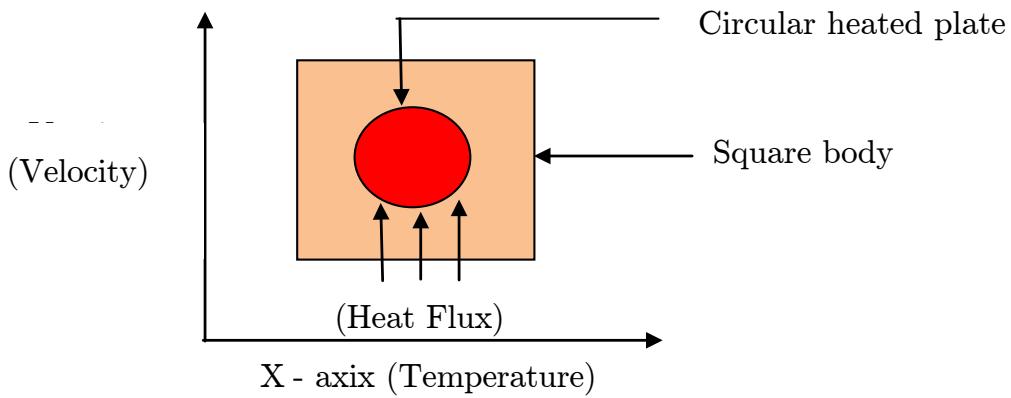
III. PHYSICAL MODEL Figure 1: Two-dimensional heat transfer in laminar fluid
The mentioned problem describes the two-dimensional circular heated plate on square body horizontally. The figure indicates y axis as velocity and x axis as temperature which defines the velocity profile of the fluid flow and temperature with respect to time when the fluid will run through the heated circular plate. The circular plate is on the square body. Through this model, viscous dissipation of the fluid by heat transfer with time is determined.
### a) Mathematical equation
Laminar flow and fluid properties of water find the results by using Stokes equation with the help of COMSOL MULTIPHYSICS.
Continuity equation,
$$
\nabla \cdot (\rho u) = 0. \tag {1}
$$
Stokes energy equation with surface pressure is
$$
\rho (\boldsymbol {u} \cdot \nabla) \boldsymbol {u} = \nabla \cdot \left[ - \rho \boldsymbol {I} + \mu (\nabla \boldsymbol {u} + (\nabla \boldsymbol {u}) ^ {T}) - \frac {2}{3} \mu (\nabla \cdot \boldsymbol {u}) \boldsymbol {I} \right] + F. \tag {2}
$$
Initial value on the wall, $u = 0$.
Where, rho $(\rho)$ is the density, $l$ is the length of square body, $u$ is the initial velocity, Mu $(\mu)$ is the Viscosity and F is the surface force.
Heat transfer in water surface
$$
\rho C _ {p} u \cdot \nabla T = \nabla \cdot (k \nabla T) + Q + Q _ {v h} + W _ {p}. \tag {3}
$$
Where, $C_p$ the specific heat at constant is pressure and $W_p$ is the constant pressure in water.
Thermal insulation
$$
- n (- k \nabla T) = 0. \tag {4}
$$
Where, $k$ is the Thermal conductivity, $T$ is the Temperature.
### b) Analysis of Mesh modeling
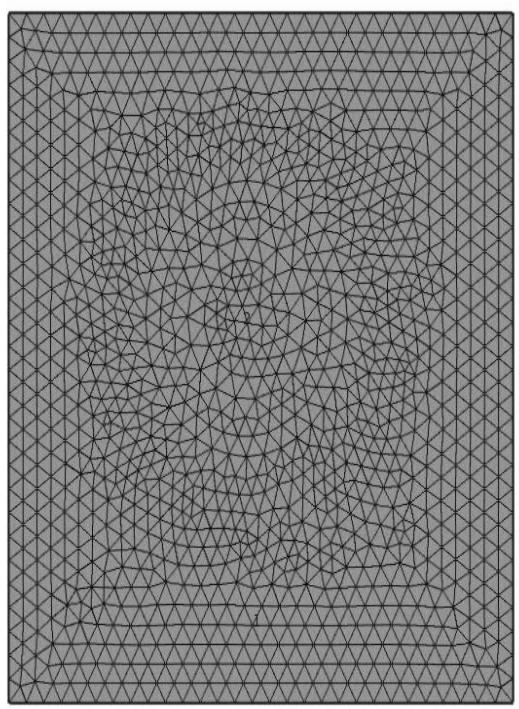
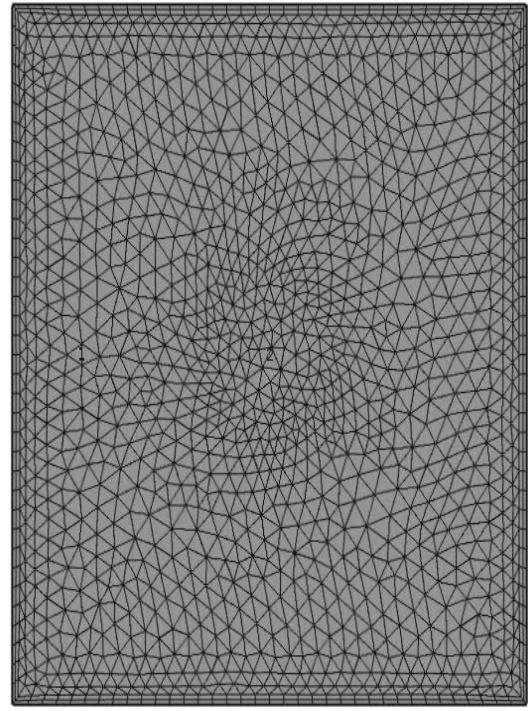
This model includes borderline layer, heat transfer free triangular mesh, heat transfer in fluid, laminar flow in Isothermal process, contour in extra fine and fine mesh are given as model. Isothermal mesh size is fine (Fig-a) and Isothermal mesh size is normal (Fig-b).
(Fig-a)
(Fig-b)
This mesh describes the molecular movement of water is driven on the heated circular plate on a square body. In this mesh, material is taken as water and the properties are Minimum element quality (0.7615), Average element quality (0.9789), Triangular elements (16832), Edge elements (404), and Vertex elements (8). The calibrated parameters are Maximum element size (0.0091), Minimum element size (0.00105), Resolution of curvature (0.25), Maximum element growth rate (1.08) and Extra fine size.
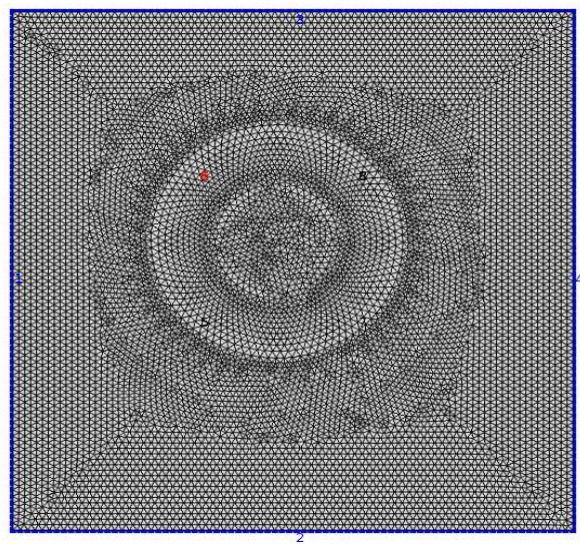
Isothermal Boundary layer mesh size is extra fine (Fig-c) (Fig-c)
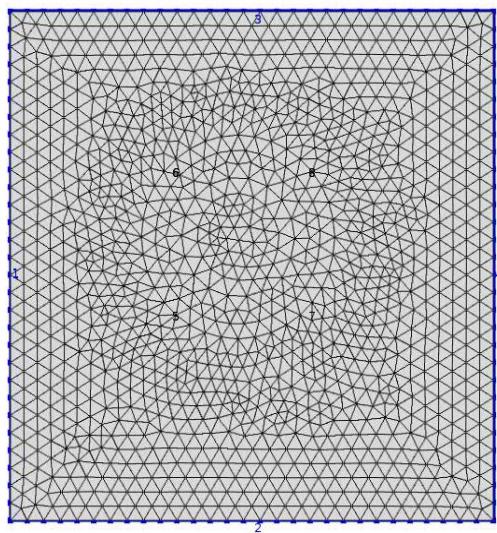
Isothermal Boundary layer mesh size is fine (Fig-d). (Fig-d)
The boundary layer is displayed in the mesh by blue color lining which keep the water particles inside the square body. After heat generation, the water particles become dispersed and create dense circular shape seems like a hole. (Fig-c) and (Fig-d) are Heat transfer of free triangular mesh.
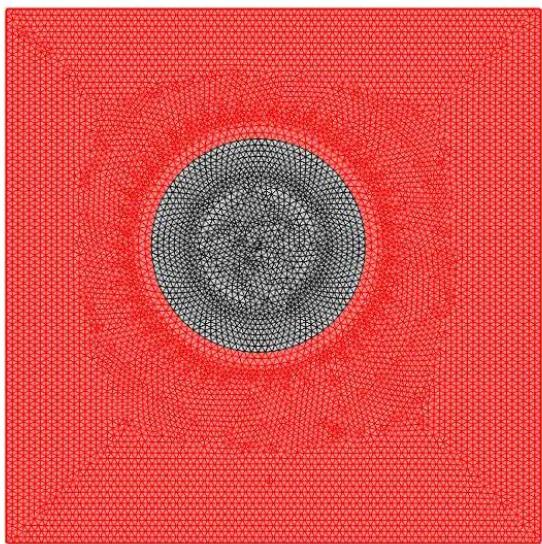
Isothermal Mesh Model size is extra fine (Fig-e). (Fig-e)
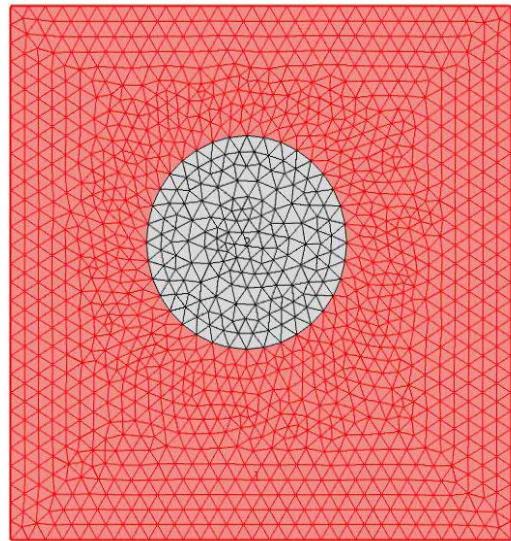
Isothermal Mesh Model size is fine (Fig-f). (Fig-f) In this model (Fig-e and Fig-f) a simulation is taken as, heat transfer of free triangular mesh is shown red and gray color where due to heated circular plate the heat is generated to square body and a triangular shape will be formed by the particles of water.
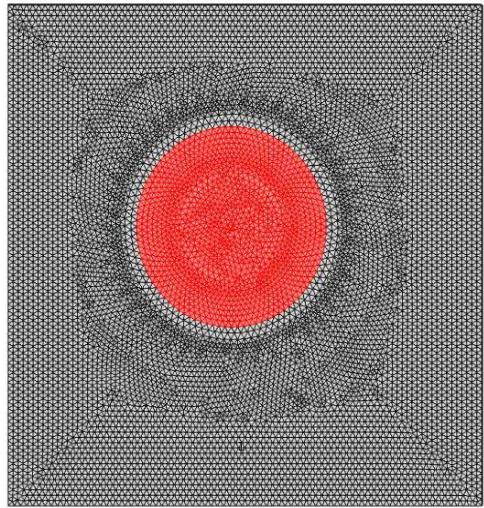
Heat transfer free triangular mesh size is extra fine (Fig-g) (Fig-g)
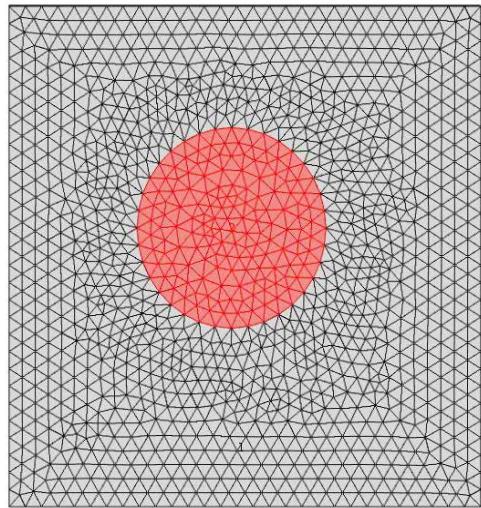
Heat transfer free triangular mesh size is fine (Fig-h). (Fig-h)
This figure represents the circular heated plate which is not generated to the whole square body but the area nearer to the circular plate is heated and shows a densely circular area comparative to the distant area.
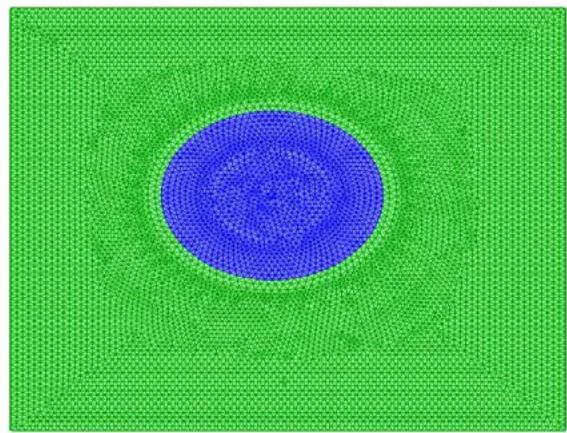
Heat transfer in fluid mesh size is extra fine (Fig-i). (Fig-i)
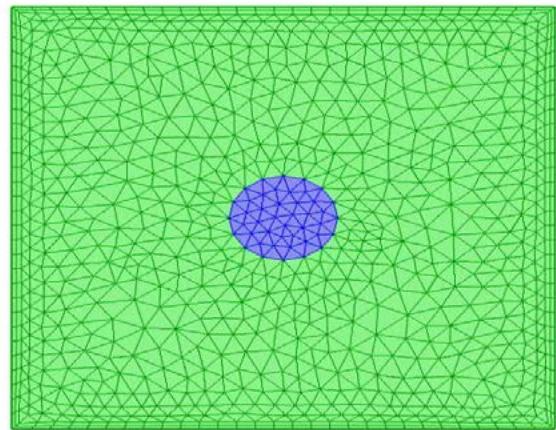
Heat transfer in fluid mesh size is fine (Fig-j). (Fig-j) In this Fig-i & j, fluid is incorporated on the square body along with heated circular plate. Here the water particles are heated and the intermolecular distance increases. Some dense area represents the movements of the particles through which it can be found that the water particles are moving discretely due to temperature. Color of the meshes is green and blue.
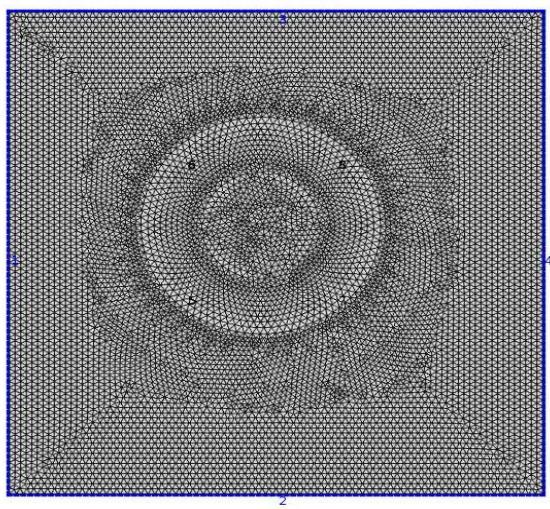
Laminar flow in Isothermal process size is extra fine (Fig-k).
(Fig-k)
Laminar flow in Isothermal process size is fine (Fig-1).
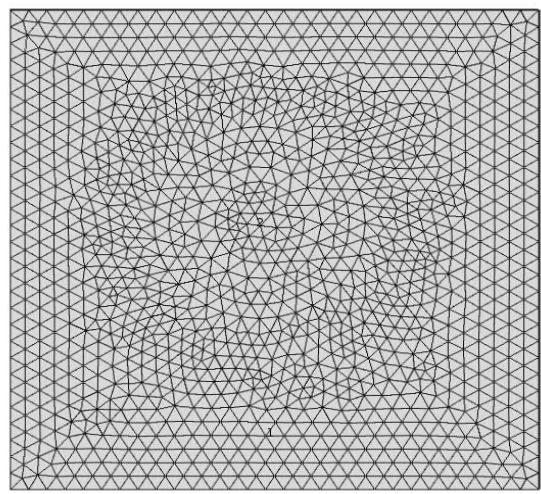
(Fig-1) In these Fig-k & l, Laminar flow is considered by fluid particles the smooth paths on layers, fluid particles moving smoothly past the adjacent layers with small or no partying. The fluid particles tend to flow at low velocities without lateral mixing, and adjacent layers meshes past one another.
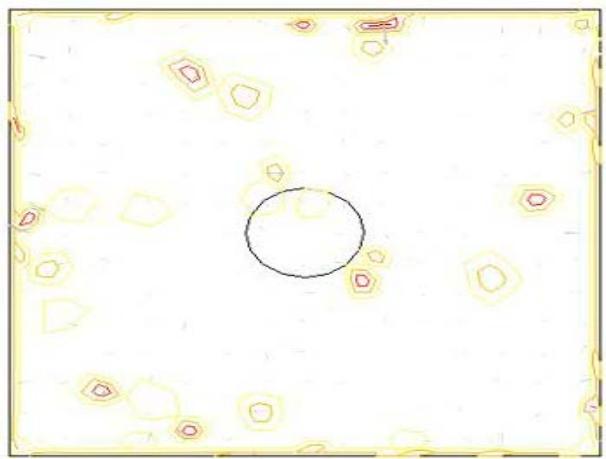
Contour of the mesh (Fig-m).
(Fig-m)
This (Fig-m) contour represents the identical curved outlines of the movement of the fluid particles when heat is generated by the circular plate on the square body. Different shapes of the water particles are visible in the mesh by contour linings which represents the condition of the particles. The interpolation data can round structured and defined on a general point rain cloud.
Thermal conduction area(Fig-0).
Laminar flow wall (Fig-n).
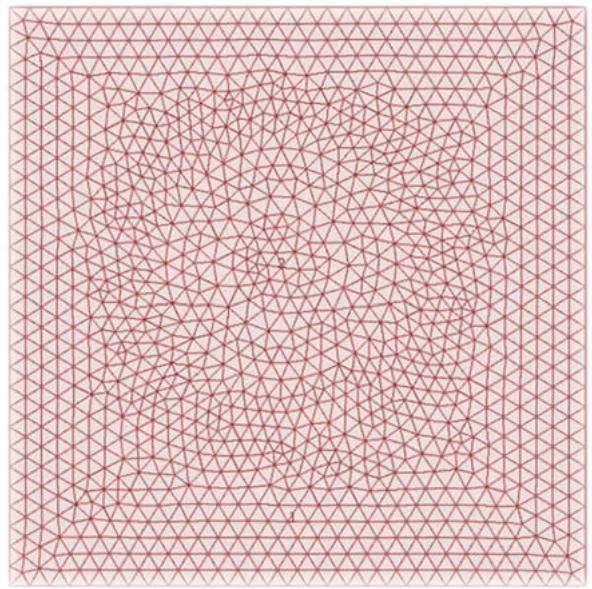
(Fig-o)
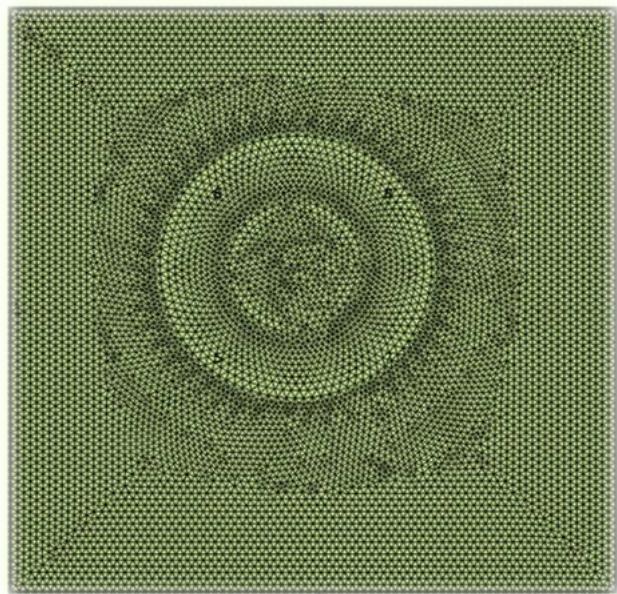
(Fig-n) In these Fig-n & o, boundary layer meshing simulations creates isotropic meshes close to walls without having to use swept meshes or specially designated domains. These fluid particles are required due to the boundary layer that typically forms at noslip walls. Boundary layer meshes are added after the domain has been meshed. A triangular path of particles is pushed into the computational domain. Observe that the qualities of elements are good in spite of isotropy. Due to boundary layer mesh built from triangles with high quality, and that results in high-quality prismatic elements as well.
## IV. METHODOLOGY
The continuity equations, stokes energy equation, heat transfer equation and thermal insulation and natural conservation equations are transformed into a system of integral equations by using the Galerkin weighted residual method of finite-element formulation. The nonlinear algebraic equations so obtained are modified by imposition of boundary conditions. These modified nonlinear equations are transferred into linear algebraic equations with the help of Newton's method. Lastly, these linear equations are solved by applying Triangular factorization. For numerical computation and post processing, the software COMSOL MULTIPHYSICS is used.
## V. RESULTS AND DISCUSSION
In different type of meshes Model is change for their temperature changes. There are some shaded area in which the frequent movement of fluid particle is more. If the fluid is incorporated on the square body along with heated circular plate then the water particles are heated and the intermolecular distance increases due to heat transfer. A Simulation is taken as, heat transfer of free triangular mesh due to heated circular plate, if the heat is generated to square body and a triangular shape will be formed by the particles of water. If the circular heated plate is not generated to the whole square body, the area nearer to the circular plate is heated then the densely circular area comparatively to the distant area. Results are presented with the help of graph.
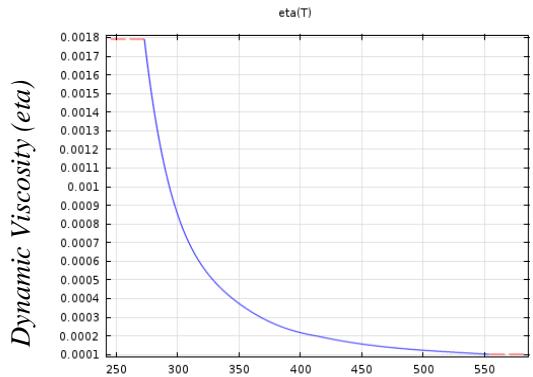
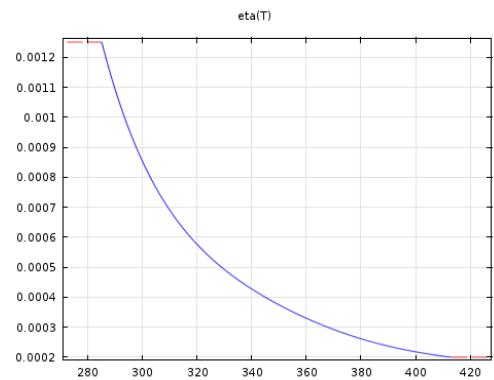
Fig-p: Temperature (T)
This graph (Fig-p) shows the change of viscosity with respect to temperature. For increasing the temperature viscosity decreased.
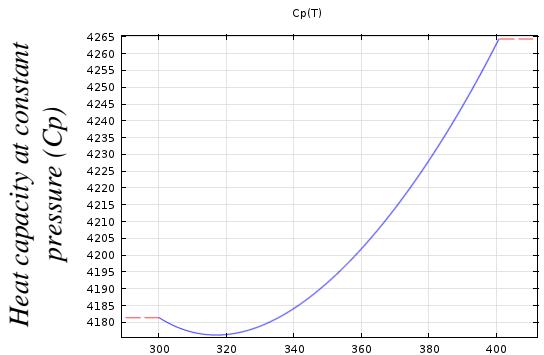
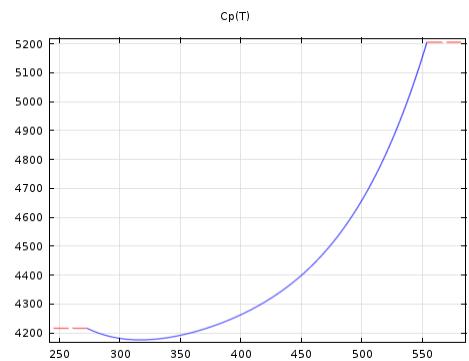
Fig-q: Temperature (T)
This graph (Fig-q) shows the change of Heat capacity at constant pressure (Cp) with respect to temperature. For increasing the temperature Heat capacity at constant pressure (Cp) also increases.
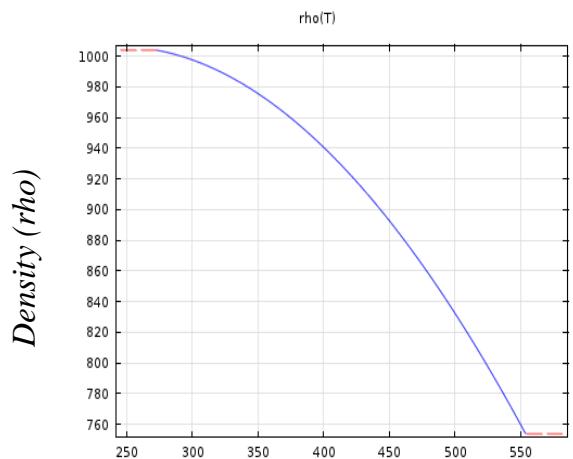
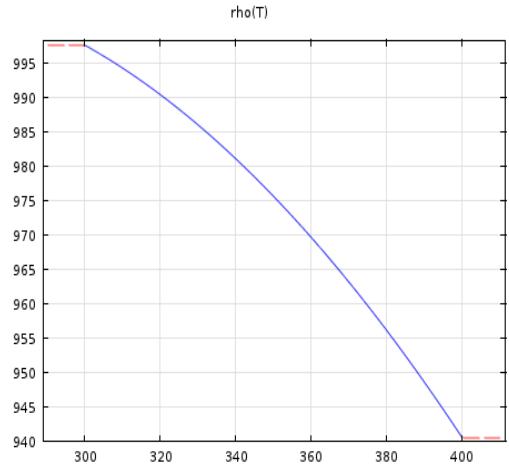
Fig-1: Temperature (T)
This graph (Fig-r) shows the change of Density (rho) with respect to temperature. For increasing the temperature Density $(\rho)$ gradually decreases and minimum at maximum temperature.
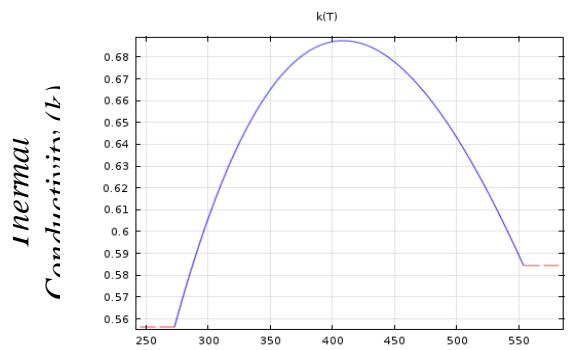
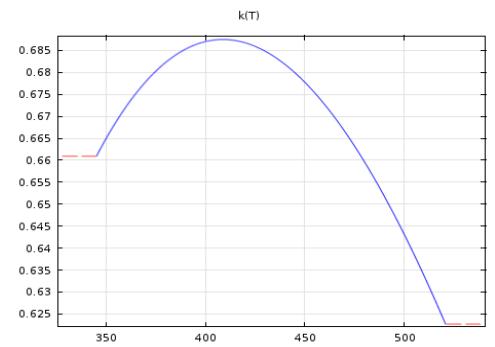
Fig-s: Temperature (T)
This graph (Fig-s) shows the change of Thermal Conductivity $(\mathbf{k})$ with respect to temperature. For increasing the temperature Thermal Conductivity $(\mathbf{k})$ increases and at a certain temperature becomes maximum after that for increasing temperature Thermal Conductivity $(\mathbf{k})$ gradually decreases.
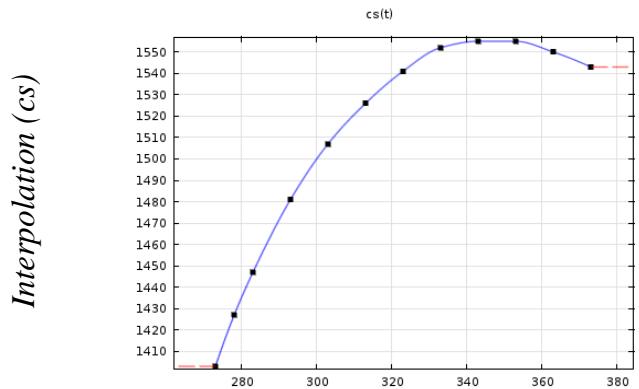
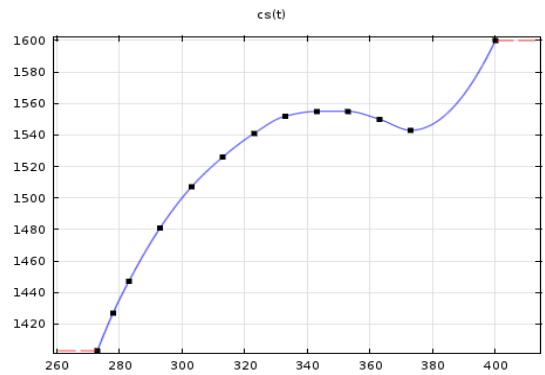 Panel label: Fig-.
$t$: Temperature (T)
This graph (Fig-05) shows the velocity profile of laminar flow fluid has a definite viscosity. Interpolation function is defined by a graph containing the values of the function in discrete points. Variation of given temperature, the discrete points of interpolation are varied according to the different value of temperature. The interpolation is a process of predicting unknown data points such as fluid that is the speed of rainfall.
## VI. CONCLUSION
Solving the numerical model equations for multiphase flow may be a very challenging task, even with access to supercomputers. In reality, these models are limited to Nano fluids and for the study of natural surfaces of viscous liquids. The disseminated multiphase flow phenomena allow for the studying of systems with millions and billions of bubbles, droplets, or particles. But even the simplest dispersed flow models can lead to the generation of very complicated and daunting model equations. The development of these models into variations that are well adapted to describe specific mixtures has allowed for engineers and scientists to study multiphase flow with a relatively good accuracy and with reasonable computational costs. We have successfully constructed many mesh models through our studied techniques which are shown in Figures a to o and we have also discussed 2D graphical representation through the proposed techniques which are shown in Figures p to t. In future, we will try to apply our results in fluid flow, natural convection, Radiation, solar energy, engineering sector, medical science and many others fields.
Generating HTML Viewer...
References
20 Cites in Article
Massimo Corcione (2003). Effects of the thermal boundary conditions at the sidewalls upon natural convection in rectangular enclosures heated from below and cooled from above.
Md. Haque,Md. Alam,Mohammad Ali,Rehayet Karim (2014). Effects of Viscous Dissipation on Natural Convection Flow Over a Sphere with Temperature Dependent Thermal Conductivity in Presence of Heat Generation.
M Esfe,A Arani,M Rezaie,W Yan,A Karimipour (2015). Experimental determination of thermal conductivity and dynamic viscosity of Ag-MgO/water hybrid nanofluid.
Md Alam,M Alim,Md Chowdhury (2006). Effect of Pressure Stress Work and Viscous Dissipation in Natural Convection Flow along a Vertical Flat Plate with Heat Conduction.
M Alim,Md. Alam,Abdullah Al-Mamun (2007). Joule Heating Effect on the Coupling of Conduction with Magnetohydrodynamic Free Convection Flow from a Vertical Flat Plate.
M Alam,M Alimand,M Chowdhury (2007). Stress work effect on natural convection flow along a vertical flat plate with joule heating and heat conduction.
M Alim,Md. Alam,Abdullah-Al-Mamun,Belal Hossain (2008). Combined effect of viscous dissipation and joule heating on the coupling of conduction and free convection along a vertical flat plate.
M Hossain,M Alim (1997). Natural convection-radiation interaction on boundary layer flow along a thin vertical cylinder.
G Barakos,E Mitsoulis,D Assimacopoulos (1994). Natural convection flow in a square cavity revisited: Laminar and turbulent models with wall functions.
A Pozziand,M Lupo (1988). The coupling of conduction with laminar natural convection along a flat plate.
Tuncer Cebeci,Peter Bradshaw (1984). Physical and Computational Aspects of Convective Heat Transfer.
Yogendra Joshi,Benjamin Gebhart (1981). Effect of pressure stress work and viscous dissipation in some natural convection flows.
Pallab Mahapatra,Nirmal Manna,Koushik Ghosh (2015). Effect of active wall location in a partially heated enclosure.
Raju Chowdhury,M Khan,M Aa,Siddiki (2015). Natural Convection in Porous Triangular Enclosure with a Circular Obstacle in Presence of Heat Generation.
Noman Sarwar,Muhammad Asjad,Sajjad Hussain,Md. Alam,Mustafa Inc (2022). Inclined magnetic field and variable viscosity effects on bioconvection of Casson nanofluid slip flow over non linearly stretching sheet.
B Ullah,U Khan,H Wahab,I Khan,M Alam (2022). Entropy Generation Analysis for MHD Flow of Hybrid Nanofluids over a Curved Stretching Surface with Shape Effects.
M Asad,M Yavuz,M Alam,M Sarker,O Bazighifan (2021). Influence of Fin Length on Magneto-Combined Convection Heat Transfer Performance in a Lid-Driven Wavy Cavity.
M Asad,M Alam,A Rashad,M Sarkar (2021). Impact of undulation on magneto-free convective heat transport in an enclosure having vertical wavy sides.
Tarikul Islam,Md. Alam,Muhammad Asjad,Nazma Parveen,Yu-Ming Chu (2021). Heatline visualization of MHD natural convection heat transfer of nanofluid in a prismatic enclosure.
M Asad,M Alam,H Ahmad,M Sarker,M Alsulami,K Gepreel (2021). Impact of a Closed Space Rectangular Heat Source on Natural Convective Flow through Triangular Cavity.
No ethics committee approval was required for this article type.
Data Availability
Not applicable for this article.
How to Cite This Article
Md Saiful Islam. 2026. \u201cEffects of Heat Transfer of Natural Convection Laminar Flow of Fluid’s Velocity Components and Viscous Dissipation through a Circular Heated Plate on a Square Body\u201d. Global Journal of Science Frontier Research - F: Mathematics & Decision GJSFR-F Volume 23 (GJSFR Volume 23 Issue F8): .
Explore published articles in an immersive Augmented Reality environment. Our platform converts research papers into interactive 3D books, allowing readers to view and interact with content using AR and VR compatible devices.
Your published article is automatically converted into a realistic 3D book. Flip through pages and read research papers in a more engaging and interactive format.
This research is on natural convection flow of a fluid through a circular plate on a two-dimensional square body. In this paper heat transfer of laminar flow will be investigated based on mesh modeling and graphs under heat flux and viscosity. Temperatures, thermal conductivity, velocity components, viscous dissipation of fluid with time are used as variables. A flat square surface with circle is considered in the investigation by using COMSOLMULTIPHYSICS. Here square body and circular plate are insulated. As material we have used water. The parameters of the fluid have inlet velocity, outlet velocity, heat flux and thermal conductivity. Using boundary condition and velocity components with temperature, we can solve governing equations numerically. The solution has been expressed as meshes and graphs in the results. Different sectors of science like magneto hydrodynamic, fluid flow, natural convection, Radiation, solar, engineering and medical science will be benefitted by this research. We construct many mesh models through our studied technique which is shown in Figure ̒ a’ to̒ o’. We will also discuss 2D graphical representation through the proposed technique which is shown in Figures ̒ p’ to ‘t’. In future, we may try to apply our results in space heating, domestic hot or cold water processes, heat from electricity and many other related fields.
Our website is actively being updated, and changes may occur frequently. Please clear your browser cache if needed. For feedback or error reporting, please email [email protected]
Thank you for connecting with us. We will respond to you shortly.
Lorem ipsum dolor sit amet, consectetur adipiscing elit. Ut elit tellus, luctus nec ullamcorper mattis, pulvinar dapibus leo.
Effects of Heat Transfer of Natural Convection Laminar Flow of Fluid’s Velocity Components and Viscous Dissipation through a Circular Heated Plate on a Square Body