Employee misconduct (EM) exists in every organization including law enforcement agencies. Law enforcement officers such as police officers can easily abuse their power or exploit their position for personal gains which subsequently will tarnish the image of the enforcement agencies as a whole. The main objective in this study is to examine the relationship between antecedents (i.e., self-control, integrity, organizational justice, organizational politics, salary, financial pressure and lifestyle), stress and EM among enforcement officers in Malaysia. This study also to examines the impacts of opportunity on the relationship between antecedents and EM as a moderator variable. This study adopted a cross-sectional survey and the data was collected from the police officers’ sample (n=428) in the area of Kuala Lumpur, Selangor, Johor, Perak and Sabah. This study found that self-control, organizational justice, salary, financial pressure and stress contributes significantly to EM. However, integrity, organizational politics and lifestyle did not contribute significantly to EM. Findings also revealed that self-control, organizational justice, salary and financial pressure contributes significantly to stress.
## I. INTRODUCTION
The phenomenon of employee misconduct (EM) is becoming a universal issue at various organizations, no exception for law enforcement agencies (Chanin, 2015; Sathappan et al., 2016; Reynolds & Helfers, 2019). Porter (2021) claims that one of the biggest problems facing police agencies worldwide is police officer misconduct. The problem of misconduct involving police officers in Malaysia is at a serious level (Berita Harian Online, 2019, August 21).
Law enforcement officer such as police officer can easily abuse their powers or exploit their position for personal gains which subsequently will tarnish the image of the public sector as a whole. Lack of integrity behavior in police department will reduce public trust towards them (KPMG, 2013). For example, according to the Enforcement Agency Integrity Commission (EAIC) public complaints statistics for 2018, 2019, 2020, 2021 and 2022 shows that many law enforcement agencies have weak integrity behavior which leads to the misconduct and abuse of their power. The results indicated that a total of 4,233 misconduct complaints were received against the law enforcement agencies in Malaysia. The statistics also show that among 22 enforcement agencies, the Royal Malaysian Police (RMP) takes the highest number (73.23% or 3,100) in five years (2018, 2019, 2020, 2021 and 2022) which had been investigated regarding the misconduct and abuse of power. Given the large-scale impact of police misconduct it is imperative that a study should investigate the underlying root causes of police misconduct in RMP.
Recently, many issues have been raised regarding police conduct in Malaysia and has been given a lot of attention in the media. Among the issues that have been raised, dishonesty, drug abuse, corruption, abuse of power, use excessive force, and theft have been reported within the police force (Berita Harian Online, 2021, June 10). For example, the Pahang Malaysian Anti-Corruption Commission (MACC) has arrested two police officers and a policeman over bribery allegations of receiving bribes of between RM20,000 and RM50,000 monthly, and is estimated to have received more than RM1 million from 2017 to 2022 (The Star Online, 2023, June 8). Furthermore, according to Ex-Inspector-General of Police, Abdul Hamid Bador reported that more than 100 police officers have tested positive for drugs during Ops Blue Devil operation conducted in every police contingent since 13 August 2019. This statistic shows that drug abuse (one type of misconduct) in the RMP was at a critical and serious level (Berita Harian Online, 2019, August 21).
Previous literature demonstrates that antecedents of EM among police officers are divided into three categories such as individual, organizational, and environmental/socio-economic factors (Eitle et al.,
2014; Hough et al., 2016; Sathappan, 2017; Teh et al., 2023; Visvanathan & Kunapalan, 2020). However, few studies focus on integrating variables between individual factors, organizational factors and environmental/socio-economic factors into a single framework on EM (Adeoti et al., 2021; Bashir et al., 2019; Cox et al., 2022; Donner & Jennings, 2014; Nasurdin et al., 2014). In addition, the possible interaction between individual and situational factors was not answered by previous studies (Khattak et al., 2018). Therefore, this study strives to fill this gap by considering both, the individual factors (self-control and integrity), organizational factors (organizational justice and organizational politics) and socio-economic factors (salary, financial pressure and lifestyle) into a single model because it is important to investigate both aspects of antecedents in a single study to provide better clarity, understanding and comprehensive outcome and also to understand the complete process of employees resorting to employee misconduct behavior. This is consistent with Narayanan and Murphy's (2017) recommendation to take into account individual, organizational, and/or environmental variables on workplace deviance behavior in order to produce a holistic and all-encompassing conclusion on the interactions between all involving variables in future research.
Furthermore, previous studies on EM are mainly come from Western settings (Nasurdin et al., 2014). In most cases, these studies have been devoted to examining various antecedents of misconduct (Faqbohungbe et al., 2012; Fida et al., 2015). However, limited empirical study examined the antecedents of EM in Malaysia setting (Nasurdin et al., 2014; Moorthy et al., 2015). Hence, there is a need for further research in this area to provide validation evidence of the applicability of research findings abroad to non-Western nations. Bashir et al. (2019) also suggest to include the elements of economic crises because these issues trigger stress among employee and lead to misconduct behavior.
To this end, the current study fills the gap in the literature by examining the moderating role of opportunity on the relationship between antecedents (self-control, integrity, organizational justice, organizational politics, salary, financial pressure and lifestyle) and police misconduct. Opportunity refers to the ability to override organization's internal controls mechanisms (Rae & Subramanian, 2008). An opportunity arises when employees recognize a chance to commit the unethical conduct without being detected (Said et al., 2018). In the context of RMP, this opportunity issue may surface from several sources, including the poor internal checks, inadequate training, poor surveillance, lack of prosecution, inefficient prevention programs, policies, and weak ethical culture (Said et al., 2018). Many researchers argued that opportunity is one of the factors to contribute to EM (Adeoti, 2018; Dellaportas, 2013; Said et al., 2018). Based on the Fraud Traingle Theory
(FTT) suggested three elements; pressure, opportunity and rationalization as factors trigger employee fraud (one type of employee misconduct) (Said et al., 2018b). In contrast, not many studies examined opportunity factor as a moderator effect on the relationship between antecedents and EM.
This study aims to examine the relationship between antecedents (i.e self-control, integrity, organizational justice, organizational politics, salary, financial pressure, and lifestyle), stress and EM among enforcement officers in Malaysia. This study also investigates the role of opportunity as a moderating variable between antecedents and EM in the context of policing. This study is expected to provide valuable evidence on the role of antecedents and opportunity on EM in the workplace of the police organization in Malaysia. In addition, this research finding will hope to assist the government especially the RMP in finding the causes to the EM problem and give suggestion for mitigate and resolve the EM problem.
## II. LITERATURE REVIEW
### a) Employee Misconduct
Employee misconduct (EM) refers to a variety of behaviors that are detrimental to an organization (Visvanathan & Kunapalan, 2020). These include acts that are categorically illegal, transgressions of formal organizational norms, legal actions that are not broken but nevertheless go against the spirit of the law, and counterproductive behaviors. Furthermore, according to the Ministry of Manpower, Singapore Government (2017), misconduct is defined as the failure to uphold the terms of employment in the service contract, such as dishonesty, immoral behavior, or absenteeism. Similarly, an act or omission that conflicts with the fulfillment of the explicit or implicit terms and conditions of an employee's contract of employment is referred to as misconduct (Mohamed et al., 2019). According to Aminuddin (2013, p. 250), employee Misconduct (EM) has been defined as the "improper behavior, intentional wrongdoing or deliberate violation of a rule or standard of behavior at the workplace". Misconduct is the most common ground for dismissal, and this refers to unacceptable behavior of an employee which may be categorized into three sub-headings, namely misconduct related to duty, misconduct related to discipline, and misconduct related to immorality (Mohamed et al., 2019). Furthermore, EM is the type of behavior that is harmful and costly to the organization (Fechter, 2023). Examples of EM included employee refuses to follow workplace policies or procedures, shows offensive behavior, breaks the law, purposefully damages company assets, or harms their place of employment. Terms such as misconduct, corruption and deviance are frequently used with different meanings and sometimes interchangeably (Porter, 2021).
### b) Antecedents of Employee Misconduct (EM)
The study's limitations were reflected in the choice of important conceptions and variables, which limited its reach. Based on both theoretical and empirical evidence, the constructs and variables relevant to this investigation were inferred. The three categories of variables, i.e. individual, organizational, and socio-economic factors were formed the foundation of the framework. The individual factors include self-control and integrity, the organizational factors comprise organizational justice and organizational politics, and the socio-economic factors involve salary, financial pressure and lifestyle.
### c) Self-control and Employee Misconduct
Self-control has been defined as "the capability of a person to override and inhibit socially unacceptable and undesirable impulse, alter and regulate his or her thoughts, behaviors and emotions" (Baumeister et al., 1994; Muraven & Baumeister, 2000). According to Khasif et al. (2020), the demonstration of self-control is the ability to regulate one's thoughts, emotions, and behaviors. In Gottfredson and Hirsch's (1990) general theory of crime, the idea of self-control was first presented. According to Gottfredson and Hirsch (1990), self-control is the overall tendency of individuals to abstain from behaviors in which the long-term repercussions transcend their current advantage (Donner et al., 2016). Restubog et al. (2010, p. 656) described self-control as "...the ability to override one's impulses and resist external influences". While self-regulation and self-control are sometimes used interchangeably, other writers define self-control as the ability to restrain one's urges in order to act morally (Peterson and Seligman, 2004a).
Self-control plays an important role in influencing the EM among law enforcement officers (Donner et al., 2016; Donner & Fridell, 2014). Previous research (Bobbio et al., 2018; Choi & Kruis, 2020; Donner & Jennings, 2014; Donner et al., 2016; Wang et al., 2021) demonstrated a relationship between self-control and employee misconduct. A study conducted by Donner et al. (2016) revealed a negative correlation between police misconduct and self-control among first-line police supervisors in the United States. Furthermore, Wang et al. (2021), which involved full-time workers from several firms in southeast China, found a negative correlation between self-control and employees' counterproductive work behavior. This finding is in line with previous study (i.e. Ishaq & Shamsher, 2016; Swanepoel, 2012; Tangney et al., 2004) found that misbehavior at work is inversely correlated with self-control. The results demonstrated congruence with the General Theory of Crime (GTC) posits that people who low self-control is more likely to participate in criminal activity, especially when given the opportunity, because they prioritize the short-term pleasure of an activity over any potential long-term negative effects (Gottfredson & Hirsch's, 1990). Therefore, this research hypothesizes that:
H1a: There is a negative relationship between self-control and EM.
### d) Integrity and Employee Misconduct
According to Peterson and Seligman (2004a), integrity is another individual antecedent of employee misconduct that is categorized as a character strength (Swanepoel, 2012). Integrity is defined as an individual's quality of being honest, having strong moral principles, moral uprightness and it depends on oneself to uphold oneself to consistent moral and ethical standards (Killinger, 2010). Integrity is a fundamental human quality that is currently thought to be important for a successful organizational operation in the modern world.
Numerous studies showed that integrity is associated with EM (Bazzy, 2012; Hunter, 2014; Van Staden, 2018; Swanepoel, 2012). For example, a study conducted by Van Staden (2018) found that there is a substantial negative correlation between integrity and counterproductive work behavior. Therefore, it stands to reason that someone with a high integrity level would not partake in unethical activities at work, and vice versa. The likelihood that workers would do wrongdoing, such stealing, was unaffected by changes in the environmental risk connected to the action, even for those who seemed to have a high degree of integrity. Conversely, in circumstances where there was less risk, people with low integrity were able to steal more easily than they would have in circumstances where there was more risk (Swanepoel, 2012). In addition, study by Hunter (2014) reported that integrity was significantly negative relationship on counterproductive work behavior. The findings from previous study were consistent showed that there is a significant negative correlation between integrity and EM (Swanepoel, 2012; Van Iddekinge et al., 2012). Therefore, this research hypothesizes that:
H1b: There is a negative relationship between integrity and EM.
### e) Organizational Justice and Employee Misconduct
Greenberg (1990) defined organizational justice as an employee's perception of fairness within an organization (Asadullah et al., 2017). According to Colquitt et al. (2005) organizational justice refers to the perceived fairness of the workplace and the relationships that exist between employees and their organizations (Colquitt et al., 2013). Byrne and Cropanzano (2001) define organizational justice as an individual's sense of and response to fairness inside an organization and divided into three elements: distributive justice, procedural justice, and interactional justice (Colquitt et al., 2013). In the context of this study, organizational justice refers to the perceived fairness within an organization, particularly in terms of how decisions are made, how employees are treated, and the overall fairness of the organizational processes.
The relationship between organizational justice and EM has been well documented (i.e. Abbasi et al., 2020; Alias and Rasdi, 2015; Colquitt et al., 2006; Fridell et al., 2020; Khattak et al., 2020; Wolfe & Piquero, 2011). For instance, research by Fridell et al. (2020) used survey information from 15,807 police officers in 101 United States departments. The findings demonstrated that organizational justice was negatively correlated with police misconduct. There is less support for wrongdoing shown by the subject the more organizational justice they see. If officers believe they are treated with respect, have a voice in agency decision-making, internal processes that are just, and outcomes that are dispersed fairly, they are less likely to publicly endorse misconduct. The results were consistent with the Social Exchange Theory (SET) (Blau, 1964). SET posits that individuals develop exchange relationships based on their experiences with others (Blau, 1964; Khattak et al., 2020). Following the norm of reciprocity (Gouldner, 1960; Levinson, 1965), individuals often repay others in the same manner as they receive; that is, good with good or bad with bad (Khattak et al., 2020). Therefore, this research hypothesizes that:
H1c: There is a negative relationship between organizational justice and EM.
### f) Organizational Politics and Employee Misconduct
Organizational politics has been defined as socially influencing behaviors which are strategically designed to maximize self-interest or self-serving behavior (Ferris et al., 1994). It is further clarified as referring to acts done by people with the intention of achieving their own goals, disregarding the welfare of others in the organization (Kacmar & Baron, 1999). Previous research (i.e. Bashir et al., 2019; Clercq & Pareira, 2023; Crawford et al., 2019; Khattak et al., 2020; Meisler et al., 2019; Nasurdin et al., 2014; Ugwu et al., 2023) demonstrated a relationship between organizational politics and workplace misbehavior practices. For example, a study conducted by Crawford et al. (2019) on workers from a state government agency revealed a positive and significant correlation between organizational politics and deviant behavior. Furthermore, a study by Bashir et al. (2019) demonstrated a strong and positive correlation between interpersonal deviance and organizational politics. These findings demonstrate that workers who encounter workplace politics frequently engage in deviant workplace conduct, including unpleasant remarks to coworkers, making fun of other people, or even acting rudely. Previous findings were consistent with the Social Exchange Theory (SET) states that workers who have a negative perception of their organizations because of perceived organizational politics would react by engaging in abnormal behavior that is detrimental to the organization (Blau, 1964). Therefore, this research hypothesizes that:
H1d: There is a positive relationship between organizational politics and EM.
### g) Salary and Employee Misconduct
Salary has been defined as a pay given to employees who are exempt from regulations of the Fair Labor Standards Act and hence do not receive overtime pay (e.g., managers and professionals). Exempt pay is calculated at an annual or monthly rate rather than hourly (Milkovich et al., 2011). Van Rijckeghem and Weder (2001) argued that there is a negative correlation between the amount of civil service salary and corruption cases, and that civil workers who receive little pay are more susceptible to illegal rent-seeking. Furthermore, it's possible that the notion of inadequate compensation will lessen the moral costs associated with corruption (Abbink, 2000). Furthermore, a study by Wells (2001) discovered that employees who are happy in their professions are less likely to participate in criminal activity, such as theft and fraud. Greenberg (1990, 1993) observed that certain types of theft are associated with lower pay and underpayment for the labor that the employee performs. Thus, this research hypothesizes that:
H1e: There is a negative relationship between salary and EM.
### h) Financial Pressure and Employee Misconduct
Financial pressure is defined as when an individual faces difficulty in maintaining a reasonable standard of living due to failure to have sufficient financial resources to achieve basic requirements (Ting, 2016; Yates, 2007). Financial pressure includes handful aspects of financial prospects such as assets, income, debts and money management. Financial pressure has been linked to employee misbehavior and work-related consequences such as asset theft and employee fraud (Hasnan et al., 2013; Adeoti et al., 2017; Said et al., 2017; Said et al., 2018). The Fraud Triangle Theory (FTT) was first proposed by Cressey (1953), who clarified that the pressure to commit fraud arises from the internal of an individual as a result of the pressure situation. For instance, according to Yusrianti et al. (2020) and Albrecht et al. (2018), financial pressure is the primary reason of fraud. Additionally, Rae and Subramanian (2008) claimed that greed and individual financial stress were the root drivers of fraud. Therefore, this research hypothesizes that:
H1f: There is a positive relationship between financial pressure and EM.
### i) Lifestyle and Employee Misconduct
Lifestyle is defined as a person's pattern of living in the world as expressed in activities, interests, and opinions (Kotler & Keller, 2009: p. 159). In the context of this study, lifestyle is viewed based on luxury lifestyle (Putri & Nihayah, 2017). As highlighted by Malaysian Anti-Corruption Commission (MACC) there are four main reasons why public service officers engaging in acts of misconduct and corruption were: (1) lifestyle beyond their means, (2) attitude of greed, (3) conducive opportunities in engaging in acts of corruption, and (4) low levels of integrity among the officers (MACC website, 2020). In relation to FTT (Cressey, 1950), in any crime there will always be a motive (Ernst & Young, 2016). Some examples of personal motive might be addiction to gambling or drugs, maintaining lifestyle, personal debt or, indeed, revenge. According to KPMG (2013) argued that the behavior of corruption and fraud precursor conditions together with the motivations for fraud for example, greed, lifestyle, personal financial pressure, gambling and substance abuse were the catalyst to reflect upon the behavioral antecedents for corruption and misconduct in local government (Purcell, 2014). Thus, this research hypothesizes that:
H1g: There is a positive relationship between lifestyle and EM.
### j) Stress
Stress among police officers has been a primary concern for police managers, officers, and the public. This concern is reasonable in that police work was recognized as one of the most stressful professions, and police officers were exposed to a wide range of organizational and environmental stressors (Wu & Makin, 2020). Specific definitions of stress vary among researchers. For instance, Selye (1964) defined stress as "an individual's material and emotional reaction, into potentially threatening aspects of the environment" (Butt et al., 2020). Stress was described by Janis et al. (1977) as an unpleasant emotional state brought on by danger. Furthermore, stress is described by Baum et al. (1981) as a process in which external forces or events, referred to as stressors, threaten the survival and well-being of an organism. When there are persistently high pressures that an individual is unable to manage through coping mechanisms, stress is a reaction syndrome of negative impacts (Kyriacou, 1987). Research has shown that prolonged stress can cause problems on the part of officers such as physical health problems, drug dependency, substance abuse, burnout, psychological difficulties, and an increase in the likelihood of marital breakdown (Wu & Makin, 2020). While police misconduct may be a function of a wide range of factors (Makin, 2016), it has been observed that officers laboring under stress tend to show low performance and high misconduct, which is certainly at odds with the goals of the police agency (Shane 2010; Bishopp et al. 2016).
### k) Self-control and Stress
Past studies showed that self-control is associated with stress (Baldwin et al., 2018; Boals et al., 2011; Bowlin & Baer, 2012; Hofmann et al., 2014; Nielsen et al., 2019). For instance, Nielsen et al. (2019) conducted a study among 4,097 respondents in Germany, Poland, Sweden, and the United States, showed that trait self-control was negatively related to stress. Furthermore, it has been suggested that individuals with low trait self-control may struggle harder to manage their thoughts and conduct (De Ridder et al., 2012). The negative relationships between stress, anxiety, and depression and self-control have been confirmed by other research (Baldwin, Garrison, Crowell, & Schmeichel, 2018; Boals et al., 2011; Bowlin & Baer, 2012; Hofmann et al., 2014). Therefore, this research hypothesizes that:
H2a: There is a negative relationship between self-control and stress.
### i) Integrity and Stress
Studies examining the relationship between integrity and stress have been few. Prottas (2013) conducted a survey using a questionnaire among 2,679 sample of workers reported that behavioral integrity is negatively related to stress. Subsequent studies report similar results. For instance, Prottas (2008) reports that behavioral integrity was negatively to stress using a US representative sample of workers $(n = 2,820)$. Thus, individuals are low integrity will lead to high stress levels. Therefore, this research hypothesizes that:
H2b: There is a negative relationship between integrity and stress.
### j) Organizational Justice and Stress
Employees assess organizational fairness based on policies, practices, and interpersonal relationships (McCardle, 2007). Employees may experience negative attitudes and emotions, such as stress, anger, frustration, and mistrust, if they believe their workplace is unfair. This could result in them acting in a deviant manner toward the company and other employees (Bies & Tripp, 1996; Folger & Skarlicki, 1998). Previous research (Elechi et al., 2020; Lambert et al., 2019; May et al., 2020; Nasurdin et al., 2014; Pérez-Rodriguez et al., 2019; Singh & Basu, 2022; Tziner & Sharoni, 2014) demonstrates a negative and significant link between organizational justice and stress. Therefore, employees who had higher perceptions of organizational injustice in their workplace perceived significantly higher stress levels. Therefore, this research hypothesizes that:
H2c: There is a negative relationship between organizational justice and stress.
### k) Organizational Politics and Stress
The impact of organizational politics on job stress has been the subject of numerous studies (Bashir et al., 2018; Khan et al., 2022; Nasurdin et al., 2014; Vigoda, 2002). For instance, a study conducted by Khan et al. (2022) among workers in Pakistani cities of Rawalpindi, Islamabad, Lahore, Faisalabad, Gujranwala, Abbottabad, and Karachi among employees in public, private, and semi-government services organizations discovered a strong positive correlation between organizational politics and job stress. Previous research by Chen et al. (2017), Ferris et al. (1996), Landells and Albrecht (2019), and Rashid et al. (2013) supports this finding. Therefore, employees who had higher perceptions of organizational politics in their workplace perceived significantly higher stress levels. Therefore, this research hypothesizes that:
H2d: There is a positive relationship between organizational politics and stress.
### l) Salary and Stress
Rasheed et al. (2016) examine a university study that found that low-paid workers experience high levels of workplace stress and lack loyalty to their employer. The study also found that an employee's interest in their work is influenced by their work environment. According to Marlow et al. (1996), teachers in educational institutions experience stress as a result of their poor pay. After looking into the matter more, he came to the conclusion that in order to keep instructors at the school and increase their motivation, their pay should be competitive with the market. According to Heneman and Judge (2000), research clearly demonstrated that a number of employee outcomes can be significantly and unfavorably impacted by pay discontent (Danish et al., 2015). Therefore, this research hypothesizes that:
H2e: There is a negative relationship between salary and stress.
### m) Financial Pressure and Stress
Positive and substantial connections were identified between the level of personal financial pressure and overall personal stress in a study conducted by Bailey et al. (1998) among hospital staff. When the other elements of the work stress scale and the links between financial stress and work stress were examined, the findings were similar. There was a noteworthy and positive correlation between work-related financial stress and work-related stress. These results showed that improved financial resource management and a greater sense of financial well-being could alleviate a number of personal difficulties. A greater sense of sufficiency in relation to job pay could also have a good effect on many of the issues that arise in the workplace. Therefore, this research hypothesizes that:
H2f: There is a positive relationship between financial pressure and stress.
### n) Lifestyle and Stress
Limited empirical study has examined the relationship between healthy lifestyle and stress. Thye (2016) argued that a healthy lifestyle (i.e., exercise pattern, eating habits, and general health practices) can reduce workplace stress. Buhr (2012) study indicated that workplace stress variables have a small effect on unhealthy lifestyle choices (probit smoker) among Canadian nurses. Therefore, employees who spend more money for luxury lifestyle perceive significantly higher stress levels. Therefore, this research hypothesizes that:
H2g: There is a positive relationship between financial pressure and stress.
### o) Stress and Employee Misconduct
Numerous prior research has examined the relationship between stress and EM (Adekanmbi & Ukpere, 2019; Bashir et al., 2019; Lawson et al., 2021; Nasurdin et al., 2014). For instance, Lawson et al. (2021) conducted a study among 437 police officers serving in eight California police departments to investigated the impact of organizational justice and workload stressors on police misconduct. The study's findings showed a strong and positive correlation between employee workload and police misconduct. Officers' views in support of misconduct tended to be stronger when they felt their jurisdiction dealt with more violent crime, calls for assistance, and other workload-related demands than their surrounding jurisdictions. Additionally, a study conducted by Nasurdin et al. (2014) found that stress had a significant and positive impact on deviant behavior among Malaysian manufacturing firms' production operators. This is because people who are under a lot of stress are more likely to act tensely and impulsively or to behave intolerantly toward others, such as engaging in misconduct at work. Thus, this research hypothesizes that:
H3: There is a positive relationship between stress and employee misconduct.
### p) Opportunity
Opportunity looks at the strength of policies and procedures in policing the workplace and the way in which punishment and rewards are used to enforce those policies and procedures (Ferrell et al., 2013). According to the second component of the Cressey (1953) fraud triangle theory, the most important factor in the incidence of fraud and unethical activity is opportunity. Even while someone is under pressure to commit fraud, they cannot act on that desire unless there is a chance to do so (Fisher, 2015; Cressey, 1953; Mohamed et al., 2010; Voon, et al., 2008). A chance presents itself when internal control is weak. Because they are less likely to be caught, personnel who take advantage of weak internal controls have the opportunity to conduct fraud (Mohamed et al., 2010; Hasnan et al., 2013; Mat et al., 2019).
### q) Moderating Effect of Opportunity
Past studies showed that antecedents (i.e., self-control, integrity, organizational justice, organizational politics, salary, financial pressure, and lifestyle) are associated with employee misconduct (Bashir et al., 2019; Donner & Jennings, 2014; Donner et al., 2017; Nasurdin et al., 2014; Wolfe & Piquero, 2011). According to the Gottfredson and Hirschi General Theory of Crime (1990), people with low self-control are more likely than people with high self-control to participate in a variety of criminal and deviant behaviors, including misconduct at work, especially when given the opportunity. Additionally, Gottfredson and Hirschi (1990) (as cited in Baek et al., 2016) assert that those who are risk-takers, impulsive, insensitive, and short-sighted are less likely to refuse the chance to conduct crimes.
A recent study by Baek et al. (2016) revealed that opportunities with low self-control had a moderating influence on online harassment. Additionally, this study discovered a substantial positive correlation between online harassment and opportunity, particularly when it comes to parental supervision over computer usage time. Additionally, it was discovered that teenagers who are risk-takers, impetuous, insensitive, and short-sighted are more likely to commit crimes when they have fewer opportunities (less parental restriction over internet use time). Previous study by LaGrange and Silverman (1999), Moon and Alarid (2014), Seipel and Etfler (2010), and Smith (2004) supports this research finding. Pratt and Cullen (2000) asserted, however, that opportunity was not a very effective moderating predictor of crime and deviance.
From managerial perspective, it can be argued that individual factors (i.e., self-control and integrity), organizational factors (i.e., organizational politics and organizational justice) and socio-economic factors (i.e., salary, financial pressure and lifestyle) are not sufficient to reduce deviant behavior unless organization minimize opportunities for misconduct through effective internal control (Shamsudin et al., 2012; Ferrell et al., 2013). Therefore, this research hypothesizes that:
<table><tr><td>H4</td><td>Opportunity moderates the relationship between antecedents and EM.</td></tr><tr><td>H4a:</td><td>Opportunity moderates the relationship between self-control and EM.</td></tr><tr><td>H4b:</td><td>Opportunity moderates the relationship between integrity and EM.</td></tr><tr><td>H4c:</td><td>Opportunity moderates the relationship between organizational justice and EM.</td></tr><tr><td>H4d:</td><td>Opportunity moderates the relationship between organizational politics and EM.</td></tr><tr><td>H4e:</td><td>Opportunity moderates the relationship between salary and EM.</td></tr><tr><td>H4f:</td><td>Opportunity moderates the relationship between financial pressure and EM.</td></tr><tr><td>H4g:</td><td>Opportunity moderates the relationship between lifestyle and EM.</td></tr></table>
The previous discussion leads to the derivation of the theoretical framework for measuring EM among enforcement officers in Malaysia (see Figure 1). This proposed conceptual framework is constructed based on three theories namely: the Gottfredson and Hirsch's (1990) General Theory of Crime (GTC), Cressey (1953) Fraud Triangle Theory (FTT) and Blau (1964) Social Exchange Theory (SET).
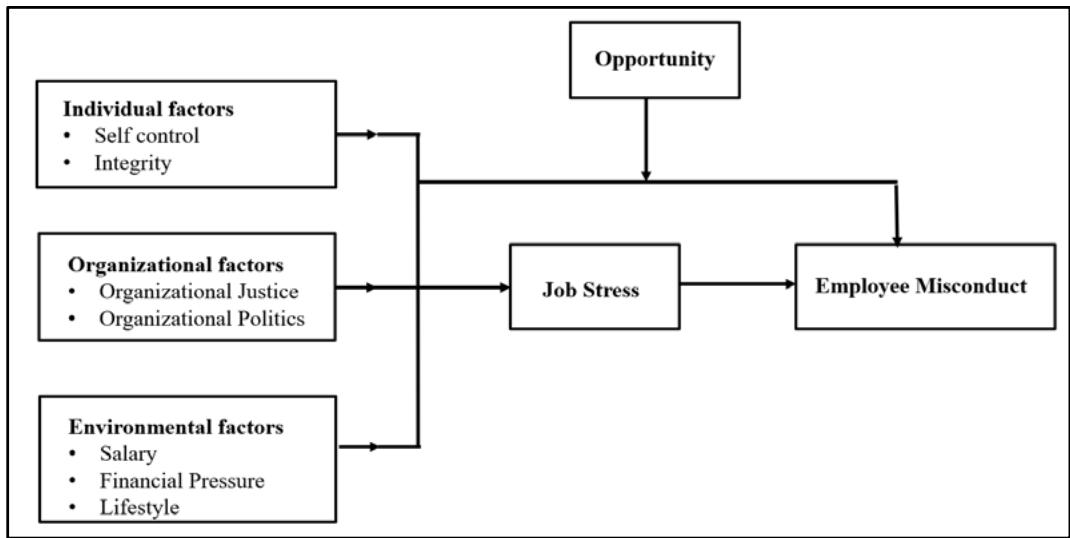 Figure 1: Research Framework
## III. RESEARCH METHODOLOGY
### a) Sample and Sampling Procedures
This study utilized a cross-sectional research design to examine the relationship between antecedents and EM among enforcement officers in Malaysia. The population of this study was enforcement officers (police officers) working in Royal Malaysian Police (RMP) located within Kuala Lumpur, Selangor, Johor, Perak and Sabah states of Malaysia. The total population of police officers in five states are 45,078 personnel (RMP, 2023). Based on the Cochran's (1977) formula with a population of 45,078, this study was determined a sample size of 381 to be the required number. The sample size of 381 meets many researchers' recommendations and agrees that the suggested sample size should be between 250 to 500 for SEM analysis (Schumacker & Lomax, 2016; Sekaran & Bougie, 2016; Kline, 2016: Rashid et al., 2021). Therefore, to avoid incomplete questionnaires that were returned and a low response rate, this study was distributed survey questionnaires to 500 participants in the targeted states.
This study utilized two-stages of multistage cluster sampling methods for data collection. This technique is used for large-scale surveys spread over large areas (Kabir, 2016). Multistage cluster sampling technique selects samples randomly and it is able to eliminate selection bias (Alias, 2013). At the first stage, the 14 states of police in Malaysia were divided into four regions, which were west, east, north and south. There was only one state purposive selected in each region except west region. Then 5 out of 14 states in Malaysia were selected in this study. The selection of states is based on two criteria such as: (i) the highest number of disciplinary cases was recorded in RMP from year 2018 to 2022, and (ii) representative to each region in Malaysia (west, south, north and east). In the second stage, two police districts (IPD) were purposively selected in each state. The selection of two police districts (IPDs) for each state based on the categories of the IPDs (i.e., Category A and B) to represent the population for each state. This study applies a simple random sampling technique in collecting data from respondents.
To avoid common method bias, a two-wave questionnaire was distributed to 500 police officers using two sets of questionnaires. The questionnaire Set A is completed by the employees using self-administered questionnaire and questionnaire Set B is completed by the supervisors via online "Google Form". In the first wave, the questionnaire set A was used to collect data on employees' perceptions of self-control, integrity, organizational justice, organizational politics, salary, financial pressure, lifestyle, stress and demographic information. A total of 450 completed self reported responses were received in the first wave equivalent to $90\%$ response rate. After two weeks, the second wave of the study was conducted by sending another 368 questionnaire Set B to the supervisor to evaluate the participating employees' job performance if their supervisee had engaged in any form of EM. A total of 301 two-wave paired questionnaires were received, resulting in a response rate of $82\%$. A total of 22 questionnaires were excluded because of significant missing data. Only 428 employee questionnaires were identified can be used for further analysis.
The characteristics of respondents are 343 (80%) males and 85 (20%) females representing with the gender's population in RMP, which primarily dominated by males. Furthermore, more than half (51.2%) of the respondents were aged between 30 and 39 years old. Majority of the respondents were married (81.1%). Majority of the respondents possessed a SPM level, representing 58.4% (250 respondents) of the sample. This is in line with the respondents rank with majority from rank-and-file police officers (83.6%), followed by senior police officers (16.4%). In addition, the majority of the respondents (64.2%) reported their monthly income between RM3,001 and RM7,000, followed by monthly income less than RM3,000.00 (33.4%).
### b) Measurement
The instruments utilized in this study were drawn from established instruments that were developed in the western countries and local. As a result, the instruments were modified to fit the Malaysian context. The survey was translated into the Malaysian language through back-to-back translation. The sources of questionnaire formation shown in Table 1. The level of agreement to each statement for organizational justice, organizational politics, salary, financial pressure, lifestyle, stress and opportunity variables used in this study is a 5-points Likert scale ranging from 1 (strongly disagree) to 5 (strongly agree). However, for self-control and integrity variables is a 5-points Likert scale ranging from 1 (not at all like me) to 5 (very much like me). In addition, for employee misconduct, this study used 5-points Likert scale ranging from 1 (never) to 5 (daily).
Table 1: Source of Questionnaire Formation
<table><tr><td>Constructs</td><td>Number of Items</td><td>Adapted from</td><td>Cronbach's alpha</td></tr><tr><td>Self-control</td><td>13</td><td>Tangney et al. (2004)</td><td>0.87</td></tr><tr><td>Integrity</td><td>8</td><td>Peterson and Seligman (2004b)</td><td>0.88</td></tr><tr><td>Organizational Justice</td><td>5</td><td>Reynolds and Helfers (2019)</td><td>0.88</td></tr><tr><td>Organizational Politics</td><td>6</td><td>Vigoda (2002)</td><td>0.91</td></tr><tr><td>Salary</td><td>6</td><td>Khalid (2016)</td><td>0.91</td></tr><tr><td>Financial Pressure</td><td>7</td><td>Said et al. (2018b)</td><td>0.91</td></tr><tr><td>Lifestyle</td><td>4</td><td>Daud et al. (2019) and Said et al. (2018a)</td><td>0.78</td></tr><tr><td>Stress</td><td>4</td><td>Motowidlo et al. (1986)</td><td>0.90</td></tr><tr><td>Opportunity</td><td>5</td><td>Khalid (2016)</td><td>0.79</td></tr><tr><td>Employee Misconduct</td><td>15</td><td>Martin (1994), Akaah and Lund (1994), Bennett and Robinson (2000) and Vardi (2001)</td><td>0.77</td></tr></table>
### c) Data Analysis
To test the hypothesis, structural equation models (SEM) were used using AMOS version 23.0. Chi-square statistics, root mean square error of approximation (RMSEA), comparative fit index (CFI), Tucker-Lewis index (TLI), normed fit index (NFI), and relative chi-square $(\chi^2 /\mathrm{df})$ are used to assess the goodness of the fit model. Hair et al. (2019) state a score above 0.90 for CFI, TLI, and NFI indicates a good fit. For RMSEA, a score less than 0.08 indicates a good fit (Hair et al., 2019). The relative chi-square $(\chi^2 /\mathrm{df})$ below the cut-off value of 5.0 indicates a good fit (Bentler, 1990). To test the moderation effect, this study was conducted using the Multi-Group Analysis in AMOS (Samah, 2016). The analysis involves splitting the data into two groups based on the moderator variable: low opportunity and high opportunity. By using Multi=group analysis, the researcher is able to test moderation effects of the moderator on the overall model and the individual paths. If there is some form of moderation on the overall model, then the researcher can proceed to test the moderation effect on the individual paths.
## IV. RESULTS
### a) Confirmatory Factor Analysis
Confirmatory factor analysis is used to ensure the validity and reliability of the research instrument (Junusi et al., 2023). Average variance extract (AVE) and construct reliability (CR) are used to check the convergent validity of constructs. The measurement scale has convergent validity if the factor loading item is greater than or equal to 0.50, AVE values are more than 0.5 (Fornell and Larcker, 1981) and CR values are more than 0.7 (Hair et al., 2019). Based on Table 2, the value of AVE and CR for each construct in this study has met the requirement since AVE values are more than 0.5 except self-control and EM construct (Fornell and Larcker, 1981) and CR values are more than 0.7 (Hair et al., 2019) showing convergent validity. The AVE score for SC is 0.472, the IN is 0.633, the OJ is 0.589, the OP is 0.671, the FP is 0.613, the LS is 0.610, the ST is 0.738, and the EM is 0.451. In addition, we found that the AVE for self-control and EM were 0.472 and 0.451 respectively, which less than 0.5 (Fornell and Lacker, 1981). However, according to Fornell and Lacker (1981 cited in Huang et al., 2013) argued that the AVE value of 0.4 is acceptable due to condition that if AVE value is less than 0.5, but construct reliability is higher than 0.6, the convergent validity of the construct is acceptable. Thus, convergent validity is achieved for self-control and EM constructs. This means that all items are valid.
The CR score for SC is 0.877, the IN score is 0.896, the OJ score is 0.876, the OP score is 0.910, the SL score is 0.912, the FP score is 0.917, the LS score is 0.818, the ST score is 0.918, and the EM score is 0.799. It can be concluded that this value is greater than 0.70 (Hair et al., 2019), which means the construction is reliable.
### b) Discriminant Validity
In addition, based on Table 2, the instrument used in this study also meets the discriminant validity criteria since the value of the AVE of two constructs (on diagonal) is higher than the squared correlation coefficients (on the off-diagonal) of the two constructs (Byrne, 2016). Therefore, these results confirm that all research variables have met discriminant validity since there are no multicollinearity issues within the study's constructs.
Table 2: Construct Reliability, Average Variance Extracted (on the Diagonal) and Squared Correlation Coefficients (on the Off-diagonal) for Study instruments
<table><tr><td>0'nb Constructs</td><td>CR</td><td>SC</td><td>IN</td><td>OJ</td><td>OP</td><td>SL</td><td>FP</td><td>LS</td><td>ST</td><td>EM</td></tr><tr><td>Self-control (SC)</td><td>.877</td><td>.472</td><td></td><td></td><td></td><td></td><td></td><td></td><td></td><td></td></tr><tr><td>Integrity (IN)</td><td>.896</td><td>.301</td><td>.633</td><td></td><td></td><td></td><td></td><td></td><td></td><td></td></tr><tr><td>Org. Justice (OJ)</td><td>.876</td><td>.128</td><td>.118</td><td>.589</td><td></td><td></td><td></td><td></td><td></td><td></td></tr><tr><td>Org. Politics (OP)</td><td>.910</td><td>.059</td><td>.014</td><td>.141</td><td>.671</td><td></td><td></td><td></td><td></td><td></td></tr><tr><td>Salary (SL)</td><td>.912</td><td>.119</td><td>.066</td><td>.144</td><td>.073</td><td>.721</td><td></td><td></td><td></td><td></td></tr><tr><td>Financial Pressure (FP)</td><td>.917</td><td>.097</td><td>.083</td><td>.152</td><td>.154</td><td>.155</td><td>.613</td><td></td><td></td><td></td></tr><tr><td>Lifestyle (LS)</td><td>.818</td><td>.102</td><td>.094</td><td>.038</td><td>.018</td><td>.008</td><td>.016</td><td>.610</td><td></td><td></td></tr><tr><td>Stress (ST)</td><td>.918</td><td>.171</td><td>.110</td><td>.147</td><td>.068</td><td>.126</td><td>.124</td><td>.033</td><td>.738</td><td></td></tr><tr><td>Employee Misconduct (EM)</td><td>.799</td><td>.235</td><td>.173</td><td>.241</td><td>.139</td><td>.243</td><td>.429</td><td>.040</td><td>.228</td><td>.451</td></tr></table>
### c) Test of Structural Model
The next step of the analysis after validation and specification of measurement model is the structural model was developed to examine the research model in describing the direct relationship between exogenous (independent variables) and endogenous (dependent variables) as well as the indirect relationship through the mediating effect of stress. Based on Table 3 and Figure
2, this study's structural model achieved the level of good fit since all the indices have met the minimum requirement as suggested by previous studies. The relative chi-square $(\chi 2 / df)$ is 1.361 which is below the cut-off value of 5.0 (Bentler, 1990). The value for RMSEA is 0.029 which is below than 0.08 (Hair et al., 2019). Other fit indices such as TLI = 0.967 and CFI = 0.970 have recorded values more than 0.9 (Hair et al., 2019).
Table 3: Goodness-of-Fit (GOF) Indices of Structural Model
<table><tr><td>Category of GOF</td><td>Fit Indices</td><td>Level of Acceptance</td><td>Authors</td><td>Results</td><td>Indication</td></tr><tr><td>Absolute Fit</td><td>RMSEA</td><td><.08</td><td>Hair et al. (2019)</td><td>.029</td><td rowspan="5">Good fit</td></tr><tr><td rowspan="3">Incremental Fit</td><td>TLI</td><td>>.90</td><td>Hair et al. (2019)</td><td>.967</td></tr><tr><td>CFI</td><td>>.90</td><td>Hair et al. (2019)</td><td>.970</td></tr><tr><td>NFI</td><td>>.90</td><td>Hair et al. (2019)</td><td>.896</td></tr><tr><td>Parsimony Fit</td><td>Relative Chi-square (CMIN/DF)</td><td>< 5.0</td><td>Bentler (1990)</td><td>1.361</td></tr></table>
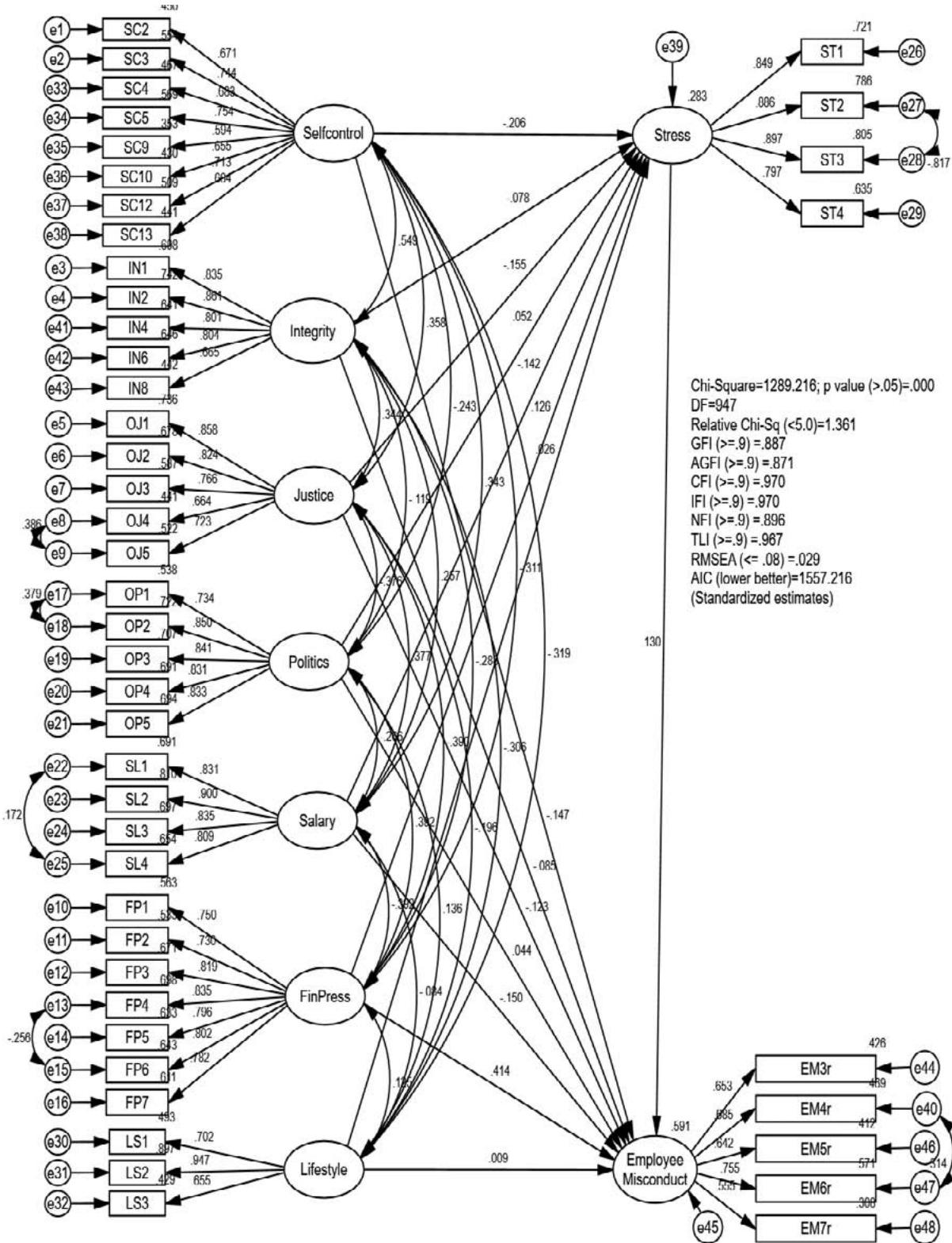 Figure 2: Structural Model of the Study
### d) Hypothesis Testing Results
Based on the structural model analysis results as illustrated in Table 4, the results indicated that from seven path coefficients associated with the path linking the model's exogenous (antecedents variables) and endogenous (EM) variable, four hypothesized relationships had been significant, either positive or negative relationships at the level of $95\%$ confidence interval with p-values less than 0.05. These exogenous variables had been significant on the relationship with EM were: self-control ( $\beta = -0.147$, CR = -2.566, p-value = 0.01), organizational justice ( $\beta = -0.123$, CR = -2.371, p-value = 0.018), salary ( $\beta = -0.150$, CR = -3.062, p-value = 0.002), and financial pressure ( $\beta = 0.414$, CR = 7.224, p-value = 0.000). However, three hypothesized relationships had been not significant at the level of $95\%$
confidence interval with p-values more than 0.05 were: integrity ( $\beta = -0.085$, CR = -1.597, p-value = 0.110), organizational politics ( $\beta = 0.044$, CR = 0.933, p-value = 0.351), and lifestyle ( $\beta = 0.009$, CR = 0.206, p-value = 0.837). Therefore, it can be concluded that self-control, organizational justice, salary and financial pressure have a significant relationship on employee misconduct among enforcement officers in Malaysia. Hence, hypothesis H1a, H1c, H1e and H1f were supported in this study.
In addition, this study found that stress was significant and positively related to employee misconduct at the level of $95\%$ confidence interval with p-values less than 0.05 ( $\beta = 0.113$, CR. = 2.748, p-value = 0.006) (Table 4). This finding can be interpreted as increasing the level of stress will increase in employee misconduct. Therefore, it can be concluded that stress has a significant and positive relationship on employee misconduct among enforcement officers in Malaysia. Hence, hypothesis H3 was supported.
Furthermore, the value reported for coefficient of determination $(R^2)$ is 0.59. Hence, it can be said that $59\%$ of the variance in employee misconduct is explained by eight factors. However, there are still another $41\%$ other factors not explained in the model for variance in employee misconduct.
Table 4: Results of SEM on Effect of Antecedents on Employee Misconduct
<table><tr><td colspan="3">Path</td><td>Estimate of regression coefficient (B)</td><td>Standard Error (SE)</td><td>Beta (β)</td><td>Critical Ratio (CR)</td><td>Significance value (P-value)</td><td>Findings</td></tr><tr><td>EM</td><td><--</td><td>SC</td><td>-.121</td><td>.047</td><td>-.147</td><td>-2.566</td><td>.010</td><td>H1a: Supported</td></tr><tr><td>EM</td><td><--</td><td>IN</td><td>-.060</td><td>.038</td><td>-.085</td><td>-1.597</td><td>.110</td><td>H1b: Rejected</td></tr><tr><td>EM</td><td><--</td><td>OJ</td><td>-.082</td><td>.034</td><td>-.123</td><td>-2.371</td><td>.018</td><td>H1c: Supported</td></tr><tr><td>EM</td><td><--</td><td>OP</td><td>.026</td><td>.028</td><td>.044</td><td>0.933</td><td>.351</td><td>H1d: Rejected</td></tr><tr><td>EM</td><td><--</td><td>SL</td><td>-.087</td><td>.028</td><td>-.150</td><td>-3.062</td><td>.002</td><td>H1e: Supported</td></tr><tr><td>EM</td><td><--</td><td>FP</td><td>.272</td><td>.038</td><td>.414</td><td>7.224</td><td>.000</td><td>H1f: Supported</td></tr><tr><td>EM</td><td><--</td><td>LS</td><td>.006</td><td>.028</td><td>.009</td><td>.206</td><td>.837</td><td>H1g: Rejected</td></tr><tr><td>EM</td><td><--</td><td>ST</td><td>.088</td><td>.032</td><td>.130</td><td>2.768</td><td>.006</td><td>H3: Supported</td></tr></table>
Legend: SC = Self-control, IN = Integrity, OJ = Organizational Justice, OP = Organizational Politics, SL = Salary, FP = Financial Pressure, LS = Lifestyle, ST = Stress, EM = Employee Misconduct, R = Multiple correlation coefficient and $R^2$ = Coefficient of determination.
Based on the structural model analysis results as illustrated in Table 5, the results obtained that from seven path coefficients associated with the path linking the model's exogenous (independent variables) and endogenous (stress) variables, four hypothesized relationships had been significant, either positive or negative relationships at the level of $95\%$ confidence interval with p-values less than 0.05. These independent variables had been significant on the relationship with stress were: self-control $(\beta = -0.206, C.R = -3.336, p$
value = 0.000), organizational justice ( $\beta = -0.155$, C.R = -2.772, p-value = 0.006), salary ( $\beta = -0.142$, C.R = -2.714, p-value = 0.007), and financial pressure ( $\beta = 0.126$, C.R = 2.351, p-value = 0.019). However, three hypothesized relationships had been not significant at the level of $95\%$ confidence interval with p-values more than 0.05 were: integrity ( $\beta = -0.078$, C.R = -1.351, p-value = 0.177), organizational politics ( $\beta = 0.052$, C.R = 1.007, p-value = 0.314), and lifestyle ( $\beta = 0.026$, C.R = 0.544, p-value = 0.586). Therefore, it can be concluded that self-control, organizational justice, salary and financial pressure have a significant relationship on stress among enforcement officers in Malaysia. Hence, hypothesis H2a, H2c, H2e and H2f were supported in this study.
Stress \<--- Self-control -.251.075 -.206 -3.336.000 H2a: Supported
<tr><td>Stress</td><td><--</td><td>Self-control</td><td>-.251</td><td>.075</td><td>-.206</td><td>-3.336</td><td>.000</td><td>H2a: Supported</td></tr>
Legend: B = Unstandardized Estimates, S.E. = Standard Error, Beta = Standardized regression weight (Path coefficient), C.R = Critical Ratio, R = Multiple correlation coefficient and $R^2 =$ Coefficient of determination.
The test for the effect of the moderating variable of opportunity on the relationship between antecedents and EM, the analysis was conducted using the Multi-group analysis in AMOS. A moderator variable is a variable that alters the strength of the causal relationship between independent (predictor) and dependent variable (Baron & Kenny, 1986; Rose et al., 2004). The analysis involves splitting the data into two groups based on the moderator: low opportunity and high opportunity. There are two-stage tests of moderation effect. By using Multi-group analysis, the researcher is able to test moderation effects of the moderator on the overall model and the individual paths. If there is some form of moderation on the overall model, then the researcher can proceed to test the moderation effect on the individual paths. According to Hair et al. (2019), the path is moderated if Beta for the one group is significant while Beta for the other group is non-significant, or both Betas for both groups are significant, however Beta for one group is positive while Beta for the other group is negative.
Table 6: Results of Moderation Effect of Opportunity on Relationship between Antecedents and EM
<table><tr><td>Paths</td><td>B</td><td>Beta</td><td>CR</td><td>P</td><td>Status</td><td>Decision</td></tr><tr><td colspan="7">Self-control - EM</td></tr><tr><td>Low OPP</td><td>-0.096</td><td>-0.129</td><td>-1.484</td><td>0.138</td><td>NS</td><td>H5a: Supported</td></tr><tr><td>High OPP</td><td>-0.144</td><td>-0.162</td><td>-2.155</td><td>0.031</td><td>S</td><td></td></tr><tr><td colspan="7">Integrity - EM</td></tr><tr><td>Low OPP</td><td>0.056</td><td>0.070</td><td>0.830</td><td>0.406</td><td>NS</td><td>H5b: Supported</td></tr><tr><td>High OPP</td><td>-0.111</td><td>-0.163</td><td>-2.398</td><td>0.016</td><td>S</td><td></td></tr><tr><td colspan="7">Org. Justice - EM</td></tr><tr><td>Low OPP</td><td>-0.057</td><td>-0.092</td><td>-1.209</td><td>0.227</td><td>NS</td><td>H5c: Supported</td></tr><tr><td>High OPP</td><td>-0.126</td><td>-0.175</td><td>-2.525</td><td>0.012</td><td>S</td><td></td></tr><tr><td colspan="7">Org. Politics - EM</td></tr><tr><td>Low OPP</td><td>-0.002</td><td>-0.004</td><td>-0.047</td><td>0.962</td><td>NS</td><td>H5d: Not Supported</td></tr><tr><td>High OPP</td><td>0.039</td><td>0.058</td><td>0.970</td><td>0.332</td><td>NS</td><td></td></tr><tr><td colspan="7">Salary - EM</td></tr><tr><td>Low OPP</td><td>-0.095</td><td>-0.181</td><td>-2.433</td><td>0.015</td><td>S</td><td>H5e: Supported</td></tr><tr><td>High OPP</td><td>-0.078</td><td>-0.124</td><td>-1.945</td><td>0.052</td><td>NS</td><td></td></tr><tr><td colspan="7">Financial Pressure - EM</td></tr><tr><td>Low OPP</td><td>0.289</td><td>0.525</td><td>5.318</td><td>0.000</td><td>S</td><td>H5f: Not Supported</td></tr><tr><td>High OPP</td><td>0.270</td><td>0.349</td><td>4.947</td><td>0.000</td><td>S</td><td></td></tr><tr><td colspan="7">Lifestyle - EM</td></tr><tr><td>Low OPP</td><td>0.069</td><td>0.131</td><td>1.822</td><td>0.069</td><td>NS</td><td>H5g: Not Supported</td></tr><tr><td>High OPP</td><td>-0.060</td><td>-0.081</td><td>-1.483</td><td>0.138</td><td>NS</td><td></td></tr></table>
Legend: B = Unstandardized Estimates, Beta = Path coefficient, CR = Critical Ratio, P = P-value, S = Significant, NS = Not significant, OPP = Opportunity and EM = Employee Misconduct As shown in Table 6, opportunity moderates the relationship between four independent variables (i.e., self-control, integrity, organizational justice, and salary) and EM. However, opportunity does not moderate the relationship between three independent variables (i.e., organizational politics, financial pressure, and lifestyle) and EM.
## V. DISCUSSIONS
The first objective of the present study was to examined the relationship between antecedents (self-control, integrity, organizational justice, organizational politics, salary, financial pressure, and lifestyle) and EM among enforcement officers in Malaysia. Specifically, our result indicated that the dimensions of individual factors (i.e. self-control), organizational factors (organizational justice), and socio-economic factors (i.e. salary and financial pressure) were significantly associated to EM. The finding means that when enforcement officers with high levels of self-control are less engaged in misconduct. The findings are consistent with previous studies that emphasized the negative significant relationship between self-control and workplace misconduct among law enforcement officers (Donner et al., 2016; Donner and Jennings, 2014; Donner et al., 2021; Wang et al., 2021). The result also strongly supported with Gottfredson and Hirschi (1990) general theory of crime postulation that employees with low self-control were highly likely to commit workplace misconduct and crime (Donner and Jennings, 2014; Donner et al., 2016; Moon et al., 2012). Similarly, when enforcement officers perceived high levels of unfair treatment within the organization are leads to higher workplace misconduct. The result obtained from the current study is consistent with the findings retrieved from prior studies found that negative relationship between organizational justice and police misconduct (Hashish, 2020; Fridell et al., 2020; Reynolds and Helfers, 2019; Wolfe and Piquero, 2011). The results are consistent with social exchange theory posits that employees tend to reciprocate with destructive behavior when the perceptions of justice in the organization are low (Abbassi et al., 2020).
The second objective of the present study was to examined the relationship between antecedents (self-control, integrity, organizational justice, organizational politics, salary, financial pressure, and lifestyle) and stress among enforcement officers in Malaysia. Specifically, our result indicated that the dimensions of individual factors (i.e. self-control), organizational factors (organizational justice), and socio-economic factors (i.e. salary and financial pressure) were significantly associated to stress. The results show that police officers' stress levels throughout their duties and responsibilities in Malaysia are predicted by their degree of self-control. This result is in line with earlier stress-related research, which demonstrated a negative relationship between occupational stress and self-control (Hamilton et al., 2014; Nielsen et al., 2019; Siddiqui et al., 2021). In addition, the research findings states that there is a negative and significant relationship between organizational justice and stress among enforcement officers in Malaysia. This implies that when enforcement officers perceive their work environment as fair and just, it is associated with lower levels of stress. This refers to the perceived fairness and justice within an organization, particularly in terms of how decisions are made, resources are allocated, and employees are treated. This result in line with the previous research demonstrated a negative relationship between organizational justice and stress (Boateng & Hsieh, 2018; Elechi et al., 2020; Lambert et al., 2019; May et al., 2020; Nasurdin et al., 2014; Pérez-Rodriguezza et al., 2019; Wolfe & Piquero, 2011). Furthermore, results states that salary has a negative and significant relationship with stress among enforcement officers in Malaysia. This finding is consistent with the previous studies that reported salary was a significant and negative relationship on stress (Danish et al., 2015; Mosadeghrad et al., 2011; Sivarajah et al., 2014). It means that employees with a high level of salary are less stressed at work. Therefore, it can be concluded that a better level of perception towards pay or salary satisfaction reflects the satisfaction in the financial matters, which reduces the stress among enforcement officers. In a similar vein, research findings demonstrate that stress and financial pressure are significantly positively correlated among Malaysian law enforcement officials. This result is consistent with a systematic study conducted by Guan et al. (2022) found a positive correlation between depression and financial stress. These results imply that improved financial resource management and a greater sense of financial well-being could alleviate a number of personal difficulties. A greater sense of sufficiency in relation to job pay could also have a good effect on many of the issues that arise in the workplace.
The third objective of the present study was to examine the relationship between stress and employee misconduct among enforcement officers in Malaysia. Finding of this study revealed that stress is positively and significantly related to employee misconduct. This finding means that when enforcement officers experienced higher levels of work-related stress, they would participate in more misconduct behavior at work. This finding is consistent with the findings retrieved from prior studies (Adekanmbi & Ukpere, 2019; Bashir et al., 2019; Bishopp et al., 2020; Bishopp et al., 2016; Nasurdin et al., 2014; Silva & Ranasinghe, 2017). found that police officers with high levels of stress are highly engaged in misconduct. As argued by Agnew (1992) general strain theory (GST), stress tend to generate negative emotion responses (i.e., anger, fear, frustration, and burnout) that create an internal pressure, which in turn are likely to lead to committing crime and deviance (Wu & Makin, 2020).
The fourth objective of the present study was to examined the moderating effect of opportunity on the relationship between antecedents (self-control, integrity, organizational justice, organizational politics, salary, financial pressure, and lifestyle) and EM among enforcement officers in Malaysia. Our results produced evidence that opportunity moderates the relationship between self-control, integrity, organizational justice, salary and EM among enforcement officers in Malaysia is significant. The finding suggests that the negative correlation between self-control and EM is stronger when presented with high opportunity ( $\beta = -0.162$, p-value $= 0.031$ ) other than low opportunity ( $\beta = -0.129$, p-value $= 0.138$ ). This meant that enforcement officers with higher opportunity have stronger tendencies to engage in misconduct when subjected to self-control, in comparison to those with low opportunity. The result of the current study is also consistent with the studies conducted by previous scholars, which claims that opportunity moderates the relationship between self-control and deviance (Baek et al., 2016; LaGrange & Silverman, 1999; Longshore & Turner, 1998; Moon & Alarid, 2015; Seipel & Eifler, 2010; Smith, 2004). Furthermore, results revealed that opportunity significantly moderates the relationship between integrity and EM among enforcement officers in Malaysia. This finding suggests that the negative correlation between integrity and EM is stronger when presented with high opportunity ( $\beta = -0.163$, $p$ -value = 0.016) other than low opportunity ( $\beta = 0.070$, $p$ -value = 0.406). This meant that enforcement officers with higher opportunity have stronger tendencies to engage in misconduct when subjected to integrity, in comparison to those with low opportunity. This study found that employees who has low integrity (i.e., dishonest, weak moral principles and ethical values) are more likely to commit misconduct with high opportunity (i.e., weak internal control system, poor security over company property, fear of exposure and likelihood of detection, or unclear policies and standard operating procedure). In other words, the lower integrity and the higher opportunities employees have, the more they commit misconduct. This implies that an organization's internal control system buffers the association by strengthening the negative influence of integrity on misconduct. Since self-control and self-discipline is inter-related, past studies found that self-control plays a role in integrity (Berry et al., 2007; Sackett & Wanek, 1996). Furthermore, both self-control and integrity have been found to be significant predictors of counterproductive behaviors (Marcus & Schuler, 2004; Ones et al., 1993; Vohs et al., 2008).
In addition, research findings states that opportunity significantly moderate the relationship between organizational justice and EM. This result suggests that the negative correlation between organizational justice and EM is stronger when presented with high opportunity ( $\beta = -0.175$, p-value $= 0.012$ ) other than low opportunity ( $\beta = -0.092$, p-value $= 0.227$ ). This meant that enforcement officers with higher opportunity have stronger tendencies to engage in misconduct when subjected to organizational justice, in comparison to those with low opportunity. As such, these results provide empirical support for the fraud triangle framework as proposed by Albrecht (1996), and specifically, suggest that employee fraud increases when both the motivation (i.e., the incentive and/or rationalization) and the opportunity exists (as cited in Rae & Subramaniam, 2008). This finding is also consistent with previous study conducted by Rae and Subramaniam (2008), which revealed that the quality of internal control procedures has a moderating effect on the relationship between perceptions of organizational justice and employee fraud. In a similar vein, results as shown in Table 6, revealed that presence of opportunity significantly moderates the relationship between salary and EM. The finding suggests that the negative correlation between salary and EM is stronger when presented with high opportunity other than low opportunity. This meant that enforcement officers with higher opportunity have stronger tendencies to engage in misconduct when subjected to salary, in comparison to those with low opportunity. In general, the results obtained from the current study are consistent with the findings retrieved from prior studies (Baek et al., 2016; LaGrange & Silverman, 1999; Longshore & Turner, 1998; Moon & Alarid, 2015; Seipel & Eifler, 2010; Smith, 2004), which claim that opportunity play a role as moderator in deviant behavior (i.e., crime and fraud). These results supported the fraud triangle theory that argued on opportunity as one of the most important factors contributing to fraud or unethical behaviors in the workplace. This shows that opportunity moderates and modifies the strength of the relationship between salary and employee misconduct among enforcement officers in Malaysia.
The findings of this study provide a new contribution to the research area of employee workplace behavior (EWB), specifically in employee misconduct literature. First, this study contributes to the development of the model that was tested in this study which represented interrelationship between the studied variables as illustrated in Figure 1. This theoretical framework improves our knowledge on the integrating of antecedents (individual, organizational and socioeconomic factors) on EM and the moderating role of opportunity in the Malaysian enforcement agencies context. Nonetheless, to date, there has been a little study that has investigated the multiple pertinent antecedents of EM collectively (Malik & Lenka, 2019). Previous research examined these antecedents have primarily focused mainly on individual and organizational factors in separate studies (e.g., Alias et al., 2013a; Bashir et al., 2019; Farhadi et al., 2012; Nasurdin et al., 2014). Unfortunately, sparse research has been given attention on the relationship between socio-economic factors and EM. Thus, the current study makes an original contribution to the literature since this study investigates the roles of individual, organizational and socio-economic factors coupled with opportunity in affecting EM concurrently in one comprehensive framework.
Furthermore, the results of this study contribute to the extended of the General Strain Theory (GST) (Agnew, 1992) to examined the applicability of GST in explaining the relationship between antecedents, stress and misconduct among enforcement officer in Malaysia. As it has been recognized that police work is a stressful job (Bishopp et al., 2018; Bishopp et al., 2020; Omar et al., 2020; Piquero et al., 2013; Strauss, 2017; Wu, 2018), and officers, especially frontline officers, normally face a wide range of stressors, the General Strain theory (GST) provide a good theoretical framework to understand the reactions of officers to stress and its consequence on police misconduct. GST had been the most recent theory used by researchers specifically in criminology and workplace deviant studies (i.e., Alias et al., 2013a; Nasurdin et al., 2014; Radzali, 2015) However, few research studies have employed this theory on police misconduct in the policing context (Bishopp et al., 2016; Park, 2015; Wu, 2018).
The findings of the present study have several implications for practitioners and policy makers in both Ministry of Home Affairs (MOHA) and Royal Malaysia Police (RMP) Department on how to formulate preventive strategies to mitigate the EM problem among police officers. Also, the present findings could be applied to other Malaysian enforcement ministries and departments (i.e. Immigrations Department, Road Transport Department, States Local Authorities) as a tool for preventing misconduct behavior in the workplace. Firsly, at the individual level, enforcement officer should be trained on how to develop self-control to enhance the management of emotions in regulating employee's behavior within the workplace, influencing ethical decision-making, stress management, goal pursuit, and interpersonal dynamics. Similarly, in the context of enforcement organizations, low self-control can be detected through two primary avenues: 1) pre-employment detection and 2) post-hiring detection. Secondly, at the organizational level, police administrators or HR department in RMP must treat their members fairly and make use of fair procedures in allocating rewards. Specifically, policies on pay raises and promotions must be transparent, clearly-defined, and objective. One suggestion would be to implement a career development and promotion system based on merit. In addition, the RMP Human Resource Department needs to do a comprehensive study for an application to review the police salary scheme and allowances in line with their duties to protect the security and ensure peace and order in the country and the increasing cost of living. The last government made a review of the salary scheme for police and civil servants was conducted in 2013 quite a long time (Malaymail, 2023).
A number of limitations were identified in relation to this study. First, there are still some limitations in employing non-self-reported measures to assess employee misconduct behaviour, despite having obtained data from supervisors to address any concerns about same-source bias. Supervisors aren't always the best providers of information regarding their workers' work behavior. Employees and their co-workers may be able to record their job behavior with greater accuracy than supervisors. Furthermore, some supervisors may present biased information due to favoritism. Hence, it is recommended that when undertaking research on sensitive topics, non-self-report measures or a combination of self-report and non-self-report measures could be more beneficial and accurate (Dar, 2011). Secondly, the sample was drawn entirely from police officers employed in the Malaysian enforcement agencies, which may limit the generalisation of the findings. In Malaysia, there are other enforcement agencies and departments (such as customs, immigrations, and road transport department) that could represent the enforcement sectors too. Since different enforcement agencies have different working cultures, working conditions/ environments, manpower and responsibilities, the findings may be different. Hence, for future study we suggest to gather data from other departments such as the Immigration Department of Malaysia and the Road Transport Department in order to further generalize the current findings on the enforcement agencies because these agencies also indicate second and third highest problems with employee misconduct among enforcement agencies in Malaysia (EAIC, 2022).
## VI. CONCLUSIONS
In conclusion, employers should realize that individual self-control, organizational justice, salary and financial pressure will eventually affect employees' behavioural responses through their affective internal state. The results obtained from this study further suggest that enforcement officers who are low self-control are likely to engage in EM, supporting Gottfredson and Hirsch's (1990) general theory of crime. Moreover, it has been confirmed that perceptions of organizational injustice among enforcement officers lead to justifications to engage in misconduct acts. On the other hand, economic and social problems such as low salary and financial pressure among enforcement officers have significant consequences that lead to employees engaging in unethical behaviors in the workplace. This finding also revealed that enforcement officers experienced stress due to low self-control, injustice, low salary and financial pressure, which further pushed their behavioral outcomes (i.e. misconduct). Therefore, to mitigate workplace misconduct, organizational authorities should focus on to develop employee self-control. Conversely, employees' stress levels could be reduced by organizational justice and fair treatment from leaders, which would reduce the possibility of misbehavior in the workplace. By doing this, workers are less likely to feel stressed out or unsatisfied, which lowers their likelihood of engaging in misconduct behavior.
## ACKNOWLEDGEMENT
The researchers would like to thank police officers in the Royal Malaysian Police for their willingness to participate in a survey conducted in this study.
Generating HTML Viewer...
References
155 Cites in Article
A Abbasi,F Baradari,H Sheghariji,J Shahraki (2020). Impact of organizational justice on workplace deviance with mediating effect of job satisfaction in SMEs of Malaysia.
Foluso Adekanmbi,Wilfred Ukpere (2019). The Relationship between Work Stress and Workplace Deviant Behaviours in the Nigerian Banking Industry.
Michael Adeoti,Faridahwati Shamsudin,Alhamwan Mohammad (2021). Opportunity, job pressure and deviant workplace behaviour: does neutralisation mediate the relationship? A study of faculty members in public universities in Nigeria.
M Adeoti,F Shamsudin,C Wan (2017). Effects of occupational stress and workplace spirituality on workplace deviance in academia: A conceptual paper.
R Agnew (1992). Foundation for a General Strain Theory of crime and delinquency.
Aminah Ahmad,Zoharah Omar,Farah Radzali,Mohammed Saidu (2017). Can Emotional Stability Buffer the Effect of Job Stress on Deviant Behavior?.
Ishmael Akaah,Daulatram Lund (1994). The influence of personal and organizational values on marketing professionals' ethical behavior.
W Albrecht,C Albrecht,C Albrecht,M Zimbelman (2018). Fraud examination.
M Alias (2013). Predictors of Workplace Deviant Behaviour and the Mediating Role of Job Satisfaction among Support Staff in Malaysian Local Authorities.
M Alias,R Rasdi (2015). Organizational predictors of workplace deviance among support staff.
Mazni Alias,Roziah Mohd Rasdi,Maimunah Ismail,Bahaman Abu Samah (2013). Predictors of workplace deviant behaviour: HRD agenda for Malaysian support personnel.
M Aminuddin (2013). Malaysian industrial relations & employment law.
Muhammad Asadullah,Ammara Akram,Hameed Imran,Ghulam Arain (2017). When and which employees feel obliged: A personality perspective of how organizational identification develops.
Hyunin Baek,Michael Losavio,George Higgins (2016). The Impact of Low Self-Control on Online Harassment: Interaction with Opportunity..
T Barker,D Carter (1994). Police deviance.
Reuben Baron,David Kenny (1986). The moderator-mediator variable distinction in social psychological research: Conceptual, strategic, and statistical considerations..
Mohsin Bashir,Muhammad Abrar,Muhammad Yousaf,Shahnawaz Saqib,Rizwan Shabbir (2019). <p>Organizational Politics And Workplace Deviance In Unionized Settings: Mediating Role Of Job Stress And Moderating Role Of Resilience</p>.
A Baum,J Singer,C Baum (1981). Stress and the environment.
R Baumeister,T Heatherton,D Tice (1994). Losing control: how and why people fail at self-regulation.
Joshua Bazzy,David Woehr (2012). Integrity, ego depletion, and the interactive impact on counterproductive behavior.
R Bennett,S Robinson (2000). Development of a measure of workplace deviance.
P Bentler (1990). Comparative fit indexes in structural models..
(2019). Abdul Hamid terkejut lebih 100 anggota polis dikesan positif dadah.
K Abbink (2000). Abstracts of Papers Presented at the Nottingham Platelet Conference, 28th-31st July 2002, Nottingham, UK.
M Bhasin (2016). Creative accounting practices: An empirical study of India.
S Bishopp,N Piquero,J Worrall,A Piquero (2018). Negative affective responses to stress among urban police officers: A general strain theory approach.
S Bishopp,N Piquero,A Piquero,J Worrall,J Rosenthal (2020). Police stress and race: Using general strain theory to examine racial differences in police misconduct.
S Bishopp,J Worrall,N Piquero (2016). General strain and police misconduct: The role of organizational influence.
P Blau (1964). Exchange and power in social life.
Antonella Bobbio,Karin Arbach,Alexander Vazsonyi (2018). Self-Control and Deviance: A Test of the General Theory of Crime in Argentina.
Osei-Assibey Mandella Bonsu,Li Dui,Zou Muyun,Evans Asare,Isaac Amankwaa (2018). Corporate Fraud: Causes, Effects, and Deterrence on Financial Institutions in Ghana.
Rehan Butt,Dr. Wen,Rana Hussain,Sabeeh Pervaiz (2020). Effect of Job Stress, Benefits and Salary on Employee Job Satisfaction Based on Mediating and Moderating Role of Work Environment and Leadership: Evidence from Telecom Sector.
Barbara Byrne (2016). Structural Equation Modeling With AMOS.
Z Byrne,R Cropanzano (2001). The History of Organizational Justice: The Founders Speak: Zinta S. Byrneand RussellCropanzano.
D Champion (2001). Police misconduct in America.
J Chanin (2015). Examining the sustainability of pattern or practice police misconduct reform.
J Choi,N Kruis (2020). Gender, self-control and opportunity: Applying the general theory of crime to online harassment.
Dirk De Clercq,Renato Pereira (2023). Perceived organizational politics, organizational disidentification and counterproductive work behaviour: moderating role of external crisis threats to work.
W Cochran (1977). Sampling techniques.
J Colquitt,J Greenberg,C Zapata-Phelan (2005). What is organizational justice? A historical overview.
Jason Colquitt,Brent Scott,Jessica Rodell,David Long,Cindy Zapata,Donald Conlon,Michael Wesson (2013). Justice at the millennium, a decade later: A meta-analytic test of social exchange and affect-based perspectives..
J Colquitt,B Scott,T Judge,J Shaw (2006). Justice and personality: Using integrative theories to derive moderators of justice effects.
J Cox,D Zawawi,I Yasin (2022). The impact of excessive stress on deviant behaviour and the mediation role of emotional intelligence among the Royal Malaysian Police.
W Crawford,E Lamarre,K Kacmar,K Harris (2019). Organizational politics and deviance: exploring the role of political skill.
Donald Cressey (1950). The Criminal Violation of Financial Trust.
D Cressey (1953). Other people's money; A study of the social psychology of embezzlement.
R Danish,A Shahid,N Aslam,A Ali (2015). The Impact of Pay Satisfaction and Job Stress on Job Satisfaction in Pakistani Firms of Gujranwala District.
O Dar (2011). Trust in Co-workers as a Mediator of Co-workers' Trustworthiness, Social Undermining Behaviour, and Job Performance.
E Daud,L Heng,A Hassan (2019). Faktor-faktor yang mempengaruhi niat untuk melakukan rasuah di kalangan penjawat awam pihak berkuasa tempatan.
S Dellaportas (2013). Conversations with inmate accountants: Motivation, opportunity and the fraud triangle.
Christopher Donner,Wesley Jennings (2014). Low Self-Control and Police Deviance: Applying Gottfredson and Hirschi’s General Theory to Officer Misconduct.
Christopher Donner,Lorie Fridell,Wesley Jennings (2016). The Relationship Between Self-Control and Police Misconduct.
Christopher Donner,Jon Maskály,Wesley Jennings,Cynthia Guzman (2021). Using criminological theory to explain police misconduct: a state-of-the-art review.
S Eitle,S D'alessio,L Stolzenberg (2014). The effects of organizational and environmental factors on police misconduct.
(2020). Annual Report 2020.
Irma Othman,Saifulazry Mokhtar,Mohd Esa (2021). THE VISIBILITY OF THE ENFORCEMENT AGENCY INTEGRITY COMMISSION (EAIC) IN STRENGTHENING THE PUBLIC SECTOR’S CULTURE.
Emilio Melfi,Daniele Monzali,Giuseppe Quaglia (2016). Gli scenari multipli IFRS9. Uno studio applicativo.
H Farhadi,O Fatimah,R Nasir,W Wan Shahrazad (2012). Agreeableness and conscientiousness as antecedents of deviant behavior in workplace.
J Fechter (2023). Employee Misconduct.
G Ferris,D Frink,D Gilmore,K Kacmar (1994). Understanding as an antidote for the dysfunctional consequences of organizational politics as a stressor.
Claes Fornell,David Larcker (1981). Evaluating Structural Equation Models with Unobservable Variables and Measurement Error.
Lorie Fridell,Jon Maskaly,Christopher Donner (2020). The relationship between organisational justice and police officer attitudes toward misconduct.
A Goldsmith (2005). Police reform and the problem of trust.
M Gottfredson,T Hirschi (1990). A general theory of crime.
Alvin Gouldner (1960). The Norm of Reciprocity: A Preliminary Statement.
Jerald Greenberg (1990). Organizational Justice: Yesterday, Today, and Tomorrow.
J Greenberg (1993). Stealing in the name of justice: informational and interpersonal moderators of theft reactions to underpayment inequity.
S Haider,Q Nisar,F Baig,M Azeem,W Hameed (2018). Dark side of leadership: employees' job stress & deviant behaviors in pharmaceutical industry.
J Hair,W Black,B Babin,R Anderson (2019). Multivariate data analysis.
E Hashish (2020). Nurses' perception of organizational justice and its relationship to their workplace deviance.
S Hasnan,R Rahman,S Mahenthiran (2013). Management motive, weak governance, earnings management, and fraudulent financial reporting: Malaysian evidence.
Matthew Hollow (2014). Money, morals and motives.
Mike Hough,Tiggey May,Gavin Hales,Jyoti Belur (2016). Misconduct by police leaders in England and Wales: an exploratory study.
Li‐tze Hu,Peter Bentler (1999). Cutoff criteria for fit indexes in covariance structure analysis: Conventional criteria versus new alternatives.
Chun-Che Huang,Yu-Min Wang,Tsin-Wei Wu,Pei-An Wang (2013). An Empirical Analysis of the Antecedents and Performance Consequences of Using the Moodle Platform.
J Skelton,C Rodgers,L Ellis,A Lyles (2014). Rubrics and Evaluations.
F Ishaq,Q Shamsher (2016). Effect of breach of psychological contracts on workplace deviant behaviors with the moderating role of revenge attitude and self-control.
R Junusi,R Agriyanto,Musahadia,S Wardayati (2023). The role of innovative work behavior and proactive behavior in mediating employee engagement and performance at Public Universities.
S Kabir (2016). Introductory Elements of Your Research Paper.
K Kacmar,R Baron (1999). Organizational politics: The state of the field, links to related processes, and an agenda for future research.
Muhammad Kashif,Merve Gürce,Petek Tosun,Shanika Wijenayake (2020). Supervisor and Customer-Driven Stressors to Predict Silence and Voice Motives: Mediating and Moderating Roles of Anger and Self-Control.
S Khalid (2016). Theory and Practice of Police Corruption in Pakistan: Case Studies of Three Police Departments.
Mohammad Khattak,Mohammad Khan,Tasneem Fatima,Syed Shah (2018). The underlying mechanism between perceived organizational injustice and deviant workplace behaviors: Moderating role of personality traits.
Mohammad Khattak,Roxanne Zolin,Noor Muhammad (2020). The combined effect of perceived organizational injustice and perceived politics on deviant behaviors.
Barbara Killinger (2010). Integrity, Second Edition.
R Kline (2016). Principles and practice of structural equation modeling.
P Kotler,K Keller (2009). Marketing management.
Kpmg (2012). A Survey of fraud, bribery and corruption in Australia and New Zealand.
A Lawal,S Babalola,U Ordu (2019). Examining age, pay satisfaction and intent to leave in counterproductive work behaviour among university support staff.
S Lawson,S Wolfe,J Rojek,G Alpert (2021). Occupational stress and attitudes toward misconduct in law enforcement: The moderating role of organizational justice.
K Lersch (2002). Policing and misconduct.
Harry Levinson (1965). Reciprocation: The Relationship Between Man and Organization.
Malaymail (2023). Public Social Services in London<i>Local Government Act, 1929—Administrative Scheme</i>. London County Council.
(2020). General enquiry: What is the main cause of public service officers accepting a bribe? Is it due to low income levels or otherwise.
C Martin (1994). Illinois municipal officers' perceptions of police ethics.
Galit Meisler,Amos Drory,Eran Vigoda-Gadot (2019). Perceived organizational politics and counterproductive work behavior.
G Milkovich,J Newman,B Gerhart (2011). Compensation management.
A Mohamed,F Baig,M Ahmad,C Ramalingam (2019). Workplace misconduct and the requirement of due inquiry: with reference to the practice in Malaysia. 5 MLJ cxii.
B Moon,J Mccluskey,C Mccluskey,S Lee (2011). A study of relationship between job stress, quality of working life and turnover intention among hospital employees.
S Motowidlo,J Packard,M Manning,K Narayanan,S Murphy (1986). Selfregulation and depletion of limited resources: Does self-control resemble a muscle?.
A Nasurdin,N Ahmad,A Razalli (2008). Violence: Occupational Hazards in Hospitals.
A Nawawi,A Puteh Salin (2018). Internal control and employees' occupational fraud on expenditure claims.
Kristian Nielsen,Jan Bauer,Wilhelm Hofmann (2019). Examining the relationship between trait self-control and stress: Evidence on generalizability and outcome variability.
D Olsen,H Mccubbin,H Barnes,A Larsen,M Muxen,M Wilson (1989). Organisational behaviour: global and Southern African perspectives.
J Park,L Penney,P Spector (2005). Job stress, incivility, and counterproductive work behavior (CWB): The moderating role of negative affectivity.
Christopher Peterson,John Stephens,Nansook Park,Fiona Lee,Martin Seligman (2004). Strengths of Character and Work.
C Peterson,M Seligman (2004). VIA Key.
Nicole Piquero,Alex Piquero,Jessica Craig,Stephen Clipper (2013). Assessing research on workplace violence, 2000–2012.
L Porter (2021). Police misconduct.
Kristopher Preacher,Andrew Hayes (2008). Asymptotic and resampling strategies for assessing and comparing indirect effects in multiple mediator models.
A Purcell (2014). Corruption and misconduct: A behavioural reflection from investigative reports into local government.
Dhiny Putri,Zahrotun Nihayah (2017). The Effect Of Moral Integrity, Lifestyle And Organizational Culture On Anti-Corruption Intention.
Sylvia Addison,Devika Nadarajah,Ida Yasin (2015). Digital Transformation and Business Model Innovation: Moderating Role of Digital Leadership.
Kirsty Rae,Nava Subramaniam (2008). Quality of internal control procedures.
S Rashid,R Ramli,M Palil,A Amir (2021). The influence of power and trust on tax compliance motivation in Malaysia.
U Rashid,N Karim,S Rashid,A Usman (2013). Employee's Perception of Organizational Politics and its Relationship with Stress.
S Restubog,P Carcia,L Wang,D Cheng (2010). It's all about control: The role of self-control in buffering the effects of negative reciprocity beliefs and trait anger on workplace Effects on the Antecedents of Employee Misconduct, Stress and Opportunity in the Royal Malaysian Police Global Journal of Management and Business Research ( A ) XXV Issue II Version I Year 2025 deviance.
Paul Reynolds,Richard Helfers (2019). Organizational Injustice and Police Misconduct: Predicting Organizational Defiance Among Police Officers.
María-José Paredes-Ruiz,María Jodar-Reverte,Inés Albertus-Cámara,Ignacio González-Moro,Vicente Ferrer-Lopez (2009). Sport Mont 2023, 21(1), 9-15 | DOI: 10.26773/smj.230202 Abstract The military parachutists are responsible of special air operations who require certain capabilities in their physical condition, due to their intense professional career. The analysis of oxygen con-sumption (VO2) and heart rate (HR) allows the determination of aerobic (VT1) and anaerobic (VT2) thresholds and used to study the adequacy of the organism to exercise and in the analysis of sporting performance. The aim of this study was to determine the effect of tactical equipment on the stress test performance of elite parachutists. 10 parachutists parti-cipated in the study, between 22 and 36 years old with an average of 27.75 years (±4.20). Anthropometric values were determined of: weight 75.69 kg (±8.79), height 173.34 cm (±5.72) and body mass index (BMI) 25.23 (±2.98). Each one, performed 2 maximal treadmill exercise testing: one a conventional stress test (A) and another with the tactical equipment (weight 20 kg) (B). We obtained maximum oxygen consumption (Metalyzer 3B) and monitored the electrocardiogram continuously. The test started at a speed of 6km/h and a slope of 1%. The results of the two test were compared. The average value and standard deviation (SD) of different variables with equipment (B) and without it (A) and p-value were obtained: velocity (A: 14.80±3.29; B: 11.50±1.42 Km/h; p=0.073), HR (A: 182.7±58.62; B: 177.75±9.71 b/m; p=0.038), VO2 (A: 51.75±13.60; B: 54.00±30.82 ml/Kg/min; p=0.891). Al-so, the values of ventilatory thresholds: VT1 and VT2 of both tests were obtained, with sig-nificant differences. Tactical equipment causes a decrease in stress test performance with changes in VT1 and VT2. Keywords military parachutist, oxygen consumption, ventilatory thresholds, stress test View full article (PDF – 356KB) References Álvarez, R., Campos, D.C., Portes, P., Rey, R., & Martín, B. (2016). Análisis de parámetros fisiológicos en jugadores juveniles españoles de bádminton. Revista Internacional de Medicina y Ciencias de la Actividad Física y del Deporte, 16(61), 44-5. Alves, J., Barrientos, G., Toro, V., Sánchez, E., Muñoz, D., & Maynar, M. (2021). Changes in anthropometric and performance parameters in high-level endurance athletes during a sports season. International Journal of Environmental Research and Public Health, 18(5), 2782. Anselmi, F., Cavigli, L., Pagliaro, A., Valente, S., Valentini, F., Cameli, M. & D’Ascenzi, F. (2021). The importance of ventilatory thresholds to define aerobic exercise intensity in cardi-ac patients and healthy subjects. Scandinavian Journal of Medicine & Science in Sports, 31(9), 1796-1808. Avellaneda, S.E., & Urbina, A. (2015). Capacidad aeróbica de bomberos aeronáuticos. Revista de la Universidad Industrial de Santander Salud, 47(1), 61-67. Beaver, W.L., Wasserman, K., & Whipp, B.J. (1985). Improved detection of lactate threshold during exercise using a log-log transformation. Journal of Applied Physiology, 59, 1936-1940. Cevallos-Tulcanaza, J.X., Morocho-Morocho, H.G. (2021). Entrenamiento interválico de alta intensidad para mantener VO2max en cadetes de tercer año de la ESMIL. Polo del Cono-cimiento: Revista Científico-Profesional, 6(3), 788-799. Contreras-Briceño, F., Valderrama, P., Moya, E., Espinosa, M., Villaseca, Y., Ira-Ira, C. & Clave-ría, C. (2021). Oxigenación de músculos respiratorios y locomotores durante el test cardio-pulmonar en pacientes con circulación de Fontan: serie de casos. Revista Chilena de Car-diología, 40(1), 27-36. Ejército del aire (1st february 2022). Escuadrón de Zapadores Paracaidistas (EZAPAC) . https://ejercitodelaire.defensa.gob.es/EA/ejercitodelaire/es/organizacion/unidades/unidad/Escuadron-de-Zapadores-Paracaidistas-EZAPAC/. Fletcher, J.R., Esau, S.P., & MacIntosh, B.R. (2009). Economy of running: beyond the measurement of oxygen uptake. Journal of Applied Physiology, 107(6), 1918-1922. Foulis, S.A., Redmond, J.E., Warr, B.J., Sauers, S.E., Walker, L.A., Canino, M.C. & Sharp, M.A. (2015). Development of a physical employment testing battery for field artillery soldiers: 13B cannon crewman and 13F fire support specialist. US Army Research Institute of Environmental Medicine Natick United States, 16(1), 17-196 Howley, E.T., Bassett, D.R., & Welch, H.G. (1995). Criteria for maximal oxygen uptake: review and commentary. Medicine and Science in Sports and Exercise, 27(1), 1292-1292. Ksoll, K.S.H., Mühlberger, A., & Stöcker, F. (2021). Central and Peripheral Oxygen Distribution in Two Different Modes of Interval Training. Metabolites, 11(11), 790. Looney, D.P., Santee, W.R., Blanchard, L.A., Karis, A.J., Carter, A.J., & Potter, A.W. (2018). Cardiorespiratory responses to heavy military load carriage over complex terrain. Applied Ergonomics, 73, 194-198. Looney, D.P., Doughty, E.M., Figueiredo, P.S., Vangala, S.V., Pryor, J.L., Santee, W.R., & Pot-ter, A.W. (2021). Effects of modern military backpack loads on walking speed and cardi-ometabolic responses of US Army Soldiers. Applied Ergonomics, 94, 103395. Mainenti, M.R.M., Vigário, P.D.S., Batista, H.B., Bastos, L.F.V., & Mello, D.B.D. (2021). Run-ning velocity at maximum oxygen uptake and at maximum effort: important variables for female military pentathlon. Motriz: Revista de Educação Física, 28, 1-6. Maté-Muñoz, J.L., Domínguez, R., Lougedo, J.H., & Garnacho-Castaño, M.V. (2017). The lac-tate and ventilatory thresholds in resistance training. Clinical Physiology and Functional Imaging, 37(5), 518-524. Metaxas, T.I. (2021). Match running performance of elite soccer players: VO2max and players position influences. The Journal of Strength & Conditioning Research, 35(1), 162-168. Mina-Paz, Y., Tafur-Tascón, L.J., Cabrera-Hernández, M.A., Povea-Combariza, C., Tejada-Rojas, C.X., Hurtado-Gutiérrez, H. & Garcia-Vallejo, F. (2021). Ventilatory threshold concordance between ergoespirometry and heart rate variability in female professional cyclists. Revista de Deporte Humano y Ejercicio, 18(1), 1-10. Mouine, N., Parada, T., Amah, G., Gagey, S., Guity, C., Duval, M. & Abdennbi, K. (2021). Pre-diction of peak oxygen consumption by incremental 6 minutes walking test in patients with Ischemic heart disease after cardiac rehabilitation. Archives of Cardiovascular Diseases Supplements, 13(1), 119. Paredes-Ruiz, M.J., Jódar-Reverte, M., Ferrer-López, V., & Martínez-González-Moro, I. (2021). Muscle oxygenation of the quadriceps and gastrocnemius during maximal aerobic effort. Revista Brasileira de Medicina do Esporte, 27, 212-217. Paredes-Ruiz, M.J., Jódar-Reverte, M., Martínez-González-Moro, I., & Ferrer-López, V. (2021). Effects of gender on oxygen saturation of thigh muscles during maximal treadmill exercise testing. Sport Mont, 19(1), 7-11. Perlsweig, K.A., Abt, J.P., Nagai, T., Sell, T.C., Wirt, M.D., & Lephart, S.M. (2015). Effects of age and military service on strength and physiological characteristics of US army soldiers. Medicine and Science in Sports and Exercise, 47(5), 420. Pihlainen, K.A.I., Santtila, M., Häkkinen, K., & Kyröläinen, H. (2018). Associations of physical fitness and body composition characteristics with simulated military task performance. The Journal of Strength & Conditioning Research, 32(4), 1089-1098. Pollock, M.L., Bohannon, R.L., Cooper, K.H., Ayres, J.J., Ward, A., White, S.R., & Linnerud, A.C. (1976). A comparative analysis of four protocols for maximal treadmill stress testing. American Heart Journal, 92(1), 39-46. Riboli, A., Coratella, G., Rampichini, S., Limonta, E., & Esposito, F. (2022). Testing protocol affects the velocity at VO2max in semi-professional soccer players. Research in Sports Medicine, 30(2), 182-192. Ronconi, M., & Alvero-Cruz, J.R. (2011). Respuesta de la frecuencia cardiaca y consumo de oxígeno de atletas varones en competiciones de duatlón sprint. Apunts Sports Medicine, 46(172), 183-188. Rosenblat, M.A., Granata, C., & Thomas, S.G. (2022). Effect of interval training on the factors influencing maximal oxygen consumption: A systematic review and meta-analysis. Sports Medicine, 1-24. Silva, M.J.S., Rabelo, A.S., Vale, R.G.S., Ferrão, M.L.D., Sarmiento, L., & Dantas, E.H.M. (2009) Correlation between VO2 max, relative fatness and lipid profile in cadets of the Military Police Academy of the State of Rio de Janeiro. European Journal of Human Movement, 22, 147-157. Stavrou, V.T., Tourlakopoulos, K.N, Daniil, Z., & Gourgoulianis, K. I. (2021). Hypoxia re-sistance comparing between physically trained pilots and non-trained population. Cureo, 13(5), 1-6. Taylor, M.K., Hernández, L.M., Schoenherr, M.R., & Stump, J. (2019). Genetic, physiologic, and behavioral predictors of cardiorespiratory fitness in specialized military men. Military Medicine, 184(9), 474-481. WHO (1st february 2022). Obesity and overweight. https://www.who.int/es/news-room/fact-sheets/detail/obesity-and-overweight. https://doi.org/10.26773/smj.230202 APA citation Paredes-Ruiz, M., Jodar-Reverte, M., Albertus-Cámara, I., González-Moro, I. M., & Ferrer-Lopez, V. (2023). Influence of Tactical Equipment on the Ergospirometric Assessment of Military Parachutists. Sport Mont, 21(1),9-15. doi: 10.26773/smj.230202 MLA8 citation Chicago citation This page has been visited 32 times This article has been downloaded 3 times.
Jamaliah Said,Md. Alam,Zulyanti Karim,Razana Johari (2018). Integrating religiosity into fraud triangle theory: findings on Malaysian police officers.
J Said,M Alam,M Ramli,M Rafidi (2017). Integrating ethical values into fraud triangle theory in assessing employee fraud: Evidence from the Malaysian banking industry.
J Said,N Omar,M Rafidi,S Yusof (2018). Does organizational factor more prevailing than individual factor in mitigating employee fraud? Finding from Royal Custom Officers.
Kavitha Selvaraja,Ramli Basri,Abdullah Mat Rashid,Arnida Abdullah (2016). School culture as predictors of primary schools’ performance.
M Sathappan (2017). Police Chiefs Perspectives regarding Obesity among Law Enforcement Officers.
Malini Sathappan,Dr. Omar,Prof Ahmad,Prof Hamzah,Associate Arif (2016). Exploring Types of Deviant Workplace behavior in a Public Organization in Malaysia..
R Schumacker,R Lomax (2016). A beginner's guide to structural equation modeling.
U Sekaran,R Bougie (2016). Research methods for business: A skill building approach.
H Selye (1964). From dream to discovery.
A Siddiqui,H Jia,Y He,Y Li,S Zhen,S Chung,H Wu,S He,X Zhang (2017). The impact of job stress on deviant workplace behaviour: A study of operational level employees of Comfort Apparel Solutions Company in Sri Lanka.
K Sivarajah,S Achchuthan,R Umanakenan (2014). Pay satisfaction and Financial Stress: A study of the school Teachers in the Northern Province.
O Socheat (2015). The relationship between low pay and intention of corruption in the Cambodia public sector.
P Spector,S Fox (2002). An emotioncentered model of voluntary work behavior: Some parallels between counterproductive work behavior and organizational citizenship behavior.
P Spector,S Fox (2005). The stressoremotion model of counterproductive work behavior.
K Strauss (2017). The 10 most stressful jobs in 2017.
R Swanepoel (2012). Self-control and integrity as antecedents of deviant workplace behavior.
J Tangney,R Baumeister,A Boone (2004). High Self-Control Predicts Good Adjustment, Less Pathology, Better Grades, and Interpersonal Success.
M Teh,E Ali,K Low (2023). Organizational factors that contribute to police misconduct among Royal Malaysia Police (RMP) in Kuala Lumpur and Selangor.
Effects on the Antecedents of Employee Misconduct, Stress and Opportunity in the Royal Malaysian Police Global Journal of Management and Business Research.
N Ting (2016). Employees' financial condition towards intention to perform: mediated by financial stress.
F Ugwu,A Nwali,L Ugwu,C Okafor,K Ozurumba,I Onyishi (2023). Mediating roles of employee cynicism and workplace ostracism on the relationship between perceived organizational politics and counterproductive work behavior.
Chad Van Iddekinge,Philip Roth,Patrick Raymark,Heather Odle-Dusseau (2012). The criterion-related validity of integrity tests: An updated meta-analysis..
Caroline Van Rijckeghem,Beatrice Weder (2001). Bureaucratic corruption and the rate of temptation: do wages in the civil service affect corruption, and by how much?.
Janke Van Der Walt,Nicola Plastow,Marianne Unger (2018). Prevalence of motor skill impairment among Grade R learners in the West Coast District of South Africa.
Yoav Vardi (2001). The Effects of Organizational and Ethical Climates on Misconduct at Work.
E Vigoda (2002). Stress-related aftermaths to workplace politics: The relationships among politics, job distress, and aggressive behavior in organizations.
V Visvanathan,H Kunapalan (2020). Individual, organization and opportunity factor in the relation to employee misconduct in workplace: A review.
Yu-Jie Wang,Kui-Yun Chen,Kai Dou,Yao-Zhong Liu (2021). Linking Self-Control to Voluntary Behaviors at Workplace: The Mediating Role of Job Satisfaction.
H Weiss,R Cropanzano (1996). Affective Events Theory: A theoretical discussion of the structure, causes and consequences of affective experiences at work.
J Wells (2001). Why employees commit fraud.
Scott Wolfe,Alex Piquero (2011). Organizational Justice and Police Misconduct.
J Skelton,C Rodgers,L Ellis,A Lyles (2018). Rubrics and Evaluations.
G Wu,D Makin (2020). The differential role of stress on police officers' perceptions of misconduct.
J Yates (2007). Housing affordability and financial stress.
Hasni Yusrianti,Imam Ghozali,Etna N. Yuyetta (2020). ASSET MISAPPROPRIATION TENDENCY: RATIONALIZATION, FINANCIAL PRESSURE, AND THE ROLE OF OPPORTUNITY (STUDY IN INDONESIAN GOVERNMENT SECTOR).
No ethics committee approval was required for this article type.
Data Availability
Not applicable for this article.
How to Cite This Article
Mazlan Ismail. 2026. \u201cEffects on the Antecedents of Employee Misconduct Stress and Opportunity in the Royal Malaysian Police\u201d. Global Journal of Management and Business Research - A: Administration & Management GJMBR A Volume 25 (GJMBR Volume 25 Issue A2): .
Explore published articles in an immersive Augmented Reality environment. Our platform converts research papers into interactive 3D books, allowing readers to view and interact with content using AR and VR compatible devices.
Your published article is automatically converted into a realistic 3D book. Flip through pages and read research papers in a more engaging and interactive format.
Employee misconduct (EM) exists in every organization including law enforcement agencies. Law enforcement officers such as police officers can easily abuse their power or exploit their position for personal gains which subsequently will tarnish the image of the enforcement agencies as a whole. The main objective in this study is to examine the relationship between antecedents (i.e., self-control, integrity, organizational justice, organizational politics, salary, financial pressure and lifestyle), stress and EM among enforcement officers in Malaysia. This study also to examines the impacts of opportunity on the relationship between antecedents and EM as a moderator variable. This study adopted a cross-sectional survey and the data was collected from the police officers’ sample (n=428) in the area of Kuala Lumpur, Selangor, Johor, Perak and Sabah. This study found that self-control, organizational justice, salary, financial pressure and stress contributes significantly to EM. However, integrity, organizational politics and lifestyle did not contribute significantly to EM. Findings also revealed that self-control, organizational justice, salary and financial pressure contributes significantly to stress.
Our website is actively being updated, and changes may occur frequently. Please clear your browser cache if needed. For feedback or error reporting, please email [email protected]
Thank you for connecting with us. We will respond to you shortly.