Efficiency of Islamic Financial Institutions

Nejia Nekaa
Nejia Nekaa
Sirine Gha
Sirine Gha
University of Sfax

Send Message

To: Author

Efficiency of Islamic Financial Institutions

Article Fingerprint

ReserarchID

C: FINANCEG0224

Efficiency of Islamic Financial Institutions Banner

AI TAKEAWAY

Connecting with the Eternal Ground
  • English
  • Afrikaans
  • Albanian
  • Amharic
  • Arabic
  • Armenian
  • Azerbaijani
  • Basque
  • Belarusian
  • Bengali
  • Bosnian
  • Bulgarian
  • Catalan
  • Cebuano
  • Chichewa
  • Chinese (Simplified)
  • Chinese (Traditional)
  • Corsican
  • Croatian
  • Czech
  • Danish
  • Dutch
  • Esperanto
  • Estonian
  • Filipino
  • Finnish
  • French
  • Frisian
  • Galician
  • Georgian
  • German
  • Greek
  • Gujarati
  • Haitian Creole
  • Hausa
  • Hawaiian
  • Hebrew
  • Hindi
  • Hmong
  • Hungarian
  • Icelandic
  • Igbo
  • Indonesian
  • Irish
  • Italian
  • Japanese
  • Javanese
  • Kannada
  • Kazakh
  • Khmer
  • Korean
  • Kurdish (Kurmanji)
  • Kyrgyz
  • Lao
  • Latin
  • Latvian
  • Lithuanian
  • Luxembourgish
  • Macedonian
  • Malagasy
  • Malay
  • Malayalam
  • Maltese
  • Maori
  • Marathi
  • Mongolian
  • Myanmar (Burmese)
  • Nepali
  • Norwegian
  • Pashto
  • Persian
  • Polish
  • Portuguese
  • Punjabi
  • Romanian
  • Russian
  • Samoan
  • Scots Gaelic
  • Serbian
  • Sesotho
  • Shona
  • Sindhi
  • Sinhala
  • Slovak
  • Slovenian
  • Somali
  • Spanish
  • Sundanese
  • Swahili
  • Swedish
  • Tajik
  • Tamil
  • Telugu
  • Thai
  • Turkish
  • Ukrainian
  • Urdu
  • Uzbek
  • Vietnamese
  • Welsh
  • Xhosa
  • Yiddish
  • Yoruba
  • Zulu
Font Type
Font Size
Font Size
Bedground

Abstract

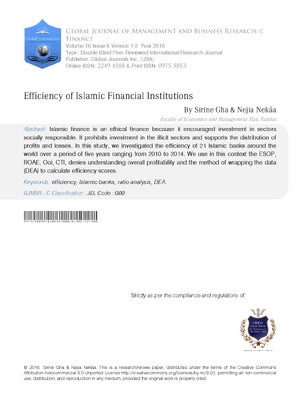
Islamic finance is an ethical finance because it encouraged investment in sectors socially responsible. It prohibits investment in the illicit sectors and supports the distribution of profits and losses. In this study, we investigated the efficiency of 21 Islamic banks around the world over a period of five years ranging from 2010 to 2014. We use in this context the ESOP, ROAE, Ooi, CTI, denies understanding overall profitability and the method of wrapping the data (DEA) to calculate efficiency scores.

References

27 Cites in Article
  1. Mariani Abdul-Majid,David Saal,Giuliana Battisti (2003). Efficiency in Islamic and conventional banking: an international comparison.
  2. Abdus Samad,M Hassan (2000). The Performance of Malaysian Islamic Bank During 1984–1997: An Exploratory Study.
  3. Jamal Al‐khasawneh,Karima Bassedat,Bora Aktan,Priya Darshini Pun Thapa (2012). Efficiency of Islamic banks: case of North African Arab countries.
  4. Mr Bader,S Mohamad,M Ariff,T Hassan (2008). Cost, Revenue, and profit efficiency of Islamic versus conventional banks: International Evidence Using Data Envelopment Analysis.
  5. R Banker,A Charnes,W Cooper (1984). Some models for estimating technical and scale inefficiencies in data envelopment analysis.
  6. T Beck,A Demirgüç-Kunt,O Merrouche (2013). Islamic vs. conventional banking: business model, efficiency and stability.
  7. B Brown (2003). Islamic Banking Comparative Analysis.
  8. Charnes,W Cooper,E Rhodes (1978). Measuring the efficiency of decision making units.
  9. Ali Emrouznejad,Barnett Parker,Gabriel Tavares (2008). Evaluation of research in efficiency and productivity: A survey and analysis of the first 30 years of scholarly literature in DEA.
  10. M Farrell (1957). The Measurement of Productive Efficiency.
  11. Z Hasan (2007). Measuring Efficiency of Islamic Banks: criteria, methods, and social priorities.
  12. Mr Hassan,A Bashir (2005). Determinants of Islamic banking profitability.
  13. Z Iqbal (1997). Islamic financial systems.
  14. J Johnes,M Izzeldin,V Pappas (2009). The efficiency of Islamic and conventional banks in the Gulf Cooperation Council (GCC) countries: an analysis using financial ratios and Data Envelopment Analysis.
  15. T Koopman (1951). Analysis of production as an efficient combination of activities.
  16. Wim Meeusen,Julien Van Den Broeck (1977). Efficiency Estimation from Cobb-Douglas Production Functions with Composed Error.
  17. Mohamad Abdul,Hamid,Azmi (2011). the performance of banking during 2000-2009: bank Islam Malaysia Berhad and conventional banking in Malaysia.
  18. G Niazi (2003). Measuring cost efficiency and productivity change of commercial banks in Pakistan 1991-2000.
  19. Nor,A Hayati,N Mohamad Akbar,S Fadzlan (2011). Measuring Islamic banks efficiency: the case of world Islamic banking sectors.
  20. Dennis Olson,Taisier Zoubi (2008). Using accounting ratios to distinguish between Islamic and conventional banks in the GCC region.
  21. Muhammad Qureshi,Madeeha Shaikh (2012). Efficiency of Islamic and Conventional Banks in Pakistan: A Non-parametric Approach.
  22. Abidi Regaieg (2015). Islamic Banks sides to the subprime crisis: study of the x-efficiency by the SFA method.
  23. A Samad (2004). Performance of Interest-Free Islamic banks vis-a-vis interest-based conventional banks of Bahrain.
  24. Souleymane Soulama (2008). technical effectiveness and inefficiency at the scale of microfinance institutions in Burkina Faso, Laboratory of Economics of Orleans.
  25. Samir Srairi,Imen Kouki (2012). Efficiency and Stock Market Performance of Islamic Banks in GCC Countries.
  26. F Sufian,M Noor (2009). The Determinants of Islamic bank's efficiency changes: Empirical Evidence from the MENA and Asian countries Islamic banking sectors.
  27. D Yudistira (2004). Efficiency in Islamic banking: an Empirical Analysis of eighteen Banks.

Funding

No external funding was declared for this work.

Conflict of Interest

The authors declare no conflict of interest.

Ethical Approval

No ethics committee approval was required for this article type.

Data Availability

Not applicable for this article.

How to Cite This Article

Nejia Nekaa. 2016. \u201cEfficiency of Islamic Financial Institutions\u201d. Global Journal of Management and Business Research - C: Finance GJMBR-C Volume 16 (GJMBR Volume 16 Issue C6).

Download Citation

Journal Specifications

Crossref Journal DOI 10.17406/GJMBR

Print ISSN 0975-5853

e-ISSN 2249-4588

Keywords
Classification
GJMBR-C Classification JEL Code: G00
Version of record

v1.2

Issue date
June 14, 2016

Language
en
Experiance in AR

Explore published articles in an immersive Augmented Reality environment. Our platform converts research papers into interactive 3D books, allowing readers to view and interact with content using AR and VR compatible devices.

Read in 3D

Your published article is automatically converted into a realistic 3D book. Flip through pages and read research papers in a more engaging and interactive format.

Article Matrices
Total Views: 3857
Total Downloads: 1882
2026 Trends
Related Research
Our website is actively being updated, and changes may occur frequently. Please clear your browser cache if needed. For feedback or error reporting, please email [email protected]

Request Access

Please fill out the form below to request access to this research paper. Your request will be reviewed by the editorial or author team.
X

Quote and Order Details

Contact Person

Invoice Address

Notes or Comments

This is the heading

Lorem ipsum dolor sit amet, consectetur adipiscing elit. Ut elit tellus, luctus nec ullamcorper mattis, pulvinar dapibus leo.


High-quality academic research articles on global topics and journals.

Efficiency of Islamic Financial Institutions

Sirine Gha
Sirine Gha
Nejia Nekaa
Nejia Nekaa <p>University of Sfax</p>

Research Journals