Eldercare in the Singapore Real Estate Market – An Emerging Perspective

α
Tee Meng Tan
Tee Meng Tan
α Swiss School of Management, Singapore

Send Message

To: Author

Eldercare in the Singapore Real Estate Market – An Emerging Perspective

Article Fingerprint

ReserarchID

V893C

Eldercare in the Singapore Real Estate Market – An Emerging Perspective Banner

AI TAKEAWAY

Connecting with the Eternal Ground
  • English
  • Afrikaans
  • Albanian
  • Amharic
  • Arabic
  • Armenian
  • Azerbaijani
  • Basque
  • Belarusian
  • Bengali
  • Bosnian
  • Bulgarian
  • Catalan
  • Cebuano
  • Chichewa
  • Chinese (Simplified)
  • Chinese (Traditional)
  • Corsican
  • Croatian
  • Czech
  • Danish
  • Dutch
  • Esperanto
  • Estonian
  • Filipino
  • Finnish
  • French
  • Frisian
  • Galician
  • Georgian
  • German
  • Greek
  • Gujarati
  • Haitian Creole
  • Hausa
  • Hawaiian
  • Hebrew
  • Hindi
  • Hmong
  • Hungarian
  • Icelandic
  • Igbo
  • Indonesian
  • Irish
  • Italian
  • Japanese
  • Javanese
  • Kannada
  • Kazakh
  • Khmer
  • Korean
  • Kurdish (Kurmanji)
  • Kyrgyz
  • Lao
  • Latin
  • Latvian
  • Lithuanian
  • Luxembourgish
  • Macedonian
  • Malagasy
  • Malay
  • Malayalam
  • Maltese
  • Maori
  • Marathi
  • Mongolian
  • Myanmar (Burmese)
  • Nepali
  • Norwegian
  • Pashto
  • Persian
  • Polish
  • Portuguese
  • Punjabi
  • Romanian
  • Russian
  • Samoan
  • Scots Gaelic
  • Serbian
  • Sesotho
  • Shona
  • Sindhi
  • Sinhala
  • Slovak
  • Slovenian
  • Somali
  • Spanish
  • Sundanese
  • Swahili
  • Swedish
  • Tajik
  • Tamil
  • Telugu
  • Thai
  • Turkish
  • Ukrainian
  • Urdu
  • Uzbek
  • Vietnamese
  • Welsh
  • Xhosa
  • Yiddish
  • Yoruba
  • Zulu

Abstract

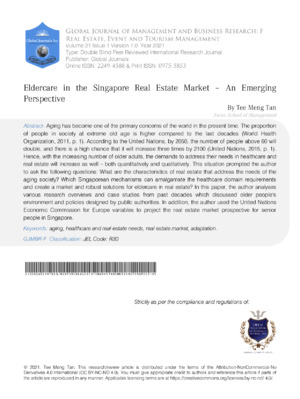
Aging has become one of the primary concerns of the world in the present time. The proportion of people in society at extreme old age is higher compared to the last decades (World Health Organization, 2011, p. 1). According to the United Nations, by 2050, the number of people above 60 will double, and there is a high chance that it will increase three times by 2100 (United Nations, 2015, p. 1). Hence, with the increasing number of older adults, the demands to address their needs in healthcare and real estate will increase as well -both quantitatively and qualitatively. This situation prompted the author to ask the following questions: What are the characteristics of real estate that address the needs of the aging society? Which Singaporean mechanisms can amalgamate the healthcare domain requirements and create a market and robust solutions for eldercare in real estate? In this paper, the author analyses various research overviews and case studies from past decades which discussed older people’s environment and policies designed by public authorities. In addition, the author used the United Nations Economic Commission for Europe variables to project the real estate market prospective for senior people in Singapore.

References

14 Cites in Article
  1. B Alomary (2020). OK, Boomer: How An Aging Population Is Going To Impact Real Estate Technology.
  2. (2020). Singapore's Long-Term Care System: Adapting to Population Aging.
  3. (2011). HETA 96-0060-2632, Cincinnati Sportsmedicine and Orthopaedic Center, Cincinnati, Ohio..
  4. R Hirschmann (2020). Aging population of Singapore -statistics & facts.
  5. Shogo Kudo,Emmanuel Mutisya,Masafumi Nagao (2015). Population Aging: An Emerging Research Agenda for Sustainable Development.
  6. C Lin (2021). Growing preference among elderly residents to 'age in place.
  7. Eunice Chan,Jacqueline Tan,David Teng,Joy Quah,Jimmy Lee,Mathew Yeo,Pek Heng (2016). Psychological resilience among emergency medical teams in Singapore.
  8. (2017). There's No Place Like Home-For Growing Old: Tips From the National Institute on Aging.
  9. (2021). Figure 1.1. The effective retirement age remains below the OECD average, especially for women.
  10. T Pettinger (2019). Review for "A time-varying impact of ageing population on the economy of Malaysia".
  11. Małgorzata Renigier-Biłozor (2017). Modern classification system of real estate markets.
  12. (2015). World Population Ageing 2015: Highlights.
  13. (2019). Why health systems must change: Addressing the needs of ageing populations in low- and middle-income countries.
  14. Elaine Worzala,Judith Karofsky,Jeffrey Davis (2020). The Senior Living Property Sector: How is it Perceived by the Institutional Investor?.

Funding

No external funding was declared for this work.

Conflict of Interest

The authors declare no conflict of interest.

Ethical Approval

No ethics committee approval was required for this article type.

Data Availability

Not applicable for this article.

How to Cite This Article

Tee Meng Tan. 2021. \u201cEldercare in the Singapore Real Estate Market – An Emerging Perspective\u201d. Global Journal of Management and Business Research - F: Real estate, Event, Tourism Management & Transporting GJMBR-F Volume 21 (GJMBR Volume 21 Issue F1): .

Download Citation

Caring for seniors in Singapore's real estate sector.
Issue Cover
GJMBR Volume 21 Issue F1
Pg. 11- 16
Journal Specifications

Crossref Journal DOI 10.17406/GJMBR

Print ISSN 0975-5853

e-ISSN 2249-4588

Keywords
Classification
GJMBR-F Classification: JEL Code: R30
Version of record

v1.2

Issue date

October 4, 2021

Language
en
Experiance in AR

Explore published articles in an immersive Augmented Reality environment. Our platform converts research papers into interactive 3D books, allowing readers to view and interact with content using AR and VR compatible devices.

Read in 3D

Your published article is automatically converted into a realistic 3D book. Flip through pages and read research papers in a more engaging and interactive format.

Article Matrices
Total Views: 1879
Total Downloads: 872
2026 Trends
Related Research

Published Article

Aging has become one of the primary concerns of the world in the present time. The proportion of people in society at extreme old age is higher compared to the last decades (World Health Organization, 2011, p. 1). According to the United Nations, by 2050, the number of people above 60 will double, and there is a high chance that it will increase three times by 2100 (United Nations, 2015, p. 1). Hence, with the increasing number of older adults, the demands to address their needs in healthcare and real estate will increase as well -both quantitatively and qualitatively. This situation prompted the author to ask the following questions: What are the characteristics of real estate that address the needs of the aging society? Which Singaporean mechanisms can amalgamate the healthcare domain requirements and create a market and robust solutions for eldercare in real estate? In this paper, the author analyses various research overviews and case studies from past decades which discussed older people’s environment and policies designed by public authorities. In addition, the author used the United Nations Economic Commission for Europe variables to project the real estate market prospective for senior people in Singapore.


Our website is actively being updated, and changes may occur frequently. Please clear your browser cache if needed. For feedback or error reporting, please email [email protected]

Request Access

Please fill out the form below to request access to this research paper. Your request will be reviewed by the editorial or author team.
X

Quote and Order Details

Contact Person

Invoice Address

Notes or Comments

This is the heading

Lorem ipsum dolor sit amet, consectetur adipiscing elit. Ut elit tellus, luctus nec ullamcorper mattis, pulvinar dapibus leo.

High-quality academic research articles on global topics and journals.

Eldercare in the Singapore Real Estate Market – An Emerging Perspective

Tee Meng Tan
Tee Meng Tan Swiss School of Management, Singapore

Research Journals