Electric Power Availability and Productivity of Industrial Enterprises in Cameroon

Djoha Seukou Yvette
Djoha Seukou Yvette
Nourou Mohammadou
Nourou Mohammadou
Etogo Nyaga Yves
Etogo Nyaga Yves
University of Ngaoundéré

Send Message

To: Author

Electric Power Availability and Productivity of Industrial Enterprises in Cameroon

Article Fingerprint

ReserarchID

AA8FL

Electric Power Availability and Productivity of Industrial Enterprises in Cameroon Banner

AI TAKEAWAY

Connecting with the Eternal Ground
  • English
  • Afrikaans
  • Albanian
  • Amharic
  • Arabic
  • Armenian
  • Azerbaijani
  • Basque
  • Belarusian
  • Bengali
  • Bosnian
  • Bulgarian
  • Catalan
  • Cebuano
  • Chichewa
  • Chinese (Simplified)
  • Chinese (Traditional)
  • Corsican
  • Croatian
  • Czech
  • Danish
  • Dutch
  • Esperanto
  • Estonian
  • Filipino
  • Finnish
  • French
  • Frisian
  • Galician
  • Georgian
  • German
  • Greek
  • Gujarati
  • Haitian Creole
  • Hausa
  • Hawaiian
  • Hebrew
  • Hindi
  • Hmong
  • Hungarian
  • Icelandic
  • Igbo
  • Indonesian
  • Irish
  • Italian
  • Japanese
  • Javanese
  • Kannada
  • Kazakh
  • Khmer
  • Korean
  • Kurdish (Kurmanji)
  • Kyrgyz
  • Lao
  • Latin
  • Latvian
  • Lithuanian
  • Luxembourgish
  • Macedonian
  • Malagasy
  • Malay
  • Malayalam
  • Maltese
  • Maori
  • Marathi
  • Mongolian
  • Myanmar (Burmese)
  • Nepali
  • Norwegian
  • Pashto
  • Persian
  • Polish
  • Portuguese
  • Punjabi
  • Romanian
  • Russian
  • Samoan
  • Scots Gaelic
  • Serbian
  • Sesotho
  • Shona
  • Sindhi
  • Sinhala
  • Slovak
  • Slovenian
  • Somali
  • Spanish
  • Sundanese
  • Swahili
  • Swedish
  • Tajik
  • Tamil
  • Telugu
  • Thai
  • Turkish
  • Ukrainian
  • Urdu
  • Uzbek
  • Vietnamese
  • Welsh
  • Xhosa
  • Yiddish
  • Yoruba
  • Zulu
Font Type
Font Size
Font Size
Bedground

Abstract

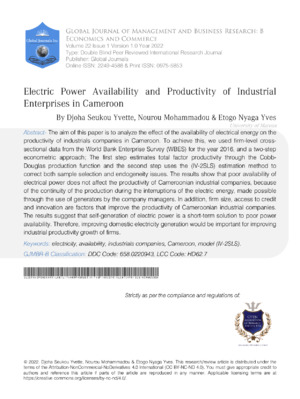
The aim of this paper is to analyze the effect of the availability of electrical energy on the productivity of industrials companies in Cameroon. To achieve this, we used firm-level crosssectional data from the World Bank Enterprise Survey (WBES) for the year 2016, and a two-step econometric approach; The first step estimates total factor productivity through the Cobb-Douglas production function and the second step uses the (IV-2SLS) estimation method to correct both sample selection and endogeneity issues. The results show that poor availability of electrical power does not affect the productivity of Cameroonian industrial companies, because of the continuity of the production during the interruptions of the electric energy, made possible through the use of generators by the company managers. In addition, firm size, access to credit and innovation are factors that improve the productivity of Cameroonian industrial companies. The results suggest that self-generation of electric power is a short-term solution to poor power availability. Therefore, improving domestic electricity generation would be important for improving industrial productivity growth of firms.

References

43 Cites in Article
  1. L Abdisa (2020). Role of investment in selfgeneration in mitigating outage loss: evidence from Sub-Saharan African firms.
  2. A Abeberesse (2020). The Effect of Electricity Shortages on Firm Investment: Evidence from Ghana.
  3. A Akarca,T Long (1980). On the relationship between energy and GNP: a reexamination.
  4. Ismaila Amadu,Fambon Samuel (2020). Power supply and manufacturing growth: Evidence from Cameroon.
  5. Elizabeth Asiedu,Théophile Azomahou,Neepa Gaekwad,Mahamady Ouédraogo (2021). The determinants of electricity constraints by firms in developing countries.
  6. (2017). The Impact of Electricity Shortages on Firm Productivity.
  7. Banque Mondiale (2019). the Dark-how Much do Power Sector Distortions Cost South Asia.
  8. M Beckmann (1974). A note on the optimal rates of resource exhaustion.
  9. M Beenstock,E Goldin,Y Haitovsky (1997). The cost of power outages in the business and public sectors in Israel: Revealed preference vs Subjective valuation.
  10. M Belloumi (2009). Energy consumption and GDP in Tunisia: Cointegration and causality analysis.
  11. J Biesebroeck (2003). Revising some productivity Debates.
  12. L Bui,P Et Nguyen (2021). The Impact of Electricity Infrastructure Quality on Firm Productivity: Empirical Evidence from Southeast Asian Countries.
  13. Douglas Caves,Joseph Herriges,Robert Windle (1992). The Cost of Electric Power Interruptions in the Industrial Sector: Estimates Derived from Interruptible Service Programs.
  14. T Christophe (2016). Cameroon's Program on Energy Statistics. A Presentation Made at the Seminar on Mainstreaming Energy Sustainable Development Goals (SDGs), Targets and Indicators into Statistical Programs.
  15. L Cissokho,A Et Seck (2013). Electric power outages and the productivity of small and medium enterprises in Senegal.
  16. L Cissoko (2020). The productivity cost of power outages for manufacturing small and medium enterprises in Senegal.
  17. Ronald Coase (1960). The Problem of Social Cost.
  18. Bruce Ackermann (1975). Economic Foundations of Property Law.
  19. K Fisher-Vanden,E Mansur,Q Wang (2015). Electricity shortages and firm productivity: evidence from China's industrial firms.
  20. Richard Harris,Mary Trainor (2005). Capital Subsidies and their Impact on Total Factor Productivity: Firm-Level Evidence from Northern Ireland*.
  21. H Jiang,T Zhao,C Li,J Ma (2011). Hierarchical self-assembly of ultrathin nickel hydroxide nanoflakes for high-performance supercapacitors.
  22. T Justice (2016). Bring Back Our Light: Power Outages and Industrial Performance in Sub-Saharan Africa.
  23. J Kraft,A Kraft (1978). On the relationship between energy and GNP.
  24. M Kremer (1993). The O-Ring Theory of Economic Development.
  25. J Mawejje,D Et Mawejje (2016). Electricity consumption and sectoral output in Uganda: an empirical investigation.
  26. J Mensah (2016). Bring back our light: Power outages and industrial performance in sub-saharan africa.
  27. Minee (2018). Délégations Régionales. Ministère de l′Energie et de l′Eau (MINEE).
  28. Risako Morimoto,Chris Hope (2004). The impact of electricity supply on economic growth in Sri Lanka.
  29. Busani Moyo (2012). Do Power Cuts Affect Productivity? A Case Study Of Nigerian Manufacturing Firms.
  30. B Moyo (2013). Power infrastructure quality and manufacturing productivity in Africa: A firm-level analysis.
  31. W Newey,D Mcfadden (1999). Large sample estimation and Hypothesis testing in.
  32. O Njikam,N Binam,S Tachi (2006). Understanding Total factor Productivity growth in SSA.
  33. P Ongono (2009). Energy consumption and economic performance in Cameroon.
  34. Musiliu Oseni,Michael Pollitt (2015). A firm-level analysis of outage loss differentials and self-generation: Evidence from African business enterprises.
  35. F Perroux (1950). Economic space: theory and applications.
  36. J Rifkin (2012). The third industrial revolution: how lateral power is transforming energy, the economy, and the world.
  37. Muhammad Shahbaz,Syed Shahzad,Mantu Mahalik,Perry Sadorsky (2018). How strong is the causal relationship between globalization and energy consumption in developed economies? A country-specific time-series and panel analysis.
  38. R Sieferle (2001). The Subterranean Forest: Energy Systems and the Industrial Revolution.
  39. R Solow (1974). The economics of resources or the resources of economics.
  40. T Tamo,A Kemajou,B Diboma (2010). Electricity self-generation costs for industrial companies in Cameroon.
  41. K Ukoima,O Ekwe (2019). Review of the impact of electricity supply on economic growth: a Nigerian case study.
  42. (2009). Energy Infrastructure and Industrial Development.
  43. H Wang,Schmidt (2002). One step and two step estimations of the effects of exogenous variables on technical efficiency levels.

Funding

No external funding was declared for this work.

Conflict of Interest

The authors declare no conflict of interest.

Ethical Approval

No ethics committee approval was required for this article type.

Data Availability

Not applicable for this article.

How to Cite This Article

Djoha Seukou Yvette. 2026. \u201cElectric Power Availability and Productivity of Industrial Enterprises in Cameroon\u201d. Global Journal of Management and Business Research - B: Economic & Commerce GJMBR-B Volume 22 (GJMBR Volume 22 Issue B1).

Download Citation

Electric power use in cameroon, industrial productivity, energy efficiency, Cameroon industries.
Journal Specifications

Crossref Journal DOI 10.17406/GJMBR

Print ISSN 0975-5853

e-ISSN 2249-4588

Keywords
Classification
GJMBR-B Classification D24
O12
L60
Version of record

v1.2

Issue date
April 9, 2022

Language
en
Experiance in AR

Explore published articles in an immersive Augmented Reality environment. Our platform converts research papers into interactive 3D books, allowing readers to view and interact with content using AR and VR compatible devices.

Read in 3D

Your published article is automatically converted into a realistic 3D book. Flip through pages and read research papers in a more engaging and interactive format.

Article Matrices
Total Views: 1718
Total Downloads: 26
2026 Trends
Related Research
Our website is actively being updated, and changes may occur frequently. Please clear your browser cache if needed. For feedback or error reporting, please email [email protected]

Request Access

Please fill out the form below to request access to this research paper. Your request will be reviewed by the editorial or author team.
X

Quote and Order Details

Contact Person

Invoice Address

Notes or Comments

This is the heading

Lorem ipsum dolor sit amet, consectetur adipiscing elit. Ut elit tellus, luctus nec ullamcorper mattis, pulvinar dapibus leo.

High-quality academic research articles on global topics and journals.

Electric Power Availability and Productivity of Industrial Enterprises in Cameroon

Djoha Seukou Yvette
Djoha Seukou Yvette <p>University of Ngaoundéré</p>
Nourou Mohammadou
Nourou Mohammadou
Etogo Nyaga Yves
Etogo Nyaga Yves

Research Journals