




I. INTRODUCTION
Most organic compounds containing nitrogen (N-heterocyclic), sulfur, long carbon chain or aromatic and oxygen atoms. Among them, organic compounds have many advantages such as: high molecular size, highly soluble in water, availability, cheap, low toxicity, easy for using and easy production[1]. Natural heterocyclic mixes have been utilized for the corrosion inhibitor on the C-steel [2], copper [3], aluminum [4], and various metals in various aqueous medium [5]. Adsorption of the drug molecules on the metal surface facilitates its inhibition[6]. The investigation of the relations between the adsorption and consumption hindrance is of awesome important. Heterocyclic mixes have demonstrated more hindrance effectiveness for C-steel in both HCI [7] and arrangements[8]. Numerous authors for the most part concur that medications are inhibitors that can compete favorably with green inhibition of corrosion and that most medications can be synthesized from natural products. Selection of some medication as corrosion inhibitors due to the followings: (1) drug molecules contain oxygen, sulphur and nitrogen as active sites, (2) it is environmentally friendly furthermore vital in organic responses and (3) drugs can be easily produced and purified (4) nontoxic compering organic inhibitors. A few medications have been discovered to be great corrosion inhibitors for metals such as: Biopolymer gave 86% IE for Cu in NaCl[9], pyromellitic diimide linked to oxadiazole cycle gave 84.6% IE for MS in HCl[10], 2-mercaptobenzimidazole gave 82% IE for MS in HClAntidiabetic Drug Janumet gave 88.7% IE for MS in HCl [11]. Januvia gave 79.5% IE for Zn in HCl [12], Cefuroxime Axetil gave 89.9% IE for Al in HCl [13], Phenytoin sodium gave 79% for MS in HCl [14], Aspirin gave 71% IE for MS in H2SO4[15], Septazole gave 84.8% IE for Cu in HCl [16] and Chloroquine diphosphate gave 80% IE for MS in HCl [17]. Study on Structural, Corrosion, and Sensitization Behavior of Ultrafine and Coarse Grain 316 Stainless Steel Processed by Multiaxial Forging and Heat Treatment [18]. Investigating the corrosion of the Heat-Affected Zones (HAZs) of API-X70 pipeline steels in aerated carbonate solution by electrochemical methods[19]. Predictions of corrosion current density and potential by using chemical composition and corrosion cell characteristics in microalloyed pipeline steels [20]. Predictions of toughness and hardness by using chemical composition and tensile properties in microalloyed line pipe steels[21].
The scope of this article is to use Simvastatin drug as save corrosion inhibitor for LCH in acid medium by electrochemical method, and to elucidate the mechanism of corrosion inhibition.
II. EXPERIMENTAL
a) Metal samples
Two samples of carbon steel was used in the study that have the chemical composition of the metal samples was determined using emission spectrometer, with the aid of ARL quant meter (model 3100-292 IC) and listed in the Table 1.
| Sample | C% | Mn% | V% | Fe% | Si% |
| Low; C | 0.26 | 0.77 | 0.11 | 98.51 | 0.35 |
b) Quenching in oil
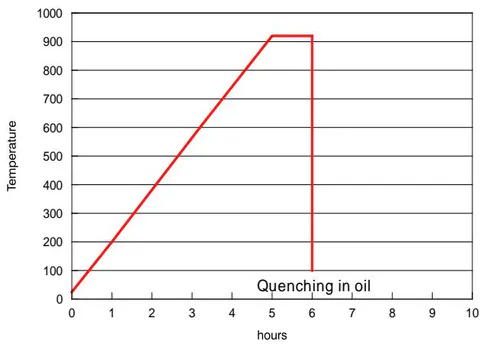
The used heat treatment regime was Quenching in oil. As-received sample was putting in an electric muffle furnace where the raising temperature is (Austentizing temperature) through five hours. Then, the sample remains in furnace for one hour at , (Holding time), followed quenching of sample in oil.
The phase, which formed due to these heat treatment sample is converted from ferretic phase to martensite phase[22].
The steps of this regime are shown diagrammatically in Figure 1.
c) Preparation of metal sample (working electrode)
The working electrode having the surface area, which, exposed to corrosion media is cross-section area and the rod was weld from one side to a copper wire used for electric connection. The sample was embedded in glass of just larger diameter than the sample. Epoxy resin was used to stick the sample to glass tube. These also insured that constant cross-sectional area would be exposed to corrosive media through the experiments. The sample was scraped with SiC polisher sheet coarseness sizes (400, 800 and 1200) and clean with . At that point, clean a few times with bi-distilled water, lastly dried by soft tissue. Finally polishing of sample surface to be mirror bright, just before immersion in the electrolyte cell.
d) Simvastatin drug as an inhibitor
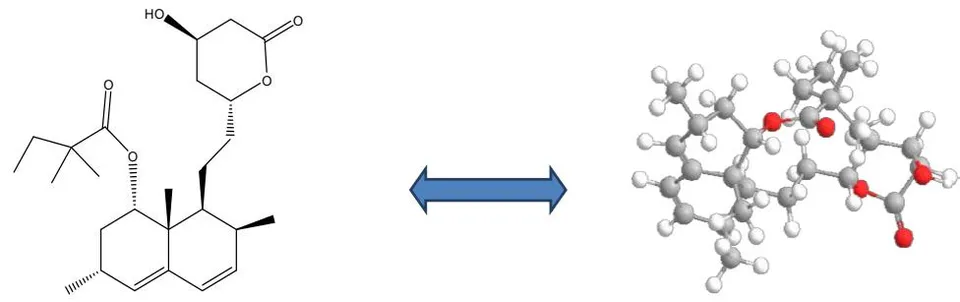
The Simvastatin inhibitor have molecular mass (418.566 g/mol) which containing 5 oxygen atoms and bonding that acts as active centers. The unshared electrons of oxygen atoms and the electron density of -bonding acts donor site to the anodic sites of the metal surface.
e) Solutions
A stock solution of Simvastatin was prepared by dissolving 0.0419gmSimvastatin in one liter in 10% ethanol-water] to obtain M Simvastatin solution. This stock solution then diluted by in 10% ethanol-water] to prepare desired other solution. These solutions were used as corrosion medium.
This mixed solution used corrosive media and add the different of concentrations of Simvastatin (2, 4, 6, 8 and ) to the corrosive media at different temperatures (15, 25, 35, 45 and ).
f) Potentiodynamic polarization measurement[23]
Cathodic and anodic polarization technique was used for determination of corrosion rate. The electrochemical cell consists of three electrodes:
Platinum electrode (as a auxiliary electrode).
Calomel electrode (as the reference electrode).
The working electrode is a LCH sample. The electrolytic cell was filled with 100 ml of the solution. The samples were immersed in the medium, then the circuit is shorted and the cathodic polarization is firstly measured by reversing the current direction; the anodic polarization is measured.
g) Calculation of rate of corrosion
The anodic and cathodic polarization is measured by using over-potential cell. The corrosion current density ( ), the corrosion potential ( ) and the corrosion rates (R) are calculated according to Tafel extrapolation method[24].
It is clear that extrapolating the line representing the Tafel region in either cathodic or anodic polarization curve to the corrosion potential will give corrosion current density ( ), which can be used to calculate the corrosion rate from the equation [25-26].
Where, Corrosion rate (mpy) = mils per year, l = the corrosion current density, d = Specimen density, and Eq.wt = Specimen equivalent weight.
The corrosion current density ( ), corrosion potential ( ) and corrosion rate are recorded in Table 7.
h) Applied Evans technique
The rate of corrosion can be understood from a graphical superposition of current-potential curves. The Evans diagrams give good and suitable interpretation about the electrode-electrolyte interface reactions. We can use the following definitions for the items of Evans diagram as follows[27]:
1- and are anodic and cathodic potentials at equilibrium at the electrode-electrolyte interface (at I = the exchange current ) respectively, where ; m= metal, so= solution,
2- the relative corrosion potential determined from the position of the intersection of the two curves (de-electronation and electronation processes) where, I considered as .
3- The anodic- potential difference at equilibrium (a.p.d,e)
4- The cathodic- potential difference at equilibrium (c.p.d,e) .
5- The anodic-potential difference (a.p.d) - ; b = bulk, x = with additive, at different concentrations or at different temperatures, and .
6- The cathodic-potential difference (c.p.d) ; .
These data can be used for kinetic calculations and to know which additive is favorable or which is faster to the electrode surface at the same conditions. It can be used for studying the inhibition mechanism and aids in the classification the additives.
i) Surface Examinations[28]
The morphology of the LCH surface used for analysis and examination nature of the surface and study the changing that appeared on the metal surface. The specimens were prepared by abraded mechanically by using different emery papers up to 1200 grit size and immersed in (10A5H) (blank) then with Mof Simvastatin at room temperature for one day (24 h). Then, after this immersion time, the specimens were washed gently with distilled water, carefully dried and take carefully to the system of surface examinations such as using scanning electron microscope (SEM), energy dispersive x-ray (EDX) and atomic force microscope (AFM).
III. RESULT AND DISCUSSION
a) Potentiodynamic polarization technique
Study the polarization of the different medium and with added the various concentration of Simvastatin as a corrosion inhibitor.
i. Dissolution of LCH sample in at different temperatures
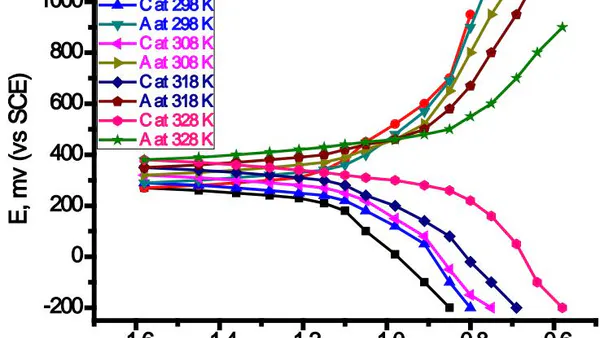
Results of the anodic and cathodic polarization processes for the LCH sample in 0.5N at different temperatures in absence of Simvastatin are shown in Figure 2 and Table 2. It obvious that the corrosion current density ( ) is increased as the temperature increased and the corrosion potential ( ) is slightly shafted to more positive value. The polarization processes are started with potential between of about 547 and 553 mV.
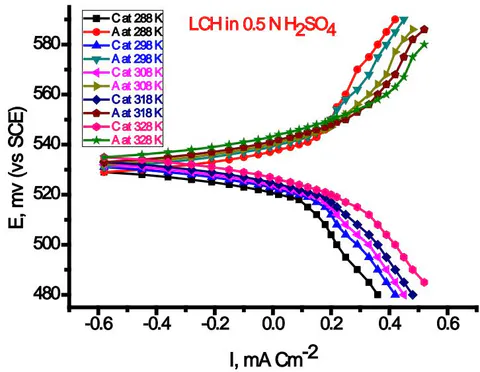
The positive potential is increased by anodic polarization, i.e. increase the dissolved component while that the potential decreased by cathodic polarization, i.e., increase the undissolved components. The dissolved component is formed as[29]:
Where, Di-hypo-ferrite, green.
In the same time occurs as:
Where, the undissolved hydrated and the (FeO) can be considered. So that at anodic polarization in presence of , the iron is dissolved and formed ferrous sulphate as:
And the cathodic processes in presence of , occurred as:
i. hydrogen evolution
The hydrogen ions adsorbed on the metal surface where an electrochemical reaction takes place in presence of as;
Where three steps can be done as;
a) 2M-H → 2M + H ↑
ii. Dissolution of LCH samples in 10% ethanol at various temperatures[30]
Results of the anodic and cathodic polarization processes for LCH in 10% ethanol at different temperatures in absence of Simvastatin is shown in Figure 3 and Table 2. It obvious that the corrosion current density ( ) is increased as the temperature increased and the corrosion potential ( ) is shafted to value that is more positive. The polarization processes are started with potential between of about 278 and 388 mV.
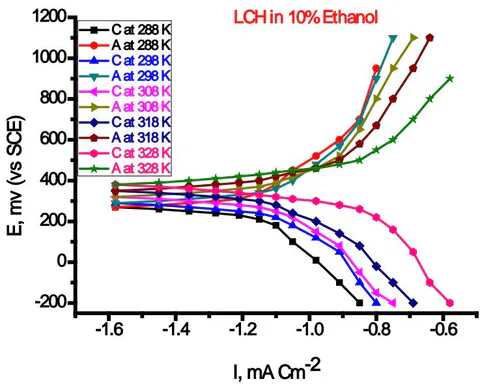
The positive potential is increased by anodic polarization, i.e. increase the dissolved component while that the potential decreased by cathodic polarization, i.e., increase the undissolved components. According to the following equation:
In total process:
In the bulk the ferrous hydroxide dissolved as:
| Concentration | Temp. | (mV) | (mA/ ) | Rate (mpy) |
| 10% Ethanol | 288K | 278 | 0.08 | 0.034 |
| 298K | 298 | 0.09 | 0.038 | |
| 308K | 328 | 0.11 | 0.047 | |
| 318K | 358 | 0.12 | 0.051 | |
| 328K | 388 | 0.15 | 0.064 | |
| 288K | 547 | 5.46 | 2.33 | |
| 298K | 549 | 5.53 | 2.36 | |
| 308K | 550 | 5.65 | 2.41 | |
| 318K | 551 | 5.75 | 2.45 | |
| 328K | 553 | 5.90 | 2.51 |
iii. Dissolution of LCH in mixed 0.5N and 10%Ethanol (10A5H)
Results of the anodic and cathodic polarization processes for (LCH) in mixed solution at different temperatures in absence of Simvastatin is shown in Figure 4 and Table 7. It obvious that the corrosion current density ( ) is increased as the temperature increased and the corrosion potential ( ) is shafted to the value that is more positive. The polarization processes are started with potential between of about 538 and 543 mV.
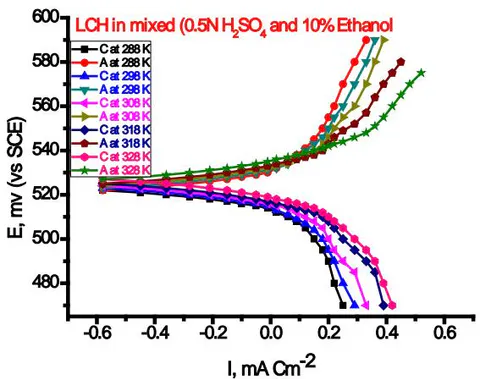
The positive potential is increased by anodic polarization, i.e. increase the dissolved component while that the potential decreased by cathodic polarization, i.e, increase the undissolved components. The results at 288K from Figure 5 and the comparison of in those three media are listed in Table 3.
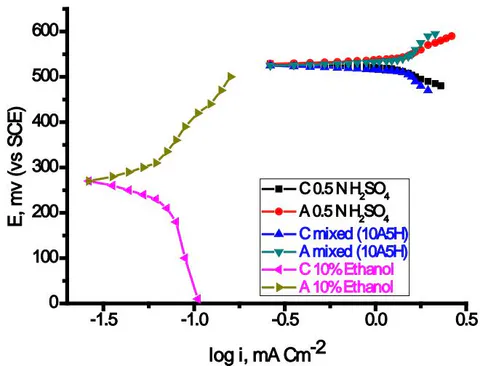
| Corrosive medium | Current density (Icorr) |
| LCH | |
| 10% Ethanol | 0.08 |
| 0.5 N H2SO4 | 5.46 |
| Mixed | 4.50 |
1- The corrosion rate in 0.5N is very high where the major product is the dissolved component while the formation of undissolved component FeO is very low and slightly detected, where is rise too (5.46)
2- In the second passivity region (in presence of 10% ethanol), the undissolved component is considered where the is dropped to (0.08).
3- In the presence of mixed medium, the corrosion rate still very high where is listed (4.50) and the undissolved component can be slightly considered.
iv. Effect of 10% ethanol on the corrosion of steel in at different temperature
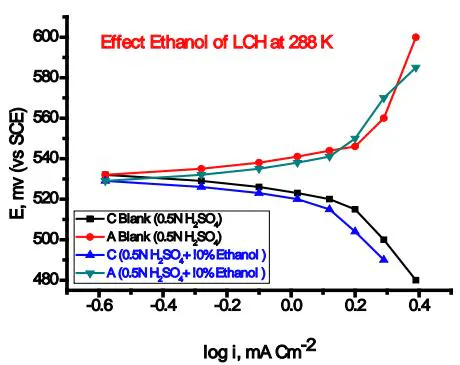
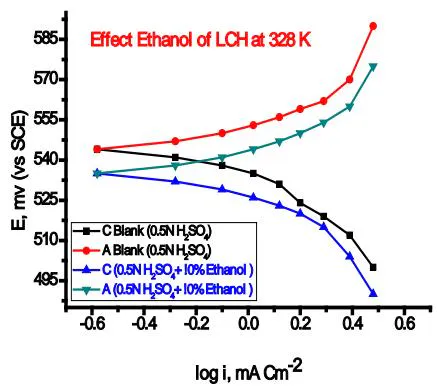
Result of the anodic and cathodic polarization of LCH in 0.5N with 10% ethanol at different temperatures (288, 298, 308, 318 and 328K) are shown in Figure 4.
a. Ptentiodynamic polarization technique
In general, as the added 10% ethanol is shifted the potentials to less positive values comparing with only and both anodic potential and cathodic potential are shifted to less positive values. The anodic current ( ) slightly decreased (shifted to less values) while the cathodic ( ) decreased and shifted to less values too, Figures 6 at different temperatures. Values of corrosion potential ( ), corrosion current density ( ) and rate of corrosion in (mpy), are given in Table 7.
b. Applied Evans technique
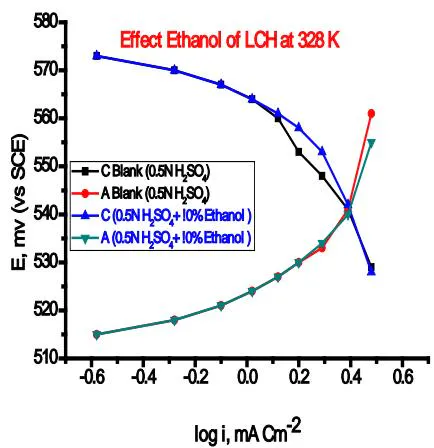
Applying the principle of Evans diagrams in presence of 10%ethanol with , was drawn in Figures7 and the Evans diagram parameters was recorded in the Table4, it is clear that[31]:
The relative corrosion potential ( ) shifted slightly to more positive values. The relative corrosion current ( ) increases with temperatures increasing.
The potential difference is slightly increased with temperature increased and the potential difference is increased to high values too. The transference coefficient of cathode is slightly increased with temperature increasing but is slightly decreased with temperatures.
The anodic-potential difference is not clear affect by temperature increased and the cathodic-potential difference is slightly increased by temperature increased. The difference in anodic corrosion current is increased with temperature increased and the difference in cathodic corrosion current is slightly increased by temperature increased. The values of ratio are decreased by temperature increased and the values of ratio are decreased by temperature increased.
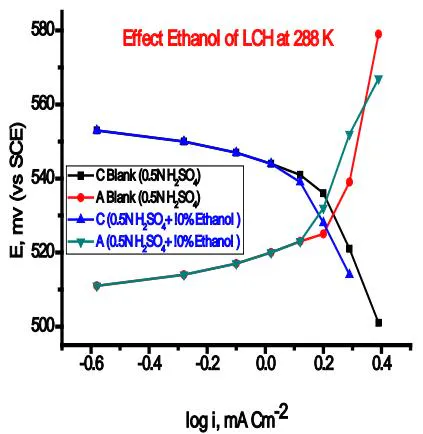
From the results illustrated in Evans diagrams for the electrode- electrolyte interface in (LCH) it is clear that:
The presence of 10% ethanol under polarization technique shifted the de-electronation potential toward more positive values (positive direction), this means that the polarization oriented and collective the ethanol molecules to the electron sink site on the electrode surface and slow down the metal dissolution. Moreover the presence of 10% ethanol under polarization technique shifted the electronation potential of acceptor spices to less positive values (negative directions), this means that the collective ethanol molecules are not only adsorbed on the electron sink area, but also the collective ethanol molecules covered the electron source area too. It is clear that, it slowing down (more and more) both the metal dissolution and the hydrogen evolution.
| α,c | 0.33 | 0.35 | 0.27 | 0.28 | 0.32 |
| α,a | 0.68 | 0.65 | 0.73 | 0.72 | 0.68 |
| Δφc'/ | 51.28 | 66.04 | 52.63 | 28.3 | 27.92 |
| Δlc | 0.12 | 0.11 | 0.04 | 0.21 | 0.39 |
| (Δlc)x | 1.39 | 1.48 | 1.62 | 1.74 | 1.95 |
| Δφ'c | 6 | 7 | 2 | 6 | 11 |
| (Δφ'c)x | 519 | 520 | 526 | 526 | 526 |
| Δφ'a/ | 30.1 | 29.96 | 36.44 | 20.64 | 8.772 |
| Δla* | 0.3 | 0.3 | 0.2 | 0.4 | 0.7 |
| (Δla)x | 1.21 | 1.32 | 1.41 | 1.51 | 1.66 |
| Δφ'a | 9 | 8 | 9 | 9 | 6 |
| (Δφ'a)x | 534 | 535 | 537 | 541 | 543 |
| (Δφ)b | 525 | 527 | 528 | 532 | 537 |
| (i)b | 1.507 | 1.585 | 1.66 | 1.95 | 2.344 |
| Δφ's | 13 | 16 | 14 | 15 | 19 |
| Δφ'm | 27 | 30 | 38 | 39 | 41 |
| Δφe,so | 545 | 549 | 553 | 555 | 560 |
| Δφe,m | 505 | 503 | 501 | 501 | 500 |
| Icorr | 1.19 | 1.3 | 1.41 | 1.52 | 1.59 |
| Δφcorr | 532 | 533 | 539 | 540 | 541 |
| Temp. | 288 | 298 | 308 | 318 | 328 |
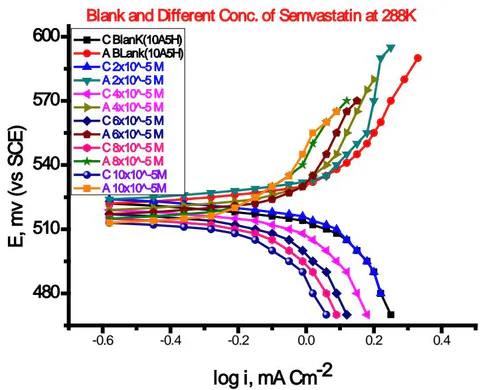
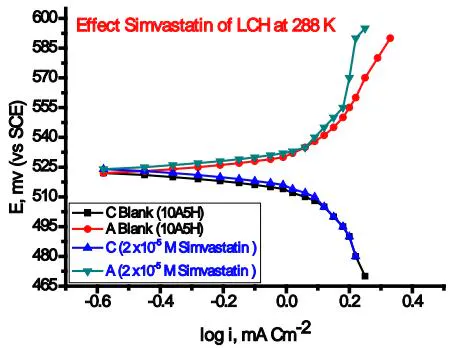
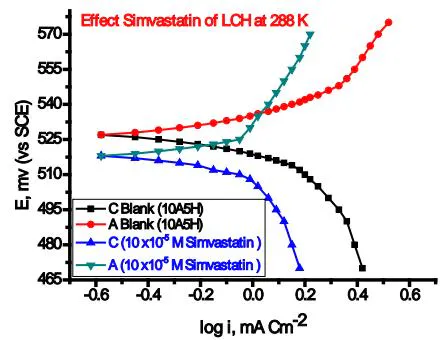
It is obvious that the presence of different concentrations are shifted the potentials to less positive values and both anodic potential and cathodic potential are shifted to less positive values. The anodic current ( ) slightly decreased (shifted to less values) while the cathodic ( ) decreased and shifted to less values too shown in Figure 9.
Values of corrosion potential ( ), corrosion current density ( ) and rate of corrosion in (mpy), are given in Table 7.
b. Applying Evans technique
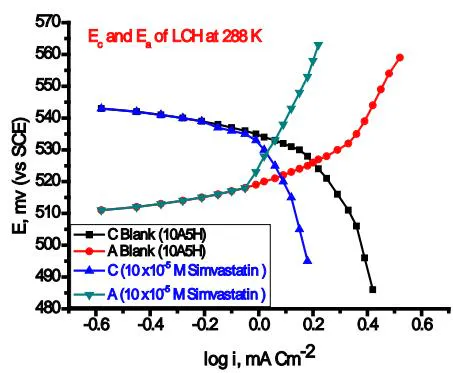
Applying the principle of Evans diagrams in presence of different concentrations from Simvastatin, which are viewed in Figures 10, and the Evans diagram parameters are listed in Table 5, it is clear that:
The relative corrosion potential ( ) shifted slightly to less positive values. The relative corrosion current ( ) decreases with temperatures increasing.
The potential difference is decreased with temperature increased and the potential is increased to high values by increasing temperatures. The transference coefficient of cathode is increased with temperature increasing but the transference coefficient of anode is decreased with temperatures increased.
The anodic-potential differenceis increased by temperature increase, and the cathodic-potential differenceis increased by temperature increase. The difference in anodic corrosion currentis increased with temperature increase, and the difference in cathodic corrosion currentis increased by temperature increase. The values of ratioare decreased by temperature increase, and the values of ratioare decreased by temperature increase.
From the results illustrated in Evans diagrams for the electrode- electrolyte interface in both (LCH), it is clear that:
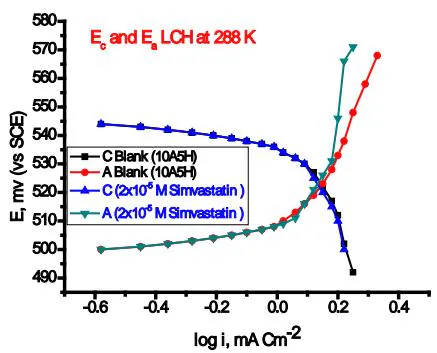
In presence concentrations of Simvastatin under polarization technique, at low Simvastatin concentrations the de-electronation potential shifted toward more positive values (positive direction) this means that the polarization affected the donor functional groups of Simvastatin molecules and oriented them to the electron sink area on the electrode surface and slow done the dissolution of metal. The moderate size of Simvastatin molecules allow to cover some what area of electron source, so that the electronation potential of acceptor spices to less positive value. It is observed that the shifted of de-electronation potential is larger than the shift of electronation potential. As the Simvastatin concentration increased the shift of electronation potential i.e., the Simvastatin molecules covered more electron source area on the corroded metal surface with increasing Simvastatin concentration and the electronation potential shift is being larger than the de-electronation potential shift, which indicates slightly formation of multilayer that adsorbed on the electrode surface. It is clear that the polarization process affects the orientation and adsorption of the inhibitor molecules, so that both the metal dissolution and the hydrogen evolution is slowing down more.
| 0.44 | 0.46 | 0.48 | 0.5 | 0.52 | |
| 0.56 | 0.54 | 0.52 | 0.5 | 0.48 | |
| 57.14 | 37.31 | 37.5 | 38.73 | 38.35 | |
| 0.03 | 0.13 | 0.24 | 0.28 | 0.34 | |
| 1.48 | 1.38 | 1.27 | 1.23 | 1.18 | |
| 2 | 5 | 9 | 11 | 13 | |
| 521 | 518 | 514 | 512 | 510 | |
| 49.5 | 42.42 | 39.22 | 30.61 | 31.1 | |
| 0.1 | 0.2 | 0.3 | 0.4 | 0.4 | |
| 1.41 | 1.35 | 1.26 | 1.12 | 1.1 | |
| 5 | 7 | 10 | 12 | 13 | |
| 528 | 530 | 533 | 535 | 536 | |
| 523 | 523 | 523 | 523 | 523 | |
| (i)b | 1.514 | 1.514 | 1.514 | 1.514 | 1.514 |
| 21 | 22 | 23 | 24 | 25 | |
| 27 | 26 | 25 | 24 | 23 | |
| 547 | 547 | 547 | 547 | 547 | |
| 499 | 499 | 499 | 499 | 499 | |
| lcorr | 1.38 | 1.29 | 1.18 | 1.05 | 1 |
| 526 | 525 | 524 | 523 | 522 | |
| Temp. | 288 | 298 | 308 | 318 | 328 |
vi. Effect of temperature on corrosion behavior
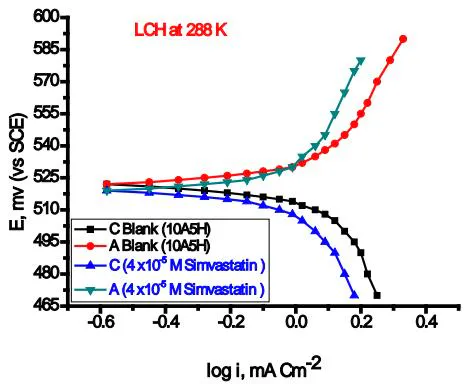
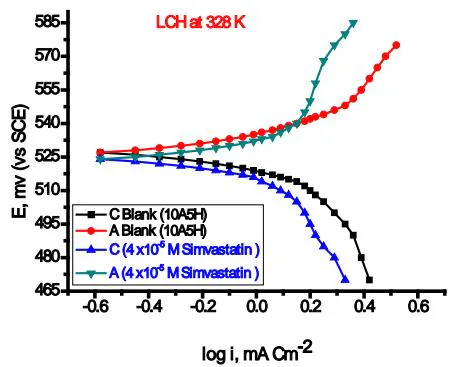
Results of the anodic and cathodic polarization processes for the LCH sample in corrosive medium. The , and the rate of corrosion were increased with temperatures increased at the same concentration ( ) of Simvastatin, which are listed in Table 7 and Figure 11.
a. Potentiodynamic
This behavior indicating to the corrosion rate of LCH stimulates with increasing of temperature and increasing of temperatures will be enhance the rate of diffusion of hydrogen ( ) ion to the metal surface beside the ionic mobility, thus increasing the conductivity of the electrolyte. Also, at lower temperatures, absorbed hydrogen atoms which are blocked on the cathodic areas, otherwise the increasing temperatures of the solution, hydrogen will be disrobed, from the cathodic area, i.e the corrosion rate increased.
a. Apply Evans technique
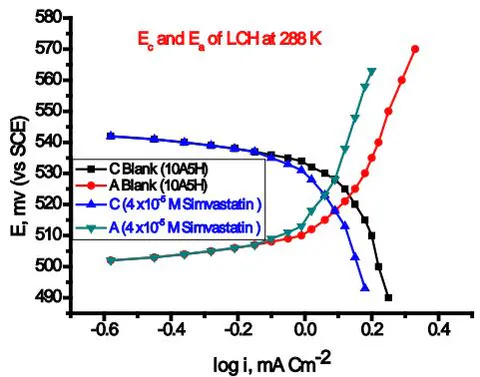
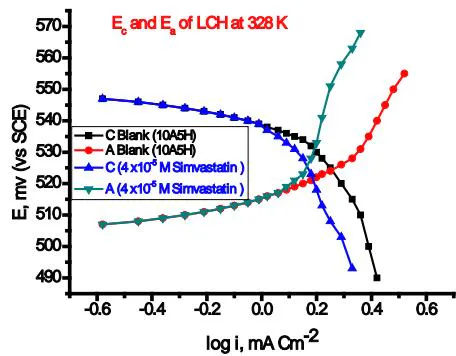
Applying the principle of Evans diagrams in presence of from Simvastatin, which are viewed in Figures 12 and the Evans diagram parameters are listed in Table 6, it is clear that: The relative corrosion potential ( ) shifted slightly to less positive values. The relative corrosion current ( ) increases with temperatures increasing.
The potential difference is slightly decreased with temperature increased and the potential is increased to high values by increasing temperatures. The transference coefficient of cathode is increased with temperature increasing but the transference coefficient of anode is decreased with temperatures increased.
From the results illustrated in Evans diagrams for the electrode- electrolyte interface it is clear that:
The effect of temperature on the behavior of Simvastatin as inhibitor of LCH corrosion, at M Simvastatin. It obvious that both electronation and deelectronation potentials are shifted to negative and positive direction respectively by increasing the temperature. This behavior clarify that the heat treatment (quenching) divided the electron sink and electron source area to small parts, so that the size of Simvastatin sufficient to cover more electron source area be side electron sink.
| 0.36 | 0.46 | 0.5 | 0.45 | 0.52 | |
| 0.64 | 0.54 | 0.5 | 0.55 | 0.48 | |
| 80 | 52.24 | 44.2 | 21.34 | 14.93 | |
| 0.13 | 0.13 | 0.18 | 0.33 | 0.4 | |
| 1.29 | 1.38 | 1.48 | 1.62 | 1.89 | |
| 10 | 7 | 8 | 7 | 6 | |
| 518 | 517 | 516 | 517 | 515 | |
| 12.99 | 42.42 | 40.49 | 35.62 | 27.12 | |
| 0.2 | 0.2 | 0.2 | 0.4 | 0.6 | |
| 1.26 | 1.35 | 1.41 | 1.59 | 1.74 | |
| 2 | 7 | 10 | 13 | 15 | |
| 530 | 531 | 534 | 537 | 536 | |
| 528 | 524 | 524 | 524 | 521 | |
| (i)b | 1.413 | 1.514 | 1.66 | 1.95 | 2.291 |
| 16 | 22 | 26 | 25 | 31 | |
| 28 | 26 | 26 | 31 | 29 | |
| 544 | 547 | 550 | 553 | 557 | |
| 500 | 499 | 498 | 497 | 497 | |
| lcorr | 1.19 | 1.29 | 1.35 | 1.48 | 1.62 |
| 528 | 525 | 524 | 528 | 526 | |
| 288 | 298 | 308 | 318 | 328 |
Table 7: The effect of (Simvastatin) additions on the
, and rate of corrosion for (LCH) in (10A5H) at various temperatures
| Conc.[I]x M | Temp.K | Ecorr(mV) | Icorr(mA/Cm2) | Rate (mpy) | % IE | |
| 0.00 | 288 | 538 | 4.50 | 1.92 | ---- | ---- |
| 298 | 539 | 4.60 | 1.96 | ---- | ---- | |
| 308 | 540 | 4.82 | 2.06 | ---- | ---- | |
| 318 | 541 | 4.95 | 2.11 | ---- | ---- | |
| 328 | 543 | 5.20 | 2.28 | ---- | ---- | |
| 2.00 | 288 | 537 | 1.31 | 0.56 | 0.709 | 70.9 |
| 298 | 538 | 1.35 | 0.58 | 0.706 | 70.6 | |
| 308 | 539 | 1.41 | 0.60 | 0.707 | 70.7 | |
| 318 | 541 | 1.48 | 0.63 | 0.700 | 70.0 | |
| 328 | 543 | 1.60 | 0.68 | 0.702 | 70.2 | |
| 4.00 | 288 | 535 | 1.27 | 0.54 | 0.718 | 71.8 |
| 298 | 536 | 1.31 | 0.56 | 0.715 | 71.5 | |
| 308 | 537 | 1.39 | 0.59 | 0.712 | 71.2 | |
| 318 | 538 | 1.44 | 0.61 | 0.709 | 70.9 | |
| 328 | 539 | 1.54 | 0.65 | 0.712 | 71.2 | |
| 6.00 | 288 | 533 | 1.24 | 0.53 | 0.724 | 72.4 |
| 298 | 534 | 1.28 | 0.55 | 0.722 | 72.2 | |
| 308 | 535 | 1.35 | 0.58 | 0.720 | 72.0 | |
| 318 | 536 | 1.41 | 0.60 | 0.715 | 71.5 | |
| 328 | 537 | 1.46 | 0.62 | 0.727 | 72.7 | |
| 8.00 | 288 | 531 | 1.21 | 0.51 | 0.731 | 73.1 |
| 298 | 532 | 1.26 | 0.54 | 0.726 | 72.6 | |
| 308 | 533 | 1.32 | 0.56 | 0.726 | 72.6 | |
| 318 | 534 | 1.37 | 0.58 | 0.723 | 72.3 | |
| 328 | 535 | 1.42 | 0.61 | 0.735 | 73.5 | |
| 10.00 | 288 | 529 | 1.191 | 0.51 | 0.735 | 73.5 |
| 298 | 530 | 1.22 | 0.52 | 0.735 | 73.5 | |
| 308 | 531 | 1.27 | 0.54 | 0.737 | 73.7 | |
| 318 | 532 | 1.33 | 0.57 | 0.732 | 73.2 | |
| 328 | 533 | 1.40 | 0.60 | 0.738 | 73.8 |
b) Inhibition efficiency (IE%)
The Simvastatin compound has eight active centers as; oxygen atoms an -bonding act as donor center. Because of the restricted un-plainer structure of Simvastatin, not all active group acts in the same time. These centers oriented and adsorbed to anodic sites (iron carbide). The Simvastatin molecule attached with anodic site and covered somewhat of cathodic area, so that the corrosion rate in presence of Simvastatin is anodic-cathodic control. The inhibition efficiency (IE%) is calculated as following [32].
Where; and are the corrosion current density in absence and presence of inhibitor respectively. The inhibition efficiency data in Table7, obvious that this inhibition efficiency for LCH sample under study increases with increasing Simvastatin concentration in the following order:
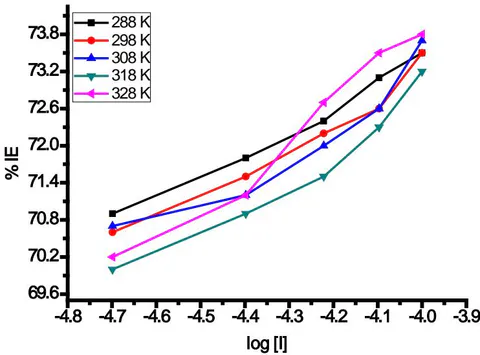
Plot IE% against logarithm of Simvastatin inhibitor (log [I]), obvious that in cases 288, 298, 308 and 318K the inhibition efficiency (IE%) decreased as the temperature of the medium is increased, but the (IE%) in 328K increased, this behavior indicated that chemisorption's occurs. See Figure13. The extra part in the curvatures that obtained from polarization technique than S shape indicates that there are multilayer proceed from the orientation of functional group under polarization where caused second chemical adsorption over the first layer[33].
c) Scanning Electron Microscopy (SEM)
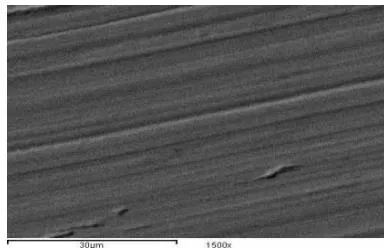
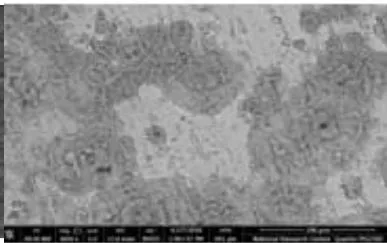
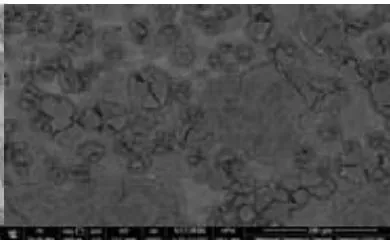
The micrographs that obtained for LCH specimens in nonexistence and in existence of M of Simvastatin drug after exposure for immersion one day in corrosive medium(10A5H). It is clear that LCH is suitable surfaces for corrosion attack in the blank sample or in corrosive medium only Figures 14 a, b and c. When the Simvastatin is existence in the corrosive medium, the morphology of LCH surfaces is quite different from the previous one, and the specimen surface was smoother. It is clear that the formation of a thin layer film adsorbed on the metal surface, which distributed in a disorder way overall surface of the LCH. This may be due to the adsorption of the Simvastatin on the LCH surface and made up the passive film in order to block the active site present on the LCH surface. The Simvastatin molecule interaction with active sites of LCH surface, resulting in a decrease in the contact between LCH and the corrosive medium and sequentially exhibited excellent inhibition effect[34].
d) Energy Dispersion Spectroscopy (EDX)[35]
To determination the elements and molecules that existence or adsorbed on the surface of MS after one day that immersion in acid with optimum doses of Simvastatin by using the EDX spectra. Figure 15, gives the EDX analysis of LCH in (10A5H) with in the presence of of Simvastatin. The spectra show additional lines, demonstrating the existence of C (owing to the carbon atoms of some Simvastatin). These data shows that the carbon, nitrogen and oxygen atoms covered the specimen surface. The EDX analysis indicates that only nitrogen, carbon and oxygen are detect and show that the passivation film contained the chemical formula of Simvastatin drag adsorbed on the surface of LCH. It is clear that, the percent weight of adsorbed elements C and O were present in the spectra and recorded in (Table 8).
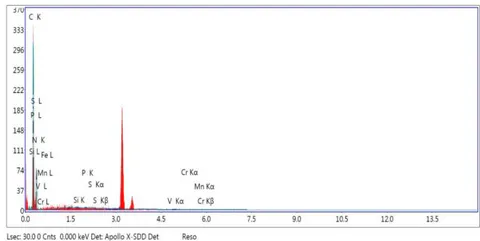
| (wt%) | Fe | C | O | N | S | Cl |
| Simvastatin | 62.16 | 1.32 | 33.54 | 1.14 | -- | 1.63 |
e) Atomic Force Microscopy (AFM)
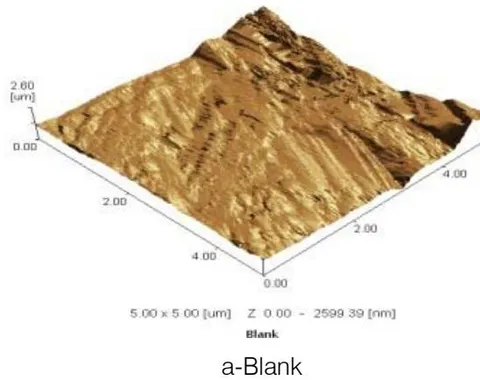
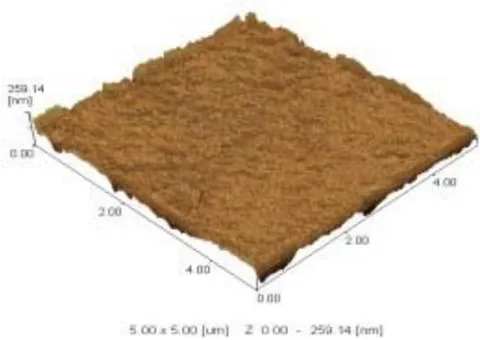
AFM is a powerful tool to investigate the surface morphology of various samples at nano- micro scale that is currently used to study the influence of corrosion inhibitors on metal solution interface. From the analysis, it can be gained regarding the roughness on the surface. The roughness profile values play an important role in identifying and report the efficiency of the inhibitor under study. Among the roughness, take a role in explanation about the nature of the adsorbed film on the surface [36-37]. Figure 16a, shows the 3D images as well as elevation profiles of polished of LCH in absence and present Simvastatin as an inhibitor. It observed in Figure 16b, the surface of LCH specimen (a) exposed to corroded solution affected vales structure with large and deep crack but the surface (b) reveal that is covering film adsorbed on the metal surface. The conclusion, that the adsorption film can protect the surface of the metal from corrosion process. Analysis of the values indicated higher the values of roughness parameter reached. The mean roughness is found to be for the blank in acid solution which placed in one day and analyzed. The observation of the metal surface which immersed in in presence of Simvastatin inhibitor possess roughness (259.14 nm) compared to the blank solution. It can be noted that the value is lower than that of the blank value. The decrease in the roughness value reflected to the adsorption of inhibitor molecule on metal surface thereby reducing the rate of corrosion.
f) Mechanism of inhibition
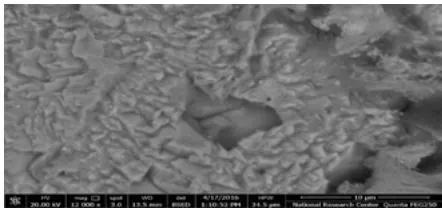
To illustrate the mechanism of inhibition of corrosion on the LCH surface in acid medium by using pharmaceutical drug compound as an inhibitor, it is must be known the nature of metal surface and the nature of the component of inhibitor structure. The LCH is regarded the metal -phase[38], It is obvious that -phase state consists of grains and grain boundaries in the surface of the metal, Figure 17. A cross-section of a piece or specimen of the metal that is a corroding to clarify that there are both anodic and cathodic sites in the metal surface structure.
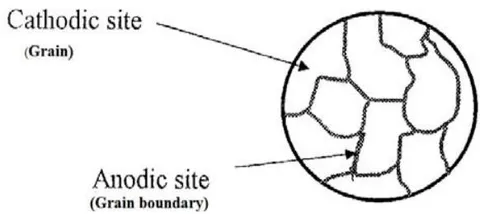
The surface of iron is usually, coated with a thin film of iron oxide. However, if this iron oxide film develops some cracks, anodic area are created on the surface, while other metal parts act as cathodes. It follows that the anodic areas are small surface, while nearly the rest of the surface of the metal large cathodes. Electrochemical corrosion involves flow of electric current between the anodic and cathodic areas called inter-granular corrosion Figure 18. SEM image is shown the corrosion of LCH in in one day immersion that illustrated inter-granular corrosion.
All previous results prove that the pharmaceutical drug compound under study were actually inhibit the corrosion of LCH in acid solution as a corrosive medium. The corrosion inhibition is due to their physical adsorption and formation of protection thin film adsorbed on the metal surface. The effect of Simvastatin as inhibitor may be corresponding to the accumulation of the inhibitor molecules on the metal surface, which prevent the direction contact of the metal surface with corrosive environment. The surface of the LCH sample is positively charge in aqueous acid solution and the adsorption occur according to[39-40]:
The partial negative charge that present in function group containing Oxygen and electron density of -bond in Simvastatin may be adsorbed on the positively charge of the metal surface like electrostatic attraction between the opposite charge, in the form of neutral molecules, that involving displacement of water molecules from the metal surface.
The unshared electrons of oxygen atoms and electron density of bondingdonate to the vacant orbital on the metal surface like chemisorption .
The inhibition action of the inhibitor can be accounted for by the interaction between the lone pair of electrons in the O and electron density of-bond with positively charged (anodic sites) on the metal surface, and the skeleton of the inhibitor compound covers the cathodic sites. This action forms a thin layer adsorbed on the metal surface and prevents corrosion processes(Figure 19).
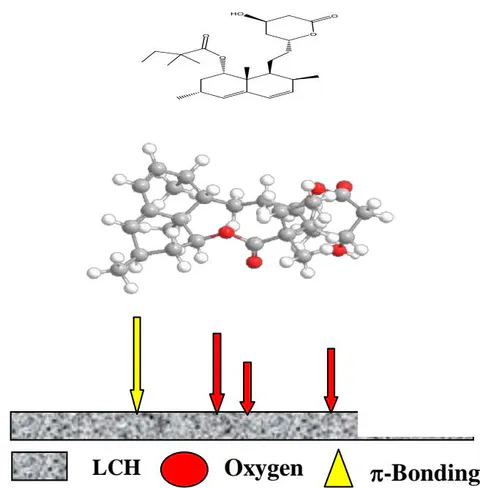
This meaning, the Simvastatin molecule attached with anodic site and covered somewhat of cathodic area, so that the corrosion rate in presence of Simvastatin is anodic-cathodic control.
IV. CONCLUSION
Inhibition of the corrosion of LCH in (10A5H) solution by Simvastatin is determine by potentiodynamic polarization and Evans techniques and surface examination by Scanning Electron Microscopy (SEM), energy Dispersive X-ray (EDX) and atomic force microscopy (AFM). It was found that the inhibition efficiency depends on concentration, nature of metal surface, the type of adsorption of the inhibitor. The observed corrosion data in presence Simvastatin inhibitor, namely:
The tested Simvastatin inhibitor establishes very good inhibition for LCH corrosion in 10A5H solution.
Simvastatin inhibits the LCH for corrosion by adsorption on its surface and forms a thin film layer.
The inhibition efficiencies of the tested compound increase with increasing of their concentrations.
The values of inhibition efficiencies obtained from the two techniques used, showed the validity of the obtained results.
The Simvastatin molecule attaches to anodic sites and covers some of the cathodic area, so that the corrosion rate in the presence of Simvastatin is anodic-cathodic controlled.


