
I. INTRODUCTION
Aluminum is widely used as a material in automobiles, aviation, household appliances, containers, and electronic devices [1]. The resistance of Aluminum against corrosion in aqueous media is attributed to the rapid formation of oxide films on the surface. However, Aluminum gets easily corroded in the presence of corrosive acids [2]. Studies of the corrosion behavior of Aluminumin different aggressive environments have continued to attract attention because of its important applications. Hydrochloric acid is one of the most widely used agents in the industrial sector and it corrodes metals such as Aluminum. There is a need to use inhibitors for retardation of the metal dissolution process [3].
Among several techniques used in mitigating corrosion problems, the use of chemical inhibitors remains the most cost-effective and practical method . The development of Aluminum corrosion inhibitors based on organic compounds is of growing interest in corrosion chemistry .
The reason for this is that even though inorganic substances like phosphates, chromates, dichromate, and arsenates were found to be effective as metal corrosion inhibitors, the major disadvantage is their toxicity. Such as their use has come under severe criticism . Research has shown that organic inhibitors are viable, and highly beneficial because they are efficient, environmentally benign, and comparatively cheap and are more effective than inorganic compounds . Numerous authors, for the most part, concur that medications are inhibitors that can compete favorably with green inhibition of corrosion and that most medications are synthesized from natural products. Selection of some medication as corrosion inhibitors due to the followings: (1) drug molecules contain oxygen, sulfur, and nitrogen as active sites, (2) it is environmentally friendly furthermore vital in organic responses, and (3) drugs are produced easily, and purified (4) nontoxic compering organic inhibitors .
The scope of this article is to use Candesartan drug as saving corrosion inhibitor for Aluminum in the acid medium by various chemical, and electrochemical methods to elucidate the mechanism of corrosion inhibition.
II. EXPERIMENTAL TECHNIQUES
a) Chemical materials
i. Metal sample Aluminum
The Aluminum alloy used has the chemical composition (% weight) 0.30 Si; 0.60 Fe; 0.10 Cu; 1.40 Mn; 0.05 Mg; 0.05 Cr; 0.05 Ti and the rest Aluminum alloy.
ii. Inhibitor
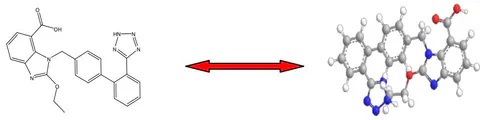
Candesartan drug is an organic compound, which has the chemical formula and purchased from Sandozinc and Pfizer in c companies.
iii. Corrosive medium
The corrosive medium is 1M HCl, which is prepared by diluted the (%37) HCl with distilled water, and the different concentrations of inhibitor (50, 100, 150, 200, 250, and 300 ppm) were prepared by dilution.
III. METHODS
a) Weight loss technique (WL)
For WL estimations, coins have the area surface (2 cm x 2 cm) x 2 that presented to the destructive solution that was utilized. The coins were scraped with SiC polisher sheet coarseness sizes (400, 800, and 1200), and clean with (CH3)2CO. At that point, clean a few times with bi-distilled water, lastly dried by soft tissue. The WL estimations were done in a 100 ml glass-measuring beaker put in an indoor regulator thermostat or water path. The coins were then quickly dipped in the test medium in nonexistence and existence various concentration of the investigate compound.
All aggressive corrosive medium were opened to air. After three hours, the coins were taken out, washed, dried, and weighted correctly per thirty minutes. The average WL for seven square Aluminum specimens will be obtained.
The% IE and surface coverage ( ) of Candesartan drug for the corrosion of Aluminum were determinate from the following equation[13]:
Where and W are the WLs in the nonexistence and existence of adding the various concentrations of investigating drugs, respectively.
ii. Potentiodynamic polarization technique
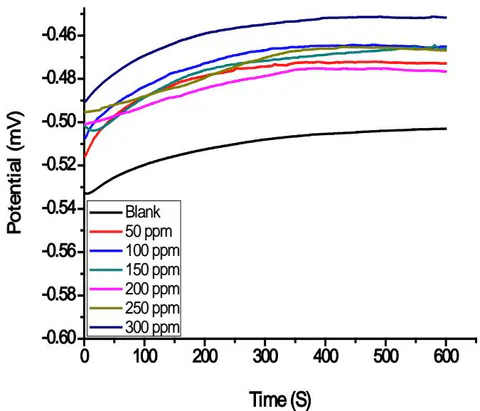
Polarization tests were done in a traditional three-electrode cell with a Pt counter electrode terminal and an immersed calomel electrode (SCE) as the reference electrode. The working electrode consists of a square sheet from Aluminum settled in epoxy resin like polytetrafluoroethylene, which does not affect by acid and covered the coin sample until the level surface that has area. The working terminal was polished by SiC polisher papers. Before estimation, the electrode was submerged in the corrosive medium at the normal potential for 30 min. until the point when an enduring or steady-state was occurring. The potential of the open circuit ( ) started in the blank -533 mV, and the presence of different concentrations of Candesartan drug started from -515.7 to -490.5 mV. All tests were done in newly arranged or preparing corrosive medium at room temperature. The data were constantly rehashed no less than three times to check the accuracy or valid results. Determination of% IE, and the are calculated by the following equations :
Where and are the corrosion current densities in the nonexistence, and existence of Candesartan drug as an inhibitor, respectively.
iii. Electrochemical impedance spectroscopy technique (EIS)
All EIS measuring data were performed at open circuit potential at more than a broad frequency range of . The perturbation potential was ten mV in abundance, peak to peak. The obtain diameters of the capacitive loops raise in the occurrence of Candesartan drug. They are indicated of the capacity of the extent of inhibition of oxidation progression, contrary to the reducing of the capacitance of double layers , which is determined by[15]:
Where is the highest frequency.
The% IE, and the (θ) acquired the impedance estimations were characterized by the accompanying connection:
Where, and are resistance of the charge move in the nonattendance and nearness of Candesartan, separately.
iv. Electrochemical frequency modulation technique
From the large peaks were utilized for the determination of the corrosion current density ( ), the Tafel slopes ( and ), and the causality factors , and [16].
The% IE was calculated as follows:
Where and are the corrosion current densities in the nonexistence, and existence of Candesartan drug.
All potentiodynamic, open circuit potential, EIS, and EFM as electrochemical analysis were investigated using Gamry tool PCI300/4.
v. Surface examinations
The Aluminum specimens utilized for analysis of the surface morphology were prepared in 1M HCl acid (blank), and add 300 ppm of Candesartan at room temperature for one day after abraded automatically utilizing various emery sheets up to 1200 gravel size. Then, the coins were dipped in the corrosive medium at even time; the coins were cleaned quietly with distill water, charily dried, and mount into the performed specimens examined by using SEM, EDX, and AFM.
IV. RESULT AND DISCUSSION
a) Weight loss measurement
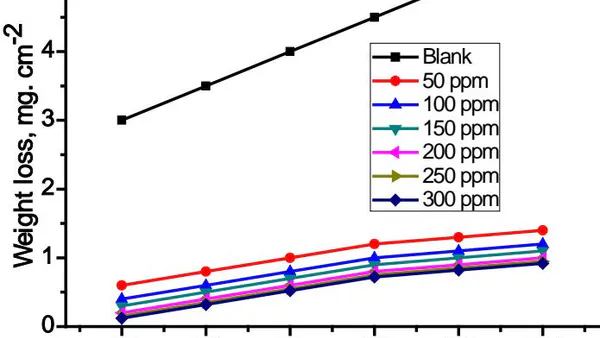
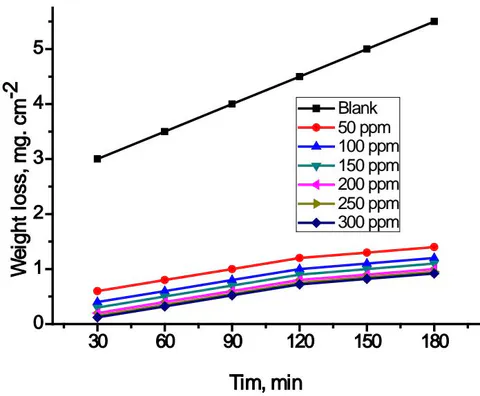
The WL of Aluminum relative to the surface area at different periods in the nonexistence, and existence of various doses (50, 100, 150, 200, 250, and 300 ppm) of the Candesartan. The curves acquired within sight of various drug doses fall essentially underneath that of the free corrosive medium is appeared. The% IE is recorded in Table 1. In all cases, the%IE of the drug increment with increasing concentration of the drug, but the rate of corrosion was decreased. These results indicated that the Candesartan under study is the good substance that prevents corrosion of Aluminum corrosive medium Fig.1.
| Compound | Conc. ppm | WL(mg/cm2) | C. R. x 10-3(WL/min.) | θ | % IE |
| Blank | Blank | 4.5 | 37.5 | ||
| Candesartan | 50 | 1.20 | 10.0 | 0.733 | 73.3 |
| 100 | 1.00 | 8.3 | 0.778 | 77.8 | |
| 150 | 0.90 | 7.5 | 0.800 | 80.0 | |
| 200 | 0.80 | 6.7 | 0.822 | 82.2 | |
| 250 | 0.75 | 6.3 | 0.833 | 83.3 | |
| 300 | 0.72 | 6.0 | 0.840 | 84.0 |
i. Temperature effect
Study the effect of temperature by applied Arrhenius equation and the rate constant of corrosion ( .) can be determined:
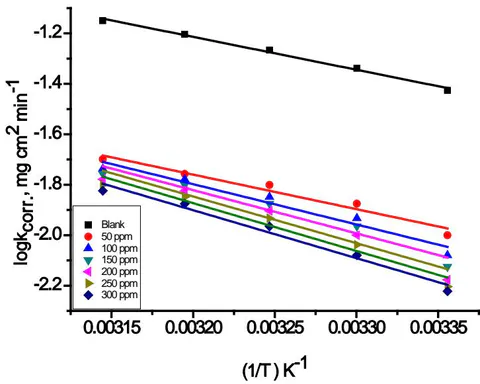
Where is the activation of inhibition for the oxidation of Aluminum in the corrosive medium in nonexistence and existence of Candesartan inhibitor, R is universal gases constant, T is the absolute temperature and A is the Arrhenius pre-exponential consistent relies upon the metal sort and electrolyte. Plots of versus (1/T) for Aluminum 1 M hydrochloric acid in the nonexistence and existence of various doses of Candesartan drug is shown graphically in Fig. 2. Gives straight lines and the estimation values of from the slope value that equal , and recorded in Table 2. These outcomes propose that the drug is comparative in the system of activity. It is obvious that the increases with increasing various doses of Candesartan drug indicating that, the energy barrier for the corrosion reaction increased. After additionally shown that the entire procedure is controlled by the relative of surface corroded occurs, since the activation energy of the consumption oxidation process is more than 24.9 kJ mol [17].
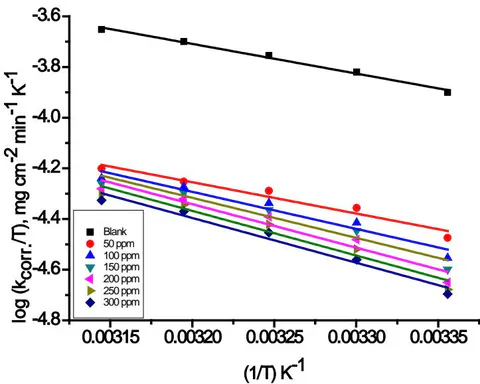
The of activation are determinate from the theory of transition state by applying the following relation (10)[18]:
Where N is Avogadro's number, h is Planck's constant. A plot of versus (1/T) likewise gave straight lines as appeared in Fig. 3, for Aluminum dissolution in 1M of HCl in the absence and presence of various concentrations of Candesartan. The slopes of these lines equal and the intercept value equal , that the estimation of and were determined, and recorded in Table 2. These outcomes demonstrate that the used compound acts as an inhibitor. The estimations of are reflected the strength of the adsorption of this drug on Aluminum surface. The estimations of without and with using Candesartan is large and negative; this demonstrates that the rate-determination step is an association on the surface of the Aluminum rather than dissolution .
| Conc. Ppm | Activation parameters | ||
| kJ mol | kJ mol | - J mol K | |
| Blank | 24.9 | 22.4 | 196.9 |
| 50 | 26.23 | 23.7 | 203.3 |
| 100 | 30.6 | 28.0 | 190.1 |
| 150 | 32.8 | 30.3 | 183.4 |
| 200 | 35.4 | 32.9 | 175.5 |
| 250 | 36.3 | 33.7 | 173.2 |
| 300 | 36.4 | 33.8 | 173.4 |
ii. Adsorption isotherms
Candesartan adsorbed on the metal surface, and the values of ( ) for various doses of the drug in 1M HCl was determined from WL data utilizing the follows relation:
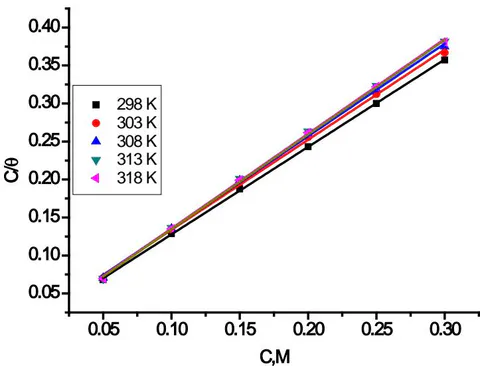
From the values, it is obvious that the increment with raising the doses of Candesartan. By utilizing these values, and for applying various adsorption isotherms, Langmuir adsorption was found the best one and to follow the next relation[20]:
Where is the equilibrium constant of adsorption. Plotting (C/ ) against (C) of Candesartan at various temperatures is shown in Fig. 4. The linear relationship is given with intercept equal to , and slope approach the unity. The values were determined by the equation (13):
Where R is the general gas constant, T is the absolute temperature and 55.5 is the concentration of water in the solution in M/L. The was determined according to the Van't Hoff equation (14)[21]:
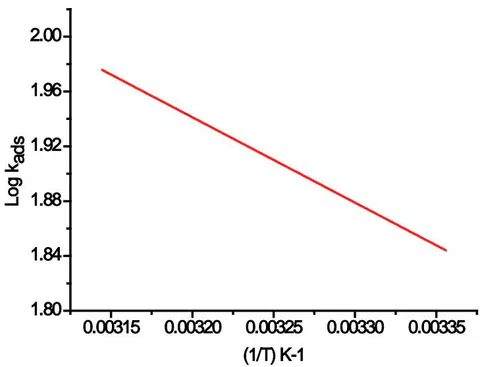
Plotting (log ) against (1/T) give straight lines as shown in Fig. 5, the straight lines gives slope equal ( ), from this slope, the values were calculated, and are listed in Table 3. Then by applying the following equation:
From introducing the values of , , and were calculated by applied the above equations (13, 14 and 15) spontaneously. From all thermodynamic adsorption parameters for Candesartan inhibitor on Aluminum from 1M HCl medium can be concluded that:
The correlation coefficients (0.99) reflected that the experimental data give good curves fitting for the adsorption isotherm, and values increase with increasing temperatures from 25 to 45°C
The negative values of reflect that the adsorption of Candesartan on Aluminum surface in 1 M HCl solution is a spontaneous process. The values are more negative than -20.8 kJ mol lead to the Ven Der Waal's forces or electrostatic attraction between the positive charge of the metal surface and the negative charge of Candesartan molecules in the bulk of the medium and formation thin film adsorbed on the metal surface. i.e. physical adsorption.
The positive sign of and less than 20Kj/molrefer to the adsorption of inhibitor molecules is an endothermic process, indicating that the adsorption is physical adsorption. The unshared pairs electron from the investigate molecule may attractive with a positive center on the surface of Aluminum by electrostatic attraction to provide a protective film prevent corrosion process[22].
The values, in the existence of the investigate drug are positive and large and decreases with increasing temperatures tend to more order tend to chemisorption.
| Temp.1°C m | -Δ kJ mol | Δ kJ mol | Δ J mol K | |
| 25 | 79.2 | 20.8 | 11.9 | 109.7 |
| 30 | 65.9 | 20.7 | 107.5 | |
| 35 | 75.9 | 21.4 | 108.0 | |
| 40 | 92.3 | 22.2 | 109.0 | |
| 45 | 98.2 | 22.7 | 108.9 |
b) Open circuit potential ( ) From the Fig.6 is shown several interesting points:
The in the blank solution is beginning from -535 mV, then shifted anodically, and reached a steady state after 300 seconds, indicating that the initial dissolution process, and formation of oxide film on the metal surface.
The is started in the existence of Candesartan drug, at less negatively potential(515.7, 507.4, 503.9, 500.8, 495.3 and 490.5) compared with that in the nonexistence of the drug, and shifted anodically, due to the increasing of concentrations of the drug, that shown in Table 4. The steady-state is attained rapidly, with increasing the doses of the drug comparing with the blank. The shift in the potential of increment in the positive direction position and the drug might certain act as an anodic inhibitor [23]. However, from Fig.6, the shift in on the addition Candesartan drug is about 57.5 mV revealing that the present drug acts as anodic inhibitor.
| Conc. Ppm | (mV) | (mV) |
| Blank | 535.0 | 505.0 |
| 50 | 519.7 | 472.1 |
| 100 | 503.4 | 466.3 |
| 150 | 500.9 | 464.5 |
| 200 | 500.8 | 463.2 |
| 250 | 495.3 | 460.2 |
| 300 | 490.5 | 451.3 |
c) Potentiodynamic Polarization technique(PP)
Polarization technique is carrying out in 1 M HCl acid medium in the nonexistence and existence of different concentrations of Candesartan drug at 25°C. The results are collected in Table 5, and drowning in Fig. 7, respectively. These outcomes information showing that the cathodic, and anodic curve lines obtained by Tafel-type behavior. The type of the curved lines is the same, which shows the dissolution of Aluminum and hydrogen evolution, obviously, stay without changing. The corrosion current densityre ducing with increasing the concentration of the drug, but the small change of the revealed that the drug acts as mixed type inhibitor[24]. The information data additionally demonstrate that the anodic and cathodic Tafel slope were slightly changed with increasing of the concentration of the drug. This demonstrates that there is no change of mechanism, but% IE increases with increasing the concentration of Candesartan drug. The way of the approximations of are somewhat higher than the approximations of . This is attributed to the cathodic activity of the drug. The steadiness and the cathodic slope obtained from the electrochemical estimations demonstrate that the hydrogen evolution reaction was activation controlled [25].
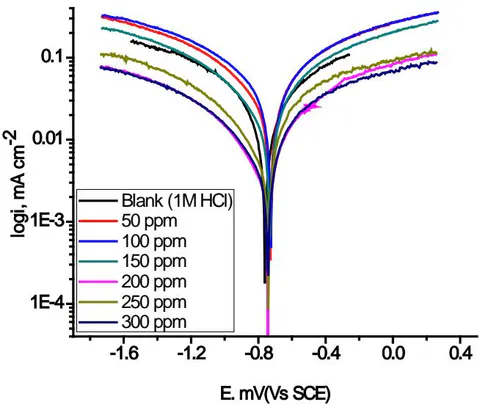
, , Tafel slopes ( & ),% IE, and for the oxidation of Aluminum 1M HCl
| Conc. Ppm | mA/cm-2 | -Ecorr. mV(SCE) | mV dec-1 | mV dec-1 | C. R. mpy | θ | % IE |
| 0 | 145 | 502 | 242 | 995 | 60 | ---- | ---- |
| 50 | 63.2 | 484 | 122 | 276 | 26 | 0.564 | 56.4 |
| 100 | 58 | 447 | 83 | 191 | 24 | 0.6 | 60 |
| 150 | 52 | 450 | 79 | 188 | 22 | 0.641 | 64.1 |
| 200 | 47 | 455 | 78 | 184 | 19.5 | 0.676 | 67.6 |
| 250 | 41 | 439 | 75 | 170 | 17 | 0.717 | 71.7 |
| 300 | 38 | 442 | 71.6 | 164 | 16 | 0.738 | 73.8 |
d) Electrochemical impedance spectroscopy technique(EIS)
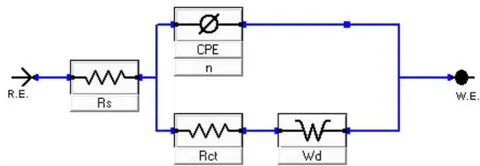
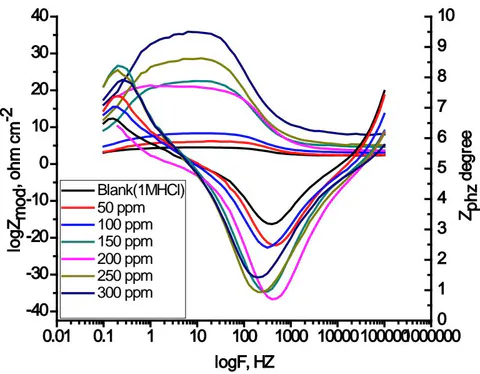
The (EIS) charts (Nyquist and Bode) and data at various frequencies range between 0.1 Hz to Hz with ten mV plenitude position at OCP for Aluminum 1M HCl acid medium in the nonexistence and existence of varied measurements of Candesartan drug concentration are required. The identical circuit that describes for Aluminum and electrolytes are found in Fig. 8: EIS parameters, and% IE were determined, and listed in Table 6. The obtained Nyquist, and Bode plotting in curves for Candesartan drug are shown in Fig. 9 a, b. Nyquist spectra are described by a semicircle loop. These demonstrate that a charge transfer processrefer to the oxidation of Aluminummetal [26]. The diameter ( ) of the capacitive circle loop increments, with increasing the Candesartan drug concentration, these means the expanding inhibition efficiency, and reducing the consumption oxidation process [27]. More details, the increase of values improve the increase of the%IE because of the progressive replacement of water molecules by the adsorption of the medication particles on the metal surface by an adherence thin film formed on the metal surface. The formation film on the metal surface reduced the double layer thickness. Also, the decreasing of capacitance double layer ( ) with rises the drug doses as a result from reduce in local dielectric constant which indicating that, the drug was adsorbed on anodic sites, and covered the cathodic sites on the surface area of the metal[28].
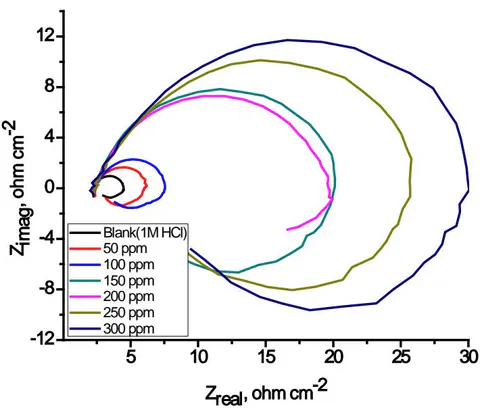
Conc. ppm Ω cm2 μF cm2 θ % IE 0 1.8 22 --- --- 50 2.8 5.5 0.357 35.7 100 3.1 4.2 0.419 41.9 150 4 3 0.55 55 200 6.1 2.8 0.705 70.5 250 7.2 2.4 0.75 75 300 11 2.1 0.836 83.6
e) Electrochemical frequency modulation technique (EFM)
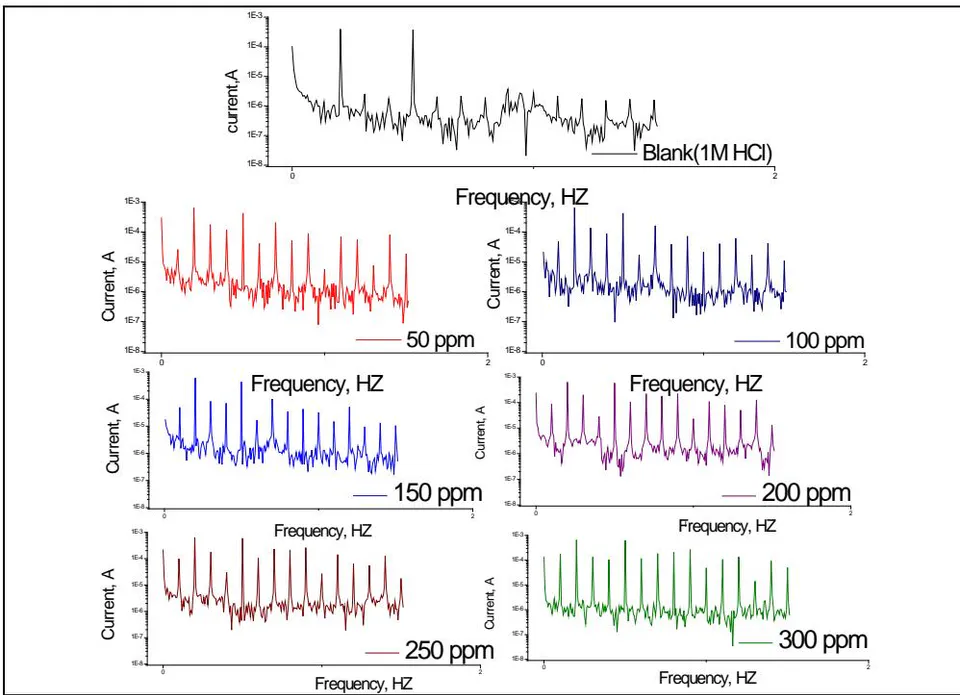
EFM is regarded as a very good technique to determine corrosion information directly and quickly because EFM is a nondestructive technique to determine corrosion [29]. The measurements data of EFM become valid data when the practical causality factors (CF2 and CF3) are equals or near the hypothetical values (2 and 3), which determination from the frequency spectrum of the current reaction. Fig. 10, illustrated the EFM inter-modulation spectrum of Aluminum 1 M HCl in nonexistence and existence deferent concentrations of Candesartan drug. It is clear that the treatment EFM data utilizing two various models: (1) the activation model by solved three nonlinear equations, and assuming no change of the corrosion potential due to the polarization of the working electrode (2) cathodic reaction controlled by complete diffusion[30]. The corrosion current density , the and ), and (CF2 and CF3) are calculated from the two large peaks of inter-modulation spectrum, and then listed in Table 7. It is obvious, that the addition of tested Candesartan drug at given concentrations to the corrosive medium reducing the , indicating that the Candesartan drug inhibits the corrosion of Aluminum by the adsorption process. The (CF2 and CF3) are equal, or near the hypothetical values (2 and 3) indicative of that. The estimation information data are valid and good value [31]. The% IE values are increments by expanding the concentrations of Candesartan drug, which determined and recorded in Table 7.
| Comp. | Conc. Ppm | μAcm-2 | mVdec-1 | mVdec-1 | CF (2) | CF (3) | CR Mpy | Θ | % IE |
| Blank | 0.0 | 140 | 182 | 195 | 1.9 | 3.3 | 61.1 | ---- | ---- |
| Candesartan | 50 | 80 | 32 | 102 | 1.8 | 4 | 37.7 | 0.429 | 42.9 |
| 100 | 70.2 | 31 | 66 | 1.8 | 3.7 | 31.9 | 0.499 | 49.9 | |
| 150 | 60.3 | 34 | 55 | 2 | 2.9 | 30.5 | 0.569 | 56.9 | |
| 200 | 49.8 | 24 | 36 | 1.7 | 3.9 | 26.1 | 0.644 | 64.4 | |
| 250 | 40 | 19 | 33 | 2.1 | 4 | 24.2 | 0.714 | 71.4 | |
| 300 | 32 | 18 | 25 | 1.8 | 2.7 | 14.4 | 0.771 | 77.1 |
f) Scanning electron microscopy analysis (SEM)
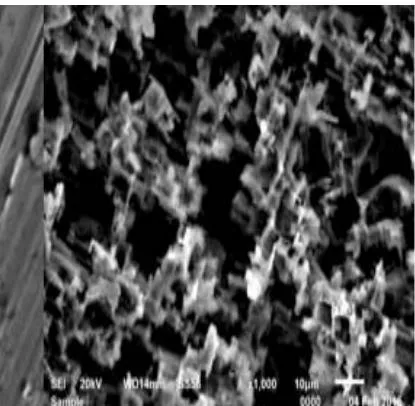
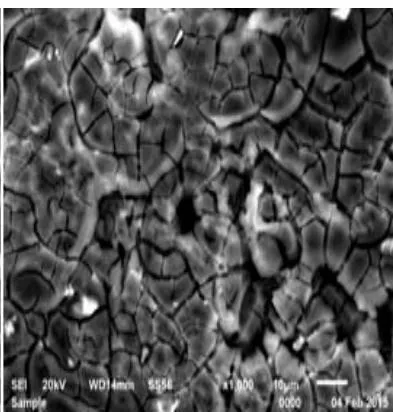
The micrograph or the topography obtains on the Aluminum coins in existence and in nonexistence of 300 ppm of Candesartan inhibitor after contact for one day submersion. The coin morphology of Aluminum surface is smooth before immersion in the corrosive medium and in corrosive medium with 300 ppm of Candesartan inhibitor. It is obvious that inter-granular corrosion occurs due to the coin immersion in a corrosive medium for only one day. After that, the coin immersion in the corrosive medium after adding 300 ppm of inhibitor, that adsorbed on the surface of metal, and formation thin passive film that prevent corrosion processes, due to the development film that aspersion on the whole surface of the Aluminum, Fig. 11, This means, the inhibitor particles association with dynamic locales on the Aluminum surface, that is reducing the contact between Aluminum surface, and the destructive medium [32, 33].
g) Energy Dispersive X-ray analysis (EDX)
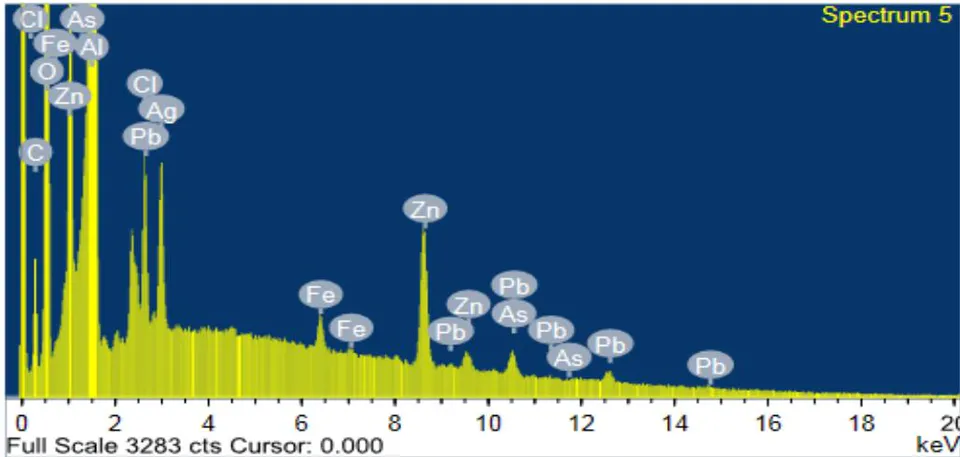
Determination the existence elements that adsorbed on Aluminum surface by EDX spectrum after one day immersion in 1M HCl with optimum concentration of Candesartan inhibitor.
Fig. 12, gives the EDX examination of Aluminum 1M HCl and the presence 300ppm of Candesartan inhibitor. The spectrum demonstrates extra lines, showing C, N, and O (inferable from the chemical structure of Candesartan drug). This information demonstrates that the C, N, and O atoms secured the coins surface.
The elements carbon, nitrogen and oxygen were the determination by EDX analysis and shown that protective film contained the chemical formula of Candesartan inhibitor adsorbed on the surface of Aluminum[34].
It is seen that the percent weight of adsorbing elements C, N, and O were present in the spectra and recorded in Table 8.
| (% Wt) | AL | C | O | N | CI |
| Candesartan | 55.12 | 8.5 | 32.1 | 2.5 | 0.56 |
h) Atomic force microscopy analysis (AFM)
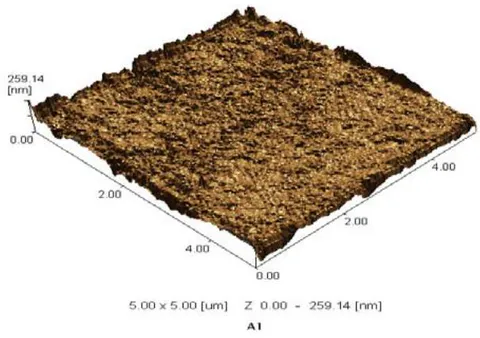
From AFM analysis, it can be gained regarding the roughness on the surface. The roughness profile values play an important role in identifying and report the efficiency of the inhibitor under study. Among the roughness, take a role in explanation about the nature of the adsorbed film on the surface [35, 36]. Fig. 13, shows the 3D images as well as elevation profiles of polished of Aluminum absence and presence Candesartan as an inhibitor. It observed that the surface of Aluminum specimen (a) exposed to corroded solution affected vales structure with large and deep crack but the surface (b) reveal that is covering thin film adsorbed on the metal surface. The conclusion that the adsorption film can protected the surface of the metal from corrosion processes [37]. Analysis of the values indicating that the higher values of roughness parameter in corrosive medium than in the presence, 300 ppm of inhibitor drug which becomes less roughness values and according to the Z value of the image that be found (2.60 m) for the blank in acid solution which placed in
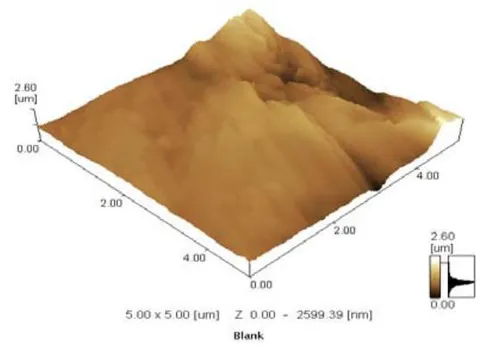
1M HCI one day and analyzed but (259.14 nm)that observed of the image of the metal surface which immersion in 1M HCI in presence of 300 ppm of Candesartan as an inhibitor that becomes less roughness. The diminish in the roughness value reflected the adsorption of Candesartan molecule as a thin film on the metal surface and prevent the corrosion processes, in other hand reducing the rate of corrosion and increasing the inhibition efficiency.
i) Mechanism of inhibition
To illustrate the mechanism of inhibition of corrosion on the Aluminum surface in acid medium by using Candesartan compound as an inhibitor, it is must be known the nature of metal surface and the nature of the component of inhibitor structure.
All previous results prove that the Candesartan inhibitor compound under study was actually inhibiting the corrosion of Aluminum 1M HCl acid solution as a corrosive medium. The corrosion inhibition is due to their physical and chemical adsorption that formation of protection thin film adsorbed on the metal surface. The effect of Candesartan inhibitor compound under study may be corresponding to the accumulation of the inhibitor molecules on the metal surface, which prevent the direction contact of the metal surface with corrosive environment. The surface of the Aluminum sample is positively charge in aqueous acid solution [38, 39]. The partial negative charge that presence in function group (O and N) and electronic density of benzene ring in Candesartan molecules under study, which adsorbed on the positively charge of the metal surface. Like electrostatic attraction between the opposite charge, in the form of neutral molecules, that involving displacement of water molecules from the metal surface and sharing electrons between electron density of bonding, oxygen and nitrogen to vacant orbitals on the metal surface on anodic side and the skeleton of inhibitor compound cover the cathodic sites this action form thin layer film adsorbed on the metal surface that prevent the corrosion processes[40], Fig. 14. The present of benzene ring, this has electrons density and -bonding that enhancement the adsorption process and gives the very good inhibition efficiency.
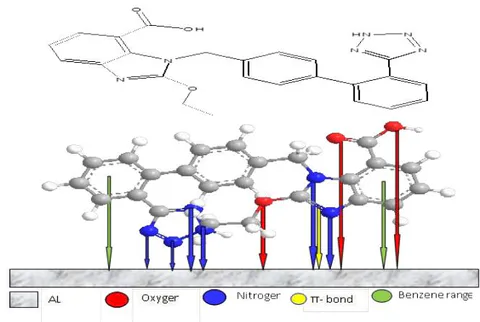
This meaning, the Candesartan molecule attached with anodic site and covered somewhat of cathodic area, so that the corrosion rate in presence of Candesartan is anodic-cathodic control.
V. CONCLUSION
Inhibition of the corrosion of Aluminumin 1M HCI solution by Candesartan is determine by weight loss, potentiodynamic polarization measurements, electrochemical impedance spectroscopy (EIS) and the electrochemical frequency modulation method (EFM). The surface of Aluminumexamination by Scanning Electron Microscopy (SEM), energy Dispersive X-ray (EDX) and atomic force microscopy (AFM). It was found that the inhibition efficiency depends on concentration, nature of metal, the mode of adsorption of the inhibitor and surface conditions. The observed corrosion data in presence Candesartan inhibitor, namely:
The tested Candesartan inhibitor establish a very good inhibition for Aluminum corrosion in 1M HCl solution
Candesartan inhibit the Aluminum for the corrosion by adsorption on its surface and make thin film layer.
The inhibition efficiencies of the tested compound increase with increasing of their concentrations.
Double layer capacitances decrease with increasing concentration of inhibitor. This fact may explained by adsorption of the inhibitor molecule on the Aluminum surface.
The adsorption of Candesartan inhibitor on the Aluminum surface in 1M HCl solution applied by Langmuir adsorption isotherm.
The values of inhibition efficiencies obtained from the different independent techniques used, showed the validity of the obtained results.
The Candesartan molecule attached with anodic site and covered somewhat of cathodic area, so that the corrosion rate in presence of Candesartan is anodic-cathodic control.