




Emotional Compass: Exploring the Socio-Emotional Wealth’s Role in Guiding Change Implementation in Family Enterprises!

1
Prof. Hourmat Allah Hind
2
Mr. Khalis Mohammed
Mr. Khalis Mohammed
1 CADI AYYAD UNIVERSITY

Send Message

To: Author

GJMBR Volume 24 Issue A2
Emotional Compass: Exploring the Socio-Emotional Wealth’s Role in Guiding Change Implementation in Family Enterprises!

Article Fingerprint

ReserarchID

7B5T8

Emotional Compass: Exploring the Socio-Emotional Wealth’s Role in Guiding Change Implementation in Family Enterprises! Banner
  • English
  • Afrikaans
  • Albanian
  • Amharic
  • Arabic
  • Armenian
  • Azerbaijani
  • Basque
  • Belarusian
  • Bengali
  • Bosnian
  • Bulgarian
  • Catalan
  • Cebuano
  • Chichewa
  • Chinese (Simplified)
  • Chinese (Traditional)
  • Corsican
  • Croatian
  • Czech
  • Danish
  • Dutch
  • Esperanto
  • Estonian
  • Filipino
  • Finnish
  • French
  • Frisian
  • Galician
  • Georgian
  • German
  • Greek
  • Gujarati
  • Haitian Creole
  • Hausa
  • Hawaiian
  • Hebrew
  • Hindi
  • Hmong
  • Hungarian
  • Icelandic
  • Igbo
  • Indonesian
  • Irish
  • Italian
  • Japanese
  • Javanese
  • Kannada
  • Kazakh
  • Khmer
  • Korean
  • Kurdish (Kurmanji)
  • Kyrgyz
  • Lao
  • Latin
  • Latvian
  • Lithuanian
  • Luxembourgish
  • Macedonian
  • Malagasy
  • Malay
  • Malayalam
  • Maltese
  • Maori
  • Marathi
  • Mongolian
  • Myanmar (Burmese)
  • Nepali
  • Norwegian
  • Pashto
  • Persian
  • Polish
  • Portuguese
  • Punjabi
  • Romanian
  • Russian
  • Samoan
  • Scots Gaelic
  • Serbian
  • Sesotho
  • Shona
  • Sindhi
  • Sinhala
  • Slovak
  • Slovenian
  • Somali
  • Spanish
  • Sundanese
  • Swahili
  • Swedish
  • Tajik
  • Tamil
  • Telugu
  • Thai
  • Turkish
  • Ukrainian
  • Urdu
  • Uzbek
  • Vietnamese
  • Welsh
  • Xhosa
  • Yiddish
  • Yoruba
  • Zulu

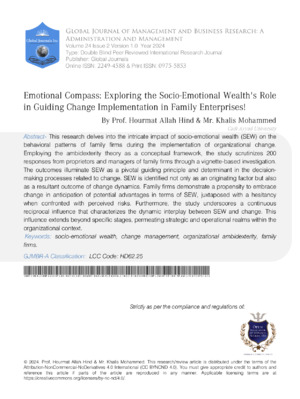
This research delves into the intricate impact of socio-emotional wealth (SEW) on the behavioral patterns of family firms during the implementation of organizational change. Employing the ambidexterity theory as a conceptual framework, the study scrutinizes 200 responses from proprietors and managers of family firms through a vignette-based investigation. The outcomes illuminate SEW as a pivotal guiding principle and determinant in the decisionmaking processes related to change. SEW is identified not only as an originating factor but also as a resultant outcome of change dynamics. Family firms demonstrate a propensity to embrace change in anticipation of potential advantages in terms of SEW, juxtaposed with a hesitancy when confronted with perceived risks. Furthermore, the study underscores a continuous reciprocal influence that characterizes the dynamic interplay between SEW and change. This influence extends beyond specific stages, permeating strategic and operational realms within the organizational context.



39 Cites in Articles

References

  1. James Chrisman,Jess Chua,Reginald Litz (2011). A unified systems perspective of family firm performance: an extension and integration.
  2. A De Massis,F Frattini,U Lichtenthaler (2013). Research on technological innovation in family firms: Present debates and future directions.
  3. T Habbershon,M Williams (2013). A resource-based framework for assessing the strategic advantages of family firms.
  4. L Gómez-Mejía,P Patel,J Chrisman,J Carr (2014). Separating the wheat from the chaff: The moderating effects of family involvement on the relationship between entrepreneurial orientation and performance.
  5. Pramodita Sharma,James Chrisman,Jess Chua (2013). Predictors of satisfaction with the succession process in family firms.
  6. J Craig,K Moores,E Sadler-Smith (2011). Learning and development: Perceptions of organizational effectiveness in a UK sample of family-owned firms.
  7. K Eddleston,F Kellermanns (2017). Toward a family-based system theory of business exit: A conceptualization and research agenda.
  8. Zulima Fernández,María Nieto (2014). Impact of ownership on the international involvement of SMEs.
  9. L Gómez-Mejía,K Haynes,M Núñez-Nickel,K Jacobson,J Moyano-Fuentes (2007). Socioemotional wealth and business risks in familycontrolled firms: Evidence from Spanish olive oil mills.
  10. W Schulze,M Lubatkin,R Dino (2003). Toward a theory of agency and altruism in family firms.
  11. Alessandro Minichilli,Guido Corbetta,Ian Macmillan (2010). Top Management Teams in Family‐Controlled Companies: ‘Familiness’, ‘Faultlines’, and Their Impact on Financial Performance.
  12. Allison Pearson,Jon Carr,John Shaw (2010). Toward a Theory of Familiness: A Social Capital Perspective.
  13. Pascual Berrone,Cristina Cruz,Luis Gomez-Mejia (2012). Socioemotional Wealth in Family Firms.
  14. Thomas Zellweger,Franz Kellermanns,James Chrisman,Jess Chua (2012). Family Control and Family Firm Valuation by Family CEOs: The Importance of Intentions for Transgenerational Control.
  15. L Naldi,M Nordqvist,K Sjöberg,J Wiklund (2007). Entrepreneurial orientation, risk taking, and performance in family firms.
  16. Timothy Habbershon,Mary Williams,Ian Macmillan (2003). A unified systems perspective of family firm performance.
  17. W Schulze,M Lubatkin,R Dino (2003). EXPLORING THE AGENCY CONSEQUENCES OF OWNERSHIP DISPERSION AMONG THE DIRECTORS OF PRIVATE FAMILY FIRMS..
  18. Paul Westhead,Marc Cowling (1998). Family Firm Research: The Need for a Methodological Rethink.
  19. L Naldi,M Nordqvist,K Sjöberg,J Wiklund (2007). Entrepreneurial orientation, risk taking, and performance in family firms.
  20. J Kotter (1996). Leading change.
  21. Kurt Lewin (1947). Frontiers in Group Dynamics.
  22. Thomas Cummings,Christopher Worley (2014). Applying Management and Organization Theory to Organization Change: More Than Meets the Eye.
  23. B Burnes (2004). Kurt Lewin and the planned approach to change: A re-appraisal.
  24. E Cameron,M Green (2009). Making sense of change management: a complete guide to the models, tools, and techniques of organizational change.
  25. Michael Beer,Nitin Nohria (2000). Cracking the Code of Change.
  26. Achilles Armenakis,Stanley Harris (2002). Crafting a change message to create transformational readiness.
  27. (2016). Best Practices in Change Management -2016 Edition.
  28. J Kotter (1995). Why transformation efforts fail John P. Kotter, Harvard Business Review (March-April 1995), pp. 59?67.
  29. Dean Anderson,Linda Anderson (2010). Conscious change leadership: Achieving breakthrough results.
  30. W Bridges (2009). Managing transitions: Making the most of change.
  31. P Senge (1990). The fifth discipline: The art and practice of the learning organization.
  32. C Carnall (2007). Change management in organizations: Towards a theoretical framework.
  33. David Nadler,Michael Tushman (1990). Beyond the Charismatic Leader: Leadership and Organizational Change.
  34. E Cameron,M Green (2012). Making sense of change management: a complete guide to the models, tools, and techniques of organizational change.
  35. Shaul Oreg,Maria Vakola,Achilles Armenakis (2011). Change Recipients’ Reactions to Organizational Change.
  36. Wayne Bovey,Andy Hede (2001). Resistance to organizational change: the role of cognitive and affective processes.
  37. B Burnes (2009). Managing change: A strategic approach to organizational dynamics.
  38. S Van Den Heuvel,E Demerouti,M Peeters (2015). The job crafting intervention: Effects on job resources, self-efficacy, and affective well-being.
  39. John Hayes (2018). The Theory and Practice of Change Management.

Funding

No external funding was declared for this work.

Conflict of Interest

The authors declare no conflict of interest.

Ethical Approval

No ethics committee approval was required for this article type.

Data Availability

Not applicable for this article.

Prof. Hourmat Allah Hind. 2026. \u201cEmotional Compass: Exploring the Socio-Emotional Wealth’s Role in Guiding Change Implementation in Family Enterprises!\u201d. Global Journal of Management and Business Research - A: Administration & Management GJMBR-A Volume 24 (GJMBR Volume 24 Issue A2): .

Download Citation

Analysis of emotional wealth in family businesses.
Journal Specifications

Crossref Journal DOI 10.17406/GJMBR

Print ISSN 0975-5853

e-ISSN 2249-4588

Keywords
Classification
Not Found
Version of record

v1.2

Issue date

March 21, 2024

Language

English

Experiance in AR

The methods for personal identification and authentication are no exception.

Read in 3D

The methods for personal identification and authentication are no exception.

Article Matrices
Total Views: 891
Total Downloads: 12
2026 Trends
Related Research

Published Article

This research delves into the intricate impact of socio-emotional wealth (SEW) on the behavioral patterns of family firms during the implementation of organizational change. Employing the ambidexterity theory as a conceptual framework, the study scrutinizes 200 responses from proprietors and managers of family firms through a vignette-based investigation. The outcomes illuminate SEW as a pivotal guiding principle and determinant in the decisionmaking processes related to change. SEW is identified not only as an originating factor but also as a resultant outcome of change dynamics. Family firms demonstrate a propensity to embrace change in anticipation of potential advantages in terms of SEW, juxtaposed with a hesitancy when confronted with perceived risks. Furthermore, the study underscores a continuous reciprocal influence that characterizes the dynamic interplay between SEW and change. This influence extends beyond specific stages, permeating strategic and operational realms within the organizational context.

Our website is actively being updated, and changes may occur frequently. Please clear your browser cache if needed. For feedback or error reporting, please email [email protected]
×

This Page is Under Development

We are currently updating this article page for a better experience.

Request Access

Please fill out the form below to request access to this research paper. Your request will be reviewed by the editorial or author team.
X

Quote and Order Details

Contact Person

Invoice Address

Notes or Comments

This is the heading

Lorem ipsum dolor sit amet, consectetur adipiscing elit. Ut elit tellus, luctus nec ullamcorper mattis, pulvinar dapibus leo.

High-quality academic research articles on global topics and journals.

Emotional Compass: Exploring the Socio-Emotional Wealth’s Role in Guiding Change Implementation in Family Enterprises!

Prof. Hourmat Allah Hind
Prof. Hourmat Allah Hind CADI AYYAD UNIVERSITY
Mr. Khalis Mohammed
Mr. Khalis Mohammed

Research Journals


























































