I. INTRODUCTION
Modern humanitarian geography adopted the concept of cultural landscapes developed by K. Sauer [Sauer, 1925], C.O. Schluter [Schluter, 1920], D.E. Cosgrove [Cosgrove, 1998], etc. According to Schluter, a cultural landscape develops from natural landscape fashioned by a cultural group. This concept differs from the traditional approach in Russian landscape studies, where culture is separated from landscape characteristics though anthropogenic transformations are studied. V.I. Vernadsky, known for his doctrine of man and the biosphere, once mentioned that culture presented a new type of biogeochemical energy [Vernadsky, 1991]. This statement somehow linked humanitarian and traditional landscape approaches but traditional landscape science approach is still dominating making its research results far from being clear for public understanding. Besides the mainstream development of a modern post-non-classical period of science focuses at interdisciplinary studies [Ravetz, 1999 Stepin, 2003, etc.]. In Russia, this gave rise to the revival of humanitarian geographical studies relevant to cultural landscapes beneficial for solving sustainable development goals. Complex spatial structure of cultural landscapes in populated regions, in several cases, promote delusion of "empty spaces" existence, i.e., landscapes not fashioned by a certain cultural group and thus free for new economic development. It happens when a previous historical background of economic development is unknown or ignored. Involvement of such territories in economic development may cause loss of traditional economy incomes, cultural heritage and socio-economic conflicts [Carstens, 2016, McNeil, 2018, Woons, 2014, Krasovskaya, 2011, etc.] The goal of this study is to reveal the origin of "empty spaces" appearance in the Russian Arctic and demonstrate the importance of cultural landscapes studies to identify and characterize them for the sake of socio-economic stability.
II. STUDY AREA
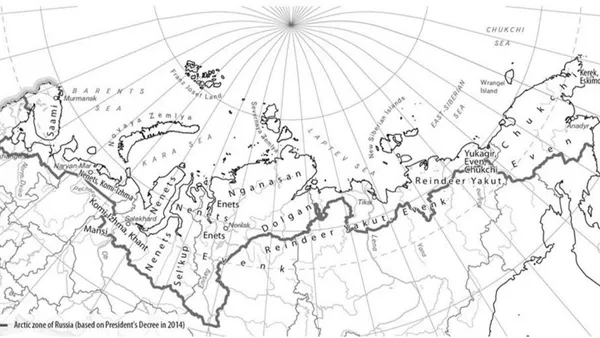
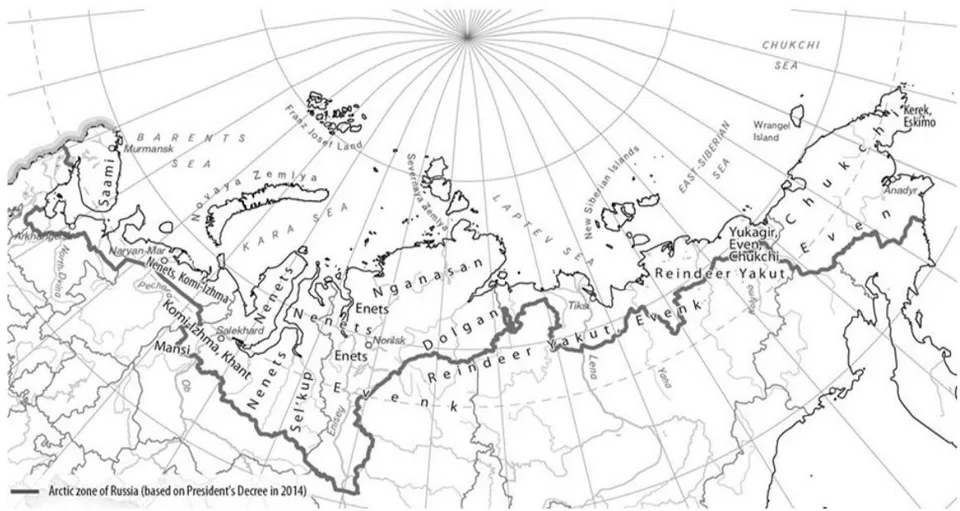
Cultural landscape studies were carried out for several decades in the Russian Arctic zone. Case studies described in this paper concerned two regions in the European part of the Russian Arctic zone (fig.1). Their indigenous population includes mainly Saami, Nenets belonging to northern minorities and old-settlers– Pomors- Russian sub-ethnic group. Traditional nature use territories (TTNU) includes reindeer breeding, hunting, fishing, wild plants picking. Nenets family-clan territories are still managed according to ethnic traditions in a certain way adapted to modern life.
Modern land use types at the studied areas are mainly TTNU and transport. Two areas present parts of the planned zones of advanced economic development; industrial (platinum group ores extraction in Fedorova-Pansky tundra) and transport (the Northern Sea Route port construction in Indiga). New land use patterns may overlap TTNU, thus promoting environment management conflicts development leading to social destabilization.
III. MATERIALS AND METHODS
Published data supported by our field experiences present materials of this study. The principle investigation method was system analysis.
IV. RESULTS AND DISCUSSION
a) Cultural landscapes composition
A cultural landscape integrated model which reflects the humanitarian-geographical approach includes six components: spiritual culture, local society, local economy, settlement pattern, language system, and natural landscape (fig.2). Their coherent development stimulates mutual adaptation and defines common characteristics of cultural landscapes evolution. Various connections of man and nature are reflected in nature management systems, settling patterns, toponomy, spiritual culture, etc. belonging to local culture.
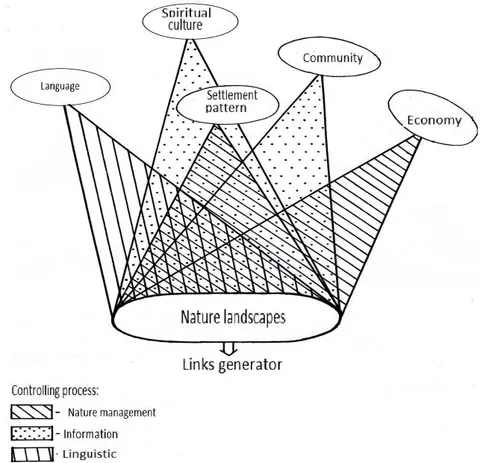
Nature management ideology controls methods of natural landscapes economic development.
b) Cultural landscapes palimpsest
Cultural landscapes of the Russian Arctic remind a palimpsest where historical spatial fragments are being combined with modern. Very often modern cultural landscapes overlap historical making their existence virtual, known only to the indigenous population. The same happens with different-aged modern cultural landscapes as well, but their virtual variants are known to old-settlers. Different spatial structure, dimensions, and management practice of historical indigenous and modern cultural landscapes explain the present day palimpsest existence.
i. The historical structure of indigenous cultural landscapes
Indigenous peoples of the North TTNU represent the initial pattern of cultural landscapes. A similar process was typical for old-settlers- Pomors. Cultural landscapes of indigenous peoples of the North social and spatial structure reflects close connections of culture (spiritual, economic, etc.) and natural environment in the course of nature management (fig.2). Cultural landscapes of indigenous peoples of the North are being visualized in patterns of economic development of a territory preserved till now, their semiotic system, toponomy, and a spatial-temporal characteristics.
These characteristics are as follows [Krasovskaya, 2011]:
Multi-scale space – the existence of several organizational levels (from a nomadic camp to the entire Arctic);
Specific "local time" formed by the original cultural, geopolitical, economic environment when local traditional nature management practices and traditional communities appeared;
Dynamic character: nomadic nuclei centers, patterns of nature management, and seasonal territorial organization of economy;
A semiotic arrangement that reflects organic unity of man and nature; feeling part of it;
Low polarization and nature-defined boundaries; and
Existence of images and symbols formed by regional identity.
Indigenous peoples' historical cultural landscapes occupy the whole region representing multiscale spatial differentiation: remote territories are often sacral mythological grounds, internal structure boundaries are nature defined traditionally, the indigenous community is a well-developed type of social organization. It controls ethnic mentality, traditions, settling patterns and nature management type. Indigenous cultural landscapes are saturated with symbols and sense almost always invisible to newcomers. Even more than that, very often, this information is kept secret. Together with natural environment archetypes, cultural landscapes form ideal images known to indigenous population and important to support regional identities. They may be regarded as cultural heritage in our modern world. Loss of cultural landscapes means depletion of the culture of indigenous peoples of the North.
Regarding the structure of indigenous cultural landscapes nowadays one may conclude that all their elements are still being preserved to a certain extent at the territory, but some of them are virtual, known to indigenous population and ethnologists. Fig.3 presents modern Babinsky Saami cultural landscapes map. Their community economy includes reindeer breeding, fishing, and hunting as well as berries harvesting, which form TTNU structure adapted to the environment. Sacral pagan places are still being preserved. There is no more traditional semi-nomadic settling pattern, the language was replaced by Russian, but regional identity exists. This map was compiled using local ecosystems map and manuscript Saami map presenting traditional pattern of reindeer breeding, settlements, sacral places, hunting and fishing grounds, Saami toponomy (ex."Girvas"- means "reindeer"). This map replaced routine social studies needed for mapping.
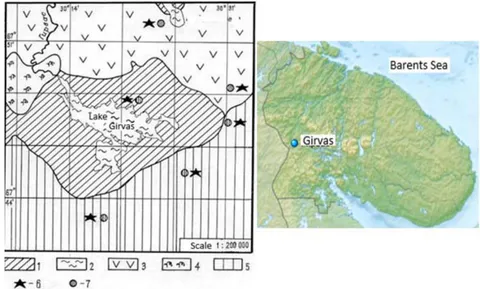
1- Pasture lands in lacustrine valleys; 2 – lake fishing grounds; 3 Hunting grounds at rolling taiga plains; 4-Berries harvesting grounds at bogged lacustrine and alluvial plains with pine forests; 5 - Combinations of hunting and berries harvesting grounds at hilly taiga plainskom; 6-sacral places; 7 -settling grounds.
ii. Modern cultural landscape structure of newsettlers.
Modern cultural landscapes appeared only at the beginning of the 20 c. and were mainly connected with industry development due to rich mineral resources deposits. Newsettlers from Central Russia founded cities, constructed plants, roads, electricity and pipe lines, etc., thus launching radical environmental changes. Newcomers were brought up in a different environment where nature management was based on European cultural canons. They adhere to different from aborigines' world outlook principles (i.e., anthropocentrism); they often do not accept the integrity of aborigine cultural landscapes at TTNU and even ignore their existence treating such lands as virgin. Spatial structure of modern cultural landscapes may be characterized as fragmented and polarized: industrial and transport centers such as Murmansk, Norilsk, Salehard, etc. form core zones surrounded by the anthropogenically transformed environment and vast non-used in modern economy lands.
Thus, sharp contrasts in cultural landscape structure and management are vivid and may provoke nature management conflicts leading to ethnic-social destabilization and cultural heritage loss in case they overlap each other or exist only virtually in the historical memory of the indigenous population.
iii. Empty spaces in cultural landscapes structure
Virgin lands for modern developers often appear to be fragments of historical indigenous cultural landscapes. Their different spatial structure and elements belonging to spiritual culture are invisible for newcomers. Nowadays, cultural landscapes palimpsest includes free spaces connected with the following:
radical differences in the spatial structure of indigenous and modern cultural landscapes;
specific "local time" of cultural landscapes formation;
different perception of space and management ideology;
inadequate historical and ethnic-cultural knowledge.
These "empty spaces" in modern economic development lead to social destabilization connected with economic losses of indigenous population and violation of their culture. Case studies described below, demonstrate this problem.
Indiga
Construction of a new sea port and its infrastructure, enlargement of settling territories will seize TTNU of Nenets and Pomors. Indiga settlement was founded about 100 years ago, but Pomor summer camps appeared there much earlier. Nenets and Pomors cultural landscapes developed in similar natural landscapes (fig.4). Close to traditional economy nature management (reindeer breeding – for Nenets; fishing and hunting – for Pomors) is partly preserved. Their spoken language- Pomor variant of Russian (ex. Губа- Bay, but not "Залив" in traditional Russian) and Nenets, local toponomy (ex. "Indiga" means in Nenets "river with fast current" or "misty river"), folklore, traditions (ex."Reindeer Day" festival) are preserved. A new type of economic development will result in breaking fishing and hunting grounds, reduction of reindeer pastures, thus destroying the traditional economy element of cultural landscapes. Newcomers will compete with the local population for many ecosystems services which pools are limited (table 1, Fig.4). Such activities may lead to natural landscapes degradation, i.e., the basement for cultural landscape may be destroyed.
Minor changes began at this territory in 1926 when more than 50 family-clan lands were united in a collective farm. Construction of fish canary followed. But local cultural landscapes experienced no radical changes due to the remoteness of this place. Transit to a market economy by the end of the 20 c. and the economic crisis turned people to their traditional economic activities and lifestyle to survive for many years.
| Ecosystem/Ecosystem service | Flat bogged marine terraces with tundra | Heightened marine and glacial marine terraces with tundra | Rolling and hilly drained marine plains with tundra | River flood plains with northern taiga | Heightened rolling marine plains with forest-tundra | Low marine terraces with northern taiga | Polygonal tundra peat bogs |
| Regulating | ++ | ++ | ++ | +++ | ++ | ++ | ++ |
| Provisioning | + | ++ | ++ | +++ | ++ | +++ | + |
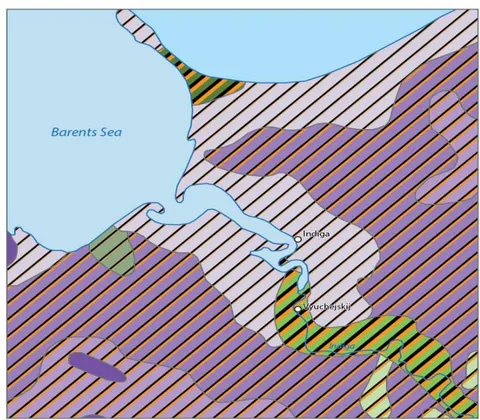
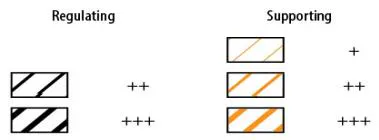
Modern economic development pattern will first, change the economic element in cultural landscapes structure; other inevitable changes may be not so vivid. The local population will be involved in the modern economy, disperse among the newcomers and will live in a different cultural background. It is a well-known fact that basic knowledge and skills of the indigenous population are not in demand in the modern economy, thus making it jobless. Local identities are strong enough nowadays but have a chance to preserve only virtual cultural landscapes. No historical studies are being planned, though Pomor population penetrated to these lands as early as in the 18 c. from Mezen', established contacts with Nenets, developed cross-cultural communications in different spheres beneficial for both ethnic groups. This nature management and relations patterns present cultural heritage, which needs studies and preservation. Nowadays only the suspension bridge and the old wooden school building are regarded as cultural heritage. Newcomers may radically change indigenous cultural landscapes destroying their natural basement, spatial organization, community patterns, violate unknown to them symbolic structure. This will provoke nature management conflict of both economic and ethnic-social origin.
Fedorova-Pansky tundra
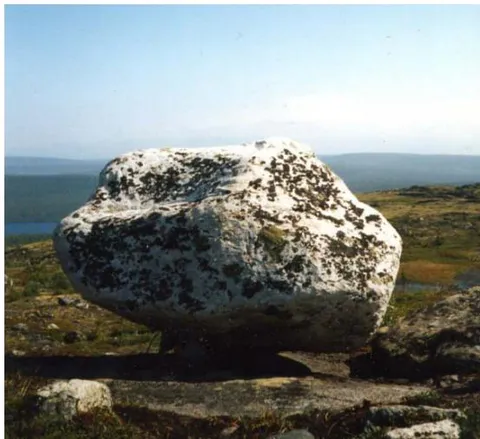
The study area is referred to as Saami family-clan lands and presents a typical TTNU in northern taiga natural landscapes. Traditional economy is based on reindeer breeding, fishing, hunting, berries harvesting. The traditional spatial structure includes economically exploited and pagan sacral objects marked by seids (fig.5). Saami language is spoken mainly by the elderly population. Semi-nomadic lifestyle and traditional nature management pattern are being preserved. Thus, the traditional cultural landscape is represented at this territory.
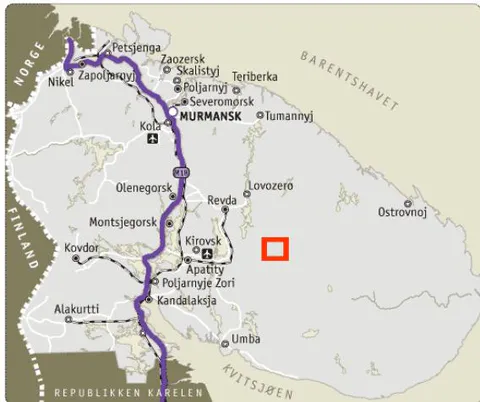
More than 1000 newcomers will settle at the territory compared to approximately the same total number of Saami rural population in Russia. Ore deposits will be depleted in 20 years. Exploitation period will radically change natural landscapes as it happened in other mining territories of the Kola peninsula-Monchegorsk, Kirovsk, Nickel, etc. Reindeer pastures may experience air pollution load and mechanical disruptions, hunting grounds - reduction of the game because of noise and pollution impact, poaching, etc. During public hearings, Saami stated that this territory belonged to sacral lands not only for the local community. This fact demands a search for a compromise to preserve at least fragments of Saami cultural landscape, keeping in mind that Saami belongs to northern minorities with a shrinking population.
V. REVEALING AND MAPPING OF CULTURAL LANDSCAPES TO BRIDGE THEIR "GAPS"
The existence of unaltered indigenous cultural landscapes is hardly possible. But even consideration for their fragments may help to preserve indigenous cultural heritage and avoid nature management conflicts. This is also important for improvement of regional nature management planning policies with adequate regard for social-cultural issues. The procedure of revealing and mapping of indigenous cultural landscapes is rather complicated. Firstly historical and ethnological information is needed. It helps to identify different spatial elements of initial cultural landscapes or their virtual boundaries in case they disappeared. When the appropriate database is available, two methods for identification and mapping are possible: traditional (see lake Girvas case above) and with the help of fuzzy classification algorithm [Tikunov, 1997]. This procedure enables one to refer territorial units either to unique categories, or, in the case of their transit character, to several categories with different attributive functions. Clusters of cultural landscapes may be found by expert evaluation of the modelling resulats. We used this method to compile a small-scale cultural landscapes map for Hanty-Mansi Autonomous Okrug (Federal region) where indigenous peoples of the North live [Krasovskaya, Kotova and Tikunov, 2006].
VI. CONCLUSION
During the last several decades the legislation on indigenous peoples of the North was formulated in the Russian Federation as a specific multi-sectoral segment. The legislation consists of two blocks of laws and regulations – federal and regional. In some cases regional legislation is more advanced. Indigenous population culture nowadays is regarded in the state Arctic Doctrine as a strategic resource for Russian economy development based on innovations and knowledge, including the traditional practice of indigenous population nature management. But at the same time priorities are often given to modern industrial and transport nature management. If it concerns TTNU compensatory measures to cover economic losses exist. Lack of adequate knowledge of cultural landscapes palimpsests often make territorial planning procedure free from the preservation of the cultural heritage of the indigenous population and even their natural landscapes which form its ethnic culture. Indigenous cultural landscape studies reveal patterns and methods of sustainable nature management adapted to the Arctic environment. Their modern understanding may benefit the transit to sustainable management practice nowadays. The discussed issues are also of interest for the preservation of historical cultural landscapes of other types (urban, industrial) as cultural heritage.