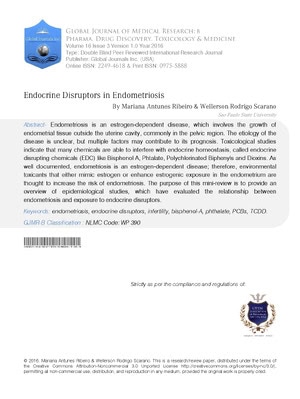
Endocrine Disruptors in Endometriosis

Wellerson Rodrigo Scarano
Mariana Antunes Ribeiro
Universidade Estadual Paulista (Unesp) Universidade Estadual Paulista (Unesp)

Send Message

To: Author

Endocrine Disruptors in Endometriosis

Article Fingerprint

ReserarchID

PDDTMYCBS7

Endocrine Disruptors in Endometriosis Banner

AI TAKEAWAY

Connecting with the Eternal Ground
  • English
  • Afrikaans
  • Albanian
  • Amharic
  • Arabic
  • Armenian
  • Azerbaijani
  • Basque
  • Belarusian
  • Bengali
  • Bosnian
  • Bulgarian
  • Catalan
  • Cebuano
  • Chichewa
  • Chinese (Simplified)
  • Chinese (Traditional)
  • Corsican
  • Croatian
  • Czech
  • Danish
  • Dutch
  • Esperanto
  • Estonian
  • Filipino
  • Finnish
  • French
  • Frisian
  • Galician
  • Georgian
  • German
  • Greek
  • Gujarati
  • Haitian Creole
  • Hausa
  • Hawaiian
  • Hebrew
  • Hindi
  • Hmong
  • Hungarian
  • Icelandic
  • Igbo
  • Indonesian
  • Irish
  • Italian
  • Japanese
  • Javanese
  • Kannada
  • Kazakh
  • Khmer
  • Korean
  • Kurdish (Kurmanji)
  • Kyrgyz
  • Lao
  • Latin
  • Latvian
  • Lithuanian
  • Luxembourgish
  • Macedonian
  • Malagasy
  • Malay
  • Malayalam
  • Maltese
  • Maori
  • Marathi
  • Mongolian
  • Myanmar (Burmese)
  • Nepali
  • Norwegian
  • Pashto
  • Persian
  • Polish
  • Portuguese
  • Punjabi
  • Romanian
  • Russian
  • Samoan
  • Scots Gaelic
  • Serbian
  • Sesotho
  • Shona
  • Sindhi
  • Sinhala
  • Slovak
  • Slovenian
  • Somali
  • Spanish
  • Sundanese
  • Swahili
  • Swedish
  • Tajik
  • Tamil
  • Telugu
  • Thai
  • Turkish
  • Ukrainian
  • Urdu
  • Uzbek
  • Vietnamese
  • Welsh
  • Xhosa
  • Yiddish
  • Yoruba
  • Zulu
Font Type
Font Size
Font Size
Bedground

Abstract

Endometriosis is an estrogen-dependent disease, which involves the growth of endometrial tissue outside the uterine cavity, commonly in the pelvic region. The etiology of the disease is unclear, but multiple factors may contribute to its prognosis. Toxicological studies indicate that many chemicals are able to interfere with endocrine homeostasis, called endocrine disrupting chemicals (EDC) like Bisphenol A, Phtalate, Polychlorinated Biphenyls and Dioxins. As well documented, endometriosis is an estrogen-dependent disease; therefore, environmental toxicants that either mimic estrogen or enhance estrogenic exposure in the endometrium are thought to increase the risk of endometriosis. The purpose of this mini-review is to provide an overview of epidemiological studies, which have evaluated the relationship between endometriosis and exposure to endocrine disruptors.

References

35 Cites in Article
  1. Sohel Ahmed,Masahiko Shibazaki,Takashi Takeuchi,Hideaki Kikuchi (2005). Protein kinase Cθ activity is involved in the 2,3,7,8‐tetrachlorodibenzo‐<i>p</i>‐dioxin‐induced signal transduction pathway leading to apoptosis in L‐MAT, a human lymphoblastic T‐cell line.
  2. Océane Albert,Bernard Jégou (2013). A critical assessment of the endocrine susceptibility of the human testis to phthalates from fetal life to adulthood.
  3. E Attar,S Bulun (2006). Aromatase and other steroidogenic genes in endometriosis: translational aspects.
  4. R Barbieri (1990). Etiology and epidemiology of endometriosis.
  5. Martin Van Den Berg,Linda Birnbaum,Michael Denison,Mike De Vito,William Farland,Mark Feeley,Heidelore Fiedler,Helen Hakansson,Annika Hanberg,Laurie Haws,Martin Rose,Stephen Safe,Dieter Schrenk,Chiharu Tohyama,Angelika Tritscher,Jouko Tuomisto,Mats Tysklind,Nigel Walker,Richard Peterson (2006). The 2005 World Health Organization Reevaluation of Human and Mammalian Toxic Equivalency Factors for Dioxins and Dioxin-Like Compounds.
  6. P Bigey (2000). Transcriptional regulation of the human DNA Methyltransferase (dnmt1) gene.
  7. F Bischoff,J Leigh (2004). Unknown Title.
  8. Buck Louis,G (2013). Bisphenol A and phthalates and endometriosis: the Endometriosis: Natural History, Diagnosis and Outcomes Study.
  9. K Burns (2012). Role of estrogen receptor signaling required for endometriosis-like lesion establishment in a mouse model.
  10. D Caserta (2008). Impact of endocrine disruptor chemicals in gynaecology.
  11. Donatella Caserta,Giulia Bordi,Francesca Ciardo,Roberto Marci,Cinzia La Rocca,Sabrina Tait,Bruno Bergamasco,Laura Stecca,Alberto Mantovani,Cristiana Guerranti,Emiliano Fanello,Guido Perra,Francesca Borghini,Silvano Focardi,Massimo Moscarini (2013). The influence of endocrine disruptors in a selected population of infertile women.
  12. Wen-Chang Chang,Jan-Jong Hung (2012). Functional role of post-translational modifications of Sp1 in tumorigenesis.
  13. L Cobellis (2009). Measurement of bisphenol A and bisphenol B levels in human blood sera from healthy and endometriotic women.
  14. W Foster,S Maharaj-Briceño,D Cyr (2010). Dioxin-induced changes in epididymal sperm count and spermatogenesis.
  15. S.-W Guo (2009). Epigenetics of endometriosis.
  16. Jouko Halme,Susanne Becker,Richard Wing (1984). Accentuated cyclic activation of peritoneal macrophages in patients with endometriosis.
  17. S Han (2015). Estrogen Receptor β Modulates Apoptosis Complexes and the Inflammasome to Drive the Pathogenesis of Endometriosis.
  18. Fred Howard (1993). The Role of Laparoscopy in Chronic Pelvic Pain: Promise and Pitfalls.
  19. C Ishida (2003). Genomic organization and promoter analysis of the Dnmt3b gene.
  20. Hiroaki Itoh,Motoki Iwasaki,Tomoyuki Hanaoka,Hiroshi Sasaki,Tadao Tanaka,Shoichiro Tsugane (2007). Urinary bisphenol-A concentration in infertile Japanese women and its association with endometriosis: A cross-sectional study.
  21. M Kogevinas (2001). Human health effects of dioxins: cancer, reproductive and endocrine system effects.
  22. Yong Lee,Karen Oslund,Philip Thai,Sharlene Velichko,Tomoyuki Fujisawa,Trang Duong,Michael Denison,Reen Wu (2011). 2,3,7,8-Tetrachlorodibenzo-p-dioxin–Induced <i>MUC5AC</i> Expression.
  23. M Levin (2005). Non-coplanar PCB-mediated modulation of human leukocyte phagocytosis: a new mechanism for immunotoxicity.
  24. Alberto Mantovani (2006). Risk Assessment of Endocrine Disrupters.
  25. J Mimura,Y Fujii-Kuriyama (2003). Functional role of AhR in the expression of toxic effects by TCDD.
  26. Eunha Oh,Eunil Lee,Hosub Im,Hyung-Sik Kang,Woon-Won Jung,Nam Won,Eun-Mi Kim,Donggeun Sul (2005). Evaluation of immuno- and reproductive toxicities and association between immunotoxicological and genotoxicological parameters in waste incineration workers.
  27. N Puebla-Osorio,K Ramos,M Falahatpisheh,R Smith,L Berghman (2004). 2,3,7,8-Tetrachlorodibenzo-p-dioxin elicits aryl hydrocarbon receptor-mediated apoptosis in the avian DT40 pre-B-cell line through activation of caspases 9 and 3.
  28. J Rawson (1991). Prevalence of endometriosis in asymptomatic women.
  29. Arnold Schecter,Linda Birnbaum,John Ryan,John Constable (2006). Dioxins: An overview.
  30. Y Shimizu (2000). Benzo[a]pyrene carcinogenicity is lost in mice lacking the aryl hydrocarbon receptor.
  31. P Simsa (2010). Increased exposure to dioxinlike compounds is associated with endometriosis in a case -control study in women.
  32. S Singh,S Li,-L (2012). Epigenetic effects of environmental chemicals bisphenol a and phthalates.
  33. Murat Ulukus,Hakan Cakmak,Aydin Arici (2006). The Role of Endometrium in Endometriosis.
  34. Kristen Upson,Sheela Sathyanarayana,Anneclaire De Roos,Mary Thompson,Delia Scholes,Russell Dills,Victoria Holt (2013). Phthalates and risk of endometriosis.
  35. Y Zhao (2015). Dual suppression of estrogenic and inflammatory activities for targeting of endometriosis.

Funding

No external funding was declared for this work.

Conflict of Interest

The authors declare no conflict of interest.

Ethical Approval

No ethics committee approval was required for this article type.

Data Availability

Not applicable for this article.

How to Cite This Article

Wellerson Rodrigo Scarano. 2016. \u201cEndocrine Disruptors in Endometriosis\u201d. Global Journal of Medical Research - B: Pharma, Drug Discovery, Toxicology & Medicine GJMR-B Volume 16 (GJMR Volume 16 Issue B3).
Download Citation

Journal Specifications

Crossref Journal DOI 10.17406/gjmra

Print ISSN 0975-5888

e-ISSN 2249-4618

Keywords
Classification
GJMR-B Classification NLMC Code: WP 390
Version of record

v1.2

Issue date
October 13, 2016

Language
en
Experiance in AR

Explore published articles in an immersive Augmented Reality environment. Our platform converts research papers into interactive 3D books, allowing readers to view and interact with content using AR and VR compatible devices.

Read in 3D

Your published article is automatically converted into a realistic 3D book. Flip through pages and read research papers in a more engaging and interactive format.

Article Matrices
Total Views: 3951
Total Downloads: 2008
2026 Trends
Related Research
Our website is actively being updated, and changes may occur frequently. Please clear your browser cache if needed. For feedback or error reporting, please email [email protected]

Request Access

Please fill out the form below to request access to this research paper. Your request will be reviewed by the editorial or author team.
X

Quote and Order Details

Contact Person

Invoice Address

Notes or Comments

This is the heading

Lorem ipsum dolor sit amet, consectetur adipiscing elit. Ut elit tellus, luctus nec ullamcorper mattis, pulvinar dapibus leo.


High-quality academic research articles on global topics and journals.

Endocrine Disruptors in Endometriosis

Mariana Antunes Ribeiro
Wellerson Rodrigo Scarano
Wellerson Rodrigo Scarano <p>Universidade Estadual Paulista (Unesp)</p>

Research Journals