


Engineering Microfluids, Biosensors and Chip Analysis

1
Lekshmi Gangadhar
Lekshmi Gangadhar

Send Message

To: Author

GJSFR Volume 22 Issue C1

Article Fingerprint

ReserarchID

P4336

Engineering Microfluids, Biosensors and Chip Analysis Banner
  • English
  • Afrikaans
  • Albanian
  • Amharic
  • Arabic
  • Armenian
  • Azerbaijani
  • Basque
  • Belarusian
  • Bengali
  • Bosnian
  • Bulgarian
  • Catalan
  • Cebuano
  • Chichewa
  • Chinese (Simplified)
  • Chinese (Traditional)
  • Corsican
  • Croatian
  • Czech
  • Danish
  • Dutch
  • Esperanto
  • Estonian
  • Filipino
  • Finnish
  • French
  • Frisian
  • Galician
  • Georgian
  • German
  • Greek
  • Gujarati
  • Haitian Creole
  • Hausa
  • Hawaiian
  • Hebrew
  • Hindi
  • Hmong
  • Hungarian
  • Icelandic
  • Igbo
  • Indonesian
  • Irish
  • Italian
  • Japanese
  • Javanese
  • Kannada
  • Kazakh
  • Khmer
  • Korean
  • Kurdish (Kurmanji)
  • Kyrgyz
  • Lao
  • Latin
  • Latvian
  • Lithuanian
  • Luxembourgish
  • Macedonian
  • Malagasy
  • Malay
  • Malayalam
  • Maltese
  • Maori
  • Marathi
  • Mongolian
  • Myanmar (Burmese)
  • Nepali
  • Norwegian
  • Pashto
  • Persian
  • Polish
  • Portuguese
  • Punjabi
  • Romanian
  • Russian
  • Samoan
  • Scots Gaelic
  • Serbian
  • Sesotho
  • Shona
  • Sindhi
  • Sinhala
  • Slovak
  • Slovenian
  • Somali
  • Spanish
  • Sundanese
  • Swahili
  • Swedish
  • Tajik
  • Tamil
  • Telugu
  • Thai
  • Turkish
  • Ukrainian
  • Urdu
  • Uzbek
  • Vietnamese
  • Welsh
  • Xhosa
  • Yiddish
  • Yoruba
  • Zulu

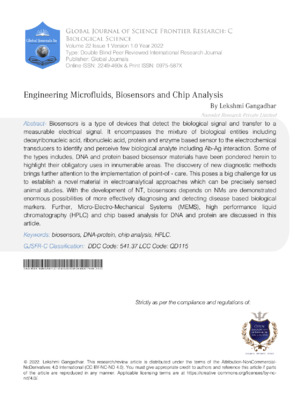
Biosensors is a type of devices that detect the biological signal and transfer to a measurable electrical signal. It encompasses the mixture of biological entities including deoxyribonucleic acid, ribonucleic acid, protein and enzyme based sensor to the electrochemical transducers to identify and perceive few biological analyte including Ab-Ag interaction. Some of the types includes, DNA and protein based biosensor materials have been pondered herein to highlight their obligatory uses in innumerable areas. The discovery of new diagnostic methods brings further attention to the implementation of point-of -care. This poses a big challenge for us to establish a novel material in electroanalytical approaches which can be precisely sensed animal studies. With the development of NT, biosensors depends on NMs are demonstrated enormous possibilities of more effectively diagnosing and detecting disease based biological markers. Further, Micro-Electro-Mechanical Systems (MEMS), high performance liquid chromatography (HPLC) and chip based analysis for DNA and protein are discussed in this article.

Funding

No external funding was declared for this work.

Conflict of Interest

The authors declare no conflict of interest.

Ethical Approval

No ethics committee approval was required for this article type.

Data Availability

Not applicable for this article.

Lekshmi Gangadhar. 2026. \u201cEngineering Microfluids, Biosensors and Chip Analysis\u201d. Global Journal of Science Frontier Research - C: Biological Science GJSFR-C Volume 22 (GJSFR Volume 22 Issue C1): .

Download Citation

Alt text only: Microfluidics, biosensors, and chip analysis for medical and scientific applications.
Journal Specifications

Crossref Journal DOI 10.17406/GJSFR

Print ISSN 0975-5896

e-ISSN 2249-4626

Keywords
Classification
GJSFR-C Classification: DDC Code: 541.37 LCC Code: QD115
Version of record

v1.2

Issue date

April 20, 2022

Language

English

Experiance in AR

The methods for personal identification and authentication are no exception.

Read in 3D

The methods for personal identification and authentication are no exception.

Article Matrices
Total Views: 1630
Total Downloads: 28
2026 Trends
Research Identity (RIN)
Related Research

Published Article

Biosensors is a type of devices that detect the biological signal and transfer to a measurable electrical signal. It encompasses the mixture of biological entities including deoxyribonucleic acid, ribonucleic acid, protein and enzyme based sensor to the electrochemical transducers to identify and perceive few biological analyte including Ab-Ag interaction. Some of the types includes, DNA and protein based biosensor materials have been pondered herein to highlight their obligatory uses in innumerable areas. The discovery of new diagnostic methods brings further attention to the implementation of point-of -care. This poses a big challenge for us to establish a novel material in electroanalytical approaches which can be precisely sensed animal studies. With the development of NT, biosensors depends on NMs are demonstrated enormous possibilities of more effectively diagnosing and detecting disease based biological markers. Further, Micro-Electro-Mechanical Systems (MEMS), high performance liquid chromatography (HPLC) and chip based analysis for DNA and protein are discussed in this article.

Our website is actively being updated, and changes may occur frequently. Please clear your browser cache if needed. For feedback or error reporting, please email [email protected]
×

This Page is Under Development

We are currently updating this article page for a better experience.

Request Access

Please fill out the form below to request access to this research paper. Your request will be reviewed by the editorial or author team.
X

Quote and Order Details

Contact Person

Invoice Address

Notes or Comments

This is the heading

Lorem ipsum dolor sit amet, consectetur adipiscing elit. Ut elit tellus, luctus nec ullamcorper mattis, pulvinar dapibus leo.


High-quality academic research articles on global topics and journals.

Engineering Microfluids, Biosensors and Chip Analysis

Lekshmi Gangadhar
Lekshmi Gangadhar

Research Journals




























































