Engineering Microfluids, Biosensors and Chip Analysis

Lekshmi Gangadhar
Lekshmi Gangadhar

Send Message

To: Author

Engineering Microfluids, Biosensors and Chip Analysis

Article Fingerprint

ReserarchID

P4336

Engineering Microfluids, Biosensors and Chip Analysis Banner

AI TAKEAWAY

Connecting with the Eternal Ground
  • English
  • Afrikaans
  • Albanian
  • Amharic
  • Arabic
  • Armenian
  • Azerbaijani
  • Basque
  • Belarusian
  • Bengali
  • Bosnian
  • Bulgarian
  • Catalan
  • Cebuano
  • Chichewa
  • Chinese (Simplified)
  • Chinese (Traditional)
  • Corsican
  • Croatian
  • Czech
  • Danish
  • Dutch
  • Esperanto
  • Estonian
  • Filipino
  • Finnish
  • French
  • Frisian
  • Galician
  • Georgian
  • German
  • Greek
  • Gujarati
  • Haitian Creole
  • Hausa
  • Hawaiian
  • Hebrew
  • Hindi
  • Hmong
  • Hungarian
  • Icelandic
  • Igbo
  • Indonesian
  • Irish
  • Italian
  • Japanese
  • Javanese
  • Kannada
  • Kazakh
  • Khmer
  • Korean
  • Kurdish (Kurmanji)
  • Kyrgyz
  • Lao
  • Latin
  • Latvian
  • Lithuanian
  • Luxembourgish
  • Macedonian
  • Malagasy
  • Malay
  • Malayalam
  • Maltese
  • Maori
  • Marathi
  • Mongolian
  • Myanmar (Burmese)
  • Nepali
  • Norwegian
  • Pashto
  • Persian
  • Polish
  • Portuguese
  • Punjabi
  • Romanian
  • Russian
  • Samoan
  • Scots Gaelic
  • Serbian
  • Sesotho
  • Shona
  • Sindhi
  • Sinhala
  • Slovak
  • Slovenian
  • Somali
  • Spanish
  • Sundanese
  • Swahili
  • Swedish
  • Tajik
  • Tamil
  • Telugu
  • Thai
  • Turkish
  • Ukrainian
  • Urdu
  • Uzbek
  • Vietnamese
  • Welsh
  • Xhosa
  • Yiddish
  • Yoruba
  • Zulu
Font Type
Font Size
Font Size
Bedground

Abstract

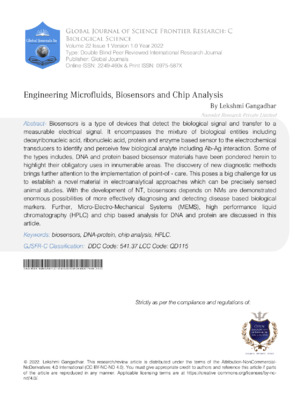
Biosensors is a type of devices that detect the biological signal and transfer to a measurable electrical signal. It encompasses the mixture of biological entities including deoxyribonucleic acid, ribonucleic acid, protein and enzyme based sensor to the electrochemical transducers to identify and perceive few biological analyte including Ab-Ag interaction. Some of the types includes, DNA and protein based biosensor materials have been pondered herein to highlight their obligatory uses in innumerable areas. The discovery of new diagnostic methods brings further attention to the implementation of point-of -care. This poses a big challenge for us to establish a novel material in electroanalytical approaches which can be precisely sensed animal studies. With the development of NT, biosensors depends on NMs are demonstrated enormous possibilities of more effectively diagnosing and detecting disease based biological markers. Further, Micro-Electro-Mechanical Systems (MEMS), high performance liquid chromatography (HPLC) and chip based analysis for DNA and protein are discussed in this article.

References

73 Cites in Article
  1. A Sassolas,L Blum,Leca-Bouvier Bd (2012). Immobilization strategies to develop enzymatic biosensors.
  2. Shruti Nambiar,John Yeow (2011). Conductive polymer-based sensors for biomedical applications.
  3. S Arya,S Saha,J Ramirez-Vick,V Gupta,S Bhansali,S Singh (2012). Recent advances in ZnO nanostructures and thin films for biosensor applications.
  4. J Wang (1999). Sol-gel materials for electrochemical biosensors.
  5. Joseph Wang,Danke Xu,Abdel-Nasser Kawde,Ronen Polsky (2001). Metal Nanoparticle-Based Electrochemical Stripping Potentiometric Detection of DNA Hybridization.
  6. Suxia Zhang,Nü Wang,Huijun Yu,Yaming Niu,Changqing Sun (2005). Covalent attachment of glucose oxidase to an Au electrode modified with gold nanoparticles for use as glucose biosensor.
  7. Joseph Wang (2005). Carbon‐Nanotube Based Electrochemical Biosensors: A Review.
  8. Joseph Wang (2005). Nanomaterial-based electrochemical biosensors.
  9. Anwei Zhu,Qiang Qu,Xiangling Shao,Biao Kong,Yang Tian (2012). Carbon‐Dot‐Based Dual‐Emission Nanohybrid Produces a Ratiometric Fluorescent Sensor for In Vivo Imaging of Cellular Copper Ions.
  10. Kevin Cash,Heather Clark (2010). Nanosensors and nanomaterials for monitoring glucose in diabetes.
  11. S Takayama (2009). Microfluidics cell culture with sensing and SqueezeFluidics.
  12. M Uhlén,L Fagerberg,B Hallström,C Lindskog,P Oksvold,A Mardinoglu,Å Sivertsson,C Kampf,E Sjöstedt,A Asplund,I Olsson (2015). Tissue-based map of the human proteome.
  13. Eric Sackmann,Anna Fulton,David Beebe (2014). The present and future role of microfluidics in biomedical research.
  14. Alireza Yazdi,Adam Popma,William Wong,Tammy Nguyen,Yayue Pan,Jie Xu (2016). 3D printing: an emerging tool for novel microfluidics and lab-on-a-chip applications.
  15. I Johnston,D Mccluskey,C Tan,M Tracey (2014). Mechanical characterization of bulk Sylgard 184 for microfluidics and microengineering.
  16. Kweku Addae‐mensah,Zuankai Wang,Hesam Parsa,Sau Chin,Tassaneewan Laksanasopin,Samuel Sia (2015). Fundamentals of Microfluidics Devices.
  17. J Fourkas,C Lafratta,College University Of Maryland,Park (2014). PROCEEDINGS OF THE THIRD ANNUAL EASTERN UNITED STATES THEORETICAL PHYSICS CONFERENCE, UNIVERSITY OF MARYLAND, COLLEGE PARK, MARYLAND, OCTOBER 30-31, 1964.
  18. J Nilsson,M Evander,B Hammarström,T Laurell (2009). Review of cell and particle trapping in microfluidic systems.
  19. Janice Chen,Enbo Ma,Lucas Harrington,Maria Da Costa,Xinran Tian,Joel Palefsky,Jennifer Doudna (2018). CRISPR-Cas12a target binding unleashes indiscriminate single-stranded DNase activity.
  20. Jonathan Gootenberg,Omar Abudayyeh,Max Kellner,Julia Joung,James Collins,Feng Zhang (2018). Multiplexed and portable nucleic acid detection platform with Cas13, Cas12a, and Csm6.
  21. Na,Nam Lee,H Shin,S (2018). Rapid molecular diagnosis of infectious viruses in microfluidics using DNA hydrogel formation.
  22. Yu-Fang Lee,Kang-Yi Lien,Huan-Yao Lei,Gwo-Bin Lee (2009). An integrated microfluidic system for rapid diagnosis of dengue virus infection.
  23. Lien-Yu Hung,Tze-Bin Huang,Yi-Che Tsai,Chen-Sheng Yeh,Huan-Yao Lei,Gwo-Bin Lee (2013). A microfluidic immunomagnetic bead-based system for the rapid detection of influenza infections: from purified virus particles to clinical specimens.
  24. M Arafat,B Dinan,S Akbar,A Haseeb (2012). Gas sensors based on one dimensional nanostructured metal-oxides: a review.
  25. Xicheng Ma (2012). Towards Enhanced SnO<SUB>2</SUB> Gas Sensor: Mini-Review.
  26. Yu-Feng Sun,Shao-Bo Liu,Fan-Li Meng,Jin-Yun Liu,Zhen Jin,Ling-Tao Kong,Jin-Huai Liu (2012). Metal Oxide Nanostructures and Their Gas Sensing Properties: A Review.
  27. Hua Bai,Gaoquan Shi (2007). Gas Sensors Based on Conducting Polymers.
  28. Jing Kong,Nathan Franklin,Chongwu Zhou,Michael Chapline,Shu Peng,Kyeongjae Cho,Hongjie Dai (2000). Nanotube Molecular Wires as Chemical Sensors.
  29. Ashish Modi,Nikhil Koratkar,Eric Lass,Bingqing Wei,Pulickel Ajayan (2003). Miniaturized gas ionization sensors using carbon nanotubes.
  30. Andreas Guber,Mathias Heckele,Dirk Herrmann,Alban Muslija,Volker Saile,Lutz Eichhorn,Thomas Gietzelt,Werner Hoffmann,Peter Hauser,Jatisai Tanyanyiwa,Andreas Gerlach,Norbert Gottschlich,Günther Knebel (2004). Microfluidic lab-on-a-chip systems based on polymers—fabrication and application.
  31. Madhavi Krishnan,Vijay Namasivayam,Rongsheng Lin,Rohit Pal,Mark Burns (2001). Microfabricated reaction and separation systems.
  32. Joel Voldman (2006). ELECTRICAL FORCES FOR MICROSCALE CELL MANIPULATION.
  33. M Gama,C Collins,C Bottoli (2013). Nano-Liquid Chromatography in Pharmaceutical and Biomedical Research.
  34. Yoshihiro Saito,Kiyokatsu Jinno,Tyge Greibrokk (2004). Capillary columns in liquid chromatography: between conventional columns and microchips.
  35. Javier Hernández‐borges,Zeineb Aturki,Anna Rocco,Salvatore Fanali (2007). Recent applications in nanoliquid chromatography.
  36. N Yandamuri,Sk ; Dinakaran,J Vissers,H Claessens,C Cramers (1997). Microcolumn liquid chromatography: Instrumentation, detection and applications.
  37. L Rieux,E.-J Sneekes,R Swart (2011). Nano LC: Principles, evolution, and state-of-the-art of the technique.
  38. Anastasia Zotou (2012). An overview of recent advances in HPLC instrumentation.
  39. B Belen'kii,E Gankina,' Mal (1987). Capillary liquid chromatography.
  40. Marek Noga,Filip Sucharski,Piotr Suder,Jerzy Silberring (2007). A practical guide to nano‐LC troubleshooting.
  41. S He´ Ron,A Tchapla,J Chervet (2000). Influence of injection parameters on column performance in nanoscale high-performance liquid chromategraphy.
  42. Klaus Unger,Romas Skudas,Michael Schulte (2008). Particle packed columns and monolithic columns in high-performance liquid chromatography-comparison and critical appraisal.
  43. N Tanaka,M Motokawa,H Kobayashi,K Hosoya,T Ikegami (2003). Monolithic silica columns for capillary liquid chromatography. In Monolithic materials-Preparation, properties and applications.
  44. Yun Li,Milton Lee (2009). Biocompatible polymeric monoliths for protein and peptide separations.
  45. Ferry Heus,Martin Giera,Gerdien De Kloe,Dick Van Iperen,Joost Buijs,Tariq Nahar,August Smit,Henk Lingeman,Iwan De Esch,Wilfried Niessen,Hubertus Irth,Jeroen Kool (2010). Development of a microfluidic confocal fluorescence detection system for the hyphenation of nano-LC to on-line biochemical assays.
  46. D Pro¨ Frock (2010). Progress and possible applications of miniaturized separation techniques and elemental mass spectrometry for quantitative, heteroatomtagged proteomics.
  47. Yufeng Shen,Richard Smith (2005). Advanced nanoscale separations and mass spectrometry for sensitive high-throughput proteomics.
  48. R Yu,H Xing,R Liu,S Qing,Y Li,K (2012). Application of nano LC-MS/MS to the shotgun proteomic analysis of the nematocyst proteins from jellyfish Stomolophus meleagris.
  49. Hanna Amelina,Marcus Sjödin,Jonas Bergquist,Susana Cristobal (2011). Quantitative subproteomic analysis of age-related changes in mouse liver peroxisomes by iTRAQ LC–MS/MS.
  50. Serenus Hua,Charles Nwosu,John Strum,Richard Seipert,Hyun An,Angela Zivkovic,J German,Carlito Lebrilla (2012). Site-specific protein glycosylation analysis with glycan isomer differentiation.
  51. Yu‐chang Tyan,Ming‐hui Yang,Sharon Chen,Shiang‐bin Jong,Wen‐cheng Chen,Yuan‐han Yang,Tze‐wen Chung,Pao‐chi Liao (2011). Urinary protein profiling by liquid chromatography/tandem mass spectrometry: ADAM28 is overexpressed in bladder transitional cell carcinoma.
  52. José Huerta-Ocampo,Juan Osuna-Castro,Gisela Lino-López,Alberto Barrera-Pacheco,Guillermo Mendoza-Hernández,Antonio De León-Rodríguez,Ana Barba De La Rosa (2012). Proteomic analysis of differentially accumulated proteins during ripening and in response to 1-MCP in papaya fruit.
  53. Ronan Rogers,Moyez Dharsee,Suzanne Ackloo,Jeremy Sivak,John Flanagan (2011). Proteomics Analyses of Human Optic Nerve Head Astrocytes Following Biomechanical Strain.
  54. Y.-J Choi,S.-H Heo,J.-M Lee,J.-Y Cho (2001). Identification of azurocidin as a potential periodontitis biomarker by a proteomic analysis of gingival crevicular fluid.
  55. Jesús Mateos,Lucía Lourido,Patricia Fernández-Puente,Valentina Calamia,Carlos Fernández-López,Natividad Oreiro,Cristina Ruiz-Romero,Francisco Blanco (2012). Differential protein profiling of synovial fluid from rheumatoid arthritis and osteoarthritis patients using LC–MALDI TOF/TOF.
  56. N Majkic´ -Singh (2011). What is a Biomarker? From its Discovery to Clinical Application.
  57. A Atkinson,W Colburn,V Degruttola,D Demets,G Downing,D Hoth (2001). Biomarkers and surrogate endpoints: Preferred definitions and conceptual framework.
  58. Rocío García-Villalba,Alegría Carrasco-Pancorbo,Cristina Oliveras-Ferraros,Javier Menéndez,Antonio Segura-Carretero,Alberto Fernández-Gutiérrez (2012). Uptake and metabolism of olive oil polyphenols in human breast cancer cells using nano-liquid chromatography coupled to electrospray ionization–time of flight-mass spectrometry.
  59. M Sjo¨ Din,J Bergquist,M Wetterhall (2010). Mining ventricular cerebrospinal fluid from patients with traumatic brain injury using hexapeptide ligand libraries to search for trauma biomarkers.
  60. H.-Y Bai,S.-L Lin,Y.-T Chung,T.-Y Liu,S.-A Chan,M.-R Fuh (2011). Quantitative determination of 8isoprostaglandin F2a in human urine using microfluidic chip-based nano-liquid chromategraphy with on-chip sample enrichment and tandem mass spectrometry.
  61. Chang-Kee Lim,Gwyn Lord (2002). Current Developments in LC-MS for Pharmaceutical Analysis.
  62. Shih-Huan Hsieh,Hsi-Ya Huang,Szetsen Lee (2009). Determination of eight penicillin antibiotics in pharmaceuticals, milk and porcine tissues by nano-liquid chromatography.
  63. Giovanni D’orazio,Silvia Rocchi,Salvatore Fanali (2012). Nano-liquid chromatography coupled with mass spectrometry: Separation of sulfonamides employing non-porous core–shell particles.
  64. Kevin Zhu,K Leung,Annie Ting,Zack Wong,Winki Ng,Roy Choi,Tina Dong,Tiejie Wang,David Lau,Karl Tsim (2012). Microfluidic chip based nano liquid chromatography coupled to tandem mass spectrometry for the determination of abused drugs and metabolites in human hair.
  65. K Sandra,I Stals,P Sandra,M Claeyssens,J Beeumen,B Devreese (2004). Combining gel and capillary electrophoresis, nano-LC and mass spectrometry for the elucidation of post-translational modifications of Trichoderma reesei cellobiohydrolase I.
  66. E Badaloni,M Barbarino,W Cabri,I D'acquarica,M Forte,F Gasparrini (2011). Efficient organic monoliths prepared by g-radiation induced polymerization in the evaluation of histone deacetylase inhibitors by capillary(nano)-high performance liquid chromatography and trap mass spectrometry.
  67. Mingxia Gao,Peng Zhang,Guangfeng Hong,Xia Guan,Guoquan Yan,Chunhui Deng,Xiangmin Zhang (2009). Novel monolithic enzymatic microreactor based on single-enzyme nanoparticles for highly efficient proteolysis and its application in multidimensional liquid chromatography.
  68. T Krˇı´zˇek,A Kubı´cˇkova´ (2012). Microscale separation methods for enzyme kinetic assays.
  69. Junfeng Ma,Zhen Liang,Xiaoqiang Qiao,Qiliang Deng,Dingyin Tao,Lihua Zhang,Yukui Zhang (2008). Organic−Inorganic Hybrid Silica Monolith Based Immobilized Trypsin Reactor with High Enzymatic Activity.
  70. Kishore Tetala,Teris Van Beek (2010). Bioaffinity chromatography on monolithic supports.
  71. Jonathan Cooper,Yueju Wang,Cheng Lee (2004). Recent advances in capillary separations for proteomics.
  72. M Szumski,B Buszewski (2002). State of the art in miniaturized separation techniques.
  73. (1988). Introduction to micro-scale high performance liquid chromatography.

Funding

No external funding was declared for this work.

Conflict of Interest

The authors declare no conflict of interest.

Ethical Approval

No ethics committee approval was required for this article type.

Data Availability

Not applicable for this article.

How to Cite This Article

Lekshmi Gangadhar. 2026. \u201cEngineering Microfluids, Biosensors and Chip Analysis\u201d. Global Journal of Science Frontier Research - C: Biological Science GJSFR-C Volume 22 (GJSFR Volume 22 Issue C1).
Download Citation

Alt text only: Microfluidics, biosensors, and chip analysis for medical and scientific applications.
Journal Specifications

Crossref Journal DOI 10.17406/GJSFR

Print ISSN 0975-5896

e-ISSN 2249-4626

Keywords
Classification
GJSFR-C Classification DDC Code: 541.37 LCC Code: QD115
Version of record

v1.2

Issue date
April 20, 2022

Language
en
Experiance in AR

Explore published articles in an immersive Augmented Reality environment. Our platform converts research papers into interactive 3D books, allowing readers to view and interact with content using AR and VR compatible devices.

Read in 3D

Your published article is automatically converted into a realistic 3D book. Flip through pages and read research papers in a more engaging and interactive format.

Article Matrices
Total Views: 1660
Total Downloads: 59
2026 Trends
Related Research
Our website is actively being updated, and changes may occur frequently. Please clear your browser cache if needed. For feedback or error reporting, please email [email protected]

Request Access

Please fill out the form below to request access to this research paper. Your request will be reviewed by the editorial or author team.
X

Quote and Order Details

Contact Person

Invoice Address

Notes or Comments

This is the heading

Lorem ipsum dolor sit amet, consectetur adipiscing elit. Ut elit tellus, luctus nec ullamcorper mattis, pulvinar dapibus leo.


High-quality academic research articles on global topics and journals.

Engineering Microfluids, Biosensors and Chip Analysis

Lekshmi Gangadhar
Lekshmi Gangadhar

Research Journals