
I. THE PROBLEM AND ITS BACKGROUND
a) Introduction
Entrepreneurship is a way of thinking that emphasizes opportunities over threats. The opportunity identification process is clearly an intentional process, and therefore, entrepreneurial intentions clearly merit our attention. Equally important, they offer a means to better explain and predict entrepreneurship.
It is well known that a career in entrepreneurship offers significant opportunities for individuals to achieve financial independence and benefit the economy by contributing to job creation, innovation, and economic growth. Today's students are tomorrow's potential entrepreneurs, which may explain why a growing number of universities offer courses and programs in entrepreneurship. However, there is little understanding of the factors that affect students' intentions of becoming entrepreneurs and the relationship between entrepreneurship education and students' entrepreneurial attitudes and intentions (Souitaris, 2010).
This study sought to contribute toward redressing this gap in our knowledge by experimental testing a model that draws on the theory of plan behavior to examine the antecedents of entrepreneurial intentions among students. The purpose of this study was to describe the nature of the individual attitudes, subjective norms and perceived control associated with their intentions to entrepreneurship, and to determine the extent to which personal attitudes, subjective norms, and perceptions of behavioral control influence students' intentions to entrepreneurship. In order to understand entrepreneurial intentions, it is necessary to understand first the main factors that drive students to start a business.
b) Research Objectives
This study aimed to determine the entrepreneurial intention of college students in Davao del Sur State College (DSSC) formerly known as a SPAMAST-Digos Campus.
Specifically, this study aimed to:
1. Demographic profile of business students
a. course b. year level c. age d. ethnicity
Ascertain the level of Personal attitude towards becoming an entrepreneurship, subjective norms, behavioral control and entrepreneurial intention of business students.
Determine the significant relationship between subjective norms band the personal attitude towards becoming an entrepreneur and perceived behavioral control of business students.
Identify significant relationship between business students' entrepreneurial intentions and subjective norms, personal attitude towards becoming an entrepreneur, and perceived behavioral control of business students.
Determine the problem encountered of business students.
c) Significance of the study
The study aimed to gather information of the entrepreneurial intention of college students in Davao del Sur State College (DSSC) formerly known as a Southern Philippines and Marine and Aquatic School of Technology (SPAMAST-Digos Campus).
Results of the study enable students to focus on the importance of factors that affect entrepreneurial intentions and to address problems/constraints identified in the study. Moreover, it is hopeful that the outputs of the study were valuable to the students, which may benefit from the result of the study since this provided reflections on factors affecting entrepreneurial intentions and the results might be outline base information for productive and efficient entrepreneurship. The researcher also benefits from the study in a way that it provides supplementary data; information's about the entrepreneurial intentions of college student while pursuing the degree.
Lastly, result of this study may be beneficial to future researchers who would like to study further using related studies and programs on the said concern.
d) Scope and Limitation of the Study
The study focused mainly on entrepreneurial intention of college students in Davao del Sur State College (DSSC) formerly known as a Southern Philippines Agri-Business and Marine and Aquatic School of Technology (SPAMAST Digos Campus). Further, this study was limited to business students, such as BSED-TLE, BSAIS and BSAB.
II. REVIEW OF RELATED LITERATURE
a) Entrepreneurial Intention
This study explored the relationship between individual differences and behavioral intentions toward entrepreneurial careers, defined here as owning one's own business. Particular interest was a recent innovation in the individual difference literature the proactive personality scale. Using a sample of 100 college students, entrepreneurial intentions were found to be significantly associated with gender, education. Having an entrepreneurial parent, and possessing a proactive personality. The strongest association was found between entrepreneurial intentions and the proactive personality scale. Hierarchical regression analysis showed that pro-activity explained significant incremental variance in entrepreneurial intentions above and beyond that explained by the other variables. In a review of trends in the entrepreneurship literature, identified eight themes characterizing the major issues of entrepreneurship (Gartner, 2011). One of these themes focused on the entrepreneur as an individual, and the notion that entrepreneurship involves individuals with unique personality characteristics and abilities. Within this domain of research, five attributes have consistently been found to co vary with entrepreneurship, need for achievement, locus of control, risk-taking propensity, tolerance for ambiguity, and behavior. The current study compares two intention-based models in terms of their ability to predict entrepreneurial intentions. Ajzen argues that intentions in general depend on perceptions of personal attractiveness, social norms, and feasibility.
Shapero argues that entrepreneurial intentions depend on perceptions of personal desirability, feasibility, and propensity to act. We employed a competing model approach, comparing regression analyses results for the two models. We tested for overall statistical fit and how well the results supported each component of the models. The sample consisted of student subjects facing imminent career decisions. Results offered strong statistical support for both models. (1) Intentions are the single best predictor of any planned behaviour, including entrepreneurship. Understanding the antecedents of intentions increases our understanding of the intended behaviour. Attitudes influence behaviour by their impact on intentions. Intentions and attitudes depend on the situation and person. Accordingly, intentions models will predict behaviour better than either individual or situational variables. Predictive power is critical to better post hoc explanations of entrepreneurial behaviour; intentions models provide superior predictive validity. (2) Personal and situational variables typically have an indirect influence on entrepreneurship through influencing key attitudes and general motivation to act. For instance, role models will affect entrepreneurial intentions only if they change attitudes and beliefs such as perceived self-efficacy. Intention-based models describe how exogenous influences change intentions and, ultimately, venture creation. (3) The versatility and robustness of intention models support the broader use of comprehensive, theory-driven, testable process models in entrepreneurship research (MacMillan and Katz, 2010).
Intentional behaviour helps explain and model why many entrepreneurs decide to start a business long before they scan for opportunities. Understanding intentions helps researchers and theoreticians to understand related phenomena. These include: what triggers opportunity scanning, the sources of ideas for a business venture, and how the venture ultimately becomes a reality. Intention models can describe how entrepreneurial training moulds intentions in subsequent venture creation. Past research has extensively explored aspects of new venture plans once written. Intentionality argues instead that we study the planning process itself for determinants of venturing behaviour. We can apply intentions models to other strategic decisions such as the decision to grow or exit a business. Researchers can model the intentions of critical stakeholders in the venture, such as venture capitalists' intentions toward investing in a given company. Finally, management researchers can explore the overlaps between venture formation intentions and venture opportunity identification. Entrepreneurs themselves should benefit from a better understanding of their own motives (Engle, 2010).
The opportunity to understand why they made certain choices in their vision of the new venture intentions base models provide practical insights to any planned behaviour. This allows us to better encourage the identification of personally-viable, personally-credible opportunities. Teachers, consultants, advisors, and entrepreneurs should benefit from a better general understanding of how intentions are formed, as well as a specific understanding of how founders' beliefs, perceptions, and motives coalesce into the intent to start a business. This understanding offers sizable diagnostic power thus entrepreneurship educators can use this model to better understand the motivations and intentions of students and trainees and to help students and trainees understand their own motivations and intentions. Carefully targeted training becomes possible. For example, ethnic and gender differences in career choice are largely explained by self-efficacy differences. Applied work in psychology and sociology tells us that we already know how to remediate self-efficacy differences. Raising entrepreneurial efficacies will raise perceptions of venture feasibility, thus increasing the perception of opportunity. Economic and community development hinges not on chasing smokestacks, but on growing new businesses (Stephan, 2011).
To encourage economic development in the form of new enterprises we must first increase perceptions of feasibility and desirability. Policy initiatives will increase business formations if those initiatives positively influence attitudes and thus influence intentions. The growing trends of downsizing and outsourcing make this more than a sterile academic exercise. Even if we successfully increase the quantity and quality of potential entrepreneurs, we must also promote such perceptions among critical stakeholders including suppliers, financiers, neighbours, government officials, and the larger community. The findings of this study argue that promoting entrepreneurial intentions by promoting public perceptions of feasibility and desirability is not just desirable; promoting entrepreneurial intentions is also thoroughly feasible (Souitaris, 2010).
b) Attitude towards Becoming Entrepreneur
A country's attitudes toward entrepreneurship affect the propensity of individuals to become entrepreneurs, their ability to rebound from business setbacks and the support that entrepreneurs receive (e.g. from family and relatives) when setting up a new enterprise. Although the effects of these attitudes are difficult to measure, positive attitudes toward entrepreneurship are found to correlate with high levels of entrepreneurship. The evidence also points to substantial differences in attitude across countries (Ajzen 2011).
Attitudes toward entrepreneurship may be affected by the level of business and entrepreneurship skills and experience in a country, an economy's administrative framework for entry and growth, and bankruptcy regulations, as they shape perceived barriers and risks to business start-ups. Public policy can encourage positive attitudes toward entrepreneurs by ensuring that all high school students are exposed to the concept of entrepreneurship, by organizing global and local events on entrepreneurship, and by using multiple channels to promote entrepreneurship (e.g. advertising, TV and radio programmes and social media). Attitudes toward entrepreneurship are affected by a variety of factors, not just those directly related to business but also those that relate to the acceptability of various actions and the values attached to them. Such attitudes and perceptions include the following categories: The society's attitude toward entrepreneurs. For example: Whether entrepreneurs are seen to create wealth and growth that will benefit all the society perceives that there are opportunities for entrepreneurship. The perception of the difficulty of being an entrepreneur, including: Whether individuals believe that they have the right skills to become entrepreneurs. To what degree failure is seen as something to fear (Conner, 2010).
c) Evidence on how attitudes influence successful entrepreneurship
Although attitudes can be difficult to quantify and to compare between countries, there is good evidence that shows a positive correlation between attitudes toward entrepreneurship and high levels of entrepreneurship and economic growth. In particular, attitudes about failure and about entrepreneurship in general are different in the United States than in European countries, and the United States also has higher levels of entrepreneurship. However, there is some difficulty in determining whether this is a causative relation or rather that higher levels of entrepreneurship create better attitudes, or that both are symptoms of some other factor. We can suppose that other cultural and historical factors have an effect on levels of enterprise and attitudes toward entrepreneurship, and that these to some degree disguise any direct effects that changes in attitudes might cause (Keilbach, 2012).
Statistics provided by the Global Entrepreneurship Monitor and reported in OECD (2012) show a wide range of perceptions and attitudes related to entrepreneurship in different OECD countries. With the exception of Japan, the perception that individuals have entrepreneurial opportunities and the capability of starting up a business appear largely distinct from their attitudes toward entrepreneurship.
A survey by the European Commission shows similarly diverse views of entrepreneurs and the way in which education has affected these views. There are significant cross-country differences in the way people perceive entrepreneurs. The highest percentage of people who have a favourable image of entrepreneurs is found in a group of Nordic countries and the US, while in Eastern European and Asian countries only one third or less of the population has a positive image of entrepreneurs. Opinions on the role of education in forming attitudes toward entrepreneurs are also very diverse from country to country. Interestingly, the ranking of countries according to the perceived role of school in helping students understand the role of entrepreneurs is quite different from the ranking based on the share of adults having a favourable image of entrepreneurs (Shleifer, 2013).
Surveys on the characteristics of entrepreneurs, such as which describes the backgrounds of 549 entrepreneurs in the US, give some idea of the most important perceptions and attitudes. In this survey, entrepreneurs tended to be middle-aged and well-educated, but nonetheless had some interest in becoming an entrepreneur when they were in college, and of the who indicated that they were extremely interested at that time, almost half went on to start more than two companies. This shows the importance of education in forming perceptions of entrepreneurship. Three quarters of entrepreneurs indicated that building wealth was an important motivation, so attitudes on this topic have some impact. Finally, more than third of respondents stated that the role played by an entrepreneurial friend or family member was important, again showing that more general attitudes will affect individuals in establishing new enterprises (Engle, 2010).
d) Perceived Behavioural Control
Conceptual and methodological ambiguities surrounding the concept of perceived behavioural control are clarified. It is shown that perceived control over performance of behaviour, though comprised of separable components that reflect beliefs about self-efficacy and about controllability, can nevertheless be considered a unitary latent variable in a hierarchical factor model. It is further argued that there is no necessary correspondence between self-efficacy and internal control factors, or between controllability and external control factors. Self-efficacy and controllability can reflect internal as well as external factors and the extent to which they reflect one or the other is an empirical question. Finally, a case is made that measures of perceived behavioural control need to incorporate self-efficacy as well as controllability items that are carefully selected to ensure high internal consistency (Armitage & Conner, M2010).
Perceived control over performance of behaviour can account for consider- able variance in intentions and actions. However, ambiguities surrounding the concept of perceived behavioural control have tended to create uncertainties and to impede progress. The present article attempted to clarify conceptual ambiguities and resolve issues related to the operation of perceived behavioural control. Recent research has demonstrated that the overarching concept of perceived behavioural control, as commonly assessed, is comprised of two components, self-efficacy and controllability. Contrary to a widely accepted view, it was argued that self-efficacy expectations do not necessarily correspond to beliefs about internal control factors, and that controllability expectations have no necessary basis in the perceived operation of external factors. Instead, it was suggested that self-efficacy and controllability may both reflect beliefs about the presence of internal as well as external factors. Rather than making a priori assumptions about the internal or external locus of self-efficacy and controllability, this issue is best treated as an empirical question (Elfving, 2009).
Also of theoretical significance, the present article tried to dispel the notion that self-efficacy and controllability are incompatible with, or independent of, each other. Although factor analyses of perceived behavioural control items provide clear and consistent evidence for the distinction, there is sufficient commonality between self-efficacy and controllability to suggest a two-level hierarchical model. In this model, perceived behavioural control is the overarching, ordinate construct that is comprised of two lower-level components, the self-efficacy and controllability. This view of the control component in the theory of planned behaviour implies that measures of perceived behavioural control should contain items that assess self-efficacy as well as controllability. Depending on the purpose of the investigation, a decision can be made to aggregate over all items, treating perceived behavioural control as a unitary factor, or to distinguish between self-efficacy and controllability by entering separate indices into the prediction equation. (Shaver, 2011)
e) Subjective Norms
Subjective norms are the perceived social pressure to engage or not to engage in behaviour. Drawing an analogy to the expectancy value model of attitude, it is assumed that subjective norm is determined by total set of accessible normative beliefs concerning the expectations of important referents. Specifically, the strength of each normative is weighted by the person's motivation to comply with the referent question, and the products are aggregated, as shown in the following equation. The relative importance of the different motivational antecedent attitudes toward the behaviour, the subjective norm and perceived behavioural control in predicting intention varies. Depending on the type of behaviour and the nature of the situation, one or two intentional antecedents might dominate over the other when predicting the intention. Although the TPB can be applied to entrepreneurial behaviour there are conflicting outcomes between the relative contribution of the attitudes, the subjective norms and the perceived behavioural control. Generally, three critical issues have been held responsible for the conflicting outcomes in research on entrepreneurial intention. The first of them may be linked to measurement issues with respect to the subjective norm, for which contradictions have been especially striking (Liñán & Santos, 2010).
In this sense, the origin of entrepreneurship is set in social processes and individual discrepancies in sociability may boost the predictive power of the subjective norm. Therefore, this factor -which reflects a person's perceived social pressure to perform a specific behaviour or not- demands more attention. Defined subjective norms as the sum of the products of the 'normative beliefs' of individuals about the perceived opinion of reference people (e.g., family, closest friends, other important people), with the 'motivations to comply the extent to which the individual cares about those perceived opinions. Nevertheless, significant dissimilarities can be found in the quantification of this cognitive variable in entrepreneurship research (Ajzen, 2011).
Others chose simplified measures of subjective norms, reflecting for instance the environment of students or measuring on a 0 - 100 scale the opinion of the respondents on whether their family and friends would want them to start up(Krueger et al., 2013). In studies using simplified items, the subjective norm tends to be non-significant, while those applying the more complex measure 'subjective norms motivations to comply' confirmed that the subjective norm significantly explains venturing intention. In their Meta-analysis, considered the kind of subjective norm measures that were applied (multiple items, single item, normative beliefs x motivations to comply, social support, normative beliefs and other) as a moderating variable of the relationship between the subjective norm and intentions. Multiple item measures of normative beliefs scored generally better than 'normative beliefs x motivations to comply' measures. The second critical issue relates to the possible existence of indirect influences between the motivational antecedents of entrepreneurial intention (Armitage & Conner, 2010).
Thus, the subjective norm, to the extent that it reflects perceived values in the individual's environment, may be considered as a form of cognitive social capital. Therefore, these values received from others around may partly determine personal attitude and perceived behavioural control. Since this line of reasoning may be contradictory with the simpler initial TPB model, a comparison of both alternatives may be justified. Consequently, this study will try to gain a better understanding of these indirect effects. Two versions of the intention model will be taken into consideration.
a) Model A is the original Theory of Planned Behaviour. This model includes possible impacts of personal attitudes, subjective norms and perceived behavioural control on intention, but also considers the correlations between each of the three antecedents of intention.
b) Model B is a modified model in which subjective norms explain personal attitude and perceived behavioural control, whereas the three motivational constructs explain the entrepreneurial intention. Based on the literature, we therefore pose this initial set of hypotheses about the alternative models and measures to test the effect of subjective norm on the entrepreneurial intention. Subjective norms have a positive direct impact on entrepreneurial intentions (models A and B) (Linán & Santos, 2010).
Subjective norms positively influence attitudes towards entrepreneurship and perceived behavioural control (model B). The simple multi-item subjective norm measure is superior to the measure combining normative beliefs with the motivations to comply (models A and B). The third critical point that potentially explains the differences between the results of studies on entrepreneurial intention is linked to the environment of their respective samples. Subjective Norms and Contextual Aspects Although subjectivity can be considered as a collective phenomenon a common collection of global and non-domain specific psychological evaluations of behaviour, norms, particular perceptions of specific attributes of phenomena it has so far mainly been discussed from an individualistic perspective. From this individualistic point of view, values, norms and beliefs play a key role in the formation of intentions. Individuals hold certain beliefs in the outcomes of performing a specific behaviour and evaluate these results; they also hold beliefs about the opinions of others and about their own capabilities. Consequently, their decisions about behaviour are based on these perceptions and beliefs. Individuals do consider their environment when judging and evaluating behaviours and opportunities: an environment that encompasses both objective (such as macroeconomic indicators or regulatory frameworks) and subjective factors (such as the cultural background or ongoing political debates)(Shaver & Scott, 2011).
The economic situation at the national level, assessed by factors such as GDP per capital, general unemployment rates or social benefits which should themselves be correlated to the fear of financial insecurity would therefore be expected to partly explain the level of start-up intention in the population of that nation. Besides the macroeconomic indicators, burdensome regulations, such as business registration, have also been found to hamper venturing. Regarding the socioeconomic variables, income level, labour conditions or business entry regulations may all affect individual perceptions about entrepreneurial activity. The first of these factors is most often measured through GDP per capital. This is one of the most prominent economic variables in research literature dealing with the drivers of entrepreneurial activities. Some studies provided evidence of low levels of total entrepreneurial activity in countries with a fairly high GDP per capital, i.e., with a rather wealthy population. Others reported the contrary, showing a positive correlation between GDP per capital and levels of self-employment. Recent findings harmonize these conflicting outcomes by suggesting a shaped relationship(Bruhn, 2011).
Thus, entrepreneurial activity decreases with income level up to a point, from which a small positive relationship is found. A second very relevant macroeconomic factor is the unemployment rate, which is most often used as an indicator of labour conditions or opportunity costs of starting-up. Several research works have approached this relationship from different perspectives. In this way, at the aggregate level put forward the 'entrepreneurial' effect, suggesting that entrepreneurship reduces unemployment. In this two-way causation, the 'entrepreneurial' effect dominates the unemployment push. On the other hand, at the individual level, unemployed persons: (i) do not enjoy the advantages of a paid job and the related relative financial security, and (ii) they also develop a less critical attitude towards the likely losses of starting-up (Audretsch, 2012).
For unemployed individuals, the positive perception of the potential gains from setting up a business dominated the possible losses of such an activity. Nevertheless, in the present study, the effect of the national-level unemployment rate on each individual's perception is considered. Higher levels of unemployment may indicate a reduced demand due to an economic downturn, which would mean less expected chances of success and profits, making individuals feel less attracted towards start-up and seeing less economic opportunities. In this sense, the unemployment rate is more directly linked to the relative entry and exit rates, and not to the aggregate self-employment stock. Therefore, aggregate unemployment may be expected to negatively influence the entrepreneurial intention of individuals. The third objective factor that will be subject of this analysis is business entry regulations. This factor significantly distinguishes countries (Ritsilä & Tervo, 2010).
With a few exceptions, Civil Law countries for instance tend to regulate business entry more heavily than their Common Law equivalents (Djankov, La Porta, Lopez-de-Silanes & Shleifer, 2013). The link between entry regulation and entrepreneurship has received frequent attention. Findings suggest the existence of a strong relationship between entry regulations and the actual entry rates. This line of research resulted in a popularity of reforms aiming to facilitate start-up regulations. The World Bank's most recent Doing Business report (2010) points out that, in 2008/2009, 61 economies recognized the importance of reducing entry barriers and introduced reforms to make it easier to start a venture.
During the period since the first publication of the Doing Business report in 2003, three-quarters of the economies have implemented such changes in regulations. Important correlated sub-categories of business entry are time needed to register a business and procedures needed to complete for registration. Therefore, the following set of hypotheses may be formulated regarding the influence of socioeconomic variables on entrepreneurial intention and the subjective norm: H2a. The GDP per capita is associated with the entrepreneurial intention, while the unemployment rate and the days to start-up have a negative impact on entrepreneurial intention. H2b. The GDP per capita is associated with the subjective norms, while the unemployment rate and the days to start-up have a negative impact on subjective norms(Krueger et al., 2009).
Additionally, authors such as emphasize the coexistence of perceptual factors and macroeconomic environment as highly-influential variables for entrepreneurial decisions. An important subjective environmental factor is cultured a set of values characteristic to a particular society or group. The sociocultural environment moderates the exploitation of an opportunity through the desirability thus through attitudes and subjective norms of venturing and through the evaluation of these activities. Thus, besides the objective environmental context, culture fosters the country effect as well. It motivates members of a community to engage in activities that may not be appropriate or evident in other countries or societies. While favourable attitudes towards entrepreneurial profit seeking in a society, for instance, encourage the willingness to choose such a career path negative attitudes have the opposite effect (Scott, 2011).
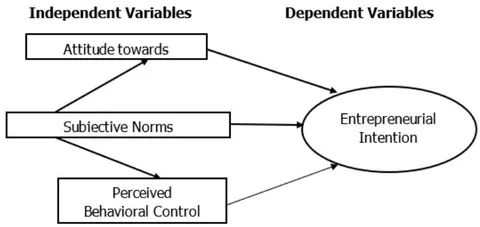
Hypothesis
- there is no significant relationship between subjective norms and personal attitude towards becoming entrepreneur and perceived behavioral control.
- there is no significant relationship between entrepreneurial intentions and personal attitude towards becoming entrepreneur, subjective norms, and perceived behavioral control.
III. METHODOLOGY
a) Research Locale
This study was conducted in Davao del Sur State College (DSSC) formerly known as a Southern Philippines Agri-Business and Marine and Aquatic school of Technology-Digos Campus, Matti, Digos City.
b) Research Design
This study used described research design to determine the factors affecting the entrepreneurial intentions of college students in Davao del Sur State College (DSSC) formerly known as a Southern Philippines Agri-Business and Marine and Aquatic school of Technoloy-Digos Campus, Matti, Digos City.
c) Respondents of the study
The respondents of this study was the college students in Davao del Sur State College (DSSC) formerly known as a Southern Philippines Agri-Business and Marine and Aquatic school of Technology-Digos Campus, Digos City Davao Del Sur. To whom the researcher will collect responses in determining the entrepreneurial intentions of third-fourth year business students who are enrolled in Bachelor of Science in agribusiness, bachelor of science in education major in technology and livelihood education and bachelor of science in accounting technology.
d) Determination of the Sample Size
Purposive sampling was used in the identification of the respondents of the study. Once the total samples have been identified per community under study, the researcher computed the required number of samples for the study. Slovin's formula was used to determine the total samples with of error.
Formula:
Where:
| Programs | No. of students | Sample size |
| BSAB (4THYear) | 130 | 75 |
| BSAB (3RDYear) | 84 | 48 |
| BSED-TLE (4THYear) | 37 | 22 |
| BSED-TLE (3THYear) | 22 | 13 |
| BSAT (3RDYear) | 20 | 11 |
| Total | 293 | 169 |
e) Sampling Design and Technique
This study employed non-probability or purposive sampling design and quota sampling techniques. Although "convenience" sampling is sometimes motivated by mere accessibility, an added value can be that it allows selection of participants who share certain desired characteristics such as the respondents are the business students. Quota sampling was done by getting the required sample size of the respondents per course.
f) Research Instrument
A researcher's prepared questionnaire was used to gather necessary information. It is categorized into two (2) parts. Part I focus on the demographic profile of the respondents. Part II entrepreneurial intention of business students in Davao del Sur State College (DSSC) formerly Southern Philippines and Marine and Aquatic School of Technology (SPAMAST)-Digos Campus, Digos City, Davao Del Sur.
The basis of interpreting the responses of the participants is presented below:
| Range of Means | Descriptive Level | Interpretation |
| 4.50-5.00 | Very high | This means that the item statement on the entrepreneurial intention of business students is always manifested. |
| 3.40-4.19 | High | This means that the item statement on the entrepreneurial intention of business students is oftentimes manifested. |
| 2.60-3.39 | Moderate | This means that the item statement on the entrepreneurial intention of business students is sometime manifested. |
| 1.80-2.59 | Low | This means that the item statement on the entrepreneurial intention of business students is rarely manifested. |
| 1.00-1.79 | Very Low | This means that the item statement on the entrepreneurial intention of business students is never manifested. |
g) Data Gathered
The data gathered in this study includes the demographic profile and the entrepreneurial intention of college students in Davao del Sur State College (DSSC) formerly Southern Philippines and Marine and Aquatic School of Technology (SPAMAST)-Digos Campus, Digos City, Davao Del Sur.
h) Data Gathering Procedure
Gathering the necessary data for the study was done through the following steps:
Secured letter to conduct the study from the adviser/department chairman was observed;
Courtesy call was done in the research area before the conduct of the study;
Gathered of empirical data with the use of a prepare structured survey questionnaire supplement with an actual or personal interview by the researcher;
Results was tabulated and interpreted by the researcher with the coordination of research adviser and verification of statistician.
i) Statistical Tool
The researcher utilized percentage, frequency, mean, and ANOVA in interpreting and analyzing the data gathered.
Percentage is a number or ratio that represents a fraction of 100. It was utilized in rating responses per indicator.
Frequency is the number of repeating event occurrences per unit of time. It has been used in each indicator to count the number of responses.
Mean defined as average of the numbers. It is used to determine the level of financial management system.
Multiple Regression Analysis a powerful technique used for predicting the unknown value of a variable from the known value of two or more variables- also called predictors.
IV. RESULT AND DISCUSSION
Discussed in this chapter are the result and findings of the study, it is based on the sequence of the study objectives beginning with the respondent's profile, level of the attitude towards becoming an entrepreneur, perceived behavioral control, subjective norms and entrepreneurial intention of business students.
a) Demographic Profile
Shown in the table 2 is the profile of the respondents. It is categorized into five groups, the courses, year level, age, ethnicity and civil status. In terms of courses, majority of the respondents was Bachelor of Science in agri-business (72.78%), followed by Bachelor of Science in Education major of Technology and Livelihood Education (20.71%), then Bachelor of Science in Accounting Information system (BSAIS) (6.50%). For year level majority of respondents were year (57.39%), and 42.60% was year. Base on the age, majority of the respondents was 23-25 years old (40.23%), followed by 20-22 (38.46%), 25 above (11.24%), and 18-20 (10.05%). In terms of ethnicity, majority of the respondents were Cebuano (73.37%), followed by indigenous people (IP) (24.85%), Tagalog (0.59%), Ilocano (0.59%), and maguindanaon (0.59%). In terms of civil status, all of the respondents were single (100%).
| Indicators | F | % |
| Courses | ||
| BSAB | 123 | 72.78 |
| BSAT | 11 | 6.50 |
| BSED-TLE | 35 | 20.71 |
| Year Level | ||
| 3rdyear | 72 | 42.60 |
| 4thyear | 97 | 57.39 |
| Age | ||
| 18-20 | 17 | 10.05 |
| 20-22 | 65 | 38.46 |
| 23-25 | 68 | 40.23 |
| 25 above | 19 | 11.24 |
| Ethnicity | ||
| Cebuano | 124 | 73.37 |
| Maguinandaon | 1 | 0.59 |
| Ip's | 42 | 24.85 |
| Tagalog | 1 | 0.59 |
| Ilocano | 1 | 0.59 |
| Civil status | ||
| Single | 169 | 100 |
| Married | 0 | 0 |
The level of personal attitude toward becoming entrepreneur, perceived behavioural control, subjective norms and entrepreneurial intention
The level of personal attitude toward becoming entrepreneur, perceived behavioural control, subjective norms and entrepreneurial intention of business students was high. Being an entrepreneur implies more advantages were scored 3.89 to business students. The attraction of a career as an entrepreneur was rated high with 4.05 mean. Opportunity and resources, like to start a business rated very high with 4.21 mean. Entrepreneurship as option, was rated high with 4.07 mean. Satisfaction as entrepreneur was rated also high with 4.01 mean. Generally, the attitude towards becoming an entrepreneur of business students is high with (4.05) mean or manifested most of the time. To support this outcome, the attitudes towards entrepreneurial behavior are a function of one's beliefs that performing the behaviors will lead to various outcomes and the evaluations of the outcomes. Therefore, if behavioral beliefs suggest that positive outcomes might be obtained by engaging in a specific behavior, individuals would likely have a positive attitude towards that specific behavior (Cavazos-Arroyo et al., 2017).
The Level of perceived behavioral control of business students was high level. Easiness to start a business and keep it working was rated high (3.51). Ability to control the creation process of a new business rated high (3.61). Having a complete control over the situation to start and run a business was high (3.73). Preparedness to do anything to be an entrepreneur was high (3.76). Knowing all about the necessary practical details needed to start a business rated high 3.61 mean.
Trying to start a business, have a high chance of being successful was high (3.79). Generally, the level of perceived behavioral control of business students is high with 3.66 total mean or manifested most of the time. To support this outcome, the search for understanding the lens through which nascent entrepreneurs' approach or perceive opportunities is a cornerstone of entrepreneurship research carrying significant practical implications. An important step in understanding how nascent entrepreneurs perceive opportunities is by understanding their perception of control over their environment. While the constructs that form the psychological capital construct, hope, resilience, optimism, and self-efficacy are all revered characteristics and highly associated with entrepreneurs, the consequences of these being applied to situations where the individual actually has a misplaced sense of control may have dire consequences (Mario Hayek, 2014).
The level of subjective norms of business students had high level. Friends, approval to start a business was high (3.49). Immediate family approval to start a business was also high 3.73 mean. Generally, the level of subjective norms of business students is high with overall total 3.61 mean or manifested most of the time. To support this outcome, the student's existing skills and capabilities do not prove to be a significant predictor of their intentions to become entrepreneurs. The study concludes that the students can become successful entrepreneurs even without existing entrepreneurial skills and capabilities, provided that they have the entrepreneurial attitude, desirability and support by the community (Yousaf et al. 2015).
The level of entrepreneurial intentions of business students had the overall mean rating of 4.05, described as high. The rating of being ready to do anything to be an entrepreneur was high (4.04). Professional goal to be an entrepreneur was high (3.99). Making every effort to start and run own business was high (4.11). Determining to create a business venture in the future was high (4.07). To support this outcome, the business students' desires to engage in entrepreneurial endeavors is merely a behavior, which is intentionally planned. In this vein, competing models have been reported in the literature in an attempt to understand entrepreneurial intention phenomenon with Shapero's model of the entrepreneurial event taking the lead followed by Ajzen's Theory of Planned Behavior. The former model emphasized perceived desirability, perceived feasibility and propensity to act while the latter model introduced personal attitude, subjective norm, and perceived behavior although conceptually both models' proposed constructs are somewhat similar or identical. These constructs are widely used in the literature to understand the entrepreneurial intention in various contexts.
However, viewing it from an academic institution's perspective flagged that entrepreneurial education is equally important in activating entrepreneurial intention among students who are nascent entrepreneurs of the future. Therefore, this study is an attempt to suggest a conceptual framework linking entrepreneurial tendency driven by the Theory of Planned Behavior and entrepreneurial intention. Additionally, entrepreneurial education is proposed as a mediator in understanding the relationship between entrepreneurial tendency and entrepreneurial intention. This research also offers relevant supporting literature and direction for future empirical investigation in order to contextualize this study (Baskaran et al. 2019).
Presented in table3 is the overall mean of attitude towards becoming entrepreneur, perceived behavioral control, subjective norms and entrepreneurial intention of business students. Attitude towards becoming entrepreneur and entrepreneurial intention has a the same mean 4.05, followed by perceived behavioral control 3.66, then subjective norms is 3.61 mean and described as a high. To support this outcome, the entrepreneurial intention, personal attitude, perceived behavioral control and subjective norms plays an important role in the decision of business students about venturing into business and be an entrepreneur in the future after they graduate. Research confirms that intentions play an important role in the decision to start a new firm. The findings indicate that although they hold a positive attitude towards entrepreneurship, both U.S. and Turkish students show a low level of entrepreneurial intention. Confirming prior work, the findings also indicate that there is a statistically significant relationship among personality attributes of optimism, innovativeness, risk-taking propensity and entrepreneurial intention. In a new line of inquiry, experiential activities known to promote creative thinking—exposure to other cultures, new experiences and art events—were found to contribute to perceived innovativeness. Both U.S. and Turkish students expressed a need for more training and education on entrepreneurship to start a new business. As U.S. students perceived a high level of risk associated with entrepreneurship, Turkish students evaluated the economic and political conditions of home country quite unfavorably to start own business (Ozaralli & Riven burgh, 2016).
| Indicators | Overall Mean | Description |
| Attitude towards becoming entrepreneur | 4.05 | High |
| Perceived behavioral control | 3.66 | High |
| Subjective norms | 3.61 | High |
| Entrepreneurial intention | 4.05 | High |
| OVERALL TOTAL MEAN | 3.84 | High |
b) Significant relationship of the variables
Presented in table 4.1 is the significant relationship between subjective norms and personal attitude towards becoming entrepreneur and perceived behavioural control. Base on the result of attitude towards becoming entrepreneur and subjective norms obtained r-value 0.11, which is interpreted as very weak positive linear relationship. It obtained p-value higher than 0.05 level, thus failed to reject the null hypothesis
(Ho). This denotes that there is significant relationship between the two variables. The perceived behavioral control and subjective norms obtained r-value 0.54, interpreted as a Moderate linear relationship and obtained p-value lower than 0.05 level, thus, the null hypothesis (Ho) is rejected. This means that there is no significant relationship between the two variables.
Table 4.1: Significant relationship between subjective norms and personal attitude towards becoming entrepreneur and perceive behavioural control
| Variables | r-value | Interpretation | p-value | Decisionon Ho |
| ATBE*SN | 0.11 | Very weak positive linear relationship | 0.129 | Failed to reject |
| PBC*SN | 0.54 | Moderate positive linear relationship | 2.9E-14 | Reject |
Legend:
ATBE- attitude towards becoming entrepreneur
PBC- perceived behavioral control
SN- subjective norms
Presented in table 4.2 is significance relationship between business student, entrepreneurial intention when analyzed by subjective norms, attitude towards becoming entrepreneur, and perceived behavioral control. The personal attitude towards becoming entrepreneur and entrepreneurial intention obtained r-value of 0.63, Strong positive linear relationship, obtained a p-value lower than 0.05 level this means that there is significant relationship between the two variables. The entrepreneur intention and perceived behavioral control with r-value 0.06, Very weak positive linear relationship obtained p-value higher than 0.05 level, thus failed to reject null hypothesis (Ho). This denotes that there is no significant relationship between two variables. Base on the result, entrepreneur intention and subjective norms obtained r-value 0.23 which is interpreted as weak positive linear relationship. It obtained a p-value higher than 0.05 level, thus failed to reject the hypothesis (Ho). This denotes that there is no significant relationship between the two variables.
Table 4.2: Significance relationship between business student, entrepreneurial intention when analyzed by subjective norms, attitude towards becoming entrepreneur, and perceived behavioral control
| Variables | r-value | Interpretation | p-value | Decisionon Ho |
| ATBE*EI | 0.63 | Strong positive linear Relationship | 8.6E-20 | Reject |
| EI*PBC | 0.06 | Very weak positive linear relationship | 0.410 | Failed to reject |
| EI*SN | 0.23 | Weak positive linear relationship | 0.002 | Reject |
Legend:
ATBE - attitude towards becoming entrepreneur
SN - subjective norms
PBC - perceived behavioral control
EI - entrepreneurial intention
The main finding is that attitudes have the strongest and positive effect on entrepreneurial intentions. This research contributes to the study of entrepreneurship as it uses the theory of planned behavior in the context of the UAE amongst active entrepreneurs. Implications for theory and practice are discussed (Fenech, R., et al. 2019). Examined how subjective norms, attitudes and entrepreneurship self-efficacy influence the entrepreneurial intentions in the Mexican population. They found support for their hypothesis stating that subjective norms, attitudes and entrepreneurial self-efficacy have a positive effect on social entrepreneurial intention (Cavazos-Arroyo et al. 2017). Similarly, within the Indonesian contest found that attitudes, subjective norms and self-efficacy have a positive and significant influence on the intention of entrepreneurship (Utami, 2017).
Presented in table 5 is the problem encountered of business students, based on the result majority of the business students encountered a financial problem rated (63.31%) followed by the subject difficulty (12.42%), lack of motivation (9.46%), friends (7.10%), school environment (3.55%) and the business students have no problem rated (4.14%).
| Problem Encountered | F | % |
| Financial problem | 107 | 63.31 |
| Lack of motivation | 16 | 9.46 |
| Subject difficulty | 21 | 12.42 |
| Friends | 12 | 7.10 |
| School environment | 6 | 3.55 |
| None | 7 | 4.14 |
V. CONCLUSION AND RECOMMENDATION
a) Conclusion
Based on the result and findings of the study, the researcher concluded the following:
Respondents were Bachelor of Science in Agri-Business, year college business students, 23-25 year's old, Cebuano and single.
Business students manifested entrepreneurial intentions often times. The same manifestation with subjective norms, attitude towards becoming entrepreneur and perceived behavioral control.
Entrepreneurial intentions of the business students were weak and strong positively affected by subjective norms and attitude towards becoming entrepreneur, respectively. Perceived behavioral control was affected by subjective norms.
Business students encountered financial problem.
b) Recommendation
Based on the finding of this study, the following recommendation are given:
Establish business center for experiential activities for the business students.
Business students need to attend the management training about business and invite successful businessman to be a guest speaker.
School need more review to the syllabus base on the variables of the particular subject.