


I. INTRODUCTION
The current change in information needs of stakeholders and the move to respond to enlarged profit horizon in the business world have led most corporations to social, ecological, and humanitarian issues (Ntim, 2016). The resultant effects of the activities of these corporations negatively affect the social and ecological well-being of the society. The impression of the adverse effect of business activities on the stakeholders has necessitated the clamour for more information disclosure requirements in conformity with global best business practices (Ndlovu & Dzomira, 2021).
Oladimeji and Folayan (2018) stated that the increasing impact of industrialization and business expansion in all public and private organizations through a new channels of enhanced product quality and innovations have brought about economic development in Nigeria, still it is, however practicable that this positive impact will not come without a cost. The manufacturing sector have highly impacted the Nigerian economy in recent time, especially in the advent of corona virus 2019 pandemic, where the significance of innovation in production methods for the survival of the economy is redefined. The societal cost of this expansion redefinition is the injection of hazardous component to the ecological and societal environment. A proactive action is should be taken to ensure that the environment is preserved while encouraging the manufacturing sector to grow in line with global demand.
Studies have been submitted on the significance of environmental disclosures on financial performance in Nigeria and other developed countries. Ezeagba, et al. (2017) stated it had a significant relationship with financial performance, in the sense that it ensured greater return and a competitive edge in the global market. This finding was supported in similar studies conducted by Arumona et al. (2020); Igbekoyi (2017); Omaliko et al. (2020); among others. Okechukwu and Okeke-Muogbo (2020) however studied the health care sector and revealed that a negative relationship exists between environmental disclosure and firm performance. Although the submissions of previous studies are divergent, the studies that upheld the significant positive effect of environmental accounting disclosure on financial performance are on the high side. Despite the increased rate of discussions and submission of existing studies on the subject matter, the incidences of environmental abuse are still persistent; these environmental abuses have led to degradation of the environment and defacement of the green nature of the land space.
This study, is therefore, firstly conducted an intra-sector appraisal of the extent of compliance of multinational firms in Nigeria to environmental accounting disclosure in line with global best practices and then investigated the effect of these environmental disclosures on the financial performance of the firms. This study will give a clue into the quality of environmental information disclosed, which will give a hint on why there are still cases of environmental degradation despite claims of environmental disclosure by Nigerian firms. It may also form a roadmap for developing of a regulatory frame work for environmental accounting disclosure in Nigeria in the future.
Apart from the introductory part of this study discussed, there are other four sections; which captures the review of related literature in the second, the third section discusses the methods, and the analysis of data and interpretation of results featured in the fourth section at the same time, conclusion and recommendations are stated in the fifth section which is the concluding section.
II. LITERATURE REVIEW AND HYPOTHESES DEVELOPMENT
Environmental accounting is defined as the process of providing information regarding the environmental and social costs, which may include environmental conservation and preservation costs as a way of social responsibility to stakeholders (Makori & Jagongo, 2013). Muhammed (2018) broadly define environmental accounting as a term that covers the financial and non-financial information regarding the environmental and ecological impact of company activities on humanity and resultant reactions to their impacts. Wozuru and Micah (2018) also described environmental accounting as the costing of the energy component of an organization activity and the efforts of preserving the environment and producing environmentally friendly products. Environmental accounting disclosure depicts the act of reporting the environmental accounting information to stakeholders as a form of responsibility of adhering to the assumptions of environmental principles (Solomon, 2020; Alok et al., 2018).
The ideology of environmental accounting disclosure is not a function of an organization's ideal but a report of stewardship in the public interest (Vanda, Burgwal & Viera, 2014). However, attempts have been made to redefine environmental accounting disclosure from various dimensions and conceptual perspectives. This study however observes the concept from the perspective of the laid down indicators that are used to evaluate the environmental responsibility level of firms. The environmental disclosure index developed by the global reporting initiative (GRI) has been gradually accepted as a form of environmental disclosure yardstick and it has got global acceptance. This study therefore captures the environmental disclosure indices as stated in the report as adopted in a similar study conducted by Galani et al. (2017) in Greece. This study purposively selected environmental disclosure indices peculiar to the Nigerian ecological system to capture the unique environmental degradation issues to determine the extent of responsibility of companies to stakeholders in the form of full disclosure of these actives. The disclosure items covered in this study are itemized in the measurement of variables in the methodology section of this paper.
Financial performance measures the achievement of firms using various criteria. Solomon (2020) stated that financial performance can be measured through profitability and issued shares capital for the year. Arumona et al. (2020) however stated that return on asset and earnings per share are symbols of firms' improvement and as such, serve as an approach of assessing firms' performance for a specific period. This study assessed the firms' performance using return on assets and earnings per share. Arumona et al. (2020) described return on assets as a ratio that measures assets and turnover for a particular period. A higher return on assets is advantageous to firms, as it can be used as bait to attract investors to subscribe to their shares. The earnings per share is measured by dividing total profit after tax by total issued shares capital for a year. The choice of these performance yardsticks attempts to appraise the firms from the internal and external perspectives of their performance. This attempt is done by appraising the ratio of profits to the total assets and the issued share; at the same time the former considers that internal assessment of the extent of return, the latter evaluates that performance at the market.
a) Theoretical Underpinning
This study is hinged on the combination of three theories. The study combined the assumptions of the sustainability, stakeholder and agency theories. The sustainability theory developed by Edward Barbier in 1987 hinges on the prioritization of the responsibility of firms to the atmospheric environment, such that the environment will be maintained in a way that will lead to preservation of its green state into the unforeseeable future. The stakeholder theory developed by Edward Freeman in 1984 is borne from the perspective of business operations carried on, bearing in mind the impact of the company's activities on individuals and groups that may be affected by their actions and inactions (Freeman, 1984, Walsh, 2005). The main argument of the theory is that firms should perform their business operations so that the value of all stakeholders will be created and not only the shareholders. From the perspective of agency theory developed by Jensen & Meckling (1976), it is theorized that a business operation is likened to a principal-agent relationship; where the agent has a fiduciary duty to the principal, who are the shareholders of the company. The fiduciary duty as assumed in the theory as a duty of trust to work on behalf of the principal for profit and wealth maximization.
The link of these theories to this study can be deduced from their assumptions. The focal points of the theories include; the environment, society and the shareholders. This study attempted to show the link between how firms account for their social and environmental activities while sustaining the core objectives of their owners. These theories have been applied in varying studies such as; sustainability reporting, corporate social responsibility, and audit and internal control. But the attempt to link these three models exposes the ability of companies to maintain all aspects of their performance evaluation without compromise.
The underpinning theories are relevant to this study because environmental accounting disclosure is a responsibility to the society and the ecosystem, especially in Nigeria where there is no existing regulation that enforces environmental disclosure. Evidence from existing literature has, however shown that although environmental disclosure is voluntary; it has shown significance in determining firm performance. The agency theory captures the financial performance aspect of this study. This study attempted to assess financial performance from the returns on invested assets and share appreciation in terms of earnings per share owned by shareholders. The theoretical link of this study is corroborated in studies conducted by Mahoney et al. (2007) and Tuwaijiri et al. (2004) in separate studies where they posited that there is a significant association between environmental performance and economic performance especially when there is more quantitative disclosure.
b) Environmental Accounting Disclosure in Nigeria
Although various studies have explored the effects of environmental accounting disclosure on financial performance, and the majority showed positive results. There is a need, however to investigate the extent of environmental disclosure of these firms, especially in the case of Nigeria and developing countries where these disclosures are voluntary.
Norha et al. (2015) investigated environmental disclosure and financial performance among the top 100 companies in Malaysia for the year 2011. The result showed mixed results regarding environmental disclosure practices in Malaysia. The study submitted that there are still ongoing debates regarding the disclosure levels because of the increasing rate of environmental abuse and the major moderating factor is the fact that there is no statutory requirement for companies in Malaysia to disclose their environmental sustainability activities. The result is not different in a study conducted by Eliyash et al. (2013) in Arab doing a comparative study of the environmental disclosure practices of national and international oil and gas corporations the country. It was found that despite a slight increase in the disclosure level, the variations are still significant.
The Nigerian case is not different, as evident in the findings of existing studies. Uwuigbe & Jimoh (2012) studied corporate environmental disclosure in manufacturing firms in Nigeria; and discovered that the level of disclosure is still in the embryonic stage as most of the disclosures were still voluntary. Oba and Fodio (2012) also supported this finding in a study conducted to compare oil and gas and construction companies. It was found that the disclosure level was generally small, but the oil and gas companies' disclosure was still more. Musa et al. (2015) conducted an x-ray on environmental accounting practices in Nigeria and found that the disclosures were not uniform which is majorly owing to lack of regulatory framework. In a recent study conducted by Adegbei & Nwobodo (2020), in the banking sector, the disclosure is said to be significant but still had poor outcomes.
In developed countries, studies have attempted to investigate the extent of environmental accounting disclosure in some developed countries. Mitchell et al. (2006) conducted a study to examine the environmental disclosure level of firms in Australia using content analysis and discovered that firms disclosed, but all disclosures were positive. Similarly, a study conducted by Cowan & Gadenne (2005) and Tilt (2001) in the same country, it revealed a positive environmental disclosure level. In China, Ane (2012) assessed the quality of environmental information disclosed in the annual reports of corporations; and found that the disclosure content is restricted and insufficient. The reporting pattern was single sided. The implication of these findings is that firms' disclosure level is selective to purposively capture only indices that reflect positive results. This assertion was supported by Nguyen& Tran (2019) in Greece & Hughes et al. (2001) posited that the rating of social and environmental responsibility of firms is based on the positivity of their environmental disclosures, and this will force firms to manipulate results to appear responsible.
Evidence from these literatures imply that disclosure of environmental activities remains an issue of global discussion as the discussion is moving away from whether a company discloses or not, but rather to full disclosure. The developing countries, including Nigeria, are still peculiar because of lack of statutory enablement. However, the multinational corporations in Nigeria have affiliations with international companies that are situated in countries where environmental accounting disclosures are mandatory and regarded as governance and strategic issues. The moral perception is that these firms will make full disclosure of their environmental related activities as a part of the organizational norm in line with global best business practices and not necessarily responding to domestic regulations. Based on these, it is, therefore, logical to state the hypothesis thus:
: There is no full compliance with environmental disclosure in Nigerian multinational firms
c) Environmental Accounting Disclosure and Financial Performance
The drive for environmental atmospheric preservation and demand for socially responsible business practices in the event of threatening signals indicated in climate change and global warming have made the study on environmental accounting attractive to scholars globally. Also, the contractual agreement between the managers (agents) of the firms and the providers of capital (owners), according to the agency theory, that focus on maximizing the investments of the owners to increase returns, made the concept of financial performance an accompanying area of discussion in environmental accounting; especially as it relates to disclosure. In a bid to link these variables, several studies have been conducted to determine the association that exists between them, measuring financial performance from various perspectives; and the findings are divergent.
In determining the effect of environmental disclosure on profitability, Nahiba (2017); and Makori & Jagongo (2013) conducted studies in India and discovered that environmental accounting disclosure had a significant positive relationship with net profit margin and dividend per share, still a significant negative relationship exists with return on capital employed. In studies conducted in Kenya and Malaysia, Gatimbu & Wabwire (2016) and Al-Tuwaijri (2004) found a significant relationship between environmental accounting and financial performance. In Nigeria, Arumona et al. (2020) using annual reports of 12 oil and gas companies quoted on the floor of the Nigeria Stock Exchange (NSE) for ten years ranging from 2010-2019, submitted that a positive and significant relationship exists between environmental accounting and financial performance. The same findings were made in studies conducted by various studies when appraising the different sectors of listed companies in Nigeria. These include: Omaliko et al. (2020); Yahaya (2018); Oyedokun et al. (2019); Oyedokun et al. (2019); Ezeagba et al. (2017); and Utile (2017).
The findings however vary in the researches of Tafadzwa & Fortune (2019); Ezejiofor et al. (2016) and Adeniran & Alade (2013), where they found a negative effect. While Okechukwu et al. (2020) submitted that environmental sustainability disclosure did not have impact on firm performance. Similarly, Saman (2019) researched on the environmental accounting disclosure and financial performance of the oil and gas companies in Nigeria and found no significant relationship between the variables. Also, when Nyirenda et al. (2013) studied environmental management practices and firm performance in South African mining firms, no significant effect was found. Likewise, In Indonesian companies, Sarumpaet (2005) found that there is no significant relationship between environmental performance and financial performance of the companies. The results are also similar in Malaysia, Singapore and Thailand companies as Rahman (2009); and Ponnu & Karthigeyan (2010) in separate studies found that no relationship exists.
For studies specifically conducted on return on assets and earnings per share, Gelb (2017), studying environmental disclosures and corporate performance in Japan, found a positive relationship between environmental disclosures and corporate performance when using return on assets as a proxy for financial performance. Okechukwu and Okeke-Muogbo (2020) worked on environmental and social responsibility sustainability disclosure and firm performance of quoted health care and consumer goods companies in Nigeria. They found that environmental sustainability disclosure did not have impact on firm performance. Saman (2019) researched on the environmental accounting disclosure and financial performance of oil and gas companies in Nigeria using 11 companies selected based on environmental information available in the annual reports. The result revealed that the explanatory variables, ROCE, NPM, EPS, and DPS, have an insignificant relationship with environmental accounting disclosure. Investigating the effect of environmental accounting disclosure on earnings per share, Perry & Singh (2011) and Norhasimah et al. (2015), in studies conducted in Malaysia, found that no relationship exists; Adeniran & Alade (2013) found a significant negative relationship in the case of Nigerian firms.
An evaluation of existing studies revealed that the findings are still divergent. It is also evident that most of the studies conducted on evaluating environmental accounting disclosure and financial performance majorly focused on financial performance indices such as profitability, return on assets, return on equity, return on capital employed among others. These indices are assessing the performance from the internal perspectives; there is a need to assess how environmental disclosure financial performance of these firms from the external perspectives to determine whether it affects the valuation of this firms. This study, therefore, attempts to make a comparative study of how environmental disclosure influences the return on assets and earnings per share of multinational companies in Nigeria. The hypotheses are stated as follows:
: Environmental accounting disclosure has no significant effect on return on asset of listed multinational firms in Nigeria.
: Environmental accounting disclosure has no significant effect on earnings per share of listed multinational firms in Nigeria.
FP = f(EADI)
RETA, EAPS = f(EADI)
......i
Where:
FP= Financial Performance
ii
EADI = Environmental Accounting Disclosure Index
RETA = Return on assets
EAPS=Earnings per share
Intercept e = stochastic error term
III. DATA AND METHODS
The study investigated the associations between the variables by adapting existing studies (Okechukwu & Okeke-Muogbo, 2020; Saman, 2019; Trireksani & Djajadikerta, 2016). The was done to see how the ideologies of the sustainability, stakeholder and agency theories can be incorporated to determine how companies can achieve results by incorporating all these ideologies into their business practice. The model is specified as follows:
a) Model Specification
A-priori expectation in equationsi and ii based on literature review is stated thus;
The study used ex-post facto research design since data used are available and not intended to be manipulated. The population comprises 40 listed multinational firms in the consumer goods, industrial goods and oil sectors in the Nigeria Exchange Group as at 31 December, 2020. The sample size is 34 listed firms, determined using purposive sampling technique to select firms that are in existence within the study time frame. The study covered a time frame of 2011 to 2020. Data used in this study include; return on assets, earnings per share, environmental accounting disclosure index, as shown in table 1. Data were obtained from the annual reports and sustainability reports of the firms within the time frame of the study. Data collected were analyzed using descriptive statistics and panel data regression analysis.
| Variables | Description | Measurement | Source |
| Environmental Accounting Disclosure | |||
| Environmental Accounting Disclosure | It consists information that relates to the environmental activities in the disclosure index | Aggregate of these disclosures as stated in index -Environmental-Material-Energy-Water-Bio-diversity-Emission-Effluents and waste disposal-Product service environmental impact-Compliance to environmental laws and regulations | Tireksani & Djajadikerta (2016); Oyedokunet.al. (2019). |
| Financial Performance | ||||
| Return on Assets | It is a ratio that measures assets and turnover for a particular period | Total income divided by Total assets | Okechukwu& Muogbo (2020) | Okeke- |
| Earnings per Share | This is total earnings per each share held by investors for a specific period | Total profit after tax divided by total issued shares capital for the year. | Solomon (2020); Solomon (2013). | JhvH |
IV. DATA ANALYSIS AND DISCUSSION OF FINDINGS
a) Descriptive Statistics
Table 2 shows the descriptive statistics of the variables. Each variable is examined based on observations, mean median, maximum, minimum, and standard deviation. The mean of edindex (environmental disclosure index), which is the explanatory variable has a value of 0.106 with an associated standard deviation of value 0.222. This presentation imply that the environmental disclosure index of these multinational companies was just 10.6% in informing the host communities of degradation of the environment. While the value standard deviation was 22%, which means it surpassed the mean, this showed that mean is being validated and reliable of its truism. On the maximum and minimum values were 1 and 0 and the associated median was 0. This implies that when the multinational disclosed is 1 otherwise 0, for the fact the minimum and median have the same value of 0, this showed that majority of the firms did not disclose information on the externalities in their corporate reporting. On the explained variables, that Earnings Per Share (EAPS) and Return on Assets (RETA). These dependent variables have average values of 3.503 and 5.324, respectively. While the associated standard deviation values were 8.048 and 19.349 which surpass the mean of the distribution, this implied that the average value of performance metrics was reliable and validated the distribution of the performance proxies with the Minimum -20.23 and -179.917, maximum 57.63 and 176.267 and median 0.97 and 4.7587 respectively.
| Variable | Obs | Mean | Std. Dev. | Min | Max | Median |
| Edindex | 340 | .106 | .222 | 0 | 1 | 0 |
| Eaps | 339 | 3.503 | 8.048 | -20.23 | 57.63 | 0.97 |
| Reta | 339 | 5.324 | 19.349 | -179.917 | 176.267 | 4.7587 |
b) Test of variables
Table 3 shows the result of correlation analysis for both the dependent variables and independent variables. The coefficients of correlation analysis revealed there subsist positive and but weak association between environmental disclosures index and performance metrics of return on assets (RETA) and earnings per share (EAPS). Also, the correlation coefficient among these variables shows nonserial correlation which suggests that no multicollinearity exists. Thus, to achieve the stated objectives, the study used a panel regression analysis to dissect the assumed causality. The panel regression results showed, presented and discussed in table 3.
| Variables | Deindex | (EAPS) | (RETA) |
| (1) edindex | 1.000 | ||
| (2) EAPS | 0.127* | 1.000 | |
| 0.020 | |||
| (3) RETA | 0.051 | 0.299* | 1.000 |
| 0.352 | 0.000 |
c) Sectoral Analysis of Environmental Accounting Disclosure Compliance of Listed Multinational firms
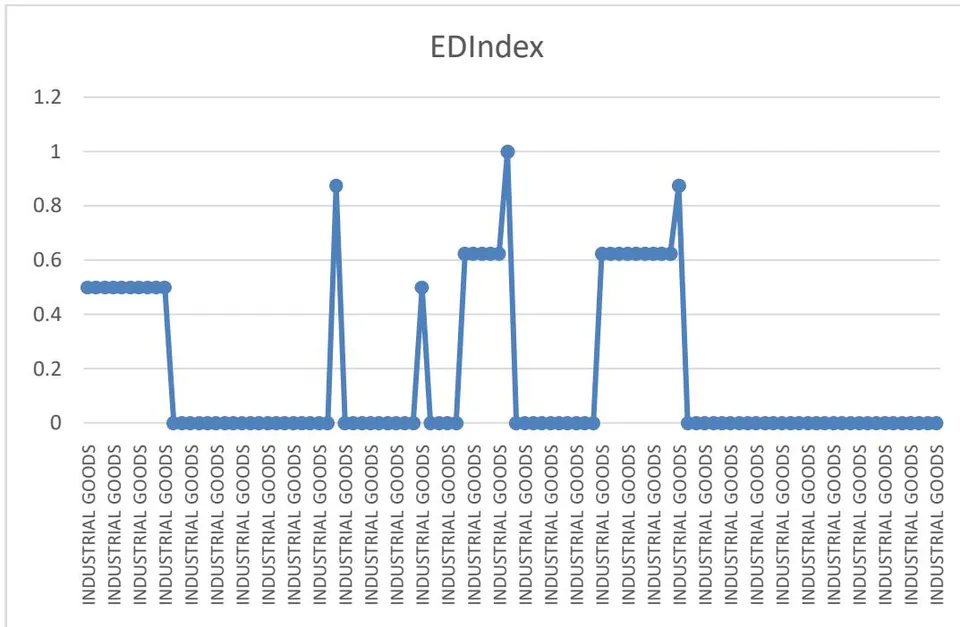
Figures 1, 2, and 3 show the sectoral analysis of the extent to which the selected sectors which are involved in the production comply with the environmental disclosure index. The sectors selected are the; industrial goods, consumer goods, and oil and gas sectors. The individual assessment of industrial goods, as shown in figure 1 indicate period from 2011 to 2020, the sector had only one full disclosure of their environmental activities; following that, there were two times they had 85% disclosures followed by 60% and
50% disclosures. It was however discovered that there are parts of the period that showed that their environmental disclosure level was zero 0, which imply that there were no disclosures at all during this period.
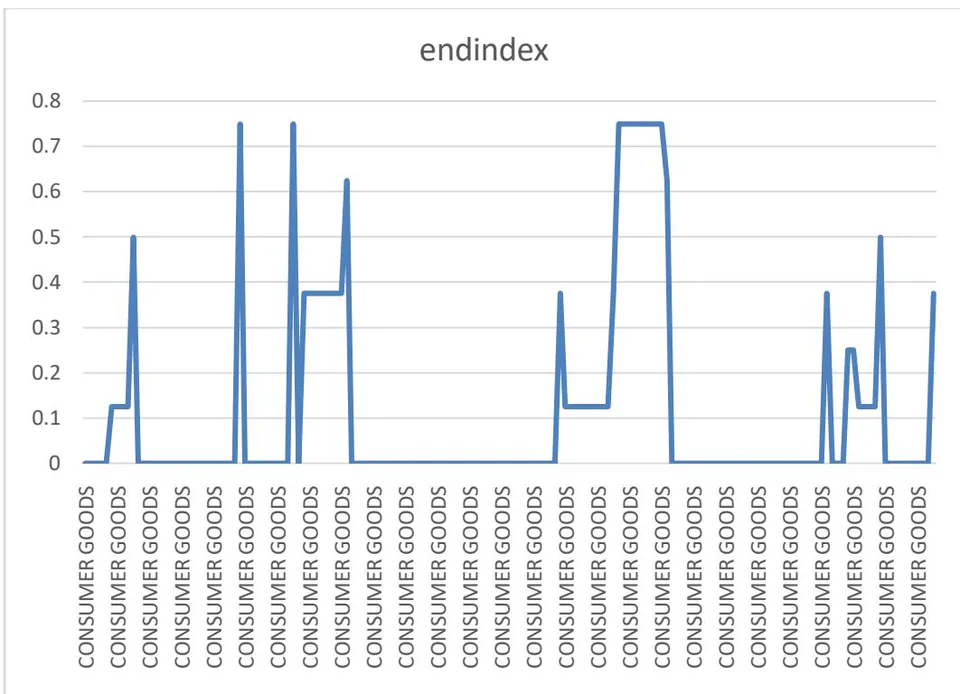
In figure 2, the graph shows the trends of environmental disclosures by the consumer goods sector of Nigeria Exchange Group. The trend showed that the sector never had any time within the scope of this study where they had full disclosure of their environmental activities. The result also showed that there was a period which had zero percent which implies non-disclosure.
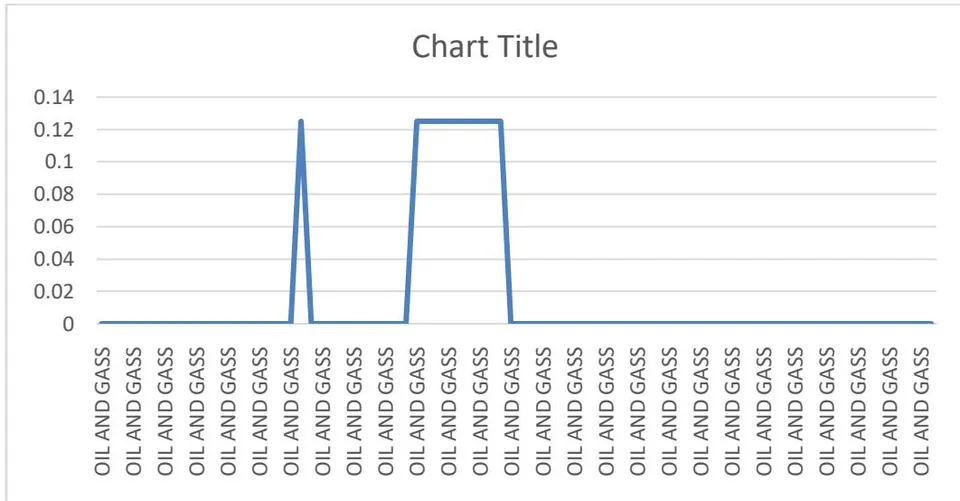
In the case of the oil and gas sector as shown in figure 3, the trends of environmental disclosure in the sectors how that the highest disclosures of these sectors 13 percent and the rest which is the larger part constitute non-disclosures.
An appraisal of the trend analysis indicates that none of the multinational companies have full disclosure of environmental disclosure according to the laid down environmental disclosure index. The implication of this is that the multinational companies despite their affiliations with companies that are situated in countries where sustainability reporting is mandatory, still indulge in non-disclosure. The individual evaluation showed that from the three sectors, the oil and gas sector had the least level of compliance with environmental disclosure as disclosed in the index. This is confirmed by the increased rate of environmental degradation, oil spillage and other negative externalities that ravage the ecological system of their host communities. It can therefore be implied that multinational companies in Nigeria are not fully compliant with disclosing their environmental activities following global best practices.
The implication of these findings going by policy, is that multinational companies in Nigeria, despite their affiliation with the international community and the developed countries are not making an effort to comply with environmental accounting disclosure. They are majorly leveraging on the loophole in the financial regulations. This assertion is also confirmed in the sectoral assessment done in this study which revealed that the multinational companies' level of compliance with environmental accounting disclosure requirements is below the benchmark.
Source: Researcher's computation, 2021
Figure 3: Oil and Gas Sector
d) Environmental Accounting Disclosure and Financial Performance
The F-statistics value of 3.91 (0.00) and 3.31 (0.00) for fixed and random effect models respectively shown in table 4 revealed that results are valid for inferential testing since they are both statistically significant at 5%. In testing for the cause-effect relationship between the variables, in model 1, the two widely used panel data regression estimation techniques (fixed effect and random effect) were adopted. Table 4 present the two panel data estimation techniques results (fixed effect and random effect). In selecting from the two panel regression estimation results, the Hausman test was conducted based on the null hypotheses that the random effect is preferred to fixed effect, for model 1.
The result of the p-value of the Hausman test (0.9073), imply that we reject the null hypothesis and accept the alternative hypothesis at a 5 percent level of significance. The study adopted the fixed effect panel
Hausman test: Model 1 (0.9073); Model 2 (0.0192).
regression results in discussing results. Following table 4, the discussion of the fixed effect results became imperative. In testing the stated hypothesis, edindex {fixed effect 4.4044 (0.049)} as an independent variable to environmental disclosure index has a positive and statistically significant at 5% influence on the earnings per share. Hence, the study accepted alternative hypothesis stated.
On the other hand, when the return on assets (ROA) was proxy is used to proxy financial performance; the result of the Hausman test has value (0.0192) implies that we should accept the null hypothesis and reject the alternative hypothesis at a 5 percent level of significance. This implies that the study adopted the random effect panel regression results in drawing our conclusion and recommendations. The result shows that edindex {random effect -0.0331 (0.995)} as an independent variable to environmental discourse index has a negative and statistically insignificant influence on the return on asset. Hence, the study accepted the null hypothesis stated.
The findings of this study concerning its significant effect on financial performance corroborate the findings of previous literatures as stated that environmental accounting disclosure influences financial performance (Oladimeji & Folayan, 2018; Igbekoyi, 2017; Nahiba, 2017; Arumona, et al., 2020; Uwaigbe, 2012).
An in-depth analysis of the financial performance indicators showed that environmental accounting disclosures affect earnings per share positively and significantly. The finding further upholds the assumptions of existing theories and literatures that compliance with environmental accounting has a significant effect on how the firms are valued externally by stakeholders in the economic market (Ezeagba, et al., 2017; Zamil & Hassan, 2019. Inspite of the non-regulatory framework, companies must strive to comply with these laid down indices in line with global best practices.
Previous studies conducted on the effect of environmental accounting disclosure on financial performance using return on asset showed a positive and significant effect (Okechukwu & Okeke-Muogbo, 2020; Gelb, 2017); others found insignificant effect (Ponnu & Karthigeyan, 2010); while Zamil & Hassan (2019) found a significant negative effects on financial performance. The findings of this study however showed that in the context of the time frame of this study, the effect of environmental accounting disclosure is negative and insignificant. Although the argument of companies to shy away from environmental costs is because they reduce profits and returns, with the findings of this study, it is established that although this assertion may be true, it is found to be insignificant.
| VARIABLES | (Fixed) EAPS | (Random) EAPS | (Fixed) RETA | (Random) RETA |
| Edindex | 4.044**(2.046) | 4.118**(1.945) | -15.51*(8.774) | -0.0331(5.766) |
| Constant | 3.075***(0.317) | 3.059**(1.229) | 6.965***(1.358) | 5.326***(1.574) |
| Observations | 339 | 339 | 339 | 339 |
| R-squared | 0.013 | 0.010 | ||
| F statistics | 3.91** | 3.13** | ||
| Number of id | 34 | 34 | 34 | 34 |
V. CONCLUSION AND RECOMMENDATIONS
The study attempts to provide environmental accounting disclosure and financial performance of listed multinational firms in Nigeria. The previous studies conducted on environmental accounting disclosure and financial performance have revealed outcomes that are divergent. The study first conducted an intra-sector appraisal of the level of compliance of these firms to environmental accounting in line with global best practices and then conducted an investigation on the effect of these environmental disclosures on the financial performance of the firms. The environmental accounting disclosure in this study is tailored around the environmental disclosure index which is the index that captures environmental appraisal indices in line with global best practices to determine how these influence the financial performance of the listed multinational firms in Nigeria. The financial performance is measured using the return on assets and earnings per share; this is done to determine the internal and external outlook of performance.
The study found that in the sectoral analysis, all of the three sectors studied majorly defaulted in full disclosure of environmental disclosure, with the oil and gas sector showing least with majority of the years falling to zero disclosure. When investigating the effect of disclosure on financial performance, the study found that environmental disclosure index had a significant positive effect on earnings per share. While in the case of return on assets, the results showed that environmental disclosure index has an insignificant negative effect. The study, therefore, concludes that multinational companies in Nigeria are not doing well enough in terms of full disclosure despite their affiliations with developed countries. Also, it was concluded that the environmental disclosure index significantly influences the earnings per share of companies within the time frame of this study. Based on these findings, the study, therefore, concludes that earning per share has a significant influence on the environmental accounting disclosure of listed multinational firms in Nigeria; the study there recommends that;
i. Environmental accounting disclosure should not be seen as a mere report but more as governance and strategic issue, such that irrespective of the presence of regulation, full disclosure will be maintained to legitimize the position of the firms in the society.
ii. The significance of earnings per share when compared with the return on assets is an indication that environmental accounting disclosure determines how a firm is valued in the economic market, so the disclosure should be prioritized by multinational firms.