To: Author
Article Fingerprint
ReserarchID
0608N

Choose where you want to hide AI Takeaway. Your site-wide choice will be remembered in this browser.
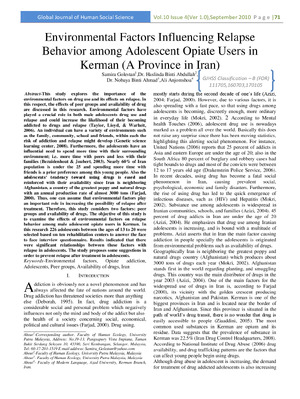
This study explores the importance of the environmental factors on drug use and its effects on relapse. In this respect, the effects of peer groups and availability of drug are discussed in this research. Environmental factors have played a crucial role in both male adolescents drug use and relapse and could increase the likelihood of their becoming addicted to drugs and relapse (Taylor, Lioyd, & Warheit, 2006). An individual can have a variety of environments such as the family, community, school and friends, within each the risk of addiction and relapse might develop (Genetic science learning center, 2008). Furthermore, the adolescents have an influential need to spend more time with their surrounding environment; i.e. more time with peers and less with their families (Bezuidenhout & Joubert, 2003). Nearly 60% of Iran population is under the 25 and spending more time with friends is a prior preference among this young people. Also the adolescents” tendency toward using drugs is eased and reinforced with their availability since Iran is neighboring Afghanistan, a country of the greatest poppy and natural drugs with an annual production rate of almost 3000 tons (Farjad, 2000). Thus, one can assume that environmental factors play an important role in increasing the possibility of relapse after treatment. Therefore, this study considers two factors: peer groups and availability of drugs. The objective of this study is to examine the effects of environmental factors on relapse behavior among male adolescent opiate users in Kerman. In this research 226 adolescents between the ages of 13 to 20 were selected based on ten rehabilitation centers to answer the face to face interview questionnaire. Results indicated that there were significant relationships between these factors with relapse in adolescents. The study proposes some suggestions in order to prevent relapse after treatment in adolescents.
Samira Golestan, Samira Golestan, Dr. Ahmad, Ali Anjomshoa. 1970. "Environmental Factors Influencing Relapse Behavior among Adolescent Opiate users in Kerman (A province in Iran)". Global Journal of Human-Social Science GJHSS Volume 10 (GJHSS Volume 10 Issue 4).

Crossref Journal DOI 10.17406/GJHSS
Print ISSN 0975-587X
e-ISSN 2249-460X
v1.2
Explore published articles in an immersive Augmented Reality environment. Our platform converts research papers into interactive 3D books, allowing readers to view and interact with content using AR and VR compatible devices.
Your published article is automatically converted into a realistic 3D book. Flip through pages and read research papers in a more engaging and interactive format.
Total Score: 114
Country: Unknown
Subject: Global Journal of Human-Social Science
Authors: Samira Golestan, Dr. Haslinda Binti Abdullah, Dr. Nobaya Binti Ahmad, Ali Anjomshoa (PhD/Dr. count: 2)
View Count (all-time): 151
Total Views (Real + Logic): 8335
Total Downloads (simulated): 441
Publish Date: 2010 03, Mon
Monthly Totals (Real + Logic):
We use cookies and similar technologies to improve site performance, understand traffic, and enhance your publishing experience. Cookie Policy
Choose which optional cookies Global Journals can use. Your preference applies across this platform and can be updated any time.
These cookies are required for core website functionality and security.

Lorem ipsum dolor sit amet, consectetur adipiscing elit. Ut elit tellus, luctus nec ullamcorper mattis, pulvinar dapibus leo.