
Introduction
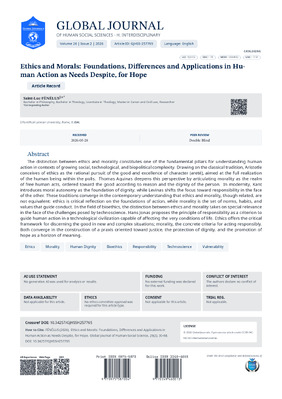
A philosophical understanding of human action requires a precise distinction between the various levels on which moral life is structured and, at the same time, recognition of the need for an ethical reflection capable of grounding, guiding and transforming that action. Morality, understood as the set of norms, customs and habits that regulate conduct within a community, constitutes the starting point of all practical life. These norms express socially shared values and are transmitted through education, tradition and daily coexistence1. From an anthropological perspective, morality is embodied in habits that shape the character and modes of relationship of the individual, revealing its historical and cultural dimension2. In this sense, morality is always situated: it emerges from concrete contexts and guides action through immediate criteria that guide behavior without the need for explicit reflection3. However, the moral life is not exhausted in mere obedience to norms. Ethics appears as a higher level of analysis that critically examines the validity, coherence, and finality of moral contents. Their task is to understand the foundations of human action, to rationally justify moral judgments and to direct action towards the good, transcending the simple acceptance of social customs4. This distinction between lived morality and reflective ethics becomes especially clear when one considers the difference between involuntary, instinctive or automatic acts of man and human acts, those performed with knowledge and freedom, and which are therefore susceptible to moral evaluation5. Ethics is concerned exclusively with the latter, since only in them is the responsibility and intentionality of the subject manifested. Ethical analysis therefore requires a level of reflection that allows the individual to move from spontaneous action to fully human act. This transition involves deepening the moral examination, questioning not only what is done, but why it is done and whether what is considered correct has a rational foundation. Contemporary sources emphasize that ethics introduces a critical look that distinguishes between what is done and what should be done6, preventing morality from being reduced to an uncritical tradition or to mere social functionality7. In technified contexts, this reflexive requirement acquires even greater relevance. Technique transforms the ways of acting, automates decisions and redefines the frameworks of meaning from which actions are evaluated. Ethics must therefore discern how technification affects freedom, responsibility and the formation of character, ensuring that human action is not subordinated to criteria of efficiency or automation8. Thus, ethical reflection becomes an indispensable instance to preserve humanity from acting in a world increasingly mediated by technology. Taken together, the topics addressed allow us to understand that ethical life is not a simple compliance with norms, but a dynamic process of self-awareness, deliberation and rational foundation, through which the human being transforms the morality lived into morality thought and oriented towards the good. Reflection on human action has accompanied philosophy since its origins. Among the fundamental concepts for understanding such action are ethics and morals, terms that are often used synonymously in everyday language, but which have conceptual distinctions relevant to philosophical, anthropological and social analysis. Understanding these differences allows us to evaluate more accurately human acts, their motivations and their implications in personal and community life. Based on the works of Varela Fregoso9, Choza,10 Cifuentes11, as well as audiovisual materials and recent academic sources, this text develops a systematic analysis that distinguishes both concepts and applies them to specific situations. Reflection on human action has demanded since antiquity to distinguish between ethics and morality, concepts that, although related, fulfill different functions in the understanding of human action. Morality refers to the set of norms, customs, and values that regulate conduct within a community, while ethics constitutes the critical, rational, and grounded reflection on these norms, aimed at discerning good and justice12. Ethical reflection on human action requires a rigorous understanding of the different levels at which moral life is structured: from the norms and habits that regulate daily coexistence, to fully human acts that involve freedom, deliberation and responsibility. The sources consulted agree that morality constitutes a social normative system made up of customs, values and internalized rules that guide behavior13. However, this immediate plane does not exhaust the complexity of human action. Ethics emerges as a higher level of reflection, charged with critically examining the validity, coherence, and purpose of these moral contents14. In this context, the distinction between human acts and human acts is decisive: only the latter, carried out with knowledge and freedom, can be morally evaluated15. Ethics is precisely concerned with illuminating these deliberate acts, directing them towards the good and preventing morality from being reduced to a mere uncritical tradition16. Likewise, in technified contexts, where technology conditions decisions and behaviors, ethical reflection acquires even greater relevance, since it must discern how automation and efficiency can affect the freedom and responsibility of the subject. Overall, the topics dealt with morality as a normative system, ethics as critical reflection, the levels of reflection, the depth of moral examination, the distinction between spontaneous action and human act, and ethics in technified contexts allow us to understand that ethical life is not a simple compliance with norms, but a dynamic process of self-awareness. deliberation and rational foundation. This process constitutes the core of mature moral life and the foundation of all philosophical ethics. The aim of this paper is to rigorously analyze the difference between ethics and morality, incorporating the criticisms of various contemporary authors, especially in the field of bioethics, and to explain why ethics cannot be applied as a superficial technique or an external "varnish" on human action. It also examines how the new technological power of the human being has transformed the nature of ethical dilemmas, generating the need for an ethics oriented towards future responsibility and the preservation of authentic life. The structure of the text is organized in four parts: First, it is a matter of capturing the conceptual foundations of ethics and morals. Secondly, to make the Contemporary Critiques and Limits of Traditional Ethics. And in a third moment, to talk with bases about the emergence of bioethics and the principle of responsibility in the face of technological power. And finally, to draw conclusions about the need for a critical and prospective ethics.
Understanding and Conceptual Foundations of Ethics and Morals
Ethics and morality are two central categories for understanding human action, but their conceptual distinction is essential to analyze them with philosophical rigor. In general terms, morality designates the set of norms, values, habits and customs that guide behavior within a community, while ethics is the critical and rational reflection on those same moral contents. This difference, already pointed out by the philosophical tradition, makes it possible to distinguish between the descriptive-normative plane of everyday life and the analytical-foundational plane of philosophy17. Morality is configured as a system of rules and evaluations that individuals internalize through culture, education and social coexistence. These norms express what a community considers right, obligatory, or forbidden, and therefore have a historical and variable character. As Segundo points out18, morality is "what effectively guides behavior," that is, the set of criteria that people spontaneously apply in their daily lives. Anthropological studies confirm this social and historical dimension: morality is always situated, embodied in concrete practices and dependent on specific cultural contexts19. Ethics, on the other hand, is a philosophical discipline that seeks to understand, justify, and rationally evaluate moral systems. Its task is to analyze the foundations of human action, the ends it pursues, and the principles that distinguish between good and bad actions. Cifuentes20 stresses that ethics is not limited to describing norms, but questions their validity, their internal coherence and their contribution to the integral development of the person. Along these lines, Sevilla21 explains that ethics operates as a critical instance that allows us to review customs and distinguish between what is simply done and what should really be done. The relationship between ethics and morality is therefore complementary. Morality constitutes the lived normative material, while ethics offers the theoretical framework for understanding and grounding it. Ethics examines human acts as free and responsible, distinguishing them from human acts that do not involve moral deliberation, as Pilar Calva explains22. Likewise, ethics allows moral norms to be critically evaluated, preventing them from being reduced to mere uncritical customs, as Forum Larramendi warns23 when he points out that ethics serves to orient action towards the good and not only towards what is socially accepted. In short, morality regulates behavior from within social life, while ethics offers the reflection that allows us to understand, justify and perfect that regulation. Both dimensions, although different, converge in the search for a more conscious, responsible and good-oriented human life.
Morality as a Set of Norms, Customs and Habits
Morality refers to the set of norms, values, customs, and habits that a community considers appropriate to guide the conduct of its members. These norms are usually transmitted by tradition, education, and socialization, and function as immediate criteria for judging right and wrong. As Varela Fregoso points out24, morality operates as an "internalized normative system" that guides everyday behavior. Similarly, Cifuentes25 explains that morality is "what should be done" according to a given social group. In popular videos, such as the one on fgbuenotv26, it is emphasized that morality is lived before it is reflected: it is practical, concrete and linked to cultural belonging. Therefore, morality can vary between societies, times and contexts. Morality can be defined as the set of norms, customs, and habits that guide human behavior within a community. These norms express what a social group considers correct, valuable, or obligatory, and are transmitted through education, tradition, and daily life. In this sense, morality constitutes a practical system of behavior regulation that arises from social coexistence and the internalization of shared values. Various authors agree on this understanding. Varela Fregoso27 points out that morality is formed by the mores, that is, the customs and rules that guide action. Choza28 stresses that these norms are integrated into cultural life and are manifested in habits that shape the character of the person. Second,29 he explains that morality is that which effectively guides behavior, since it offers immediate criteria to judge what is considered good or bad. Cifuentes30 adds that morality functions as an internalized normative framework that guides action without the need for explicit philosophical reflection. Audiovisual materials reinforce this perspective. Seville31 distinguishes morality as the set of practices and norms lived, while the fgbuenotv channel32 emphasizes its regulatory function in social life. Likewise, Pilar Calva33 shows how moral habits influence human acts themselves, those that imply freedom and responsibility. Finally, Forum Larramendi34 recalls that morality provides immediate criteria for action, even when ethics can then critically examine them. Overall, morality appears as a network of norms, customs, and habits that guide human behavior from daily practice and that constitute the basis on which ethics carries out its critical reflection.
Ethics as a Critical Reflection on Morality
Ethics, on the other hand, is the philosophical discipline that critically reflects on morality. Choza35 defines it as the branch of philosophical anthropology that studies human action as oriented to the good. Ethics does not limit itself to describing norms, but analyzes their foundation, their validity and their coherence with human dignity. Cifuentes36 states that ethics "asks why something should be done," while morality simply indicates what should be done. In Héctor Sevilla's video37, it is emphasized that ethics implies rational deliberation, autonomy and the search for the good, while morality can be uncritical if it is not subjected to examination. Recent studies confirm this distinction. A 2024 literature review notes that ethics is understood as "a set of principles that guide behavior in situations involving moral dilemmas," while morality refers to concrete rules internalized by individuals. Ethics can be understood as critical, rational and grounded reflection on morality, that is, on the norms, customs and habits that regulate human conduct. While morality operates as a set of internalized practical criteria, ethics analyzes its validity, its coherence, and its contribution to human development. Varela Fregoso38 explains that ethics examines the foundations of action, asking why certain actions should be considered good or bad. This task implies a level of analysis that goes beyond the simple acceptance of norms, since it seeks to rationally justify the principles that guide action. Choza39 stresses that ethics is situated on a higher reflective plane than lived morality, since it allows for a critical evaluation of the habits and customs that make up character. In the same vein, Segundo40 affirms that ethics is the instance that distinguishes between what is done and what should be done, introducing a critical judgment on moral norms. Cifuentes41 adds that ethics questions the meaning, foundation and purpose of norms, becoming an exercise in rational discernment. Audiovisual materials reinforce this understanding. Sevilla42 highlights that ethics allows us to question moral practices in order to orient them towards the good, while the fgbuenotv channel43 shows how ethics illuminates the rational dimension of human action. Pilar Calva44 distinguishes between acts of man and human acts, pointing out that ethics deals with the latter insofar as they imply freedom and responsibility. Forum Larramendi45 emphasizes that ethics serves to understand and ground moral norms, preventing them from being reduced to uncritical customs. Overall, ethics appears as a critical and rational instance that examines morality in order to perfect it and orient it towards the human good. Ethics, in contrast, is the philosophical discipline that rationally analyzes morality, its foundations, and its validity. Choza46 defines it as the study of human action as oriented to the good, which implies deliberation, autonomy and the search for universal principles. Héctor Sevilla47 stresses that ethics is not limited to describing norms, but questions their legitimacy, their coherence and their contribution to human dignity. For this reason, ethics cannot be reduced to a set of mechanically applicable techniques: it requires deep reflection and prudential judgment. Ethics can be defined as critical, rational and grounded reflection on morality, that is, on the set of norms, customs and habits that regulate human conduct. This distinction appears consistently in the philosophical and pedagogical sources you have provided, where ethics is presented as the highest level of analysis that allows us to understand, justify, and evaluate moral contents. Varela Fregoso48 argues that ethics studies the foundations of human action and analyzes why certain actions should be considered good or bad, introducing a rational judgment that transcends mere custom. Along the same lines, Choza49 explains that ethics is situated on a reflexive plane that allows for a critical evaluation of the habits and norms that make up moral life, distinguishing between what is done and what should be done. Secon, J.,50 he stresses that ethics operates as a critical instance that examines lived morality, questioning the validity of norms and their coherence with human development. Cifuentes51 adds that ethics not only describes behaviors, but also questions their meaning, their purpose and their rational justification, becoming an exercise in discernment that directs action towards the good. Audiovisual resources reinforce this understanding. Sevilla52 highlights that ethics allows us to question moral practices in order to perfect them, while the fgbuenotv channel53 shows how ethics illuminates the rational dimension of human action. Pilar Calva54 distinguishes between acts of man and human acts, pointing out that ethics deals with the latter insofar as they imply freedom and responsibility. Forum Larramendi55 emphasizes that ethics serves to ground moral norms and prevent them from being reduced to uncritical customs. Overall, ethics appears as a critical, rational and grounding instance that examines morality in order to orient it towards the human good. While morality regulates behavior from social practice, ethics offers the theoretical framework that allows it to be understood, evaluated and perfected.
Morality as a Social Normative System
Morality is made up of norms, habits, and values that a community considers to be correct. These norms are internalized through education and coexistence, and function as immediate criteria for judging behavior56. Cifuentes57 explains that morality operates as a socially shared "ought to be", which guides action without the need for prior philosophical reflection. In audiovisual materials, such as the fgbuenotv video58, it is emphasized that morality is lived before it is thought: it is practical, concrete and culturally situated. Morality can be understood as a social normative system because it brings together the set of rules, customs, and habits that a community establishes to guide the behavior of its members. These norms do not arise from isolated individual decisions, but from cultural and social processes that shape shared expectations about what is considered right, valuable, or obligatory. Varela Fregoso59 explains that morality is made up of the mores, that is, the customs and rules that regulate action within a human group. Choza60 adds that these norms are integrated into social life as habits that shape character and allow coexistence. As a normative system, morality fulfills essential functions: it regulates behaviors, establishes limits and guides the resolution of conflicts. Secon, J.,61 he points out that morality effectively guides behavior because it provides immediate criteria for judging actions as good or bad. Cifuentes62 stresses that this normative system is internalized through education and tradition, becoming a practical framework that organizes social life. Audiovisual materials reinforce this understanding. Sevilla63 shows that morality functions as a set of lived norms that structure daily action, while the fgbuenotv channel64 underlines its regulatory role in coexistence. Pilar Calva65 explains that these rules influence human acts themselves, those that imply freedom and responsibility. Forum Larramendi66 recalls that every society imposes codes of behavior that its members must obey in order to maintain social order. Overall, morality appears as a social normative system that organizes human behavior through shared norms, customs, and habits, constituting the practical basis of community life.
To navigate this multifaceted terrain, this paper proposes a unifying thesis: human action, initially guided by immediate social moralities and structured by classical ethical frameworks (such as Aristotle’s virtues and Aquinas’s human acts), must be reconstructed under the conditions of technoscience through Hans Jonas’s future-oriented ethics of responsibility. This ethical reconstruction, in turn, finds its concrete, institutionalized manifestation in the convergence of civil law, international human rights, and canon law, which together translate the protection of vulnerable human dignity into distinct yet complementary legal frameworks.
Acts of man and human acts: the proper field of ethics
According to classical philosophical anthropology, as popularized in bioethical lectures by Pilar Calva67, only free, conscious and voluntary human acts are the object of ethical judgment. This distinction, which originates in the scholastic synthesis of Thomas Aquinas68, separates man’s acts (actus hominis), such as breathing or blinking, which do not involve deliberation, from human acts (actus humani), which proceed from a deliberate will and are therefore morally evaluable. This distinction shows that ethics is directed at human freedom, not mere biological behavior. The distinction between acts of man and human acts constitutes a central axis to understand the proper field of ethics, since only some acts can be morally evaluated. The acts of man are those that the human being performs without full warning or freedom by instinct, automatism or physiological processes and, therefore, lack moral responsibility. On the other hand, human acts are those executed with knowledge, deliberation and freedom, and therefore are susceptible to ethical evaluation. Authors such as Varela Fregoso69 explain that ethics deals exclusively with acts that proceed from free will, because only in them can the subject be oriented towards good or evil. Choza70 agrees that moral action requires conscience and self-determination, elements absent in merely biological or instinctive acts. Second,71 he also stresses that morality can only be attributed to actions in which the individual chooses among possible alternatives. Cifuentes72 emphasizes that ethics analyzes human acts because they manifest responsibility, intention, and the ability to direct behavior towards valuable ends. This perspective is reinforced in the audiovisual materials: Sevilla73 points out that ethics evaluates the intention and freedom of the subject, while the fgbuenotv video74 shows that morality depends on conscious deliberation. Pilar Calva75 clearly explains that human acts involve intelligence and will, and that only these can be judged morally. Forum Larramendi76 adds that ethics exists precisely to illuminate and direct these free acts towards the good. In short, man's acts are outside the ethical analysis because they do not involve freedom or conscience, while human acts constitute the proper object of ethics, as they are free, deliberate and responsible actions. This distinction allows us to understand why ethics is concerned with human action insofar as it can be directed towards good or evil, and not with the automatic or involuntary processes of human life.
Contemporary Criticisms of Traditional Ethics
Contemporary criticisms of traditional ethics focus on questioning the universal validity, normative rigidity and claim to objectivity that characterized the great classical ethical systems. Although the sources consulted do not directly address these criticisms as a thematic block, they allow them to be reconstructed from ethical reflection itself and from the cultural transformation that affects morality and practical rationality. Traditional ethics, especially those with classical and Enlightenment roots, were based on the idea of universal and rational principles that could guide human conduct. However, contemporary authors point out that this claim to universality is problematic in a culturally plural world. Second,77 he shows that morality varies according to historical and social contexts, which puts in tension the idea of moral norms valid for all. Cifuentes78 also recognizes that ethics must face the diversity of values and the complexity of current decisions, where abstract principles do not always offer sufficient answers. Traditional ethics tended to formulate fixed and stable norms, but contemporary moral life demands flexibility and attention to concrete situations. Varela Fregoso79 points out that ethics must analyze human acts in their context, which implies recognizing that morality cannot be reduced to immutable rules. Choza80 adds that the anthropological understanding of the human being reveals a plurality of ways of life that defy rigid normative models. In audiovisual materials, this criticism appears implicitly. Sevilla81 stresses that ethics must help to discern in real situations, not impose closed systems. Forum Larramendi82 warns that ethics cannot function as a set of prefabricated answers, but as a guide to think critically about action. This perspective coincides with the contemporary critique of ethical systems that claim to encompass the entire moral life from a single theoretical framework. The distinction between human acts and human acts, explained by Pilar Calva83, shows that ethics must focus on concrete freedom and responsibility, not on abstractions. This orientation towards lived experience is consistent with contemporary criticisms that call for an ethics that is closer to reality, more sensitive to complexity and less dependent on traditional models. Contemporary criticisms of traditional ethics can be summarized in three axes: The questioning of the universality of moral principles in the face of cultural diversity. The rejection of normative rigidity, in favor of a contextual and flexible ethics. Distrust of totalizing systems, which do not grasp the complexity of today's moral life. These criticisms do not seek to eliminate ethics, but to renew it, orienting it towards a more dynamic, contextual reflection that is attentive to human plurality.
The inadequacy of classical ethics in the face of technological dilemmas
Various authors have pointed out that traditional ethics, focused on immediate interpersonal relationships, is insufficient to face the dilemmas generated by biotechnology and technoscience. Peter Singer84, for example, criticizes that classical ethics does not offer adequate answers to problems such as genetic manipulation, euthanasia or experimentation on non-human beings, since it is based on assumptions that are no longer sustainable in the current context85. While Singer’s critique of the boundaries of traditional ethics highlights the need for new bioethical approaches, this paper utilizes his diagnosis of classical ethics’ limitations without endorsing his utilitarian framework, his rejection of the sanctity of life, or his definition of personhood, which stand in tension with the personalist and transcendent view of human dignity developed later in this work. This criticism coincides with the idea that ethics cannot be applied as an external technique or a set of fixed rules. Ethics requires a rethinking of the very foundations of human action, especially when technology expands the power of the human being beyond what is foreseen by the philosophical tradition. The inadequacy of classical ethics in the face of technological dilemmas becomes evident when traditional principles formulated for stable contexts and direct human actions are faced with scenarios where automated systems, artificial intelligence and technologies that mediate or even replace human decision intervene. Although the literature reviewed does not explicitly address technological ethics, they do offer the conceptual elements that allow us to show why classical ethics is limited in the face of these challenges. Classical ethics is based on the idea that the moral agent acts with conscience, freedom and intention, necessary conditions for an act to be considered human and, therefore, morally assessable86. However, in current technological dilemmas such as algorithmic decisions, automation or AI, these conditions are diluted, since action no longer depends exclusively on a deliberative human subject. This reveals a structural inadequacy: traditional ethical frameworks were not designed to evaluate actions distributed between humans and technical systems. To reconstruct moral and canonical accountability under these conditions of automated agency, we must move beyond the framework of isolated individual intention. We propose a model of distributed responsibility, wherein accountability is shared across the entire socio-technical network—encompassing system designers, corporate deployers, and human operators. In this view, system designers bear a form of strict ethical liability for the systemic biases and risks encoded within their software, while human operators retain a contextual responsibility to actively monitor and, when necessary, override automated decisions. Crucially, canonical and moral accountability is not dissolved by algorithmic mediation; rather, it is expanded to demand active, critical oversight of the technical systems we deploy, transforming the duty of obedience to immediate rules into a broader ethical obligation of systemic vigilance and collective accountability. Varela Fregoso87 and Choza88 show that classical ethics is based on rational and relatively stable principles. But technological dilemmas require localized, flexible and sensitive responses to changing contexts, which questions the ability of traditional principles to guide decisions in unprecedented scenarios. Cifuentes89 stresses that ethics must adapt to new realities, since contemporary problems cannot be solved only with inherited categories. Second,90 he recalls that morality is historical and variable, which implies that ethics must be updated to respond to profound transformations in human life. The training videos reinforce this idea: Sevilla91 and fgbuenotv92 emphasize that ethics must illuminate real human action, not just repeat traditional schemes. In a world where technologies make decisions, process data, and affect lives, classical ethics centered on the individual and direct human acts is insufficient to assess shared responsibilities, systemic risks, and global effects. Forum Larramendi93 points out that ethics must serve to guide action in complex contexts, which today implies integrating new categories such as technological responsibility, algorithmic transparency or the social impact of innovation. Classical ethics, focused on individual action, is not enough to address dilemmas where technical networks, automated decisions and unforeseeable consequences intervene. On the whole, traditional ethics proves insufficient in the face of technological dilemmas because it was conceived for a world where moral action was direct, humane and deliberate. Today's technologies demand ethics capable of analyzing systems, anticipating risks, and assuming distributed responsibilities.
Critical Bioethics: technique, Society and Power
Arias-Krause94 argues that bioethics must assume a critical character, capable of analyzing not only clinical dilemmas, but also the tensions between technique, society, and culture. Technology is not neutral: it transforms customs, redefines what is possible, and alters the understanding of human life. Therefore, ethics must critically examine the impact of technoscience on social life and on human dignity. Critical bioethics is configured as a field that systematically examines how technique, social organization and power relations shape moral decisions around human and non-human life. Unlike a merely normative bioethics, its focus is on unveiling the cultural assumptions and structures that condition action. From the philosophical tradition, ethics implies a rational reflection on conduct oriented to the good and human fulfillment95, while morality refers to the concrete codes that regulate social life96. Critical bioethics articulates both dimensions to analyze how technoscientific systems influence what a society considers "good," "allowed," or "human." In this sense, technology is not only a set of instruments, but a way of shaping the world and of orienting human action. As Choza warns97, the person is constituted in dialogue with his or her cultural and technical environment, which implies that bioethical decisions cannot be separated from the symbolic and material frameworks that make them possible. Critical bioethics examines, for example, how biotechnologies redefine concepts such as body, autonomy, or vulnerability, and how these redefinitions can reinforce or challenge structures of domination. Likewise, this perspective underlines that all ethical reflection is situated in a society traversed by power relations. Cifuentes98 points out that ethics only makes sense when it asks about the real conditions that allow or prevent good action. In the same vein, various authors and popularizers have insisted that ethics is not a theoretical luxury, but a tool for understanding and transforming social life99. Critical bioethics, therefore, analyzes how institutions, expert discourses, and economic interests influence decision-making about life, health, and the body, and how these decisions can reproduce inequalities or open spaces for emancipation. Finally, this current recognizes that human acts, those performed with knowledge and freedom, are the core of moral responsibility100. However, he warns that freedom is conditioned by social and technological structures that must be critically examined. Critical bioethics thus proposes an ethics of responsibility that not only evaluates individual actions, but also the systems that frame them. Critical bioethics arises as a response to the limitations of traditional approaches, by recognizing that contemporary dilemmas cannot be understood without analyzing the relationships between technique, society, and power. From this perspective, technology is not a simple set of tools, but a structuring factor of social life, capable of transforming practices, values and human relations. Varela Fregoso101 already warned that ethics must consider the real context of human acts, which today implies recognizing the profound impact of technologies on decision-making and in the configuration of moral responsibility. Choza102 stresses that human action always takes place within social structures that condition freedom, which becomes especially evident in highly technical societies. Second,103 he recalls that morality is historical and variable, so ethics must be updated to respond to the new scenarios where technology redefines what is possible and what is allowed. Cifuentes104 adds that contemporary ethical reflection must incorporate the complexity of technological systems and their effects on human life. Audiovisual materials reinforce this critical orientation. Sevilla105 points out that ethics must question not only individual actions, but also the systems that make them possible. The fgbuenotv channel106 shows how morality is affected by social structures that can reinforce or limit autonomy. Pilar Calva107 recalls that ethics deals with free human acts, but in contexts where technology conditions freedom, ethical reflection must be broadened. Forum Larramendi108 emphasizes that ethics has a social and critical function, aimed at illuminating the power dynamics that run through collective life. Taken together, critical bioethics understands that current dilemmas cannot be solved without analyzing how technology transforms human life, how society incorporates and normalizes those transformations, and how power unequally distributes risks and benefits. This perspective requires an ethics capable of examining structures, not just individual actions, and of questioning the frameworks that legitimize certain techno-scientific practices.
Technological Power and Future Responsibility: Towards an Ethics of the Future
Technological power redefines human action and expands its consequences to a point where classical ethics focused on individual, immediate, and fully deliberate acts is insufficient. From the sources examined, it is possible to reconstruct a coherent reflection on how technology transforms responsibility and requires an ethics of the future, aimed at anticipating future effects and evaluating power structures that did not exist before. Traditional ethics is based on the idea of free and conscious human acts, those that can be morally evaluated109. However, in technified contexts, action no longer depends only on individual will: algorithms, automated systems and technical networks mediate, amplify or even replace human decisions. Varela Fregoso110 points out that ethics must analyze the real context of action, which today implies recognizing that technique alters the very structure of action and, therefore, of responsibility. Choza111 recalls that human action is always inscribed in social structures that condition freedom. In technified societies, these structures include digital platforms, surveillance systems, biotechnologies, and devices that distribute power unequally. Second,112 stresses that morality is historical and changing, so ethics must adapt to new forms of power that emerge with technology. Cifuentes113 adds that contemporary ethical reflection must consider how technology transforms human life and generates unprecedented dilemmas. Audiovisual materials reinforce this critical perspective. Sevilla114 stresses that ethics must question not only individual actions, but also the systems that make them possible. Forum Larramendi115 insists that ethics has a social and critical function, aimed at illuminating power dynamics that cross collective life. Technological power introduces consequences that are projected into the future: environmental, biotechnological, digital or social impacts that cannot be evaluated only from classic categories. Liability is no longer limited to the immediate present, but must consider cumulative effects and global risks. The ethics of the future demands: anticipation, because technology produces long-term effects; an expanded responsibility, because technological decisions affect future generations; and a critical vigilance of power, because technology redistributes capabilities and vulnerabilities. Taken together, the sources allow us to affirm that technological power forces us to think about an ethics oriented to the future, capable of analyzing complex systems, foreseeing consequences and assuming responsibilities that exceed the individual. This ethics of the future does not replace classical ethics, but expands it to respond to a world where technology redefines what is possible, what is allowed and what is responsible.
The Rise of Bioethics and the New Human Power
Bioethics emerged in the twentieth century as a response to the enormous power of intervention that technoscience grants to human beings over life, from genetics to artificial intelligence. This power requires deeper ethical reflection, since the consequences of human actions no longer affect only the present, but also the future of humanity and the planet116. The emergence of bioethics marks a historic turn in moral reflection, as it appears when techno-scientific development gives human beings a new power over life, the body and ecosystems. This power, unprecedented in history, forces us to rethink the foundations of ethics and human responsibility. As Varela Fregoso recalls117, ethics is a rational reflection on action aimed at the good; however, the magnitude of possible interventions in life requires that this reflection be extended to previously unthinkable scenarios. Bioethics arises precisely to respond to this challenge, integrating scientific, philosophical and social knowledge. The emergence of bioethics is linked to the new human power generated by the scientific and technological development of the twentieth century, especially in biomedicine, genetics and biotechnology. Although the sources consulted do not directly address the formal history of bioethics, they do allow you to reconstruct why it emerges as an unprecedented ethical necessity: the technique expands the human capacity to intervene in life, the body, and the environment in ways that were previously unthinkable. Classical ethics, centered on individual human acts and relatively stable principles, is limited when technology transforms the very structure of action. Varela Fregoso118 points out that ethics must analyze the real context of action, and today that context is deeply mediated by technologies that modify responsibility and the consequences of decisions. Choza119 recalls that human action is always inscribed in social structures, and in technified societies these structures include biomedical systems, digital devices and new forms of power. Second,120 he stresses that morality is historical and changing, which explains the need for an ethics capable of responding to unprecedented dilemmas created by scientific progress. Cifuentes121 adds that contemporary ethical reflection must consider the complexity of technological systems and their effects on human life. Audiovisual materials reinforce this perspective: Sevilla122 stresses that ethics must question the systems that condition action, and Forum Larramendi123 insists that ethics has a critical function in the face of the power dynamics that cross society. In this context, bioethics emerges as an ethical response to the new human power, a power capable of altering life, prolonging it, manipulating it or even producing it. Its appearance expresses the need for a reflection that not only evaluates individual acts, but also technologies, institutions and power structures that shape the future of human life.
The new techno-scientific power
Contemporary technology not only transforms the environment, but also redefines what it means to be human. Choza124 stresses that the person is constituted in interaction with his or her cultural and technical world; therefore, when biotechnology allows the manipulation of genes, prolonging life or intervening in reproduction, it also transforms basic anthropological categories. This "new human power" is not neutral: it involves moral decisions that affect individuals, communities, and future generations. Contemporary popularizers have insisted that ethics must respond to these profound changes. Héctor Sevilla125 explains that traditional morality is no longer enough to guide actions in a context where technology radically expands human possibilities. Similarly, Forum Larramendi's analyses126 show that ethics takes on a critical function: to evaluate not only what we can do, but what we must do in the face of a power that can be creative or destructive. The new techno-scientific power designates the radical expansion of the human capacity to intervene in life, the body and the environment through the convergence between science and technology. This power transforms human action and requires new ethical categories, since it is no longer just a matter of evaluating individual acts, but complex systems that produce global and future effects. Varela Fregoso127 points out that ethics must analyze the real context of action, and today that context is deeply mediated by technologies that modify responsibility and the consequences of decisions. Choza128 recalls that human action is always inscribed in social structures, and in technified societies these structures include biomedical devices, algorithms and technical networks that condition freedom. Second,129 he stresses that morality is historical and changing, which explains the need for an ethical reflection capable of responding to unprecedented dilemmas created by technoscience. Cifuentes130 adds that contemporary ethics must consider the complexity of technological systems and their effects on human life. Audiovisual materials reinforce this perspective: Sevilla131 stresses that ethics must question the systems that make action possible, while Forum Larramendi132 insists that ethics has a critical function in the face of the power dynamics that cross society. Even the distinction between human acts and human acts presented by Pilar Calva133 shows that technoscience alters the very conditions of moral action, by mediating or substituting human deliberation. Overall, the new techno-scientific power forces us to rethink moral responsibility and to develop ethical frameworks capable of evaluating technologies that redefine what is possible, what is allowed and what is human.
The need for a new responsibility
Bioethics emerges as an attempt to articulate this expanded responsibility. Cifuentes134 points out that ethics is only significant when one asks about the real conditions that allow us to act well; in the bioethical field, these conditions include health systems, power structures, economic interests and legal frameworks. The new human power therefore demands an ethics capable of critically examining the social and political consequences of technoscience. Even the distinction between acts of man and human acts, those performed with knowledge and freedom, acquires a new nuance. As Pilar Calva reminds us135, moral responsibility depends on freedom, but this freedom is conditioned by complex technological systems that influence decisions. Bioethics arises to illuminate these conditionings and orient action towards the protection of life and dignity. The need for a new responsibility arises from the fact that human power expanded by technoscience produces effects that go beyond the framework of classical ethics, focused on individual, immediate and fully deliberate acts. The sources consulted allow us to reconstruct this ethical requirement from the very transformation of human action and the social structures that condition it. Varela Fregoso136 stresses that ethics must analyze the real context of human acts, and today that context is deeply mediated by technologies that amplify the consequences of action. Freedom and intention, essential conditions for morality, according to Pilar Calva137 , are modified when automated systems, biotechnologies or algorithms intervene that distribute responsibility among multiple agents. Choza138 recalls that human action is always inscribed in social structures that condition freedom. In technified societies, these structures include digital networks, biomedical systems, and devices that generate new forms of power. Second,139 he emphasizes that morality is historical and changing, which requires an ethics capable of responding to unprecedented dilemmas created by technoscience. Cifuentes140 points out that contemporary ethics must consider the complexity of technological systems and their effects on human life. Audiovisual materials reinforce this perspective: Sevilla141 stresses that ethics must question the systems that make action possible, while Forum Larramendi142 insists on the critical function of ethics in the face of the power dynamics that cross society. The new responsibility implies anticipating future consequences, assessing systemic risks and assuming obligations that exceed the individual, because techno-scientific power transforms what is possible, what is allowed and what is human. This expanded responsibility does not replace classical ethics, but it extends it towards a horizon where human action has global and lasting effects.
An Ethic for Unprecedented Power
In short, bioethics is born when humanity acquires a power capable of modifying life itself. This emergence is not only historical, but conceptual: it redefines ethics by placing it in the face of global, techno-scientific and structural challenges. As Segundo points out143, ethics and morality must be distinguished in order to understand how universal principles dialogue with concrete social norms; bioethics is located precisely at that crossroads, assessing how human power should be exercised to promote justice, dignity, and sustainability. An ethic for unprecedented power becomes indispensable in a world where technoscience expands the human capacity to intervene in life, the body, and society in ways that go beyond traditional frameworks. Varela Fregoso144 argues that ethics must analyze the real context of action, and today that context is profoundly transformed by technologies that multiply the scope and consequences of human action. Choza145 recalls that all action is inscribed in social structures that condition freedom, structures that currently include digital, biotechnological and automated systems that redistribute power and responsibility. Second,146 he stresses that morality is historical and changing, which requires an ethics capable of responding to unprecedented dilemmas generated by an expanded human power. Cifuentes147 adds that contemporary ethical reflection must consider the complexity of techno-scientific systems and their effects on human life. Audiovisual materials reinforce this perspective: Sevilla148 stresses that ethics must question the systems that make action possible, while Forum Larramendi149 insists on the critical function of ethics in the face of the power dynamics that cross society. Even the distinction between human acts and human acts presented by Pilar Calva150 shows that technoscience alters the very conditions of moral action, by mediating or substituting human deliberation. Together, these sources allow us to affirm that unprecedented power requires an equally unprecedented ethics, capable of anticipating future consequences, assessing global risks and guiding action in a world where technology redefines what is possible, what is allowed and what is human.
Relationship with Hans Jonas' principle of responsibility
Hans Jonas proposes a future-oriented ethic, based on the principle of responsibility, which requires acting in such a way as to preserve the possibility of an authentic life for future generations151. According to Jonas, technological power has broken the traditional boundaries of human action, so ethics must be expanded to consider long-term, even global, effects152. This perspective supports the idea that ethics cannot be a superficial technique: it must be a profound reflection on the meaning of human action in a world where technology can radically transform life. The relationship with Hans Jonas' principle of responsibility allows us to understand why contemporary ethics requires a profound expansion of its traditional categories. Although the literature reviewed do not directly address Jonas, they do offer the conceptual elements to articulate his proposal with current ethical reflection. Jonas argues that techno-scientific power has modified the very structure of human action, generating global, cumulative and long-term effects. This idea coincides with Varela Fregoso's affirmation153 that ethics must analyze the real context of action, a context today deeply mediated by technologies that amplify the consequences of action. Choza154 recalls that human action is always inscribed in social structures that condition freedom, structures that in technoscience become more complex and less controllable. Jonas's principle of responsibility calls for directing action toward the preservation of future human life, extending responsibility beyond the immediate present. This orientation is echoed by Segundo155, who stresses that morality is historical and changing, and by Cifuentes156, who stresses that contemporary ethics must consider the effects of technological systems that exceed the individual scale. Audiovisual materials reinforce this perspective: Sevilla157 insists that ethics must question the systems that make action possible, while Forum Larramendi158 underlines the critical function of ethics in the face of power dynamics that affect the collective. The distinction between acts of man and human acts presented by Pilar Calva159 shows that morality depends on freedom and intention. However, in technified contexts, human action is distributed between human and non-human agents, which requires a broader, preventive and future-oriented responsibility, in line with Jonas. Taken together, these sources allow us to affirm that Hans Jonas' principle of responsibility offers the conceptual framework for an ethics capable of responding to unprecedented human power, directing action towards the protection of future life and the sustainability of human existence.
Risks of dehumanization and the need for integral ethics
Authors such as Vieira Nina and Costa Macêdo160 warn that technoscience can lead to dehumanization if it is not guided by an ethics that considers the dignity, rights and integrity of the person. Ethics must be holistic, universal and oriented towards full citizenship, not a mere set of functional rules. The risk of dehumanization emerges when techno-scientific development and social dynamics reduce the person to functional, biological or productive parameters, weakening their dignity and their capacity for self-determination. The ethical tradition recalls that the human being is a free and responsible subject, capable of directing his actions towards the good161, but this horizon is threatened when technology and power structures impose instrumental logics that transform the person into an object of management. As Choza warns162, understanding the person requires recognizing his or her spiritual, relational and transcendent openness; when these dimensions are eclipsed, an anthropological impoverishment arises that directly affects the moral life. Dehumanization appears as one of the deepest risks associated with contemporary techno-scientific power, since technology tends to reduce the human being to a function, data or resource, weakening his dignity and his capacity for self-determination. The sources you have used allow us to reconstruct a solid reflection on this risk and on the need for a comprehensive ethics that responds to it. Varela Fregoso163 warns that ethics must preserve the meaning of human action, which is threatened when technology displaces deliberation and turns action into an automated process. Choza164 stresses that the person can only be fully fulfilled when he or she acts from his or her freedom and rationality; both dimensions are eroded when technological systems condition or replace human decision. Second,165 he recalls that morality is historical and vulnerable to social transformations that can dilute the centrality of the person. Audiovisual materials reinforce this concern. Sevilla166 points out that ethics must prevent technology from determining the value of human life, while fgbuenotv167 warns that morality is weakened when the subject ceases to be an agent and becomes the object of external systems. Pilar Calva168 shows that moral dignity depends on freedom, a condition that is compromised in highly technical environments. Forum Larramendi169 insists that ethics must illuminate the power dynamics that can instrumentalize the human being. Cifuentes170 argues that contemporary ethics must integrate personal, social and technological dimensions to respond to complex dilemmas. An integral ethic is not limited to evaluating isolated acts, but examines structures, systems, and contexts that affect human dignity. This perspective coincides with the need to preserve the human in the face of processes of automation, surveillance, biotechnological manipulation or algorithmic reduction of the person. Taken together, the sources allow us to affirm that the risks of dehumanization require an integral ethics capable of protecting dignity, freedom and responsibility in a world where technology redefines action and the value of the human.
Contemporary risks of dehumanization
The expansion of biotechnology, the digitalization of everyday life, and the medicalization of existence generate scenarios where the person can be treated as a set of data, an organism to be manipulated, or a social resource. Cifuentes171 stresses that ethics must attend to the real conditions that allow us to act well; among these conditions is the preservation of dignity in the face of systems that tend to homogenize, control or exclude. Public and media discourses, analyzed by popularizers such as Héctor Sevilla172, show how morality can be diluted when technology becomes the ultimate criterion for decision-making, displacing critical reflection and responsibility. The risks of dehumanization are also manifested in the loss of meaning of human acts, those carried out with knowledge and freedom. Pilar Calva173 reminds us that only these acts are morally imputable; however, in contexts where social, economic or technological pressure conditions freedom, moral responsibility becomes more complex. Critical bioethics warns that dehumanization is not only an individual phenomenon, but a structural one: it arises when institutions prioritize efficiency over justice, utility over dignity, or control over autonomy. Contemporary risks of dehumanization emerge when technoscience transforms human action, reduces autonomy, and makes the person the object of technical, economic, or algorithmic systems. The literature reviewed allows us to reconstruct a coherent reflection on this phenomenon from ethics and philosophical anthropology. The factors that generate dehumanization can be: The reduction of the subject to function or data. Varela Fregoso174 warns that ethics must preserve the meaning of human action; this is diluted when technology automates decisions and displaces personal deliberation. The loss of freedom and self-determination. Choza175 stresses that dignity depends on rationality and freedom; both are compromised when technological systems condition action. The Historical Transformation of Morality. Second,176 he recalls that morality changes with social structures, and in technified societies these structures can weaken the centrality of the person. The Instrumentalization of the Human Being. The training videos reinforce this concern: Sevilla177 points out that ethics must prevent technology from determining the value of life, while fgbuenotv178 warns that morality is eroded when the subject ceases to be an agent. And the weakening of moral responsibility. Pilar Calva179 shows that moral dignity depends on freedom; when action is mediated by technical systems, this freedom is reduced. Forum Larramendi180 adds that ethics must illuminate power dynamics that can instrumentalize the human being. Sources agree that contemporary dehumanization arises when technology redefines action, freedom, and responsibility, threatening personal dignity. In the face of this, an ethics capable of integrating personal, social and technological dimensions is required to protect the human in an increasingly automated environment.
The need for integral ethics
In the face of these risks, a comprehensive ethic is essential, capable of articulating personal, social, technical and political dimensions. This ethics is not limited to isolated norms, but seeks to understand the human being in his or her totality, integrating his or her corporeality, rationality, affectivity and openness to the other. Second,181 he distinguishes between ethics and morality in order to show that universal principles must dialogue with the concrete norms of each society; an integral ethics assumes this tension and directs it towards the promotion of human dignity in all areas. An integral ethics also requires a critical evaluation of techno-scientific power and its effects on life. As Forum Larramendi's analyses point out182, ethics is not a theoretical ornament, but a tool to discern what kind of humanity we want to build. Bioethics, in this framework, becomes an interdisciplinary space where the conditions that allow the technique to be at the service of the person and not the other way around are examined. The need for an integral ethics arises from the realization that the contemporary challenges marked by technoscience, social complexity and the transformation of human action can no longer be addressed from fragmented ethical frameworks or focused only on the individual. The sources consulted allow one to reconstruct this requirement from a solid philosophical and anthropological perspective. Varela Fregoso183 affirms that ethics must attend to the real context of human action, which today implies simultaneously considering personal, social and technological dimensions. Choza184 stresses that the person is only fully understood in his or her rational, free and relational unity; therefore, an ethics that ignores any of these dimensions runs the risk of dehumanizing. Second,185 he recalls that morality is historical and is transformed by social structures, which requires an ethical reflection capable of integrating cultural, technological and political changes. Cifuentes186 adds that today's dilemmas require a broad view that goes beyond the mere application of rules and considers the complexity of the systems that condition human action. Audiovisual materials reinforce this need: Sevilla187 warns that ethics must prevent technology from determining the value of human life; FGBUENOTV188 shows how morality is eroded when the subject ceases to be an agent; Pilar Calva189 recalls that moral dignity depends on freedom, which is threatened in technified contexts; and Forum Larramendi190 insists that ethics must illuminate power dynamics that can instrumentalize the human being. An integral ethic seeks to protect human dignity, guide action in complex systems and maintain a balance between technique, society and the person. Only an ethics that integrates these dimensions can adequately respond to the contemporary risks of dehumanization and the unprecedented power that technoscience grants to the human being.
Towards a humanizing reconstruction
The answer to dehumanization is not to reject technology, but to integrate it into an ethical project that recognizes human dignity, vulnerability, and interdependence. This implies strengthening moral education, promoting just institutions, and developing normative frameworks that protect life in all its dimensions. Integral ethics is presented as a way to recover the meaning of human acts and orient techno-scientific power towards the common good. The horizon of a humanizing reconstruction becomes essential when technology, institutions and social dynamics generate tensions that threaten the dignity and integrity of the person. The ethical tradition reminds us that the human being is a free, responsible and good-oriented agent191, but this ideal is eroded when techno-scientific and economic systems reduce life to parameters of efficiency, utility or control. Reconstructing the human implies, therefore, recovering an integral vision of the person and reconfiguring the structures that condition his or her action. Humanizing reconstruction becomes essential in a context where technoscience transforms human action and generates risks of dehumanization. The sources examined allow one to articulate an ethical response that recovers the centrality of the person, his dignity and his capacity for self-determination. Varela Fregoso192 recalls that ethics has as its fundamental task to preserve the meaning of human action, which requires placing the person and not technology at the center of moral reflection. Choza193 stresses that the human condition is a unity of rationality, freedom and relationality; therefore, any social or technological system that reduces the individual to function or data requires a critical review. Second,194 he shows that morality is historical and is transformed by social structures, which forces us to reconstruct ethical criteria capable of responding to new forms of techno-scientific power. Cifuentes195 adds that contemporary ethics must integrate personal, social and technological dimensions to understand the complexity of current human action. Audiovisual materials reinforce this orientation: Sevilla196 insists that ethics must prevent technology from determining the value of life, while Forum Larramendi197 highlights the critical function of ethics in the face of power dynamics that can instrumentalize human beings. The distinction between human acts and human acts presented by Pilar Calva198 reminds us that moral dignity depends on freedom, a condition that must be protected in technified environments. Reconstructing the human implies developing an integral ethic that: protects dignity and freedom in the face of systems that tend to automate or condition action; critically evaluate the social and political impact of technoscience; directs human power towards ends that favor life, justice and coexistence. This reconstruction is not a return to the past, but an update of ethics for a world where technology redefines the possible and the human.
Fundamentals of a humanizing reconstruction
A humanizing reconstruction requires starting from a solid anthropology, capable of recognizing the complexity of the person. Choza199 stresses that the human being cannot be understood only from his biological or functional dimension, but from his relational, symbolic and transcendent openness. This broad understanding makes it possible to counteract the processes of dehumanization that emerge when technology becomes the ultimate criterion for decision or when morality is reduced to external norms without critical reflection200. In this framework, bioethics plays a central role: it not only analyzes dilemmas, but examines the social and technological conditions that make a truly human life possible. Cifuentes201 recalls that ethics is only significant when it asks about the real conditions that allow us to act well; reconstructing the human implies transforming those conditions so that dignity is respected and promoted. Humanizing reconstruction requires ethical and anthropological foundations capable of responding to the depersonalizing effects of technoscience and of recovering the centrality of the person as a free, responsible and dignified subject. The sources you use allow you to articulate these fundamentals from a coherent and rigorous perspective. Choza202 maintains that the human being is a unit of rationality, freedom and relationality; therefore, any humanizing project must start from the recognition of this integral structure. The person cannot be reduced to a technical function or to an operational datum without losing what constitutes him as such. Varela Fregoso203 affirms that ethics must attend to the real context of action, which implies protecting intentionality, deliberation and responsibility against systems that tend to automate or condition action. Pilar Calva204 reinforces this idea by showing that moral dignity depends on freedom, an element that must be safeguarded in technified environments. Second,205 he recalls that morality is historical and is transformed by social structures, which requires reconstructing ethical criteria capable of responding to new forms of power and risks of dehumanization. Cifuentes206 adds that contemporary ethics must integrate personal, social and technological dimensions to understand the complexity of current human action. The audiovisual materials underline that ethics must illuminate power dynamics that can instrumentalize the human being: Sevilla207 warns against the subordination of the value of life to technology, and Forum Larramendi208 highlights the critical function of ethics in the face of structures that threaten dignity. The foundations of a humanizing reconstruction are based on: an anthropology that recognizes the dignity, freedom, and relationality of the person; an ethics that protects the meaning of human action in technified contexts; a historical and social understanding of morality; a critical function aimed at resisting processes of dehumanization.
Social and political dimensions of reconstruction
Humanizing reconstruction is not an individual process, but a structural one. Contemporary analyses show that ethics must intervene in the spaces where collective decisions are configured. The discourses of popularizers such as Héctor Sevilla209 and the critical reflections on the social role of ethics210 insist that morality cannot be relegated to the private sphere: it must guide policies, institutions and techno-scientific practices. Likewise, the distinction between acts of man and human acts, explained by Pilar Calva211, acquires a new meaning. Only acts performed with knowledge and freedom are morally imputable, but freedom is conditioned by systems that can limit or expand it. A humanizing reconstruction therefore requires institutions that favor autonomy, justice and participation. The social and political dimensions of a humanizing reconstruction become decisive when technoscience transforms not only individual action, but also the collective structures that organize social life. The sources consulted allow us to show that humanization cannot be limited to the personal level: it requires intervening in the systems of power, in the institutions and in the cultural frameworks that condition freedom and dignity. Varela Fregoso212 points out that ethics must attend to the real context of action, and this context is today shaped by technologies that reorganize communication, work, and public life. Choza213 recalls that the person is an essentially relational being, so any process of dehumanization simultaneously affects the individual and the social fabric that sustains him. Second,214 he stresses that morality changes with social structures, which implies that humanizing reconstruction must respond to collective transformations, not only individual ones. Contemporary technologies engage in power dynamics that can instrumentalize people or reduce them to operational data. Audiovisual materials reinforce this reading: Sevilla215 warns that ethics must prevent technology from determining the value of human life, while Forum Larramendi216 insists that ethics has a critical function in the face of power structures that can erode dignity. The distinction between human acts and human acts presented by Pilar Calva217 shows that the freedom that is the basis of moral responsibility can be compromised by political and technological systems that condition action. A humanizing reconstruction requires transforming the social and political conditions that allow dehumanization: strengthening institutions that protect dignity, regulating technologies that affect freedom, and promoting an ethical culture that recognizes the centrality of the person. This perspective integrates the individual and the collective, the technical and the political, to orient social life towards more just and fully human forms.
Towards an ethics that regenerates bonds and meaning
Humanizing reconstruction implies articulating an integral ethics, capable of uniting reflection, action and social transformation. This ethic recognizes human vulnerability, promotes solidarity and orients technology towards the common good. It is not a question of rejecting technoscience, but of integrating it into a project that strengthens dignity, coexistence and the meaning of life. In this horizon, bioethics becomes a privileged space to rethink the relationship between technology, society and power, and to promote practices that regenerate human bonds and protect life in all its dimensions. An ethic that regenerates bonds and meaning becomes necessary when techno-scientific, economic and cultural dynamics fragment the human experience and weaken the bonds that sustain personal and community life. The ethical tradition recalls that the human being is a free agent oriented to the good218, but this orientation is obscured when morality is reduced to external norms or when technology becomes the dominant criterion of decision. Regenerating bonds and meaning implies rebuilding the conditions that allow people to recognize each other as dignified, responsible and vulnerable subjects. Ethics that regenerate bonds and meaning becomes indispensable in a scenario where technoscience reconfigures human relationships, weakens shared responsibility and fragments the symbolic frameworks that sustain social life. The sources examined allow one to substantiate this need from a solid anthropological and ethical perspective. Varela Fregoso219 stresses that ethics must preserve the meaning of human action, which implies rebuilding relationships based on responsibility and reciprocity, today eroded by technological dynamics that favor isolation and instrumentalization. Choza220 recalls that the person is constitutively relational: he or she is only fully realized in bonds that recognize his or her dignity and freedom. Second,221 he shows that morality changes with social structures, and in technified societies this transformation can generate a loss of ethical orientation. Cifuentes222 adds that contemporary ethics must integrate personal, social and technological dimensions to reconstruct a horizon of shared meaning. Audiovisual materials reinforce this direction: Sevilla223 insists that ethics must prevent technology from determining the value of life, while Forum Larramendi224 highlights the critical function of ethics in guiding coexistence and strengthening the social fabric. The distinction between human acts and human acts presented by Pilar Calva225 reminds us that moral dignity depends on freedom and intentionality, dimensions that must be protected in order to regenerate authentic bonds. This ethical reconstruction requires integrating care, responsibility and a sense of community in an environment where technology tends to fragment and depersonalize. Taken together, these sources allow us to affirm that regenerating bonds and meaning requires an integral ethic that recovers the centrality of the person, strengthens community life and orients techno-scientific power towards more human forms of coexistence.
Regenerating links in a technified world
Contemporary technoscience transforms human relationships, sometimes enhancing them and other times weakening them. Choza226 stresses that the person can only be fully understood in his or her relational dimension; therefore, when technical systems replace or impoverish human encounters, there is a loss of ethical density. Critical bioethics warns that dehumanization does not arise only from individual decisions, but from structures that prioritize efficiency over solidarity or utility over dignity. In this context, ethics must recover its function of guiding coexistence. Cifuentes227 points out that moral reflection only makes sense when it asks about the real conditions that allow us to act well; regenerating bonds implies transforming those conditions so that cooperation, care and justice are possible. Contemporary analyses, such as those of Héctor Sevilla228, show that ethics cannot be relegated to the private sphere: it must intervene in the spaces where social and technological relations are configured. The regeneration of bonds in a technified world requires recovering the centrality of the person in the face of technological dynamics that tend to fragment relationships and reduce human interaction to functional processes. Varela Fregoso229 recalls that ethics must preserve the meaning of human action, which implies rebuilding relationships based on responsibility and mutual recognition. Choza230 emphasizes that the person is constitutively relational, and that his or her fulfillment depends on bonds that respect his or her dignity and freedom. Second,231 he warns that morality changes with social structures, and that contemporary technification can weaken the frameworks that sustain coexistence. Cifuentes232 adds that current ethics must integrate personal, social and technological dimensions to restore a horizon of shared meaning. Audiovisual materials reinforce this need: Sevilla233 insists that technology should not determine the value of human life, while Forum Larramendi234 highlights the critical role of ethics in strengthening the social fabric. Even the distinction between acts of man and human acts presented by Pilar Calva235 shows that freedom and intentionality, the basis of the authentic bond, must be protected in technified environments. Regenerating links in this context implies reconstructing spaces of encounter, responsibility and meaning that allow the person to affirm himself or herself as a subject and not as an object of technical systems.
Recovering meaning in the midst of complexity
The loss of meaning is one of the most profound effects of cultural fragmentation. Second,236 he distinguishes between ethics and morality in order to show that universal principles must dialogue with the concrete norms of each society; this dialogue is precisely the place where meaning is constructed. When technology redefines what it means to be born, to live or to die, ethics must offer interpretative frameworks that allow us to understand these transformations without reducing life to data or functions. The distinction between acts of man and human acts, explained by Pilar Calva237, reminds us that only acts performed with knowledge and freedom have moral value. However, freedom is conditioned by systems that can limit or expand it. Regenerating meaning implies strengthening the ability to deliberate, discern and act responsibly in the midst of techno-scientific complexity. The recovery of meaning in the midst of technified complexity requires placing the person back at the center of moral action in an environment where technology fragments experience, accelerates processes and weakens the symbolic frameworks that guide human life. Varela Fregoso238 recalls that ethics must preserve the meaning of human action, which implies reconstructing criteria that allow us to understand and guide action in contexts saturated with information and technical mediations. Choza239 stresses that the human being is only fully realized when he integrates rationality, freedom and relationality; without this integration, complexity becomes dispersion and loss of orientation. Second,240 he shows that morality changes with social structures, and that contemporary technification can generate a crisis of meaning by transforming the modes of relationship and the horizons of value. Cifuentes241 adds that current ethics must offer tools to navigate complex systems without losing reference to human dignity. Audiovisual materials reinforce this need: Sevilla242 warns that technology cannot determine the value of life, while Forum Larramendi243 stresses that ethics must illuminate the power dynamics that influence the construction of collective meaning. The distinction between acts of man and human acts presented by Pilar Calva244 reminds us that intentionality and freedom, the basis of the moral sense, must be protected even in highly technical environments. Recovering meaning in the midst of complexity implies, therefore, reconstructing ethical frameworks that integrate freedom, responsibility and community orientation, allowing the person not to be diluted in the logic of technical systems, but to find a horizon of meaning that sustains his or her action.
An inclusive ethic for a common future
The regeneration of bonds and meaning requires an integral ethics, capable of articulating personal, social, technical and political dimensions. Forum Larramendi245 insists that ethics is not a theoretical ornament, but a tool to guide collective action and build fairer societies. This integral ethic recognizes human vulnerability, promotes solidarity and orients technology towards the common good. Regenerating ties means rebuilding trust, cooperation and mutual recognition. Regenerating meaning means offering horizons that allow us to understand life as a shared project. Bioethics, in this framework, becomes a privileged space to rethink the relationship between technology, society and power, and to promote practices that strengthen human dignity in all its dimensions. An inclusive ethic for a common future requires articulating human dignity, social responsibility, and the critical use of technoscience in a shared horizon. The sources consulted allow one to base this proposal from a broad understanding of the person and contemporary challenges. Varela Fregoso246 affirms that ethics must preserve the meaning of human action, which implies placing the person at the center of all technical, political and social decisions. Choza247 reinforces this idea by describing the human being as a unit of rationality, freedom and relationality, dimensions that must be kept integrated to avoid functionalist reductions. Second,248 he recalls that morality changes with social structures, so an ethics for the future must integrate the effects of technification on coexistence and collective values. Cifuentes249 adds that contemporary ethics must simultaneously encompass the individual, the community and the technological in order to respond to complex dilemmas that can no longer be approached from partial perspectives. Audiovisual materials underline the need for this integration: Sevilla250 warns that technology should not determine the value of human life; Forum Larramendi251 highlights the critical function of ethics in the face of power dynamics that affect the collective; and Pilar Calva252 recalls that the freedom that is the basis of moral responsibility must be protected in technified environments. An inclusive ethic for a common future must unite dignity, freedom, responsibility and social justice, orienting technoscience towards the construction of solid bonds and a shared horizon of meaning. This integration allows us to face contemporary complexity without losing the human as the ultimate criterion.
Essential differences between ethics and morality
The essential difference between ethics and morality can be expressed as the distinction between critical reflection and social norm, a separation that appears both in the philosophical tradition and in contemporary analyses. Morality designates the set of norms, customs, and values that regulate behavior within a community; it is lived before it is thought and is transmitted through education and culture, functioning as an "internalized normative system" that guides daily action253. In this sense, morality is concrete, historical and variable according to the social context, as also pointed out by recent studies on the plurality of moral codes in different societies. Ethics, on the other hand, constitutes the philosophical reflection that critically analyzes these moral codes. Choza254 explains that ethics studies human action as oriented to the good, which implies rational deliberation, autonomy and the search for universal principles. This reflective dimension is also underlined by Sevilla255, who states that ethics asks why something should be done, while morality simply indicates what should be done. Contemporary literature confirms this conceptual distinction, showing that ethics and morality are not synonymous, although in everyday use they are confused; In fact, some authors warn that the separation between the two concepts has become necessary to face the "conceptual crisis" that arises when they are used interchangeably. In short, while morality offers concrete norms that regulate conduct, ethics critically examines those norms, evaluates their foundation, and determines whether they contribute to human dignity and fulfillment. This difference allows us to understand why ethics cannot be reduced to a set of fixed rules: its function is to illuminate, question and guide human action beyond mere habit. The essential differences between ethics and morality can be synthesized from the sources examined as a distinction between reflection and lived normativity. Morality designates the set of norms, values and customs that guide behavior in a community or in an individual; for this reason, it is historical, variable and dependent on the social context, as Segundo emphasizes256. Varela Fregoso257 understands it as the concrete sphere of human action, where daily habits and decisions are expressed. Choza258 adds that morality is embodied in practical life and in the formation of character. Ethics, on the other hand, is the critical and rational reflection on morality. Cifuentes259 presents it as the analysis of the principles that underpin human action, while audiovisual materials such as Sevilla260 and fgbuenotv261 highlight that ethics examines, questions and guides the value systems that guide behavior. The distinction between human acts and human acts exposed by Pilar Calva262 shows that ethics evaluates the intentionality and freedom that make an act morally significant. In short, morality is the lived content of norms and values, while ethics is the discipline that analyzes, grounds and guides them, allowing us to understand and transform human action.
Nature of Content
The nature of the moral and ethical content refers to the deep structure from which the human being orients his action, interprets his experience and constructs criteria to distinguish good from evil. In the philosophical tradition, ethics is understood as a rational reflection on human conduct aimed at the good and personal fulfillment263, while morality designates the concrete codes, norms and practices that regulate social life264. This distinction allows us to understand that moral content is not arbitrary: it arises from human experience, from its rationality, from its freedom and from its openness to others. The nature of moral and ethical content can be understood, from the literature reviewed, as the articulation between what people experience in their daily behavior and the critical reflection that allows us to understand, guide and transform that behavior. This distinction illuminates how values, norms and decisions are configured in social and technified contexts. Moral content is made up of the values, customs, and rules that effectively guide behavior in a community. Second,265 he stresses that this content is historical and changing, since it depends on the social and cultural structures in which people act. Varela Fregoso266 links it to concrete human action, where habits, decisions and ways of life are expressed. Choza267 adds that morality is embodied in the formation of character and in the way in which the person relates to others. Audiovisual materials reinforce this lived dimension: fgbuenotv268 shows that morality is manifested in everyday action, while Pilar Calva269 distinguishes between human acts and human acts to point out that only the latter have moral content, since they imply freedom and intentionality. Ethics, on the other hand, analyzes and substantiates this moral content. Cifuentes270 explains that ethics studies the principles that guide human action and critically evaluates current values. Sevilla271 stresses that ethics questions the systems that determine what we consider good or right, especially in technified contexts where technology can influence the valuation of human life. Forum Larramendi272 adds that ethics plays a critical role in the face of power dynamics that shape moral content without people being fully aware of it. The nature of moral and ethical content is articulated as follows: Morality expresses what is lived: norms, habits, values and concrete decisions. Ethics offers the reflection that illuminates and guides that content, allowing it to be understood, evaluated and transformed. This distinction is key to analyzing how technoscience modifies both moral practices and the ethical frameworks that interpret them.
The structure of moral content
Moral content is based on the human capacity to deliberate**,** choose and assume responsibility. Choza273 stresses that the person is a relational and transcendent being, whose moral life cannot be reduced to external impulses or conditioning. Therefore, moral content includes: Values are fundamental orientations that express what a community considers worthy of being sought. Norms are concrete formulations that guide action in specific situations. Virtues are stable dispositions that allow you to act well on a regular basis. Ends are what human action is directed towards, such as justice, dignity or the common good. Cifuentes274 recalls that ethics only acquires meaning when it asks about the real conditions that allow us to act well; therefore, the moral content is not only theoretical, but practical and situated. The structure of moral content can be understood, from its sources, as the articulation between freedom, norms and values that guide human action within a specific social context. This structure is not static: it is formed, transformed, and lived in everyday practice. Freedom and intentionality as Pilar Calva275 shows that only human acts, carried out with conscience and will, have moral content. Freedom is, therefore, the structural core that allows an act to be morally evaluated. Norms and customs: Second,276 he explains that morality is made up of historical values and rules that guide behavior. These norms are not abstract: they are embodied in social habits and practices. Values and ends: Varela Fregoso277 points out that moral content includes the ends that the person pursues and the meaning he or she gives to his or her action. Morality is not only obedience to rules, but orientation towards goods considered valuable. Character and personal formation: Choza278 emphasizes that morality is also structured in the configuration of character, where habits, virtues and ways of relating to others are integrated. The social and technological context: Cifuentes279 recalls that moral content is affected by social and technical systems that condition action. The training videos280 add that morality is expressed in everyday life and is transformed by the environments in which we operate. The structure of moral content integrates freedom, norms, values, character, and context, allowing the person to act consciously and responsibly within a community. This structure is dynamic and requires ethical reflection to remain oriented towards human dignity.
The ethical dimension of moral content
Ethics critically examines this moral content, grounds it and guides it. It does not limit itself to describing norms, but analyzes their legitimacy, their coherence and their impact on human life. Contemporary popularizers, such as Héctor Sevilla281, insist that ethics must illuminate action in complex contexts, especially when technology and social structures transform traditional decision-making criteria. In this sense, ethics: Interprets moral experience to understand its foundations. It distinguishes between practices that promote dignity and those that violate it. Evaluates the social, cultural, and techno-scientific consequences of actions. It guides the construction of fair and humanizing regulatory frameworks. The ethical dimension of moral content refers to the capacity of reason to illuminate, evaluate, and guide the values, norms, and habits that make up lived morality. While morality expresses what a community practices and considers valuable, ethics introduces a critical look that allows us to understand that content, justify it and transform it when necessary. The ethical dimension of moral content expresses the capacity of reason to illuminate, evaluate, and guide the values and norms that guide human conduct. From the sources examined, this dimension appears as the reflective level that allows you to critically understand lived morality and ensure that it remains linked to the dignity of the person. This ethical dimension is configured as follows: Rational clarification of human action. Varela Fregoso282 points out that ethics seeks to preserve the meaning of action, which implies analyzing why we consider certain acts valuable and what ends we pursue with them. Foundation of dignity and freedom: Choza283 reminds us that the person is a rational and free being; therefore, ethics examines whether moral norms respect these essential dimensions. Critical evaluation of norms and customs: Second,284, he stresses that morality is historical and changing, so ethics must discern which values are still valid and which require revision. Orientation towards fundamental human goods. Cifuentes285 explains that ethics not only describes, but also directs action towards ends that promote the good life and just coexistence. Illumination of moral intentionality: The distinction between acts of man and human acts presented by Pilar Calva286 shows that ethics analyzes the freedom and intention that make an act morally significant. Critique of power dynamics and technification. The videos by Sevilla287 and Forum Larramendi288 highlight that ethics must question structures that can distort moral content, especially in technified contexts. The ethical dimension of moral content consists of thinking, grounding and orienting the values and norms that guide human action, ensuring that they respond to dignity, freedom and the common good. Without this reflective dimension, morality is reduced to custom; with it, it becomes a conscious path towards the human.
Human acts and moral content
The distinction between human acts and human acts, explained by Pilar Calva289, is key to understanding the nature of moral content. Only acts performed with knowledge and freedom have ethical value, because they express the interiority and responsibility of the person. This implies that moral content is not reduced to external behaviors, but includes intentions, motivations, and ends. The relationship between human acts and moral content is understood, according to the literature reviewed, as the point where freedom and rationality turn an action into an object of ethical evaluation. Only when the person acts with conscience and intention does his conduct acquire moral meaning. Human acts, explains Pilar Calva290, are those carried out with knowledge and will. This double condition allows the action to be evaluated morally, since it implies deliberation and responsibility. On the other hand, man's instinctive or involuntary acts lack moral content because they do not proceed from freedom. How do they generate moral content? Moral content is generated in the following way, by: Intentionality: Varela Fregoso emphasizes291 that the meaning of action depends on the intention that guides the action; without intention, there is no morality. Responsible freedom: Choza292 affirms that the person is a free and rational being, and that this structure makes possible the moral evaluation of his or her actions. Context and norms: Second,293, remember that morality is formed in a social and historical framework, so that human acts are inserted in shared values and norms. Orientation towards goods: Cifuentes294 emphasizes that ethics analyzes whether human acts are directed towards goods that promote the good life and fair coexistence. Critical discernment: The videos of Sevilla295 and fgbuenotv296 show that ethics allows us to evaluate whether human acts respond to fair criteria or require correction. Human acts constitute the core of moral content because they integrate freedom, intention, and responsibility within a social framework of values. Where the person decides and acts consciously, the possibility of moral judgment and ethical growth arises.
Morality as a social and cultural content
Morality also has a historical and community dimension. Forum Larramendi297 stresses that ethics must analyze how societies construct their norms and how these can serve to humanize or dehumanize. The moral content, therefore, is configured in dialogue between: Personal experience. Cultural tradition. Social institutions. Contemporary techno-scientific challenges. This dialogue allows morality to evolve without losing its anchorage in human dignity. Morality as a social and cultural content is understood, from its sources, as the set of norms, values and habits that a community considers valid and that guide the behavior of its members. It does not arise in isolation in the individual, but is historically formed within a social, symbolic and cultural framework that shapes what each era understands as "good", "correct" or "acceptable". Second,298 he stresses that morality is historical and changing, since it depends on the social structures that generate and transform it. Varela Fregoso299 agrees when he affirms that morality is expressed in concrete human action, that is, in shared practices and customs that are transmitted culturally. Choza300 adds that morality is embodied in the formation of character within a community, where the person learns ways of relating and criteria of evaluation. Cifuentes301 explains that moral contents are configured in dialogue with institutions, traditions, and symbolic systems that give meaning to social life. The training videos reinforce this collective dimension: Sevilla302 and fgbuenotv303 show that morality is learned in coexistence and is transformed with cultural changes. The distinction between human acts and human acts presented by Pilar Calva304 reminds us that morality requires freedom, but this freedom is always exercised within a cultural framework that guides what is considered valuable. Forum Larramendi305 stresses that ethics must critically analyze these frameworks to prevent power dynamics from distorting the moral content. Morality is a social and cultural content because it is born from collective life, is transmitted through shared customs and values, and is transformed by historical changes. The person acts morally within this common horizon, which ethics is responsible for understanding and evaluating.
The moral content and ethical horizon
The nature of the moral and ethical content reveals that human life cannot be understood without reference to values, norms, aims and virtues that guide action. Ethics, by critically reflecting on this content, allows us to regenerate bonds, strengthen responsibility and build fairer societies. In a world marked by technical and social complexity, this reflection becomes indispensable to preserve the dignity and meaning of human life. Morality: as concrete, practical, historical and cultural norms. Ethics: as universal, rational and critical principles. The synthesis between moral content and ethical horizon shows how the concrete moral life made up of norms, values, habits and decisions always needs an ethical reflection that illuminates it, grounds it and orients it towards human dignity. The sources consulted agree that morality expresses what a community experiences, while ethics offers the critical framework that allows us to understand and transform that content. Morality arises from social and cultural life: norms, customs and values that are transmitted historically and that guide daily conduct. Second,306 , he highlights its historical and changing character, while Varela Fregoso307 links it to concrete human action. Choza308 adds that morality is embodied in the character and in the ways of relating learned in community. The videos of Sevilla309 and fgbuenotv310 show that morality is learned in coexistence and is transformed with cultural changes. Ethics critically analyzes this moral content. Cifuentes311 explains that ethics underpins and evaluates the principles that guide action, while Forum Larramendi312 underlines its critical function in the face of power dynamics that can distort social values. The distinction between acts of man and human acts presented by Pilar Calva313 shows that ethics illuminates the freedom and intentionality that make an act morally significant. The moral content offers what is lived; the ethical horizon offers the light to understand and guide it. Together they allow the person to act with freedom, responsibility and meaning within a social framework that needs to be continuously evaluated and renewed.
Level of reflection
The level of reflection in ethics and morality expresses the depth with which human beings examine their actions, their motivations and the principles that guide their lives. Ethics, understood as rational reflection on good-oriented conduct314, requires a degree of analysis that goes beyond mere obedience to rules. Morality, on the other hand, is manifested in concrete practices and codes315, but it only acquires full meaning when it is illuminated by a critical reflection capable of grounding and renewing it. The level of reflection, therefore, determines the quality of moral life and the person's ability to act freely and responsibly. The notion of "level of reflection" makes it possible to distinguish between lived morality made up of norms, habits and social values and ethical reflection that critically analyzes that content. The literature reviewed agrees that morality operates immediately in everyday life, while ethics introduces a higher level of rational examination. Morality is configured as a social and historical content that guides behavior within a community, since it expresses shared values and norms that are transmitted culturally316. This content is manifested in daily actions and in the habits that people internalize through coexistence317. From an anthropological perspective, morality is embodied in the character and in the ways of relating that the person learns in his or her social environment318. Audiovisual materials reinforce this collective dimension by showing that morality is formed in interaction and evolves with cultural changes319. Ethics, on the other hand, introduces a level of critical reflection that allows us to evaluate these contents and orient them towards human dignity320, remembering that only acts performed with freedom and intention have true moral meaning321. In reality, this level of reflection is understood in this way: The notion of "level of reflection" makes it possible to distinguish precisely the different planes on which human practical rationality operates and, therefore, to clarify the relationship between morality and ethics. The sources consulted agree that the moral life is not reduced to mere obedience to norms, but involves differentiated degrees of conscience, deliberation and foundation. Levels of reflection in moral life: Everyday morality is the first level of reflection, where people act guided by internalized norms, customs, and habits. Second,322 he describes this plane as that of the immediate criteria that effectively guide behavior, without the subject necessarily examining their origin or validity. Choza323 stresses that this level is profoundly marked by culture, since moral habits are formed in coexistence and education. A second level appears when the subject deliberates on his actions, evaluating alternatives and consequences. This plane corresponds to human acts, those performed with knowledge and freedom, and which therefore have moral content. Pilar Calva324 explains that only these acts can be the object of moral judgment, because they imply intentionality and responsibility. The ethical level itself constitutes a third degree of reflection, deeper and more systematic. Varela Fregoso (2010) argues that ethics examines the foundations of human action, asking why certain norms should be considered valid. Cifuentes (2019) adds that this level implies a rational analysis that seeks to justify principles, evaluate their coherence, and guide action towards the good. Audiovisual materials reinforce this perspective: Sevilla (2020) and fgbuenotv (2009) show that ethics introduces a critical look that allows us to distinguish between accepted customs and truly justified principles. Forum Larramendi (2014) stresses that this critical level is essential to prevent morality from being reduced to an uncritical tradition. The level of reflection allows us to understand the staggered structure of moral life: from lived and spontaneous morality, through the conscious deliberation of human acts, to ethical reflection that analyzes and substantiates the principles that guide action. This distinction shows that ethics does not replace morality, but rather illuminates and perfects it, allowing for a more conscious and responsible life.
Depth of moral examination
The level of reflection implies the ability to understand**,** deliberate and evaluate one's own actions. Choza325 stresses that the person is a rational and relational being, whose moral life cannot be reduced to uncritical impulses or habits. The greater the reflection, the greater the possibility of: Recognizing the values that guide action. Identify internal motivations and their possible ambiguities. Evaluate the personal and social consequences of the acts. To integrate moral experience into a coherent life project. Cifuentes326 stresses that ethics is only significant when it asks about the real conditions that allow us to act well; the level of reflection is precisely the tool that allows us to examine these conditions and transform them when necessary. Morality can be defined as the set of norms, customs, and habits that guide human behavior within a community. These norms express what a social group considers correct, valuable or obligatory, and are transmitted through education, tradition and daily coexistence. Varela Fregoso327 explains that morality is constituted by the mores, that is, the rules and customs that regulate human action within a social group. From an anthropological perspective, Choza328 stresses that these norms are integrated into cultural life and are manifested in habits that shape the person's character and ways of relating. In its practical dimension, morality functions as an internalized normative system that guides action without the need for explicit reflection. Second,329, he affirms that morality is "what effectively guides behavior," since it provides immediate criteria for judging what is considered good or bad in everyday life. Cifuentes330 adds that this regulatory system is incorporated through educational and social processes, becoming a practical framework that organizes coexistence. Audiovisual materials reinforce this understanding. Sevilla331 shows that morality operates as a set of lived norms that structure daily action, while fgbuenotv332 highlights its regulatory function in social life. Pilar Calva333 recalls that these rules influence human acts, that is, those that imply freedom and responsibility. Forum Larramendi334 emphasizes that every society establishes codes of behavior that its members must follow in order to maintain order and social cohesion. In short, morality constitutes a social and cultural system of norms, customs, and habits that guides human behavior, regulates coexistence, and provides shared criteria for evaluating actions. Its historical and communal character explains why morality is dynamic and transforms with cultural changes. The depth of the moral examination depends on the degree of awareness, deliberation and foundation with which the subject analyzes his own actions and the criteria that guide them. At a first level, morality operates as a set of internalized norms and habits that guide behavior in an almost spontaneous way335. However, when the person begins to question himself about the reasons for his judgments and decisions, a deeper plane of reflection opens up, in which it is no longer enough to "follow customs", but it is required to justify why something should be considered good or bad. This deepening of moral examination is precisely the area in which ethics emerges as a critical reflection. Varela Fregoso336 argues that ethics studies the foundations of human action, which implies moving from the mere application of norms to the question of their validity and meaning. Cifuentes337 stresses that this rational examination makes it possible to evaluate the coherence of moral principles and their contribution to the integral development of the person. The audiovisual materials reinforce this idea: Sevilla338 and fgbuenotv339 show that ethics invites a critical review of moral practices, while Forum Larramendi340 insists that ethical reflection prevents morality from being reduced to an uncritical tradition. The depth of moral examination is manifested, therefore, in the passage from a morality lived uncritically to a morality that is thought, subject to rational discernment and guided by the search for the good. In this process, the distinction between acts of man and human acts, that is, between unfree acts and deliberate acts, is decisive, since only the latter can be the object of a profound moral examination341. The greater the depth of this examination, the greater is also the possibility of a conscious, responsible and coherent moral life. The depth of moral examination expresses the degree to which a person not only acts in accordance with internalized norms and habits, but also understands, evaluates, and rationally substantiates the principles that guide his or her behavior. The sources you use agree that the moral life has different layers of reflection, and that ethics arises precisely when moral examination reaches a critical and conscious level. At its most immediate level, morality functions as a system of internalized norms and customs that guide action without the need for explicit reflection. Second,342 describes this plane as that of the practical criteria that "effectively guide behavior," while Choza343 emphasizes that these habits are formed in culture and in social coexistence. This level is indispensable, but limited: it regulates action, although it does not necessarily include it. A deeper moral examination appears when the subject deliberates on his actions, evaluating intentions, ends and consequences. This is where human acts are situated, those performed with knowledge and freedom, and which therefore have moral content. Pilar Calva344 explains that only these acts can be judged morally, as they imply responsibility and self-determination. The greatest depth of moral examination corresponds to the field of ethics, understood as critical reflection on morality. Varela Fregoso345 argues that ethics studies the foundations of human action, asking about the validity and meaning of norms. Cifuentes346 adds that this rational analysis makes it possible to evaluate the coherence of moral principles and their contribution to the integral development of the person. Audiovisual materials reinforce this perspective: Sevilla347 and fgbuenotv348 show that ethics invites a critical review of moral practices, while Forum Larramendi349 highlights that ethical reflection prevents morality from being reduced to an uncritical tradition. The depth of moral examination unfolds from lived morality, internalized norms and habits, to the conscious deliberation of human acts and, finally, to the ethical reflection that analyzes and substantiates the principles that guide action. The greater this depth, the greater the subject's capacity to act consciously, responsibly and coherently with the human good.
From spontaneous action to fully human act
The distinction between acts of man and human acts, explained by Pilar Calva350, shows that only acts performed with knowledge and freedom have moral value. The level of reflection is what turns an action into a full human act, since it allows: To understand the meaning of the act. Discern between possible alternatives. Take responsibility for the decision. Without reflection, action is reduced to automatisms or external conditioning, losing its ethical dimension. The transition from spontaneous action to fully human act describes the process by which behavior ceases to be a mere impulse or automatism and becomes a free, conscious, and responsible action, that is, a morally significant act. The sources examined agree that this transformation constitutes the very core of ethical action. Many human actions are carried out spontaneously, guided by habits, emotions or automatisms incorporated into everyday life. Second,351 he points out that a large part of moral behavior is based on immediate criteria that are socially internalized, without the subject necessarily reflecting on them. Choza352 explains that these habits are formed in culture and in coexistence, configuring ways of acting that do not always pass through a rational examination. However, action becomes properly human when the subject introduces a moment of deliberation, evaluating alternatives, intentions and consequences. This step requires awareness and self-determination, elements that allow us to distinguish between what is simply done and what is decided to be done. Ethics is concerned exclusively with human acts, that is, those performed with knowledge and freedom. Varela Fregoso353 affirms that only these acts can be morally evaluated, because they proceed from free will and are oriented towards ends that the subject recognizes as valuable. Cifuentes354 adds that moral responsibility is manifested in these acts, since the individual can rationally justify his choice. Audiovisual materials reinforce this distinction. Pilar Calva355 explains that instinctive, physiological or involuntary acts of man lack morality, while human acts imply intelligence and will. Sevilla356 and fgbuenotv357 show that ethics evaluates precisely the intention and freedom present in these deliberate acts. Forum Larramendi358 stresses that ethics exists to illuminate and guide these free decisions towards the good. The passage from spontaneous action to fully human act marks the transition from behavior guided by impulses or habits to conscious, deliberate, and responsible action. Only at this level can conduct be the object of moral judgment and ethical reflection. This distinction allows us to understand why ethics is concerned with human action insofar as it can be directed towards good or evil, and not with the automatic or involuntary processes of life.
Ethical reflection in technified contexts
In a world marked by technoscience, the level of reflection acquires even greater relevance. Contemporary analyses, such as those of Héctor Sevilla359, show that technology can displace moral deliberation if it becomes the dominant criterion for decision-making. Forum Larramendi360 insists that ethics must recover its critical function to guide action in contexts where efficiency and utility tend to replace responsibility and dignity. Ethical reflection, in this sense, is not an abstract exercise, but a practice that makes it possible to resist dehumanization and to orient technology towards the common good. Ethical reflection in technified contexts becomes indispensable because technology transforms not only human actions, but also the frameworks of meaning from which they are morally evaluated. In societies where technology mediates decisions, relationships and daily practices, ethics must deepen its critical capacity to discern how these environments condition freedom, responsibility and the values that guide action. Technification introduces new ways of acting that can become automatic, efficient and functional, but not necessarily conscious. Second,361 he recalls that morality is formed in concrete social life, and in technified contexts this life is reconfigured by devices, algorithms and systems that influence the daily criteria of action. Choza362 stresses that the technique modifies habits and ways of relating, affecting the formation of character and the perception of the good. In this sense, spontaneous action can be absorbed by technical dynamics that reduce personal deliberation. Ethics acquires a decisive role here: to recover reflection where technology tends to automate decisions. Varela Fregoso363 argues that ethics examines the foundations of human action, which implies evaluating whether technified practices respect dignity and freedom. Cifuentes364 adds that ethics must critically analyze the systems that condition action, asking about the purpose and meaning of the technical means used. Audiovisual materials reinforce this perspective: Sevilla365 shows that ethics allows us to question practices normalized by technology, while fgbuenotv366 highlights that ethical reflection illuminates the rationality of action beyond technical efficiency. The distinction between human acts and human acts acquires special relevance in technified contexts. Pilar Calva367 explains that only acts carried out with freedom and knowledge can be morally evaluated. However, the technique can dilute this freedom by delegating decisions to automated systems. Forum Larramendi368 warns that ethics must prevent morality from being subordinated to purely functional criteria, recalling that the purpose of human action cannot be reduced to technical efficiency. Ethical reflection in technified contexts requires analysing how technology conditions action, critically evaluating its effects on freedom and responsibility, and ensuring that human values are not displaced by criteria of efficiency or automation. Ethics thus becomes an indispensable instance to preserve humanity from acting in a world increasingly mediated by technology.
The level of reflection as the core of ethical life
The level of reflection constitutes the heart of moral and ethical life. It allows us to understand values, discern ends, evaluate consequences and take responsibility for actions. In a complex social and techno-scientific context, this level of reflection becomes indispensable to preserve human dignity and to orient action towards justice and the common good. Morality: spontaneous level; it is lived before reflection. Ethics: reflective level; analyzes, substantiates and evaluates morality. The synthesis of the level of reflection as the nucleus of ethical life shows that ethics does not arise simply from the existence of moral norms, but from the degree of awareness, deliberation and foundation with which the human being examines his own actions. Your the sources examined agree that the moral life has different layers, but it is the deepest level of reflection that makes action a fully human act and, therefore, an object of ethics. Everyday morality operates on an immediate level: internalized norms, habits, and customs that guide action without the need for explicit analysis369. This level is indispensable for coexistence, but limited to understanding the rationality of action. Ethical reflection appears when the subject critically distances himself from these norms and questions their foundation, their validity and their orientation towards the good. Varela Fregoso370 argues that ethics studies the principles that guide human action, which requires a level of reflection that transcends mere obedience to customs. Cifuentes371 adds that this rational examination makes it possible to evaluate the coherence of moral judgments and their contribution to the integral development of the person. The audiovisual materials reinforce this perspective: Sevilla372 and fgbuenotv373 show that ethics introduces a critical look that distinguishes between what is done and what should be done, while Forum Larramendi374 stresses that ethics prevents morality from being reduced to an uncritical tradition. The level of reflection also determines the difference between human acts and human acts. Pilar Calva375 explains that only acts carried out with knowledge and freedom can be morally evaluated, because they imply deliberation and responsibility. Reflection, therefore, is not an external addition, but the element that turns the action into a morally significant act. The level of reflection constitutes the core of ethical life because it allows us to move from lived morality made up of internalized habits and norms to thought morality, subjected to rational examination and oriented towards the good. Ethics arises precisely at this deep level, where the subject understands, evaluates and substantiates his actions, transforming mere habit into a conscious, free and responsible moral life.
Universality vs. Special feature
Critical bioethics is situated in the tension between the aspiration to universal principles and the need to recognize the historical, cultural and contextual particularity of moral subjects. This tension emerges because, as the classic manuals of ethics point out, all moral reflection starts from the question of the human good, but that good is never manifested in an abstract way, but incarnated in concrete situations376. Critical bioethics, by problematizing the assumptions of traditional bioethics, questions whether it is possible to sustain universal norms without making invisible the diversity of experiences, vulnerabilities, and worldviews. From philosophical anthropology, Choza377 recalls that the person is a situated being, whose dignity is universal but whose cultural expressions are irreducibly plural. This double dimension forces us to think of bioethics not only as a set of principles, but as a hermeneutical exercise capable of dialoguing with specific contexts. In the same vein, Cifuentes378 stresses that ethics unfolds in questions that arise from everyday life, which implies that universality must always be reviewed in the light of concrete cases. The distinction between ethics and morality also illuminates this tension. While ethics seeks rational and universal foundations, morality expresses historical and community norms379. Contemporary analyses, including those of Sevilla380 and fgbuenotv381, show that critical bioethics attempts to articulate both dimensions: guiding principles, but without imposing unique cultural models. Even in the reflection on human acts, as Pilar Calva explains382, ethical assessment requires understanding intentionality and circumstances, which inevitably introduces particular elements. Finally, critical bioethics, as Forum Larramendi suggests383, serves to question power structures that are hidden behind apparently universal discourses. Universality, then, is not abandoned, but is reconstructed from the recognition of human plurality and contextual justice. Morality: varies between cultures and times. Ethics: seeks criteria valid for any human being.
Autonomy
Autonomy in bioethics is understood as the ability of the subject to direct his or her own life through free, informed and responsible decisions. However, critical bioethics warns that this notion, often presented as universal, is traversed by cultural, social and anthropological conditioning that prevents it from being reduced to an abstract principle. From the point of view of general ethics, Varela Fregoso384 recalls that human action can only be evaluated by considering the concrete freedom of the agent, which implies recognizing real psychological, social and structural limits that affect the possibility of deciding. This perspective already introduces a tension between autonomy as a universal ideal and autonomy lived in particular contexts. Philosophical anthropology provides a decisive nuance: the person is a relational and situated being, whose freedom is not exercised in isolation385. For this reason, autonomy cannot be understood as absolute independence, but as a capacity that unfolds within specific cultural ties, traditions and frameworks. This view coincides with the distinction between ethics and morality: while ethics seeks universally applicable rational principles, morality expresses historical norms that shape the understanding of what it means to "decide well."386 Contemporary approaches emphasize that autonomy requires material and symbolic conditions to be real. Cifuentes387 points out that ethical questions arise from everyday life, where freedom is affected by inequalities, vulnerabilities and social pressures. The informative analyses of Sevilla388 and fgbuenotv389 show that autonomy is not only an internal act of will, but a process that requires deliberation, information and accompaniment. Even in the reflection on human acts, Pilar Calva explains that intentionality and circumstances determine the moral quality of action, which implies that autonomy period. Finally, critical bioethics, as Forum Larramendi suggests390, questions the idea of a purely individualistic autonomy, showing that its uncritical use can hide power relations or inequality. Autonomy, then, must be defended as a universal value, but reinterpreted from the particularity of each human, cultural and social context. Morality: it can be heteronomous (imposed by society). Ethics: requires autonomy and personal deliberation.
The Purpose
Purpose in critical bioethics is understood as the ultimate orientation of human acts and biomedical practices towards a good that is not merely technical, but profoundly human. This notion, far from being univocal, is located at the intersection between universal principles and particular contexts. From general ethics, Varela Fregoso391 explains that all human action is directed towards an end, and that moral evaluation depends on the rectitude of that end and the means used. This teleological structure introduces the question of finality as a universal criterion, but it also requires attention to the concrete circumstances in which each action is carried out. Philosophical anthropology provides a decisive foundation: the person is a being who acts oriented by ends that express his dignity and his life project392. However, these ends are configured in specific cultural, social and symbolic contexts, which implies that the purpose cannot be reduced to an abstract scheme. Cifuentes393 recalls that ethical questions arise from everyday life, where goals are intertwined with diverse needs, vulnerabilities and expectations. The distinction between ethics and morality also sheds light on this issue. While ethics seeks rational principles that guide action toward universally valid ends, morality expresses historical norms that shape what is considered a "good end" in each community394. This tension is reflected in the contemporary analyses of Sevilla395 and fgbuenotv396, who show that ethical purpose cannot be separated from the intentionality of the agent and his understanding of the good. Even in her reflection on human acts, Pilar Calva stresses that purpose is a constitutive element of the moral act, since it determines its meaning and value397. Critical bioethics takes up this perspective to question implicit purposes in biomedical practices that, under discourses of neutrality, can reproduce economic, technocratic or power interests. Along these lines, Forum Larramendi398 points out that ethics serves precisely to discern whether the ends pursued respond to the human good or to logics alien to it. Purpose, then, is presented as a universal criterion of moral orientation, but its interpretation requires recognizing the particularity of each context and the plurality of goods that people seek to realize. Morality: maintaining social order and coexistence. Ethics: to orient towards the good and human fulfillment. These differences coincide with contemporary philosophical literature, which stresses that ethics and morality are related, but not equivalent, and that it is convenient to distinguish them to avoid conceptual confusion.
Acts of Man and Human Acts: A Bridge Between Ethics and Morality
The distinction between human acts and human acts constitutes a conceptual axis that allows us to build a bridge between ethics and morality, since it clarifies which actions can be morally evaluated and which are outside that scope. In the ethical tradition, the acts of man are those that the subject performs without full warning or freedom as biological functions or automatic responses and, therefore, lack moral value. On the other hand, human acts are those executed with knowledge**,** intentionality and freedom, conditions that allow attributing responsibility and ethical sense to the action399. From philosophical anthropology, this distinction is based on the understanding of the person as a being endowed with rationality and will, capable of directing his actions towards deliberate ends400. Human acts therefore express the profound structure of personal freedom, while human acts refer to the natural and non-deliberative dimension of the human being. This difference is key to understanding how ethics as a rational reflection on the good is articulated with morality as a set of historical and community norms, since only properly human acts can be judged in the light of ethical principles and moral norms401. The contemporary literature stresses that this distinction is not merely theoretical, but has practical implications in the assessment of responsibility. Cifuentes402 recalls that ethical questions arise precisely when the subject can choose between alternatives, which presupposes a human act. In philosophical popularization, Sevilla403 and fgbuenotv404 insist that morality depends on the intentionality and conscience of the agent, elements absent in man's acts. This perspective is reinforced by the explanation of Pilar Calva, who points out that moral evaluation requires analyzing the warning, freedom and purpose of the act, characteristics of human acts405. In the framework of critical bioethics, this distinction acquires an additional nuance: it allows us to question biomedical practices that reduce the subject to biological processes, forgetting his or her capacity for self-determination. As Forum Larramendi warns406, ethics serves to discern when an action respects the dignity of the agent as a moral subject and not only as an organism. Thus, understanding the difference between human acts and human acts helps to integrate the universal dimension of ethics with the particularity of concrete moral experiences. The distinction between acts of man and human acts, explained by Pilar Calva407, is fundamental to understanding how ethics and morality are applied to action: The Acts of man: non-deliberate actions (breathing, blinking). They are not the object of moral or ethical judgment. Human acts: free, conscious and voluntary actions. They are the only ones that can be evaluated morally and ethically. This distinction allows us to understand that ethics does not apply to any behavior, but only to those in which freedom intervenes.
Examples applied to clarify the difference
Example 1: Professional decision
Moral: A doctor follows the code of his institution.
Ethics: the doctor reflects on whether this code respects the dignity of the patient in a borderline case.
Example 2: Social custom
Moral: in a community it is customary not to contradict the elders.
Ethics: a person evaluates whether keeping silent in the face of injustice is compatible with the good.
Example 3: Personal Dilemma
Moral: A family teaches that "lying is always wrong."
Ethics: someone analyzes whether lying to protect a victim is justifiable.
Importance of distinguishing ethics and morality in contemporary life
The distinction between ethics and morality acquires a particular relevance in contemporary life because it allows us to understand how universal principles are articulated with the historical and cultural norms that guide conduct. In a context marked by the plurality of values, technological acceleration and social complexity, differentiating both concepts helps to avoid confusion that affects public deliberation and personal decision-making. As Varela Fregoso points out408, ethics deals with the rational foundations of human action, while morality expresses the concrete codes that each society adopts to regulate coexistence.
Tensions between universality and context
The tension between universality and context is one of the central challenges of contemporary ethics, especially in critical bioethics, where it seeks to balance principles valid for every human being with the cultural, historical and social diversity in which these principles are applied. Ethics, understood as rational reflection on the good, aspires to formulate universal criteria that guide human action409, while morality expresses situated norms and practices that vary according to communities and their traditions410. This duality becomes especially visible in pluralistic societies, where the coexistence of different values requires a constant dialogue between the common and the particular. From philosophical anthropology, the person is a being whose dignity is universal, but whose cultural expressions are irreducibly diverse411. For this reason, critical bioethics maintains that ethical principles cannot be imposed without considering the concrete circumstances, vulnerabilities and symbolic frameworks that shape the moral experience of each individual412. Contemporary analyses, including those of Sevilla413 and fgbuenotv414 , show that ignoring context leads to dogmatism, while renouncing all universality leads to relativism. Even in the evaluation of human acts, intentionality and circumstances reveal how the universal and the particular are intertwined in every decision415. Critical bioethics, as Forum Larramendi points out416, invites us to critically review discourses that are presented as universal but that may hide particular interests. Thus, the tension between universality and context is not an obstacle, but a fertile space for building an ethics capable of respecting human dignity without losing sight of the plurality of ways in which that dignity is lived and interpreted. The tension between universality and context constitutes one of the most fertile problematic nuclei of contemporary ethical reflection, especially in the field of critical bioethics. This tension arises because ethics, as a rational search for the human good, aspires to formulate universal principles, while morality, as a historical and cultural expression of these principles, is always deployed in particular contexts. Varela Fregoso417 recalls that human action can only be adequately understood if we pay attention to both its rational structure common to all and the concrete circumstances in which it is carried out.
Universality: the aspiration to common criteria
Universality in ethics expresses the aspiration to formulate common criteria that guide human action beyond cultural, historical or social differences. This aspiration is based on the idea that there are goods and values that belong to every person by virtue of being human, such as dignity, freedom or the search for the good. Varela Fregoso418 points out that ethical reflection is based on shared rational structures, which allows human acts to be evaluated from principles that do not depend solely on local norms. From philosophical anthropology, Choza419 reinforces this perspective by affirming that the person has a common nature that makes it possible to speak of universally valid ends and values. In concrete moral life, this universality functions as a horizon that allows us to discern between just and unjust practices, even when social customs vary. Cifuentes420 recalls that ethical questions arise precisely when a foundation is sought that transcends the merely conventional. Contemporary analyses such as those of Sevilla421 and fgbuenotv422 show that, without some level of universality, ethics would dissolve into relativisms incapable of protecting the most vulnerable. Even in the evaluation of human acts, intentionality and freedom, elements common to every person, allow for the establishment of shared ethical criteria423. Critical bioethics, however, warns that this aspiration to common criteria must remain open to dialogue with contexts, preventing the "universal" from becoming a cultural imposition disguised as neutrality. Forum Larramendi424 stresses that ethics also serves to question universal assumptions that conceal particular interests. Thus, universality is not a dogma, but a starting point for building principles that respect human dignity in all its diversity. The philosophical tradition has maintained that certain values such as dignity, justice or freedom have a universal scope. From philosophical anthropology, Choza425 affirms that the human person shares the same nature, which allows us to speak of goods that transcend cultures and times. This universal dimension is indispensable to support human rights, responsible biomedical practices and ethical criteria that do not depend on moral relativism.
Context: the irreducible human plurality
Human plurality is the point where ethics meets the concrete reality of the diverse lives, cultures and experiences that make up the contemporary world. To speak of context means to recognize that all moral action is situated in a network of meanings, norms, vulnerabilities and expectations that vary between communities and historical moments. This contextual dimension is irreducible because the person, although he or she possesses universal dignity, lives, decides and relates from a specific cultural horizon426. In this sense, morality is expressed in practices and codes that each society develops to guide coexistence, which explains why norms can differ without implying the absence of common ethical foundations427. Ethical questions, as Cifuentes points out428, emerge precisely from everyday life, where universal principles must dialogue with particular situations marked by inequalities, traditions and unique experiences. Contemporary analyses such as those of Sevilla429 and fgbuenotv430 show that understanding the context allows us to avoid rigid or abstract interpretations of ethics, making visible the complexity of real decisions. Even in the evaluation of human acts, intentionality and circumstances reveal how context influences freedom and moral responsibility431. Critical bioethics takes up this perspective to question discourses that are presented as universal but that can ignore or make local experiences invisible. Forum Larramendi432 stresses that ethics must serve to critically examine these tensions, recognizing that human plurality is not an obstacle, but a necessary condition for a fairer and more humane ethical reflection. However, moral life develops in concrete scenarios, marked by traditions, languages, vulnerabilities and specific social structures. Cifuentes433 stresses that ethical questions emerge from everyday experience, where universal norms must dialogue with particular situations. Second,434 he distinguishes between ethics and morality precisely to show that morality historically embodies ethical principles, adapting them to the needs and values of each community.
The productive tension between the two poles
The productive tension between universality and context constitutes a central axis of contemporary ethics because it allows us to understand how the principles that aspire to be valid for all necessarily meet the irreducible diversity of human experiences. Ethics seeks to formulate rational and shared criteria that guide action towards the good, while morality embodies these criteria in concrete historical and cultural practices435. This tension is not a conflict to be resolved, but a fertile space where ethical reflection itself is constructed.
Two Poles That Need Each Other
Universality offers a common horizon from which to affirm human dignity, justice and freedom as goods that transcend cultural differences436. The context, on the other hand, reminds us that all moral action is carried out in specific circumstances, marked by traditions, vulnerabilities and particular meanings437. Without universality, ethics is diluted in relativisms incapable of protecting the most vulnerable; Without context, it becomes a dogmatism that ignores the real complexity of human life. Contemporary analyses such as those of Sevilla438 and fgbuenotv439 show that moral deliberation is only possible when both poles are in dialogue.
A tension that enriches critical bioethics
In the evaluation of human acts, intentionality and circumstances reveal how the universal and the particular are intertwined in each decision440. Critical bioethics takes up this tension to question discourses that are presented as universal but that can hide particular interests or power structures. Forum Larramendi441 stresses that this tension is precisely what allows for a more just ethics, capable of respecting human dignity without losing sight of the plurality of ways in which that dignity is lived. Contemporary analyses such as those of Sevilla442 and fgbuenotv443 show that this tension should not be resolved by suppressing one of the poles, but by keeping them in dialogue. Universality without context leads to dogmatism, while context without universality leads to relativism. In the bioethical field, Pilar Calva444 shows that the evaluation of human acts requires considering both the universally understandable intentionality and the particular circumstances that condition the agent's freedom.
Critical bioethics as a space of mediation
Forum Larramendi445 stresses that ethics serves to question power structures that are presented as universal, but that in reality respond to particular interests. Critical bioethics, in recognizing this tension, proposes an open universality, capable of being reviewed in the light of contexts, and a responsible particularity, which does not renounce common principles that protect human dignity. Ethics, understood as critical reflection on the good, seeks criteria that are valid for any human being. Morality, on the other hand, manifests itself in norms, customs, and expectations that vary according to history and culture. This distinction, underlined by Second,446, allows us to understand why certain contemporary debates such as those linked to bioethics, social justice or cultural diversity require an analysis that does not limit itself to repeating inherited norms, but critically examines their foundations.
Anthropological and philosophical contributions
From philosophical anthropology, Choza447 recalls that the person is a situated being, whose dignity is universal but whose cultural expressions are multiple. This double dimension requires distinguishing between ethical principles that guide action and moral norms that apply in specific contexts. Cifuentes448 adds that ethical questions arise precisely when moral norms are no longer sufficient to respond to the challenges of everyday life. The distinction between ethics and morality constitutes one of the fundamental pillars of contemporary philosophical and bioethical reflection. In general terms, ethics is understood as the philosophical discipline that studies the foundations of human action, while morality refers to the set of norms, customs and values that regulate behavior within a community449. The aim of this paper is to clearly explain the difference between the two concepts, to analyze their relevance in the current context and to show why this distinction is essential to understand the ethical challenges arising from the growing technological power of human beings. The exhibition is organized into four sections: first, the basic definitions are presented; second, contemporary criticisms are analyzed; third, the philosophical and bioethical foundations that support the distinction are examined; and finally, the importance of this differentiation for social life and future responsibility is exposed.
Civil and Canonical Legal Contributions-Moral-Ethics and Bioethics in all types of society, family, human and social existence, despite human frailties and vulnerabilities
Reflection on ethics and morality, understood as the foundations of human action, acquires a singular relevance when they are placed on the horizon of the fragilities and vulnerabilities constitutive of the human condition. From classical antiquity to contemporary technology, humanity has sought to understand the criteria that guide action, the principles that legitimize decisions and the norms that regulate social coexistence. This search is not merely theoretical: it is inscribed in the concrete experience of finite beings, exposed to suffering, uncertainty, dependence and the need for legal, moral and spiritual protection. Ethics, morality and bioethics emerge, as well as historical and conceptual answers to the question of good, justice and responsibility, while civil law and canon law are configured as institutional structures that translate these principles into binding norms, aimed at safeguarding human dignity in all its dimensions.
The distinction between ethics and morality, although often treated superficially, has a conceptual density that has been the object of analysis by many contemporary authors. Ortiz Millán450 points out that morality refers to concrete, historically situated normative systems, while ethics constitutes the critical reflection on these systems, their justification and their rational validity. This distinction, already present in Aristotle and reworked by Kant451, allows us to understand that morality expresses the set of values and norms internalized by a community, while ethics questions the legitimacy of such norms, their coherence with human dignity and their capacity to guide action in new or conflictive contexts. In this sense, ethics does not replace morality, but rather illuminates it, purifies it and orients it towards greater rationality and universality. Contemporary philosophical anthropology has insisted that human frailty is not an accident, but a constitutive feature of existence. Choza452 stresses that the human being is an unfinished, open, vulnerable being, whose identity is built in interaction with others and with the world. This ontological vulnerability manifests itself in multiple dimensions: bodily, emotionally, socially, spiritually. Ethics and morality, far from being external impositions, respond precisely to this condition: they are ways of protecting life, of guiding freedom, of promoting justice and of guaranteeing that coexistence does not degrade into violence or arbitrariness. Vulnerability, therefore, is not only a problem to be solved, but a foundation for responsibility and solidarity. Hans Jonas453, in The Principle of Responsibility, offers one of the most profound reflections on ethics in the technological age. For Jonas454, the human capacity to transform nature and to intervene in life processes has reached such a level that it demands a future-oriented ethics, capable of foreseeing the long-term consequences of our actions. Vulnerability is no longer limited to the individual, but extends to humanity itself and the planetary ecosystem. Crucial to Jonas’s methodology is the "heuristic of fear" (heuristics of vulnerability), which posits that in the face of the massive, unpredictable risks of technoscience, we must prioritize pessimistic projections of technology’s potential harm over optimistic promises of progress. This heuristic serves as a vital tool for anticipating the existential and biopolitical risks of contemporary biotechnology, genetic manipulation, and autonomous algorithmic systems, ensuring that our technological power does not inadvertently destroy the essential conditions of authentic human life. Jonas455 says that modern technology introduces an asymmetry between power and responsibility, so that traditional ethics, focused on the immediacy of interpersonal relationships, are insufficient456. Bioethics, in this context, emerges as a necessary response, aimed at protecting life in all its forms and ensuring that scientific progress does not become a threat to human dignity. Contemporary bioethics, from Potter457 to Singer458, has broadened the horizon of moral reflection, incorporating issues related to biomedicine, genetics, artificial intelligence, the end of life, and health justice. Potter459 coined the term "bioethics" to designate a bridge between the biological sciences and human values, stressing the need for an ethics of survival. Singer460, for his part, proposes a utilitarian ethic that has generated intense debates, especially around the dignity of the most vulnerable.
Rosa461 critically analyzes Singer's proposal, pointing out that his approach can lead to a dehumanization of ethics if dignity is reduced to functional criteria. Arias-Krause462 insists on the need for a critical bioethics, capable of questioning the ideological assumptions that underlie biomedical practices and technoscientific discourses. In all these approaches, human vulnerability appears as an inescapable point of reference, whether to protect it, to redefine it or to problematize it. Civil law, as a normative structure that regulates the relations between people in a society, incorporates fundamental ethical principles, especially with regard to the protection of the vulnerable. The notion of human dignity, present in many contemporary constitutions, constitutes a guiding principle that guides the interpretation of fundamental rights. The protection of minors, people with disabilities, the elderly and the sick is based on the idea that vulnerability requires a proportionate legal response, oriented towards care and justice. Civil liability, understood as the obligation to repair the damage caused, is based on an ethical principle of corrective justice that Aristotle463 had already formulated in the Nicomachean Ethics. Autonomy, legal capacity, informed consent and effective judicial protection are legal expressions of ethical principles that seek to balance freedom and protection. Canon law, for its part, integrates the moral and spiritual dimension of the person, recognizing that human dignity has a transcendent foundation. The Code of Canon Law establishes that the human person is subject to rights and duties by virtue of his or her baptism, and that the Church has the mission of protecting life, the family, and freedom of conscience. The notion of human act, developed by the Thomistic tradition and taken up by Catholic moral theology, distinguishes between acts of man and human acts, emphasizing that only the latter, carried out with knowledge and freedom, are morally imputable464. This distinction is fundamental to understanding moral responsibility in contexts of fragility, where freedom may be diminished by psychological, social or biological factors.
Moral theology recognizes that vulnerability does not eliminate responsibility, but it does qualify it, demanding pastoral prudence and ethical discernment. The family, as a natural and juridical institution, constitutes a privileged space where human frailties are manifested and where ethics, morality and law converge to promote the common good. Civil law protects the family through norms on marriage, filiation, parental authority and maintenance, while canon law emphasizes the sacramentality of marriage and the indissolubility of the bond. Bioethics intervenes in issues such as assisted reproduction, surrogacy, abortion and the end of life, raising questions about the dignity of the embryo, reproductive autonomy and the limits of medical intervention. Philosophical ethics, on the other hand, offers criteria for evaluating these practices from the perspective of justice, virtue, and respect for life. Human vulnerability is particularly evident in the field of health. Souza-Junior et al.465 stress that ethics and bioethics in the scientific world must be oriented towards the humanization of care, preventing technology from displacing the centrality of the person. Vieira Nina and Costa Macêdo466 warn of the risks of dehumanization in a context where technical efficiency can prevail over compassion and respect. The ethics of care, developed by authors such as Gilligan467 and Noddings468, offers a complementary perspective to the ethics of justice, underscoring the importance of empathy, care, and relational responsibility. This ethic is especially relevant in contexts of illness, disability or dependency, where autonomy is limited and where dignity is expressed in the need to be cared for. Human action, in its complexity, requires an articulation between freedom and responsibility. Kantian ethics emphasizes autonomy as the ability to give oneself the moral law, while Aristotelian ethics emphasizes the importance of virtue as a habit oriented to the good. Ricoeur469 proposes an ethics of solicitude, where the subject's narrative identity is constructed in relation to others. MacIntyre470, for his part, insists that morality can only be understood within the framework of practical traditions that give meaning to virtues. These perspectives converge in the idea that human action is not a mere exercise of will, but a situated process, conditioned by personal history, by social structures and by the vulnerabilities inherent in existence. Responsibility, understood as a response to the other and to the future, is a central axis of contemporary ethics. Jonas471 says that responsibility must be extended to future generations, especially in a context where technology can irreversibly affect living conditions. This responsibility is not only legal, but also moral and ontological: it implies recognizing that the fragility of the other challenges and obliges me. Levinas E.He 472 deepens this idea by affirming that the face of the other summons me to an infinite responsibility, prior to any contract or norm.
This perspective, although philosophical, has legal and bioethical implications, especially with regard to the protection of the most vulnerable. Morality, understood as a set of internalized norms and values, is expressed in conscience, which philosophical and theological tradition considers to be the "most secret and sacred nucleus of man," according to the Second Vatican Council473. Moral conscience is not a subjective feeling, but a practical judgment that applies ethical principles to concrete situations. The formation of conscience, therefore, is essential for moral action, especially in contexts of fragility where decisions can have serious consequences. Moral theology stresses that conscience must be illuminated by reason, by natural law and by revelation, while contemporary philosophy insists on the need for a critical dialogue between tradition and autonomy. Ethics and morality, in their interaction with civil law and canon law, configure a normative framework that seeks to protect human dignity in all its dimensions. Bioethics, as an interdisciplinary discipline, expands this framework by incorporating the scientific and technological perspective. Human vulnerability, far from being an obstacle, becomes the foundation of responsibility, solidarity and justice. Human action, in its complexity, requires profound ethical reflection, well-formed morality, just law and critical bioethics, capable of responding to the challenges of a world in constant transformation. Understanding human action requires recognizing that freedom, although essential, is never exercised in a vacuum, but in a network of biological, psychological, social, cultural and spiritual conditioning. Ethics and morality thus become indispensable instruments for directing freedom towards the good, preventing human frailty from leading to injustice or abuse. This perspective is found in classical philosophy as well as in moral theology and in contemporary law. Thomas Aquinas maintains that human freedom is a shared freedom, naturally oriented to the good, but vulnerable to ignorance, passion, and external pressure474. This vulnerability does not nullify liability, but it does require prudential discernment that takes into account the specific circumstances of the agent. In the legal field, this idea translates into the notion of imputability, which recognizes that civil or criminal liability depends on the subject's ability to understand and will his or her actions. Civil law establishes that certain subjects such as minors or people with intellectual disabilities require special protection, not because they lack dignity, but precisely because their dignity requires measures that compensate for their vulnerability. Guardianship, guardianship, parental authority and guardianship institutions are legal expressions of an ethics of care that recognizes fragility as the basis of specific obligations. Contemporary jurisprudence has insisted that autonomy cannot be understood in isolation, but in relation to human interdependence, especially in health, family and disability contexts.
Bioethics has extensively developed this tension between autonomy and vulnerability. Beauchamp and Childress475 propose four principles: autonomy, beneficence, nonmaleficence, and justice, which have guided clinical practice for decades. However, multiple authors have pointed out that excessive emphasis on autonomy can make invisible the fragility of patients who cannot fully express their will. Arias-Krause476 stresses that a critical bioethics must question the individualistic assumptions that dominate certain biomedical discourses, recognizing that vulnerability is a structural condition, not an accident. Vieira Nina and Costa Macêdo477 warn that technology can exacerbate this vulnerability if used without an ethical framework that prioritizes human dignity. The ethics of care, in this sense, complements the ethics of autonomy, recalling that dependence is not an exception, but a constitutive dimension of human life. Moral theology brings a unique perspective by recognizing that human frailty is not only a biological or psychological condition, but also a spiritual one. The Christian tradition holds that the human being is created in the image of God, but wounded by sin, which introduces a tension between the desire for good and the inclination to evil. This wound does not destroy freedom, but it weakens it, making grace and moral formation necessary. Christian morality, far from being a set of prohibitions, is presented as a path of growth in virtue, where fragility becomes an opportunity for humility and openness to divine help. Canon law, in regulating ecclesial life, incorporates this anthropological vision, recognizing that moral responsibility must be evaluated in the light of the real freedom of the subject, of his intention and of his circumstances478. The relationship between ethics, morality and law becomes especially complex in contexts where human life is at risk or where decisions have irreversible consequences. The bioethics of the beginning of life raises questions about the moral status of the embryo, the legitimacy of assisted reproduction, genetic selection and surrogacy. Singer479 proposes functional criteria to determine moral dignity, which has generated criticism from authors who defend an ontological vision of dignity, such as Spaemann and Gracia. Rosa480 points out that the reduction of dignity to the ability to feel or reason can justify practices that violate the rights of the most defenseless. Civil law, in many countries, recognizes the conceived child as a subject of legal protection, although not always as a full person, which generates tensions between reproductive autonomy and protection of the unborn. Canon law, for its part, affirms the dignity of the embryo from conception, based on an anthropology that recognizes the substantial unity of body and soul481.
At the end of life, vulnerability acquires an existential dimension that profoundly challenges ethics, law and theology. Euthanasia, assisted suicide, palliative care, and limitation of therapeutic effort are issues that demand careful discernment. Jonas482 warns that the temptation to eliminate suffering by eliminating the suffering can lead to an efficiency ethic that dehumanizes medicine. Contemporary bioethics insists on the importance of informed consent, but also on the need for accompaniment, compassion and comprehensive care. Civil law regulates these practices in different ways depending on the country, while canon law maintains that life is an inviolable gift and that death must be accompanied with dignity, avoiding both therapeutic ferocity and direct euthanasia483. Ethics applied to the social sphere reveals that vulnerability is not only individual, but structural. Poverty, exclusion, violence, forced migration and discrimination generate conditions of fragility that require ethical and legal responses. The Church's social teaching stresses that justice cannot be reduced to formal equality, but requires attention to the concrete needs of the most vulnerable. Civil law incorporates this perspective through social protection policies, labour rights, social security systems and equal opportunities mechanisms. Social bioethics, developed by authors such as Potter484 and Daniels485, broadens the horizon of clinical bioethics by including issues of distributive justice, access to health, and global equity. Contemporary philosophy has insisted that vulnerability is a constitutive element of human identity. Ricoeur486 argues that the human being is a "capable self", but also a "wounded self", whose identity is narratively constructed in the midst of fragilities and conflicts. Levinas affirms that the vulnerability of the other is what founds ethics, since the face of the other challenges me and obliges me before any contract or norm. MacIntyre487, from a communitarian perspective, stresses that virtues can only be developed within the framework of social practices that recognize mutual dependence. These perspectives converge in the idea that ethics cannot be reduced to abstract rules, but must take into account the concrete condition of the subjects, their history, their relationships and their limits. Civil law and canon law, although they belong to different normative orders, share a concern for human dignity and for the protection of the vulnerable.
Civil law is aimed at guaranteeing just coexistence in a plural society, while canon law seeks to promote the spiritual good of the faithful. Methodologically, integrating a confessional legal system like canon law with secular legal frameworks such as civil law and international human rights requires careful distinction of their respective sources of authority. Canon law operates within a theological and faith-based framework, deriving its normative force from ecclesial authority, whereas civil law and international human rights are grounded in secular democratic processes and universal rational principles. However, these distinct systems can be coherently integrated in a bioethical dialogue because they converge on a shared material object: the protection of the vulnerable human person. Rather than conflating the theological authority of canon law with secular legal principles, this integration operates as a comparative, interdisciplinary dialogue. In this dialogue, each system acts as a distinct normative voice that contributes complementary insights to the protection of human dignity in the face of contemporary biotechnological challenges. Both recognize that human frailty requires norms that regulate behavior, protect the weak, and promote the common good. Morality and ethics provide the principles that guide these norms, while bioethics offers criteria for evaluating practices that affect life and health. Human action, in its complexity, requires an integration of these perspectives. Ethics provides the rational foundations, morality offers the internalization of values, law establishes binding norms, theology illuminates the transcendent dimension, and bioethics articulates these elements in contexts of high technological complexity. Human vulnerability, far from being an obstacle, becomes the starting point for an ethics of responsibility, a morality of virtue, a just right and a humanizing bioethics. Fragility is not a failure, but a condition that demands care, solidarity and justice. Contemporary society is facing unprecedented challenges that put these conceptual frameworks to the test. Artificial intelligence, biotechnology, genetic manipulation, digital surveillance and the ecological crisis raise questions about the limits of human intervention and about responsibility towards future generations. Jonas488 insists that ethics must anticipate risks, adopting a precautionary principle that protects life in all its forms. Environmental bioethics, developed from Potter489, stresses that human survival depends on the integrity of the ecosystem, which demands global ethics and shared responsibility. Civil law incorporates these concerns through environmental regulations, while moral theology recalls that creation is a gift to be cared for, not exploited. Digital vulnerability, an emerging dimension, reveals that human fragility also manifests itself in the realm of information, privacy, and identity. Exposure to algorithmic manipulation, misinformation, and loss of control over personal data requires technological ethics that protect autonomy and dignity. Civil law responds through data protection laws, while ethics and technological bioethics seek criteria to evaluate the impact of artificial intelligence on human life. Moral theology, on the other hand, warns that technology cannot replace personal responsibility and interpersonal relationships, which are essential to human dignity. The integration of ethics, morals, civil law, canon law, theology and bioethics makes it possible to understand human action in all its complexity. Fragility and vulnerability are not obstacles, but foundations for a deeper responsibility, which recognizes human interdependence and the need to protect life in all its dimensions. Human action, enlightened by these principles, can be oriented towards a future where dignity is respected, justice promoted and life protected, even in the midst of the most difficult challenges. The articulation between ethics, morality and law takes on an even more complex dimension when considering the national and international legal frameworks that seek to protect human dignity in the face of multiple forms of vulnerability.
Civil law, in its various Roman-Germanic, Anglo-Saxon, and Latin American traditions, has developed principles that reflect a profound ethical influence, especially with regard to the protection of the person, the family, and vulnerable groups. The notion of human dignity, present in constitutions such as the German (Grundgesetz, art. 1), 490the Spanish (CE, art. 10491), the Italian (Costituzione, art. 2)492 and the Brazilian (CF, art. 1, III),493 constitutes a guiding principle that guides the interpretation of all fundamental rights. This dignity, understood as an intrinsic and inalienable value, is the basis for the legal protection of life, physical and mental integrity, autonomy, privacy and equality. Contemporary civil law recognizes that human vulnerability requires specific protection mechanisms. The Convention on the Rights of Persons with Disabilities494 states that States must ensure the full exercise of legal capacity, providing adequate support and safeguards against abuse. This approach, based on respect for autonomy and dignity, reflects an ethic of recognition that goes beyond traditional paternalistic models. However, it also recognizes that frailty may require protective measures, such as guardianship or legal assistance, always aimed at the best interests of the person. The jurisprudence of the Inter-American Court of Human Rights has insisted that vulnerability should not be a reason for exclusion, but rather the basis for enhanced protection495. International human rights law constitutes an essential normative framework for understanding the relationship between ethics, morality and vulnerability. The Universal Declaration of Human Rights496 affirms that "all human beings are born free and equal in dignity and rights", establishing a universal ethical principle that transcends cultures and legal systems.
The International Covenants on Civil and Political Rights and on Economic, Social and Cultural Rights497 develop this principle, recognizing rights that protect life, health, family, education and social participation. International bioethics, expressed in documents such as the UNESCO Universal Declaration on Bioethics and Human Rights498, explicitly integrates ethical principles dignity, autonomy, justice, vulnerability into a global legal framework, stressing that science must be at the service of humanity and not the other way around. Canon law, although it belongs to a different juridical order, shares with international law the concern for human dignity and for the protection of the vulnerable. The Code of Canon Law establishes in canon 208 that "among all the faithful there is true equality in dignity and action," 499recognizing that dignity does not depend on functions or states of life. Canon 219 guarantees the freedom of the faithful to choose their state of life500, while canon 747 affirms the right and duty of the Church to proclaim moral truth501. In matters of the family, canon 1055 defines marriage as a covenant ordered to the good of the spouses and to the generation and education of children, emphasizing the ethical and sacramental dimension of the institution502. The protection of minors and vulnerable persons has been reinforced by recent regulations, such as Vos estis lux mundi, which establishes procedures to prevent and punish abuse, recognizing fragility as the basis of moral and legal obligations503. The interaction between civil law and canon law is especially manifest in contexts where human vulnerability demands coordinated responses. The protection of minors, the defence of life, the regulation of marriage and the care of people at risk require an articulation between universal ethical principles and specific legal norms. Moral theology provides criteria for discerning justice from laws, recalling that human law must be oriented to the common good and respect the dignity of the person. Thomas Aquinas maintains that an unjust law does not bind in conscience, except to avoid scandal or disorder, which introduces an ethical dimension into legal interpretation504. This perspective is relevant in contexts where civil laws may contradict fundamental ethical principles, such as in the case of euthanasia, abortion, or genetic manipulation. Bioethics, as an interdisciplinary discipline, is located at the crossroads between ethics, law and science, offering criteria to evaluate practices that affect human life in situations of vulnerability. The Declaration of Helsinki505 establishes ethical principles for research involving human subjects, stressing the need for informed consent, risk assessment and protection of vulnerable subjects.
Research ethics recognize that frailty can increase the risk of exploitation, especially in contexts of poverty, disease, or dependency. Distributive justice, developed by Daniels506 and Rawls507, requires that the benefits of research and health care be distributed equitably, preventing the most vulnerable from bearing the risks without receiving the corresponding benefits. Human vulnerability is also manifested in the context of the family, where civil law and canon law offer complementary normative frameworks. Civil law regulates marriage as a contract, while canon law understands it as a sacrament. Both systems recognize the importance of the family as the fundamental nucleus of society and as a space where human frailties are intensely manifested. The protection of minors, parental responsibility, filiation, adoption and guardianship are legal institutions that reflect ethical principles aimed at the care and integral development of the person. Bioethics intervenes in issues such as assisted reproduction, surrogacy and genetic selection, raising questions about the dignity of the embryo, the identity of the child and the limits of medical intervention. Philosophical ethics offers criteria for evaluating these practices from the perspective of justice, virtue, and respect for life. Aristotle508 maintains that virtue is acquired through practice and that justice consists in giving to each his own, which implies recognizing the dignity of the other and acting accordingly. Kant509 affirms that the person must always be treated as an end and never as a means, which excludes practices that instrumentalize human life. Ricoeur510 proposes an ethics of solicitude, where the identity of the subject is constructed in relation to others, recognizing their vulnerability and their capacity to respond. These perspectives converge in the idea that human action must be directed to the good of the other, especially when he or she is in a situation of fragility. Moral theology brings a transcendent dimension to this reflection, recalling that human dignity is based on creation in the image of God and on the vocation to love. Human frailty, far from being a defect, is an opportunity for encounter, compassion and solidarity. Christian morality emphasizes that responsibility is not limited to the fulfillment of norms, but implies a personal response to the call of the other and of God. Charity, understood as effective and affective love, is the virtue that integrates all the others and that directs action towards the good of one's neighbour. Vulnerability, in this perspective, is not only an ethical challenge, but a theological place where grace is manifested and where community is built. Human action, illuminated by ethics, morals, civil law, canon law, theology and bioethics, can be oriented towards a more just, more humane and more supportive society. Fragility and vulnerability, far from being obstacles, become foundations for a deeper responsibility, which recognizes human interdependence and the need to protect life in all its dimensions. Human dignity, as an ethical and juridical principle, requires that human action always be directed to the good of the other, especially when he or she is in a situation of fragility. The ethics of responsibility, proposed by Jonas, the ethics of care, developed by Gilligan and Noddings, and the ethics of justice, elaborated by Rawls and Aristotle, converge in the idea that human action must be at the service of life, dignity and the common good.
Consequences of the Lack of Morals, Ethics and the Educational Ways or Possibilities of Overcoming
The lack of morality and ethics in contemporary societies is one of the most determining factors in the degradation of human coexistence, in the erosion of social trust and in the weakening of institutions. When individuals and communities lack solid moral criteria, stable ethical habits and an education that allows us to discern good from evil, human action becomes erratic, impulsive or instrumental, guided more by immediate interests than by rational principles or respect for human dignity. This lack is not an isolated phenomenon, but a symptom of a deeper crisis affecting anthropology, education, law and culture. Morality and ethics, far from being conceptual embellishments, constitute the pillars that sustain human action and social life; its absence generates consequences that manifest themselves at all levels of individual and collective existence. Morality, understood as the set of norms, values and habits internalized by a community, provides a framework of orientation that allows individuals to act in a coherent and responsible manner. Ethics, as a critical reflection on morality, offers rational criteria for evaluating the legitimacy of norms and for guiding action in new or conflictive contexts511. When these two elements are missing or weakened, human action loses its compass, and society is exposed to forms of relativism, nihilism or extreme utilitarianism that can justify practices contrary to human dignity. Singer512, for example, proposes a utilitarian ethic that, in the absence of an ontological conception of dignity, can lead to decisions that exclude or instrumentalize the most vulnerable. Rosa513 warns that this reduction of morality to calculations of utility can dehumanize ethics and legitimize practices that threaten life. The consequences of the lack of morality and ethics are manifested in a particularly serious way in the legal sphere. Civil law, which is based on ethical principles such as justice, equity and human dignity, loses its normative force when society ceases to recognize these principles as binding. Human dignity, recognized in constitutions such as the German (art. 1), 514the Spanish (art. 10)515 and the Italian (art. 2),516 constitutes the foundation of fundamental rights, and dignity appears as the foundation of the Federative Republic of Brazil517. When morality is weakened, these principles are emptied of content and become rhetorical formulas without transformative force. The protection of vulnerable children, the elderly, and people with disabilities depends on an ethic of care that recognizes frailty as the foundation of specific obligations. Without this ethic, law becomes formalistic, incapable of responding to the real needs of people.
International human rights law is also affected by a lack of morality and ethics. The Universal Declaration of Human Rights518 affirms that all human beings are born free and equal in dignity and rights, but this affirmation loses its force when societies adopt relativistic perspectives that deny the existence of universal values. The Convention on the Rights of the Child519 and the Convention on the Rights of Persons with Disabilities520 are based on ethical principles that recognize vulnerability as a basis for protection. Without strong morals, these international instruments become symbolic statements with no real impact on people's lives. The lack of morals and ethics also has profound consequences in the canonical and theological sphere. Canon law recognizes that human dignity has a transcendent foundation, and that Christian morality is oriented to the integral good of the person. Canon 208 of the Code of Canon Law affirms the fundamental equality of all the faithful in dignity and action521, while canon 747 recognizes the Church's duty to proclaim moral truth522. When morals are weakened, ecclesial life is fragmented, and the community loses its capacity to be a sign of unity and justice. Moral theology, which recognizes human frailty as a condition for grace, is challenged by a culture that denies the existence of sin and reduces freedom to mere individual autonomy. Bioethics, as a discipline that integrates ethics, science and law, reveals in a particularly clear way the consequences of the lack of morality. Biomedical research, clinical practice, and emerging technologies require strong ethical criteria to prevent abuse, exploitation, or dehumanization. The Declaration of Helsinki523 establishes ethical principles for research with human subjects, but these principles only have force when the scientific community recognizes morality as the foundation of its practice. Souza-Junior et al.524 They warn that dehumanization in the scientific world is a direct consequence of the lack of ethics and the primacy of technical efficiency over human dignity. Vieira Nina and Costa Macêdo525 point out that technology can aggravate vulnerability if it is not guided by an ethic of care. The lack of morality and ethics also affects education, which is the privileged environment for the formation of conscience and virtue.
Moral education is not reduced to the transmission of norms, but involves the formation of habits, critical reflection and the development of the capacity for discernment. Aristotle526 maintains that virtue is acquired through practice, and that education must guide the individual towards the good. Kant527 certifies that moral autonomy requires a formation that allows the subject to give himself the moral law. Moral theology stresses that conscience must be formed in the light of reason, natural law, and revelation. When education lacks a moral dimension, individuals become incapable of making responsible decisions, and society is exposed to forms of violence, corruption, and disintegration. The consequences of the lack of morality and ethics are also manifested in family life, which is the first space of moral socialization. The family, recognized by civil law and canon law as a fundamental institution, is weakened when moral values are not transmitted from generation to generation. The lack of parental responsibility, domestic violence and the breakdown of emotional ties are symptoms of a moral crisis that affects society as a whole. Bioethics intervenes in issues such as assisted reproduction, surrogacy and genetic selection, raising questions about the dignity of the embryo, the identity of the child and the limits of medical intervention. Without sound morality, these practices can become forms of instrumentalization of human life. The lack of morality and ethics also has consequences in the political and social sphere. Corruption, injustice, inequality and violence are symptoms of a moral crisis that affects institutions and coexistence. Political ethics, developed by authors such as Ricoeur528 and Habermas529, stresses the importance of dialogue, justice and responsibility. When these principles are weakened, politics becomes an exercise of power without ethical guidance, and society fragments into groups that seek their own interests without considering the common good. Overcoming these shortcomings requires a comprehensive moral education that integrates philosophy, law, theology and bioethics. Moral education must be oriented to the formation of conscience, the development of virtue and critical discernment. The ethics of care, developed by Gilligan530 and Noddings531, offers a perspective that recognizes the importance of empathy, care, and relational responsibility. The ethics of responsibility, proposed by Jonas532, stresses the need to foresee the consequences of our actions and to protect life in all its forms. Moral education must integrate these perspectives, offering individuals tools to act responsibly in a complex and changing world.
The absence of a solid moral formation not only affects individual behavior, but also weakens the social structures that sustain coexistence. When morality is reduced to subjective preferences or decisions driven by immediate interests, society loses the bonds of trust that allow cooperation and solidarity. Ricoeur533 argues that personal and collective identity is constructed narratively, and that this construction requires an ethical horizon that gives meaning to actions and commitments. Without a shared morality, social identity becomes fragmented, and individuals become incapable of recognizing each other as subjects of rights and duties. This fragmentation is manifested in political polarization, in the loss of trust in institutions and in the inability to build common projects aimed at the common good. The lack of ethics also affects the ability of institutions to fulfill their function. Civil law, for example, is based on ethical principles such as justice, fairness, and good faith. When these principles are weakened, the law becomes an instrument of power, used to protect particular interests rather than to promote justice. Corruption, which is one of the most serious consequences of lack of ethics, erodes the legitimacy of institutions and generates distrust among citizens. The United Nations Convention against Corruption534 recognizes that corruption is not just a legal problem, but a moral phenomenon that requires a comprehensive response that includes ethics education, institutional transparency, and citizen participation535. International law is also affected by a lack of ethics. International treaties, such as the Convention on the Rights of the Child536 and the Convention on the Rights of Persons with Disabilities537, are based on universal ethical principles that recognize dignity and vulnerability as foundations of protection. When states lack strong public ethics, these treaties become formal commitments without effective implementation. The Inter-American Court of Human Rights538 has pointed out in multiple judgments that the lack of ethics in public administration and in political culture is one of the main causes of systematic human rights violations539. Ethics, therefore, is not a complement to law, but its foundation. Canon law, for its part, recognizes that morality is essential for ecclesial life and for the mission of the Church. Canon 747 establishes that the Church has the duty to proclaim moral truth540, and canon 213 recognizes the right of the faithful to receive spiritual goods and an adequate moral formation541. When morality is weakened, the ecclesial community loses its capacity to be a sign of unity and justice. A lack of ethics in ecclesial life can lead to abuses of power, scandals and loss of credibility. Recent documents, always valuing human life542 and such as Vos estis lux mundi543, underline the importance of ethics in the protection of minors and vulnerable people, recognizing that the lack of morality has devastating consequences for victims and for the community544. Bioethics reveals in a particularly clear way the consequences of the lack of morality and ethics. Biomedical research, clinical practice, and emerging technologies require strong ethical criteria to prevent abuse, exploitation, or dehumanization. The Declaration of Helsinki545 establishes ethical principles for research with human subjects, but these principles only have force when the scientific community recognizes morality as the foundation of its practice. Souza-Junior et al.546 They warn that dehumanization in the scientific world is a direct consequence of the lack of ethics and the primacy of technical efficiency over human dignity. Vieira Nina and Costa Macêdo547 point out that technology can aggravate vulnerability if it is not guided by an ethic of care. The lack of morality and ethics also affects education, which is the privileged environment for the formation of conscience and virtue. Moral education is not reduced to the transmission of norms, but involves the formation of habits, critical reflection and the development of the capacity for discernment. Aristotle548 maintains that virtue is acquired through practice, and that education must guide the individual towards the good. Kant549 affirms that moral autonomy requires a formation that allows the subject to give himself the moral law. Moral theology stresses that conscience must be formed in the light of reason, natural law, and revelation. When education lacks a moral dimension, individuals become incapable of making responsible decisions, and society is exposed to forms of violence, corruption, and disintegration. The absence of ethics in education also affects the ability of individuals to recognize the dignity of others. The ethics of care, perfected by Gilligan550 and Noddings551, underlines the importance of empathy, care, and relational responsibility. Without an education that fosters these virtues, individuals become incapable of establishing relationships of care and solidarity.
The ethics of responsibility, proposed by Jonas552, stresses the need to foresee the consequences of our actions and to protect life in all its forms. Moral education must integrate these perspectives, offering individuals tools to act responsibly in a complex and changing world. The lack of morals and ethics also has consequences in family life, which is the first space for moral socialization. The family, recognized by civil law and canon law as a fundamental institution, is weakened when moral values are not transmitted from generation to generation. The lack of parental responsibility, domestic violence and the breakdown of emotional ties are symptoms of a moral crisis that affects society as a whole. Bioethics intervenes in issues such as assisted reproduction, surrogacy and genetic selection, raising questions about the dignity of the embryo, the identity of the child and the limits of medical intervention. Without sound morality, these practices can become forms of instrumentalization of human life. The lack of morality and ethics also affects politics, which is the area where decisions are made that affect society as a whole. Political ethics, developed by authors such as Ricoeur and Habermas, stresses the importance of dialogue, justice and responsibility. When these principles are weakened, politics becomes an exercise of power without ethical guidance, and society fragments into groups that seek their own interests without considering the common good. Corruption, injustice and inequality are symptoms of a moral crisis that affects institutions and coexistence. Overcoming these shortcomings requires a comprehensive moral education that integrates philosophy, law, theology and bioethics. Moral education must be oriented to the formation of conscience, the development of virtue and critical discernment. The ethics of care, worked on by Gilligan553 and Noddings554, offers a perspective that recognizes the importance of empathy, care, and relational responsibility. The ethics of responsibility, proposed by H. Jonas555, emphasizes the need to foresee the consequences of our actions and to protect life in all its forms. Moral education must integrate these perspectives, offering individuals tools to act responsibly in a complex and changing world. The absence of morality and ethics in social life produces a cumulative effect that manifests itself in the loss of community cohesion, in the erosion of interpersonal trust and in the inability of institutions to respond to the real needs of the population. When individuals cease to recognize the dignity of the other as the foundation of coexistence, society fragments into particular interests that compete without a common horizon. This fragmentation is observed in political polarization, social violence and the inability to build lasting consensus.
Ethics, understood as rational reflection on the good, and morality, as the internalization of values and norms, are indispensable to sustain social life. Its absence generates a vacuum that can be filled by extreme ideologies, authoritarian practices or forms of manipulation that exploit human vulnerability. The lack of ethics also affects the economy, which depends on trust, transparency and accountability. Economic ethics, developed by authors such as Amartya Sen556, stresses that development cannot be reduced to economic growth, but must include the expansion of human capacities and the promotion of justice. When morale is weakened, the economy becomes a space of exploitation, inequality and corruption. Lack of ethics in the labour market leads to unfair practices, such as discrimination, child labour or the exploitation of vulnerable workers. Labor law, which is based on ethical principles such as the dignity of work and social justice, loses its force when morality is reduced to the search for immediate profits. The absence of morality and ethics also has consequences in the environmental sphere. The ecological crisis, which threatens the survival of humanity, is largely the consequence of an anthropocentric ethic that has instrumentalized nature without considering its limits. Jonas557 points out that modern technology has expanded human power to a point where traditional ethics are insufficient. Environmental ethics, developed by Potter and by global bioethics, underscores the need for responsibility towards future generations and towards the ecosystem. A lack of morality in this area leads to destructive practices that put life on the planet at risk. Environmental law, both national and international, attempts to respond to this crisis through regulations, but these are only effective when they are based on an ethic that recognizes the intrinsic value of nature. The lack of ethics also affects digital culture, where information circulates without filters and where identity can be manipulated. Digital vulnerability, including exposure to misinformation, surveillance, and loss of privacy, requires technological ethics that protect autonomy and dignity. The right to data protection, recognized in instruments such as the European Union's General Data Protection Regulation558, is based on ethical principles that recognize the importance of privacy for freedom. Without strong morals, technology can become an instrument of control, manipulation or exploitation.
Moral education, as a response to these shortcomings, must be comprehensive, interdisciplinary and oriented to the development of the person in all his or her dimensions. Education cannot be limited to the transmission of technical knowledge, but must include the formation of conscience, the development of virtue and the capacity for discernment. Aristotle559 maintains that virtue is acquired through practice, and that education must guide the individual towards the good. Kant560 affirms that moral autonomy requires a formation that allows the subject to give himself the moral law. Moral theology stresses that conscience must be formed in the light of reason, natural law, and revelation. Bioethics, on the other hand, offers criteria for evaluating practices that affect human life in situations of vulnerability. Moral education must integrate these perspectives, offering individuals tools to act responsibly in a complex and changing world. The ethics of care, shredded by Gilligan561 and Noddings562, offers a perspective that recognizes the importance of empathy, care, and relational responsibility. The ethics of responsibility, proposed by Jonas563, stresses the need to foresee the consequences of our actions and to protect life in all its forms. Moral education must integrate these perspectives, offering individuals tools to act responsibly in a complex and changing world. Overcoming moral and ethical shortcomings also requires a renewal of institutions, which must be transparent, accountable and oriented to the common good. Civil law, canon law and international law must work together to promote a culture of dignity, justice and solidarity. Bioethics must guide scientific and technological practice towards respect for life and vulnerability. Moral theology must offer a transcendent vision that illuminates human action and that recalls that dignity does not depend on functional capacities, but on the ontological condition of the person. Human action, illuminated by ethics, morals, law and theology, can be directed towards a more just, more humane and more supportive society. Fragility and vulnerability, far from being obstacles, become foundations for a deeper responsibility, which recognizes human interdependence and the need to protect life in all its dimensions. Human dignity, as an ethical and juridical principle, requires that human action always be directed to the good of the other, especially when he or she is in a situation of fragility. Ultimately, overcoming moral and ethical shortcomings does not depend only on norms or institutions, but on the inner transformation of people. Moral education, the formation of conscience and the development of virtue are processes that require time, effort and accompaniment. Society must create spaces where these processes can take place, promoting a culture of encounter, dialogue and responsibility.
Ethics, morals, law and theology converge on the idea that human dignity is the foundation of all just action, and that the protection of the vulnerable is the ultimate criterion of a truly human society. In short, when a society loses its moral and ethical compass, it is not only the individual that is disoriented: the structures that sustain coexistence are disintegrated, institutions are weakened, bonds are fractured and the horizon of the common good is darkened. The absence of ethics opens up space for injustice, manipulation and the instrumentalization of human life. However, this very fragility reveals the urgency of rebuilding a profound moral education, capable of forming free, responsible and supportive consciences. Philosophy, civil and international law, canon law, theology and bioethics offer complementary paths for this reconstruction. Where morality is lacking, education can sow virtue; where ethics are weakened, responsibility can be reborn; Where dignity is denied, justice can restore it. The task is arduous, but indispensable: only a humanity that educates its conscience can overcome its shadows and open itself to a truly human future.
Understanding human fragility and vulnerability with its varieties
Reflection on human fragility and vulnerability constitutes one of the deepest and most persistent axes of the philosophical, theological, juridical and bioethical tradition. From Aristotle to Hans Jonas, from Thomas Aquinas to contemporary bioethics, the human condition appears marked by a constitutive finitude that is not an accident, but an essential feature of our way of being. Fragility is not simply a biological limit, but an ontological structure that crosses corporeality, affectivity, rationality, moral life, social coexistence and spiritual openness. Understanding it requires an interdisciplinary approach that allows us to articulate the wealth of perspectives that tradition has elaborated to think about human dignity in its precariousness. Aristotle already warned that the human being is a composite of potency and act, and that his moral life is always exposed to the instability of the passions, to the contingency of circumstances and to the fallibility of practical judgment564. The ethics of virtue is born precisely from this observation: moral excellence is not a fixed state, but a habit that is built in the midst of vulnerability. Thomas Aquinas deepens this intuition by affirming that creaturehood implies radical dependence on God and the order of being, and that human finitude is expressed in the limitation of knowledge, in the inclination to evil and in the need for social cooperation to achieve the common good565. Fragility, far from being a defect, is the space where freedom unfolds and where grace can elevate nature. In modernity, vulnerability takes on new nuances. Kant recognizes that moral autonomy is exercised in a subject affected by inclinations that can divert him from duty566. Levinas, on the other hand, places vulnerability in the face of the other, whose naked exposure ethically challenges before any rational deliberation567. Ricoeur takes up this line by showing that human identity is always a wounded, fragile identity that needs to be narrated in order to integrate its ruptures568. MacIntyre, from the ethics of virtue, stresses that dependence and vulnerability are not anomalies, but normal conditions of human life, and that every moral community must organize itself to support those who cannot support themselves569.
Contemporary bioethics has made vulnerability a fundamental principle. Potter570 inaugurates global bioethics precisely to respond to ecological and human fragility in the face of technological power. Jonas571 develops the ethics of responsibility as a response to the risk that modern technology will destroy the very conditions of life. His warning is clear: human vulnerability has expanded to encompass the vulnerability of the planet, and ethics must anticipate possible harms before they occur. Fragility is no longer only biological or moral, but civilizational. Singer572, from another perspective, questions traditional ethics for not having taken the suffering of all sentient beings seriously enough, expanding the field of vulnerability beyond the human species573. In the legal field, human frailty translates into the need for institutional protection. Civil law recognizes vulnerability in figures such as incapacity, guardianship, consumer protection, the right to health and liability for damages. International human rights law has developed a robust doctrine on the protection of vulnerable groups, as evidenced by the jurisprudence of the Inter-American Court of Human Rights574. Vulnerability is not only a sociological fact, but a normative criterion that requires the State to adopt reinforced protection measures. The Convention on the Rights of the Child575, the Convention on the Rights of Persons with Disabilities576 and the Universal Declaration of Human Rights577 are expressions of this global legal awareness. In canon law and in the Magisterium of the Church, vulnerability is understood from the dignity of the person created in the image of God. Documents such as Gaudium et Spes578, Donum Vitae, Evangelium Vitae and Vos estis lux mundi insist on the moral and pastoral responsibility to protect human life in all its stages, especially when it is threatened. Fragility is not only an anthropological fact, but a theological place where divine mercy and the communitarian vocation of the Church are revealed. The Codex Iuris Canonici establishes specific norms to safeguard the weakest, recognizing that canonical justice must always be pastoral justice for the salvation of souls579. Human vulnerability manifests itself in multiple dimensions. There is an ontological vulnerability, derived from the finitude and contingency of the human being; a bodily vulnerability, linked to disease, aging and death; a psychological vulnerability, associated with affectivity, memory and identity; a moral vulnerability, which is expressed in the inclination to evil and in the possibility of error; social vulnerability, linked to poverty, exclusion and structural violence; a legal vulnerability, which emerges when institutions fail to protect fundamental rights; a technological vulnerability, derived from the power of biotechnology, artificial intelligence and genetic manipulation; and a spiritual vulnerability, which manifests itself in the search for meaning, in the experience of suffering and in the openness to transcendence.
Overcoming these vulnerabilities does not imply their elimination, which would be impossible and, in a certain sense, undesirable, but their ethical, juridical and spiritual integration. The philosophical tradition teaches that fragility is the starting point of virtue; bioethics, that vulnerability requires responsibility; the law, that weakness demands protection; theology, that finitude is the place where grace is manifested; and morality, that the fragility of the other, founds the obligation to take care of him. Vulnerability is not an obstacle to dignity, but its condition of possibility. Human fragility, understood in its ontological and existential density, cannot be reduced to a descriptive category; it is a normative concept that guides moral action, legal responsibility and community praxis. Vulnerability, in its deepest sense, is not just the possibility of being hurt, but the constitutive exposure that makes relationship, care, and justice possible. Levinas expresses it radically when he affirms that the face of the other is what obliges me before any decision, precisely because it is vulnerable, because it can be damaged, because it depends on me580. This exposure of the other founds ethics as an infinite responsibility, prior to reciprocity and autonomy. Vulnerability, understood in this way, is not a deficit, but the condition of possibility of ethics itself. In the Thomistic tradition, vulnerability is articulated with the notion of creatureliness. The human being is a contingent, dependent, finite entity, whose perfection is not self-sufficient. Thomas Aquinas maintains that moral fragility, the inclination to evil, ignorance, and concupiscence do not destroy dignity, but place it in a dynamic horizon where virtue is acquired through effort, education, and grace581. Bodily vulnerability, expressed in sickness, pain, and death, is not an absolute evil, but a sign of the fallen condition that can be assumed and redeemed. Christian theology sees in frailty a place of revelation: "strength is made perfect in weakness" (2 Cor 12:9), and the incarnation itself is the divine acceptance of human vulnerability. In this sense, fragility is not only anthropological, but Christological. Contemporary bioethics has expanded the concept of vulnerability to respond to the challenges of technoscience. Jonas582 suggests that the human ability to intervene in life, from genetic engineering to artificial intelligence, has created new forms of vulnerability that did not exist in earlier times. Modern technology not only exposes the individual to risks, but threatens the continuity of humanity as such. Therefore, the principle of responsibility requires us to act in such a way that the effects of our actions are compatible with the permanence of an authentically human life on Earth.
Vulnerability, in this framework, becomes a criterion of prudence and ethical limit in the face of technological power. Araujo and Lima583 show how Jonasian ethics has influenced Latin American bioethics, especially in the reflection on the protection of vulnerable populations in contexts of structural inequality. Vulnerability also manifests itself in the moral and psychological sphere. Human identity is fragile because it depends on memory, narrative coherence and affective stability. Ricoeur584 maintains that the self is always a "capable self", but also a "wounded self", exposed to guilt, suffering and loss. Moral vulnerability is expressed in the possibility of error, self-deception, and corruption. The ethics of care, developed by Gilligan585 and Noddings586, stresses that morality cannot be reduced to abstract principles, but must recognize mutual dependence and the need for relationships that sustain emotional fragility. This perspective complements the ethics of justice by showing that vulnerability is not just an individual problem, but a relational one. In the legal-civil sphere, vulnerability translates into the need for reinforced protection mechanisms. The law recognizes that not all subjects are in equal conditions to exercise their rights, and therefore establishes figures such as guardianship, guardianship, consumer protection, the right to health and strict liability. The jurisprudence of the Inter-American Court of Human Rights has been particularly clear in affirming that the State has reinforced obligations when it comes to individuals or groups in situations of vulnerability, as in the cases of Ximenes Lopes v. Brazil587 and Campo Algodonero vs. Mexico588. Vulnerability, in this sense, is not only a fact, but a legal criterion that requires the adoption of specific measures to guarantee the dignity and integrity of people. International law has developed a normative architecture to protect human vulnerability. The Universal Declaration of Human Rights589 states that all human beings are born free and equal in dignity and rights, but implicitly recognizes that this equality requires institutional protection. The Convention on the Rights of the Child590 and the Convention on the Rights of Persons with Disabilities591 make it explicit that certain groups require special measures due to their structural fragility. UNESCO's Universal Declaration on Bioethics and Human Rights592 incorporates vulnerability as a fundamental ethical principle, affirming that particularly vulnerable individuals and groups must be protected and that their integrity must be respected in all biomedical research and practice. In canon law, vulnerability is understood from the dignity of the human person and the pastoral mission of the Church. Gaudium et Spes affirms that the joys and hopes, the sorrows and anxieties of men, especially the poor and afflicted, are also those of Christ's disciples593.
In John Paul II's Evangelium Vitae and Donum Vitae594 they insist on the protection of human life from conception to natural death, recognizing that the embryo, the terminally ill and the elderly represent extreme forms of vulnerability that demand special care. Vos estis lux mundi595 establishes mechanisms to protect victims of abuse, recognizing that moral and psychological vulnerability requires clear and effective institutional responses. The Codex Iuris Canonici596 incorporates norms that seek to guarantee pastoral justice, especially in situations where human frailty can be exploited or ignored. Spiritual vulnerability is another fundamental dimension. The human being is a being open to meaning, to transcendence, to the question of the good and of the ultimate destiny. This openness implies a radical fragility: the possibility of despair, of emptiness, of the loss of meaning. The Christian tradition holds that this spiritual vulnerability is not a defect, but the condition for faith, hope, and charity. Christian morality understands that spiritual fragility must be accompanied, not repressed, and that the ecclesial community has the responsibility to support those who are going through crises of faith, moral suffering or existential anguish. Technological vulnerability is one of the most recent and complex forms of human frailty. Biotechnology, artificial intelligence, gene editing, and the digitalization of life have created new dependencies and risks. Habermas597 warns that genetic manipulation can affect the future autonomy of the individual, creating an unprecedented moral vulnerability. Singer598, from a utilitarian ethics, proposes criteria to evaluate the suffering and protection of sentient beings, which opens debates on animal vulnerability and the expansion of the moral circle. Vieira Nina and Costa Macêdo599 point out that technology can dehumanize if it is not guided by solid ethical principles, generating new forms of exclusion and social fragility. Overcoming vulnerability does not imply its denial, but rather its integration into an ethical, juridical and spiritual horizon that allows fragility to be transformed into an opportunity for growth, solidarity and justice. The philosophical tradition teaches that virtue is born from the struggle against fragility; bioethics, that responsibility arises from the recognition of risk; the law, that legal protection is based on the weakness of the other; theology, that grace acts precisely where human strength is exhausted; and morality, that the care of the vulnerable is the ultimate criterion of all authentic ethics. Human frailty, far from being an obstacle, is the place where the greatness of human dignity is revealed.
A comprehensive understanding of human fragility and vulnerability also requires recognizing that these are not mere passive conditions, but dynamic realities that are transformed over time and that depend on biological, social, cultural, spiritual and technological factors. Vulnerability is not homogeneous: there are structural, conjunctural, relational, self-induced vulnerabilities and vulnerabilities produced by systems of power. Arias-Krause600 stresses that Latin American critical bioethics has insisted that vulnerability cannot be understood without considering the historical, economic, and political inequalities that affect entire peoples. Human frailty, in this sense, is not only an ontological condition, but also a social construction that can be aggravated or mitigated by institutions. Structural vulnerability manifests itself in poverty, exclusion, discrimination and violence. These forms of fragility do not derive from human nature, but from social injustice. Rawls601 argues that a just society is one that organizes its institutions in such a way that inequalities are only acceptable if they benefit the most disadvantaged. Sen602 complements this view by stating that justice should be measured by people's actual capacities to live the life they value. Structural vulnerability, therefore, requires public policies aimed at guaranteeing social, economic and cultural rights, as well as mechanisms of redistribution and recognition. Civil and constitutional law, in this framework, has the responsibility to ensure that social fragility does not become destiny. Short-term vulnerability appears in crisis situations: diseases, accidents, natural disasters, armed conflicts, pandemics. These circumstances reveal the precariousness of human existence and the need for health systems, civil protection and community solidarity. Beauchamp and Childress603 point out that the principle of justice in bioethics requires that health resources be distributed equitably, especially in contexts where vulnerability is intensified. The recent pandemic showed that human frailty is not only individual, but collective, and that global interdependence requires coordinated ethical and legal responses. Relational vulnerability manifests itself in affective, family and community dependence. The ethics of care has shown that human fragility is sustained by support networks that allow the integral development of the person604. Childhood, old age, illness and disability are moments where relational vulnerability becomes more evident. The Convention on the Rights of the Child605 and the Convention on the Rights of Persons with Disabilities606 explicitly recognize that legal protection must consider dependency and the need for support.
Canon law also recognizes this relational dimension by insisting on the pastoral responsibility to accompany those who find themselves in situations of moral, spiritual or psychological fragility607. Self-induced vulnerability appears when the person, by their own decisions, is exposed to unnecessary or destructive risks. Classical morality recognizes that human freedom can be directed towards apparent goods that end up damaging personal integrity. Thomas Aquinas distinguishes between human acts and acts of man, emphasizing that moral responsibility depends on knowledge and voluntariness608. Self-induced vulnerability does not eliminate dignity, but it requires processes of moral education, spiritual accompaniment and, in some cases, legal intervention to protect the person from himself. Contemporary bioethics addresses this issue in debates about addictions, informed consent, autonomy, and paternalism. The vulnerability produced by systems of power is perhaps the most complex and dangerous form of human fragility. It manifests itself when political, economic, technological or religious structures generate conditions of domination, exploitation or abuse. The Inter-American Court of Human Rights has documented how institutional violence can turn entire populations into vulnerable subjects, as in the Ximenes Lopes609 and Campo Algodonero610 cases. The Magisterium of the Church, especially in Vos estis lux mundi611, recognizes that even within religious institutions power dynamics can arise that violate human dignity, and establishes mechanisms to prevent and punish these abuses. Institutionalized vulnerability requires structural reforms, transparency, and accountability mechanisms. Overcoming human vulnerability does not consist in eliminating fragility, which would be impossible and contrary to the human condition, but in transforming it into an opportunity for growth, solidarity and justice. Aristotle already stated that virtue is forged in the fight against fragility, and that prudence consists of deliberating well in situations of uncertainty612. Thomas Aquinas maintains that grace does not destroy nature, but perfects it, raising human frailty to its fullness613. Jonas614 proposes that ethical responsibility arises precisely from the recognition of the vulnerability of the other and of the world. Levinas615 affirms that the vulnerability of the face of the other is the source of moral obligation. MacIntyre616 insists that virtuous communities are those that organize their practices to sustain the most fragile. Singer617 broadens the moral circle to include all beings capable of suffering, showing that vulnerability is a universal criterion of ethical consideration. The legal overcoming of vulnerability implies building normative systems that protect the weak, guarantee fundamental rights and promote social justice. Civil, constitutional and international law must recognize that formal equality is not enough, and that enhanced protection is necessary for those in fragile situations.
International jurisprudence and human rights treaties are fundamental tools for transforming vulnerability into protected dignity. The theological and spiritual overcoming of vulnerability is expressed in hope, charity and community. Human frailty, illuminated by faith, becomes a place of encounter with God and with others. Christian morality teaches that vulnerability is not an obstacle to holiness, but its condition. The Church, as a community of care, is called to accompany, protect and heal, recognizing that we are all fragile and that mercy is the deepest response to human vulnerability. Finally, the ethical overcoming of vulnerability consists in assuming it as a constituent part of the human condition and in responding to it with responsibility, justice and love. Fragility is not a defect to be hidden, but an anthropological truth that reveals our need for others and our openness to transcendence. Vulnerability, when recognized and embraced, becomes a source of solidarity, compassion and moral creativity. Humanity is built precisely on mutual care, on the protection of the weak, on the search for the common good and on the affirmation of the dignity of each person, especially those whose fragility is most visible. A deep understanding of human fragility and vulnerability reveals that these are not peripheral accidents, but constitutive dimensions of existence. The human person is fragile because he is finite, contingent, relational, historical and open to transcendence. This fragility is manifested in multiple typologies that, far from fragmenting the unity of the person, show the richness and complexity of his or her being. Ontological vulnerability expresses the radical dependence of the human being on the order of being, as pointed out by Aristotle and Thomas Aquinas, who saw in finitude not a defect, but the space where freedom and virtue unfold. Bodily vulnerability, visible in illness, pain and death, reminds us that human life is a fragile good that demands care, responsibility and limits in the face of technological power, as Jonas warned618. Psychological and moral vulnerability shows that human identity is wounded, exposed to error, suffering and temptation, but also capable of reconstruction, as Ricoeur, Levinas and the ethics of care teach. Social and structural vulnerability shows that human fragility is not distributed equitably, but is aggravated by conditions of injustice, poverty, discrimination and violence. International jurisprudence and human rights treaties have recognized that certain groups require enhanced protection, because vulnerability can be produced or intensified by systems of power. Legal vulnerability, on the other hand, requires that civil, constitutional and international law establish effective mechanisms to guarantee dignity and fundamental rights, especially when formal equality is not sufficient to ensure real equality.
Technological vulnerability, emerging in the era of biotechnology and artificial intelligence, poses unprecedented challenges to autonomy, privacy and human integrity, forcing us to rethink the ethical limits of intervention on life. Spiritual vulnerability, finally, reminds us that the human being is a being open to meaning, truth and God. This openness implies a radical fragility: the possibility of despair, emptiness and loss of meaning. The Christian theological tradition teaches that this vulnerability is not an obstacle, but the place where grace acts and where the community becomes a space of accompaniment, mercy, and healing. Canon law and the Magisterium of the Church have insisted that the protection of human life, especially in its most fragile stages, is an indispensable moral and pastoral requirement. Overcoming these vulnerabilities does not mean eliminating them, which would be impossible and contrary to the human condition, but integrating them into an ethical, juridical and spiritual horizon that allows us to transform fragility into an opportunity for growth, justice and communion. Ontological overcoming consists in recognizing finitude as a condition of possibility for freedom and virtue. Body improvement is achieved through care, medicine, solidarity and respect for the limits of technique. Psychological and moral improvement requires education, accompaniment, narration of one's own life and cultivation of virtues. Social improvement requires public policies aimed at justice, redistribution and inclusion. Legal improvement implies building normative systems that protect the weak and guarantee effective rights. Technological improvement demands prudence, responsibility and an ethics that puts human dignity above efficiency. Spiritual overcoming is achieved in faith, hope and charity, which make it possible to transform fragility into a path of fullness. In short, human fragility and vulnerability are not realities to be hidden or denied, but anthropological truths that reveal the depth of the human being and his vocation to care for each other. Humanity is built precisely on the ethical, juridical and spiritual response to the vulnerability of the other. Where fragility is recognized and welcomed, the possibility of a truly human life arises, founded on dignity, justice and love. Overcoming vulnerability does not consist in eliminating it, but in turning it into a source of solidarity, responsibility and transcendence. In this sense, human frailty, far from being a limit, is the place where the greatness of the person is manifested and where the possibility of authentic ethics, of just law and of a truly human community is founded.
Relevance in contemporary culture
In today's society, marked by globalization and diversity, confusing ethics and morality can lead to two opposing risks: Moral relativism, which dissolves any common criteria. Normative imposition, which aims to universalize particular codes. The informative analyses of Sevilla619 and fgbuenotv620 show that understanding this distinction allows dialogue without falling into dogmatism or moral indifferentism. Likewise, reflection on human acts, as Pilar Calva explains,621 shows that ethical assessment requires considering intentionality and freedom, elements that transcend social norms.
A tool for critical deliberation
Forum Larramendi622 stresses that ethics serves to question power structures and critically review current moral norms. In contemporary life, distinguishing ethics and morality allows: Critically evaluate social and technological practices. Recognize plurality without renouncing universal principles. To promote coexistence based on human dignity and not only on inherited customs. Distinguishing ethics and morality allows: Avoiding uncritical moral relativism. Base complex decisions on rational principles. Understanding cultural diversity without renouncing universal values. Exercising personal autonomy in the face of social pressures. Critically evaluate unfair norms or harmful practices. As Ortiz Millán points out623, the distinction is not merely terminological, but allows us to analyze how norms are constructed and justified in pluralistic societies.
Infographics
Infographic: Ethics and Morals - Fundamentals, Differences, and Contemporary Relevance
Infographic: What are ethics and morals?
Infographic: Ethics and Morals - Foundations, Differences and Contemporary Relevance
Infographic: Complete Synthesis of Ethics and Morals
| Appearance | Concept | Features | Rationale | Application |
|---|---|---|---|---|
| Ethics | Philosophical reflection on the principles of duty and human action. | Reflective, critical, universalizable, it recognizes dignity. | Person as a rational, free and dignified being (Choro, 2016). | It guides human action from universal principles and the common good. |
| Morale | A set of norms, values and customs that govern conduct in a community. | Historical, cultural, variable. | Customs and social norms (Varela & Presno, 2010). | It regulates specific behaviors according to what is socially expected. |
Comparison between Ethics and Morals
| Section | Main content | Author/Reference |
|---|---|---|
| Introduction | Ethics: philosophical reflection on human duty. Moral: principles that guide action. | Varela & Presno, 2010; Segundo, 2023 |
| What about ethics? And what is morality? | Norms, values and customs that govern conduct. Example: "It's okay to help others." | Varela and Presno, 2010 |
| Contemporary criticism | Confusion between ethics and morality. Person as a foundation. Moral value of human acts. | Moro, 2016 |
| Philosophical and bioethical foundations | Person as a rational, free and dignified being. Human acts as free and conscious. | Choro, 2016; Vásquez, 2014 |
| Key Differences | Ethics: philosophical reflection, universal norms. Morals: concrete norms, customs. | Varela and Segundo, 2014 |
| Technological power and responsibility | Ethics and morality as foundations for action in the digital age. Ethical responsibility for the common good. | — |
| Conclusion | Ethics and morality are distinct but complementary. Ethics is the foundation of morality and orients towards human dignity. | — |
| Bibliography | Varela, A. (2010); Segundo, G. (2023); Choro, M. (2016); Vásquez, J. (2014) | — |
Thematic structure of the content
Conclusions
Ethics and morality are complementary but distinct concepts. Morality is the set of norms and values that guide behavior in a specific social context, while ethics is the critical reflection that examines, substantiates, and evaluates these norms. This distinction makes it possible to better understand human action, promote autonomy and direct life towards the good. In a world characterized by cultural diversity and complex dilemmas, ethics becomes indispensable to discern between what is simply done and what must truly be done. The distinction between ethics and morality is fundamental to understanding human action in the contemporary context. Morality offers concrete norms that regulate coexistence, while ethics provides the critical reflection that grounds and orients these norms towards the good and human dignity. Contemporary criticisms show that traditional ethics is insufficient in the face of the challenges of technological power, which requires a critical, forward-looking ethics oriented towards future responsibility. Bioethics, especially based on Hans Jonas' principle of responsibility, offers an adequate framework to face these challenges, underlining the need to preserve the possibility of authentic life for future generations. In a world where technology redefines the limits of human action, ethics cannot be applied as an external technique, but rather as a profound reflection on the meaning, ends and consequences of our decisions. The conceptual journey made shows that mature ethical life is based on a fundamental axis: the level of reflection that human beings are capable of exercising on their own actions. Morality provides the basic normative framework, norms, customs, and habits that make social coexistence possible624. However, this immediate level, although necessary, is insufficient to guarantee a fully human moral life. Ethics appears as the critical instance that makes it possible to evaluate the validity of these norms, to discern between justified and unjustified customs and to direct action towards truly human ends625. The distinction between acts of man and human acts reveals that morality does not reside in any action, but only in those that involve freedom, deliberation, and intention626. Ethics is precisely concerned with illuminating these deliberate acts, showing that moral responsibility arises where the subject can rationally justify his decisions. This process of deepening the moral examination, passing from spontaneous action to the fully human act, constitutes the anthropological nucleus of ethical life. In technified contexts, ethical reflection becomes even more urgent. By automating behaviors and mediating decisions, technology can reduce deliberation and shift human values in favor of efficiency criteria. In the face of this, ethics must guarantee that human action retains its free and responsible character, preventing morality from being subordinated to uncritical technical or social dynamics627. In reality, ethics does not replace morality, but perfects it, allowing the human being to move from mere habit to conscious action, from thoughtless obedience to deliberate responsibility, and from lived morality to thought morality. The ethical life is also constituted as a continuous process of reflection, discernment and orientation towards the good, through which the person affirms his dignity and freedom in the midst of contemporary cultural and technological challenges. Distinguishing between ethics and morality is not a merely theoretical exercise, but a practical necessity to understand the challenges of contemporary life. Ethics, as a rational and universal reflection, allows us to base principles that guide human action; Morality, as a historical and cultural expression, embodies these principles in concrete norms. Contemporary criticism shows that ethics cannot be applied as an external technique, but must be integrated into responsible deliberation, especially in the face of the growing technological power of human beings. Understanding this distinction is essential to build a more just, aware and responsible society with the future. The conceptual journey made shows that ethical life is based on a fundamental axis: the level of reflection that human beings are capable of exercising on their own actions. Morality provides the basic normative framework, norms, customs, and habits that make social coexistence possible628. But it is ethics that makes it possible to critically evaluate this framework, to discern between valid customs and unjustified practices, and to orient action towards truly human ends629. The distinction between acts of man and human acts reveals that morality does not reside in any action, but in those that involve freedom, deliberation, and intention630. Ethics, therefore, is not an external addition, but the deepest expression of practical rationality: the moment in which the subject understands, justifies and perfects his decisions. In technified contexts, this requirement is intensified, since technology can automate behaviors and reduce deliberation, making ethical reflection even more necessary to preserve dignity and responsibility631. In short, mature ethical life arises when the human being passes from spontaneous action to fully human act, and from lived morality to thought morality. Ethics thus becomes the critical and guiding nucleus of moral existence, allowing the person to act not only according to norms, but also according to rationally grounded and good-oriented principles. This integration between morality and ethics constitutes the basis of a truly conscious, free and responsible life. Reflection on morality, ethics, bioethics, and civil, canonical, and international juridical frameworks reveals that humanity, in all ages, has oscillated between luminous greatness and profound frailties. Where morality is weakened, ethics is obscured and responsibility is diluted, forms of poverty inevitably emerge that are not only material, but also spiritual, affective, cultural and relational. History shows that societies that lose their moral compass end up generating new miseries: structural injustices, normalized violence, indifference to suffering, instrumentalization of human life, environmental degradation and ruptures in the bonds that sustain coexistence. However, this same critical observation opens a horizon of hope. Human vulnerability, far from being a sign of defeat, is also the point where reconstruction becomes possible. Where morality is lacking, virtue can be born; where ethics are weakened, responsibility can arise; where the law becomes insufficient, justice can be reborn; where bioethics faces unprecedented dilemmas, wisdom can grow; Where theology recognizes the wound, grace can break in. Human fragility is not only a limit: it is also a place of encounter, solidarity and transformation. The various forms of economic, educational, affective, spiritual, cultural, technological, and ecological poverty are not only lacks: they are called. Calls to compassion, justice, moral creativity, intergenerational responsibility. Jonas's ethics of responsibility, Gilligan's ethics of care, Aristotle and Rawls' ethics of justice, Ricoeur's ethics of solicitude, and the ethics of dignity of the canonical tradition converge on the same point: humanity is only saved when it recognizes that no one is saved alone. Interdependence, which is sometimes experienced as fragility, is also the condition for the possibility of all hope. Moral education, when it is authentic, does not aim to manufacture perfect beings, but to accompany real people on their path to maturity, freedom and responsibility. Educating in morality is not imposing norms, but awakening the conscience; it is not to domesticate, but to liberate; it is not to standardize, but to humanize. A society that educates ethically is a society that sows the future, that recognizes that every person, even the most wounded, the poorest, the most forgotten, possesses a dignity that no circumstance can erase. Civil law, international law and canon law, when founded on human dignity, can become instruments of protection for those who suffer most. Bioethics, when guided by compassion and justice, can humanize science and technology. Moral theology, when it recognizes the greatness and fragility of the person, can offer a horizon of meaning that sustains hope even in the midst of darkness. That is why, although the lack of morality and ethics produces deep wounds, history shows that humanity has always been capable of regenerating itself. Each era has known its miseries, but also its rebirths. Each society has faced its shadows, but it has also discovered new lights. Hope is not born of denying fragility, but of looking at it head-on and discovering in it a possibility of growth. Human poverty in all its forms can become a place of encounter, solidarity and transformation. In short, humanity is not condemned to repeat its mistakes. Morality can be reborn, ethics can illuminate, law can protect, bioethics can humanize, theology can console, and education can transform. Where misery seems to prevail, a community can emerge that accompanies; where fragility becomes evident, a holding hand may appear; Where dignity is denied, a voice can be raised to defend it. Hope is not naivety: it is the certainty that human dignity, however wounded, is never lost. And as long as there is a single human being capable of recognizing the value of the other, history will remain open to the possibility of a more just, more humane and more fraternal future. As we travel through the vast territory where morality, ethics, law, bioethics and theology intersect, it becomes clear that humanity has always lived under the sign of fragility. Ethical shortcomings are not isolated episodes: they are cracks that cross eras, cultures and systems, exposing the precariousness of our structures and the vulnerability of our decisions. Where solid criteria are lacking, where conscience is numbed or where responsibility is diluted, new forms of human destitution arise: injustices that are perpetuated, bonds that are broken, institutions that are emptied, lives that are disfigured. However, this observation does not lead to discouragement. Precisely because human history is marked by ruptures, it is also full of restarts. Each generation has had to face its own shadows, and yet, in the midst of deep crises, movements have emerged capable of regenerating coexistence, restoring justice and reviving hope. Poverty in its many faces: material, affective, spiritual, cultural, educational, ecological is not only a sign of decadence; It is also a call to moral creativity, active compassion and shared responsibility. The societies that have managed to overcome their darkest moments did not do so only through legal reforms or technical advances, but thanks to people and communities that dared to rebuild from within: educators who awakened consciences, families who transmitted values, institutions that recovered their integrity, believers who offered meaning, scientists who put their knowledge at the service of life, jurists who defended dignity, citizens who chose solidarity over selfishness. Ethical renewal has never been the result of chance: it has always arisen from the decision to look at the other not as a threat, but as a brother. The various forms of poverty that run through the world, from extreme misery to silent loneliness, from social exclusion to the loss of meaning, reveal that humanity needs more than just technical solutions: it needs an inner transformation that restores depth to freedom, truth to justice and humanity to coexistence. Where morality is rebuilt, life recovers its dignity; where ethics is strengthened, the community is reborn; Where education is oriented towards the good, history changes course. That is why, although the contemporary panorama is marked by tensions, inequalities and open wounds, we are not condemned to repeat the mistakes of the past. Human frailty, when humbly recognized, can become a source of renewal. Vulnerability, when welcomed with respect, can open paths of encounter. Poverty, when viewed with compassion, can awaken justice. And history, when read with lucidity, can teach us that it is always possible to start over. Hope is not born of ignoring suffering, but of discovering that even in the most adverse scenarios, human dignity retains an unshakable force. As long as there is a single human being capable of choosing the good, of defending the weak, of caring for life, of seeking the truth or of reaching out to those who fall, humanity will continue to have a future. And that more just, more fraternal, more luminous future always begins in the hearts of those who decide to live ethically, to act morally and to educate for responsibility.
Primary education: Between 1984 to 1993 in Puilboreau and Ennery
Secondary Education: from 1993 to 2000 in Ennery and Gonaïves CDSP
Philosophy Studies: 2001 to 2004 at (Bachelor) CESSADES Haiti, affiliated with PUS Rome.
Theological Studies: 2004 to 2008 a baccalaureate (Bachelor) at the CEIT at the Convent of Dominican Priests, op, in Rep. Dom., affiliated to the Pontifical University of Rome “Angelicum”, St. Thomas Aquinas in Rome and then leaving the community; and a licentiate in theology from the PUCE (Pontifical Catholic University of the Holy Age; Ecuador).
Experience in many countries: 2000 to 2008 between Haiti and Rep. DOM.
Continuing studies: 2017 to present: A Master’ s degree in Canon and Civil Law by the PUL (Pontifical Lateran University (Pontificia Universitas Lateranensis) of Rome) in Utroque Iure) and begins by developing the doctoral thesis at the same PUL in Utroque Iure. Graduate in Higher Education for the Causes of Saints in the Institutum Patristicum Agustinianum PUL and the Dicastery for the Causes of Saints in 2024-2025, graduated in the course of exorcism of the Pontifical Athenaeum Regina Apostolorum (PARA) 2025 and graduated in the course of strengthening bioethics of this APRA in Rome 2024-2025. Graduate of CEBIPAL and the Centrality Program for the Protection of Children and Young People (PCN), an entity formed by the Latin American Episcopal Conference (CELAM), Caritas Latino Association, Liver and Joy, World Vision and other socio-ecclesial organizations, whose objective is to form agents of tenderness and well-treatment, within the framework of the continental strategy for the prevention and protection of children and adolescents, with the support of under mission work, in 2021. And graduate member in schools of the Academy of Catholic Leaders between 2019/2021. And currently pursuing a Master’ s degree in Bioethics at the University of ANÁHUAC (Mexico). This Master’ s degree is recognized and eligible for specific degrees from the following three institutions: Athenaeum Pontifical Regina Apostolorum (Italy)* Francisco de Vitoria University (Spain), UNESCO Organization in Bioethics and Human Rights (Italy).
Pastoral experience: In all the countries where I study in parishes, a bit of time at UPAG in Haiti, in schools in others and in an ecclesiastical court in Brazil.
Ref: Daiane da Silva
Email: mailto:[email protected]
Father. Saint-Luc FÉNÉLUS
Saint-Luc Fénélus completed his primary and secondary education in Puilboreau, Ennery, and Gonaïves, Haiti (1984–2000). He earned a Bachelor’s degree in Philosophy from Cessades, Haiti (2001–2004), affiliated with the Pontifical Salesian University in Rome, and a Bachelor’s degree in Theology from CEIT, Dominican Convent, Santo Domingo, affiliated with the Angelicum, followed by a Licentiate in Theology from PUCE, Ecuador.
He holds a Master’s degree in Canon and Civil Law and is currently pursuing a Doctorate in Canon and Civil Law (Utroque Iure), both at the Pontifical Lateran University (PUL) in Rome. He is also pursuing a Master’s in Bioethics at Anáhuac University, Mexico, and completed a course in Bioethics at the Pontifical Athenaeum Regina Apostolorum (PARA). His academic formation further includes specialization in Causes of Saints and Exorcism (PUL–APRA), and training in Child Protection and Leadership through CELAM and the Academy of Catholic Leaders.
He completed programs at Faculdade São Basílio Magno (FASBAM) in Brazil covering formation for formators of priests and consecrated life, Mariology, and the role of philosophy in ecclesiastical formation, as well as seminars on Canon Law in 2020–2021. He received a certificate at the International Congress on the Protection of Minors and Vulnerable Persons at PUC Goiás in 2020, and participated in the Alumni Meeting of the Faculty of Law of Ribeirão Preto/USP at the University of São Paulo in 2020. In 2019, he received a certificate at the III Canonical Symposium of the Superior Institute of Canon Law of Santa Catarina on the Administration of Ecclesiastical Goods in Light of the Brazil–Holy See Agreement: Challenges and Perspectives. He also participated in the Brazilian Communication Workshop in 2021.
Additional academic engagements include the congress on the Second Vatican Council and its challenges at PUCE in 2012, a UFFS seminar on international migration, the 1st UFFS Meeting of Institutional Commissions PROHAITI on the Historical and Political Dimensions of Recent Migration in Brazil in 2022, the XXXIII Meeting of the Brazilian Society of Canonists in 2018, and a symposium in Joinville on Matrimony, Theological, Canonical, Pastoral Updates, also in 2018.
Footnotes
Cf. Varela Fregoso, G. (2010). Ethics. National Polytechnic Institute. https://elibro-net.eu1.proxy.openathens.net/es/lc/anahuac/titulos/74754. ↩
Cf. Choza, J. (2016). Manual of Philosophical Anthropology (2nd ed.). Editorial Thémata. https://elibro-net.eu1.proxy.openathens.net/es/lc/anahuac/titulos/59912. ↩
Cf. Segundo, J. (2023). Ethics and morals: What they are, their similarities and differences. https://humanidades.com/etica-y-moral/. ↩
Cf. Cifuentes, P. L. M. (2019). Ethics in 100 questions. Retrieved from https://ebookcentral.proquest.com. ↩
Cf. Universidad Vasco de Quiroga. (2014, July 31). Pilar Calva. Acts of man and humans . YouTube. https://youtu.be/FrRHelu-AzM. ↩
Cf. Héctor Sevilla. (2020, December 6). What is ethics and morals? . YouTube. https://youtu.be/dH8zoyLMlRk; fgbuenotv. (2009, November 30). Ethics and Morals . YouTube. https://youtu.be/dm3WCZud0UQ. ↩
Cf. Forum Larramendi. (2014, July 14). What is ethics really for? 1st Part . YouTube. https://youtu.be/F3LXHC6CMyc. ↩
Cf. Segundo, J. (2023). Ethics and morals: What they are, their similarities and differences; Choza, J. (2016). Manual of Philosophical Anthropology (2nd ed.). Editorial Thémata. ↩
Cf. Varela Fregoso, G. (2010). Ethics. National Polytechnic Institute. ↩
Cf. Choza, J. (2016). Manual of Philosophical Anthropology (2nd ed.). Editorial Thémata. ↩
Cf. Cifuentes, P. L. M. (2019). Ethics in 100 questions. ↩
Cf. Varela Fregoso, G. (2010). Ethics. National Polytechnic Institute; Choza, J. (2016). Manual of Philosophical Anthropology (2nd ed.). Editorial Thémata. ↩
Cf. Varela Fregoso, G. (2010). Ethics. National Polytechnic Institute; Choza, J. (2016). Manual of Philosophical Anthropology (2nd ed.). Editorial Thémata; Segundo, J. (2023). Ethics and morals: What they are, their similarities and differences. ↩
Cf. Cifuentes, P. L. M. (2019). Ethics in 100 questions; Héctor Sevilla. (2020, December 6). What is ethics and morals? . ↩
Cf. Universidad Vasco de Quiroga. (2014, July 31). Pilar Calva. Acts of man and humans . ↩
Cf. Forum Larramendi. (2014, July 14). What is ethics really for? 1st Part . ↩
Cf. Varela Fregoso, G. (2010). Ethics. National Polytechnic Institute. ↩
Cf. Segundo, J. (2023). Ethics and morals: What they are, their similarities and differences. ↩
Cf. Choza, J. (2016). Manual of Philosophical Anthropology (2nd ed.). Editorial Thémata. ↩
Cf. Cifuentes, P. L. M. (2019). Ethics in 100 questions. ↩
Cf. Héctor Sevilla. (2020, December 6). What is ethics and morals? . ↩
Cf. Universidad Vasco de Quiroga. (2014, July 31). Pilar Calva. Acts of man and humans . ↩
Cf. Forum Larramendi. (2014, July 14). What is ethics really for? 1st Part . ↩
Cf. Varela Fregoso, G. (2010). Ethics. National Polytechnic Institute. ↩
Cf. Cifuentes, P. L. M. (2019). Ethics in 100 questions. ↩
Cf. fgbuenotv. (2009, November 30). Ethics and Morals . ↩
Cf. Varela Fregoso, G. (2010). Ethics. National Polytechnic Institute. ↩
Cf. Choza, J. (2016). Manual of Philosophical Anthropology (2nd ed.). Editorial Thémata. ↩
Cf. Segundo, J. (2023). Ethics and morals: What they are, their similarities and differences. ↩
Cf. Cifuentes, P. L. M. (2019). Ethics in 100 questions. ↩
Cf. Héctor Sevilla. (2020, December 6). What is ethics and morals? . ↩
Cf. fgbuenotv. (2009, November 30). Ethics and Morals . ↩
Cf. Universidad Vasco de Quiroga. (2014, July 31). Pilar Calva. Acts of man and humans . ↩
Cf. Forum Larramendi. (2014, July 14). What is ethics really for? 1st Part . ↩
Cf. Choza, J. (2016). Manual of Philosophical Anthropology (2nd ed.). Editorial Thémata. ↩
Cf. Cifuentes, P. L. M. (2019). Ethics in 100 questions. ↩
Cf. Héctor Sevilla. (2020, December 6). What is ethics and morals? . ↩
Cf. Varela Fregoso, G. (2010). Ethics. National Polytechnic Institute. ↩
Cf. Choza, J. (2016). Manual of Philosophical Anthropology (2nd ed.). Editorial Thémata. ↩
Cf. Varela Fregoso, G. (2010). Ethics. National Polytechnic Institute. ↩
Cf. Cifuentes, P. L. M. (2019). Ethics in 100 questions. ↩
Cf. Héctor Sevilla. (2020, December 6). What is ethics and morals? . ↩
Cf. fgbuenotv. (2009, November 30). Ethics and Morals . ↩
Cf. Universidad Vasco de Quiroga. (2014, July 31). Pilar Calva. Acts of man and humans . ↩
Cf. Forum Larramendi. (2014, July 14). What is ethics really for? 1st Part . ↩
Cf. Choza, J. (2016). Manual of Philosophical Anthropology (2nd ed.). Editorial Thémata. ↩
Cf. Héctor Sevilla. (2020, December 6). What is ethics and morals? . ↩
Cf. Varela Fregoso, G. (2010). Ethics. National Polytechnic Institute. ↩
Cf. Choza, J. (2016). Manual of Philosophical Anthropology (2nd ed.). Editorial Thémata. ↩
Cf. Segundo, J. (2023). Ethics and morals: What they are, their similarities and differences. ↩
Cf. Cifuentes, P. L. M. (2019). Ethics in 100 questions. ↩
Cf. Héctor Sevilla. (2020, December 6). What is ethics and morals? . ↩
Cf. fgbuenotv. (2009, November 30). Ethics and Morals . ↩
Cf. Universidad Vasco de Quiroga. (2014, July 31). Pilar Calva. Acts of man and humans . ↩
Cf. Forum Larramendi. (2014, July 14). What is ethics really for? 1st Part . ↩
Cf. Varela Fregoso, G. (2010). Ethics. National Polytechnic Institute. ↩
Cf. Cifuentes, P. L. M. (2019). Ethics in 100 questions. ↩
Cf. fgbuenotv. (2009, November 30). Ethics and Morals . ↩
Cf. Varela Fregoso, G. (2010). Ethics. National Polytechnic Institute. ↩
Cf. Choza, J. (2016). Manual of Philosophical Anthropology (2nd ed.). Editorial Thémata. ↩
Cf. Segundo, J. (2023). Ethics and morals: What they are, their similarities and differences. ↩
Cf. Cifuentes, P. L. M. (2019). Ethics in 100 questions. ↩
Cf. Héctor Sevilla. (2020, December 6). What is ethics and morals? . ↩
Cf. fgbuenotv. (2009, November 30). Ethics and Morals . ↩
Cf. Universidad Vasco de Quiroga. (2014, July 31). Pilar Calva. Acts of man and humans. ↩
Cf. Forum Larramendi. (2014, July 14). What is ethics really for? 1st Part. ↩
Cf. Universidad Vasco de Quiroga. (2014, July 31). Pilar Calva. Acts of man and humans. ↩
Cf. Aquinas, T. Summa Theologiae, I-II, q. 1, a. 1. ↩
Cf. Varela Fregoso, G. (2010). Ethics. National Polytechnic Institute. ↩
Cf. Choza, J. (2016). Manual of Philosophical Anthropology (2nd ed.). Editorial Thémata. ↩
Cf. Segundo, J. (2023). Ethics and morals: What they are, their similarities and differences. ↩
Cf. Cifuentes, P. L. M. (2019). Ethics in 100 questions. ↩
Cf. Héctor Sevilla. (2020, December 6). What is ethics and morals? . ↩
Cf. fgbuenotv. (2009, November 30). Ethics and Morals . ↩
Cf. Universidad Vasco de Quiroga. (2014, July 31). Pilar Calva. Acts of man and humans. ↩
Cf. Forum Larramendi. (2014, July 14). What is ethics really for? 1st Part. ↩
Cf. Segundo, J. (2023). Ethics and morals: What they are, their similarities and differences. ↩
Cf. Cifuentes, P. L. M. (2019). Ethics in 100 questions. ↩
Cf. Varela Fregoso, G. (2010). Ethics. National Polytechnic Institute. ↩
Cf. Choza, J. (2016). Manual of Philosophical Anthropology (2nd ed.). Editorial Thémata. ↩
Cf. Héctor Sevilla. (2020, December 6). What is ethics and morals? . ↩
Cf. Forum Larramendi. (2014, July 14). What is ethics really for? 1st Part. ↩
Cf. Universidad Vasco de Quiroga. (2014, July 31). Pilar Calva. Acts of man and humans. ↩
Cfr. Singer, P. (2011). Practical ethics (3rd ed.). Cambridge University Press. ↩
Cf. Rosa, Leila. "Bioethics: Singer's critique of the approach to traditional ethics." Revista Em Extensão (Extension Journal), vol. 10, n. 1, 2011; Rosa, Leila. Bioethics: Singer's critique of the traditional ethics approach. Reprint edition, 2020. ↩
Cf. Universidad Vasco de Quiroga. (2014, July 31). Pilar Calva. Acts of man and humans. ↩
Cf. Varela Fregoso, G. (2010). Ethics. National Polytechnic Institute. ↩
Cf. Choza, J. (2016). Manual of Philosophical Anthropology (2nd ed.). Editorial Thémata. ↩
Cf. Cifuentes, P. L. M. (2019). Ethics in 100 questions. ↩
Cf. Segundo, J. (2023). Ethics and morals: What they are, their similarities and differences. ↩
Cf. Héctor Sevilla. (2020, December 6). What is ethics and morals? . ↩
Cf. fgbuenotv. (2009, November 30). Ethics and Morals . ↩
Cf. Forum Larramendi. (2014, July 14). What is ethics really for? 1st Part. ↩
Cf. Arias-Krause, J. I. (2021). Contributions to a critical bioethics. Journal of Bioethics and Law, (53), 81–96. https://doi.org/10.1344/rbd2021.53.32833. ↩
Cf. Varela Fregoso, G. (2010). Ethics. National Polytechnic Institute. ↩
Cf. Segundo, J. (2023). Ethics and morals: What they are, their similarities and differences. ↩
Cf. Choza, J. (2016). Manual of Philosophical Anthropology (2nd ed.). Editorial Thémata. ↩
Cf. Cifuentes, P. L. M. (2019). Ethics in 100 questions. ↩
Cf. Héctor Sevilla. (2020, December 6). What is ethics and morals? ; Forum Larramendi. (2014, July 14). What is ethics really for? 1st Part. ↩
Cf. Universidad Vasco de Quiroga. (2014, July 31). Pilar Calva. Acts of man and humans. ↩
Cf. Varela Fregoso, G. (2010). Ethics. National Polytechnic Institute. ↩
Cf. Choza, J. (2016). Manual of Philosophical Anthropology (2nd ed.). Editorial Thémata. ↩
Cf. Segundo, J. (2023). Ethics and morals: What they are, their similarities and differences. ↩
Cf. Cifuentes, P. L. M. (2019). Ethics in 100 questions. ↩
Cf. Héctor Sevilla. (2020, December 6). What is ethics and morals? . ↩
Cf. fgbuenotv. (2009, November 30). Ethics and Morals . ↩
Cf. Universidad Vasco de Quiroga. (2014, July 31). Pilar Calva. Acts of man and humans. ↩
Cf. Forum Larramendi. (2014, July 14). What is ethics really for? 1st Part. ↩
Cf. Universidad Vasco de Quiroga. (2014, July 31). Pilar Calva. Acts of man and humans. ↩
Cf. Varela Fregoso, G. (2010). Ethics. National Polytechnic Institute. ↩
Cf. Choza, J. (2016). Manual of Philosophical Anthropology (2nd ed.). Editorial Thémata. ↩
Cf. Segundo, J. (2023). Ethics and morals: What they are, their similarities and differences. ↩
Cf. Cifuentes, P. L. M. (2019). Ethics in 100 questions. ↩
Cf. Héctor Sevilla. (2020, December 6). What is ethics and morals? . ↩
Cf. Forum Larramendi. (2014, July 14). What is ethics really for? 1st Part. ↩
Cf. Souza-Junior, E. V., Rosa, R. S., Guedes, T. P., Silva, C. S., Ribeiro, D. B., Balbinote, F. S., Souza, D. F., Teixeira, R. B., Silva-Filho, B. F., & Sawada, N. O. (2020). Ethics and bioethics in the scientific world: an integrative review. Perspectives in Bioethics, 24(2), 151–165. https://doi.org/10.5294/pebi.2020.24.2.3. ↩
Cf. Varela Fregoso, G. (2010). Ethics. National Polytechnic Institute. ↩
Cf. Varela Fregoso, G. (2010). Ethics. National Polytechnic Institute. ↩
Cf. Choza, J. (2016). Manual of Philosophical Anthropology (2nd ed.). Editorial Thémata. ↩
Cf. Segundo, J. (2023). Ethics and morals: What they are, their similarities and differences. ↩
Cf. Cifuentes, P. L. M. (2019). Ethics in 100 questions. ↩
Cf. Héctor Sevilla. (2020, December 6). What is ethics and morals? . ↩
Cf. Forum Larramendi. (2014, July 14). What is ethics really for? 1st Part. ↩
Cf. Choza, J. (2016). Manual of Philosophical Anthropology (2nd ed.). Editorial Thémata. ↩
Cf. Héctor Sevilla. (2020, December 6). What is ethics and morals? . ↩
Cf. Forum Larramendi. (2014, July 14). What is ethics really for? 1st Part. ↩
Cf. Varela Fregoso, G. (2010). Ethics. National Polytechnic Institute. ↩
Cf. Choza, J. (2016). Manual of Philosophical Anthropology (2nd ed.). Editorial Thémata. ↩
Cf. Segundo, J. (2023). Ethics and morals: What they are, their similarities and differences. ↩
Cf. Cifuentes, P. L. M. (2019). Ethics in 100 questions. ↩
Cf. Héctor Sevilla. (2020, December 6). What is ethics and morals? . ↩
Cf. Forum Larramendi. (2014, July 14). What is ethics really for? 1st Part. ↩
Cf. Universidad Vasco de Quiroga. (2014, July 31). Pilar Calva. Acts of man and humans. ↩
Cf. Cifuentes, P. L. M. (2019). Ethics in 100 questions. ↩
Cf. Universidad Vasco de Quiroga. (2014, July 31). Pilar Calva. Acts of man and humans. ↩
Cf. Varela Fregoso, G. (2010). Ethics. National Polytechnic Institute. ↩
Cf. Universidad Vasco de Quiroga. (2014, July 31). Pilar Calva. Acts of man and humans. ↩
Cf. Choza, J. (2016). Manual of Philosophical Anthropology (2nd ed.). Editorial Thémata. ↩
Cf. Segundo, J. (2023). Ethics and morals: What they are, their similarities and differences. ↩
Cf. Cifuentes, P. L. M. (2019). Ethics in 100 questions. ↩
Cf. Héctor Sevilla. (2020, December 6). What is ethics and morals? . ↩
Cf. Forum Larramendi. (2014, July 14). What is ethics really for? 1st Part. ↩
Cf. Segundo, J. (2023). Ethics and morals: What they are, their similarities and differences. ↩
Cf. Varela Fregoso, G. (2010). Ethics. National Polytechnic Institute. ↩
Cf. Choza, J. (2016). Manual of Philosophical Anthropology (2nd ed.). Editorial Thémata. ↩
Cf. Segundo, J. (2023). Ethics and morals: What they are, their similarities and differences. ↩
Cf. Cifuentes, P. L. M. (2019). Ethics in 100 questions. ↩
Cf. Héctor Sevilla. (2020, December 6). What is ethics and morals? . ↩
Cf. Forum Larramendi. (2014, July 14). What is ethics really for? 1st Part. ↩
Cf. Universidad Vasco de Quiroga. (2014, July 31). Pilar Calva. Acts of man and humans. ↩
Cf. Jonas, Hans. The Principle of Responsibility: An Essay on an Ethics for Technological Civilization. Barcelona: Herder, 1995. (Original German: Das Prinzip Verantwortung, 1979.) ↩
Cf. Araujo, T. A., & Lima, D. D. (2020). The principle of responsibility of Hans Jonas and the repercussions on bioethics. Instant Magazine, (—), —. https://revista.uepb.edu.br/revistainstante/pt_BR/article/download/206/142/722. ↩
Cf. Varela Fregoso, G. (2010). Ethics. National Polytechnic Institute. ↩
Cf. Choza, J. (2016). Manual of Philosophical Anthropology (2nd ed.). Editorial Thémata. ↩
Cf. Segundo, J. (2023). Ethics and morals: What they are, their similarities and differences. ↩
Cf. Cifuentes, P. L. M. (2019). Ethics in 100 questions. ↩
Cf. Héctor Sevilla. (2020, December 6). What is ethics and morals? . ↩
Cf. Forum Larramendi. (2014, July 14). What is ethics really for? 1st Part. ↩
Cf. Universidad Vasco de Quiroga. (2014, July 31). Pilar Calva. Acts of man and humans. ↩
Cf. Vieira Nina, C. H., & Costa Macêdo, M. M. (2020). Ethics, bioethics and technology: the risks of dehumanization. Senatus Magazine, 4, 1–15. ↩
Cf. Varela Fregoso, G. (2010). Ethics. National Polytechnic Institute. ↩
Cf. Choza, J. (2016). Manual of Philosophical Anthropology (2nd ed.). Editorial Thémata. ↩
Cf. Varela Fregoso, G. (2010). Ethics. National Polytechnic Institute. ↩
Cf. Choza, J. (2016). Manual of Philosophical Anthropology (2nd ed.). Editorial Thémata. ↩
Cf. Segundo, J. (2023). Ethics and morals: What they are, their similarities and differences. ↩
Cf. Héctor Sevilla. (2020, December 6). What is ethics and morals? . ↩
Cf. fgbuenotv. (2009, November 30). Ethics and Morals . ↩
Cf. Universidad Vasco de Quiroga. (2014, July 31). Pilar Calva. Acts of man and humans. ↩
Cf. Forum Larramendi. (2014, July 14). What is ethics really for? 1st Part. ↩
Cf. Cifuentes, P. L. M. (2019). Ethics in 100 questions. ↩
Cf. Cifuentes, P. L. M. (2019). Ethics in 100 questions. ↩
Cf. Héctor Sevilla. (2020, December 6). What is ethics and morals? . ↩
Cf. Universidad Vasco de Quiroga. (2014, July 31). Pilar Calva. Acts of man and humans. ↩
Cf. Varela Fregoso, G. (2010). Ethics. National Polytechnic Institute. ↩
Cf. Choza, J. (2016). Manual of Philosophical Anthropology (2nd ed.). Editorial Thémata. ↩
Cf. Segundo, J. (2023). Ethics and morals: What they are, their similarities and differences. ↩
Cf. Héctor Sevilla. (2020, December 6). What is ethics and morals? . ↩
Cf. fgbuenotv. (2009, November 30). Ethics and Morals . ↩
Cf. Universidad Vasco de Quiroga. (2014, July 31). Pilar Calva. Acts of man and humans. ↩
Cf. Forum Larramendi. (2014, July 14). What is ethics really for? 1st Part. ↩
Cf. Segundo, J. (2023). Ethics and morals: What they are, their similarities and differences. ↩
Cf. Forum Larramendi. (2014, July 14). What is ethics really for? 1st Part. ↩
Cf. Varela Fregoso, G. (2010). Ethics. National Polytechnic Institute. ↩
Cf. Choza, J. (2016). Manual of Philosophical Anthropology (2nd ed.). Editorial Thémata. ↩
Cf. Segundo, J. (2023). Ethics and morals: What they are, their similarities and differences. ↩
Cf. Cifuentes, P. L. M. (2019). Ethics in 100 questions. ↩
Cf. Héctor Sevilla. (2020, December 6). What is ethics and morals? . ↩
Cf. fgbuenotv. (2009, November 30). Ethics and Morals . ↩
Cf. Universidad Vasco de Quiroga. (2014, July 31). Pilar Calva. Acts of man and humans. ↩
Cf. Forum Larramendi. (2014, July 14). What is ethics really for? 1st Part. ↩
Cf. Varela Fregoso, G. (2010). Ethics. National Polytechnic Institute. ↩
Cf. Varela Fregoso, G. (2010). Ethics. National Polytechnic Institute. ↩
Cf. Choza, J. (2016). Manual of Philosophical Anthropology (2nd ed.). Editorial Thémata. ↩
Cf. Segundo, J. (2023). Ethics and morals: What they are, their similarities and differences. ↩
Cf. Cifuentes, P. L. M. (2019). Ethics in 100 questions. ↩
Cf. Héctor Sevilla. (2020, December 6). What is ethics and morals? . ↩
Cf. Forum Larramendi. (2014, July 14). What is ethics really for? 1st Part. ↩
Cf. Universidad Vasco de Quiroga. (2014, July 31). Pilar Calva. Acts of man and humans. ↩
Cf. Choza, J. (2016). Manual of Philosophical Anthropology (2nd ed.). Editorial Thémata. ↩
Cf. Segundo, J. (2023). Ethics and morals: What they are, their similarities and differences. ↩
Cf. Cifuentes, P. L. M. (2019). Ethics in 100 questions. ↩
Cf. Choza, J. (2016). Manual of Philosophical Anthropology (2nd ed.). Editorial Thémata. ↩
Cf. Varela Fregoso, G. (2010). Ethics. National Polytechnic Institute. ↩
Cf. Universidad Vasco de Quiroga. (2014, July 31). Pilar Calva. Acts of man and humans. ↩
Cf. Segundo, J. (2023). Ethics and morals: What they are, their similarities and differences. ↩
Cf. Cifuentes, P. L. M. (2019). Ethics in 100 questions. ↩
Cf. Héctor Sevilla. (2020, December 6). What is ethics and morals? . ↩
Cf. Forum Larramendi. (2014, July 14). What is ethics really for? 1st Part. ↩
Cf. Héctor Sevilla. (2020, December 6). What is ethics and morals? . ↩
Cf. Forum Larramendi. (2014, July 14). What is ethics really for? 1st Part. ↩
Cf. Universidad Vasco de Quiroga. (2014, July 31). Pilar Calva. Acts of man and humans. ↩
Cf. Varela Fregoso, G. (2010). Ethics. National Polytechnic Institute. ↩
Cf. Choza, J. (2016). Manual of Philosophical Anthropology (2nd ed.). Editorial Thémata. ↩
Cf. Segundo, J. (2023). Ethics and morals: What they are, their similarities and differences. ↩
Cf. Héctor Sevilla. (2020, December 6). What is ethics and morals? . ↩
Cf. Forum Larramendi. (2014, July 14). What is ethics really for? 1st Part. ↩
Cf. Universidad Vasco de Quiroga. (2014, July 31). Pilar Calva. Acts of man and humans. ↩
Cf. Varela Fregoso, G. (2010). Ethics. National Polytechnic Institute. ↩
Cf. Varela Fregoso, G. (2010). Ethics. National Polytechnic Institute. ↩
Cf. Choza, J. (2016). Manual of Philosophical Anthropology (2nd ed.). Editorial Thémata. ↩
Cf. Segundo, J. (2023). Ethics and morals: What they are, their similarities and differences. ↩
Cf. Cifuentes, P. L. M. (2019). Ethics in 100 questions. ↩
Cf. Héctor Sevilla. (2020, December 6). What is ethics and morals? . ↩
Cf. Forum Larramendi. (2014, July 14). What is ethics really for? 1st Part. ↩
Cf. Universidad Vasco de Quiroga. (2014, July 31). Pilar Calva. Acts of man and humans. ↩
Cf. Choza, J. (2016). Manual of Philosophical Anthropology (2nd ed.). Editorial Thémata. ↩
Cf. Cifuentes, P. L. M. (2019). Ethics in 100 questions. ↩
Cf. Héctor Sevilla. (2020, December 6). What is ethics and morals? . ↩
Cf. Varela Fregoso, G. (2010). Ethics. National Polytechnic Institute. ↩
Cf. Choza, J. (2016). Manual of Philosophical Anthropology (2nd ed.). Editorial Thémata. ↩
Cf. Segundo, J. (2023). Ethics and morals: What they are, their similarities and differences. ↩
Cf. Cifuentes, P. L. M. (2019). Ethics in 100 questions. ↩
Cf. Héctor Sevilla. (2020, December 6). What is ethics and morals? . ↩
Cf. Forum Larramendi. (2014, July 14). What is ethics really for? 1st Part. ↩
Cf. Universidad Vasco de Quiroga. (2014, July 31). Pilar Calva. Acts of man and humans. ↩
Cf. Segundo, J. (2023). Ethics and morals: What they are, their similarities and differences. ↩
Cf. Universidad Vasco de Quiroga. (2014, July 31). Pilar Calva. Acts of man and humans. ↩
Cf. Varela Fregoso, G. (2010). Ethics. National Polytechnic Institute. ↩
Cf. Choza, J. (2016). Manual of Philosophical Anthropology (2nd ed.). Editorial Thémata. ↩
Cf. Segundo, J. (2023). Ethics and morals: What they are, their similarities and differences. ↩
Cf. Cifuentes, P. L. M. (2019). Ethics in 100 questions. ↩
Cf. Héctor Sevilla. (2020, December 6). What is ethics and morals? . ↩
Cf. Forum Larramendi. (2014, July 14). What is ethics really for? 1st Part. ↩
Cf. Universidad Vasco de Quiroga. (2014, July 31). Pilar Calva. Acts of man and humans. ↩
Cf. Forum Larramendi. (2014, July 14). What is ethics really for? 1st Part. ↩
Cf. Varela Fregoso, G. (2010). Ethics. National Polytechnic Institute. ↩
Cf. Choza, J. (2016). Manual of Philosophical Anthropology (2nd ed.). Editorial Thémata. ↩
Cf. Segundo, J. (2023). Ethics and morals: What they are, their similarities and differences. ↩
Cf. Cifuentes, P. L. M. (2019). Ethics in 100 questions. ↩
Cf. Héctor Sevilla. (2020, December 6). What is ethics and morals? . ↩
Cf. Forum Larramendi. (2014, July 14). What is ethics really for? 1st Part. ↩
Cf. Universidad Vasco de Quiroga. (2014, July 31). Pilar Calva. Acts of man and humans. ↩
Cf. Varela Fregoso, G. (2010). Ethics. National Polytechnic Institute. ↩
Cf. Choza, J. (2016). Manual of Philosophical Anthropology (2nd ed.). Editorial Thémata. ↩
Cf. Héctor Sevilla. (2020, December 6). What is ethics and morals? . ↩
Cf. Segundo, J. (2023). Ethics and morals: What they are, their similarities and differences. ↩
Cf. Varela Fregoso, G. (2010). Ethics. National Polytechnic Institute. ↩
Cf. Choza, J. (2016). Manual of Philosophical Anthropology (2nd ed.). Editorial Thémata. ↩
Cf. Cifuentes, P. L. M. (2019). Ethics in 100 questions. ↩
Cf. Héctor Sevilla. (2020, December 6). What is ethics and morals? . ↩
Cf. fgbuenotv. (2009, November 30). Ethics and Morals . ↩
Cf. Universidad Vasco de Quiroga. (2014, July 31). Pilar Calva. Acts of man and humans. ↩
Cf. Varela Fregoso, G. (2010). Ethics. National Polytechnic Institute. ↩
Cf. Segundo, J. (2023). Ethics and morals: What they are, their similarities and differences. ↩
Cf. Segundo, J. (2023). Ethics and morals: What they are, their similarities and differences. ↩
Cf. Varela Fregoso, G. (2010). Ethics. National Polytechnic Institute. ↩
Cf. Choza, J. (2016). Manual of Philosophical Anthropology (2nd ed.). Editorial Thémata. ↩
Cf. fgbuenotv. (2009, November 30). Ethics and Morals . ↩
Cf. Universidad Vasco de Quiroga. (2014, July 31). Pilar Calva. Acts of man and humans. ↩
Cf. Cifuentes, P. L. M. (2019). Ethics in 100 questions. ↩
Cf. Héctor Sevilla. (2020, December 6). What is ethics and morals? . ↩
Cf. Forum Larramendi. (2014, July 14). What is ethics really for? 1st Part. ↩
Cf. Choza, J. (2016). Manual of Philosophical Anthropology (2nd ed.). Editorial Thémata. ↩
Cf. Cifuentes, P. L. M. (2019). Ethics in 100 questions. ↩
Cf. Universidad Vasco de Quiroga. (2014, July 31). Pilar Calva. Acts of man and humans. ↩
Cf. Segundo, J. (2023). Ethics and morals: What they are, their similarities and differences. ↩
Cf. Varela Fregoso, G. (2010). Ethics. National Polytechnic Institute. ↩
Cf. Choza, J. (2016). Manual of Philosophical Anthropology (2nd ed.). Editorial Thémata. ↩
Cf. Cifuentes, P. L. M. (2019). Ethics in 100 questions. ↩
Cf. Héctor Sevilla. (2020, December 6). What is ethics and morals? ; fgbuenotv. (2009, November 30). Ethics and Morals . ↩
Cf. Héctor Sevilla. (2020, December 6). What is ethics and morals? . YouTube. ↩
Cf. Varela Fregoso, G. (2010). Ethics. National Polytechnic Institute. ↩
Cf. Choza, J. (2016). Manual of Philosophical Anthropology (2nd ed.). Editorial Thémata. ↩
Cf. Segundo, J. (2023). Ethics and morals: What they are, their similarities and differences. ↩
Cf. Cifuentes, P. L. M. (2019). Ethics in 100 questions. ↩
Cf. Universidad Vasco de Quiroga. (2014, July 31). Pilar Calva. Acts of man and humans. ↩
Cf. Héctor Sevilla. (2020, December 6). What is ethics and morals? . YouTube. ↩
Cf. Forum Larramendi. (2014, July 14). What is ethics really for? 1st Part. ↩
Cf. Universidad Vasco de Quiroga. (2014, July 31). Pilar Calva. Acts of man and humans. ↩
Cf. Universidad Vasco de Quiroga. (2014, July 31). Pilar Calva. Acts of man and humans. ↩
Cf. Varela Fregoso, G. (2010). Ethics. National Polytechnic Institute. ↩
Cf. Choza, J. (2016). Manual of Philosophical Anthropology (2nd ed.). Editorial Thémata. ↩
Cf. Segundo, J. (2023). Ethics and morals: What they are, their similarities and differences. ↩
Cf. Cifuentes, P. L. M. (2019). Ethics in 100 questions. ↩
Cf. Héctor Sevilla. (2020, December 6). What is ethics and morals? . ↩
Cf. fgbuenotv. (2009, November 30). Ethics and Morals . ↩
Cf. Forum Larramendi. (2014, July 14). What is ethics really for? 1st Part. ↩
Cf. Segundo, J. (2023). Ethics and morals: What they are, their similarities and differences. ↩
Cf. Varela Fregoso, G. (2010). Ethics. National Polytechnic Institute. ↩
Cf. Choza, J. (2016). Manual of Philosophical Anthropology (2nd ed.). Editorial Thémata. ↩
Cf. Cifuentes, P. L. M. (2019). Ethics in 100 questions. ↩
Cf. Héctor Sevilla. (2020, December 6). What is ethics and morals? . ↩
Cf. fgbuenotv. (2009, November 30). Ethics and Morals . ↩
Cf. Universidad Vasco de Quiroga. (2014, July 31). Pilar Calva. Acts of man and humans. ↩
Cf. Forum Larramendi. (2014, July 14). What is ethics really for? 1st Part. ↩
Cf. Segundo, J. (2023). Ethics and morals: What they are, their similarities and differences. ↩
Cf. Varela Fregoso, G. (2010). Ethics. National Polytechnic Institute. ↩
Cf. Choza, J. (2016). Manual of Philosophical Anthropology (2nd ed.). Editorial Thémata. ↩
Cf. Héctor Sevilla. (2020, December 6). What is ethics and morals? . ↩
Cf. fgbuenotv. (2009, November 30). Ethics and Morals . ↩
Cf. Cifuentes, P. L. M. (2019). Ethics in 100 questions. ↩
Cf. Forum Larramendi. (2014, July 14). What is ethics really for? 1st Part. ↩
Cf. Universidad Vasco de Quiroga. (2014, July 31). Pilar Calva. Acts of man and humans. ↩
Cf. Varela Fregoso, G. (2010). Ethics. National Polytechnic Institute. ↩
Cf. Segundo, J. (2023). Ethics and morals: What they are, their similarities and differences. ↩
Cf. Segundo, J. (2023). Ethics and morals: What they are, their similarities and differences. ↩
Cf. Varela Fregoso, G. (2010). Ethics. National Polytechnic Institute; ↩
Cf. Choza, J. (2016). Manual of Philosophical Anthropology (2nd ed.). Editorial Thémata. ↩
Cf. Héctor Sevilla. (2020, December 6). What is ethics and morals? ; fgbuenotv. (2009, November 30). Ethics and Morals . ↩
Cf. Cifuentes, P. L. M. (2019). Ethics in 100 questions; Forum Larramendi. (2014, July 14). What is ethics really for? 1st Part. ↩
Cf. Universidad Vasco de Quiroga. (2014, July 31). Pilar Calva. Acts of man and humans. ↩
Cf. Segundo, J. (2023). Ethics and morals: What they are, their similarities and differences. ↩
Cf. Choza, J. (2016). Manual of Philosophical Anthropology (2nd ed.). Editorial Thémata. ↩
Cf. Universidad Vasco de Quiroga. (2014, July 31). Pilar Calva. Acts of man and humans. ↩
Cf. Choza, J. (2016). Manual of Philosophical Anthropology (2nd ed.). Editorial Thémata. ↩
Cf. Cifuentes, P. L. M. (2019). Ethics in 100 questions. ↩
Cf. Varela Fregoso, G. (2010). Ethics. National Polytechnic Institute. ↩
Cf. Choza, J. (2016). Manual of Philosophical Anthropology (2nd ed.). Editorial Thémata. ↩
Cf. Segundo, J. (2023). Ethics and morals: What they are, their similarities and differences. ↩
Cf. Cifuentes, P. L. M. (2019). Ethics in 100 questions. ↩
Cf. Héctor Sevilla. (2020, December 6). What is ethics and morals? . ↩
Cf. fgbuenotv. (2009, November 30). Ethics and Morals . ↩
Cf. Universidad Vasco de Quiroga. (2014, July 31). Pilar Calva. Acts of man and humans. ↩
Cf. Forum Larramendi. (2014, July 14). What is ethics really for? 1st Part. ↩
Cf. Segundo, J. (2023). Ethics and morals: What they are, their similarities and differences; Choza, J. (2016). Manual of Philosophical Anthropology (2nd ed.). Editorial Thémata. ↩
Cf. Varela Fregoso, G. (2010). Ethics. National Polytechnic Institute. ↩
Cf. Cifuentes, P. L. M. (2019). Ethics in 100 questions. ↩
Cf. Héctor Sevilla. (2020, December 6). What is ethics and morals? . ↩
Cf. fgbuenotv. (2009, November 30). Ethics and Morals . ↩
Cf. Forum Larramendi. (2014, July 14). What is ethics really for? 1st Part. ↩
Cf. Universidad Vasco de Quiroga. (2014, July 31). Pilar Calva. Acts of man and humans. ↩
Cf. Segundo, J. (2023). Ethics and morals: What they are, their similarities and differences. ↩
Cf. Choza, J. (2016). Manual of Philosophical Anthropology (2nd ed.). Editorial Thémata. ↩
Cf. Universidad Vasco de Quiroga. (2014, July 31). Pilar Calva. Acts of man and humans. ↩
Cf. Varela Fregoso, G. (2010). Ethics. National Polytechnic Institute. ↩
Cf. Cifuentes, P. L. M. (2019). Ethics in 100 questions. ↩
Cf. Héctor Sevilla. (2020, December 6). What is ethics and morals? . ↩
Cf. fgbuenotv. (2009, November 30). Ethics and Morals . ↩
Cf. Forum Larramendi. (2014, July 14). What is ethics really for? 1st Part. ↩
Cf. Universidad Vasco de Quiroga. (2014, July 31). Pilar Calva. Acts of man and humans. ↩
Cf. Segundo, J. (2023). Ethics and morals: What they are, their similarities and differences. ↩
Cf. Choza, J. (2016). Manual of Philosophical Anthropology (2nd ed.). Editorial Thémata. ↩
Cf. Varela Fregoso, G. (2010). Ethics. National Polytechnic Institute. ↩
Cf. Cifuentes, P. L. M. (2019). Ethics in 100 questions. ↩
Cf. Universidad Vasco de Quiroga. (2014, July 31). Pilar Calva. Acts of man and humans. ↩
Cf. Héctor Sevilla. (2020, December 6). What is ethics and morals? . ↩
Cf. fgbuenotv. (2009, November 30). Ethics and Morals . ↩
Cf. Forum Larramendi. (2014, July 14). What is ethics really for? 1st Part. ↩
Cf. Héctor Sevilla. (2020, December 6). What is ethics and morals? . ↩
Cf. Forum Larramendi. (2014, July 14). What is ethics really for? 1st Part. ↩
Cf. Segundo, J. (2023). Ethics and morals: What they are, their similarities and differences. ↩
Cf. Choza, J. (2016). Manual of Philosophical Anthropology (2nd ed.). Editorial Thémata. ↩
Cf. Varela Fregoso, G. (2010). Ethics. National Polytechnic Institute. ↩
Cf. Cifuentes, P. L. M. (2019). Ethics in 100 questions. ↩
Cf. Héctor Sevilla. (2020, December 6). What is ethics and morals? . ↩
Cf. fgbuenotv. (2009, November 30). Ethics and Morals . ↩
Cf. Universidad Vasco de Quiroga. (2014, July 31). Pilar Calva. Acts of man and humans. ↩
Cf. Forum Larramendi. (2014, July 14). What is ethics really for? 1st Part. ↩
Cf. Segundo, J. (2023). Ethics and morals: What they are, their similarities and differences; Choza, J. (2016). Manual of Philosophical Anthropology (2nd ed.). Editorial Thémata. ↩
Cf. Varela Fregoso, G. (2010). Ethics. National Polytechnic Institute. ↩
Cf. Cifuentes, P. L. M. (2019). Ethics in 100 questions. ↩
Cf. Héctor Sevilla. (2020, December 6). What is ethics and morals? . ↩
Cf. fgbuenotv. (2009, November 30). Ethics and Morals . ↩
Cf. Forum Larramendi. (2014, July 14). What is ethics really for? 1st Part. ↩
Cf. Universidad Vasco de Quiroga. (2014, July 31). Pilar Calva. Acts of man and humans. ↩
Cf. Varela Fregoso, G. (2010). Ethics. National Polytechnic Institute. ↩
Cf. Choza, J. (2016). Manual of Philosophical Anthropology (2nd ed.). Editorial Thémata. ↩
Cf. Cifuentes, P. L. M. (2019). Ethics in 100 questions. ↩
Cf. Segundo, J. (2023). Ethics and morals: What they are, their similarities and differences. ↩
Cf. Héctor Sevilla. (2020, December 6). What is ethics and morals? . ↩
Cf. fgbuenotv. (2009, November 30). Ethics and Morals . ↩
Cf. Universidad Vasco de Quiroga. (2014, July 31). Pilar Calva. Acts of man and humans. ↩
Cf. Forum Larramendi. (2014, July 14). What is ethics really for? 1st Part. ↩
Cf. Varela Fregoso, G. (2010). Ethics. National Polytechnic Institute. ↩
Cf. Choza, J. (2016). Manual of Philosophical Anthropology (2nd ed.). Editorial Thémata. ↩
Cf. Segundo, J. (2023). Ethics and morals: What they are, their similarities and differences. ↩
Cf. Cifuentes, P. L. M. (2019). Ethics in 100 questions. ↩
Cf. Héctor Sevilla. (2020, December 6). What is ethics and morals? . ↩
Cf. fgbuenotv. (2009, November 30). Ethics and Morals . ↩
Cf. Forum Larramendi. (2014, July 14). What is ethics really for? 1st Part. ↩
Cf. Varela Fregoso, G. (2010). Ethics. National Polytechnic Institute. ↩
Cf. Choza, J. (2016). Manual of Philosophical Anthropology (2nd ed.). Editorial Thémata. ↩
Cf. Cifuentes, P. L. M. (2019). Ethics in 100 questions. ↩
Cf. Segundo, J. (2023). Ethics and morals: What they are, their similarities and differences. ↩
Cf. Héctor Sevilla. (2020, December 6). What is ethics and morals? . ↩
Cf. fgbuenotv. (2009, November 30). Ethics and Morals . ↩
Cf. Universidad Vasco de Quiroga. (2014, July 31). Pilar Calva. Acts of man and humans. ↩
Cf. Forum Larramendi. (2014, July 14). What is ethics really for? 1st Part. ↩
Cf. Varela Fregoso, G. (2010). Ethics. National Polytechnic Institute. ↩
Cf. Choza, J. (2016). Manual of Philosophical Anthropology (2nd ed.). Editorial Thémata. ↩
Cf. Segundo, J. (2023). Ethics and morals: What they are, their similarities and differences. ↩
Cf. Cifuentes, P. L. M. (2019). Ethics in 100 questions. ↩
Cf. Héctor Sevilla. (2020, December 6). What is ethics and morals? . ↩
Cf. fgbuenotv. (2009, November 30). Ethics and Morals . ↩
Cf. Universidad Vasco de Quiroga. (2014, July 31). Pilar Calva. Acts of man and humans. ↩
Cf. Forum Larramendi. (2014, July 14). What is ethics really for? 1st Part. ↩
Cf. Universidad Vasco de Quiroga. (2014, July 31). Pilar Calva. Acts of man and humans. ↩
Cf. Varela Fregoso, G. (2010). Ethics. National Polytechnic Institute. ↩
Cf. Varela Fregoso, G. (2010). Ethics. National Polytechnic Institute. ↩
Cf. Segundo, J. (2023). Ethics and morals: What they are, their similarities and differences. ↩
Cf. Choza, J. (2016). Manual of Philosophical Anthropology (2nd ed.). Editorial Thémata. ↩
Cf. Cifuentes, P. L. M. (2019). Ethics in 100 questions. ↩
Cf. Héctor Sevilla. (2020, December 6). What is ethics and morals? . ↩
Cf. fgbuenotv. (2009, November 30). Ethics and Morals . ↩
Cf. Universidad Vasco de Quiroga. (2014, July 31). Pilar Calva. Acts of man and humans. ↩
Cf. Forum Larramendi. (2014, July 14). What is ethics really for? 1st Part. ↩
Cf. Varela Fregoso, G. (2010). Ethics. National Polytechnic Institute. ↩
Cf. Varela Fregoso, G. (2010). Ethics. National Polytechnic Institute. ↩
Cf. Choza, J. (2016). Manual of Philosophical Anthropology (2nd ed.). Editorial Thémata. ↩
Cf. Cifuentes, P. L. M. (2019). Ethics in 100 questions. ↩
Cf. Héctor Sevilla. (2020, December 6). What is ethics and morals? . ↩
Cf. fgbuenotv. (2009, November 30). Ethics and Morals . ↩
Cf. Universidad Vasco de Quiroga. (2014, July 31). Pilar Calva. Acts of man and humans. ↩
Cf. Forum Larramendi. (2014, July 14). What is ethics really for? 1st Part. ↩
Cf. Choza, J. (2016). Manual of Philosophical Anthropology (2nd ed.). Editorial Thémata. ↩
Cf. Choza, J. (2016). Manual of Philosophical Anthropology (2nd ed.). Editorial Thémata. ↩
Cf. Segundo, J. (2023). Ethics and morals: What they are, their similarities and differences. ↩
Cf. Cifuentes, P. L. M. (2019). Ethics in 100 questions. ↩
Cf. Héctor Sevilla. (2020, December 6). What is ethics and morals? . ↩
Cf. fgbuenotv. (2009, November 30). Ethics and Morals . ↩
Cf. Universidad Vasco de Quiroga. (2014, July 31). Pilar Calva. Acts of man and humans. ↩
Cf. Forum Larramendi. (2014, July 14). What is ethics really for? 1st Part. ↩
Cf. Cifuentes, P. L. M. (2019). Ethics in 100 questions. ↩
Cf. Segundo, J. (2023). Ethics and morals: What they are, their similarities and differences. ↩
Cf. Varela Fregoso, G. (2010). Ethics. National Polytechnic Institute; Segundo, J. (2023). Ethics and morals: What they are, their similarities and differences. ↩
Cf. Choza, J. (2016). Manual of Philosophical Anthropology (2nd ed.). Editorial Thémata. ↩
Cf. Cifuentes, P. L. M. (2019). Ethics in 100 questions. ↩
Cf. Héctor Sevilla. (2020, December 6). What is ethics and morals? . ↩
Cf. fgbuenotv. (2009, November 30). Ethics and Morals . ↩
Cf. Universidad Vasco de Quiroga. (2014, July 31). Pilar Calva. Acts of man and humans. ↩
Cf. Forum Larramendi. (2014, July 14). What is ethics really for? 1st Part. ↩
Cf. Héctor Sevilla. (2020, December 6). What is ethics and morals? . ↩
Cf. fgbuenotv. (2009, November 30). Ethics and Morals . ↩
Cf. Universidad Vasco de Quiroga. (2014, July 31). Pilar Calva. Acts of man and humans. ↩
Cf. Forum Larramendi. (2014, July 14). What is ethics really for? 1st Part. ↩
Cf. Segundo, J. (2023). Ethics and morals: What they are, their similarities and differences. ↩
Cf. Choza, J. (2016). Manual of Philosophical Anthropology (2nd ed.). Editorial Thémata. ↩
Cf. Cifuentes, P. L. M. (2019). Ethics in 100 questions. ↩
Cf. Varela Fregoso, G. (2010). Ethics. National Polytechnic Institute; Segundo, J. (2023). Ethics and morals: What they are, their similarities and differences. ↩
Cf. Ortiz Millán, G. (2016). On the distinction between ethics and morality. Isonomía, (45), 113–139. ↩
Cfr. Kant, I. (1785). Grundlegung zur Metaphysik der Sitten. Johann Friedrich Hartknoch. ↩
Cf. Choza, J. (2016). Manual of Philosophical Anthropology (2nd ed.). Editorial Thémata. ↩
Cf. Jonas, H. (1995). The Principle of Responsibility: Essay on an Ethics for Technological Civilization (A. Sánchez Pascual, Trans.). Herder. (Original work published in 1979). ↩
Cf. Jonas, H. (1995). The Principle of Responsibility: Essay on an Ethics for Technological Civilization (A. Sánchez Pascual, Trans.). Herder. (Original work published in 1979). ↩
Cf. Jonas, H. (1995). The Principle of Responsibility: Essay on an Ethics for Technological Civilization (A. Sánchez Pascual, Trans.). Herder. (Original work published in 1979). ↩
Cf. Jonas develops this idea in the context of technological civilization, where human power acquires an unprecedented dimension that demands an ethics oriented to the future. ↩
Cfr. Potter, V. R. (1971). Bioethics: Bridge to the future. Prentice Hall. ↩
Cfr. Singer, P. (2011). Practical ethics (3rd ed.). Cambridge University Press. ↩
Cfr. Potter, V. R. (1971). Bioethics: Bridge to the future. Prentice Hall. ↩
Cfr. Cfr. Singer, P. (2011). Practical ethics (3rd ed.). Cambridge University Press. ↩
Cf. Rosa, L. (2011). Bioethics: Singer's critique of the traditional ethics approach. Revista em Extensão (10(1), 1–15, Rosa, L. (2020). Bioethics: Singer's Critique of the Traditional Ethics Approach (Reprint ed.). ↩
Cf. Arias-Krause, J. I. (2021). Contributions to a critical bioethics. Journal of Bioethics and Law, (53), 81–96. https://doi.org/10.1344/rbd2021.53.32833. ↩
Cf. Aristotle. (1831). Éthica Nicomachea (I. Bekker, ed.). Reimer, Aristocles. (1894). Ethica Nicomachea (I. Bywater, ed.). Oxford University Press, Aristotle. (1994). Nicomachean Ethics (J. Pallí Bonet, Trans.). Editorial Gredos. ↩
Cf. The distinction between acts of man and human acts is classic in the Thomistic tradition and has been assumed by canon law and moral theology. ↩
Cf. Souza-Junior, E. V., Rosa, R. S., Guedes, T. P., Silva, C. S., Ribeiro, D. B., Balbinote, F. S., Souza, D. F., Teixeira, R. B., Silva-Filho, B. F., & Sawada, N. O. (2020). Ethics and bioethics in the scientific world: An integrative review. Perspectives in Bioethics, 24(2), 151–165. https://doi.org/10.5294/pebi.2020.24.2.3. ↩
Cf. Vieira Nina, C. H., & Costa Macêdo, M. M. (2020). Ethics, bioethics and technology: The risks of dehumanization. Senatus Magazine, 4, 1–15. ↩
Cfr. Gilligan, C. (1982). In a different voice: Psychological theory and women’s development. Harvard University Press. ↩
Cfr. Noddings, N. (1984). Caring: A feminine approach to ethics and moral education. University of California Press. ↩
Cf. Ricoeur, P. (1990). Yourself as another. Editions du Seuil. ↩
Cfr. MacIntyre, A. (1981). After virtue: A study in moral theory. University of Notre Dame Press. ↩
Cf. Jonas, H. (1995). The Principle of Responsibility: Essay on an Ethics for Technological Civilization (A. Sánchez Pascual, Trans.). Herder. (Original work published in 1979). ↩
Cf. Levinas, E. (1961). Totality and infinity. Martinus Nijhoff. ↩
Cfr. Concilio Vaticano II. (1966). Constitutio pastoralis de Ecclesia in mundo huius temporis: Gaudium et spes. Acta Apostolicae Sedis, 58, 1025–1120. GS, n. 16. ↩
Cfr. Aquinas, T. (1888–1906). Sancti Thomae Aquinatis Doctoris Angelici Opera Omnia (ed. Leonina), vol. 4–12: Summa Theologiae. Roma: Ex Typographia Polyglotta S.C. de Propaganda Fide., Aquinas, T. (1950). Summa Theologiae. Taurini–Romae: Marietti., Aquinas, T. (1964–1981). Summa Theologiae (60 vols.). Latin text and English translation, introduction, notes, and appendices by the Dominican Fathers of the English Province. Cambridge: Cambridge University Press / New York: McGraw-Hill., Aquinas, T. (2001–2009). Suma Teológica (9 vols.). Edición bilingüe, introducciones y notas por los PP. Dominicos. Madrid: Biblioteca de Autores Cristianos (BAC*)., Summa Theologiae*, I-II, q. 13–17. ↩
Cfr. Beauchamp, T. L., & Childress, J. F. (2019). Principles of biomedical ethics (8th ed.). Oxford University Press. ↩
Cf. Arias-Krause, J. I. (2021). Contributions to a critical bioethics. Journal of Bioethics and Law, (53), 81–96. ↩
Cf. Vieira Nina, C. H., & Costa Macêdo, M. M. (2020). Ethics, bioethics and technology: The risks of dehumanization. Senatus Magazine, 4, 1–15. ↩
Cf. Code of Canon Law. (1983). Codex Iuris Canonici auctoritate Ioannis Pauli PP. II promulgatus. Acta Apostolicae Sedis, 75 (Suppl.). Libreria Editrice Vaticana., cann. 1321–1324. ↩
Cfr. Singer, P. (2011). Practical ethics (3rd ed.). Cambridge University Press. ↩
Cf. Spaemann, R., & Gracia, D. (2011). Ethics: Fundamental issues. Madrid: Ediciones Rialp. ↩
Cfr. Congregación para la Doctrina de la Fe. (1988). Instructio de observantia erga vitam humanam nascentem deque procreationis dignitate tuenda: Donum vitae. Acta Apostolicae Sedis, 80, 70–102. Vitae (1987). ↩
Cf. Jonas, H. (1995). The Principle of Responsibility: Essay on an Ethics for Technological Civilization (A. Sánchez Pascual, Trans.). Herder. (Original work published in 1979). ↩
Cfr. Juan Pablo II. (1995). Litterae encyclicae Evangelium vitae. Acta Apostolicae Sedis, 87, 401–522., n. 65. ↩
Cfr. Potter, V. R. (1971). Bioethics: Bridge to the future. Prentice Hall. ↩
Cfr. Daniels, N. (2008). Just health: Meeting health needs fairly. Cambridge University Press. ↩
Cf. Ricoeur, P. (1990). Yourself as another. Editions du Seuil. ↩
Cfr. MacIntyre, A. (1981). After virtue: A study in moral theory. University of Notre Dame Press. ↩
Cf. Jonas, Hans. The Principle of Responsibility: An Essay on an Ethics for Technological Civilization. Barcelona: Herder, 1995. (Original German: Das Prinzip Verantwortung, 1979.) ↩
Cfr. Potter, V. R. (1971). Bioethics: Bridge to the future. Prentice Hall. ↩
Cf. Germany. (1949). Grundgesetz für die Bundesrepublik Deutschland [Basic Law of the Federal Republic of Germany]. Art. 1. Promulgated on May 23, 1949; last modified in accordance with BGBl. I. ↩
Cf. Spain. (1978). Spanish Constitution. Art. 10. Approved by referendum on December 6, 1978; sanctioned on December 27, 1978; published in the Official State Gazette No. 311 of 29 December 1978. ↩
Cf. Italy. (1947). Constitution of the Italian Republic. Art. 2. Approved by the Constituent Assembly on 22 December 1947; promulgated on 27 December 1947; published in the Official Gazette no. 298, of 27 December 1947; entered into force on 1 January 1948. ↩
Cf. Brazil. (1988). Constitution of the Federative Republic of Brazil. Art. 1, III. Promulgated on October 5, 1988; published in the Official Gazette of October 5, 1988; with subsequent constitutional amendments. ↩
Cf. United Nations Organization. (2006). Convention on the Rights of Persons with Disabilities. ↩
Cf. Inter-American Court of Human Rights. (2006). Case of Ximenes Lopes v. Brazil. Judgment of 4 July 2006 (Merits, Reparations and Costs). Series C No. 149. ↩
Cf. United Nations Organization. (1948). Universal Declaration of Human Rights. ↩
Cf. United Nations Organization. (1966). International Covenant on Economic, Social and Cultural Rights. Adopted by the General Assembly in its resolution 2200 A (XXI) of 16 December 1966; opened for signature on December 19, 1966; entry into force on 3 January 1976, in accordance with art. 27. ↩
Cf. UNESCO. (2005). Universal Declaration on Bioethics and Human Rights. ↩
Cfr. CIC 83, can. 208. ↩
Cfr. CIC 83, can. 219. ↩
Cfr. CIC 83, can. 747. ↩
Cfr. CIC 83, can. 1055. ↩
Cf. Francis. (2019). Litterae apostolicae motu proprio datae Vos estis lux mundi. Acta Apostolicae Sedis, 111, 757–770. arts. 1–3.; Inter-American Court of Human Rights. (2009). Case of González et al. ("Campo Algodonero") v. Mexico. Judgment of November 16, 2009 (Preliminary Objections, Merits, Reparations and Costs). Series C No. 205. ↩
Cfr. Summa Theologiae, I-II, q. 96, a. 4. Francisco. (2019). Litterae apostolicae motu proprio datae Vos estis lux mundi. Acta Apostolicae Sedis, 111, 757–770. ↩
Cf. World Medical Association. (1964/2013). Declaration of Helsinki: Ethical Principles for Medical Research on Human Subjects. Adopted by the 18th World Medical Assembly, Helsinki, June 1964; amended by successive World Medical Assemblies; last reviewed at the 64th World Medical Assembly, Fortaleza, October 2013. ↩
Cfr. Daniels, N. (2008). Just health: Meeting health needs fairly. Cambridge University Press. ↩
Cfr. Rawls, J. (1971). A theory of justice. Harvard University Press. ↩
Cfr. Aristóteles. (1831). Ethica Nicomachea (I. Bekker, Ed.). Reimer. ↩
Cfr. Kant, I. (1785). Grundlegung zur Metaphysik der Sitten. Johann Friedrich Hartknoch. ↩
Cf. Ricoeur, P. (1990). Yourself as another. Editions du Seuil. ↩
Cf. Ortiz Millán, G. (2016). On the distinction between ethics and morality. Isonomía, (45), 113–139. ↩
Cfr. Singer, P. (2011). Practical ethics (3rd ed.). Cambridge University Press. ↩
Cf. Rosa, Leila. "Bioethics: Singer's critique of the approach to traditional ethics." Revista Em Extensão (Extension Journal), vol. 10, n. 1, 2011. ↩
Cf. Grundgesetz (Germany), art. 1. ↩
Cf. Spain. (1978). Spanish Constitution. Art. 1. Approved by referendum on December 6, 1978; sanctioned on December 27, 1978. ↩
Cf. Italy. (1947). Constitution of the Italian Republic. Art. 1. Approved on 22 December 1947; entered into force on 1 January 1948. ↩
Cf. Art. 1, III, da Const. Federal of 1988. ↩
Cf. United Nations Organization. (1948). Universal Declaration of Human Rights. ↩
Cf. United Nations Organization. (1989). Convention on the Rights of the Child. ↩
Cf. United Nations Organization. (2006). Convention on the Rights of Persons with Disabilities. ↩
Cfr. CIC 83, can. 208. ↩
Cfr. CIC 83, can. 747. ↩
Cf. World Medical Association. (2013). Declaration of Helsinki: Ethical Principles for Medical Research on Human Subjects. AMM. ↩
Cf. Souza-Junior, E. V., Rosa, R. S., Guedes, T. P., Silva, C. S., Ribeiro, D. B., Balbinote, F. S., Souza, D. F., Teixeira, R. B., Silva-Filho, B. F., & Sawada, N. O. (2020). Ethics and bioethics in the scientific world: an integrative review. Perspectives in Bioethics, 24(2), 151–165. https://doi.org/10.5294/pebi.2020.24.2.3. ↩
Cf. Vieira Nina, C. H., & Costa Macêdo, M. M. (2020). Ethics, bioethics and technology: The risks of dehumanization. Senatus Magazine, 4, 1–15. ↩
Cf. Aristotle. (1994). Nicomachean Ethics (J. Pallí Bonet, Trans.). Editorial Gredos. ↩
Cfr. Kant, I. (1785). Grundlegung zur Metaphysik der Sitten. Johann Friedrich Hartknoch. ↩
Cf. Ricoeur, P. (1990). Yourself as another. Editions du Seuil. ↩
Cf. Habermas, J. (2003). The future of human nature. Paidós. ↩
Cfr. Gilligan, C. (1982). In a different voice: Psychological theory and women’s ↩
Cfr. Noddings, N. (1984). Caring: A feminine approach to ethics and moral education. University of California Press. ↩
Cf. Jonas, Hans. The Principle of Responsibility: An Essay on an Ethics for Technological Civilization. Barcelona: Herder, 1995. (Original German: Das Prinzip Verantwortung, 1979.) ↩
Cf. Ricoeur, P. (1990). Yourself as another. Editions du Seuil. ↩
Cf. United Nations Organization. (2003). United Nations Convention against Corruption. ↩
Cf. United Nations Convention against Corruption (2003), arts. 5–13. ↩
Cf. United Nations Organization. (1989). Convention on the Rights of the Child. ↩
Cf. United Nations Organization. (2006). Convention on the Rights of Persons with Disabilities. ↩
Cf. Brazil. Judgment of July 4, 2006.
Inter-American Court of Human Rights. (2009). Case of González et al. ("Campo Algodonero") v. Mexico. Judgment of November 16, 2009 (Preliminary Objections, Merits, Reparations and Costs). Series C No. 205. ↩
Cf. Inter-American Court of Human Rights, Case of González et al. ("Campo Algodonero") v. Mexico (2009). ↩
Cfr. CIC83, can. 747. ↩
Cfr. CIC 83, can. 213. ↩
Cfr. Congregación para la Doctrina de la Fe. (1988). Instructio de observantia erga vitam humanam nascentem deque procreationis dignitate tuenda: Donum vitae. AAS, 80, 70–102. ↩
Cfr. Francisco. (2019). Litterae apostolicae motu proprio datae Vos estis lux mundi. AAS, 111, 757–770. ↩
Francisco, Lett. Enc. Vos estis lux mundi (2019), arts. 1–3. ↩
Cf. World Medical Association. (1964/2013). Declaration of Helsinki: Ethical Principles for Medical Research on Human Subjects. Adopted by the 18th World Medical Assembly, Helsinki, June 1964; amended by successive World Medical Assemblies; last reviewed at the 64th World Medical Assembly, Fortaleza, October 2013. ↩
Cf. Souza-Junior, V. B., Silva, R. P., & Santos, L. M. (2020). Desumanização e ética na prática científica: tensões entre efficiência técnica e dignidade humana. Bioethics Journal, 28(3), 412–420. https://doi.org/10.1590/1983-80422020283440 (doi.org in Bing). (Note: this is the 2020 article in which the authors explicitly discuss dehumanization as an effect of technification and the loss of ethical reference.) ↩
Cf. Vieira Nina, C. H., & Costa Macêdo, M. M. (2020). Ethics, bioethics and technology: The risks of dehumanization. Senatus Magazine, 4, 1–15. ↩
Cfr. Aristotle. (1894). Ethica Nicomachea (I. Bywater, Ed.). Oxford University Press. ↩
Cfr. Kant, I. (1785). Grundlegung zur Metaphysik der Sitten. Johann Friedrich Hartknoch. ↩
Cfr. Gilligan, C. (1982). In a different voice: Psychological theory and women’s ↩
Cfr. Noddings, N. (1984). Caring: A feminine approach to ethics and moral education. University of California Press. ↩
Cf. Jonas, Hans. The principle of responsibility: ↩
Cf. Gilligan, C. (1982). ↩
Cfr. Noddings, N. (1984). ↩
Cf. Jonas, Hans. The principle of responsibility... ↩
Cfr. Sen, A. (1999). Development as freedom. Oxford University Press. ↩
Cf. Jonas, Hans. The principle of responsibility: ↩
European Union. (2016). Regulation (EU) 2016/679 of the European Parliament and of the Council of 27 April 2016 on the protection of natural persons with regard to the processing of personal data and on the free movement of such data (General Data Protection Regulation). Official Journal of the European Union, L 119, 1–88. ↩
Cf. Aristotle. (1994). Nicomachean Ethics (J. Pallí Bonet, Trans.). Editorial Gredos. ↩
Cfr. Kant, I. (1785). Grundlegung zur Metaphysik der Sitten. ↩
Cfr. Gilligan, C. (1982). In a different voice: ↩
Cfr. Noddings, N. (1984). Caring: A feminine approach to ethics and moral education. ↩
Cf. Jonas, Hans. The principle of responsibility: ↩
Cf. Aristotle, Ethics, 1831; 1894; 1994. ↩
Cfr. Aquinas T. Summa Th, 1888–1906; 1950; 1964–1981; 2001–2009. ↩
Cfr. Kant, I. (1785). Grundlegung zur Metaphysik der Sitten. ↩
Cf. Levinas, E. (1961). Totality and infinity. ↩
Cf. Ricoeur, P. (1990). Yourself as another. ↩
Cf. MacIntyre, (1981). ↩
Cfr. Potter (1971). ↩
Cfr. H. Jonas (1995). ↩
Cfr. P. Singer (2011). ↩
Cf. (Rosa, 2011; 2020). ↩
Cf. Inter-American Court of Human Rights (2006; 2009). ↩
Cf. UN, (1989). ↩
See UN, (2006). ↩
Cf. UN, (1948). ↩
Cfr. Gaudium et spes (1966), GS ; Donum vitae (1987-1988) ; (Juan Pablo II, 1995) ; (Francisco, 2019). ↩
Cfr. CIC83, can. 1752. ↩
Cf. E. Levinas, (1961). ↩
Cfr. Aquinas, Th., Summa Th., (1888–1906). ↩
Cfr. H. Jonas (1995). ↩
Cf. Araujo, T. A., & Lima, D. D. (2020). The principle of responsibility of Hans Jonas and the repercussions on bioethics. Instant Magazine, (—), —. https://revista.uepb.edu.br/revistainstante/pt_BR/article/download/206/142/722. ↩
Cf. Ricoeur (1990) : ↩
Cfr. Gilligan (1982). ↩
Cfr. Noddings (1984) : ↩
Cf. Inter-American Court of Human Rights. (2006). Case of Ximenes Lopes v. Brazil. Judgment of 4 July 2006 (Merits, Reparations and Costs). ↩
Cf. Inter-American Court of Human Rights. (2009). Case of González et al. ("Campo Algodonero") v. Mexico. Judgment of November 16, 2009 (Preliminary Objections, Merits, Reparations and Costs). ↩
Cf. UN, (1948). ↩
Cf. UN, (1989). ↩
See UN, (2006) ↩
Cfr. UNESCO (2005). ↩
Cf. GS, n. 1. ↩
Cfr. Congr. DF, Magist. Donum vitae,1987-1988- Juan Pablo II, 1995 : ↩
Cf. Francisco, 2019. ↩
Cfr. CIC83, can. 383 §1 ↩
Cf. J. Habermas (2003) ↩
Cfr. P. Singer (2011). ↩
Cf. Vieira Nina y Costa Macêdo (2020) ↩
See Arias-Krause (2021). ↩
Cfr. J. Rawls (1971). ↩
Cf. Sem, A. (1999) ↩
Cf. Beauchamp and Childress (2019). ↩
Cfr. Gilligan, 1982; Noddings, 1984. ↩
Cf. ONU, 1989. ↩
Cf. ONU, 2006. ↩
Cfr. CIC83, Can. 529 §1. ↩
Cfr. Aquinas, Th., Summa Th, 2001–2009 ↩
Cf. Inter-American Court of Human Rights. (2006). Case of Ximenes Lopes v. Brazil. Judgment of July 4, 2006. ↩
Cf. Inter-American Court of Human Rights. (2009). Case of González et al. ("Campo Algodonero") v. Mexico. Judgment of November 16, 2009 (Preliminary Objections, Merits, Reparations and Costs). ↩
Cf. Francisco, 2019. ↩
Cf. Aristotle. (1994). Nicomachean Ethics (J. Pallí Bonet, Trans.). ↩
Cfr. Aquinas, T. (1964–1981). Summa Theologiae (60 vols.). Latin text and English translation, introduction, notes, and appendices by the Dominican Fathers of the English Province. ↩
Cf. Jonas, Hans. The principle of responsibility: ↩
Cf. Levinas, E. (1961). Totality and infinity. ↩
Cfr. Sen, A. (1999). Development as freedom. ↩
Cfr. Singer, P. (2011). Practical ethics (3rd ed.). ↩
Cf. Jonas, Hans. The principle of responsibility: ↩
Cf. Héctor Sevilla. (2020, December 6). What is ethics and morals? . ↩
Cf. fgbuenotv. (2009, November 30). Ethics and Morals . ↩
Cf. Universidad Vasco de Quiroga. (2014, July 31). Pilar Calva. Acts of man and humans. ↩
Cf. Forum Larramendi. (2014, July 14). What is ethics really for? 1st Part. ↩
Cf. Ortiz Millán, G. (2016). On the distinction between ethics and morality. Isonomía, (45), 113–139. ↩
Cf. Varela Fregoso, G. (2010). Ethics. National Polytechnic Institute; Choza, J. (2016). Manual of Philosophical Anthropology (2nd ed.). Editorial Thémata. ↩
Cf. Cifuentes, P. L. M. (2019). Ethics in 100 questions. ↩
Cf. Universidad Vasco de Quiroga. (2014, July 31). Pilar Calva. Acts of man and humans. ↩
Cf. Héctor Sevilla. (2020, December 6). What is ethics and morals? ; Forum Larramendi. (2014, July 14). What is ethics really for? Part 1 . ↩
Cf. Segundo, J. (2023). Ethics and morals: What they are, their similarities and differences; Choza, J. (2016). Manual of Philosophical Anthropology (2nd ed.). Editorial Thémata. ↩
Cf. Varela Fregoso, G. (2010). Ethics. National Polytechnic Institute; Cifuentes, P. L. M. (2019). Ethics in 100 questions. ↩
Cf. Universidad Vasco de Quiroga. (2014, July 31). Pilar Calva. Acts of man and humans . ↩
Cf. Héctor Sevilla. (2020, December 6). What is ethics and morals? ; Forum Larramendi. (2014, July 14). What is ethics really for? Part 1 . ↩