In the thousands of years of development and evolution of ancient China, sometimes it split, sometimes it unified, but after each division, there would be greater unification, which is the law of division and unification in ancient Chinese history. Why does this law come into being? The study found that there are two fundamental reasons: one is all major ethnic groups in China have common blood and ethnic origin. Second, based on this same root and homology, China complex and China identity effect were formed. The analysis of a large number of prehistoric myths and legends of Zhuang, Yao, Hun, Xianbei and many other ethnic groups, as well as the rich historical documents of the Central Plains Empire, shows that many ethnic groups that had appeared in history have consanguinity and cultural homology with the Central Plains, which was regarded as the core area of Chinese orthodox culture. Just because of the limitation of historical conditions, it was inconvenient for them to communicate with the Central Plains. As time goes on, the two sides did not understand enough and the development level was different, which gradually widened the gap.
## I. INTRODUCTION: THE EVOLUTION OF ANCIENT CHINA SHOWN OBVIOUS SPLIT-REUNIFICATION LAW
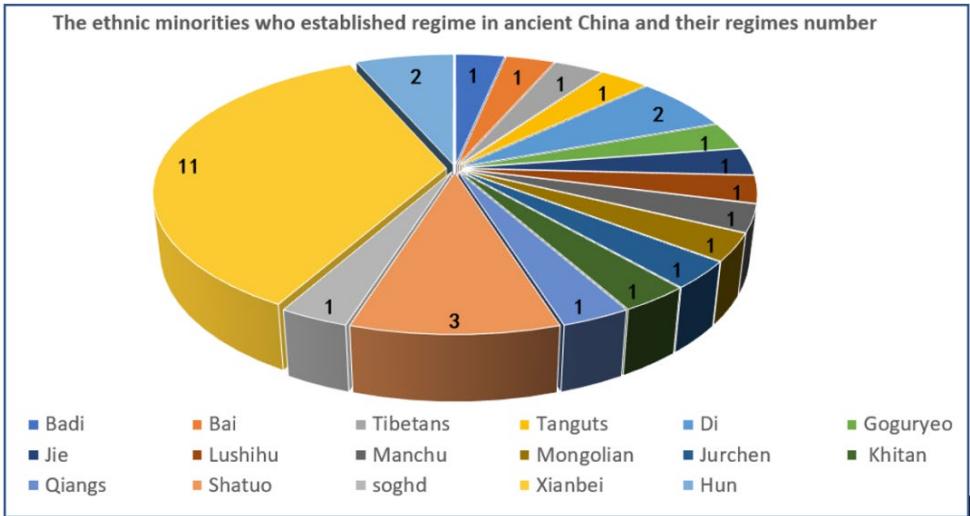
For thousands of years, in the process of forming the territory of contemporary China and the community of the Chinese nation, there were no less than 17 ethnic minorities had established political power (the graph The ethnic minorities who established regime in ancient China and their regimes number shows some details). Historically, the regimes established by all ethnic groups in the territory of China are part of ancient China. Therefore, from a macro perspective, the time of reunification in ancient China was very short, and there were few unified dynasties. Only the Yuan and Qing dynasties had a real reunification that lasted not very long. It is a common phenomenon that multiple regimes coexist at the same time, but under this appearance, the spiral road from division to unity has been continued without interruption. The most outstanding feature is unified and divided law—from split to unity, then from unity to split, and then to end the split and regain unity.
There are many reasons for the formation of this law, but there are two fundamental reasons that have played an important role: First, every split in ancient Chinese history only divides the body and the
shape, while the heart and spirit are not separated, but the next dynasty is more cohesive than the present dynasty. Second, since ancient times, "China" identity has always been the common mentality of all empires and ethnic groups. The two are discussed below.
# II. IN ANCIENT CHINA, THE BODY WAS SPLIT MANY TIMES, BUT THE MIND
On the one hand, the dual closeness of blood and kinship is an important evidence and rationale to explain this phenomenon of physical division and spiritual coagulation of ancient China. The family history of the Tuoba family, the royal family of the State of Wei in Xianbei (known as the Northern Wei Dynasty), was recorded in the Weishu as follows:
"In the past, the Yellow Emperor had twenty-five sons, who either lived in Huaxia or scattered to distant places. Changyi, the youngest son, was enfeoffed to the land in the north. Because there was a Daxianbei Mountain in his country, he took this mountain's name as his national title. His descendants have been kings for generations, ruling the vast wilderness, north of the ancient capital Youzhou. The people there raised and herded livestock, hunted as their means of survival, their social custom is pure and honest, their education used simple enlightenment. They didn't have words, they just carved some signs on the wood to record important events. All the far and near affairs in the country are dictated by people, just as historiographers record history. The Yellow Emperor ruled with Tu De (taking Tu in the Five Elements Philosophy as the national virtue). According to the customs of the northern people, the land was called "Tuo" and the king was called "Ba", so Tu Ba was taken as the surname. The descendant "Shijun" of the Toba family served as an official of the Yao government, expelling the Nüba to the north of the Ruo river. The people lived a good life because of his diligence. Emperor Shun rewarded him and appointed him as the Tianzu (God of agriculture). Since then, his descendants of generations have held this post. Up to the Qin and Han Dynasties, the tribes of Xunyu, Xianyun, Shanrong and the Hun had been ruthless for generations, harming the people in central plains. Because of this, Shijun's descendants didn't communicate with Huaxia in the south, they were unknown in China's historical documents. After 67 generations, Emperor Cheng Tuoba Mao ascended the throne. He was smart and resourceful. He was highly respected from far and near. He ruled 36 countries, with 99 big names. He was powerful in the north, no one disobeyed his rule.... [1]
This official historical original document about the origin of Tuoba Xianbei is the key for us to understand why many ethnic groups have always been separated from the Central Plains and the mainland, but their hearts have not been separated, the country had been divided but not divided spiritually - they were brothers originally, but they did not know each other, the customs were different, only because of they were far away from each other and their contacts were cut off. In fact, the fact that many ethnic groups now known as ethnic minorities and Han people "were originally born from the same root" is supported by numerous historical data. Here are a few examples. The record of the origin of the Yuwen family in the Northern Zhou Dynasty in Zhoushu is another proof.
Taizu Emperor Wen took Yuwen as his surname. His given name was Tai. He was also called Heita, he came from Wuchuan town of the place Dai. His ancestors came from Shennong, the Yan Emperor, and were destroyed by the Yellow Emperor, so his descendants fled to live in the northern wilderness. There was a man named Gewutu, who was a hero who was good at wars and strategy. Xianbei admired him and respected him as the leader, so he commanded twelve tribes and served as a Daren (monarch) for generations. Later, the tribe had been called Puhui. Owing to three jade seals with the words "Emperor's Seal" on them they got when they went hunting, Puhui thought it was a great gift from heaven. Because the local custom called Heaven as Yu, calling the monarch as Wen, they called their country as Yuwen State, and took Yuwen as their surname.[2] For another example, Panhu is considered to be "the ancestor of various ethnic groups that are used to call 'Manyi' in the south of the Yangtze River" [3], its academic basis is derived from ancient historical materials and myths. According to The History of the Hou hanshu Biographies of Southern Man and Southwestern Yi,
"In the past, Gaoxin's country was attacked by the Quanrong army on the border. The emperor was worried about its invasion and cruelty since many crusades did not completely win the enemy. So, he sent a recruitment notice to the whole world. If anyone could get the head of General Wu, the general of the Quanrong army, he would be rewarded with 1,000 Yi of gold, a city with 10,000 families and marry his youngest daughter to him. At that time, the emperor kept a dog with colorful fur named Panhu. After the imperial edict was issued, Panhu came to the palace with a man's head in his mouth. The officials were surprised and went to check, they found that it was the head of General Wu. The emperor was very happy. However, Panhu was a dog and could not marry his daughter to him as his wife, but there was no other way to reward him. So, they negotiated to give Panhu enough reward, but there was no suitable way. When the emperor's youngest daughter heard about this, she felt that the emperor had issued this edict, he could not now break it and lose his credit. Therefore, she asked her father to marry her to Panhu. The emperor had no choice but to marry his youngest daughter to Panhu. After Pan Hu got the emperor's little daughter, he carried her into the Nanshan Mountain and came to the stone chamber. The terrain there was precipitous, few people from outside could come there. So, the little girl took off her clothes, tied up the same hair knot as the people living in the cave, put on the same clothes as the children. The emperor was very sad and missed his little daughter, so he sent messengers to look for her. Every time, the messengers encountered stormy weather and thick fog, so they could not enter the mountains. After several years, she gave birth to twelve children, six boys and six girls. After Panhu died, they married each other. They wove wood hides and dyed them with grass seeds. They liked making colorful clothes. Their clothes were cut and made with tail shape. Later, their mother returned to her hometown and told the emperor about these living conditions, so the emperor sent people to pick up the descendants. Their clothes were colorful and their language was completely different. They liked climbing mountains and crossing valleys; they were not used to living in flat and open places. The emperor gave them famous mountains and vast plains according to their wishes. Since then, they lived and multiplied there, they were called Manyi. " [4]
According to Zhao Guangting's research, "the Yao people regard Pangu and Panhu as their common ancestors", "The Yao people worship their clan ancestors, they worship Panhu even more" [3]. The Classic of Mountains and Rivers - The Eastern Classic of the Great Wilderness contains:
There is a country called Yinmin, which takes Gou as its surname and has millet as its food. There was a man named Wang Hai in the country. He grabbed a bird in each hand and ate the head of a bird. Wang Hai entrusted a group of cattle to Hebo, the water god of Youyi country. Someone in Youyi killed Wang Hai, Youyi people took Wanghai's cattle. Hebo thought about the friendship with Youyi, so he helped the people of that country escape. They established a new country where many wild animals live, so they ate animal meat. This country was called Yaomin country. Emperor Shun gave birth to Xi and Xi gave birth to Yaomin. [5]
### Zhao Guangting believes that:
"The beginning of Yao is the voice of You. 'At the beginning of the Zhou Dynasty, the voice of You is You'. You is the self- assertion of the Yao people. The Yao people first lived in the Yellow River basin. It seems that Chiyou tribal alliance was originally called Youmian. Chiyou was defeated by the Yellow Emperor. His descendants moved south and merged into the southern Man tribe, collectively called Nanman. Yao people also call themselves Youmian. Mian is transformed from the sound of man. There is no doubt that South Man contain You. At the end of the Shang Dynasty, Nanman, who lived in Jingshan and Cheshui, was known as Jingman in history. The Yao people also called themselves Jingmen, for example, the Lantian Yao called themselves Jingmen, meaning Jingman.
"Mian' and 'Men' are the transformation of man's pronunciation, which implies the meaning of human. Youmian' should be the ancestors of Yao people in You tribe of Chiyou tribal alliance; Jingmen' should be the Yao people living in You tribe of Jingshan and Cheshui, which translates Yao language into Chinese meaning. Both Youmian' and Jingmen' are the Yao people of descendants of You tribe. Yao people are descendants of Chiyou tribal alliance" [3].
Mao Qiling, who lived in the late Ming Dynasty to the early Qing Dynasty, wrote in his Mansi Hezhi: "In Xincheng, Libo and the three townships in the north, south and west of Tianhe", "sacrificing Panhu on the New Year's Eve", "every sacrifice must be accompanied by a band" [6]. The Zhuang people have a legend that "the ancestors intentionally brought a yellow dog to the immortal's field in the sky to roll and let the dog touch rice seed, making the dog bring the rice seed back to the world". It is now still a tradition that "people can not forget the merits of the dog". "When harvesting new grain in June of the lunar calendar, Zhuang people cook new rice and feed the dog first" [7].
Although the historical materials of Yao, Zhuang and other nationalities listed above are myths and legends, they are by no means unfounded and fabricated by the ancients. The ethnic groups in the south of the Yangtze River originated from the North of the Five Ridges, which is by no means false. The respect for "dogs" in the cultures of Zhuang, Yao and other nationalities is essentially the historical deposit and legacy of ancestor worship and totem culture. It is a history that has been gradually mysterious in the process of inheritance. It is undeniable that since ancient times, all ethnic groups in China have not only been geographically close to each other, but also may be closely related by blood. This kind of kinship, which is thicker than water, is one of the reasons why the China's body had been divided many times in the past several thousand years, but the heart had always been connected.
On the other hand, looking at the whole process of China's historical evolution, it can be found that from ancient times to the present, the outward expansion of Central Plains, with agriculture as its pillar industry, mainly depends on the attraction and centripetal force generated by relatively developed material culture, spiritual culture and institutional culture. On the contrary, the surrounding non-agricultural ethnic groups often launch wars against the Central Plains from time to time by virtue of the fast mobility of cavalry and the fierce national personality, from the snatching in the alternating seasons of winter and spring to the infiltrative blending, until the conquering fusion. In the process of alternating the flexible outward movement of the Central Plains regime and the rigid inward movement of the neighboring regimes, these two major types of civilizations have done their best to learn from each other and grow together - the agricultural regime is good at enhancing its industrial, technological and cultural strength through peaceful construction, the pastoral regime is good at military development, developing commerce and trade, as well as more inclusive cultural reference psychology - not only had the territory expanded several times, more and more ethnic groups gathered together, but also the centripetal force has been becoming greater and greater, creating today's pluralistic and integrated Chinese national community, which is a unique feature of the historical process of the Chinese nation's continuous development and growth.
# III. SINCE ANCIENT TIMES, "CHINA IDENTITY" HAS ALWAYS BEEN THE COMMON MENTALITY OF
Looking at ancient China all-sidedly, it is not difficult to find a thought-provoking and interesting phenomenon. No matter who established a dynasty, big or small, no matter what nationality or family name, there was a strong sense of "China identity" and orthodoxy. They naturally believed that they were Chinese, their regime represented China or a part of China. They even fought for the title of "China" and did not allow others to seize the status of the orthodox "China" to swear the legitimacy of the regime, gaining a sense of dignity and superiority belonging to China. Therefore, since ancient times, "one China" has always been the common mentality of the rulers and people of all countries under the banner of "China".
Liu Yuan, the founding monarch of the State of Zhao (historically known as Qianzhao), was a Hun, but his father Liu Bao was an official of the Central Plains Court from the time of Cao Cao. After the demise of the Western Jin Dynasty, Liu Yuan established his own country, calling himself "the nephew of the Han family" [7], not only did the country name use Han to show that its political power was the revival of the Liu Han Dynasty, but also "recognized Liu Chan as the Emperor Xiaohuai, set up memorial tablets of names of eight generations below Liu Bang, Emperor Gaodi of the Han Dynasty "[9]. Liu Yuan attached great importance to the kinship between their family and Liu Bang's family. He was proud of it and offered sacrifices to Liu Bang and his descendants according to the etiquette. This is the inheritance and development of the Hun ruling family with Liu as their surname and their heart toward the Central Plains since the Heqin policy (make peace with rulers of minority nationalities in the border areas by marriage) was implemented by Emperor Taizu Liu Bang of the Han Dynasty and Chanyu Modu of the Hun. The belief that "I am a Chinese" and "I am the emperor of China" has not only been transformed into action, but also inherited from generation to generation. Similar to Liu Yuan's blood relationship, the founder of the Great Xia State known as Hu Xia, Helianbobobo belongs to the same clan with Liu Yuanhai. [10] This Liu Yuanhai is the Liu Yuan just mentioned. Therefore, the original surname of Helianbobobo was also Liu, and the origin of the surname was also from Heqin of Han and Hun. Jin Shu (History of Jin Dynasty) records his words:
"My imperial ancestor moved from the north to You and Shuo and changed his surname to Si Shi, which did not pronounce the same as it did in the Central Plains, so I used my mother's surname- Liu. It was not a custom for a son to follow his mother's name. In ancient times, people had different surnames, including those who followed their mother and those who followed their father. Now I want to change this habit according to the meaning. The emperor is the son of heaven, a prominent emblem, and a hub connecting heaven and earth. Therefore, I now change our surname to Helian, which conforms to the will of heaven and enjoys the world forever. the son of Heaven is the most honorable person in the world. He cannot share the same surname with others. Therefore, all other unorthodox descendants took Tiefa as their surname. I hope all my descendants are as tough as iron and can fight well." [10]
Not only that, Jinshu also records the origin of the country name, saying that he "thought he was a descendant of the Xiahou family of the Hun, so the country name was Great Xia" [10]. Of course, what Helianbobo said is not groundless. The first sentence of Shiji Vol.110 • the Hun' Biographies $50^{th}$ is that "The Hun, whose ancestor was a Miao descendant of Xiahou family, he was called Chunwei." [11] undoubtedly, the strict historian Sima Qian had his own historical basis.
Qian Qin Emperor Fujian was a Di person, and Hou Zhao Emperor Shile was a Jie person. Because their empires were located in the Central Plains and had metropolises as Chang'an and Luoyang, they considered themselves "the emperor of China". They instead blamed the Dong Jin Dynasty, which regarded itself as the legitimate successors of the Central Plains, for being "Simajia (Sima family)" and "Wuren (Wu people)". During the Northern and Southern Dynasties, all the regimes in the Southern Dynasties regarded themselves as the legitimate successors of Chinese culture and despised the Northern Dynasty as suolu (barbarians in the North). While the Northern Dynasties' regimes righteously regarded themselves as Chinese orthodoxy, on the contrary, they denounced the Southern Dynasties as Daoyi (island barbarians) and Nanwei (southern hypocrites). The two sides argued endlessly and the outcome was hard to decide until the Sui Dynasty completed the unification of Central China. Today, it seems that their rather interesting arguments both make sense, because they were originally members of China, and are all part of one China. As far as the region is concerned, the Northern Dynasty is undoubtedly China, while the Southern Dynasty is relatively remote, so it is difficult to have enough confidence. In terms of culture, the Southern Dynasty claimed to be the successor of China's orthodox culture, which is true. However, the Northern Dynasty was also by no means an alternative culture. Not only were there a large number of talented people, but also the achievements made in developing Chinese culture were obvious to all. Even the upper-class people in the Southern Dynasty had to admire it.
Chen Qingzhi, a senior official of the Liang Dynasty, was sent to Luoyang at the order of Emperor Xiao Yan. His perception of the north has changed from contempt to respect, admiration and imitation, which is very persuasive. When Chen Qingzhi first arrived in Luoyang, his old friend Jingren hosted a banquet. During the dinner, Chen proudly said, "The Wei Dynasty is very prosperous, but it is still called the Wuhu. The orthodox inheritance is in Jiangzuo, the Jade Seal of the Qin Emperor is now in the Liang Dynasty." [12] As soon as he said this, Yuan Shen, who was on the side of the host, was extremely angry, he spoke fiercely and severely refuted the South Dynasty as well as Chen Qingzhi's mission:
"Jiangzuo is a secluded place that is temporarily quiet on the surface. It is low-lying and humid everywhere. There are insects and ants everywhere. The soil is thin and the rocks are big. The miasma is rampant. Frogs and flies live in one cave together. People and birds live together in the same house. Men wear short hair, not like people who live long. Everyone has tattoos, which is very ugly and crude. They float among the three rivers and paddle among the five lakes. They have never been influenced by etiquette and music; the country's laws have also never improved. Although some survivors of the Qin Dynasty and criminals of the Han Dynasty escaped there, making the barbarian accent mixed with the Chinese accent, there was still no communication with them in Fujian and Chu, and there was no change. Although there are so-called monarchs and ministers, the upper class of society does not know how to respect themselves, and the lower class is cruel. First there was Liu Shao's murder of his father, and then there was the scandal of incest between Xiulong (referring to Liu Jun, Emperor Xiaowu of the Song Dynasty) and his mother. They all rebelled against human relations, just like animals. In addition, Princess Shanyin Chu Yu asked the emperor to recruit gigolo for her. She had sex at home and ignored the ridicule of others. You grew up in this kind of folkway legacy and had not received etiquette education. This is what people say that people in Yangzhai do not know that tumors are ugly. Our country, the State of Wei, the emperors were inspired by the map, located between Mount Song and River Luo with the five mountains as the place of statecraft and the four seas as our homeland. It is a model of changing customs and is parallel to the relics of the Five Emperors; The prosperity of the etiquette and music charter is second to none in all countries. You, a person like fish and turtle, are qualified to comment on us? You admire the high righteousness of our country and come here to worship, drinking the water of our country, pecking the rice of our country, but your words are impolite and nonsense. How can you come to such an extent? " [12]
After hearing these words, all the people in the Southern Dynasty were ashamed and speechless. Shortly thereafter, Chen Qingzhi was ill and needed treatment as soon as possible. Yuan Shen said, "It can be solved" and cured him. After Chen Qingzhi returned from his mission, the Liang State "attached great importance to the northern people, reaching a level beyond the ordinary" [12], Zhu Yi was puzzled by this phenomenon, Chen Qingzhi explained the mystery for him:
"Since the Jin and Song Dynasties, we have regarded Luoyang as a wasteland. All said with one voice that the north of the Yangtze River is full of barbarians. When I arrived in Luoyang not long ago, I came to learn that the aristocratic families of scholars and bureaucrats in gorgeous clothes are the same in the Central Plains. Luoyang has a complete and prosperous etiquette, a large population and abundant material products. There are many things we have never seen before and cannot say their names. It is often said that the capital of the empire stands tall and towering, which is an example for all regions to learn from. This is just like a person who climbs Mount Tai will feel that the mound made of ants' nests is too low; A person who has sailed on the big rivers and seas will naturally feel that crossing the Xiangjiang River and Yuanjiang River is a small matter. How can we not attach importance to the people in the north? ["12]
Chen Qingzhi not only praised Luoyang's cultural prosperity, but also imitated it: "Qingzhi therefore wore the clothes of the State of Wei and performed the etiquette of the State of Wei. In Jiangzuo area, ordinary people and nobles with status and knowledge competed to take him as an example, which made the wide sleeves and tall hats of Wei popular." [12] It is like that people today catch up with the fashion of Shanghai, Guangzhou and Shenzhen, a Luoyang trend has been launched in Jinling City.
In 648 AD, the 22nd year of Zhenguan in the Tang Dynasty, a tribute group named Xiajiasi from the upper reaches of Yenisei River in Russia arrived in Chang'an under the leadership of Ailifa (Induna) shiboquezhan. This Ailifa claimed to be the descendant of General Li Ling who surrendered to the Hun in the Western Han Dynasty. He shared the same family name with the Emperor of the Tang Dynasty and wanted to regard the Emperor of the Tang Dynasty as his kindred. Tang Taizong saw that they were different from the Xiajiasi natives with red hair and green eyes. They were both black hair and black eyes, which showed obviously mixed blood. He recognized them as kinsmen of the same clan on the spot. The delegation of Xiajiasi Ailifa received extremely warm hospitality. At the banquet, Ailifa drank happily and requested to be attached to the Tang Dynasty. Taizong immediately decided to set up Jiankun Governor's Office in the jurisdiction of Xiajiasi, which was subordinate to Yanran Governor's Office, and granted Ailifa the title of Zuo Tunwei Grand General and Jiankun Governor. Since then, Xiajiasi has always regarded the Tang Dynasty as the ancestral home country, and has sent troops to help the Tang Dynasty for many times. Emperor Xuanzong of the Tang Dynasty once praised Xiajiasi's army for its "advantage of arrow, which is invincible". Even when the power of the Tang Dynasty was greatly weakened due to civil strife, Xiajiasi was still able to focus on family ties with Tang. The emperors of the Tang Dynasty also always bestowed special favor on it. Emperor Zhongzong once touched the back of the envoy of Xiajiasi and said, "Your country is the same clan as mine, no other dependent country can compare with you." When hearing this, the envoy kowtowed with gratitude. "During the reign of Emperor Xuanzong, Xiajiasi paid tribute to the Tang Dynasty four times." Later, due to the obstruction of Huihe, the bilateral exchanges were forced to be interrupted.
In 843 A.D., Xiajiasi came to pay tribute again, Wuzong ordered Khan A'er to be included in the imperial register of Zongzheng Temple. It also said in the Imperial edict given to the Xiajiasi Khan in response to the request of Xiajiasi to restore the relationship of the Suzerain state and the affiliated state: "I also heard about the origin of Khan's family name, which is the same family as mine in Datang. Datang is the descendant of Li Guang, the Taishou (satrap) of Beijing in the Han Dynasty, Khan is the descendant of Li Ling, the Duwei (commandant) of the Han Dynasty. According to this situation, we are of the same family name, so the relationship of the superior and the inferior is clear. Now, the imperial court plans to canonize you as Khan and specially grants you a good name..." In 847 A.D., Emperor Xuanzong (Li Chen) conferred the title of Xiajiasi Khan as a "brave and honest Khan". "During the reign of Xiantong, Xiajiasi paid tribute to the Tang Dynasty three times in all. [8, 13]
The Liao Dynasty established by the Khitan nationality, the Xia Dynasty established by the Tanguts nationality and the Jin Dynasty established by the Jurchen nationality all stood side by side with the Zhao family's Song Dynasty. They all called themselves China. Moreover, they "called themselves Chinese titles, imitated Chinese officials, appointed Chinese talents, read Chinese books, used Chinese carriages and clothes, and enforced Chinese laws[14], demonstrating their Chinese identity and status in various ways. According to the Turkic Dictionary written by Mahmoud Kashgari, the Karahan dynasty, which is located in the westernmost part of China, also insists on being a part of China. He explained under the entry "Taohuashi (Peach Blossom Stone)":
"Taohuashi (Peach Blossom Stone): The name of the 'Ma Qin' country. This country is four months away from Qin. Qin was originally divided into three parts: first, the upper Qin Dynasty, which is located in the east, is called the Peach Blossom Stone; second, the middle Qin Dynasty, which is called the Khitan; third, the lower Qin Dynasty, which is called the Balhan, which is in Kashgar. But now it is considered to be 'Ma Qin'" [15].
In addition, all these king titles, such as "Peach Blossom Stone Khan Mahamo" and "Peach Blossom Stone Bugla Khan Hasen", mean "the king of China". The coins minted by the Karahan Dynasty also have the title of "the king of China" or "the king of the East and China" in front of their names. [15] In other words, Kashgari believed that in the Great Song Dynasty, the complete China was composed of three parts: the Great Song Dynasty of the Upper Qin Dynasty, the Khitan of the Middle Qin Dynasty and the Balhan of the Lower Qin Dynasty. Almost at the same time as Kashgar, a Muslim writer named Ma Weiji also said in his book "Natural Attributes of Animals" that China consists of three parts: "The territory of Qin is divided into three parts: Qin, Khitan and Uighur, of which the largest territory and country is Qin". [16]
These historical materials confirm that the Xiyu (Western Regions) have always been a part of China since the Xihan (Western Han Dynasty), which was widely inherited by the Muslim world in the Song Dynasty. China is composed of several parts, and this concept of "oneness" and "one country" contains a deep Chinese complex. The academic research on Kashgari shows that he is a descendant of the Uighur Khanate in the northern desert. The Karahan Dynasty was a regime established by a group of tribes that moved west to the west of Congling and united with the local peoples and tribes such as Yaghma and Qarluq after the disintegration of the original Uighur Khanate in the northern desert. Kashgari's interpretation of the peach blossom stone reveals that the intellectual class of the Karahan Dynasty, which originated from the East, cherishes and recalls their ancestors' origins and historical activities. At that time, the Uighur khanate was very close to the Tang Dynasty. Many Tang Dynasty princesses married the Uighur khan. The descendants of the Uighur royal family were very proud of this. "The Uighurs called the central plains dynasties their uncle for generations, every imperial edict issued by the central plains dynasties was also called the Uighur's nephew, which had been followed since the Five Dynasties - Ten Kingdoms period." [17] Indeed, in 1081 A.D., the Karahan Dynasty in its official document to the Song Dynasty called Song its "Hanjia Ajiu (uncle of the Han family)", its coexisting leader of the Gaochang Uighur in its official document to the Song Dynasty called himself "Xizhou waisheng (the nephew of western state)." [16]
# IV. CONCLUSION
In the evolution of ancient China, which was from small to large, there was division and unification. After a period of division, there was bound to be reunification, this law worked again and again. This kind of rhythm, in essence, division is a special manifestation of unification and a preparation for the next greater and better reunification. Unification is the end result and the pursuit and ideal of all ethnic groups from emperors to civilians. The root and motive force behind the appearance of division lies in the historical fact that they have the same root and origin and have been a family since ancient times. Because of the low level of productivity and the specific time and space conditions of the shortage of social wealth, people who originally belonged to one family were scattered from all directions for various reasons. Over the years, customs and habits had become increasingly different, cultural differences had become increasingly obvious, traffic had been blocked, and bilateral exchanges between each other were intermittent. However, the roots and venation of family blood has been handed down from mouth to mouth for generations. The heart of "root in China" has been inherited from generation to generation. "I am the master of China" has also never been interrupted. Therefore, despite China's history is so long, these ideas have never been changed. There is no doubt that the Chinese complex and the mentality of "Chinese emperors" of these ancient people are the common mentality of the monarchs and the people of all nationalities in ancient China, and also the fundamental reason why ancient China, despite its split body, had always been united in spirit.
Fund Project
This paper is the phased research result of the 2022 Guangxi Higher Education Undergraduate Teaching Reform Project: The Practice of Improving the Quality of the Core Course "Ancient Chinese History" for Undergraduate History Majors under the Guidance of the New Liberal Arts Concept, Project No.: 2022JGB306.
Generating HTML Viewer...
References
17 Cites in Article
Wei Shou (2004). The Preface of Emperor Records 1 st , Weishu.
Linghu Defen,Wen (2004). Emperor Records 1 st.
Guangting Zhao (2002). Yao Ancestor Worship and Yao Culture.
Fan Ye (2004). 5. Westerners in Shanghai: Th e Chinese Malaise.
Yuan Ke (1985). The Classic of Mountains and Rivers.
Zechao Zhang,Yu Chen,Xuejin Ye,Botao Tang,Shuping Huang,Zesen Lin,Fang Hu,Qingyun Yang,Min Zhu (2015). Computer Prediction and Experimental Verification of Guizhi Fuling Pill in the Treatment of Benign Prostatic Hyperplasia.
Xi Chen,Zhen-Kang Qiu,Guo-Bao Wang,Xin-Lin Chen,Fu-Jun Zhang,Fei Gao (2018). Effect of transjugular intrahepatic portosystemic shunt on transarterial chemoembolization for hepatocellular carcinoma: a systematic review and meta-analysis.
Sima Guang (1998). The Third Year of Emperor Wuzong's Huichang of the Tang Dynasty.
Fang Xuanling,Yuanhai (2004). Unknown Title.
Fang Xuanling,Helianbobo (2004). Study of fatigue spalling mechanism of cold-working roll surfaceYang. Y. Shanghai Jinshu (Shanghai Metals) July 1992 14, (4), 38–43 (in Chinese).
Sima Qian (2004). Huns' Biography.
Yang Xuan,; Zhou,Zumo (1963). Qielan Ji in Luoyang (Records of Buddhism, Buddhist temples, monks in Luoyang).
Song Qi (2004). Xiajiasi, Biography 2 nd of Uighurs.
Li Tao,Renzong (1995). Unknown Title.
Mahmoud Kashgari (2002). Turkic Dictionary.
Tian Weijiang (2016). peach blossom, n. & adj..
Tuotuo (2004). Biography of Uighurs, Song History.
No ethics committee approval was required for this article type.
Data Availability
Not applicable for this article.
How to Cite This Article
Yao Jianguang. 2026. \u201cEthnic Homology and China Identity Effect of Division-Unification Law in Ancient China\u201d. Global Journal of Human-Social Science - D: History, Archaeology & Anthropology GJHSS-D Volume 23 (GJHSS Volume 23 Issue D1): .
Explore published articles in an immersive Augmented Reality environment. Our platform converts research papers into interactive 3D books, allowing readers to view and interact with content using AR and VR compatible devices.
Your published article is automatically converted into a realistic 3D book. Flip through pages and read research papers in a more engaging and interactive format.
In the thousands of years of development and evolution of ancient China, sometimes it split, sometimes it unified, but after each division, there would be greater unification, which is the law of division and unification in ancient Chinese history. Why does this law come into being? The study found that there are two fundamental reasons: one is all major ethnic groups in China have common blood and ethnic origin. Second, based on this same root and homology, China complex and China identity effect were formed. The analysis of a large number of prehistoric myths and legends of Zhuang, Yao, Hun, Xianbei and many other ethnic groups, as well as the rich historical documents of the Central Plains Empire, shows that many ethnic groups that had appeared in history have consanguinity and cultural homology with the Central Plains, which was regarded as the core area of Chinese orthodox culture. Just because of the limitation of historical conditions, it was inconvenient for them to communicate with the Central Plains. As time goes on, the two sides did not understand enough and the development level was different, which gradually widened the gap.
Our website is actively being updated, and changes may occur frequently. Please clear your browser cache if needed. For feedback or error reporting, please email [email protected]
Thank you for connecting with us. We will respond to you shortly.