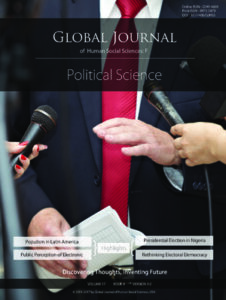
Ethnicity, Religion and Voters Behaviour: The Experience of the 2015 Presidential Election in Nigeria

α
Dr. Anthony Egobueze
σ
Callistus U. Ojirika
α Rivers State House of Assembly, Port Harcourt, Nigeria

Send Message

To: Author

Ethnicity, Religion and Voters Behaviour: The Experience of the 2015 Presidential Election in Nigeria

Article Fingerprint

ReserarchID

5YDUL

Ethnicity, Religion and Voters Behaviour: The Experience of the 2015 Presidential Election in Nigeria Banner

AI TAKEAWAY

Connecting with the Eternal Ground
  • English
  • Afrikaans
  • Albanian
  • Amharic
  • Arabic
  • Armenian
  • Azerbaijani
  • Basque
  • Belarusian
  • Bengali
  • Bosnian
  • Bulgarian
  • Catalan
  • Cebuano
  • Chichewa
  • Chinese (Simplified)
  • Chinese (Traditional)
  • Corsican
  • Croatian
  • Czech
  • Danish
  • Dutch
  • Esperanto
  • Estonian
  • Filipino
  • Finnish
  • French
  • Frisian
  • Galician
  • Georgian
  • German
  • Greek
  • Gujarati
  • Haitian Creole
  • Hausa
  • Hawaiian
  • Hebrew
  • Hindi
  • Hmong
  • Hungarian
  • Icelandic
  • Igbo
  • Indonesian
  • Irish
  • Italian
  • Japanese
  • Javanese
  • Kannada
  • Kazakh
  • Khmer
  • Korean
  • Kurdish (Kurmanji)
  • Kyrgyz
  • Lao
  • Latin
  • Latvian
  • Lithuanian
  • Luxembourgish
  • Macedonian
  • Malagasy
  • Malay
  • Malayalam
  • Maltese
  • Maori
  • Marathi
  • Mongolian
  • Myanmar (Burmese)
  • Nepali
  • Norwegian
  • Pashto
  • Persian
  • Polish
  • Portuguese
  • Punjabi
  • Romanian
  • Russian
  • Samoan
  • Scots Gaelic
  • Serbian
  • Sesotho
  • Shona
  • Sindhi
  • Sinhala
  • Slovak
  • Slovenian
  • Somali
  • Spanish
  • Sundanese
  • Swahili
  • Swedish
  • Tajik
  • Tamil
  • Telugu
  • Thai
  • Turkish
  • Ukrainian
  • Urdu
  • Uzbek
  • Vietnamese
  • Welsh
  • Xhosa
  • Yiddish
  • Yoruba
  • Zulu

Abstract

The need for political stability and virile democratic culture in Nigeria is a great concern to all Nigerians and the international community. Since the advent of the Fourth Republic in 1999, several elections have been conducted, but the 2015 election is very significant to us because it exposed the unflinching role of ethnicity and religion in the voting behaviour of different segments of our society. We adopted Rational Choice Theory as our conceptual framework. This paper interrogates the influence of ethnicity and religion in the voting behaviour of the Nigerian electorates and recommends that voting behaviour should be based on party ideology and competence and reputation of the candidates and not ethnicity and religion.

References

21 Cites in Article
  1. C Achebe (1998). The Trouble with Nigeria.
  2. C Ake (1981). A Political Economy of Africa.
  3. C Ake (2001). Democratic and Development in Africa.
  4. C Ake (2008). The Feasibility of Democracy in Africa.
  5. C Ake (1982). Social Science as Imperialism: Theory of Political Development.
  6. H Alapiki (2015). The state and the Culture of Terrorism in Nigeria: Unveiling the real Terrorists.
  7. T Chenda (1999). J. A. Yakubu and A. T. Oyewo, <i>Criminal Law and Procedure in Nigeria</i>, Lagos: Malthouse Press Ltd., 2000, xxvii+281 pp.; C. Eche Adah, <i>The Nigerian Law of Evidence</i>, Lagos: Malthouse Press Ltd., 2000, xlvii+293 pp.; J. A. Yakubu (ed.), <i>Administration of Justice in Nigeria: Essays in Honour of Hon. Justice Mohammed Lawal Uwais</i>, Lagos: Malthouse Press Ltd., 2000, xxv+250 pp..
  8. G Becker (1976). the Economic Approach to Human Behavior.
  9. Duncan Black (1948). On the Rationale of Group Decision-making.
  10. James Coleman (1986). Nigeria.
  11. A Ikelegbe (1995). Politics and Government: An Introductory and Comparative Perspective.
  12. Obasi Igwe (2005). Politics and Globe Dictionary.
  13. U Ikpe (1980). State -Society Interactions; A Conceptual and Comparative Introduction to Political Sociology.
  14. Sanda Al,Adekoya Va,Nwawolo Cc,Idowu Mo (2015). An uncommon impacted laryngeal foreign body: A case report.
  15. O Nnoli (1980). Ethnic Politics in Nigeria, Enugu.
  16. S Obulor,T Olagunju (2015). Buhari, IBB and a new military era.
  17. Ilufoye Ogundiya,Sarafa (2009). Political Corruption in Nigeria: Theoretical Perspectives and Some Explanations.
  18. C Ojirika (1999). Military Governments in the third world and the concept of legitimacy: the Nigerian experience" a thesis submitted ill partial fulfillment of the requirements for the onward of M.Sc. Political Administrative Studies.
  19. S Omodia,M (2009). Elections and Democratic Survival inthe Fourth Republic of Nigeria.
  20. P Shively,W (1997). Power and Choice: An Introduction toPolitical Science.
  21. (2017). Rethinking Rational Choice Theory.

Funding

No external funding was declared for this work.

Conflict of Interest

The authors declare no conflict of interest.

Ethical Approval

No ethics committee approval was required for this article type.

Data Availability

Not applicable for this article.

How to Cite This Article

Dr. Anthony Egobueze. 2017. \u201cEthnicity, Religion and Voters Behaviour: The Experience of the 2015 Presidential Election in Nigeria\u201d. Global Journal of Human-Social Science - F: Political Science GJHSS-F Volume 17 (GJHSS Volume 17 Issue F4): .

Download Citation

Issue Cover
GJHSS Volume 17 Issue F4
Pg. 25- 36
Journal Specifications

Crossref Journal DOI 10.17406/GJHSS

Print ISSN 0975-587X

e-ISSN 2249-460X

Keywords
Classification
GJHSS-F Classification: FOR Code: 360199p
Version of record

v1.2

Issue date

November 22, 2017

Language
en
Experiance in AR

Explore published articles in an immersive Augmented Reality environment. Our platform converts research papers into interactive 3D books, allowing readers to view and interact with content using AR and VR compatible devices.

Read in 3D

Your published article is automatically converted into a realistic 3D book. Flip through pages and read research papers in a more engaging and interactive format.

Article Matrices
Total Views: 3347
Total Downloads: 1621
2026 Trends
Related Research

Published Article

The need for political stability and virile democratic culture in Nigeria is a great concern to all Nigerians and the international community. Since the advent of the Fourth Republic in 1999, several elections have been conducted, but the 2015 election is very significant to us because it exposed the unflinching role of ethnicity and religion in the voting behaviour of different segments of our society. We adopted Rational Choice Theory as our conceptual framework. This paper interrogates the influence of ethnicity and religion in the voting behaviour of the Nigerian electorates and recommends that voting behaviour should be based on party ideology and competence and reputation of the candidates and not ethnicity and religion.

Our website is actively being updated, and changes may occur frequently. Please clear your browser cache if needed. For feedback or error reporting, please email [email protected]

Request Access

Please fill out the form below to request access to this research paper. Your request will be reviewed by the editorial or author team.
X

Quote and Order Details

Contact Person

Invoice Address

Notes or Comments

This is the heading

Lorem ipsum dolor sit amet, consectetur adipiscing elit. Ut elit tellus, luctus nec ullamcorper mattis, pulvinar dapibus leo.

High-quality academic research articles on global topics and journals.

Ethnicity, Religion and Voters Behaviour: The Experience of the 2015 Presidential Election in Nigeria

Dr. Anthony Egobueze
Dr. Anthony Egobueze Rivers State House of Assembly, Port Harcourt, Nigeria
Callistus U. Ojirika

Research Journals