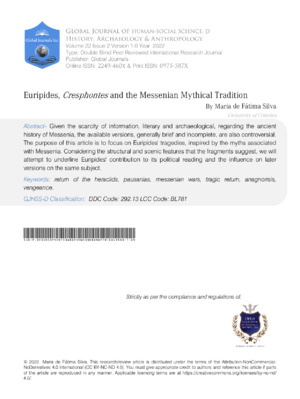
Euripides, Cresphontes and the Messenian Mythical Tradition

α
Maria de Fátima Silva

Send Message

To: Author

Euripides, Cresphontes and the Messenian Mythical Tradition

Article Fingerprint

ReserarchID

051R1

Euripides, Cresphontes and the Messenian Mythical Tradition Banner

AI TAKEAWAY

Connecting with the Eternal Ground
  • English
  • Afrikaans
  • Albanian
  • Amharic
  • Arabic
  • Armenian
  • Azerbaijani
  • Basque
  • Belarusian
  • Bengali
  • Bosnian
  • Bulgarian
  • Catalan
  • Cebuano
  • Chichewa
  • Chinese (Simplified)
  • Chinese (Traditional)
  • Corsican
  • Croatian
  • Czech
  • Danish
  • Dutch
  • Esperanto
  • Estonian
  • Filipino
  • Finnish
  • French
  • Frisian
  • Galician
  • Georgian
  • German
  • Greek
  • Gujarati
  • Haitian Creole
  • Hausa
  • Hawaiian
  • Hebrew
  • Hindi
  • Hmong
  • Hungarian
  • Icelandic
  • Igbo
  • Indonesian
  • Irish
  • Italian
  • Japanese
  • Javanese
  • Kannada
  • Kazakh
  • Khmer
  • Korean
  • Kurdish (Kurmanji)
  • Kyrgyz
  • Lao
  • Latin
  • Latvian
  • Lithuanian
  • Luxembourgish
  • Macedonian
  • Malagasy
  • Malay
  • Malayalam
  • Maltese
  • Maori
  • Marathi
  • Mongolian
  • Myanmar (Burmese)
  • Nepali
  • Norwegian
  • Pashto
  • Persian
  • Polish
  • Portuguese
  • Punjabi
  • Romanian
  • Russian
  • Samoan
  • Scots Gaelic
  • Serbian
  • Sesotho
  • Shona
  • Sindhi
  • Sinhala
  • Slovak
  • Slovenian
  • Somali
  • Spanish
  • Sundanese
  • Swahili
  • Swedish
  • Tajik
  • Tamil
  • Telugu
  • Thai
  • Turkish
  • Ukrainian
  • Urdu
  • Uzbek
  • Vietnamese
  • Welsh
  • Xhosa
  • Yiddish
  • Yoruba
  • Zulu

Abstract

Given the scarcity of information, literary and archaeological, regarding the ancient history of Messenia, the available versions, generally brief and incomplete, are also controversial. The purpose of this article is to focus on Euripides’ tragedies, inspired by the myths associated with Messenia. Considering the structural and scenic features that the fragments suggest, we will attempt to underline Euripides’ contribution to its political reading and the influence on later versions on the same subject.

References

8 Cites in Article
  1. Susan Alcock (1999). The Pseudo-History of Messenia Unplugged.
  2. Janick Auberger (2000). Pausanias et le Livre 4: Une Lecon Pour L'empire?.
  3. Rafael Brunhara (2014). Elegia grega arcaica, ocasião de performance e tradição épica: o caso de Tirteu.
  4. A Harder (1985). Euripides' Cresphontes and Archelaos.
  5. N Luraghi (2008). The ancient Messenians. Constructions of Ethnicity and Memory.
  6. A Podlecki (1984). The early Greek poets and their times.
  7. M Rocha Pereira (2006). Estudos de História da Cultura Clássica. I. Cultura Grega.
  8. M Rodríguez Alcocer (2015). Mesenia: uma identidade creada mediante na alteridade.

Funding

No external funding was declared for this work.

Conflict of Interest

The authors declare no conflict of interest.

Ethical Approval

No ethics committee approval was required for this article type.

Data Availability

Not applicable for this article.

How to Cite This Article

Maria de Fátima Silva. 2026. \u201cEuripides, Cresphontes and the Messenian Mythical Tradition\u201d. Global Journal of Human-Social Science - D: History, Archaeology & Anthropology GJHSS-D Volume 22 (GJHSS Volume 22 Issue D2): .

Download Citation

Ancient Greek tragedy, myth, and archeology research journal.
Journal Specifications

Crossref Journal DOI 10.17406/GJHSS

Print ISSN 0975-587X

e-ISSN 2249-460X

Keywords
Classification
GJHSS-D Classification: DDC Code: 292.13 LCC Code: BL781
Version of record

v1.2

Issue date

December 8, 2022

Language
en
Experiance in AR

Explore published articles in an immersive Augmented Reality environment. Our platform converts research papers into interactive 3D books, allowing readers to view and interact with content using AR and VR compatible devices.

Read in 3D

Your published article is automatically converted into a realistic 3D book. Flip through pages and read research papers in a more engaging and interactive format.

Article Matrices
Total Views: 1519
Total Downloads: 37
2026 Trends
Related Research

Published Article

Given the scarcity of information, literary and archaeological, regarding the ancient history of Messenia, the available versions, generally brief and incomplete, are also controversial. The purpose of this article is to focus on Euripides’ tragedies, inspired by the myths associated with Messenia. Considering the structural and scenic features that the fragments suggest, we will attempt to underline Euripides’ contribution to its political reading and the influence on later versions on the same subject.

Our website is actively being updated, and changes may occur frequently. Please clear your browser cache if needed. For feedback or error reporting, please email [email protected]

Request Access

Please fill out the form below to request access to this research paper. Your request will be reviewed by the editorial or author team.
X

Quote and Order Details

Contact Person

Invoice Address

Notes or Comments

This is the heading

Lorem ipsum dolor sit amet, consectetur adipiscing elit. Ut elit tellus, luctus nec ullamcorper mattis, pulvinar dapibus leo.

High-quality academic research articles on global topics and journals.

Euripides, Cresphontes and the Messenian Mythical Tradition

Maria de Fátima Silva

Research Journals