Article Fingerprint
ReserarchID
3VJ54
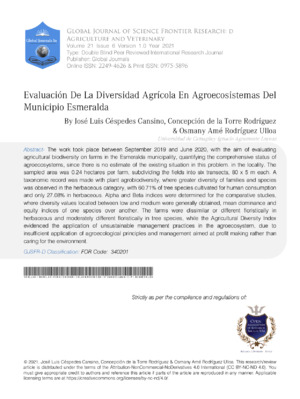
The work took place between September 2019 and June 2020, with the aim of evaluating agricultural biodiversity on farms in the Esmeralda municipality, quantifying the comprehensive status of agroecosystems, since there is no estimate of the existing situation in this problem. in the locality. The sampled area was 0.24 hectares per farm, subdividing the fields into six transects, 80 x 5 m each. A taxonomic record was made with plant agrobiodiversity, where greater diversity of families and species was observed in the herbaceous category, with 60.71% of tree species cultivated for human consumption and only 27.08% in herbaceous. Alpha and Beta indices were determined for the comparative studies, where diversity values located between low and medium were generally obtained, mean dominance and equity indices of one species over another. The farms were dissimilar or different floristically in herbaceous and moderately different floristically in tree species, while the Agricultural Diversity Index evidenced the application of unsustainable management practices in the agroecosystem, due to insufficient application of agroecological principles and management aimed at profit making rather than caring for the environment.
Jose Luis Cespedes Cansino. 2021. \u201cEvaluacion De La Diversidad Agricola En Agroecosistemas Del Municipio Esmeralda\u201d. Global Journal of Science Frontier Research - D: Agriculture & Veterinary GJSFR-D Volume 21 (GJSFR Volume 21 Issue D6): .
Crossref Journal DOI 10.17406/GJSFR
Print ISSN 0975-5896
e-ISSN 2249-4626
Explore published articles in an immersive Augmented Reality environment. Our platform converts research papers into interactive 3D books, allowing readers to view and interact with content using AR and VR compatible devices.
Your published article is automatically converted into a realistic 3D book. Flip through pages and read research papers in a more engaging and interactive format.
Total Score: 103
Country: Cuba
Subject: Global Journal of Science Frontier Research - D: Agriculture & Veterinary
Authors: Jose Luis Cespedes Cansino, Concepcion de la Torre Rodriguez, Osmany Ame Rodriguez Ulloa (PhD/Dr. count: 0)
View Count (all-time): 164
Total Views (Real + Logic): 1960

Total Downloads (simulated): 957

Publish Date: 2021 11, Wed
Monthly Totals (Real + Logic):
This paper attempted to assess the attitudes of students in
Advances in technology have created the potential for a new
Inclusion has become a priority on the global educational agenda,
The work took place between September 2019 and June 2020, with the aim of evaluating agricultural biodiversity on farms in the Esmeralda municipality, quantifying the comprehensive status of agroecosystems, since there is no estimate of the existing situation in this problem. in the locality. The sampled area was 0.24 hectares per farm, subdividing the fields into six transects, 80 x 5 m each. A taxonomic record was made with plant agrobiodiversity, where greater diversity of families and species was observed in the herbaceous category, with 60.71% of tree species cultivated for human consumption and only 27.08% in herbaceous. Alpha and Beta indices were determined for the comparative studies, where diversity values located between low and medium were generally obtained, mean dominance and equity indices of one species over another. The farms were dissimilar or different floristically in herbaceous and moderately different floristically in tree species, while the Agricultural Diversity Index evidenced the application of unsustainable management practices in the agroecosystem, due to insufficient application of agroecological principles and management aimed at profit making rather than caring for the environment.
Lorem ipsum dolor sit amet, consectetur adipiscing elit. Ut elit tellus, luctus nec ullamcorper mattis, pulvinar dapibus leo.