In this paper, evaluated the behavior of the workers in the industry toward safety, conducted among workers in workshops and factories in the Omdurman industrial area to identify and highlight the behaviors of workers toward occupational health and safety and their impacts on the environment. Data were collected through a questionnaire given to 58 workers, to explain the attitudes and practices of workers and tanker drivers were observed. Interviews were conducted with number of decision-makers in several departments concerned with the environmental impacts of industry. The workshops studied included welding, carpentry, car repairing, and disposal and restoring batteries. Related, hazards were identified and classified. The caught in or between things had the highest incidence, the machines were the primary cause of fractures, amputation, and wounds (17.2%, 15.5%, 24.2%, respectively). Equipment was leading the main cause of burn and contusive from the heat source (8.6%, 12.1%, respectively). Hazardous materials was the fundamental cause of poisonous from a chemical birth sources, coma, and death (13.8%, 6.9%, respectively).
## I. INTRODUCTION
Sudan has witnessed industrialization since the mid-fifties, such as Soap and Oil, Printing, Soft Drink and sweet, cottage industries, and some utilities such as Railways, Water, and Electricity, etc. Spread in several geographical areas. Workers enrolled at that time were in the order of a few thousand. Legislation concerning worker's safety was first passed as envisaged in the workshops and factories ordinance 1949. Although occupational health (OCH) has been practiced since 1967, its functions were only stipulated after the Public Health Act passed in 1975. These stated establishment a section of OCH [1]. Small workplaces were not considered in safety policies. When a person walks through, he will immediately notice the lack of security, protection is a culture that must be built in all working in these workplaces [2]. The typical, standard physical hazard in most industries is heat, noise, ionizing radiation, and vibration [3]. Mechanical vibration produces a level of danger that affect the nerves, and noise exceeds the permissible level, leads to loss of hearing [4], and ergonomics are related to the space within the workshop building and layout the machine. The size of the workshop does not allow workers to assign separate places for raw materials and products. The passage between devices is so tiny to endanger the workers [5]. With rapid industrial development other minerals like asbestos, radioactive ore, oil and diesel which are also source of occupational disease [6]. The study conducted that the research is still in its infancy in Sudan, various researchers have examined the nature, source, and impacts of accident, injuries, and illnesses that severely comprises workers Health and safety [7].
### a) Sample Data Manipulation
The data in this study was collected from the following personal information of the targeted people. As shown in figure 1, the sample was randomly selected from most of the education levels present in the study area, to compare the education level to knowledge. Clear successes indicator were given that confirmed the correct sample selection.
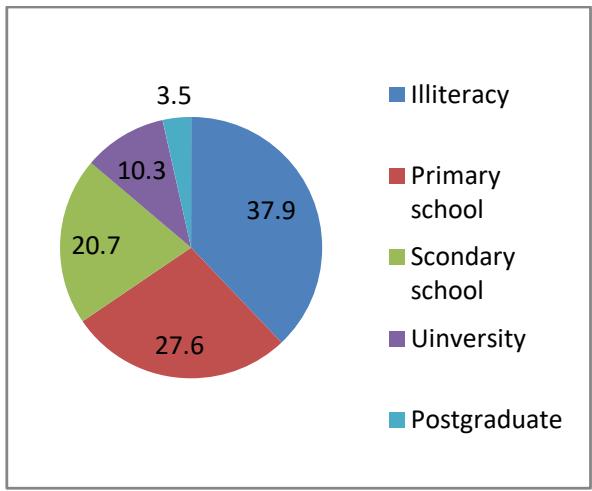 Figure 1: Education level
The type of job affects the safety behaviors of many workers. So the main occupations concerned with the conduct of workers towards occupational safety and health and their impact on the environment were chosen, as shown in figure 2.
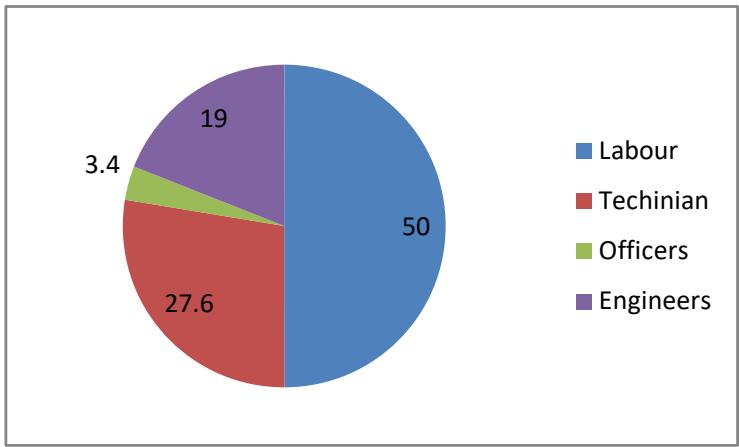 Figure 2: Respondents by job
The study area is characterized by age diversity. It has been observed that age has a direct impact on safety procedures, as in figure 3. Also, practical experiences affect occupational safety and health decisions, so multiple occasions were selected in this study, as shown in figure 4.
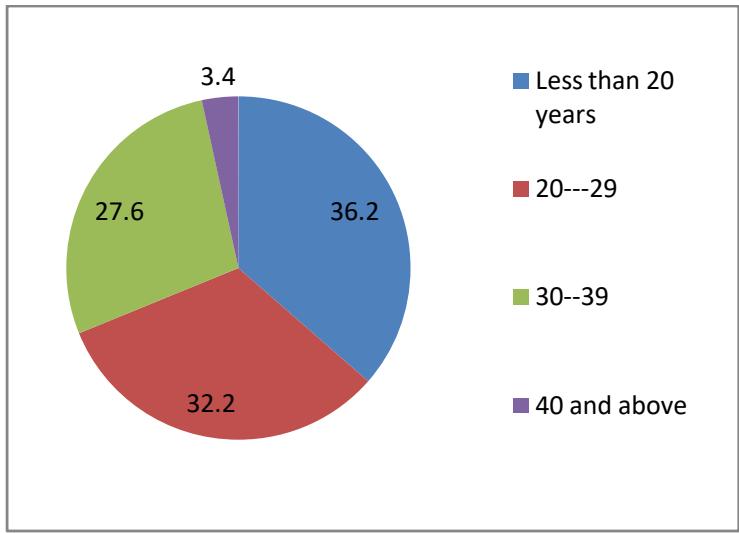 Figure 3: Respondents by age
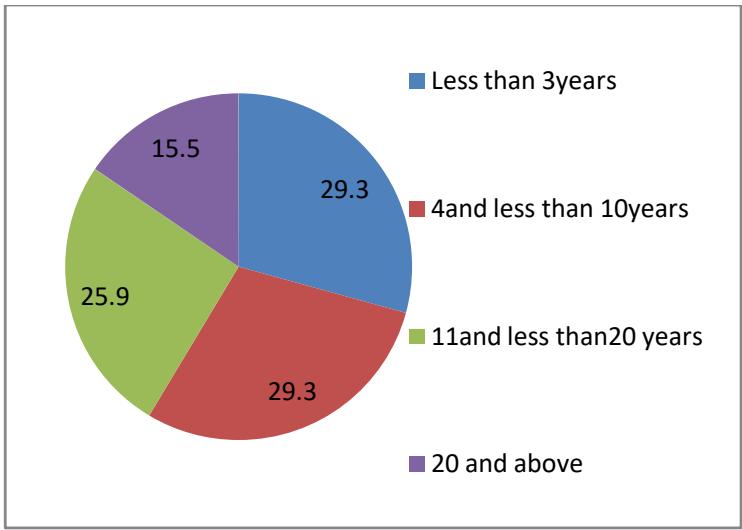 Figure 4: Respondents by experience
There are many industrial activities in the study area. Two types of activities were selected that have a hazardous on health in the surrounding residential areas, as in figures (5 and 6).
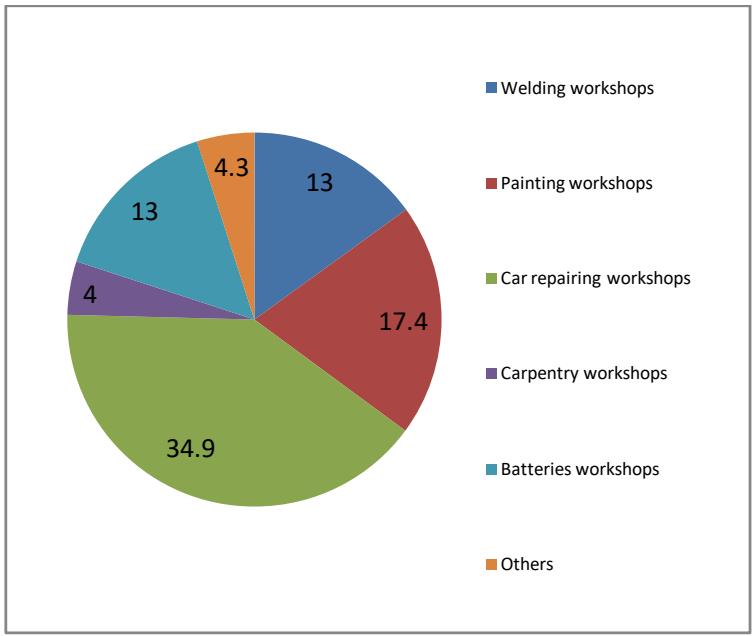
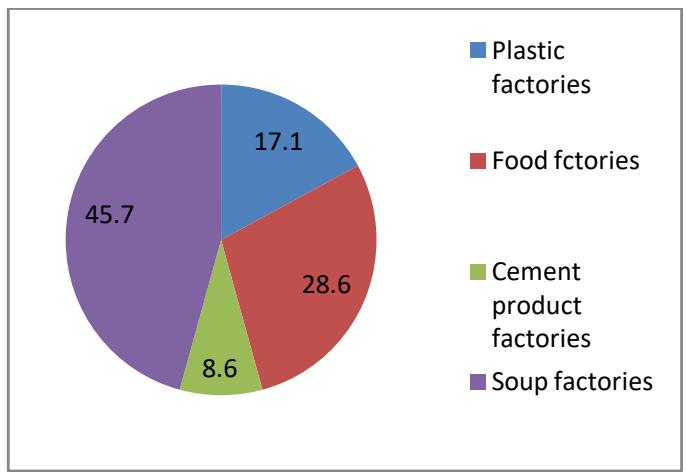 Figure 5: Types of workshops Figure 6: Types of factories
The leading causes of accidents in the study area were identified. The following figure determines the percentage of the causes of the accidents. So the most frequent causes of accidents, $48.3\%$ of workers said unsafe behavior, and $27.6\%$ said unsafe work and, $24.1\%$ said personal reasons. This figure represents the accident analysis according to the hazardous workplace condition, dangerous acts, and unsafe individual factors, respectively. The dangerous workplace conditions included inadequate guard, unguarded hazards, defective safety devices, faulty or lack of tools or equipment, hazardous workstation layout, unsafe ventilation or lighting, lack of personal protective equipment (PPE), and flimsy clothing, and lack of or insufficient training in the engineering, industry.
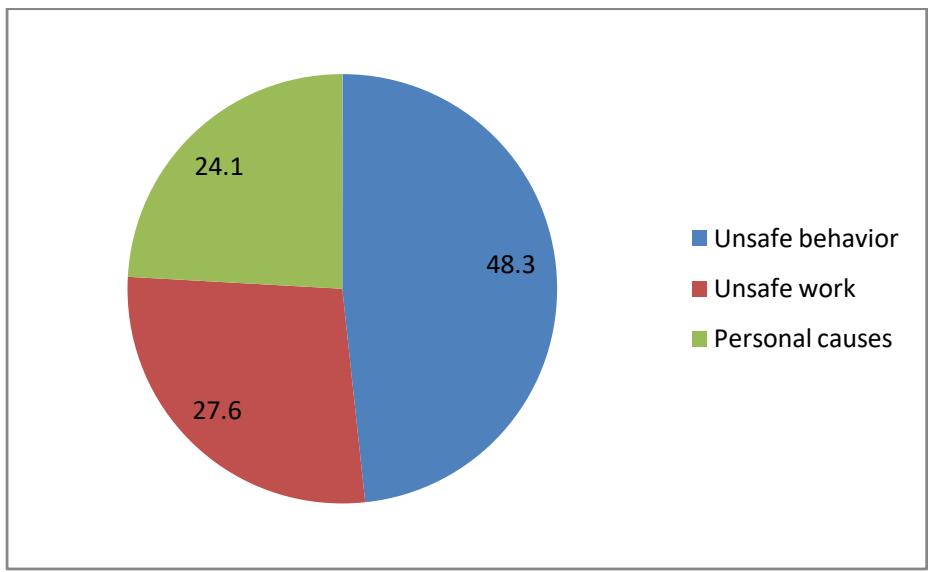 Figure 7: Causes of Accidents
## II. RESULTS
By analyzing the manipulated data, the leading causes of injuries were identified, as shown in the following tables.
Table 1: Personal causes
<table><tr><td>Personal causes</td><td>Number of people</td><td>Percentage%</td></tr><tr><td>Deliberate causes</td><td>0</td><td>0%</td></tr><tr><td>Polemical</td><td>17</td><td>29.3%</td></tr><tr><td>Fatigue</td><td>16</td><td>27.6%</td></tr><tr><td>Carelessness</td><td>20</td><td>30.5%</td></tr><tr><td>Other</td><td>5</td><td>8.6%</td></tr><tr><td>Total</td><td>58</td><td>100%</td></tr></table>
As show in table 1 the personal causes of work accidents, no deliberate causes, but $29.3\%$ of personal reasons were polemical, $27.6\%$ of the ground from fatigue, $30.5\%$ carelessness, and $8.6\%$ from other reasons.
Table 2: Technical cause
<table><tr><td>Technical causes</td><td>Number of people</td><td>Percentage%</td></tr><tr><td>Arrangement of machines</td><td>14</td><td>24.1%</td></tr><tr><td>Type of machine</td><td>15</td><td>25.9%</td></tr><tr><td>Tools</td><td>13</td><td>22.4%</td></tr><tr><td>Lack of maintenance</td><td>13</td><td>22.4%</td></tr><tr><td>Other</td><td>3</td><td>5.2%</td></tr><tr><td>Total</td><td>58</td><td>100%</td></tr></table>
Table 2 shows the technical causes that cause accidents $24.1\%$ from the arrangement of the machine, $25.9\%$ from the type of machines, $22.4\%$ from tool, $22.4\%$ from lack of maintenance, and $5.2\%$ from other.
Table 3: Medical causes
<table><tr><td>Number of people</td><td>Percentage%</td><td>Medical cause</td></tr><tr><td>22</td><td>37.9%</td><td>Intensity of light</td></tr><tr><td>4</td><td>6.9%</td><td>Ventilation</td></tr><tr><td>5</td><td>8.6%</td><td>Noise</td></tr><tr><td>19</td><td>32.8%</td><td>Poisonous material</td></tr><tr><td>8</td><td>13.8%</td><td>Others</td></tr><tr><td>58</td><td>100%</td><td>Total</td></tr></table>
As shown in table 3, the accidents from medical causes were $37.9\%$ from the poor levels of light, $6.9\%$ from ventilation, $8.6\%$ from noise, $32.8\%$ from poisonous material, and $13.8\%$ from other materials.
Table 4: Administrative causes
<table><tr><td>Administrative causes</td><td>Number of people</td><td>Percentage%</td></tr><tr><td>Lack of training</td><td>15</td><td>25.9%</td></tr><tr><td>Lack of follows</td><td>20</td><td>34.5%</td></tr><tr><td>Lack of awareness</td><td>8</td><td>13.8%</td></tr><tr><td>Lack of PPE</td><td>9</td><td>15.5%</td></tr><tr><td>Others</td><td>6</td><td>10.3%</td></tr><tr><td>Total</td><td>58</td><td>100%</td></tr></table>
Table 4 shows the accidents from the administrative causes $25.9\%$ of casualties from lack of training, $34.5\%$ of accidents from a lack of awareness but $15.5\%$ from lack of PPE, and $10.3\%$ from others.
Table 5: Most common injuries
<table><tr><td>Common injuries</td><td>Number of people</td><td>Percentage%</td></tr><tr><td>Fractures</td><td>10</td><td>17.2%</td></tr><tr><td>Amputation</td><td>9</td><td>15.5%</td></tr><tr><td>Death</td><td>1</td><td>1.7%</td></tr><tr><td>Poisonous</td><td>8</td><td>13.8%</td></tr><tr><td>Wounds</td><td>14</td><td>24.2%</td></tr><tr><td>Coma</td><td>4</td><td>6.9%</td></tr><tr><td>Burns</td><td>5</td><td>8.6%</td></tr><tr><td>Contusive</td><td>7</td><td>12.1%</td></tr><tr><td>Others</td><td>0</td><td>0%</td></tr><tr><td>Total</td><td>58</td><td>100%</td></tr></table>
Table 5 show the accident incidence rate of the different types of accident. The caught in or between things had the highest incidence. The table shows the distribution of accident according to their causes; it, is clear from the table that machines were the primary cause of fractures, amputation, and wounds (17.2%, 15.5% and 24.2%, respectively). Equipment was the leading cause of burn and contusive from the heat source (8.6%, 12.1% respectively). Hazardous materials were the fundamental cause of poisonous from a chemical sources birth, coma, and death (13.8%, 6.9%, respectively).
## III. DISCUSSION
As indicated by the result, the majority of workers early, young in age and have low levels of education not reached primary school. When investigating their knowledge about hazards exposed from the jobs, the finding revealed that their perception towards such hazards was negatively associated with the magnitude of actual the real situations. This indicates that knowledge about the dangers, risk need high levels of education by which individuals can get, the difference between what kinds of risky work. On the other hand, the findings of the interview showed that although the decision-makers in safety are fully aware of the risk of hazards, they complained about the absence of collaborative work for managing these hazards due to neglecting this issue by the specialized authorities. The most frequent unsafe acts by workers were using defective equipment and failure to use perfect equipment, tools, especially in oil and soap. engineering and food industries. This might be due to the lack of regulation of occupational health and safety in Sudan. As regards unsafe personal factors, attitude had the highest percentage in all industrial this might be due to the bad psychological conditions, including, poor wages, critical incident and accidents were caused by combination of equipment and unsafe personal factors. Most researchers believed that unsafe personal factors were key agent for more than $70\%$ of occupational accidents.
## IV. CONCLUSIONS
The study reviewed health and safety. Results showed there is no system for safety and health management in Omdurman-Locality. There are no control or safety measures. There are some gaps in the knowledge of workers in safety and health. However, there is generally a positive attitude to improving industrial safety and health among those surveyed and interviewed. A national program for industrial safety management is essential in Sudan.
This work can be further extended by studying the impact of environmental pollution, and the effectiveness of safety procedures on productivity.
Generating HTML Viewer...
References
7 Cites in Article
M Osman (2000). Educating health and safety to engineering students in Sudan case study.
Dina Adel,Imoro Braimah,John Victor Mensah (2021). Improving upon the working environment of informal sector workers in Ghana: The role of planning Published online25 APR.
Ismail Ahmad Rasdan,Norfadzilah Jusoh,Mohd Amin Mahd,Raemy Asri,Ismail Md Zein,Nor Abdul Rahman,Kamilah Makhtar,Darlina Mohamed (2020). The Factor affecting heat stress in industrial workers exposed to extreme heat: A case study of methodology.
Sardinia Rui,P Alves De Oliveira (2019). Exposure to Occupational Noise industrial environment: Case study.
Eltahir M. Elshaikh,Salma M. Mahmoud,Ahmed Omar,Audi Noureldin,Khalid Alkamil (2019). Key performance indicators in the construction industry in Khartoum.
Nida Qafisheh,Omer Mohamed,Abdelelah Elhassan,Abdalla Ibrahim,Mariam Hamdan (2021). Effects of the occupational exposure on health status among petroleum station workers, Khartoum State, Sudan.
Rasha Abdelrahim,Faris Omer,Victor Otitolaiye (2021). Current Status and Future Outlook on Occupational Health and Safety Research in Sudan: A Concise Review.
No ethics committee approval was required for this article type.
Data Availability
Not applicable for this article.
How to Cite This Article
Mustafa Eldoma Hassan. 2026. \u201cEvaluate the Behavior of Industry Workers toward Safety and their Impacts in Environment\u201d. Global Journal of Research in Engineering - A : Mechanical & Mechanics GJRE-A Volume 23 (GJRE Volume 23 Issue A1): .
Explore published articles in an immersive Augmented Reality environment. Our platform converts research papers into interactive 3D books, allowing readers to view and interact with content using AR and VR compatible devices.
Your published article is automatically converted into a realistic 3D book. Flip through pages and read research papers in a more engaging and interactive format.
In this paper, evaluated the behavior of the workers in the industry toward safety, conducted among workers in workshops and factories in the Omdurman industrial area to identify and highlight the behaviors of workers toward occupational health and safety and their impacts on the environment. Data were collected through a questionnaire given to 58 workers, to explain the attitudes and practices of workers and tanker drivers were observed. Interviews were conducted with number of decision-makers in several departments concerned with the environmental impacts of industry. The workshops studied included welding, carpentry, car repairing, and disposal and restoring batteries. Related, hazards were identified and classified. The caught in or between things had the highest incidence, the machines were the primary cause of fractures, amputation, and wounds (17.2%, 15.5%, 24.2%, respectively). Equipment was leading the main cause of burn and contusive from the heat source (8.6%, 12.1%, respectively). Hazardous materials was the fundamental cause of poisonous from a chemical birth sources, coma, and death (13.8%, 6.9%, respectively).
Our website is actively being updated, and changes may occur frequently. Please clear your browser cache if needed. For feedback or error reporting, please email [email protected]
Thank you for connecting with us. We will respond to you shortly.