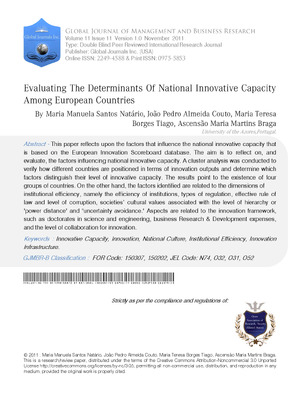
Evaluating the determinants of national innovative capacity among European countries

§ Guarda Polytechnics Institute

Send Message

To: Author

Evaluating the determinants of national innovative capacity among European countries

Article Fingerprint

ReserarchID

MBR1BQ21

Evaluating the determinants of national innovative capacity among European countries Banner

AI TAKEAWAY

Connecting with the Eternal Ground
  • English
  • Afrikaans
  • Albanian
  • Amharic
  • Arabic
  • Armenian
  • Azerbaijani
  • Basque
  • Belarusian
  • Bengali
  • Bosnian
  • Bulgarian
  • Catalan
  • Cebuano
  • Chichewa
  • Chinese (Simplified)
  • Chinese (Traditional)
  • Corsican
  • Croatian
  • Czech
  • Danish
  • Dutch
  • Esperanto
  • Estonian
  • Filipino
  • Finnish
  • French
  • Frisian
  • Galician
  • Georgian
  • German
  • Greek
  • Gujarati
  • Haitian Creole
  • Hausa
  • Hawaiian
  • Hebrew
  • Hindi
  • Hmong
  • Hungarian
  • Icelandic
  • Igbo
  • Indonesian
  • Irish
  • Italian
  • Japanese
  • Javanese
  • Kannada
  • Kazakh
  • Khmer
  • Korean
  • Kurdish (Kurmanji)
  • Kyrgyz
  • Lao
  • Latin
  • Latvian
  • Lithuanian
  • Luxembourgish
  • Macedonian
  • Malagasy
  • Malay
  • Malayalam
  • Maltese
  • Maori
  • Marathi
  • Mongolian
  • Myanmar (Burmese)
  • Nepali
  • Norwegian
  • Pashto
  • Persian
  • Polish
  • Portuguese
  • Punjabi
  • Romanian
  • Russian
  • Samoan
  • Scots Gaelic
  • Serbian
  • Sesotho
  • Shona
  • Sindhi
  • Sinhala
  • Slovak
  • Slovenian
  • Somali
  • Spanish
  • Sundanese
  • Swahili
  • Swedish
  • Tajik
  • Tamil
  • Telugu
  • Thai
  • Turkish
  • Ukrainian
  • Urdu
  • Uzbek
  • Vietnamese
  • Welsh
  • Xhosa
  • Yiddish
  • Yoruba
  • Zulu
Font Type
Font Size
Font Size
Bedground

Abstract

This paper reflects upon the factors that influence the national innovative capacity that is based on the European Innovation Scoreboard database. The aim is to reflect on, and evaluate, the factors influencing national innovative capacity. A cluster analysis was conducted to verify how different countries are positioned in terms of innovation outputs and determine which factors distinguish their level of innovative capacity. The results point to the existence of four groups of countries. On the other hand, the factors identified are related to the dimensions of institutional efficiency, namely the efficiency of institutions, types of regulation, effective rule of law and level of corruption, societies’ cultural values associated with the level of hierarchy or “power distance” and “uncertainty avoidance.” Aspects are related to the innovation framework, such as doctorates in science and engineering, business Research & Development expenses, and the level of collaboration for innovation.

References

48 Cites in Article
  1. Daniele Archibugi,Mario Planta (1996). Measuring technological change through patents and innovation surveys.
  2. D Archibugi,M Pianta (2009). Innovationperformances in Europe: a long term perspective.
  3. D Archibugi,A Coco (2005). Measuring technological capabilities at the country level: a survey and menu for choice.
  4. A Arundel,H Hollanders (2007). Differences in socio-economic conditions and regulatory environment: explaining variations in national innovation performance and policy implications.
  5. Bjørn Asheim,Lars Coenen (2006). Contextualising Regional Innovation Systems in a Globalising Learning Economy: On Knowledge Bases and Institutional Frameworks.
  6. R Belderbos,M ; Carree,B Lokshin (2004). Cooperative R&D and firm performance.
  7. H; Belitz,M; Clemens,Jens Schmidt-Ehmcke,A Werwatz (2008). Deficits in education endanger Germany's innovative capacity.
  8. F Bogliacino,M Pianta (2009). Innovation performances in Europe: a long term perspective.
  9. A Bramanti (1999). From space to territory: relational development and territorial competitiveness.
  10. R Camagni,R Capello (2005). ICTs and territorial competitiveness in the era of internet.
  11. C; Camelo-Ordaz,A Hernandéz-Lara,R Valle-Cabrera (2005). The relationship between top management teams and innovative capacity in companies.
  12. M Castells,P Hall (1994). Technopoles of the World: The Making of The 21st Century Industrial Complexes.
  13. T Davenport,L Prusak (1998). Working Knowledge: How Organizations Manage What They Know.
  14. D Doloreux (2004). Regional innovation systems in Canada: a comparative study.
  15. J Dunning (1998). Location and the multinational enterprise: a neglected factors.
  16. P Evans,J Rauch (1999). Bureaucracy and growth: a cross -national analysis of the effects of "Weberian" state structures on economic growth.
  17. P Fan (2008). Innovation Capacity and Economic Development: China and India.
  18. C Freeman (1995). The national systems of innovation in a historic perspective.
  19. Jeffrey Furman,Michael Porter,Scott Stern (2002). The determinants of national innovative capacity.
  20. A; Ganzaroli,G Fiscato,L Pilote (2006). Does business succession enhance firms' Innovation capacity? Results from an exploratory analysis in Italian SMES.
  21. Zvi Griliches (1990). Patent Statistics as Economic Indicators: A Survey.
  22. K Henttonen (2006). Innovation in Complex Networks -the State -of-the-Art and propositions for Further Research.
  23. G Hofstede (1987). Culture and Organizations: Software of the Mind.
  24. Hugo Hollanders,A Van Cruysen (2008). A critical assessment of the European Innovation Scoreboard.
  25. J Howells (2005). Innovation and regional economic development: a matter of perspective?.
  26. M-C And Hu,J Mathews (2005). Innovative capacity in East Asia.
  27. Mei-Chih Hu,John Mathews (2008). China's national innovative capacity.
  28. H-C And Huang,H-Yu Shih (2009). National innovative capacity in the international technology diffusion: the perspective of network contagion effects.
  29. F Jaumotte (2006). Maintaining Switzerland's Top Innovation Capacity.
  30. D; Kaufmann,Kraay,M Mastruzzi (1996). Governance Matters VII: Aggregate and Individual Governance Indicators.
  31. M Landabaso (1997). The promotion of innovation in regional policy: proposals for a regional innovation strategy.
  32. M Laranja (2001). Que politicas de ciência e tecnologia para uma nova economia do conhecimento e da inovação em Portugal?.
  33. E Lorenz (2005). Developing indicators for skills and innovation.
  34. Elisabetta Marinelli (2006). Lundvall, B.A., K.J. Joseph, C. Chaminade and J. Vang eds, (2010), <i>Handbook of Innovation Systems and Developing Countries: Building Domestic Capabilities in a Global Setting</i>. Cheltenham, UK and Northampton MA: Edward Elgar, 395 pp. £ 125.00.
  35. B Lundvall,B Johnson (1994). The learning economy.
  36. (1992). National Systems of Innovation: Towards a Theory of Innovation and Interactive Learning.
  37. J Mathews,M-C Hu (2007). Enhancing the role of universities in building national innovative capacity in East Asia: the case of Taiwan.
  38. Maria Natário,João Couto,Maria Borges Tiago,Ascensão Braga (2007). Factors and Dimensions of National Innovative Capacity.
  39. Andy Neely,Jasper Hii (1999). The Innovative Capacity of Firms.
  40. (1993). National Systems of Innovation: a Comparative Study.
  41. (1997). National Innovation System.
  42. Oecd (2000). Perspectives de L'OCDE de la Science.
  43. (2001). Relatório de Desenvolvimento Humano 2001.
  44. D; Pontikakis,T Mcdonnell,W Geoghegan (2005). Conceptualising a National Innovation System: Actor, Roles and Incentives.
  45. M Porter (1990). The Competitive Advantage of Nations.
  46. Michael Porter (1998). Determinants of National Competitive Advantage.
  47. B Kogut,H Singh (1988). The effect of national culture on the choice of the entry mode.
  48. M Porter,S Stern (1999). The New Challenge to America's Prosperity: Finding from the.

Funding

No external funding was declared for this work.

Conflict of Interest

The authors declare no conflict of interest.

Ethical Approval

No ethics committee approval was required for this article type.

Data Availability

Not applicable for this article.

How to Cite This Article

Dr. NatArio, JoAo Couto, Maria Tiago. 1970. "Evaluating the determinants of national innovative capacity among European countries". Global Journal of Management and Business Research, Global Journal of Management and Business Research - B: Economic & Commerce GJMBR-B Volume 11 (GJMBR Volume 11 Issue B11).

Download Citation

Journal Specifications

Crossref Journal DOI 10.17406/GJMBR

Print ISSN 0975-5853

e-ISSN 2249-4588

Keywords
Classification
GJMBR-B Classification FOR Code: 150307
150202
JEL Code N74
O32
O31
O52
Version of record

v1.2

Language
English
Experiance in AR

Explore published articles in an immersive Augmented Reality environment. Our platform converts research papers into interactive 3D books, allowing readers to view and interact with content using AR and VR compatible devices.

Read in 3D

Your published article is automatically converted into a realistic 3D book. Flip through pages and read research papers in a more engaging and interactive format.

Article Matrices
Total Views: 7.2K
Total Downloads: 461
All Trends

Request Access

Please fill out the form below to request access to this research paper. Your request will be reviewed by the editorial or author team.
X

This is the heading

Lorem ipsum dolor sit amet, consectetur adipiscing elit. Ut elit tellus, luctus nec ullamcorper mattis, pulvinar dapibus leo.


High-quality academic research articles on global topics and journals.

Evaluating the determinants of national innovative capacity among European countries

Dr. NatArio
Dr. NatArio Guarda Polytechnics Institute
JoAo Couto
JoAo Couto
Maria Tiago
Maria Tiago