Bangladesh has launched the mass rapid transit (MRT) service for the first time in the transportation sector. The MRT has significantly brought access to instantaneous communication in one of the congested cities, Dhaka. Since the service is a brand-new offering in Bangladesh, there is a complete gap in research in this sector. Therefore, the objective of this study is to evaluate the effects of service quality dimensions on passengers’ satisfaction with MRT in Bangladesh. The researchers used a convenient sampling method and collected primary data from 251 respondents who consumed the MRT service frequently. Using the reliable software Smart PLS 3.0, the data were analyzed. The researchers have examined Cronbach’s alpha, composite reliability, and average variance extracted (AVE) to test the reliability and validity of the collected data. This study finds that the constructs namely tangibility, responsiveness, assurance, hedonic motivation, and price value are significant in determining passengers’ satisfaction with MRT. Price value is more significant followed by hedonic motivation and responsiveness. In contrast, statistics reveal that reliability and empathy are insignificant in nature.
## I. INTRODUCTION
Metro rail transits have created a milestone in transportation and communication advancements (Kurniawati, 2023). After London first launched an electric train in 1890 (Duffy, 2003), high-speed trains have become an undeniable option for technological, commercial, and socioeconomic success over the passage of time (Fowler, 2023). They also added that many developed nations like Italy, France, Germany, Poland, Netherlands, Spain, and Switzerland have invested in metro or high-speed railways to achieve far-reaching benefits in various aspects.
Australian government emphasized greatly on high-speed rail (HRS) services for urban development (Gharehbaghi et al., 2020).
The country, China has introduced the world's largest high-speed rail (HSR) network expecting that it would have a substantial impact on the country's mobility, accessibility, socioeconomic development, and other factors, particularly at the megaregional level (Chen, 2013).
The Indian metros have most remarkably contributed to the diversion of a significant portion of current passenger traffic from road to the METs and consequently reduced the number of buses, passenger cars, and other vehicles carrying passengers on its roadways (Bhagyalakshmi & Vasudevan, 2020).
Bangladesh has introduced its first metro rail journey which will contribute to making Bangladesh smart from various perspectives (The Daily Star, 28<sup>th</sup> December 2022). It also added that this mass rapid transit (MRT) will reduce traffic congestion and air pollution in Dhaka city. It will enable people to move quickly from one place to another.
Decision-makers must urgently redirect urban transportation development toward a more sustainable future in order to build greener and more livable cities. The socio-economic development of a country greatly depends on transportation whereas in developing countries, it's critical where accessibility and mobility are commonly hampered by a lack of adequate levels of transportation services (Luke & Heyns, 2020). The management of public transportation quality has become a focus of in-depth study in recent years (Majumdar et al., 2020).
Establishing a sustainable urban transportation system necessitates an all-encompassing integrated approach to decision-making with the shared objective of strengthening an inexpensive, environmentally friendly, people-oriented, and commercially viable transportation system (Goldman & Gorham, 2006). Congestion is a great problem because it has a domino effect on other factors that affect the economy, the environment, and society including poor air quality, traffic accidents, travel delays, and public health issues where metro rail services could be a better alternative to other public transports (Majumdar et al., 2020).
It is crucial for managers and authorities to ensure higher levels of customer satisfaction (CS) in public transportation (PT) systems (Buran & Ercek,
2022). To evaluate how efficient and sufficient their services are, PT providers must assess the performance of their service quality (SQ) (Girma et al., 2022). Therefore, public organizations must look into what components of service enhancements may be implemented to both improve the experience of present consumers and draw in new ones.
Additionally, the performance evaluation is required to take into account the top activities, stakeholder concerns, current and projected demand trends, and unmet service needs (Kuo et al., 2023). Appraisal of performance helps to ensure better economic performance, links- interactions and output from service providers and improves organizational SQ (Chan et al., 2023). Thus, the availability of adequate public transportation becomes more and more important as cities in developing countries expand, especially in big cities with rapid population expansion.
According to Kilibarda et al. (2016), and Ricardian to et al., (2023), the quality of service delivery, which is regarded as the most crucial factor in both consumer attitudes and customer loyalty, has a considerable impact on customer satisfaction. The first step in improving customer satisfaction is to assess the grade of the services offered (Hamid & Baharudin, 2023). As a result, it is critical for public entities to create service quality standards in order to provide high-quality services that go above and beyond what is expected of them by the public (Dullah et al., 2023). Measuring customer satisfaction with public transportation services is essential in both transportation research and practice (Anburuvel et al., 2022). To boost the infrastructure, facilities, services, and demand for public transportation, transit authorities must understand how well passenger expectations have been satisfied. Customer surveys are significant because they provide transportation agencies with useful information on the specific areas with which customers are satisfied and dissatisfied (Rong et al., 2022; Sukhov et al., 2022). Service frequency, on-time performance, travel speed, and vehicle cleanliness are found to have the greatest effects on customer satisfaction in the tendered regions (Singh & Kathuria, 2023; Wong et al., 2023). According to Deb et al. (2022), waiting time, cleanliness, and comfort are the three most crucial PT qualities. The most commonly mentioned attributes of transportation services are dependability, frequency, capacity, cost, cleanliness, comfort, security, crew, knowledge, and ticketing system (Anburuvel et al., 2022; Farazi et al., 2022). Reliability, frequency, price, speed, access, comfort, and convenience also found themselves significant in rapid transit networks (Kepaptsoglou et al., 2020).
Measuring commuters' satisfaction with MRT service has got significant attention in different developed and developing countries (Gharehbaghi et al., 2020; Chen, 2013; Bhagyalakshmi & Vasudevan,
2020). But, as we know the MRT service is very new in our country (The Daily Star, $28^{\text{th}}$ December 2022) that's why this sector still has not been conducted significant research. The authors believe that this research work is going to be the first research on MRT in Bangladesh. Still, no research on this sector has been published. There is some news that passengers are facing various problems in getting metro rail services (The Business Standard, $29^{\text{th}}$ December 2022). Along with that lax security at metro rail stations is raising concerns (Dhaka Tribune, $31^{\text{st}}$ December 2022). The researchers made an effort to investigate the service quality characteristics and the resulting passenger satisfaction with Bangladesh's metro rail services in light of these research gaps. Alike other countries, the evaluation of the service quality of metro rail or mass rapid transit can minimize the service gaps and ensure the expected service levels from MRT. It may also help the concerned authorities to design good quality services for similar mega projects that are now under construction.
This raises the following research question; What are the effects of service quality dimensions on passengers' satisfaction with MRT in Bangladesh? This study aims to investigate the service quality of MRT from the users' perspective using the widely accepted SERVQUAL model. This study aims to-
Following this Introduction, the rest of the parts of this research outline are as follows: the second section presents the pertinent literature, conceptual framework, and hypotheses development. Next, the study details the methodology. Subsequently, the fourth section depicts the findings and discussion on service quality dimensions and passenger satisfaction. Finally, the fifth section highlights the theoretical and practical implications, noting some limitations and signifying actions for imminent research.
## II. LITERATURE REVIEW
Congestion at stations, relatively high-priced tickets, and the inconvenience of using transportation facilities that connect to other modes of transportation rank as the three main causes of customers' unhappiness with MRT (Iqbal et al., 2022; Reyes et al., 2023). All countries need transportation for their social and economic growth, but developing countries are especially dependent on it because mobility and accessibility are usually restricted due to insufficient levels of transportation services (Luke & Heyns, 2020). The development of the transportation infrastructure is essential to the development of wealthy communities (Fantin & Appadurai, 2022). Congestion, along with related issues including pollution, accidents, dwindling public transportation, and environmental deterioration, characterizes the city's transportation system today, demanding a premium on rapid and safe transport (Pojani & Stead, 2015).
Now, passengers are more dependent on the most recent metro rail steering system in the current circumstances because of machine life and modern growth. This approach performs a better job of assisting people to plan their day and get them to their destination on time (Yen et al., 2023). Considering the significance of metro transportation, it must offer high levels of comfort to both staff and passengers (Ding & Hou, 2022). Almost 3.08 million people use the community train and the network of mass rapid transit lines every day to connect the city's center and its surroundings (Liu et al., 2023). Given that the majority of respondents use metro services to reach their destination, a better and more efficient system of ticketing and information about train arrival and departure should be required. Also, it is crucial to boost security during the trip to eliminate petty crime and other offenses (Nguyen & Pojani, 2023; Leoni & Owen, 2023). Evaluating the factors that diminish commuter satisfaction and steadfastly measuring them have become requirements for MRT organizations in an effort to implement the necessary improvements based on commuters' knowledge and needs (Bhagyalakshmi & Vasudevan, 2020). Customer satisfaction and service quality dimensions have typically drawn researchers' attention, according to the researchers and one of the fundamental approaches to improving customer satisfaction is the ongoing improvement of service quality dimensions (Hoo et al., 2023; Sama et al., 2023; Hamzah et al., 2023).
Customer satisfaction is an evaluation of the requirements and expectations of the products and services each service provider provides (Li et al., 2023). Customer satisfaction refers to a good fit between customers' expectations of a particular product or item and the performance of that product (Nugroho & Wang, 2023; Moussaoui et al., 2023; Naz et al., 2023). Customer satisfaction and service quality in the travel industry are strongly positively correlated (Aseres and Sira, 2020; Ong et al., 2023). Measuring customer satisfaction is viewed as a crucial activity in marketing programs, and from an organizational viewpoint, customer satisfaction is portrayed as a prominent aspect (Ibrahim & Aljarah, 2023; Jahmani et al., 2023; Wisitnorapatt & Sirirat, 2023). Another study's findings demonstrated that customers' satisfaction with public transportation services was positively impacted by both the quality of traditional services and e-services, but e-services satisfy customers more (Khairani & Hati, 2017; Prawesti et al., 2023; Awal et al., 2023).
Customer satisfaction has a positive effect on actual behavior related to the use of technological services (Camilleri et al., 2023; Park & Kim, 2013). The integration of customer satisfaction has shifted business philosophies from product orientation to customer orientation due to technological advancement (Qalati et al., 2020). They also concluded that it is quite difficult to retain customer happiness while addressing all of their needs. Additionally, "customer satisfaction" has been often employed in business literature, especially in the fields of marketing and finance (Yi & Natarajan, 2018). According to previous research (Alshihre et al., 2023; Das et al., 2023; Luo et al., 2023; Prasidi et al., 2023; Wahyudi, 2023), customer satisfaction may therefore be utilized to close the gap between the needs and expectations of customers' products and services. According to Tsabita & Djamaludin (2023), research in Indonesia, the level of service provided had a positive effect on how satisfied customers were with transportation services. A key tactic for increasing customer satisfaction is to continuously enhance the service quality aspects (Abdujalilovich & Ibroximjon, 2023; Chao et al., 2023; Hawa et al., 2023). The factors affecting customer satisfaction and service quality, according to academics, have historically made for intriguing research topics (Shyju et al., 2023; Venkatakrishnan et al., 2023; Drouet et al., 2023).
The number of research areas using the SERVQUAL model to explore passengers' satisfaction with Metro Rails is not significant in nature. Along with that, as this is a totally new service area in Bangladesh, there has not been much research done yet. To bridge this research gap, researchers have been interested in conducting research in this area.
## III. CONCEPTUAL FRAMEWORK AND HYPOTHESIS DEVELOPMENT
a) The use of SERVQUAL and UTAUT2 (Two factors from UTAUT2-Hedonic Motivation and Price Value) in assessing Service Quality
The method most often used to measure consumer perceptions of quality in the service industry is SERVQUAL, which was created by Parasuraman et al. (1985, 1988, 1991). Over the past 50 years, research on service excellence and customer satisfaction has generated a significant amount of literature (Aseres and Sira, 2020). The value of service quality in the travel sector was discussed in earlier literature, which has become increasingly popular in academic study circles (Cheunkamon et al., 2023; Chikazhe et al., 2023; Dai et al., 2023; Ofe & Sandberg, 2023). A company should generally aim to narrow the gap between perceptions and expectations in industries like e-commerce (Jauhar et al., 2023; Li et al., 2023; Lindell & Nilsson, 2023; Wang et al., 2023; Wu & Dong, 2023), banking (Ananda et al., 2023; Imran et al., 2023; Manohar et al., 2023; Senanu & Narteh, 2023), healthcare (Crafford et al., 2023; Nie et al., 2023; Panagou et al., 2023; Syed et al., 2023), hospitality (Akarsu et al., 2023; Huang, 2023; Mariani & Borghi, 2023; McCartney & Kwok, 2023; Mehta et al., 2023), education (Keane et al., 2023; Pujol et al., 2023; Rouse et al., 2023; Twyford & Dean, 2023; Wan et al., 2023), and so forth. The RAILQUAL, a modified SERVQUAL (Gopal et al., 2023; Li et al., 2023; Mishra & Panda, 2023), uses different aspects instead of five to measure customers' impressions of the service's quality (comfort, security, and convenience are added to the original dimensions).
Urban transportation studies by Guzman et al. (2023) and Drabicki et al. (2023) respectively examined the gap between perceived and expected quality among urban transportation stakeholders commuting within metropolitan areas. The SERVQUAL model has been identified by Amankwah et al. (2023) as one of the influential models in service quality. The model, also known as the RATER Model, was developed by the researchers to address five constructs (Ravichandran et al., 2010). They are responsiveness, empathy, tangibility, assurance, and reliability. To increase customer satisfaction, service providers should make sure that the expected and perceived services are consistent (Ahrholdt et al., 2017). The results of the prior study also suggested that, depending on the type of research being conducted by the researchers, the SERVQUAL model would need to be updated (Ali & Raza, 2017). Examining the critical and determining elements that influence Bangladesh's MRT service consumers' happiness is the goal of this study. It has done this by placing a strong emphasis on tangibility, dependability, responsiveness, assurance, and empathy. Despite the above-mentioned research, there are not many applications in the field of public transportation, and (to our knowledge) no attempt has yet been made to create a framework for the service quality measurement using a SERVQUAL technique in MRT service in Bangladesh. Bridging this gap could be quite beneficial for MRT agencies, especially those that are willing to comply with the standards as stated.
Kalinc et al. (2019) found that the UTAUT2 model is a significant tool to measure customer satisfaction. This model has found its ability to predict the intention and customer satisfaction toward a market offering (Barbosa et al., 2021). In the public transportation sector, the UTAUT2 model determines the performance levels of service providers and users' satisfaction critically (Korkmaz et al., 2023). Venkatesh et al. (2012) added three independent constructs- hedonic motivation, price value, and habit- with this model. Hedonic motivation and price value are the salient variables in ensuring commuters' satisfaction (Chopdar et al., 2022). Keeping relevance with these findings, the researchers have taken price value and hedonic motivation along with SERVQUAL model dimensions to evaluate the satisfaction of MRT passengers.
The following constructs are included in the study model in Figure 1:
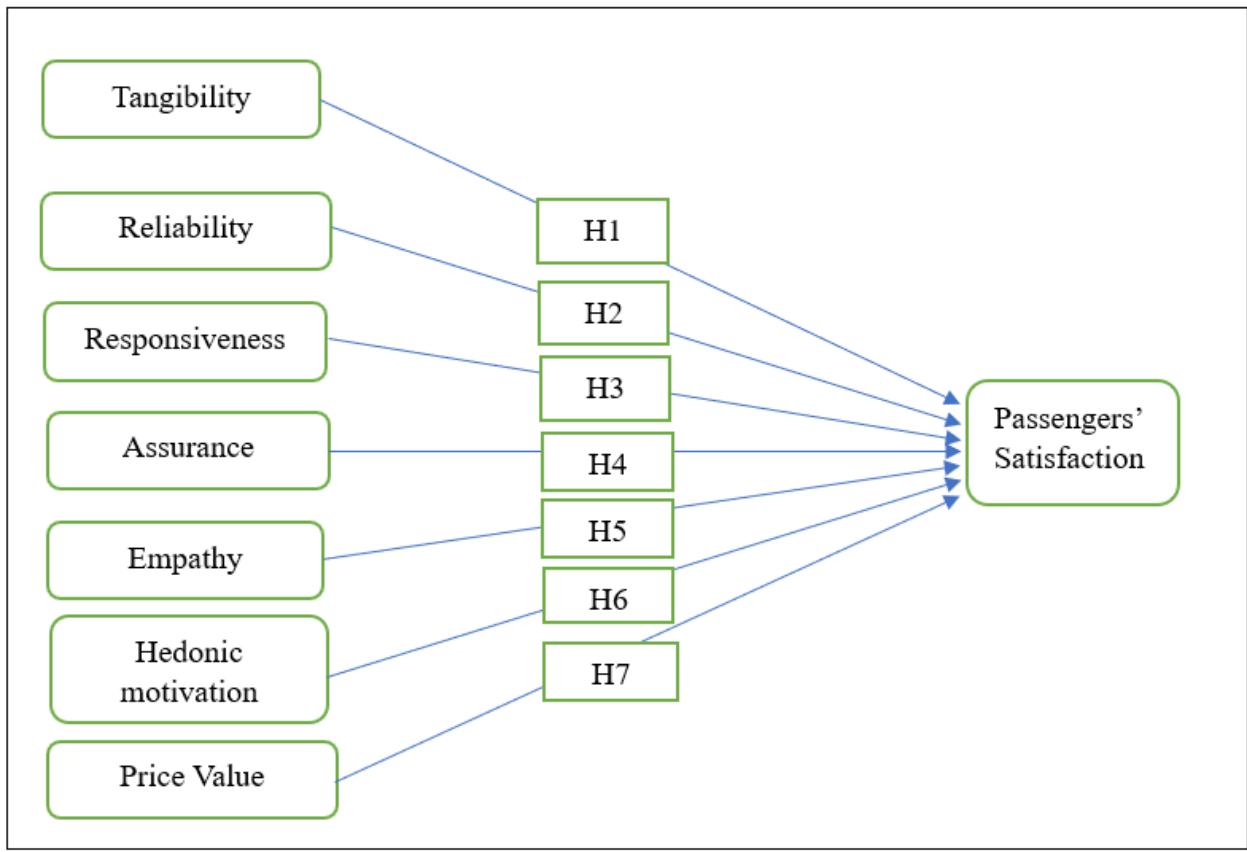 Figure 1: The Conceptual Model of the Proposed Research
### b) Hypotheses Development
## i. Tangibility
The tangibility dimension of service consists of the physical appearance of the service facility, the equipment, the personnel, and the communication resources. For example, the appearance of MRT, public phones, stations, and so on (Parasuraman et al., 1988; Thomson et al., 2023). The service facility's physical attributes, as well as its equipment, personnel, and communication resources, are considered tangibles (Parasuraman et al., 1988; Hamzah et al., 2023). For example, the installation of public phones, metro stations, etc. The study team by Arteaga-Sanchez et al. (2020) found evidence from the transit industry that tangibility has a big impact on consumer satisfaction. The researchers focused on Indian transit services when they discussed service quality and customer satisfaction in the context of South Asia (Singh & Kathuria, 2023). The tangible elements of services have a positive impact on customer satisfaction, and the results of a recent study show that the degree to which the service quality component is tangible has a significant impact on customer satisfaction (Aseres & Sira, 2020; Hussein, 2016; Al-Mhasnah et al., 2018). Therefore, this study assumes that the tangibility dimension will affect the passengers' satisfaction with MRT. Thus, the following hypothesis has been drawn.
H1: Tangibility has a positive relationship with passengers' MRT satisfaction.
## ii. Reliability
The ability of the service provider to deliver the promised service precisely and dependably is referred to as reliability (Parasuraman et al., 1988; Vasanthi et al., 2023) for instance, metros are punctual in their arrival and departure (Jayanthi et al., 2023). Octavines et al. (2023) assert that reliability is a representation of a customer's dedication, promptness, and relevance in obtaining satisfaction. Some recent studies found that the reliability attribute has the greatest impact on customer satisfaction (Christian et al., 2023; Luo et al., 2023; Shamsudin et al., 2023). The reliability construct has a positive and significant impact on customer satisfaction, according to similar findings (Conceicao et al., 2023; Cebeci et al., 2023). Eventually, the authors perceive that the reliability dimension will affect the passengers' satisfaction with MRT. Hence, the following hypothesis is as follows-
H2: Reliability has a positive relationship with passengers' MRT satisfaction.
## iii. Responsiveness
Response time, as demonstrated by having service employees on call (Awasthi et al., 2011), demonstrates how flexible and timely the service provider is (Parasuraman et al., 1988). In several studies on transportation services, it was found that responsiveness had a significant and positive impact on customer satisfaction (Arteaga-Sanchez et al., 2020; Ong et al., 2023; Wong et al., 2023; Luo et al., 2023). The timeliness component of outstanding service has a considerable and direct impact on customer satisfaction, according to recent research (Hamzah et al., 2023; Wurtz & Sandkuhl, 2023). Additionally, Sama et al. (2023) discovered that responsiveness is a crucial element of the quality of e-services that affects client satisfaction. In light of these findings, this study posits that the authors perceive that the responsiveness dimension will affect the passengers' satisfaction with MRT. So, the hypothesis is designed as below-
H3: Responsiveness has a positive relationship with passengers' MRT satisfaction.
## iv. Assurance
The ability of the employees to convey trust, faith, and confidence as well as their knowledge and manners are all aspects of assurance (Parasuraman et al., 1988; Vasanthi et al., 2023; Ong et al., 2023). An emergency circumstance can call for staff communication, for instance. Experts have highlighted assurance as one of the crucial components of transport systems, especially when individuals are traveling with random people (Tengilimoglu et al., 2023; Parmar & James, 2023; Moulahi et al., 2023). According to Zhang & Jennings (2023), customer satisfaction with transportation services is significantly impacted by assurance. Additionally, earlier studies have shown that the assurance construct of the service quality dimension significantly and favorably affects customer satisfaction (Al-Mhasnah et al., 2018). Consumer happiness is significantly impacted by worries about privacy and security, according to a study by Zhu et al. (2023) and Khan et al. (2023). Hence, this study supposes that the assurance dimension will affect the passengers' satisfaction with MRT. Accordingly, the hypothesis here is-
H4: Assurance has a positive relationship with passengers' MRT satisfaction.
## v. Empathy
Empathy implies thoughtfulness on the part of staff members and customized customer care. Drouet et al. (2023) and Parasuraman et al. (1988) both mention the assistance of seniors or youngsters in getting through toll gates to access the station. The empathy construct of the service quality dimension has been shown to have a large and positive impact on customer satisfaction (Biswas & Verma, 2023; Jasin et al., 2023). In a study on service quality and customer satisfaction in the context of an online cab company, researchers found that empathy had a substantial impact on consumer satisfaction (Panggabean & Yohana, 2023). Arteaga-Sanchez et al. (2020) assert that empathy has a favorable and significant effect on customer satisfaction in the transportation industry. The results of the earlier studies similarly demonstrated a significant relationship between customer satisfaction and the empathy construct of service quality (Ananda et al., 2023; Putta, 2023; Jou et al., 2023). Thus, the authors daresay that the empathy dimension will affect the passengers' satisfaction with MRT.
Therefore, the proposed hypothesis is as follows
H5: Empathy has a positive relationship with passengers' MRT satisfaction.
## vi. Hedonic Motivation
Hedonic motivation is the idea that people get certain benefits from an event they find enjoyable, pleasurable, multisensory, emotional, and thrilling (Hirschman and Holbrook 1982: Venkatesh et al., 2012). Offering all passengers this kind of experience is one of the foundational elements of transport and destination services (Chen et al., 2023; Maas et al., 2023).
Researchers, professionals, and governments are becoming intensely interested in the relationships between transportation and hedonistic motivation (Osman et al., 2023; Cui & Aulton, 2023; Parvatiyar & Sheth, 2023). It's also added that in order to increase traffic security as well as commuters' satisfaction for all, stakeholders need accurate methods for assessing the emotional states of travelers. Hedonic motivation measurement has been usefully used in the travel domain. The researcher also mentioned that the Satisfaction with Travel Scale (STS) is linked to Hedonic motivations, which are connected to core affect (emotions) and cognitive evaluation. In line with this, Liu et al. (2021) commented that the subject of mobility and transportation has become increasingly interesting in studies that link commuting and hedonic well-being. They discovered that certain combinations of personality traits and modes of transportation are connected to the commuter experience and hedonic well-being. Since these studies used hedonic motivation to identify passengers' satisfaction and found the results positive, the authors also assume that hedonic motivation will positively affect the satisfaction of passengers with MRT. Therefore, the following hypothesis has been drawn.
H6: Hedonic motivation has a positive relationship with passengers' MRT satisfaction.
## vii. Price Value
The price value (PV) is defined as the customers' cognitive tradeoff between the perceived benefits and monetary cost of using a product or service (Venkatesh et al., 2012). PV significantly affects passengers' intentions to consume autonomous public transport services (Korkmaz et al., 2022). Additionally, in the case of Uber-based transportation systems, PV is regarded as a significant construct in instigating the passengers' intentions to take ride-sharing services (Soares et al., 2020). The MRT must ensure a good price value tradeoff to satisfy the passengers significantly (Yan et al., 2023). Furthermore, it creates a significant user perception around the relationships between benefits and costs leading to adopt travel services (García de Blanes Sebastián et al., 2023). As the PV construct has been used in identifying passengers' satisfaction in these earlier studies, the authors perceive that this construct will also positively affect the satisfaction of passengers with MRT in Bangladesh. Hence, the authors posit that:
H7: Price value has a positive relationship with passengers' MRT satisfaction.
## IV. METHODOLOGY
### a) Research Design
The previous studies adopted both qualitative (Satranarakun & Kraiwanit, 2023; Nxele, 2021; Cascajo et al., 2019; Balasubramani et al., 2020; Bergman et al., 2019;) and quantitative (Zhang et al., 2023; Yin et al., 2022; Kumar & Cao, 2021; Dong et al., 2021; Kumar & Cao, 2023) approaches to conduct their studies on metro rail transit and other public transportation. Since we have collected numerical data, we have analyzed our data using a quantitative approach (Bauer et al., 2021). In addition to that, a quantitative method focuses on validating or rejecting predefined research hypotheses (Mcleod, 2019). Qualitative research focuses on in-depth interviews, statements, and "how" type questions whereas quantitative research focuses on collecting and analyzing numerical data (Brazen et al., 2021). Therefore, we have conducted quantitative research.
### b) Measurement
The UTAUT2 model (Venkatesh et al., 2012) and the SERVQUAL model (Parasuraman et al., 1985) were taken into consideration when designing the study's variables and creating the questionnaire to gauge MRT passengers' satisfaction. The study's questionnaire was prepared after examining the expert's advice and recommendations, the passengers' perspectives, and a pretest. Tangibility, dependability, assurance, empathy, and responsiveness are SERVQUAL model aspects that are also referred to as RATER model characteristics (Ziyad et al., 2020). The remaining variables, hedonic motivation, and price value are obtained from Venkatesh et al. (2012). According to the specifications of the setting of the current investigation, every element from these models has been altered. The researchers employed a five-point Likert scale. The scale ranges from strongly disagree (1) to strongly agree (5). On the basis of these scales, every construct has been examined. The questionnaire is broken up into two sections, the first of which covers all of the items and constructs and the second of which covers the sociodemographic characteristics of the chosen respondents.
The Partial Least Square (PLS)-structural equation modeling method was employed by the researchers in this study, which was carried out using SmartPLS software 3.0. This statistical technique is used to assess the constructs' discriminant validity, path coefficients, validity and reliability of the constructs, and structural model. In the case of exploratory research, researchers regularly used SmartPLS, especially in the marketing sector (Hair et al., 2012).
### c) Target Population
As the study context is the MRT in Bangladesh, the target population is the users of MRT in Bangladesh. The persons who traveled by MRT frequently are mainly targeted in this study since they could scale in-depth insights and experience with MRT. The population of this study includes people who have traveled by the MRT several times.
### d) Questionnaire Design and Pretesting
The data was collected by an in-person survey using a closed-ended structured questionnaire using a five-point Likert scale ranging from strongly disagree (1) to strongly agree (5)(Emerson, 2015). Furthermore, the respondents' confidentiality and anonymity were protected by the researchers. The researchers provided an introduction before the survey began and explained why it was being conducted. 290 questionnaires were supplied to the respondents where 39 questionnaires were found incomplete in getting actual responses. 251 surveys were found to be full and suitable for statistical analysis, and the response rate of $86.55\%$ met the benchmark or general guideline for the Smart PLS procedures, according to the researchers (Urbach & Ahlemann, 2010). We collected our data from March to October 2023 (eight months). For better and more insightful understanding we prepared the questionnaire in both English and Bengali languages.
Before beginning the primary data collection process, we conducted two rounds of pre-testing on our questionnaire. Two subject-matter experts extensively examined the study questionnaire's first draft. In the following stage, 30 MRT users pretested the questionnaire. We moderated our questionnaire accordingly. Finally, 24 items that are the best fit for the questionnaire were retained.
### e) Sample Size, Sample Technique, and Data Collection
This study has focused on a field survey to evaluate the satisfaction of MRT passengers in Bangladesh. Dhaka city has been taken into consideration as the MRT is functioning only in this city in the country. The sample-to-variable ratio should not be less than 5:1, even though a 15:1 or 20:1 ratio is preferred (Hair et al., 2018; Liao et al., 2016; Yeoh et al., 2016; Forsberg & Rantala, 2020). In light of these references, the minimum sample size in our study should be $20^{*}8 = 160$. The non-probability convenience sampling technique is considered by the researchers to obtain the needed sample size for the research (Aseres & Sira, 2020). The convenient sampling technique is appropriate when a large sample size is required for generalization (Tsiotsou, 2015) and it makes the data collection quick and easier (Senyo & Osabutey, 2020). The authors collected data from MRT stations, their waiting areas, and inside the metro rails.
The confidence level in this study's methodology is set at $95\%$. Information for secondary sources was gamthered from prior publications, including papers, books, online sources, and others. Despite this, the researchers chose a deductive method over an inductive one because the study's base was an established theory of the Bangladeshi context (Ziyad et al., 2020). SMART-PLS 3.00 was used to evaluate the data.
## V. FINDINGS AND ANALYSIS
### a) Demographic Profile
From table-01, it's been seen that most of the respondents are male passengers (74.90%) followed by female passengers (25.10%). Furthermore, the majority of the respondents (38.25%) fall in the age group of 24-30 years followed by 31-37 aged respondents (29.89%). Besides, the majority portion of the respondents (43.03%) are undergraduates followed by graduates (34.26%). The income range of the majority of respondents (39.44%) is between 20,001- 30,000 takaper month. In addition to that the most significant number of respondents (56.97%) have used MRT services more than 10 times in their journeys.
Table 01: Demographic Profile of the Respondents
<table><tr><td>Variables</td><td>N</td><td>Percentage (%)</td></tr><tr><td colspan="3">Gender</td></tr><tr><td>Male</td><td>188</td><td>74.90</td></tr><tr><td>Female</td><td>63</td><td>25.10</td></tr><tr><td colspan="3">Ages (in terms of years)</td></tr><tr><td>17-23</td><td>39</td><td>15.54</td></tr><tr><td>24-30</td><td>96</td><td>38.25</td></tr><tr><td>31-37</td><td>75</td><td>29.89</td></tr><tr><td>38-44</td><td>23</td><td>9.16</td></tr><tr><td>45- Above</td><td>18</td><td>7.16</td></tr><tr><td colspan="3">Level of Education</td></tr><tr><td>Up to Secondary</td><td>12</td><td>4.78</td></tr><tr><td>Higher Secondary</td><td>11</td><td>4.38</td></tr><tr><td>Undergraduate</td><td>108</td><td>43.03</td></tr><tr><td>Graduate</td><td>86</td><td>34.26</td></tr><tr><td>Postgraduate</td><td>34</td><td>13.55</td></tr><tr><td colspan="3">Income (BDT)-Monthly</td></tr><tr><td>Below 20,000</td><td>79</td><td>31.48</td></tr><tr><td>20,001- 30,000</td><td>99</td><td>39.44</td></tr><tr><td>30,001- 40,000</td><td>62</td><td>24.70</td></tr><tr><td>Above 40,001</td><td>11</td><td>4.38</td></tr><tr><td colspan="3">Frequency of using MRT</td></tr><tr><td>4-6 times</td><td>40</td><td>15.94</td></tr><tr><td>7-9 times</td><td>68</td><td>27.09</td></tr><tr><td>More than 10 times</td><td>143</td><td>56.97</td></tr></table>
### b) Measurement Model
All of the suggested constructs have Cronbach's alpha and composite reliability values of more than 0.7, which is considered acceptable (Fornell & Larcker, 1981; Table-02), which is in the range. The outer loadings value should be equal to or more than 0.7 but in exploratory research values of 0.5 to 0.6 even could be acceptable (Chin, 1998). Cronbach's alpha is used to measure the internal consistency of the data. The range of acceptable Cronbach's alpha values, in this case, is from 0.701\` to 0.842. Given that the values are more than 0.7, this study complies with the requirements for outer loadings. Cronbach's alpha and composite reliability have both been examined in order to guarantee the data's dependability. To further confirm the accuracy of the data, the average variance extracted (AVE) has been carried out. The values of CR and AVE should be equal to or higher than 0.7 and 0.5, respectively (Hair et al., 2014). These parameters are easily met by our results, which provide a strong fit of the data dependability with CR values ranging from 0.832 to 0.894 and AVE values ranging from 0.524 to 0.683. Because all VIFs values are below the required levels, which are lower than 5 (Hair et al., 2014), the results of this investigation are within acceptable ranges.
Table 02: Measurement Models' Findings (Convergent Validity and Internal Consistency Reliability)
<table><tr><td>Constructs</td><td>Items</td><td>Items' Loadings</td><td>VIFs</td><td>Cronbach's Alpha (β)</td><td>Composite Reliability</td><td>AVE</td><td>R2</td></tr><tr><td rowspan="3">Tangibility</td><td>TAN1</td><td>0.866</td><td>1.240</td><td>0.842</td><td>0.894</td><td>0.683</td><td>-</td></tr><tr><td>TAN2</td><td>0.778</td><td>1.165</td><td></td><td></td><td></td><td></td></tr><tr><td>TAN3</td><td>0.798</td><td>1.212</td><td></td><td></td><td></td><td></td></tr><tr><td rowspan="3">Reliability</td><td>REL1</td><td>0.708</td><td>1.585</td><td>0.772</td><td>0.845</td><td>0.598.</td><td>-</td></tr><tr><td>REL2</td><td>0.776</td><td>1.086</td><td></td><td></td><td></td><td></td></tr><tr><td>REL3</td><td>0.752</td><td>1.132</td><td></td><td></td><td></td><td></td></tr><tr><td rowspan="3">Responsiveness</td><td>RES1</td><td>0.850</td><td>1.171</td><td>0.832</td><td>0.876</td><td>0.658</td><td>-</td></tr><tr><td>RES2</td><td>0.792</td><td>1.280</td><td></td><td></td><td></td><td></td></tr><tr><td>RES3</td><td>0.766</td><td>1.152</td><td></td><td></td><td></td><td></td></tr><tr><td rowspan="3">Assurance</td><td>ASS1</td><td>0.852</td><td>1.217</td><td>0.753</td><td>0.856</td><td>0.667</td><td>-</td></tr><tr><td>ASS2</td><td>0.781</td><td>1.470</td><td></td><td></td><td></td><td></td></tr><tr><td>ASS3</td><td>0.825</td><td>1.483</td><td></td><td></td><td></td><td></td></tr><tr><td rowspan="3">Empathy</td><td>EMP1</td><td>0.748</td><td>1.530</td><td>0.801</td><td>0.860</td><td>0.567</td><td>-</td></tr><tr><td>EMP2</td><td>0.725</td><td>1.479</td><td></td><td></td><td></td><td></td></tr><tr><td>EMP3</td><td>0.780</td><td>1.720</td><td></td><td></td><td></td><td></td></tr><tr><td rowspan="3">Hedonic Motivation</td><td>HMV1</td><td>0.727</td><td>1.248</td><td>0.701</td><td>0.832</td><td>0.623</td><td>-</td></tr><tr><td>HMV2</td><td>0.853</td><td>1.199</td><td></td><td></td><td></td><td></td></tr><tr><td>HMV3</td><td>0.795</td><td>1.433</td><td></td><td></td><td></td><td></td></tr><tr><td rowspan="3">Price Value</td><td>PRV1</td><td>0.720</td><td>1.410</td><td>0.765</td><td>0.851</td><td>0.524</td><td>-</td></tr><tr><td>PRV2</td><td>0.748</td><td>1.488</td><td></td><td></td><td></td><td></td></tr><tr><td>PRV3</td><td>0.820</td><td>1.004</td><td></td><td></td><td></td><td></td></tr><tr><td rowspan="3">Satisfaction</td><td>STF1</td><td>0.784</td><td>1.349</td><td>0.787</td><td>0.863</td><td>0.609</td><td>0.598</td></tr><tr><td>STF2</td><td>0.817</td><td>1.278</td><td></td><td></td><td></td><td></td></tr><tr><td>STF3</td><td>0.758</td><td>1.260</td><td></td><td></td><td></td><td></td></tr><tr><td colspan="8">Variance explained by Harman's single factor test 31.59%</td></tr></table>
### c) Common Method Variance
The researchers conducted Harman's single-factor test on the questionnaire items to check whether there is any common method variance (CMV). The 30 survey questions were placed onto a single factor. The additional factor was not a component of our study framework; it was just added for analytical purposes and eliminated subsequently. According to Table 01, fewer than $50\%$ $(34.56\%)$ of the variance could be explained by a common component, indicating that the items did not contain CMV (Eichhorn, 2014). Along with this, Hong et al. (2023) claimed that if the VIFs results are equal to or lower than 3.3 (see Table 02), then we could recommend that the findings are not affected by the common method bias.
The researchers have applied Fornell & Larcker's (1981) discriminant validity test to measure the relationships or validity among the proposed constructs in this study. The discriminant validity is thoroughly examined by taking into account the square roots of AVE values and the correlations between the components (Chiu & Wang, 2008). The statistics for discriminant validity in table-03 demonstrate that convergent validity and discriminant validity both support the correlations between the components.
Table 03: Findings of the Discriminant Validity Test
<table><tr><td>Constructs</td><td>TAN</td><td>REL</td><td>RES</td><td>ASS</td><td>EMP</td><td>HMV</td><td>PRV</td><td>STF</td></tr><tr><td>TAN</td><td>0.826</td><td></td><td></td><td></td><td></td><td></td><td></td><td></td></tr><tr><td>REL</td><td>0.524</td><td>0.773</td><td></td><td></td><td></td><td></td><td></td><td></td></tr><tr><td>RES</td><td>0.702</td><td>0.632</td><td>0.811</td><td></td><td></td><td></td><td></td><td></td></tr><tr><td>ASS</td><td>0.602</td><td>0.612</td><td>0.547</td><td>0.817</td><td></td><td></td><td></td><td></td></tr><tr><td>EMP</td><td>0.532</td><td>0.628</td><td>0.562</td><td>0.621</td><td>0.753</td><td></td><td></td><td></td></tr><tr><td>HMV</td><td>0.585</td><td>0.590</td><td>0.502</td><td>0.627</td><td>0.657</td><td>0.789</td><td></td><td></td></tr><tr><td>PRV</td><td>0.487</td><td>0.387</td><td>0.423</td><td>0.469</td><td>0.579</td><td>0.425</td><td>0.724</td><td></td></tr><tr><td>STF</td><td>0.295</td><td>0.192</td><td>0.217</td><td>0.287</td><td>0.325</td><td>0.388</td><td>0.393</td><td>0.780</td></tr></table>
In addition to figuring out the correlation matrix and the square root of the average variance extracted, Henseler et al. (2015) recommended checking the discriminant validity with the help of the HTMT ratio. Having the value of the HTMT ratio less than 0.90 or
0.85 alludes that the discriminant validity accepted all constructs (Azeem et al., 2021). We have all HTMT ratios under these cut-off values. The values of the HTMT ratio in Table 04 are presented below.
Table 04: Heterotrait Monotrait Ratio (HTMT)
<table><tr><td>Constructs</td><td>TAN</td><td>REL</td><td>RES</td><td>ASS</td><td>EMP</td><td>HMV</td><td>PRV</td><td>STF</td></tr><tr><td>TAN</td><td></td><td></td><td></td><td></td><td></td><td></td><td></td><td></td></tr><tr><td>REL</td><td>0.684</td><td></td><td></td><td></td><td></td><td></td><td></td><td></td></tr><tr><td>RES</td><td>0.770</td><td>0.654</td><td></td><td></td><td></td><td></td><td></td><td></td></tr><tr><td>ASS</td><td>0.688</td><td>0.600</td><td>0.778</td><td></td><td></td><td></td><td></td><td></td></tr><tr><td>EMP</td><td>0.736</td><td>0.520</td><td>0.660</td><td>0.632</td><td></td><td></td><td></td><td></td></tr><tr><td>HMV</td><td>0.787</td><td>0.790</td><td>0.685</td><td>0.452</td><td>0.777</td><td></td><td></td><td></td></tr><tr><td>PRV</td><td>0.802</td><td>0.604</td><td>0.748</td><td>0.632</td><td>0.780</td><td>0.524</td><td></td><td></td></tr><tr><td>STF</td><td>0.584</td><td>0.768</td><td>0.669</td><td>0.784</td><td>0.776</td><td>0.452</td><td>0.762</td><td></td></tr></table>
### d) Structural Model
To test the hypotheses in this study, the researchers have conducted path analysis. Along with that, Reddy et al. (2023) mentioned that the cause-and-effect relationships are figured out by the path coefficients. Additionally, to analyze the structural model, the path coefficients $(\beta)$ and the coefficients of the determination $(R^2)$ are taken into consideration (Akbari et al., 2021). The value of $R^2$ (0.598) indicates that the passengers of MRT are getting $59.8\%$ satisfaction from their MRT journeys considering seven dimensions. A moderate association has been found, and the findings are supported by the value of $R^2$. The path coefficients are tested using the effective 1000 bootstrapping resampling method (Chin, 2009). From the findings, we found five hypotheses are supported out of seven. Empathy and reliability do not have significantly positive impacts on passengers' satisfaction $\beta = 0.052$, $t = 0.556$, $p > 0.05$ and $\beta = 0.063$, $t = 0.060$, $p > 0.05$ respectively). But the other constructs have significantly positive impacts on passengers' satisfaction (Tangibility has $\beta = 0.173$, $t = 1.967$, $p < 0.05$; Responsiveness has $\beta = 0.221$, $t = 2.124$, $p < 0.05$; Assurance has $\beta = 0.197$, $t = 2.506$, $p < 0.05$; Hedonic Motivation has $\beta = 0.245$,
$t = 2.274, p < 0.05$; Price Value has $\beta = 0.272, t = 2.802, p < 0.05$.
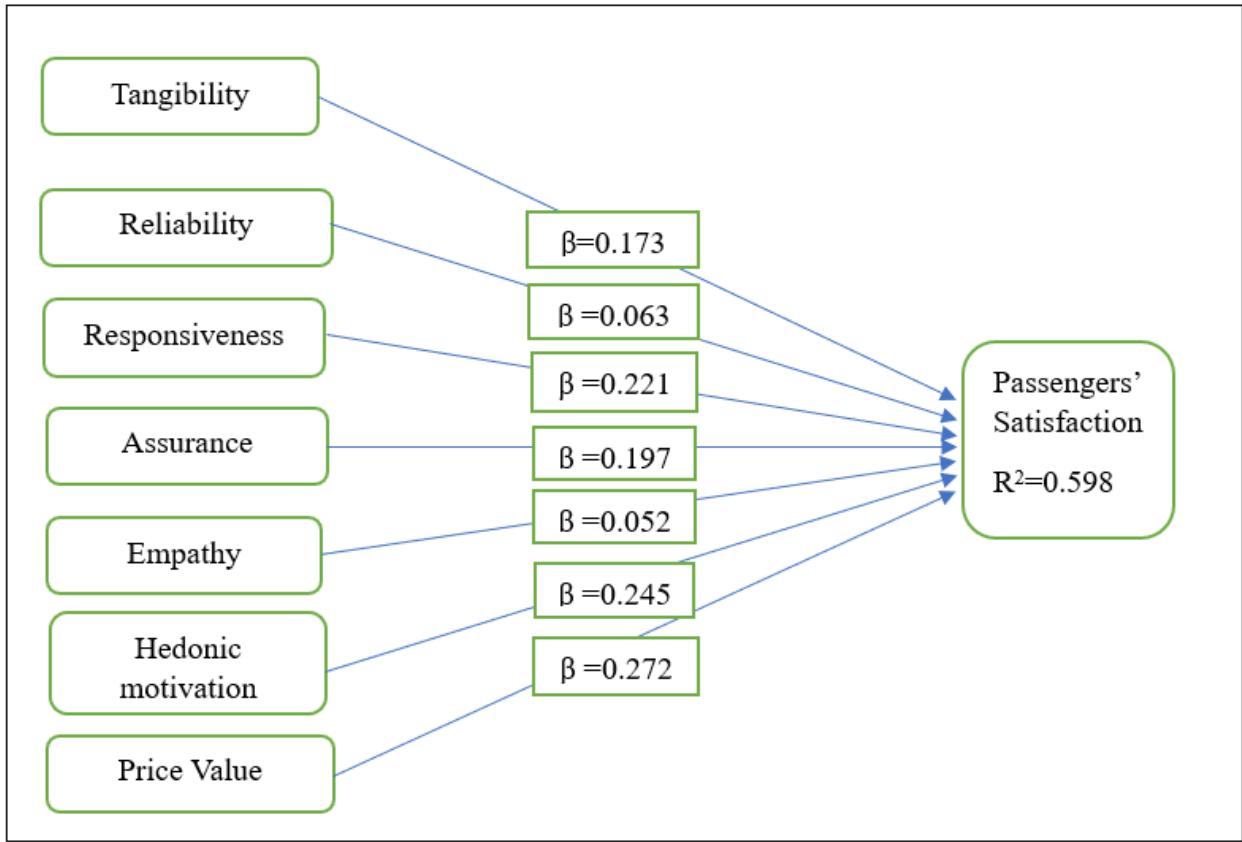 Figure 2: Path Coefficients' Results
Table 05: Findings of the hypotheses test
<table><tr><td>Direct relationships</td><td>Path Coefficients (β)</td><td>Sample Mean</td><td>Standard Deviation</td><td>T Statistics</td><td>P Values</td><td>Comments Supported (✓) Not Supported (✗)</td></tr><tr><td>H1: TAN -> STF</td><td>0.173</td><td>0.198</td><td>0.081</td><td>1.967</td><td>0.003</td><td>✓</td></tr><tr><td>H2: REL -> STF</td><td>0.063</td><td>0.011</td><td>0.073</td><td>0.060</td><td>0.450</td><td>✗</td></tr><tr><td>H3: RES -> STF</td><td>0.221</td><td>0.258</td><td>0.065</td><td>2.124</td><td>0.007</td><td>✓</td></tr><tr><td>H4: ASS -> STF</td><td>0.197</td><td>0.186</td><td>0.085</td><td>2.506</td><td>0.001</td><td>✓</td></tr><tr><td>H5: EMP -> STF</td><td>0.052</td><td>0.013</td><td>0.071</td><td>0.556</td><td>0.354</td><td>✗</td></tr><tr><td>H6: HMV -> STF</td><td>0.245</td><td>0.297</td><td>0.055</td><td>2.274</td><td>0.042</td><td>✓</td></tr><tr><td>H7: PRV -> STF</td><td>0.272</td><td>0.221</td><td>0.076</td><td>2.802</td><td>0.032</td><td>✓</td></tr></table>
## VI. DISCUSSION
The study tends to evaluate the satisfaction of MRT passengers in Bangladesh. Using five dimensions of SERVQUAL and two dimensions of UTAUT2 the study has designed the methodology to explore the satisfaction of MRT passengers. The dimensions are tangibility, reliability, responsiveness, assurance, empathy, hedonic motivation, and price value. Among the dimensions, reliability, and empathy do not significantly affect passengers' MRT satisfaction. All other dimensions positively affect the MRT satisfaction of the passengers.
Responsiveness, hedonic motivation, and price value have the most significant impacts on the satisfaction of MRT passengers. In this study, tangibility positively affects the satisfaction of the passengers which is also supported by Arteaga-Sanchez et al. (2020) in the case of the transit industry. Shah (2021) also found tangibility as a driver to satisfy the passengers' satisfaction in the Indian transit perspective. In other studies, tangibility was identified to have a direct, significant, and positive impact on customer satisfaction (Al-Mhasnah et al., 2018). Therefore, the policymakers of MRT should focus on ensuring the creation and maintenance of tangibility to reap the benefits of MRT through passengers' satisfaction. Reliability in this study is found to have insignificant effects on passengers' satisfaction whereas the other studies found it as the significant one (Aseres & Sira, 2020; Horsu and Yeboah, 2015). The authorized stakeholders should focus on generating a significant level of reliability to ensure a higher level of passenger satisfaction with MRT. According to our study, responsiveness has a considerable favorable effect on passengers' satisfaction. This finding is also supported by earlier studies (Alarifi & Husain, 2023; Arteaga-Sanchez et al., 2020; Al-Shamayleh et al., 2015; Prentice, 2023). The authority should maintain strong responsiveness to ensure the continuous satisfaction of the MRT passengers. Assurance also positively affects passengers' satisfaction in this study and is supported by several other studies (Khan et al., 2023; Bhojak et al., 2023; Kautish et al., 2022). Therefore, the assurance should get considerable attention to make the passengers satisfied enough. Though several prior studies had found empathy as a significant construct in passengers' satisfaction (Al-Mhasnah et al., 2018; Arteaga-Sanchez et al., 2020)) whereas in our studies, it's found to be insignificant in passengers' satisfaction. So, to make it more productive, the authority should milk this construct. Hedonic motivation has got special attention from the passengers of MRT. This construct has also a significant positive impact on their MRT satisfaction. Our findings are also strongly supported by other previous studies (Liu et al., 2021;Tomas, 2022; Zhang et al., 2022). Finally, the price value in this study has the maximum path coefficient values and most significantly impacts passengers' satisfaction with MRT services. The passengers have been getting a good value for their prices. Our results are supported by a number of earlier studies (Korkmaz et al., 2022; Paramita et al., 2018; Soares et al., 2020; Zhang et al., 2022; Zhou et al., 2022). Policymakers should keep their constant eyes on making the prices more reasonable to ensure the durability of the passengers' satisfaction with MRT in Bangladesh.
## VII. THEORETICAL IMPLICATIONS
This study can contribute new knowledge to the MRT sector. It can also input new insights into the literature on the SERVQUAL model dimensions and the dimensions of UTAUT2 in exploring the satisfaction of passengers with MRT services. Hedonic motivation and the price value can be viewed as important characteristics in addition to SERVQUAL model dimensions including tangibility, reliability, responsiveness, assurance, and empathy to measure the satisfaction of customers in a particular field, especially in the MRT sector of Bangladesh. The proposed theoretical model in this study has a significant impact on evaluating passengers' MRT satisfaction. The price value and hedonic motivation constructs have significant positive impacts on passengers' satisfaction. In contrast, the empathy and reliability constructs exert insignificant impacts on passengers' satisfaction.
## VIII. PRACTICAL IMPLICATIONS
The policymakers in the MRT area could get significant insights to design and improve the levels of service and passenger satisfaction. They can improve the level of service dimensions to ensure the satisfaction levels of MRT passengers in a great manner. Responsiveness, hedonic motivation, and price value are found the most significant factors in ensuring passengers' satisfaction with MRT. So, the policymakers can shed light on these areas. In addition to that the empathy and reliability dimensions should get special attention so that the passengers would get them as the significant dimensions in the case of satisfaction with the MRT experience. As the tangibility has a significant impact on passengers' MRT satisfaction the authority must add more features to make the service tangible enough and it should be maintained with care. The assurance should also be important to satisfy the MRT passengers. The MRT sector can take the initiative to excel in service quality by emphasizing all SERVQUAL factors and two factors namely price value and hedonic motivation from UTAUT2. This sector can train its personnel to interact with passengers, keep track of its progress, and examine passengers' reviews to scale a good quality of its service. The authority should maintain better tangibility in its service from various perspectives. The MRT service sector should also create reliability in the service areas. Passengers must embrace responsiveness while traveling through the MRT. This sector must design assurance and empathy as per the expectations of the passengers and maintain for constantly. To ensure a pleasant journey, the sector could focus on building a concrete Hedonic motivation with MRT. Additionally, as price and satisfaction stand together, this sector must provide a significant dive into the price factor.
## IX. CONCLUSION
MRT service in Bangladesh is completely a new addition to the transportation field. Evaluating its service quality and passengers' satisfaction could find out the required areas to improve and offer the best possible services to the passengers. The concerned authority also can utilize the insights from this study in other related mega projects in Bangladesh. Using SERVQUAL and UTAUT2 model's dimensions could generate a deep understanding of user satisfaction levels and ensure proper service from the concerned authority. It's significant to evaluate the satisfaction of MRT passengers in Bangladesh because it's completely a new milestone in the transportation field of Bangladesh and no prior research is conducted in this field.
## X. LIMITATIONS AND FUTURE RESEARCH DIRECTION
This study has met some limitations from different perspectives. The respondents are mostly young and students at different levels. So, the specification in the demographic profile might generate new findings. The non probability convenient sampling technique has been taken into consideration to collect the data where other sampling techniques might make different results. Furthermore, a few MRT stations have not yet been launched. Passenger satisfaction ratings may be the same, lower, or higher than the current figures when all stations are operating at full capacity. In addition to that, a bigger sample size might be a better representative of all passengers traveling through the MRT frequently. Along with the proposed constructs, further research could be conducted considering several other reasonable constructs. Finally, the continuous usage intention of passengers' MRT service might be another study area.
Generating HTML Viewer...
References
153 Cites in Article
A Abdujalilovich,M Ibroximjono'g'li (2023). Methodology for Modeling the Efficiency of the Implementation of Objects to Improve the Transport Network of Tashkent City.
D Ahrholdt,S Gudergan,C Ringle (2017). Enhancing service loyalty: The roles of delight, satisfaction, and service quality.
T Akarsu,R Marvi,P &foroudi (2023). Service failure research in the hospitality and tourism industry: a synopsis of past, present and future dynamics from 2001 to 2020.
Morteza Akbari,Afsaneh Moradi,Nader Seyyedamiri,Miguel Zúñiga,Zahra Rahmani,Hamid Padash (2021). Consumers’ intentions to use ridesharing services in Iran.
Areej Alarifi,Khalid Husain (2023). The influence of Internet banking services quality on e-customers’ satisfaction of Saudi banks: comparison study before and during COVID-19.
Muhammad Ali,Syed Raza (2017). Service quality perception and customer satisfaction in Islamic banks of Pakistan: the modified SERVQUAL model.
Anas Al-Mhasnah,Fauzilah Salleh,Asyraf Afthanorhan,Puspa Ghazali (2018). The relationship between services quality and customer satisfaction among Jordanian healthcare sector.
H Al-Shamayleh,R Aljaafreh,A Aljaafreh,D Albadayneh,M Al-Ali,N Bazin,A Khasawneh (2015). Measuring The Quality Of E-Services And Its Impact On Students Satisfaction At Jordanian Universities.
F Alshihre,E Chinyio,C Nzekwe-Excel,E Daniel (2023). Pursuing alignment of clients' and contractors' perceptions of client satisfaction in Saudi Arabian projects.
Oti Amankwah,Weng Choong,Naana Boakye-Agyeman,Ebenezer Afrane (2023). The intervening influence of the quality of health-care administrative process on the relationship between facilities management service quality and patients’ health-care experience in Ghana.
S Ananda,Raghavendra Kumar,Dharmendra Singh (2023). A mediation analysis of perceived service quality, customer satisfaction and customer engagement in the banking sector.
A Anburuvel,W Perera,R Randeniya (2022). A demand responsive public transport for a spatially scattered population in a developing country.
Rocío Arteaga-Sánchez,Maria Belda-Ruiz,Alejandro Ros-Galvez,Alfonso Rosa-Garcia (2020). Why continue sharing: Determinants of behavior in ridesharing services.
Sintayehu Aseres,Raminder Sira (2020). An exploratory study of ecotourism services quality (ESQ) in Bale Mountains National Park (BMNP), Ethiopia: using an ECOSERV model.
Md. Awal,Tahmina Arzin,Md. Islam,Md. Hasan (2023). Understanding railway passengers’ E-ticketing usage intention in an emerging economic context: application of an extended technology acceptance model.
Muhammad Azeem,Munir Ahmed,Sajid Haider,Muhammad Sajjad (2021). Expanding competitive advantage through organizational culture, knowledge sharing and organizational innovation.
Mahesh Balasubramani,Ashwin Mahalingam,W Scott (2020). Imitation and adaptation: lessons from a case study of a metro rail project in India.
H Barbosa,J García-Fernández,V Pedragosa,G Cepeda-Carrion (2021). The use of fitness centre apps and its relation to customer satisfaction: a UTAUT2 perspective.
G Bauer,S Churchill,M Mahendran,C Walwyn,D Lizotte,A Villa-Rueda (2021). Intersectionality in quantitative research: A systematic review of its emergence and applications of theory and methods.
Alexus Bazen,Frances Barg,Junko Takeshita (2021). Research Techniques Made Simple: An Introduction to Qualitative Research.
Zinette Bergman,Manfred Bergman,Andrew Thatcher (2019). Agency and Bandura’s Model of Triadic Reciprocal Causation: An Exploratory Mobility Study Among Metrorail Commuters in the Western Cape, South Africa.
R Bhagyalakshmi,M Vasudevan (2020). An empirical study on the commuters satisfaction towards service quality dimension with reference to chennai metro rail limited.
Nimesh Bhojak,Chanduji Thakor,Mohammadali Momin (2023). Impact of trust, sales agent and service delivery on health insurance holder satisfaction and experience.
Abhijeet Biswas,Rohit Verma (2023). Augmenting service quality dimensions: mediation of image in the Indian restaurant industry.
B Buran,M Erçek (2022). Public transportation business model evaluation with Spherical and Intuitionistic Fuzzy AHP and sensitivity analysis.
Mark Camilleri,Raffaele Filieri (2023). Customer satisfaction and loyalty with online consumer reviews: Factors affecting revisit intentions.
R Cascajo,E Lopez,F Herrero,A Monzon (2019). User perception of transfers in multimodal urban trips: A qualitative study.
S Chao,M Yu,Y Sun (2023). Ascertaining the effects of service quality on customer loyalty in the context of ocean freight forwarders: An integration of structural equation modeling and network data envelopment analysis.
Rocio Cascajo,Elena Lopez,Fernando Herrero,Andres Monzon (2019). User perception of transfers in multimodal urban trips: A qualitative study.
M Cebeci,R Tapia,M Kroesen,M De Bok,L Tavasszy (2023). The effect of trust on the choice for crowdshipping services.
Erkan Celik,Nezir Aydin,Alev Gumus (2014). A multiattribute customer satisfaction evaluation approach for rail transit network: A real case study for Istanbul, Turkey.
H Chan,Y Xu,A Chen,J Zhou (2023). Choice and equity: A critical analysis of multi-modal public transport services.
Ching-Fu Chen,Chiang Fu,Pei-Ya Siao (2023). Exploring electric moped sharing preferences with integrated choice and latent variable approach.
Xueming Chen (2013). Assessing the Impacts of High Speed Rail Development in China’s Yangtze River Delta Megaregion.
Ekkapong Cheunkamon,Sajjakaj Jomnonkwao,Vatanavongs Ratanavaraha (2023). Measurement model of service quality of tourism supply chains in Thailand.
L Chikazhe,S Siziba,T Bhebhe,O Sifile,B Nyagadza (2023). Fleet management system, perceived service quality and the public health sector performance in Zimbabwe.
W Chin (1998). The partial least squares approach to structural equation modeling.
Wynne Chin (2009). How to Write Up and Report PLS Analyses.
C Chiu,E Wang (2008). Understanding Web-based learning continuance intention: The role of subjective task value.
Prasanta Chopdar,Miltiadis Lytras,Anna Visvizi (2022). Exploring factors influencing bicycle-sharing adoption in India: a UTAUT 2 based mixed-method approach.
M Christian,H Yulita,L Girsang,S Wibowo,E Indriyarti,S (2023). The Impact of Cashless Payment in Application-Based Transportation on Gen Z User Behavior in Jakarta.
Marta Conceição,Mayara Monteiro,Dena Kasraian,Pauline Van Den Berg,Sonja Haustein,Inês Alves,Carlos Azevedo,Bruno Miranda (2023). The effect of transport infrastructure, congestion and reliability on mental wellbeing: a systematic review of empirical studies.
Tie Cui,Katharine Aulton (2023). Conceptualizing the elements of value in public services: insights from practitioners.
L Crafford,R Kusurkar,E Bronkhorst,Ags Gous,A Wouters (2023). Understanding of healthcare professionals towards the roles and competencies of clinical pharmacists in South Africa.
J Dai,R Alvarado,S Ali,Z Ahmed,M Meo (2023). Transport infrastructure, economic and transport CO2 emissions nexus: Does green energy consumption in the transport sector matter?.
A Das,A Setiawan,W Dony (2023). Assessment of how satisfaction with service quality and service value affect passenger’s loyalty to the MRT-SBK service in greater Kuala Lumpur.
S Deb,M Ahmed,D Das (2022). Service quality estimation and improvement plan of bus Service: A perception and expectation based analysis.
Y Ding,Y Hou (2022). Analysis of indoor environment state characteristics of urban rail transit stations based on actual measurements in Chongqing, China.
Yun-Hao Dong,Fang-Le Peng,Teng-Fei Guo (2021). Quantitative assessment method on urban vitality of metro-led underground space based on multi-source data: A case study of Shanghai Inner Ring area.
Arkadiusz Drabicki,Oded Cats,Rafał Kucharski,Achille Fonzone,Andrzej Szarata (2023). Should I stay or should I board? Willingness to wait with real-time crowding information in urban public transport.
Luce Drouet,Carine Lallemand,Vincent Koenig,Francesco Viti,Kerstin Bongard-Blanchy (2023). Uncovering factors influencing railway passenger experiences through love and breakup declarations.
M Duffy (2003). Electric Railways.
Hayana Dullah,Wong Khai,Norlela Ismail,Shuhairy Norhisham,Nur Samsudin,Agusril Syamsir,Ani Mohamad,Muhammad Bakar (2022). Identifying the Mass Rapid Transit (MRT) Customer’s Demographic and Traveling Pattern.
Ankur Mantri,Abdul Razaque,Hiral Makwana,Parita Parekh,Tariq Soomro (2014). Analytical Comparison Of RSA And RSA With Chinese Remainder Theorem.
A El Moussaoui,B Benbba,Z El Andaloussi (2023). Impact of logistics performance on the store image, consumer satisfaction and loyalty: A quantitative case study.
Robert Emerson (2015). Convenience Sampling, Random Sampling, and Snowball Sampling: How Does Sampling Affect the Validity of Research?.
J Hair,M Sarstedt,L Hopkins,V Kuppelwieser (2014). Partial least squares structural equation modeling (PLS-SEM): An emerging tool in business research.
Fantin Irudaya,Raj,E Appadurai,M (2022). Internet of things-based smart transportation system for smart cities.
N Farazi,M Murshed,M Hadiuzzaman (2022). Application of machine learning to investigate heterogeneity in users' perception of intercity train service quality in developing countries.
James Fowler (2023). Private Hustlers and Public Traitors.
Claes Fornell,David Larcker (1981). Structural Equation Models with Unobservable Variables and Measurement Error: Algebra and Statistics.
Anna Forsberg,Andreas Rantala (2020). The Being Taken Seriously Questionnaire—Development and Psychometric Evaluation of a PREM Measure for Person-Centeredness in a High-Tech Hospital Environment.
R Iqbal,M Ullah,G Habib,M Ullah (2022). Evaluating Public and Private Transport of Lahore.
A Jahmani,O Jawabreh,R Abokhoza,A Alrabei (2023). The Impact of Marketing Mix Elements on Tourist's Satisfaction towards Five Stars Hotel Services in Dubai during COVID-19.
Mochammad Jasin,Yunia Sesunan,Muniaty Aisyah,Cut Fatimah,Firman Azra (2023). SMEs repurchase intention and customer satisfaction: Investigating the role of utilitarian value and service quality.
Sunil Jauhar,B Chakma,Sachin Kamble,Amine Belhadi (2023). Digital transformation technologies to analyze product returns in the e-commerce industry.
L Jayanthi,S Pulugurtha,R Mishra (2023). Examining the association between bus transit reliability and the number of boarding Public Transport.
Y Jou,C Saflor,K Mariñas,M Young (2023). Determining Factors Affecting Perceived Customer Satisfaction on Public Utility Bus System in Occidental Mindoro, Philippines: A Case Study on Service Quality Assessment during Major Disruptions.
Z Kalinić,V Marinković,A Djordjevic,F Liébana-Cabanillas (2019). What drives customer satisfaction and word of mouth in mobile commerce services? A UTAUT2-based analytical approach.
Pradeep Kautish,Arpita Khare,Rajesh Sharma (2022). Health insurance policy renewal: an exploration of reputation, performance, and affect to understand customer inertia.
Therese Keane,Tanya Linden,Paul Hernandez-Martinez,Andreea Molnar,Aaron Blicblau (2023). Digital technologies: students’ expectations and experiences during their transition from high school to university.
Konstantinos Kepaptsoglou,Christina Milioti,Dimitra Spyropoulou,Farhan Haider,Aristeidis Karlaftis (2020). Comparing traveler preferences for BRT and LRT systems in developing countries: Evidence from Multan, Pakistan.
M Khan,J Loh,A Hossain,M Talukder (2023). Cynicism as strength: Privacy cynicism, satisfaction and trust among social media users.
Sadia Khan,Muhammad Ali,Chin-Hong Puah,Hanudin Amin,Muhammad Mubarak (2023). Islamic bank customer satisfaction, trust, loyalty and word of mouth: the CREATOR model.
Milorad Kilibarda,Svetlana Nikolicic,Milan Andrejic (2016). Measurement of logistics service quality in freight forwarding companies.
Huseyin Korkmaz,Akif Fidanoglu,Salih Ozcelik,Abdullah Okumus (2022). User Acceptance of Autonomous Public Transport Systems (APTS): Extended UTAUT2 Model.
Y Kuo,J Leung,Y Yan (2021). Simulation-based techno-economic feasibility study on sector coupled net-zero/positive energy metro railway system.
G Kumar,S Cao (2023). Leveraging energy flexibilities for enhancing the costeffectiveness and grid-responsiveness of net-zeroenergy metro railway and station systems.
Wahyuni Kurniawati (2023). THE IMPACT ANALYSIS OF CONSTRUCTION PROJECT OF MRT (MASS RAPID TRANSIT) ON ECONOMIC GROWTH IN JAKARTA USING INPUT-OUTPUT ANALYSIS.
Julie Leoni,Dorota Owen (2023). From Stress to Happiness.
Xue Liao,Siu-Ian (amy) So,Desmond Lam (2016). Residents’ Perceptions of the Role of Leisure Satisfaction and Quality of Life in Overall Tourism Development: Case of a Fast-Growing Tourism Destination – Macao.
Chang Liu,Eleni Bardaka,Evangelos Paschalidis (2023). Sustainable transport choices in public transit access: Travel behavior differences between university students and other young adults.
Q Liu,C Chen,M Cao (2021). Exploring the relationship between the commuting experience and hedonic and eudaimonic well-being.
Z Li,X Zhao,G Ou (2020). Understanding customer satisfaction in curated subscription services: Moderating roles of subscription time and information disclosure.
Shuli Luo,Sylvia He,Susan Grant-Muller,Linqi Song (2023). Influential factors in customer satisfaction of transit services: Using crowdsourced data to capture the heterogeneity across individuals, space and time.
Julian Maas,Benjamin Nitsche,Frank Straube (2023). Systematization of autonomous vehicles in last mile transportation processes – taxonomy development and clustering of existing concepts.
Bandhan Majumdar,Dilum Dissanayake,Avanindra Rajput,Yong Saw,Prasanta Sahu (2020). Prioritizing Metro Service Quality Attributes to Enhance Commuter Experience: TOPSIS Ranking and Importance Satisfaction Analysis Methods.
S Manohar,J Paul,C Strong,A Mittal (2023). INNOSERV: Generalized scale for perceived service innovation.
Marcello Mariani,Matteo Borghi (2023). Artificial intelligence in service industries: customers’ assessment of service production and resilient service operations.
G Mccartney,S Kwok (2023). Closing the gap between hospitality industry and academia research agendas: an exploratory analysis case study.
S Mcleod (2019). Qualitative vs quantitative research: methods & data analysis.
Mihir Mehta,Gopal Kumar,M Ramkumar (2023). Customer expectations in the hotel industry during the COVID-19 pandemic: a global perspective using sentiment analysis.
D Mishra,R Panda (2023). Decoding customer experiences in rail transport service: application of hybrid sentiment analysis.
Tarek Moulahi,Rateb Jabbar,Abdulatif Alabdulatif,Sidra Abbas,Salim El Khediri,Salah Zidi,Muhammad Rizwan (2023). Privacy‐preserving federated learning cyber‐threat detection for intelligent transport systems with blockchain‐based security.
Nazia Nabi (2023). Segmenting travellers of luxury destinations in a post-pandemic era.
Minh Nguyen,Dorina Pojani (2023). Can electric buses entice more public transport use? Empirical evidence from Vietnam.
A Nugroho,W Wang (2023). Credibility of Youtube product reviews and customers' product return intention: a product fit uncertainty perspective.
Nokulunga Nxele,Londeka Ngubane (2021). Crime in Public Transit: Commuter’s Perceptions of Crime in Metrorail trains in the South African Context.
N Octavines,A Suparman,Z Abidin (2023). IMPROVING SHIP PASSENGER SATISFACTION BASED ON TICKET PRICE POLICIES AND CUSTOMER RELATIONSHIP MANAGEMENT THROUGH SERVICE QUALITY.
A Ong,Y Prasetyo,F Lagura,R Ramos,K Sigua,J Villas,J Diaz (2023). Determining tricycle service quality and satisfaction in the Philippine urban areas: A SERVQUAL approach.
I Osman,J Junid,H Ali,S Buyong,S Syed Marzuki,N Othman (2023). Consumption values, image and loyalty of Malaysian travellers towards Muslim-friendly accommodation recognition (MFAR).
Sotirios Panagou,W Neumann,Fabio Fruggiero (2023). A scoping review of human robot interaction research towards Industry 5.0 human-centric workplaces.
R Panggabean,C Yohana (2023). The Influence Of Service Quality And Sales Promotion On Customer Loyalty Through Customer Satisfaction Online Travel Agent In Jakarta.
A Parasuraman,L Berry,V Zeithaml (1991). Refinement and reassessment of the SERVQUAL scale.
A Parasuraman,Valarie Zeithaml,Leonard Berry (1985). A Conceptual Model of Service Quality and Its Implications for Future Research.
A Parasuraman,V Zethaml,L Berry (1988). SERVQUAL: a multiple-item scale for measuring consumer perceptions of service quality.
Puteri Paramita,Zuduo Zheng,Md. Haque,Simon Washington,Paul Hyland (2018). User satisfaction with train fares: A comparative analysis in five Australian cities.
E Park,K Kim (2013). User acceptance of long-term evolution (LTE) services: An application of extended technology acceptance model.
N Parmar,A James (2023). Confronting the deep problem of consumption: Why individual responsibility for mindful consumption matters.
S Pj,K Singh,J Kokkranikal,R Bharadwaj,S Rai,J Antony (2023). Service quality and customer satisfaction in hospitality, leisure, sport and tourism: an assessment of research in Web of Science.
Dorina Pojani,Dominic Stead (2015). Sustainable Urban Transport in the Developing World: Beyond Megacities.
A Prasidi,P Fachrial,M Sabilla,P Maisarah,D Ratnasari,C Pahrudin (2023). The Influence of Service Quality and Station Facilities on Mass Rapid Transit Jakarta Passengers' Satisfaction.
The Impact Of Service Quality,Promotion AND PRICE PERCEPTIONS ON USER SATISFACTION OF SOLO-YOGYAKARTA ELECTRIC RAIL TRAIN.
Catherine Prentice (2023). Leveraging Artificial Intelligence for Customer Satisfaction and Loyalty.
M Pujol-Jover,L Duque,M Riera-Prunera (2023). The recruit requirements of recent graduates: approaching the existing mismatch.
S Putta (2023). The Effect of Service Quality on Consumer Satisfaction in Restaurants.
S Qalati,W Li,N Ahmed,M Mirani,A Khan (2020). Examining the factors affecting SME performance: the mediating role of social media adoption.
K Ravichandran,B Mani,S Kumar,S Prabhakaran (2010). Influence of service quality on customer satisfaction application of servqual model.
Paleru Reddy,Gaibriyal Lal,Y Reddy (2022). Assessment of Genetic Variability, Cause and Effect Inter-relationship among Yield Component Characters in Maize (Zea mays L.).
(2022). Passengers face problems purchasing metro rail tickets due to technical issues.
Eunice Reyes,Gerome Cangco,Shiela Ilagan,Hazel Pacunayen,Jeunise Piamonte,Josephine German (2023). An Application of Queueing Theory on the Ticketing Booth of Light Rail Transit 1 (LRT-1) Central Station.
A Satranarakun,T Kraiwanit (2023). Rules and Regulations for Enhancing Metro Rail Accessibility in a Developing Country.
Bright Senanu,Bedman Narteh (2020). Banking sector reforms and customer switching intentions: evidence from the Ghanaian banking industry.
Tejas Shah (2021). Service quality dimensions of ride-sourcing services in Indian context.
Mohd Shamsudin,Abdul Abu Bakar,Fariza Hashim (2023). Understanding passengers’ satisfaction and loyalty towards ridesharing services.
Hongyun Si,Jiangang Shi,Wenwen Hua,Long Cheng,Jonas De Vos,Wenxiang Li (2023). What influences people to choose ridesharing? An overview of the literature.
Singh,A Kathuria (2023). Heterogeneity in passenger satisfaction of bus rapid transit system among age and gender groups: A PLS-SEM Multigroup analysis.
Harpreet Singh,Ankit Kathuria (2023). Heterogeneity in passenger satisfaction of bus rapid transit system among age and gender groups: A PLS-SEM Multi-group analysis.
J Soares,J Christino,M Gosling,L Vera,É Cardozo (2020). Acceptance and use of e-hailing technology: a study of Uber based on the UTAUT2 model.
A Sukhov,L Olsson,M Friman (2022). Necessary and sufficient conditions for attractive public Transport: Combined use of PLS-SEM and NCA.
F Syed,R Donvito,G Aiello,O Tengilimoglu,O Carsten,Z ; Wadud,Thomson (2022). Global Impacts of Online Reputation Management of Preand Post-Coronavirus Pandemic: Comparative Analysis in Context of Industry 4.0.
Harika Tsabita,Moh. Djamaludin (2023). THE INFLUENCE OF PERCEIVED LOYALTY PROGRAM AND SATISFACTION LEVEL TOWARDS LOYALTY LEVEL OF ONLINE TRANSPORTATION CONSUMERS.
R Tsiotsou (2015). The role of social and parasocial relationships on social networking sites loyalty.
Erin Twyford,Bonnie Dean (2023). Inviting students to talk the talk: developing employability skills in accounting education through industry-led experiences.
N Urbach,F Ahlemann (2010). Structural equation modeling in information systems research using partial least squares.
V,S Asrar-Ul-Haq,M Iqbal,A Ahmed,M (2023). Relationship between brand innovativeness and customer satisfaction: a moderated mediation model from Generation M perspective.
V Venkatesh,J Thong,X Xu (2012). Consumer acceptance and use of information technology: extending the unified theory of acceptance and use of technology.
Jeeva Venkatakrishnan,Ravikumar Alagiriswamy,Satyanarayana Parayitam (2023). Web design and trust as moderators in the relationship between e-service quality, customer satisfaction and customer loyalty.
Novie Wahyudi (2023). The Effect of Timeliness and Convenience on Passenger Railways MRT Satisfaction and Loyalty.
Y Wan,H Gao,U Eddy,M Ng,Y (2023). Expectations and perceptions of the internship program: A case study of tourism retail and marketing students in Macao.
C Wang,S Ahmad,A Ayassrah,E Awwad,M Irshad,Y Ali,. Han,H (2023). Comparing passengers' satisfaction with fixed-route and demand-responsive transport services: Empirical evidence from public light bus services in Hong Kong.
Jianyun Wu,Mingqiu Dong (2023). Research on customer satisfaction of pharmaceutical e-commerce logistics service under service encounter theory.
M Wulandari (2022). Analysis of Acceptance and Use of Online Transportation on Grab and Go-Jek Application for The Public Using The UTAUT2 Model (Case Study: Bandung).
M Würtz,K Sandkuhl (2023). Content and Evaluation of an Enterprise Reference Architecture for Demand-Responsive Public Transport.
Shang-Yao Yan,Jieh-Haur Chen,Andina Utami,Ting-Yo Young,Hsi-Hsien Wei (2023). Scheming preventive maintenance assignments for mass rapid transit (MRT): Taoyuan Metro MRT system.
Barbara Yen,Corinne Mulley,Chia-Jung Yeh (2016). How public shared bike can assist first and last mile accessibility: A case study of the MRT system in Taipei City, Taiwan.
Y Yi,R Nataraajan (2018). Customer satisfaction in Asia.
Jiateng Yin,Xianliang Ren,Ronghui Liu,Tao Tang,Shuai Su (2022). Quantitative analysis for resilience-based urban rail systems: A hybrid knowledge-based and data-driven approach.
Ruchuan Zhang,Aijun Li,Davo Dahoro,Shanshan Chen (2022). Technology inequality, Marginal Rate of Transformation and Rate of Substitution measurement by DEA: The sustainability improvement of passenger cars.
Zhipeng Zhang,Hao Chai,Zhongjie Guo (2023). Quantitative resilience assessment of the network-level metro rail service's responses to the COVID-19 pandemic.
B Zhou,Q Xiong,P Li,J Jin,S Liu,C Ryan (2022). High-speed electric multiple unit trains and tourism in China: service quality impact on passenger satisfaction and loyalty.
Jiangtao Zhu,Ningke Xie,Zeen Cai,Wei Tang,Xiqun Chen (2023). A comprehensive review of shared mobility for sustainable transportation systems.
A Ziyad,Z Rehman,Z Batool,A Khan (2020). INFLUENCE OF SERVICE EXCELLENCE ON CONSUMER SATISFACTION OF RIDESHARING INDUSTRY.
No ethics committee approval was required for this article type.
Data Availability
Not applicable for this article.
How to Cite This Article
Md. Soleman Mollik. 2026. \u201cEvaluating The Satisfaction of Passengers Towards Metro Rail Services- Bangladesh Perspective\u201d. Global Journal of Management and Business Research - E: Marketing GJMBR-E Volume 23 (GJMBR Volume 23 Issue E3): .
Explore published articles in an immersive Augmented Reality environment. Our platform converts research papers into interactive 3D books, allowing readers to view and interact with content using AR and VR compatible devices.
Your published article is automatically converted into a realistic 3D book. Flip through pages and read research papers in a more engaging and interactive format.
Bangladesh has launched the mass rapid transit (MRT) service for the first time in the transportation sector. The MRT has significantly brought access to instantaneous communication in one of the congested cities, Dhaka. Since the service is a brand-new offering in Bangladesh, there is a complete gap in research in this sector. Therefore, the objective of this study is to evaluate the effects of service quality dimensions on passengers’ satisfaction with MRT in Bangladesh. The researchers used a convenient sampling method and collected primary data from 251 respondents who consumed the MRT service frequently. Using the reliable software Smart PLS 3.0, the data were analyzed. The researchers have examined Cronbach’s alpha, composite reliability, and average variance extracted (AVE) to test the reliability and validity of the collected data. This study finds that the constructs namely tangibility, responsiveness, assurance, hedonic motivation, and price value are significant in determining passengers’ satisfaction with MRT. Price value is more significant followed by hedonic motivation and responsiveness. In contrast, statistics reveal that reliability and empathy are insignificant in nature.
Our website is actively being updated, and changes may occur frequently. Please clear your browser cache if needed. For feedback or error reporting, please email [email protected]
Thank you for connecting with us. We will respond to you shortly.