
Evaluation of Bactericidal Performances on Various Knitted Fabric Treated with the Natural Dye Extraction from Tagetes Erecta Leaves

1
Sonjit Kumar Saha
Sonjit Kumar Saha
2
Md. Golam Robbani
Md. Golam Robbani
3
Rozina Aktar
Rozina Aktar
4
Md. Abdul Mukit
Md. Abdul Mukit
5
Mahbuba Sultana Mukta
1 BGMEA University of Fashion & Technology (BUFT)

Send Message

To: Author

GJSFR Volume 23 Issue G1

Article Fingerprint

ReserarchID

XGQWY

Evaluation of Bactericidal Performances on Various Knitted Fabric Treated with the Natural Dye Extraction from Tagetes Erecta Leaves Banner
  • English
  • Afrikaans
  • Albanian
  • Amharic
  • Arabic
  • Armenian
  • Azerbaijani
  • Basque
  • Belarusian
  • Bengali
  • Bosnian
  • Bulgarian
  • Catalan
  • Cebuano
  • Chichewa
  • Chinese (Simplified)
  • Chinese (Traditional)
  • Corsican
  • Croatian
  • Czech
  • Danish
  • Dutch
  • Esperanto
  • Estonian
  • Filipino
  • Finnish
  • French
  • Frisian
  • Galician
  • Georgian
  • German
  • Greek
  • Gujarati
  • Haitian Creole
  • Hausa
  • Hawaiian
  • Hebrew
  • Hindi
  • Hmong
  • Hungarian
  • Icelandic
  • Igbo
  • Indonesian
  • Irish
  • Italian
  • Japanese
  • Javanese
  • Kannada
  • Kazakh
  • Khmer
  • Korean
  • Kurdish (Kurmanji)
  • Kyrgyz
  • Lao
  • Latin
  • Latvian
  • Lithuanian
  • Luxembourgish
  • Macedonian
  • Malagasy
  • Malay
  • Malayalam
  • Maltese
  • Maori
  • Marathi
  • Mongolian
  • Myanmar (Burmese)
  • Nepali
  • Norwegian
  • Pashto
  • Persian
  • Polish
  • Portuguese
  • Punjabi
  • Romanian
  • Russian
  • Samoan
  • Scots Gaelic
  • Serbian
  • Sesotho
  • Shona
  • Sindhi
  • Sinhala
  • Slovak
  • Slovenian
  • Somali
  • Spanish
  • Sundanese
  • Swahili
  • Swedish
  • Tajik
  • Tamil
  • Telugu
  • Thai
  • Turkish
  • Ukrainian
  • Urdu
  • Uzbek
  • Vietnamese
  • Welsh
  • Xhosa
  • Yiddish
  • Yoruba
  • Zulu

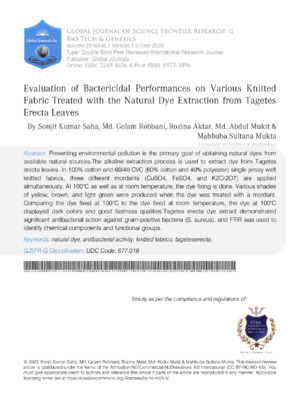
Preventing environmental pollution is the primary goal of obtaining natural dyes from available natural sources.The alkaline extraction process is used to extract dye from Tagetes erecta leaves. In 100% cotton and 60/40 CVC (60% cotton and 40% polyester) single jersey weft knitted fabrics, three different mordants (CuSO4, FeSO4, and K2Cr2O7) are applied simultaneously. At 100°C as well as at room temperature, the dye fixing is done. Various shades of yellow, brown, and light green were produced when the dye was treated with a mordant. Comparing the dye fixed at 100°C to the dye fixed at room temperature, the dye at 100°C displayed dark colors and good fastness qualities.Tagetes erecta dye extract demonstrated significant antibacterial action against gram-positive bacteria (S. aureus), and FTIR was used to identify chemical components and functional groups.

Funding

No external funding was declared for this work.

Conflict of Interest

The authors declare no conflict of interest.

Ethical Approval

No ethics committee approval was required for this article type.

Data Availability

Not applicable for this article.

Sonjit Kumar Saha. 2026. \u201cEvaluation of Bactericidal Performances on Various Knitted Fabric Treated with the Natural Dye Extraction from Tagetes Erecta Leaves\u201d. Global Journal of Science Frontier Research - G: Bio-Tech & Genetics GJSFR-G Volume 23 (GJSFR Volume 23 Issue G1): .

Download Citation

Bacterial performance evaluation on knitted fabrics treated with natural dye extracts for enhanced colorfastness and antibacterial properties.
Journal Specifications

Crossref Journal DOI 10.17406/GJSFR

Print ISSN 0975-5896

e-ISSN 2249-4626

Keywords
Classification
UDC Code: 677.018
Version of record

v1.2

Issue date

September 28, 2023

Language

English

Experiance in AR

The methods for personal identification and authentication are no exception.

Read in 3D

The methods for personal identification and authentication are no exception.

Article Matrices
Total Views: 1220
Total Downloads: 13
2026 Trends
Research Identity (RIN)
Related Research

Published Article

Preventing environmental pollution is the primary goal of obtaining natural dyes from available natural sources.The alkaline extraction process is used to extract dye from Tagetes erecta leaves. In 100% cotton and 60/40 CVC (60% cotton and 40% polyester) single jersey weft knitted fabrics, three different mordants (CuSO4, FeSO4, and K2Cr2O7) are applied simultaneously. At 100°C as well as at room temperature, the dye fixing is done. Various shades of yellow, brown, and light green were produced when the dye was treated with a mordant. Comparing the dye fixed at 100°C to the dye fixed at room temperature, the dye at 100°C displayed dark colors and good fastness qualities.Tagetes erecta dye extract demonstrated significant antibacterial action against gram-positive bacteria (S. aureus), and FTIR was used to identify chemical components and functional groups.

Our website is actively being updated, and changes may occur frequently. Please clear your browser cache if needed. For feedback or error reporting, please email [email protected]
×

This Page is Under Development

We are currently updating this article page for a better experience.

Request Access

Please fill out the form below to request access to this research paper. Your request will be reviewed by the editorial or author team.
X

Quote and Order Details

Contact Person

Invoice Address

Notes or Comments

This is the heading

Lorem ipsum dolor sit amet, consectetur adipiscing elit. Ut elit tellus, luctus nec ullamcorper mattis, pulvinar dapibus leo.


High-quality academic research articles on global topics and journals.

Evaluation of Bactericidal Performances on Various Knitted Fabric Treated with the Natural Dye Extraction from Tagetes Erecta Leaves

Sonjit Kumar Saha
Sonjit Kumar Saha BGMEA University of Fashion & Technology (BUFT)
Md. Golam Robbani
Md. Golam Robbani
Rozina Aktar
Rozina Aktar
Md. Abdul Mukit
Md. Abdul Mukit
Mahbuba Sultana Mukta

Research Journals





























































