
I. INTRODUCTION
The establishment of a scientific theory is derived from its correct theoretical basis. For example, the mechanics theory is derived from Newton's three laws, which have been proved by numerous experiments. Special relativity is derived from the principle of constancy of light velocity as well as the relativity principle. The principle of constancy of light velocity has also been proved by many experiments. However, the equivalence principle for the theoretical basis of general relativity, that is, the gravitation mass is equal to the inertial mass, has not been fully proved by experiments, because so far all equivalence principles have been verified at low velocity, and no experiment has been carried out at high velocity. At high velocity, experiments have shown that the inertial mass of an object increases with the increase of velocity, while no experiments have proved that the gravitational mass of an object also increases with the increase of velocity. Obviously, no experiment has proved that the gravitational mass of an object at high velocity has the same increase effect as the inertial mass, so it cannot be sure that the gravitational mass is completely equal to the inertial mass. It becomes necessary to study whether the gravitational mass of an object increases significantly during high velocity motion, so as to determine whether the equivalence principle is tenable or not.
At present, there is no experimental method to verify whether the gravitational mass of an object increases at high velocity. However, if we can determine that the gravitational mass of an object is unrelated to the motion velocity by using reasonable physical analysis methods, we will be able to deny that the gravitational mass is related to the velocity, which is equivalent to determining the relationship between the gravitational mass and the velocity at high velocity.
As we all know, there are many physical quantities unrelated to the motion velocity, such as the electric charge of an object, the elastic force of a deformed object and gas pressure. We can compare the relationship between gravitational mass and these physical quantities under the same conditions, so as to analyze and determine the relationship between gravitational mass and velocity. In addition, gravitational mass will inevitably generate gravitational field. We can also obtain this relationship by analyzing the basic properties of the gravitational field. In this case, we can finally determine whether or not the equivalence principle is tenable, so that the general relativity can be correctly evaluated.
II. DETERMINING THAT GRAVITATIONAL MASS SHALL ALSO BE UNRELATED TO VELOCITY BASED ON THE FACT THAT ELECTRIC QUANTITY IS NOT RELATED TO VELOCITY
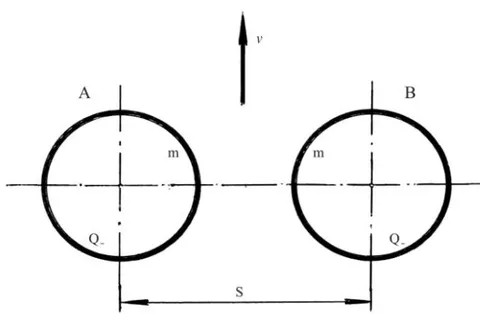
Fig. 1 indicates that the two objects A and B, with the same mass m and the same distance from the center S, have the equal negative charge Q. If the electrostatic repulsion between A and B happens to be equal to the universal gravitation between them due to the electric quantity Q., A and B shall be in equilibrium, and the distance S shall not change.
When the observer moves at velocity V relative to A and B, the inertial mass of A and B shall increase with the increase of V. If the gravitational mass of A and B is equal to their inertial mass, the gravitational mass of A and B shall also increase with the increase of V. With the increase of gravitational mass, the universal gravitation between A and B shall also inevitably increase. However, experiments have proved that the electric quantity Q of A and B is unrelated to the motion velocity of A and B, that is to say, the electrostatic repulsion between A and B shall be constant. The electrostatic repulsion remains unchanged, while the universal gravitation increases. The inevitable result is that the universal gravitation is greater than the electrostatic repulsion and the imbalance between A and B will cause them to collide together. Obviously, this result is impossible since any observer can see that A and B are always in equilibrium. This suggests that the universal gravitation between A and B must be equal to the electrostatic repulsion, but they are in the opposite direction. Both of them are unrelated to the velocity of A and B, that is, the gravitational mass of A and B must be unrelated to their motion. In other words, the gravitational mass of an object is a constant unrelated to the motion velocity of the object.
III. DETERMINING THAT GRAVITATIONAL MASS SHALL BE ALSO UNRELATED TO VELOCITY BASED ON THE FACT THAT ELASTIC FORCE IS NOT RELATED TO VELOCITY
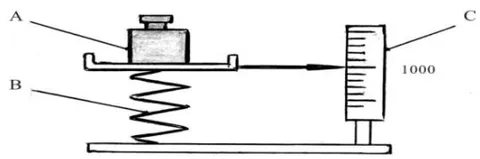
Fig. 2 is a schematic diagram of the spring scale. A represents the 1,000g weight, B represents the spring scale, and C represents the dial of the spring scale. The pointer of the spring scale stops at 1,000g on the dial when the weight in Fig. 2 is placed on the spring scale. This indicates that the pointer of spring scale will stop at 1,000g when the earth's universal gravitation on the weight is in equilibrium with the elastic force generated by the deformed spring. Obviously, the observer moving at any velocity relative to the spring scale will see the pointer stop at the same 1,000g position. Since the deformation of the spring is unrelated to its motion velocity, the only possibility for the spring scale pointer to stop at 1,000g position must be that the earth's universal gravitation on the weight is unrelated to the velocity of the weight, that is, the gravitational mass of the weight is unrelated to its velocity.
IV. DETERMINING THAT GRAVITATIONAL MASS SHALL BE UNRELATED TO MOTION VELOCITY ACCORDING TO THE PROPERTIES OF GRAVITATIONAL FIELD
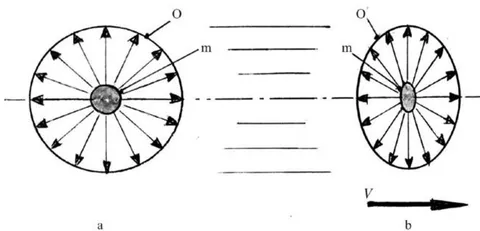
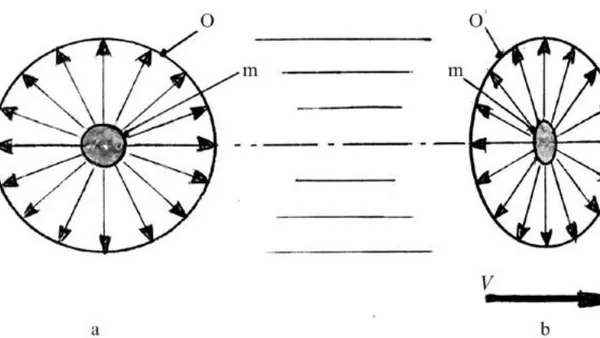
Fig. 3a indicates that the gravitational mass m of an object generates a uniform gravitational field around it. In the figure, lines with arrows are used to represent the gravitational field. The smaller the distance between the lines, the greater the intensity of the gravitational field. O represents a closed surface surrounding m, and the number of gravitational field lines passing through O represents the intensity flux of gravitational field passing through O. Since the distribution of the gravitational field for gravitational mass is completely similar to that of electric field for electrified body, according to Gauss theorem on electric field, we can draw that the intensity flux of the gravitational field passing through arbitrary closed surface is equal to the total gravitational mass surrounded by the surface. The intensity flux for gravitational field of the closed surface O indicated in figure 3a is equal to the gravitational mass m. As shown in figure 3b, when m is moving at a high velocity relative to the observer, according to the special relativity, the length shall shrink in the direction of motion, O shall shrink to , and the distribution of the gravitational line shall also change. However, it can be seen that although the distribution of gravitational field lines in figure 3b has changed, the total number of gravitational lines has not changed. That is to say, the intensity flux of gravitational field passing through is still the same as the flux passing through O, that is, the gravitational mass surrounded by is the same as that surrounded by O. This also indicates that the gravitational mass of an object is unrelated to its motion velocity, and the gravitational mass is the constant unrelated to the motion.
V. EVALUATION ON GENERAL RELATIVITY
a) General relativity is not a scientific theory
The general relativity is derived from the equivalence principle, which assumes that the gravitational mass of an object is equal to the inertial mass. This assumption can be derived from the elevator effect. When the elevator suddenly rises, the people in the elevator feel that his weight has increased. This increase seems to be no different from the increase of the earth's gravitation. That is, inertial force is not essentially different from gravitation. Thus, the famous equivalence principle that the gravitational mass is equal to the inertial mass is generated.
Through further analysis on the force, we know that it is mostly one-sided to determine the inexorable law only by a feeling. Taking two equal forces as an example, if an airtight cabin is placed in deep water, the buoyancy of the water will accelerate the rise of the cabin, and the people in the cabin will inevitably feel that his weight has increased. He can naturally assume that the buoyancy of water is equal to the universal gravitation. Or under the action of strong updraft, the cabin rises with accelerated velocity, and the people inside the cabin will also assume that the updraft is equal to the universal gravitation. Obviously, buoyancy and updraft are completely different from universal gravitation in properties, so buoyancy and updraft shall not be regarded to be the same as universal gravitation. Therefore, it is not scientific to identify the two forces only by feeling without further discriminant analysis on their properties. Through further comparative analysis on universal gravitation and inertial force, we can find that the basic properties of these two forces are essentially different, and there are at least three essential differences.
Inertial force is energy transfer force, and the universal gravitation is unrelated to the energy transfer. This is because if the acting force F, generated by A, makes the object B move by distance S in time t, the energy transferred from A to B shall be FS, while if B moves with the acceleration a under the action of F, the velocity obtained by B in time t shall be V = at, and the energy obtained by B shall be . According to , the energy that A transfers to B shall be , which is equal to the energy obtained by B. Accordingly the formula is generated, and after the elimination of on both sides, we get the inertial force equation F = ma. This shows that the existence of inertial force is inevitably accompanied by the acquisition of energy by the object, that is, the inertial force is an energy transfer force. However, the universal gravitation can act on the stationary object eternally, that is to say, the universal gravitation is not the energy transfer force. Obviously, the energy transfer force and the non-energy transfer force are fundamentally different in properties, that is, the energy transfer inertial force cannot be equal to the non-energy transfer universal gravitation.
The inertial force is the force that pushes the object to move, that is, the inertial force shall always be in motion, while the universal gravitation can always be at rest.
Universal gravitation is a field force. The magnitude and direction of the universal gravitation on any objects shall depend on the position of the object in the gravitational field, while the magnitude and direction of the inertial force on all objects can be unrelated to the position of the object.
The above is illustrated in terms of physical properties, which shows that the universal gravitation is different from the inertial force in nature. This difference also means that the gravitational mass is different from the inertial mass. Further determination to verify this undoubted difference is tested through experiments. Numerous experimental results now have confirmed that the inertial mass of an object will surely increase with the increase of its velocity, and the relation derived from special relativity is (where is rest mass and C is light velocity). Nevertheless, as already stated previously, the fact that the gravitational mass of an object is a constant unrelated to motion has been further proved beyond any doubt, so the inertial mass is definitely not equal to the gravitational mass. That is, the equivalence principle has been undoubtedly proved to be untenable in physics.
In fact, any object has not only the two physical properties of inertial mass and gravitational mass, but also other properties such as the density, specific heat and electrical resistivity. All physical properties have their own characteristics and shall not be considered to be equivalent to each other. Even if the gravitational mass of the object is completely proportional to the density of the object, it cannot be considered that the two are equal by changing the dimension. This is because the density of an object is affected by temperature (generally, the density decreases with the increase of temperature), while the gravitational mass is unrelated to temperature.
The theoretical basis of all physical theories must be objective and realistic. This is the basic principle of physics. For example, the principle of constancy of light velocity, which is the theoretical basis of special relativity, has been proved by many experiments. It is certainly in line with this basic principle of physics. However, as stated previously, the equivalence principle for the theoretical basis of general relativity is untenable, that is, the theoretical basis of general relativity does not conform to the basic principle of physics. Therefore, according to the basic principle of scientific physics, it can be concluded that general relativity is not a scientific theory.
b) For all real objects in the universe, general relativity is approximately tenable In order to analyze the problem simply and calculate the data easily, people often put forward some approximate calculation methods, such as the trigonometric function , where y and x are not linearly correlated, and their values are not proportional. For example, when x is less than , if we assume that y = Ax, the error shall not be greater than 0.5%; if we assume that y = Ax, the error shall not be greater than 0.07%. Therefore, in the actual calculation and analysis, if x is very small, it can be considered that . In reality, there are lots of approximate formulas similar to . Then, can the equivalence principle be approximately tenable under certain conditions? The analysis on the inertial mass expression shows that the approximate formula is tenable when the relative light velocity V is very low. According to the calculation, the error between m and is less than even if V is as high as the fourth cosmic velocity of 120 km/s. While in the real universe, there are no celestial body or object with velocity of V > 120 km/s except particles. Therefore, it can be considered that the relation is tenable for all real objects in the universe. In other words, the inertial mass of all objects in the universe is approximately equal to the rest mass.
That is, the inertial mass is approximately a constant unrelated to the motion. Obviously, under such condition, if the assumption that the inertia mass is the same as the gravitational mass is basically in line with the reality, the equivalence principle will be naturally and basically realistic. Since both equivalence principle and general relativity are tenable, we can obtain the conclusion that general relativity is approximately tenable for all real objects in the universe.
c) General relativity is not tenable when the motion velocity of an object is very high
It can be seen from the formula that as V increase, the difference between m and gets bigger. When V > 0.1C, the numerical error of m and will be greater than one thousandth. When V > 0.5C, the numerical error of m and will be greater than 86%. When V approaches the light velocity, the value of m will be ten times larger than . Therefore, when V is high, will be untenable, m cannot be considered to be the constant , the equivalence principle is not tenable naturally, and the general relativity analysis conclusion shall be incorrect. Therefore, our conclusion is that general relativity is not tenable when V is high. It can be consequently inferred that when V is unrestricted, some analysis results obtained by applying general relativity, such as Black Hole, White Hole, Worm Hole and so on, cannot be true.
VI. BLACK HOLE CANNOT BE A MATERIAL EXISTENCE
Experiments show that when V is quite high, the inertial mass will become significantly larger. According to the equivalence principle of general relativity, the gravitational mass shall also increase significantly. Therefore, when the motion velocity of an object reaches close to the light velocity, the gravitational mass of any object in the form of solid, liquid or gas can increase by several trillions of times, resulting in the formation of the Black Hole. Thus, according to the equivalence principle of general relativity, any object can become a Black Hole and the Black Hole is not fixed in structure. However, the previous 2, 3 and 4 have proved that gravitational mass is a constant unrelated to motion, that is, no matter what motion an object takes, it cannot become the Black Hole.
Let us assume that Black Hole exists and it is a moving object, then what kind of movement does the Black Hole take? Obviously it cannot be linear motion, because the object takes linear motion is the one that never returns, that falls into an infinite abyss, and that may collide with other celestial bodies on the way. Therefore, Black Hole can only take repeated circular motion, which will inevitably generate centrifugal force. However, there is no celestial body in the universe that can balance the huge centrifugal force of Black Hole, and the centrifugal force of the Black Hole shall not exist naturally, so the Black Hole cannot move. That is to say, the velocity of Black Hole must be zero. Thus, even if the equivalence principle is tenable, no one can deduce the existence of Black Hole according to general relativity under the prerequisite V = 0, that is, the existence of Black Hole is theoretically impossible.
The analysis of material structure can also deny the existence of Black Holes. According to Black Hole theory, the mass of a Black Hole sphere with a diameter of 120m is equal to that of four suns, that is, it is equal to the mass of 1.32 million earths, and the volume of the earth is times larger than that of a Black Hole sphere with a diameter of 120m, which means that the density of Black Hole material is more than times that of the earth. According to this proportion, the mass of 6 trillion people is less than that of a Black Hole with the size of a grain of rice.
It is well known that all matter in the universe consists of several of 118 elements. However, according to the density of the above-mentioned Black Hole material, if the Black Hole is also made up of atoms, the size of the Black Hole atom is only of the size of the Earth's material atoms. So it's obviously impossible. According to Black Hole theory, Black Holes are made up of collapsed atoms, and we assume that all the electrons around the collapsed atoms fall onto protons and become neutrons, and that these neutrons are squeezed together and become one big neutron. Calculation shows that such large neutrons are more than one million times larger than the theoretical volume of Black Holes. It is obviously impossible to find the matter with a density of one million times larger than that of the neutron. Moreover, according to atomic physics, there is no possibility that all electrons around any atom will fall on protons, that is, there is no possibility of atomic collapse. And even if the atom did collapse, it would still fall far short of the density of a Black Hole. In this regard, we can conclude that Black Holes cannot be made up of real atoms, that is, Black Holes cannot be a real material existence.
As mentioned above, if the Black Hole exists, its velocity must be V=0. Under the prerequisite of V=0, it is impossible to deduce the existence of the Black Holes based on general relativity. Moreover, Black Holes can never be made of real atoms. For these two reasons, the only conclusion we can draw is that there can be no Black Hole in the universe, and in fact, there is no conclusive evidence to prove that the Black Hole exists. On April 10, eight astronomical observatories in the world jointly released a photograph of the black hole and also explained that the photo displays the black hole of 14 billion solar mass, which attracts surrounding gases and produce special astronomical phenomena. Such an explanation is too one-sided! Does it mean that the black hole can't attract solids but only gases? As indicated by the simple calculation of universal gravitation, this black hole has the same universal gravitation to the earth as the sun at a distance of 2 light-years. Its universal gravitation to the earth at a distance of 10 light-years is also of that of the sun. Such a huge universal gravitation will inevitably make many celestial bodies around collide into the black hole quickly, releasing huge energy and producing strong light. However, to this day, no astronomical observatories have found that the black hole emits light when it is impacted by celestial bodies, which indicates that such a black hole don't exist at all. This photo of the black hole doesn't unveil the real black hole. What it puts before the public is only a special astronomical phenomenon. I believe that black holes that violate atomic physics cannot really exist
The denial of the existence of Black Holes makes time travel impossible. This is because if humans want to travel through time, the velocity of spacecraft must be close to the light velocity, and the spacecraft cannot take linear motion that will not return and that may collide with other celestial bodies. It can only rotate around a gravitationally powerful massive star in a circle, so as to balance the centrifugal force inevitably generated by its circular motion, such as the rotation of the earth around the sun, which achieves a rotation velocity of 29km per second. What kind of stars does the spaceship rotate around? According to current astronomical observations, the largest A1 star is 150 times the mass of the sun and 114 times the diameter of the sun. Calculation shows that the spacecraft can rotate around the surface of A1 star and only 510km/s rotation velocity can be achieved. At this velocity, the spacecraft has a delay of 271 seconds every year, and the lifespan of the passengers in the spacecraft can only be prolonged by less than one in ten thousand, which is not time travel at all. Calculation also shows that the velocity of spacecraft can approach the light velocity only when it rotates around the Black Hole. In this case, the passengers in the spacecraft can possibly travel through time with lifespan prolonged by several times. As we already explained, real Black Holes cannot exist, so it is impossible for humans to travel through time in spacecraft.
VII. SUMMARY
One of the theoretical bases of general relativity is the equivalence principle, which assumes that gravitational mass is equal to inertial mass. However, up to now, there has been no evidence to prove that the gravitational mass of an object increases in the same pattern with the inertial mass when it moves at high velocity. Therefore, it is necessary to determine the relationship between gravitational mass and velocity in order to determine whether the equivalence principle is tenable. According to the fact that the electric charge as well as the elastic force generated by the deformed object is unrelated to the velocity, we analyze and prove in this paper that the gravitational mass of an object is inevitably unrelated to its motion. By analyzing the properties of the gravitational field that is inevitably generated by gravitational mass, we further determine that the gravitational mass of an object is a constant unrelated to its motion. By comparing the gravitational mass with the inertial mass, we point out that the two have three completely different physical properties, especially the property that the gravitational mass is a constant unrelated to the motion, while experiments have proved that the inertial mass of an object is definitely a variable related to the motion velocity. According to these completely different properties, it can be concluded that the gravitational mass of an object cannot be equal to its inertial mass, that is, the equivalence principle cannot be tenable. It is a basic principle of physics that the theoretical basis of physical theories must conform to the reality. The equivalence principle for the theoretical basis of general relativity does not conform to this basic principle, so we can conclude that general relativity is not a scientific physical theory.
for inertial mass, we find that when is very low relative to the light velocity, the approximate expression will be surely tenable. Therefore, we can conclude that when the motion velocity is very low relative to the light velocity, the inertial mass of an object is very approximate to the rest mass. Under such condition, the inertial mass is approximately equal to the gravitational mass and both are constant, then the equivalence principle is basically tenable. Naturally, the general relativity is also basically tenable. Since in the real universe, all objects move at a velocity much lower than the light velocity, the inertial mass is approximately equal to the rest mass, and the equivalence principle is tenable, so general relativity is considered to be applicable to all cosmic celestial bodies. When the velocity of movement is quite high, the equivalence principle will not be tenable, and the analysis conclusion of general relativity becomes inevitably unrealistic. Black Holes are the analysis conclusion of general relativity when the velocity is not limited and the equivalence principle is not tenable, so the existence of Black Holes cannot be true. We put forward through analysis that if a Black Hole exists, its velocity must be V = 0, while when V = 0, it is impossible to obtain the analysis result of Black Hole through general relativity. Such contradictory analysis proves that general relativity analysis is not realistic. According to atomic physics, Black Hole cannot be atomic material, that is, Black Hole cannot be the real material existence. Finally, time travel is discussed. The only way for humans to travel through time is to be in spacecraft rotating around the Black Hole. Since Black Hole does not really exist, it becomes impossible for humans to travel through time.