Neural Networks and Rules-based Systems used to Find Rational and Scientific Correlations between being Here and Now with Afterlife Conditions
Neural Networks and Rules-based Systems used to Find Rational and
Article Fingerprint
ReserarchID
Y97Y4
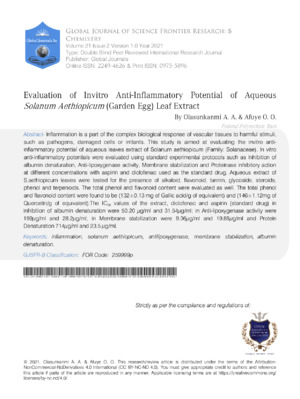
Inflammation is a part of the complex biological response of vascular tissues to harmful stimuli, such as pathogens, damaged cells or irritants. This study is aimed at evaluating the invitro antiinflammatory potential of aqueous leaves extract of Solanum aethiopicum (Family: Solanaceae). In vitro anti-inflammatory potentials were evaluated using standard experimental protocols such as Inhibition of albumin denaturation, Anti-lipoxygenase activity, Membrane stabilization and Proteinase inhibitory action at different concentrations with aspirin and diclofenac used as the standard drug. Aqueous extract of S.aethiopicum leaves were tested for the presence of alkaloid, flavonoid, tannin, glycoside, steroids, phenol and terpenoids. The total phenol and flavonoid content were evaluated as well. The total phenol and flavonoid content were found to be (132±0.13 mg of Gallic acid/g of equivalent) and (146±1.12mg of Quercetin/g of equivalent).The IC 50 values of the extract, diclofenac and aspirin (standard drug) in inhibition of albumin denaturation were 50.20 µg/ml and 31.54µg/ml; in Anti-lipoxygenase activity were 199µg/ml and 28.2µg/ml; in Membrane stabilization were 9.36µg/ml and 19.85µg/ml and Protein Denaturation 714µg/ml and 23.5 µg/ml.
afuye_olukorede_oyewale. 2021. \u201cEvaluation of Invitro Anti-Inflammatory Potential of Aqueous Solanum Aethiopicum (Garden Egg) Leaf Extract\u201d. Global Journal of Science Frontier Research - B: Chemistry GJSFR-B Volume 21 (GJSFR Volume 21 Issue B2): .
Crossref Journal DOI 10.17406/GJSFR
Print ISSN 0975-5896
e-ISSN 2249-4626
The methods for personal identification and authentication are no exception.
Total Score: 102
Country: Unknown
Subject: Global Journal of Science Frontier Research - B: Chemistry
Authors: Afuye Olukorede Oyewale, Olasunkanmi A.A. (PhD/Dr. count: 0)
View Count (all-time): 152
Total Views (Real + Logic): 1950

Total Downloads (simulated): 940

Publish Date: 2021 09, Fri
Monthly Totals (Real + Logic):
Neural Networks and Rules-based Systems used to Find Rational and
A Comparative Study of the Effeect of Promotion on Employee
The Problem Managing Bicycling Mobility in Latin American Cities: Ciclovias
Impact of Capillarity-Induced Rising Damp on the Energy Performance of
Inflammation is a part of the complex biological response of vascular tissues to harmful stimuli, such as pathogens, damaged cells or irritants. This study is aimed at evaluating the invitro antiinflammatory potential of aqueous leaves extract of Solanum aethiopicum (Family: Solanaceae). In vitro anti-inflammatory potentials were evaluated using standard experimental protocols such as Inhibition of albumin denaturation, Anti-lipoxygenase activity, Membrane stabilization and Proteinase inhibitory action at different concentrations with aspirin and diclofenac used as the standard drug. Aqueous extract of S.aethiopicum leaves were tested for the presence of alkaloid, flavonoid, tannin, glycoside, steroids, phenol and terpenoids. The total phenol and flavonoid content were evaluated as well. The total phenol and flavonoid content were found to be (132±0.13 mg of Gallic acid/g of equivalent) and (146±1.12mg of Quercetin/g of equivalent).The IC 50 values of the extract, diclofenac and aspirin (standard drug) in inhibition of albumin denaturation were 50.20 µg/ml and 31.54µg/ml; in Anti-lipoxygenase activity were 199µg/ml and 28.2µg/ml; in Membrane stabilization were 9.36µg/ml and 19.85µg/ml and Protein Denaturation 714µg/ml and 23.5 µg/ml.
We are currently updating this article page for a better experience.
Lorem ipsum dolor sit amet, consectetur adipiscing elit. Ut elit tellus, luctus nec ullamcorper mattis, pulvinar dapibus leo.