
I. INTRODUCTION
Pastoralism is important to many people in Africa as it is a way of life, which is based on raising different livestock including cattle, small ruminants, and camels (Tilahun et al., 2017). Sudan economy is highly dependent on selling the live animals to Egypt as a source of meat by the pastoral nomads "Abbala" or by exporting the raising and sports camels to Saudia Arabia and the gulf countries (Yousof and El Zubeir, 2018). According to FAOSTAT (2021), the estimation of camel population during 2019, the Sudan is rated second highest world size of camel population in the world; after Somalia; with population of more than 5 million heads.
Camel milk has unique benefits for human health because of its remarkable properties in terms of its proteins in addition to its richness in vitamin C, manganese, iron, unsaturated fatty acids, immunoglobulin, insulin-like protein, and the protective enzymes like lactoferrin, and lysozyme (Mohammadabadi, 2020). Camel milk could be one of the future promising industrial products due to its unique properties (El Zubeir, 2015; Abdullahi, 2019; Ali et al., 2019). Despite its merits among the pastoralists, still the camel milk is facing with various problems such as high postharvest quantity losses, and quality deterioration (Oselu et al., 2022). Moreover, camel milk is reported to be contaminated by some spoilage, and pathogenic microorganisms (Shuiep et al., 2007; Shuiep et al., 2009; Benyagoub et al., 2013; Mohamed and El Zubeir, 2014; Elhosseny et al., 20018). This situation necessitates the introduction of some safe method of preservation like pasteurization, however good manufacturing practices has to follow to ensure public health (El Zubeir, 2015). Mohamed and El Zubeir (2014) found that the heat treatment of camel milk was efficient in reducing the microbial loads, and the increase of the shelf life of the product. Nevertheless, raw camels' milk, compared to cows' milk, has more shelf life at room temperature, and if heat treatment is applied, it can stay stable for a longer time (El Zubeir, 2015).
Wernery (2007) demonstrated that many camel milk components were more resistant to heat than cow's milk. Moreover, Wernery et al. (2003) found that pasteurization process for 5 minutes) has no effect on fat, protein, -lactoglobulin, minerals (zinc, iron, calcium, and copper), and vitamins (A, E, B1, B2, B6, D3, C, and pyridoxal) of camel milk. However, significant decrease was reported in the pH, protein, and lactose contents, while the acidity was increased due to the increase in heat treatment for camel milk (Elhasan et al., 2017). Moreover, some countries like India and the United Arab Emirates have started the industrial production of pasteurized camel milk (using for 15 seconds) commercially; the product secured a shelf life of about 15 days in the refrigerator (Yadav et al., 2014). However, the processing of camel milk is rarely adopted in the countries owning the high numbers of camels due to many constraints, including socioeconomic aspects.
The heating of camel milk is not commonly practiced among pastoralist in Sudan because they believe that camel milk is produced ready cooked from the udder (El Zubeir, 2015). Hence awareness programs are needed among the consumers on the health risks that might occur when raw milk is consumed (Warsma and El Zubeir, 2015). Therefore, it is aimed in this study to investigate the effect of pasteurization and sterilization treatments on camel milk properties, and to get safe products from camels with longer shelf life.
II. MATERIALS AND METHODS
a) Source of camel milk
Two batches of fresh camel milk (thirty liters, each) were collected from a local camel herd that browsed the natural pasture of Green Valley at the Eastern Nile of Khartoum State, Sudan in August 2018. The milk samples were kept cool in an icebox, during their transportation for processing.
b) Processing of pasteurized and sterilized camel milk
In this study, the camel milk was made into pasteurized and sterilized products. The two experiments were conducted spartantly in the Products Promotion Unit of DAL Food's Company (CAPO) at Khartoum North, Sudan.
Both pasteurization and sterilization processes of camel milk were conducted using the USPTO UHT+ S1 pilot plant (Germany). Camel milk was first preheated at under homogenization pressure (160 Bar) before applying of the pasteurization and sterilization process. The temperature used for pasteurization was fixed at for 15 seconds, and that used for the sterilization was for 4 seconds. The data for evaluation of the milk after application of the heat treatments was obtained immediately after pasteurization and sterilization and during the storage (on the , , , and days) for the pasteurization, and sterilization process. Each batch of heat-treated camel milk products was examined four times for the chemical compositional content.
c) Chemical analysis of the pasteurized and sterilized camel milk
In the present study, the chemical analysis of camel milk samples was determined using the milk analyzer Milkoscan FT2, FOSS Analytical A/S.69 according to the manufacture instructions (Slangerug-gade, and DK3400 Hillerod, Denmark). The chemical composition of camel milk that were examined include the total solids (TS), solids not fat (SNF), fat, free fatty acid (FFA), lactose, protein, casein, urea, citric acid (CA), density, acidity, and freezing point depression (FPD). Meanwhile the pH meter was used for the determination of the pH. The measurements for the chemical analysis of camel milk included raw milk, immediately after heat treatments and on the , , ,
, and days while storing of the pasteurized and sterilized products.
d) Microbial loads of processed camel milk
The total bacterial counts in fresh, pasteurized, and sterilized camel milk were determined using the plate count agar medium according to the method described by Houghtby et al. (1992). Meanwhile, the coliform bacterial count was estimated in the same samples using violet red bile salt agar medium (Christen et al., 1992).
e) Sensory evaluation of processed camel milk
The obtained pasteurized and sterilized camel milk products were subjected to the assessment by 20 semi-trained panelists that belong to DAL Food's Company (CAPO). They evaluated the following sensory attributes for the 2 products: appearance, aroma, immediate taste, flavor, taste, after taste, and acceptance of the overall product. Each attribute was evaluated by the semi trained panelist according to the differences among the preference scales (Like very much, like moderately, like slightly, neither like nor a dislike, dislike slightly, dislike rather and dislike very much) for respect to the scores given. Furthermore, the differences in the judgment between the pasteurized and the sterilized products of camel milk were calculated.
f) Statistical analysis of the data
The analysis of variance (ANOVA) by IBM SPSS statistics (version 22) was conducted in the present study using Complete Randomized Design with four replicates. The means were compared and separated using Duncan's Multiple Range Test. Moreover, the Student t-test was used for sensory evaluation data.
III. RESULTS AND DISCUSSION
a) Physio-chemical properties of pasteurized camel milk
The average mean values for the pasteurized camel milk samples revealed for fat, TS, SNF, FAA, lactose, protein, casein, urea, citric acid, density, acidity, and FPD (Table 1). The obtained values were approaching those reported for the means of total solids (10.80-11.19%), SNF (7.31-7.54%), fat (3.62-3.86%), lactose (3.58-3.72%), protein (2.37-2.45%), casein (1.469-1.557%) and density (1.024-1.025 gm/cm3) of camel milk samples subjected to the heat treatment of pasteurization process (Hessain et al., 2013). Also, the obtained values for the unsaturated fatty acids (Table 1) supported Al-Shamsi et al. (2018) who stated that camel milk has a higher amount of unsaturated fatty acids compared to bovine milk. Moreover, Dowelmadina et al. (2018) reported that the fatty acids composition of camels' milk from Arabi ecotypes in Sudan confirmed the nutritional and health interest of camel's milk. They added that the fatty acids composition and types of camel milk seems to be very different from that of other mammalian milk consumed by humans due to their lower content of long-chain fatty acids. Also, higher values were reported for urea concentration in camel milk (Table 1, 2, 3) compared to the values mentioned for camel milk in Kazakhstan, which gave a mean value of and a range of (Faye et al., 2010).
The data in Table 2 showed non-significant variations in the values of the TS, SNF, lactose, fat, FFA, protein, casein, urea, citric acid, density, and acidity of pasteurized camel milk during the storage periods. Similarly, heating camel milk at either for 30 minutes, for 15 seconds, or for 15 seconds showed no effect on the levels of SNF, lactose, fat, and density of camel milk (Hessain et al., 2013). Hence using heat treatment to improve camel milk quality, and to extend its shelf life is recommended (Hessain et al., 2013). Moreover, the indirect boiling of camel milk did not affect its Physio-chemical properties, while the direct boiling was found to cause an increase in the total solids, lactose, ash, density, and casein contents. In contrast, it decreased the whey protein of milk from camel (Mohammed and El Zubeir, 2016). Also, with an increasing heat treatment applied for camel milk, no effect was found in SNF, fat, and density. In contrast, a significant decrease was found for protein, lactose, and the pH, and a significant increase was reported for the level of the acidity (Elhasan et al., 2017). However, higher significant variations were found in the protein and total solids of camel milk during heat treatment at both minutes and minutes, while the fat content was not affected (Hattem et al., 2011). Moreover, Elhasan et al. (2017) reported variable results for the physico-chemical content of milk samples obtained from cows, goats, sheep, and camels according to the differences in heat treatments to which the milk was subjected. The present results supported the conclusion that it is possible to produce pasteurized camel milk (Ipsen, 2017).
The obtained pH values of fresh and the pasteurized camel milk samples were significantly different (Table 1). Similarly, Mohamed and El Zubeir (2014) found a gradual increase of lactic acid in the raw and heat-treated milk samples from camel during their storage. The present finding was also in line with those which indicated that the pH of fresh camel milk was in a range of 6.4 and 6.7 (Singh et al., 2017) or 6.2 to 6.5 (Abdullahi, 2019). Also, Elhasan et al. (2017) found that the mean value of the pH of camel milk samples subjected to heat treatment was 6.6.
The freezing point depression was and for the fresh and pasteurized camel milk samples, respectively (Table 1). The freezing point depression of camel milk revealed values between 570 and 610 or -0.57 and -0.61C (Ipsen, 2017). Moreover, the freezing point depression was found to show a significant reduction immediately after the pasteurization process. At the same time, it revealed non-significant variation at the end of the storage period (Table 2).
b) Physio-chemical properties of sterilized camel milk
The values obtained for the sterilized camel milk revealed for fat, TS, SNF, FAA, lactose, protein, casein, urea, citric acid, acidity, , density and FPD (Table 1). More or less similar values for TS, fat, SNF, lactose, protein, acidity, pH and density were reported previously for the fresh raw camel milk (Shuiep et al., 2008; Babiker and El Zubeir, 2014 and Mohamed Elhassan et al., 2015).
The results indicated non-significant variations between the values of TS, SNF, lactose, fat, protein, casein, urea, citric acid, density, and the pH of the sterilized camel milk during the storage periods (Table 3). Meanwhile, the obtained values of FAA and the acidity of camel milk (Table 1) were significantly different between the sterilized and the fresh raw products. However, Elhasan et al. (2017) found variations in the physico-chemical characteristics of camel milk after sterilization at . Also, Hattem et al. (2011) stated that usually the milk processors face challenges when applying UHT treatment of camel milk due to the heat resistance of its casein, whey proteins, vitamins and fat globules, in addition to some other compounds. Similarly, He et al. (2020) reported that the ultra-high-temperature treatment of camel milk was found to reduce the levels of its proteins and lactose significantly. Pasteurization of the camel milk in its final package was tried previously using direct and indirect UHT treatment (150 °C/2 seconds and 138 °C/4 seconds, respectively) at the pilot scale (Farah et al., 2007). Short shelf live was obtained for the UHT from camel milk (Table 3). This might be because of the difficulty of obtaining UHT from camel milk.
Table 3 illustrated that sterilized camel milk has short shelf life, which indicated the difficulty of securing UHT from camel milk. The reason might be because in this study, the UHT product was packed into the bottles that were usually used for the pasteurized milk. Hence we recommend that Tetra back containers should be used in the future studies on sterilized camel milk. Also, the sedimentation of protein and short shelf life (5 weeks only) under refrigeration conditions suggested that mild UHT treatment of camel milk is not suitable (Ipsen, 2017). The origin of these deposits is the camel milk proteins, which is due to the low quantities of free thiol groups in comparison to that from bovine milk
(Konuspayeva and Faye, 2021). Thus more research is needed to solve the problem of instability before introducing the UHT and sterilization treatments at the industrial level (Ipsen, 2017). This especially because of the benefit from the camel milk product that will be gained by many of the milk producers and retailers due to the extended storage period at the shelf without refrigeration (Oselu et al., 2022).
c) The bacterial count of pasteurized and sterilized camel milk
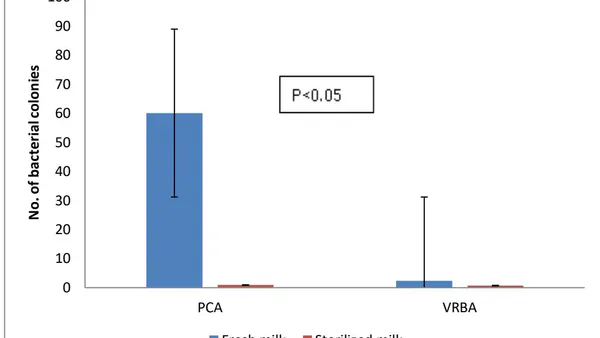
The data in Figures 1a and 1b showed a significantly higher total bacterial count in raw fresh camel milk than in pasteurized CFU vs. CFU) and sterilized CFU vs. CFU) camel milk. However non-significant variations for the total bacterial counts of the pasteurized and sterilized camel milk were found (Figure 1). Also, El Zubeir (2015) reported that the microbial loads in camel milk were reduced when applying different heat treatments. Suliman et al. (2013) mentioned that the purpose of heat treatment of milk include the destruction of microorganism and prolonging its shelf life. Moreover Tay and Chua (2015) reported on the introduction of a pilot pasteurization plant for the raw camel milk; it was based on indirect heating using HTST continuous process for 15 seconds) to kill the most harmful microorganisms present in the milk. The slightly reported difference in the microbial loads could be attributed to the different temperature degrees used for pasteurization for 15 seconds) and sterilization for 4 seconds) of camel milk used during the present study. The high temperature/short time treatment had similar effects to UHT treatment on microbial diversity of camel milk; however, the low temperature/long time treatment had a different impact (He et al., 2020). Also, Yehia et al., 2019) reported that the use of ultra-high temperatures (UHTs) for reducing or killing the bacteria in camel milk is preferable especially where this problem is encountered in camel milk factories.
Significant differences in the bacterial coliform count between the raw and the pasteurized vs. CFU) and between natural and sterilized vs. CFU) camel milk was found (Figure 1).
The relatively low coliform count obtained during the present study (Figure 1) for unheated milk supported the previous data, which showed an acceptable bacteriological quality for camel milk (Warsma and El Zubeir, 2015). However, the high loads obtained for both the total bacteria and the coliform in raw camel milk reported previously (Mohamed and El Zubeir, 2014 and Elhosseny et al., 2018) necessitate the application of pasteurization before the consumption of camel milk. The total bacteria and coliform counts showed highly significant differences for the raw camel and that were subjected to heat treatment during the storage (Mohamed and El Zubeir, 2014). HTST is an essential milk processing technique that used commonly to destroy the pathogenic microbes in milk products to ensure the production and sale of safe products to the public (Tay and Chua, 2015). Moreover, Warsma and El Zubeir (2015) recommend that heat treatment for camel milk should be encouraged, and that collection centers and, or mobile dairy processing units should be established in the production areas to produce safe, clean camel milk.
Mohamed and El Zubeir (2014) reported that the reasons for the high burden of raw camel milk; when a high microbial load was found; were lack of good practices and sanitation in its treatment, collection, transportation, and storage. Similarly Konuspayeva and Faye (2021) stated that the traditional methods used for camel milk handling and transportation decrease the possibility of marketing the milk to other localities due to the contamination. In a previous study, Mohamed and El Zubeir (2014) found high thermoduric bacterial count in the heat-treated samples of camel milk. The variation might be because in the present study, appropriate pasteurization and sterilization processes were conducted via the use of USPTO UHT+ S1 pilot plant that enables proper heat treatment. The high bacterial counts are expected in milk in Sudan due to the high environmental temperature and lack of cooling (Warsma and El Zubeir, 2015). El Zubeir (2015) reported that the contamination of raw camel milk might be due to the poor hygiene, and environmental contamination, and the milking procedures. she added that the high coliform count could arise from fecal contamination, low level of sanitation, and, or udder infection with mastitis. However, the most dangerous or alarming situation is if people consume pasteurized camel milk contaminated with pathogenic bacteria. Therefore, camel milk should be subjected to high temperatures during its heat treatments in order to kill all kinds of pathogens and other contaminating bacteria associated with raw milk (Yehia et al., 2020).
d) Comparison of shelf life of pasteurized and sterilized camel milk
During this study (Tables 2 and 3), both the pasteurized and sterilized camel milk products revealed longer shelf life compared to the original raw milk from which the products were made. Pasteurized camel milk has been successfully undertaken and applied industrially for mass production. Still, ultrahigh temperature (UHT) and sterilization of camel milk resulted in protein instability (Yirda et al., 2020). In a previous reports, Wernery, 2007) and Mohamed and El Zubeir, 2014) found that heating of camel milk resulted in longer shelf life products than the raw original milk. The reason might be because the heat treatment of milk is well known as an efficient method for killing the pathogenic and the thermoduric microorganisms. However, Mohamed and El Zubeir (2014) found higher keeping quality (20 days) compared to that found by Wernery (2007) who reported that pasteurized camel milk kept at four had a shelf life of 10 days. In this study, the sterilized camel milk showed shorter shelf life in comparison with cow's milk. Ipsen (2017) showed increased viscosity and reduced sedimentation in UHT treated camel milk, and he attributed this to the presence of plasmin during the production of that UHT product. Mohamed and El Zubeir (2014) conducted a study on the heat-treated camel milk, and found that the stability of the total acidity can reach 46 days when storing milk at four . After pasteurization, the camel milk can be ready for either consumption or refrigeration storage for further 21 days (Konuspayeva and Faye, 2021). They added that with the introduction of such a pasteurization pilot plant, it is hoped that the level of hygiene and the livelihood of the farmers will be improved as there is a possibility of storing and transporting camel milk safely to satisfy the demands of the consumers.
e) Comparison of sensory evaluation between pasteurized and sterilized camel milk
Non-significant differences were reported for the scores given to the pasteurized and sterilized camel milk for all the studied attributes (appearance, aroma, immediate taste, flavor, taste, after taste, and the overall acceptability) as shown in Figure 2. However, the sterilized camel milk revealed higher scores for all attributes than the pasteurized camel milk (Figure 2).
As shown in Table 4, the panelists recorded non-significant differences for the scores of the preference scales (like very much, like moderately, like slightly, neither like nor dislike, dislike slightly, dislike moderately, and dislike very much) evaluated in each parameter (appearance, aroma, immediate taste, flavor, taste, after taste and acceptance of the overall product) for pasteurized camel milk. However, the scores reported by the panelists revealed significant differences for the preference scales (like very much, like rather, like slightly, neither like nor a dislike, dislike slightly, dislike rather, and dislike very much) evaluated for the aroma and flavor of sterilized camel milk (Table 4). Farah et al. (2007) reported that camel milk pasteurization can be achieved at an industrial scale as some dairy plants have good experience in producing such products. Moreover, they added that pasteurized camel milk, with a shelf-life of about a week, can be provided directly to consumers. Furthermore, due to the camel milk's distinct properties, its consumption is going to increase as currently, some industries are promoting the production and processing of camel milk (Ali et al., 2019).
Results in Figure 2 and Table 4, as was recorded by the panelists, it indicated slightly significant variations in the scores for aroma and flavor for sterilized milk. However, the scores given by the panelist during the evaluation of the pasteurized and sterilized camel milk products showed non-significant differences in the sensory-evaluated parameters. Moreover, Lund et al. (2020) found lower scores for taste, texture, and overall acceptability for camel milk heat-treated samples compared to the control one. Furthermore, in this study, most of the panelists accepted both the pasteurized and sterilized camel milk products (Table 4 and Figure 2). They recorded non-significant differences for the sensory scores between the two products. Lund et al. (2020) reported that the highest sensory scores for taste and texture for the camel milk subjected to heat treatment were at minutes, while the highest keeping quality and the best shelf life of camel milk were obtained at minutes.
The salty taste noticed by the panelist (Figure 2 and Table 4) for camel milk is because of the high chloride proportion compared to phosphorous, copper, and iron, as camel feeding is mainly on the dried plants in addition to the shortage of water that available to other dairy ruminants (Khaskheli et al., 2005). Generally, the milk from the camel is white, and its taste is acceptable (El Zubeir and Jabreel, 2008). The global increase in consumption of camel milk is due to its salty taste and medicinal properties (Ali et al., 2019).
IV. CONCLUSIONS
This study concluded that pasteurized and sterilized camel milk are rich in their chemical components, which are not different from that of raw milk. In addition, both the pasteurized and sterilized camel milks are safe due to their low bacterial counts and revealed longer shelf life in comparison to the original fresh (unheated) milk. Moreover, the acceptability of these products will increase the chance of improving the lifestyles of the camel herders' societies and provides profitable products for the industry in the future.
ACKNOWLEDGEMENTS
The partial financial support that was received from the Ministry of Higher Education and Scientific Research, Sudan is acknowledged with thanks. The technical assistant provided by the staff of DAL Food's Company (CAPO) during processing and analysis of the camel milk is gratefully acknowledged. The help provided by Dr. Omar A. A. Sidahmed during the statistical analysis of the data is also appreciated with thanks.