
I. INTRODUCTION
To tackle the heavy burden of tuberculosis (TB) and improve the quality of treatment, Government of India, in 1993, revitalized its National TB Programme (NTP) as Revised National TB Control Programme (RNTCP). In 1997, Directly Observed Treatment, Short-course (DOTS) was officially adopted as the strategy of RNTCP. By the end of 2005, the whole of India was covered under this programme (i.e., RNTCP). During the second phase of RNTCP i.e., RNTCP-II, which was started in 2006, there was an improvement in the quality and reach of service.
Since 2003, the medical colleges have been involved in the RNTCP programme. Here, the treatment categories are assigned to the patients, after diagnosis.
Next, they are referred to DOTS centres situated within short distances from their residences. There, the actual treatment is done. This is the system of 'referral for treatment'.
The objective of this paper is to judge how the technique of 'referral for treatment' worked under RNTCP-II.
To achieve this objective, this study was conducted between 01.09.2007 and 31.08.2008, on the TB patients referred from RG Kar Medical College to various DOTS centres in West Bengal (India).
Before undertaking the study, a brief literature survey was performed, but no work dealing with the appraisal of the system of 'referral for treatment' in West Bengal, was found.
II. METHODOLOGY
In this work, the details regarding the 758 patients (the study population), referred from this college between 01.10.2006 and 30.09.2007, were recorded. The referrals had been classified into two categories viz., inside district (i.e., DOTS centres inside the Kolkata (metropolis) district), and outside district (i.e., DOTS centres outside Kolkata). The data regarding the fate of patients, after their referrals, were also collected. To understand whether there is a significant association between the area of referral and the registration status (at the DOTS centre), between the area of referral and the disease status, between the area of referral and the conversion status of new sputum positive cases, and between the type of patient and the outcome of the treatment after referral, the chi-square tests were done at level of significance, in all the cases. The formula for chi-square is given by equation (1):
where,
each observed value in any one of tables- 2 to 5, each expected value in the same table (row total X column total/grand total) corresponding to each value in that table,
If , then it can be concluded that the relevant association is significant; otherwise, it (i.e., the pertinent association) is not significant.
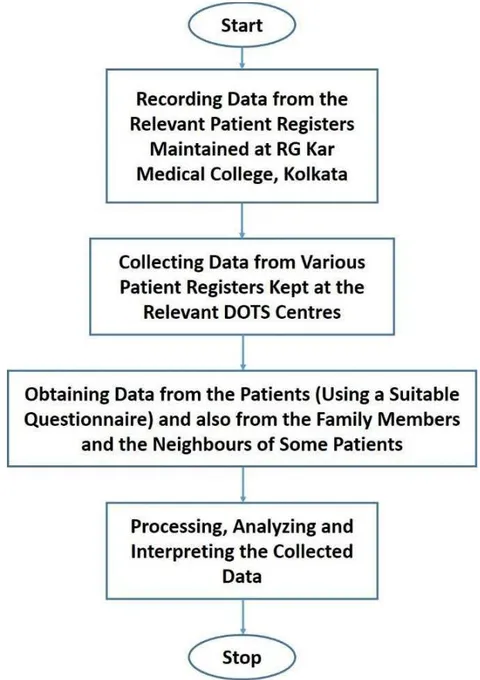
The outline of the method, used in this study, is depicted in figure-1.
III. RESULTS AND DISCUSSIONS
Table-1 gives a preliminary idea about the study population (i.e., the referred patients) on the basis of age and gender.
Table-1: Distribution of the study population according to age and gender
| Age (years) | Referrals inside district | Referrals outside district | Total | ||
| Male | Female | Male | Female | ||
| 15-44 | 73 | 100 | 184 | 135 | 492 |
| Other | 48 | 36 | 126 | 56 | 266 |
| Total | 121 | 136 | 310 | 191 | 758 |
It may be noted here that 15-44 years pertains to the productive age group; hence, it has been highlighted in table-1. It is really a matter of concern that the total number of referrals was much higher for this age group, than for the other groups (as per table-1). Also, table-1 shows that the number of females, referred to DOTS centres inside the district, was more than that of the males, whereas higher number of males, as compared to females, were referred to DOTS centres outside the district.
Table-2 shows how many of the referred patients actually registered in the DOTS centres after referral.
Table-2: Distribution of the study population according to the registration status
| Registration status | Area of referral | Total | |
| Inside district | Outside district | ||
| Registered | 224 | 439 | 663 |
| Not registered | 33 | 62 | 95 |
| Total | 257 | 501 | 758 |
It can be seen from table-2 that a considerable number of patients (95 among 758 i.e., nearly ) did not register in the DOTS centre for treatment after referral; this is a cause of worry. Also, it may be noted that the number of non-registered patients at DOTS centres located outside district (i.e., outside the metropolis of Kolkata) is nearly double that for DOTS centres located inside district (i.e., within Kolkata). However, the chi-square test shows that the association between the area of referral and the registration status is not significant at level ( -value ;
degree of freedom ). Thus, though there is no significant urban-rural divide in case of registration at the DOTS centres, the relevant authorities should urgently devise ways to urge all the referred patients to register at the DOTS centres; otherwise the problem of TB cannot be handled efficiently.
Table-3 displays how many of the referred patients were newly infected with TB, and how many were infected with TB before, but had come for treatment again, as the previous treatment was unsuccessful.
Table-3: Distribution of the study population according to disease status
| Area of referral | Disease status | Total | |
| New case | Retreatment case | ||
| Inside district | 204 | 53 | 257 |
| Outside district | 435 | 66 | 501 |
| Total | 639 | 119 | 758 |
It is clear from table-3 that quite a large number of patients (119 among 758 i.e., nearly ) had come for retreatment due to inadequacy of previous treatment method. This is really a cause of concern. Also, this fact indicates the shortcomings of the 'referral for treatment' system going on since 2003. Further, the chi-square test shows that the association between the area of referral and the disease status is significant at level ( -value ; degree of freedom ). It shows that there is a significant urban-rural divide with respect to the adequacy/success of previous TB treatment technique. The pertinent authorities should see that new TB patients get adequate treatment so that, in future, there will be no need for retreating previously treated TB patients. Also, they should ascertain that there is no urban-rural divide with regard to adequacy of TB treatment.
Table-4 depicts how many of the new sputum positive TB patients (who registered in the DOTS centres after referral) were converted into sputum negative patients after 2-3 months of treatment.
Table-4: Distribution of the new sputum positive registered patients according to conversion status
| Area of referral | Conversion status | |||
| Conversion of new sputum +ve cases after 2-3 months (A) | No conversion of new sputum +ve cases after 2-3 months | Total new sputum +ve cases (B) | Conversion rate (%) [AX100/B] | |
| Inside district | 60 | 34 | 94 | 64 |
| Outside district | 78 | 28 | 106 | 74 |
| Total | 138 | 62 | 200 | 69 |
It is evident from table-4 that the number of sputum positive patients who were not converted into sputum negative ones in 2-3 months, is substantial (62 among 200 i.e., ). The reason for this should be investigated. However, the chi-square test shows that the association between the area of referral and the conversion status is not significant at level (p-value ; degree of freedom ). Thus, there is no significant urban-rural divide in case of conversion of sputum positive patients; rather the conversion rate is better for patients attending DOTS centres outside Kolkata, than for the ones attached to DOTS centres within Kolkata. Anyway, competent authorities should find out ways to ensure or near conversion rate after 2-3 months of treatment, instead of , as shown in table-4.
Table-5 presents how many of the patients who registered at the DOTS centres, got positive/favourable result after treatment. In this table, (i.e., table-5), "favourable outcome" implies any one of the following:
- the patient was cured, and
- the patient's treatment was completed, but it was not ascertained whether the patient was ultimately cured or not (i.e., -ve sputum was found at the end of initial phase of treatment, but sputum was not tested at the end of the final phase),
and "unfavourable outcome" indicates any one of the following:
- the patient died during treatment, irrespective of the cause,
- the patient defaulted (i.e., at any time after registration, the patient did not continue the treatment for 2 months or more consecutively),
- the patient was transferred to another area, and
- the patient's treatment failed (i.e., +ve sputum was found after months of treatment), but the patient was not dead (when the data were collected).
Table-5: Distribution of registered patients according to outcome of treatment
| Type of patient | Outcome of treatment | Total | |
| Favourable outcome | Unfavourable outcome | ||
| Seriously ill (categories-I and II) | 416 | 76 | 492 |
| Not seriously ill (category-III) | 167 | 3 | 170 |
| Total | 583 | 79 | 662 |
Table-5 indicates that the number of patients for whom the outcome of the treatment was unfavourable (unfavourable outcome includes death, as already indicated), is considerable (79 among 662 i.e., nearly ). This matter needs urgent attention of the pertinent authorities. Moreover, the chi-square test shows that the association between the type of patient (seriously ill/not seriously ill) and the outcome of treatment is significant at level ( -value ; degree of freedom ). This is also a cause of worry.
It may be mentioned here that in table-5, patients with category-I treatment regimen are the new sputum positive pulmonary TB cases, the new sputum negative pulmonary TB cases, who are seriously ill, the new cases of extra-pulmonary tuberculosis, who are seriously ill, and all the new TB cases with known HIV positive status (Central TB Division (under Directorate General of Health Services of Government of India) 2005). Patients with category-II treatment regimen, in table-5, are the sputum positive relapse cases, the sputum positive failure cases, the sputum positive default cases currently under treatment, and the others i.e., extrapulmonary relapse or failure cases (Central TB Division (under Directorate General of Health Services of Government of India) 2005). And, in the same table, i.e., table-5, the patients with category-III treatment regimen are the new sputum negative pulmonary TB cases, who are not seriously ill, and the new extra-pulmonary TB cases, who are not seriously ill (Central TB Division (under Directorate General of Health Services of Government of India) 2005).
Further, in table-5, the total number of registered patients is shown as 662, while it is mentioned as 663 in table-2. Actually, for one of these 663 registered patients, the mode of treatment was other than DOTS; hence, the outcome of treatment he/she received is not relevant to this study, and his/her case has not been included in table-5.
Thus, this study shows that there are certain serious lacunae in the system of 'referral for treatment' in West Bengal, which should be urgently looked into. These are:
the problem of not registering at the DOTS centre after referral,
the problem of inadequacy of previous TB treatment method (indicating the drawbacks of the 'referral for treatment' system (which includes the drug treatment) going on since 2003), and the urban-rural divide with regard to this,
the problem of low rate of conversion from sputum positive to sputum negative patients after 2-3 months of treatment, and
the problem of unfavourable outcome (which includes death) following treatment, and its dependence on the type of patient (i.e., whether he is seriously ill or not).
Further, this study indicates a high prevalence of TB among the patients of productive age group viz., 15-44 years; this matter also needs urgent attention.
Before concluding this section, it will be prudent to have a quick look at the findings of some of the other researchers working in this field.
Kondapaka et al. found that among the patients admitted to Government General and Chest Hospital, Hyderabad (India), between 1st January, 2010 and 30th June, 2010, for treatment of TB, 921 were ultimately referred to peripheral centres, but formal feedback was received for only 682 of them, indicating deficiencies in the system of referral for treatment and feedback (Kondapaka et al. 2012). Bharaswadkar et al. studied the role of Private Practitioners (PPs) in RNTCP in Pune (India) in 2010, and observed that though many PPs worked as referral centres, a considerable number of them were not adhering to the standard international guidelines for the treatment of TB (Bharaswadkar et al. 2014). Jayabal et al. noted that for a considerable number of TB patients, referred within and outside the Chennai district (India) by some Tuberculosis Units of Chennai Municipal Corporation, between January 1, 2014 and June 30, 2014, either no further information was available or treatment was not initiated (Jayabal et al. 2017). Thomas et al. conducted research, in 2015-16, on some TB patients of Chennai (India) who stopped following up the treatment process either during diagnosis, or at the time of referral/hospital admission, or when the official RNTCP registration process was to be done, and discussed various possible reasons for this behaviour of the patients (Thomas et al. 2020). Stalin et al. devised an intervention package to reduce the number of those TB patients of the Puducherry district (India), who were referred for treatment by four medical colleges in the district, but for whom no feedback was available (Stalin et al. 2020). They (i.e., Stalin and his group) observed that before using the package, the percentage of such patients was 54 (in the 3rd and the 4th quarters of 2016), and after applying the package, it became 34 (in the 2nd quarter of 2017) (Stalin et al. 2020). Arora et al. found that among the 4395 TB patients, handled by Maulana Azad Medical College, Delhi (India), and its associated hospitals, between July 2018 and March 2019, 3315 were referred out, but feedback was received for only 797 of them (Arora et al. 2021).
Thus, these studies point out the drawbacks in the system of 'referral for treatment', in various parts of India, other than West Bengal.
IV. CONCLUSIONS
This study evaluated the system of 'referral for treatment' in West Bengal, in 2007-08, and found certain serious shortcomings in this technique, with regard to percentage of registration at DOTS centre, adequacy of previous TB treatment method (which gives an idea about the performance of the 'referral for treatment' system going on since 2003), rate of conversion from sputum positive to sputum negative patients after 2-3 months of treatment, and chance of overall positive result following treatment.
Also, this work shows a high occurrence of TB among the patients of productive age group i.e., 15-44 years.
A more comprehensive study needs to be done to judge the strengths and the weaknesses of not only the system of 'referral for treatment' but also the RNTCP programme, considering the fact that the problem of TB in India should be handled effectively and urgently. This task may be taken up in future, if possible.
ACKNOWLEDGEMENTS
The author acknowledges her indebtedness to Dr. Debasish Sinha, student of MD (Community Medicine) (session: 2007-09), Department of Preventive and Social Medicine, All India Institute of Hygiene and Public Health, Kolkata, who sincerely collected and analyzed the data, used in this work, under her guidance.
The author is thankful to Dr. Malay Kumar Maitra, Coordinator, RNTCP and Medical Colleges, West Bengal, for his help, cooperation and advice with regard to this study.
The author expresses her gratitude to the pertinent staff members of RG Kar Medical College, Kolkata, and the relevant DOTS centres, for their cooperation, help and assistance in obtaining important patient data.
Also, the author is indebted to the patients involved in this study, and their family members and neighbours, for their help and cooperation in the data collection process.