Annotation-The article analyzes the “life” cycle of the plowshare and shows an effective solution to increase the resource. The analysis of complex factors affecting the wear of the ploughshare emphasizes their main ones. The working condition of the ploughshare is evaluated and the essence of the influencing forces on its wear is revealed. A mathematical model for determining the ploughshare resource is derived. Having solved the model using the example of a plowshare for different values of their components, it is determined that the resource of the plowshare decreases with increasing width and angle of the occipital chamfer, and at the same time, with increasing width, especially in hard soils, the resource decrease is observed at a more intensive rate. It is established that an increase in the width of the rear chamfer by 1 mm and the angle by 10 reduces the life of the plowshare by 33% and 12%, respectively, and an increase in the plowing depth by 1 cm reduces the life of the plowshare by 16%.
Annotation- The article analyzes the "life" cycle of the plowshare and shows an effective solution to increase the resource. The analysis of complex factors affecting the wear of the ploughshare emphasizes their main ones. The working condition of the ploughshare is evaluated and the essence of the influencing forces on its wear is revealed. A mathematical model for determining the ploughshare resource is derived. Having solved the model using the example of a plowshare for different values of their components, it is determined that the resource of the plowshare decreases with increasing width and angle of the occipital chamfer, and at the same time, with increasing width, especially in hard soils, the resource decrease is observed at a more intensive rate. It is established that an increase in the width of the rear chamfer by $1\mathrm{mm}$ and the angle by 10 reduces the life of the plowshare by $33\%$ and $12\%$, respectively, and an increase in the plowing depth by 1 cm reduces the life of the plowshare by $16\%$. It is proved that the reason for the plow surfacing due to an increase in the soil reaction is an increase in the parameters of the rear chamfer. A method of reducing the magnitude of the soil reaction is recommended.
## I. INTRODUCTION
As is obvious, the work of the plow is evaluated by its plowshare. Since when the plowshare is worn out and the agrotechnical indicators for the depth of plowing are not provided, the work of the plow stops. When the plowshare is restored or replaced with a new one, only then is the plow allowed to continue working. Therefore, when the plowshare is inoperable, the plow is also considered inoperable. From this it can be concluded that the operational and technological indicators of the plow are determined by the ploughshare, which are considered its working body.
## II. THE STATE OF THE ISSUE UNDER STUDY
In order for the plow to consistently fulfill the agrotechnical requirement (ATT) for plowing, its plowshare must be constantly sharp - self-sharpening. (A ploughshare is considered sharp when the thickness of the edge of its blade does not exceed 1 mm, the chamfer parameter formed from the rear side should have a minimum permissible value for these operating conditions, the angle of sharpening should not exceed 1.5-2 times the initial values).
The main issue here is to ensure that the sharpness of the blade is preserved for the longest time, i.e. the maximum resource of the ploughshare, since the productivity of the ploughshare unit is directly proportional to the resource of the ploughshare.
Therefore, ensuring its high resource is considered very important.
## III. METHODS AND RESULTS OF THE STUDY
To develop a way to increase the resource of a plowshare used in production, consider the period of its "life" cycle.
As you know, the work of the plow can be stopped mainly according to three criteria:
- Technical (arrival of the ploughshare parameters to the limit values);
- Technological (non-ploughshare ploughshare ATT);
- Economic (sharp increase of zartat when using a plow).
Of these three criteria evaluating the quality of the work of the ploughshare from an agro-technological point of view (in terms of the quality of work), we choose the second one. For this criterion, the main indicator is to ensure the depth of plowing.
If by this indicator, having studied the work of a serial plowshare, we determine its resource by taking the change in the depth of plowing according to ATT equal to $\sigma = \pm 2\mathrm{cm}$ and taking into account the results of long-term research by scientists and expressing the change in the resource of serial and proposed plowshares with a curved graph, they can be studied and evaluated together (Figure 1).
As is known, always in the initial period of time, both variants of the $T_{1}$ and $T_{1}^{\prime}$ ploughshares have working surfaces in which intensive wear occurs. Then comes the second period where the wear process of the serial plowshare slows down and normal operation begins with a stable wear intensity during time $T_{2}$, until the thickness of the cutting edge exceeds the maximum permissible value of $\alpha_{np}$. The period $T_{3}$ characterizes the work with a blunted blade.
Thus, the time period $T_{2}$ can be considered as the main stage of the plowshare life cycle, after which it is necessary to replace it.
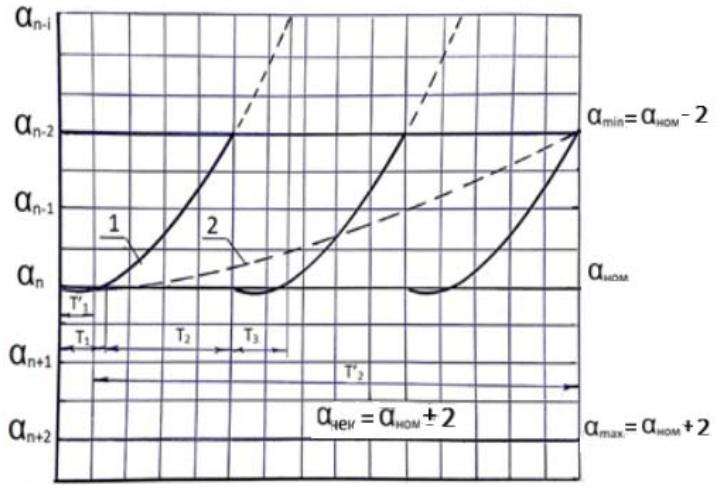 Figure 1: Life Cycles of the Serial and Proposed Plowshare
Considering the wear rate stable for the blades of a serial plowshare, its resource can be determined by the following dependence:
$$
T _ {1} = T _ {1} + T _ {2} + T _ {3} \tag {1}
$$
where, $T_{1}$ - the run-in period of the serial plowshare; $T_{2}$ - the period of stable operation of the serial plowshare; $T_{3}$ - the period of work with the worn blade of the serial plowshare. Analyzing the life cycle of a serial plowshare, it can be noted that the second period is the defining period of the components $T_{2}$. Therefore, it can be assumed that an increase in the service life of a serial plowshare is possible due to the lengthening of this period, and at the same time the third period of T3 can be excluded from the life cycle.
Then the resource of the proposed plowshare can be determined by the following dependence:
$$
T_{\pi}^{l} = T_{1}^{l} + T_{2}^{l}
$$
where $T_{1}^{1}$ - the period of operation of the proposed plowshare; $T_{2}^{1}$ - the period of stable operation of the proposed plowshare.
The best way to increase the efficiency of the proposed ploughshare can be considered to increase only the normal period of operation to the service life of three serial ploughshares. This can be expressed by curve 2 in Figure 1. As noted above, the service life of a serial plowshare is set by the average wear rate of the blade of the plowshare. In this regard, in order to implement the recommended method of improving the efficiency of the proposed plowshare, it is necessary to ensure 3 times less wear intensity of the blade of the plowshare than that of a serial plowshare or to increase the resource reserve (reserve - structural wear resistance) by the same number of times. Having studied and analyzed the studies conducted by many scientists [1-10], it is possible to determine the flooding of the ploughshare blade by adding up four generalized factors:
$$
I=f\left(A1+A2+A3+A4+A5\right)
$$
And so the intensity of wear is determined by the physical and mechanical properties of the soil (A1), physical and mechanical properties of the material and the solid (cutting) layer ((A2) and loading conditions (A3) as well as structural (A4) and technological (A5) parameters of the working body.
All of the above factors can be quantified using several indicators. If we imagine the dependence of the wear intensity on certain components in the form of functions, we get:
$$
\begin{array}{l} I = f (A 1) = f \left(H _ {p} w _ {p} c _ {t}\right); I = f (A 2) = f \left(H _ {o}, H _ {3}\right); I = f (A 3) = f (P, R) \\I = f (A 4) = f \left(B, h, L, h _ {0}, \alpha , \beta\right); I = f (A 5) = f (v, E, k _ {v} \sigma_ {p}, a) \text {o r} \\I = f \left(H _ {t}, w _ {t}, c _ {t}, H _ {o}, H _ {9}, P, R, B, h, L, h _ {0}, \alpha , \beta , v, E, k _ {v}, \sigma_ {p}, a\right) \tag {4} \\\end{array}
$$
Where $B, h, L$ -width, thickness and length of the ploughshare, m; $h_0$ -the thickness of the blade edge, m; $\alpha$ -angle of sharpening of the ploughshare blade; $\beta$ -the angle of the ploughshare installation to the bottom of the furrow; $\nu$ -the speed of the ploughshare, m/s; $E$ -modulus of elasticity, MPa; $k_t$ -the coefficient of friction of the soil on the blade; $\sigma_\rho$ -destructive contact stress on the edge of the ploughshare blade; a- plowing depth, m; $H_t$ -soil hardness; $w_t$ -soil moisture; $c_t$ -soil composition; $H_o$ -hardness of the main material of the ploughshare blade, HRC; $H_{\mathrm{g}}$ - hardness of the deposited material of the ploughshare blade HRC; $P,R$ - accordingly, the pressure on the blade of the ploughshare from the back and front sides, $\mathrm{kg} / \mathrm{m}^{2}$.
Based on numerous studies, it has been established that the total number of factors influencing the wear rate of the ploughshare is about twenty (Figure 2). If we consider in detail, it can be noted that when the ploughshare is worn out, not all factors have a decisive influence on its bluntness. Based on the research data [1-5] and the above, it can be concluded that, in relation to plows for basic tillage, the main parameters affecting the wear rate of the working surface of the blade and, accordingly, the resource of the plowshare are:
- Properties of the material from which the plowshare is made $(H)$;
- The degree of change in the speed and pressure of the soil on the blades of the ploughshare $(v, P)$;
- Soilproperties $(c_{\nu})$
## IV. DISCUSSION OF THE RESULTS OBTAINED
We will try to link the resource with the bluntness of the plowshare, which is associated with the study of the wear process under the action of resistance forces. Analysis of changes in the geometric dimensions of the ploughshares shows that the blade wears out under the influence of the pressure forces of the soil layer on the wedge $Q$ and the reaction of the bottom of the furrow $R$ (Figure 3).
As a result, between the directions of these forces, the acute angle $\alpha$ gradually transforms into a blunt angle $\theta$. As the geometric shape of the blade of the ploughshare changes, the direction of action of these forces changes. With prolonged operation under the influence of reservoir pressure $Q$, the wear of the nose of the blade increases along the axis of the $OX$, in this regard, the surface of the $OK$ tends to a position perpendicular to the abscissa of the $OX$. The direction of action of the force $R$ also changes. After some operation, it tends to reach a position perpendicular to the ordinate of the op. Under the action of forces $Q$ and $R$, wear occurs and during operation, the blade changes its geometric dimensions compared to the initial one, which can be seen by moving the sock from the origin $O$ to the point $O_{1}$. At the same time, the reaction forces of the soil acting on the front and rear parts of the blade increase, the intensity of wear $I$ increases in both directions. It is determined by the formula [8].
$$
I = I _ {P} + I _ {R}, \tag {5}
$$
Where $I_{Q}, I_{R}$ – the intensity of wear, respectively, of the front and back surfaces of the blade.
The intensity of wear of the ploughshare blade with unchanged mechanical composition and soil moisture, as well as unchanged properties of the material of the working body depends mainly on soil pressure and is expressed by formulas
$$
I _ {P} = K _ {n} \cdot P \quad \text{and} \quad I _ {R} = K _ {\pi} \cdot R, \tag{6}
$$
Where $K_{n}$ - the coefficient of proportionality, depending on the physical and mechanical properties, the state of the soil and the geometric dimensions of the blades of the ploughshares, $\frac{MM}{ra\cdot H}$.
According to formulas (5) and (6), you can write
$$
I = K _ {n} (P + R) \tag {7}
$$
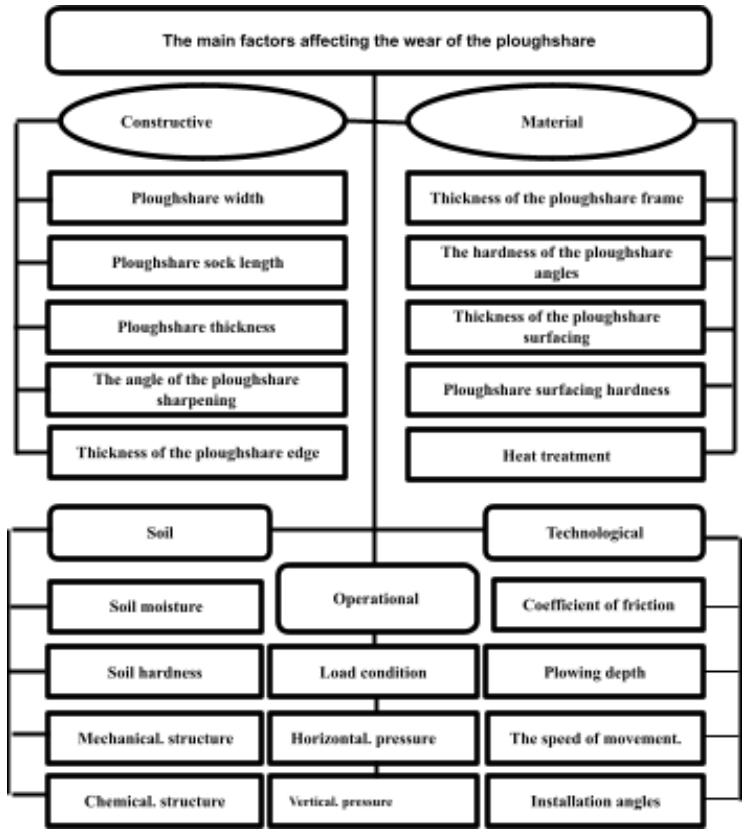 Figure 2: Factors Influencing to the Ploughshare Resource
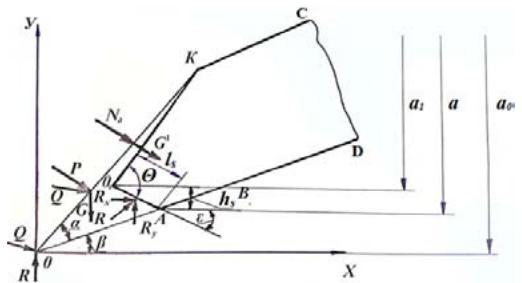 Figure 3: Changing Blade Parameters the Ploughshare $t$ under wear under the Action of Forces Q and R
Consequently, the intensity of blade wear depends mainly on the magnitude of the forces $P$ and $R$. Now we will try to determine their values through the physical and mechanical properties of the soil and the structural dimensions of the blade.
The component of the force $Q$ acting on the front surface of the ploughshare consists of the forces of normal pressure $P$ and the weight of the soil $G$. The normal soil pressure $P$ acting on the front surface of the ploughshare can be determined by the weight of the soil particles $G$ and the dynamic pressure on the surface of the blade of the ploughshare $N_{o}$, i.e.
$$
P = N _ {A} + G ^ {\prime} \tag {8}
$$
Using the theorem on the change in the amount of motion and the results of the study of M.M. Severnev [8] and G.N. Sineokov [9], we determine the force of dynamic pressure on the direction of the normal to the surface $O_{1}K$
$$
N_{\partial} = a \cdot b \cdot \delta \cdot V_{n}^{2} \cdot \sin(\alpha + \beta) \cdot \sin \gamma ,
$$
Where $a$ and $b$ - thickness and width of the soil layer; $\delta$ - soil density; $V_{n}$ - translational speed of the working body; $\beta$ and $\gamma$ - angles of installation of the working body relative to the bottom and wall of the furrow; $\alpha$ - blade sharpening angle.
The magnitude of the force projection vector $G$ on the direction of the normal to the blade surface can be defined as
$$
G ^ {\prime} = a \cdot b \cdot L _ {i} \cdot g \cdot \delta \cdot \cos (\alpha + \beta), \tag {10}
$$
Where $L_{g}$ - blade length of the working body; $g$ - acceleration of gravity.
Then substituting expressions (9) and (10) into (8) we get
$$
P = a \cdot b \cdot \delta \cdot g \cdot \left[ \frac{V _ {n} ^ {2}}{g} \sin (\alpha + \beta) \cdot \sin \gamma + L _ {n} \cdot \cos (\alpha + \beta) \right] \tag{11}
$$
As can be seen from formula (11), the dynamic pressure to the blade surface is directly proportional to the parameters of the formation, the density of the soil and the speed of movement of the unit. In the presence of an occipital chamfer, the reactive force $R$ is determined by the formula [17]
$$
R = b l _ {s} \sin \varepsilon \left\{K _ {1} H + \frac {\cos \varepsilon}{\sin \gamma} l _ {s} g _ {0} ^ {1} \left[ 1 + K _ {g} \vartheta_ {M} (\cos \varepsilon - \sin \varepsilon \times t g \varphi) \sin \varepsilon \right] \right\} \tag {12}
$$
Where $H$ -average soil hardness at the depth of treatment, $Mna;F$ - the area of the deformable layer, $sm^2$; $K_1$ -conversion factor that takes into account the influence of the shape and size of the occipital chamfer; $b$ -the width of the ploughshare, $h_s$ -height of the occipital chamfer, $l_s$ -width of the occipital chamfer, $V_s$ -volume of the washed-off soil, $g_o$ -the coefficient of volumetric crumpling of the soil; $g_0^1$ - the volumetric crumpling coefficient selected during static tests, i.e. at a deformation rate equal to zero; $K_g$ - a coefficient that takes into account the change in the
coefficient of volumetric crumpling of the soil depending on the crumpling rate, $s / m$, $g_{\mathrm{g}}$ -the rate of crushing of the soil by the occipital chamfer in the vertical direction $m / s$.
According to research [13] we will be able to record $h_{s} = a\left(1 - \frac{\rho_{0}}{\rho}\right)$ (13) where, $a$ - depth of tillage, m; $\rho_0$ and $\rho$ - soil density before and after treatment, kg/m $^3$. Given the expression
$$
h _ {s} = l _ {s} \times \sin \varepsilon \quad \text{weget} \quad l _ {s} = \frac{a \left(\rho_ {0} - \rho\right)}{\rho \sin \varepsilon} \tag{14}
$$
$$
\text {o r} \quad R = b \frac {a \left(\rho_ {0} - \rho\right)}{\rho} \left\{K _ {1} H + \frac {\cos \varepsilon}{\sin \gamma} \frac {a \left(\rho_ {0} - \rho\right)}{\rho \sin \varepsilon} g _ {0} ^ {1} \left[ 1 + K _ {9} \vartheta_ {M} (\cos \varepsilon - \sin \varepsilon \times t g \varphi) \sin \varepsilon \right] \right\} \tag {15}
$$
Using the formula (15), it is possible to analyze the change in the reaction of the soil to the occipital chamfer depending on its main parameters.
As noted above, the stability of the plow stroke in depth is violated if the condition is not met $P_{y} \geq R_{y}$ (16)
Substituting the values $P_y$ and $R_y$ into the formula (16) and after some transformations, we obtain a mathematical model of the change in the depth of plowing.
$$
a = \frac {\delta \cdot g \cdot 2 \sin \gamma \left[ \frac {V _ {n} ^ {2}}{g} \sin (\alpha + \beta) \cdot \sin \gamma + L _ {i l} \cdot \cos (\alpha + \beta) \right]}{\left(1 - \frac {\rho_ {0}}{\rho}\right) \left\{K _ {1} H + \frac {\cos \varepsilon}{\sin \gamma} \frac {\left(\rho_ {0} - \rho\right) ^ {2}}{\rho \sin \varepsilon} g _ {0} ^ {1} \left[ 1 + K _ {9} \vartheta_ {M} (\cos \varepsilon - \sin \varepsilon \times t g \varphi) \sin \varepsilon \right] \right\}} \tag {17}
$$
If we take into account that the stability of maintaining a given processing depth is determined by the suitability of the ploughshare for further operation, then it can be seen from formula (17) that the main influencing factor on the processing depth is the physical and mechanical properties of the soil and the geometric parameters of the blade.
The resource of the ploughshare according to the constructive factor is determined by the formula [14]
$$
T = \left(h _ {0} - h _ {n}\right) \frac {d h}{d t}, \tag {18}
$$
where $h_0, h_n$ - initial and maximum wear width of the part; $dh / dt$ - intensity of blade width change. If we use the value of the average rate of wear, the resource of the working body is as follows
$$
T = \frac{h _ {0} - h _ {n}}{I} = \frac{h _ {\pi}}{I}
$$
After substituting the value of $I$ from formula (7) into formula (13), we get
$$
T = \frac {h _ {\partial}}{K _ {n} (P + R)} \tag {20}
$$
If in formula (20), instead of $P$ and $R$, substitute their values from formulas (11) and (12), taking into account the value $h_{\partial}$ [15]
$$
\begin{array}{l} T = \left[ \mathbb {I} _ {o} - K _ {0} \cdot \cot \varphi \right] \colon K _ {n} \cdot b \cdot \left\{a \cdot \delta \cdot g \times \left[ \frac {V _ {n} ^ {2}}{g} \cdot \sin (\alpha + \beta) \cdot \sin \gamma + L _ {i} \cdot \cos (\alpha + \beta) \right] \right. \\+ \frac {a (\rho_ {0} - \rho)}{\rho} \left\{K _ {1} H + \frac {\cos \varepsilon}{\sin \gamma} \times \frac {a (\rho_ {0} - \rho)}{\rho \sin \varepsilon} g _ {0} ^ {1} \left[ 1 + K _ {9} \vartheta_ {M} (\cos \varepsilon - \sin \varepsilon \times \tan \varphi) \sin \varepsilon \right] \right\} \end{array}
$$
It can be seen from formula (21) and Figure 4 that the resource of the working body (at constant angles of installation of the working body to the bottom and walls of the furrow) is directly proportional to the maximum permissible wear and inversely proportional to the density and hardness of the soil, the angle of sharpening of the blade, the square of the speed of the unit and the parameters of the formation and the occipital chamfer.
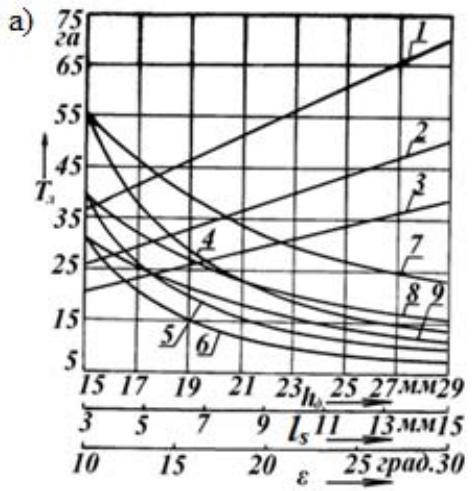
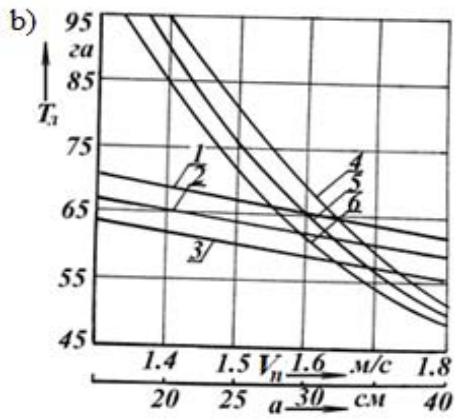 Figure 4: Graphs of the plowshare resource change. a – from the maximum permissible wear (1, 2, 3,) width (4, 5, 6) and angle (7, 8, 9) of the occipital chamfer and at a soil hardness of $3.5\mathrm{MPa}$ (1, 4, 7): $5.3\mathrm{MPa}$ (2, 5, 8) and $7.1\mathrm{MPa}$ (3, 6, 9); b – from the speed of movement of the unit (1, 2, 3) and the depth of treatment (4, 5, 6) with a soil hardness of $3.5\mathrm{MPa}$ (1, 4); $5.3\mathrm{MPa}$ (2, 5) and $7.1\mathrm{MPa}$ (3, 6).
As can be seen from Figure 4, the parameters of the occipital chamfer have the main influence on the resource of the ploughshare. The volume of the removed soil and, accordingly, the pushing force $R$ depend on these parameters. However, these parameters change during operation (wear) arbitrarily and are considered unmanageable and. In this regard, a scientific hypothesis has been put forward about the possibility of developing such technical solutions for the ploughshare, which contributed to reducing the volume of crushed soil and, accordingly, the pushing force, which will eventually improve the self-sharpening of the blade and prolong the service life of the ploughshare [13, 14].
## V. CONCLUSION
The main criterion for the rejection of ploughshares is their failure to provide a given processing depth (quality of work) during operation, a deviation from which occurs, as a rule, due to an arbitrary increase in the parameters of the occipital chamfer of the ploughshare during operation. The resource of the ploughshare decreases with increasing width and angle of the occipital chamfer, and at the same time, with increasing width, especially in hard soils, the resource decrease is observed at a more intensive rate. It was found that an increase in the width of the rear chamfer by 1 mm and the angle by $1^{\circ}$ reduces the life of the plowshare by $33\%$ and $12\%$, respectively, and an increase in the plowing depth by 1 cm reduces the life of the plowshare by $16\%$. It has been proved that the reason for the plough surfacing due to an increase in the soil reaction is an increase in the parameters of the rear chamfer and the depth of plowing. In order to minimize the influence of the parameters of the rear chamfer on the stability of the plow, it is necessary to develop such technical solutions for the plowshare, which contributed to a decrease in the volume of crushed soil and, accordingly, the pushing force during operation, which will eventually improve the self-sharpening of the blade and extend the life of the plowshare.
Generating HTML Viewer...
References
14 Cites in Article
D Mironov (2017). Substantiation of structural and material science parameters that ensure an increase in the resource and efficiency of ploughshare working bodies.
I Liskin,V Liskin,D Mironov,S Sidorov (2014). Innovative development of the agroindustrial complex of Russia on the basis of intelligent machine technologies: Collection of scientific documents.
S Sidorov (2013). Justification of increasing the operational and resource characteristics of plowshares/Agricultural machines and technologies.
V Denisov,N Kozhukhova,G Orekhova,M Mikhal'chenkova (2016). Influence of ploughshare design and welding reinforcement on the hardness of its nose part.
I Liskin,S Sidorov,D Mironov (2014). Substantiation of geometric and setting parameters of plow working bodies for heavy soils.
V Denisov,N Yu (2016). The influence of the ploughshare design and surfacing reinforcement on the hardness of its nose.
A Mikhalchenkov,I Kozarez,Yu. Filin,M Mikhalchenkova (2017). Removal of solid filler particles from composite with polymer matrix as abrasive wear factor.
A Kolomeichenko (2014). Tests on the wear of the working surfaces of the paws of cultivators hardened by flame spraying of powder material / Kolomeichenko A.
V Komogortsev Theoretical and analytical consideration of the movement of light soil particles on a reinforced surface / Komogortsev V.
A Mikhalchenkov,Yu. Filin,S Feskov,M Mikhalchenkova (2015). Forecast of residual life of "lemken" plough bits and dimensional groups of parts suitable for operation.
A Mikhalchenkov,I Kozarez,A Dyachenko,A Tyureva (2016). Wearing and service life of agricultural machine blades restored by various technologies.
R Bayer,U Clinton,K Nelson,R Schumacher (1964). Note on the application of the dependence of wear on stress.
K Nuriev,M Nuriev (2022). Patent UZ FAP 02154.
K Nuriev,M Nuriev,O Rakhmatov,Sh,M Karabekova,Bahronova (2022). Determination of the total resistance of the ploughshare when the blade is blunted. ETESD-2022.
No ethics committee approval was required for this article type.
Data Availability
Not applicable for this article.
How to Cite This Article
K K Nuriev,. 2026. \u201cEvaluation of the Effectiveness of using the Plowshare\u201d. Global Journal of Science Frontier Research - D: Agriculture & Veterinary GJSFR-D Volume 23 (GJSFR Volume 23 Issue D4): .
Explore published articles in an immersive Augmented Reality environment. Our platform converts research papers into interactive 3D books, allowing readers to view and interact with content using AR and VR compatible devices.
Your published article is automatically converted into a realistic 3D book. Flip through pages and read research papers in a more engaging and interactive format.
Annotation-The article analyzes the “life” cycle of the plowshare and shows an effective solution to increase the resource. The analysis of complex factors affecting the wear of the ploughshare emphasizes their main ones. The working condition of the ploughshare is evaluated and the essence of the influencing forces on its wear is revealed. A mathematical model for determining the ploughshare resource is derived. Having solved the model using the example of a plowshare for different values of their components, it is determined that the resource of the plowshare decreases with increasing width and angle of the occipital chamfer, and at the same time, with increasing width, especially in hard soils, the resource decrease is observed at a more intensive rate. It is established that an increase in the width of the rear chamfer by 1 mm and the angle by 10 reduces the life of the plowshare by 33% and 12%, respectively, and an increase in the plowing depth by 1 cm reduces the life of the plowshare by 16%.
Our website is actively being updated, and changes may occur frequently. Please clear your browser cache if needed. For feedback or error reporting, please email [email protected]
Thank you for connecting with us. We will respond to you shortly.