Rezumat- The paper presents the result of the study focused on the analysis of the structural elements of the traditional Romanian costume - the join points called "keys" that ensure the processing of the edges of the components of the pieces of the traditional costume, their combination and the increase of the artistic value.
The diversity, aesthetic and technical complexity of making the keys that combine the pieces of traditional shirts, both for women and for men, denotes the creativity and aesthetic taste of the creators. In addition to the structural variety of the keys, the functional characteristics are equally representative. Thus, the last part of the study is directed to the evaluation of the durability of the keys, demonstrating high strength and long service life.
I. INTRODUCTION
The traditional Romanian costume of Dacian origin is represented by various constructive solutions with an impact on its aesthetics, complemented by the implications of the technical solutions of decoration with a great diversity of ornamental systems found on the elements of the costume, but also in the joints between them. Combining the elements of the traditional Romanian costume has excelled over time, from the most straightforward solutions for integrating through manual techniques to the most complex ones. Among the methods of combining the elements of a difficult aesthetic revelation are those generically called "keys."
The keys are the techniques of combining the elements of the pieces of the traditional costume of different complexity found especially in all the constructive types of traditional Romanian shirts with an aesthetic character. They are used from the most straightforward techniques of their reproduction to the complex forms generated by the imagination, and creativity of our predecessors, developed in new aesthetic, functional and sustainable structures.
II. TYPES OF KEYS
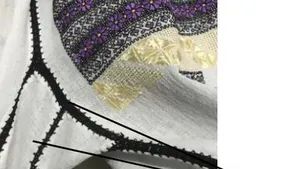
The shirt represents the most essential piece of the traditional Romanian costume, the constructive lines of which are accentuated by contrasting colors by the joints through the keys of the elements (fig. 1) or being made with the thread of the same type from which the textile is made, giving a remarkable elegance and refinement to the pieces.
The most extraordinary diversity of the keys is attested in the shirts made in the XIXth century- XX.
Maria Hedving Fromagiu [1] had to remark that "among the most archaic forms of ornamentation and highlighting of the silhouette using a special artistic effect, there is the great variety of stitches that assemble the parts of the piece, materialized in the beautiful "keys"... important also in the decorative composition of men's shirts. They emphasize the shape of the cut while delimiting the spaces for the development of ornamental compositions. The presence of these orderly but particularly beautiful lines is often enough to recognize the play's artistic value."
In the same context, the researcher Secoşan Elena mentioned that "characteristic for each type of shirt is a certain arrangement of decorative stitching, taking different appearances within the numerous ethnographic areas, according to local traditions, "canons" shaped over time by social factors,"". we find a surprising ingenuity and variety in the systems of joining the pieces of cloth, either through the "keys" sewn on the line of joining the elements or through the lace keys.... which have become the most precious achievements in the art of textiles" [3].
Thus, trying to structure the keys according to the principle of realization, they were structured in keys:
- uncrossed;
- crossed/lace.
Each of these groups includes a wide range of keys according to the realization technique. To the uncrossed keys, refer those:
- simple;
- with chain;
- "piglets";
- beams type;
- with alternate legs;
- etc.
Crossed keys include those:
- knotted insertion stitch;
- twisted insertion stitch;
- from multiple knots, etc.
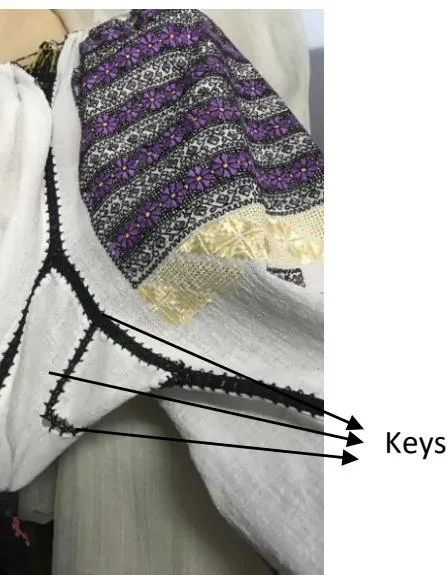
The diversification of the keys can be performed depending on the size of the seam point pitch, the number of points per surface unit, and the visibility of the keys (visible in contrasting colors, with low perceptibility achieved in the primary color of the product).
a) Functions of keys
The keys as elements of joining the components have a functional, informative/communication, and decorative role. Regarding to the joining techniques [2], "the researchers Elena Secoşan and Ortnasa Dogaru mentioned that the seam points, both those with practical function and decorative role, constitute a precious documentary material in the study of ethnographic aspects, regarding the origin and evolution of the techniques practiced in the manufacture and ornamentation of the port pieces, all the more so as the being of the seam point cannot be isolated from the content of the ornament, given that the seam point is organically related to the ornamental structure and motif, being in relation and dependence on the shape and material of the ornamented object."
Undoubtedly, the aspirations and the aesthetic sense of the creators determined the generation of a great diversity of keys with implications on the image of
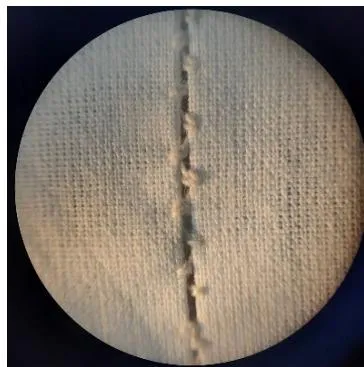
The ornamental structure of the reproduction of the keys is inscribed in wide lines with few white spaces, continuous.
From the aspect of the communication/information function, the "keys" distinctly suggest the ethnic and zonal identity mark of the costume, the age, the social status, the civil status, and the material condition of the wearers.
The functional character of the keys is determined by ensuring the following:
- the flexibility of the joints;
- elongation of joints;
- durability through tensile strength;
- protection of the edges of desirability.
b) Durability of the keys
Durability of the keys is one of the objectives of this study, aimed at evaluating the keys' functionality. Starting from the above-mentioned, nine types of keys were selected, made, and evaluated by tensile strength, both at their arrangement a horizontal direction and in a transverse direction. The experimental tests were carried out on samples of 4 types of materials: 2 cotton materials of different finesse, cotton mixed with linen-50%+50%, and linen-100% (Table 1). The step of the seam points was identical in all types of keys. The same is the type of thread with which the keys were reproduced: crochet thread, nr. 60/2x3, cotton-100%.
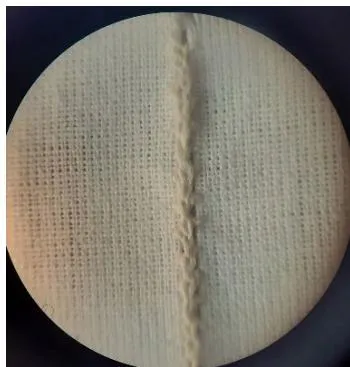
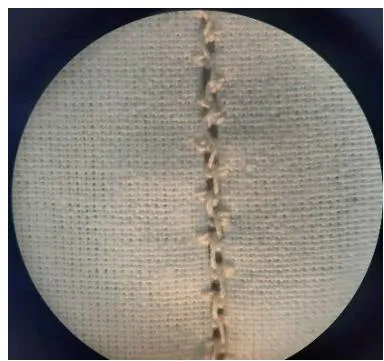
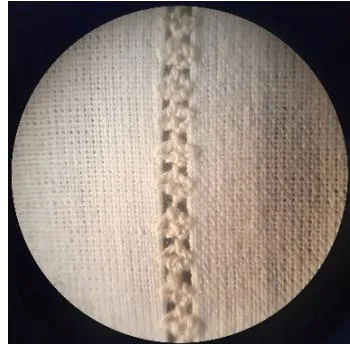
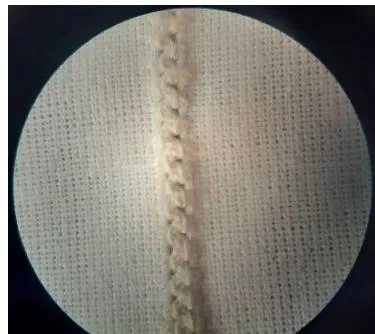
The types of keys included in the study were those presented in fig. 2: simple (fig. 2 a), with chain (fig. 2 b), with alternating points (fig. 2 c), piglets (fig. 2 d), knotted insertion stitch (fig. 2 e), twisted insertion stitch (fig. 2 i), with alternate legs (fig. 2 k), with double alternate legs (fig. 2 l) twisted insertion double stitch (fig. 2 m).
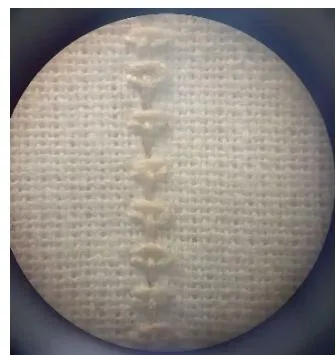
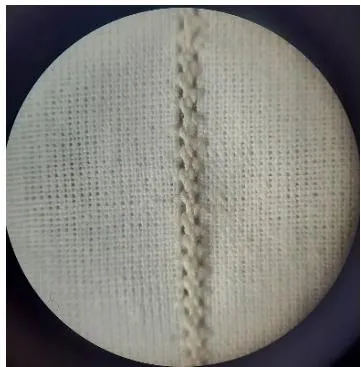
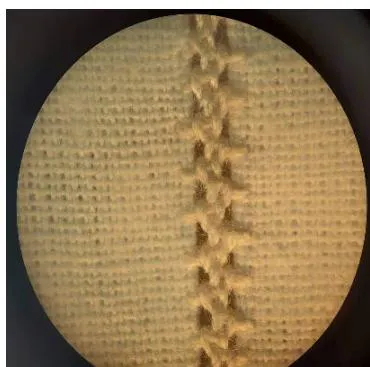
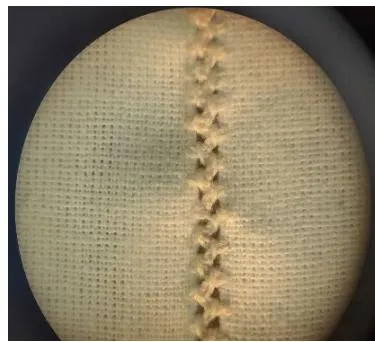
Nr. crt Fabric width, L, m Thickness of textiles Surface density, M g/m2 The desiness of the threads No wires /10cm Linear density of warp threads Linear density of weft threads U B Ttex Nm Ttex Nm I1 1,5 0,35 159,6 140 220 30 33 57 18 I2 1,7 0,4 160,4 190 140 48 21 50 20 B6 2,1 0,3 140,4 190 240 32 31/1 30 32/1 B8 1,5 0,3 90,4 150 220 10x2 25/2 10x2 24/2
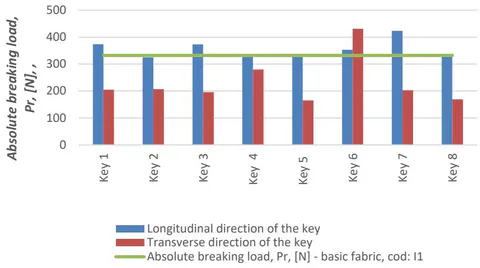
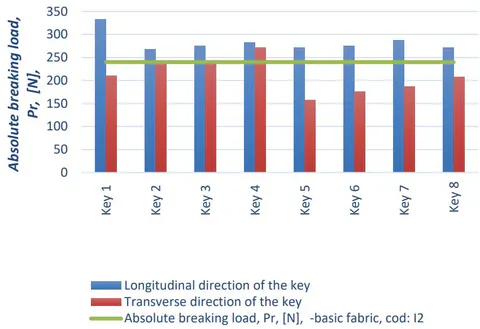
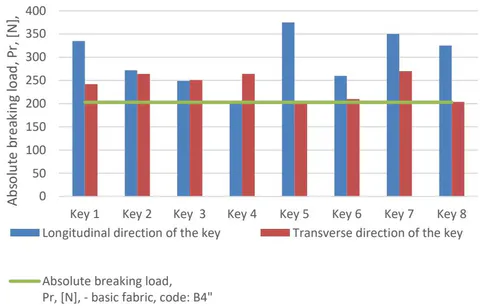
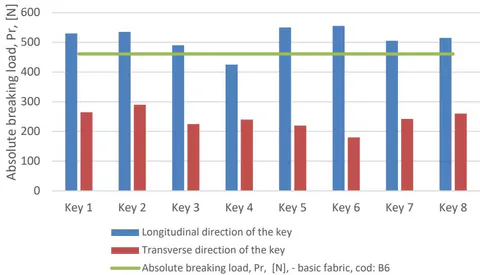
The results of the sustainability assessment of the keys included in the study are presented in Table 2, fig. 3-6.
From the data presented in Table 2, it is obvious the durability of all types of keys, from the simplest to the most complex, indicates their long service life. The durability values of the keys increase directly proportional to the complexity of the keys. Thus, the double-knotted keys, those with double, double-knotted legs, denote a high resistance to tearing, ensuring an excellent resistance to the stresses determined by the dynamics of the movements of the human body, in the case of their use in traditional shirts.
The durability of the wrenches assessed by the tensile strength denotes their high resistance far beyond the strength of the textiles, which is contrary to the requirements according to which the resistance of the joints of the clothing elements must not exceed the strength of the textiles. It is necessary that the tensile strength of textiles be higher than that of the joints, thus keeping the elements of the products intact. In case of breaking the threads from the joint, they can be restored again.
Analyzed from an aesthetic point of view, the keys denote an elegant and fine presence that fits perfectly in the ornamental repertoire of the pieces of the traditional costume, assigning them personality, emphasizing the lines of the wearer's silhouette and those of the costume.
| Indices for evaluation of breaking strength | Types of keys | ||||||||||||||||
| 1 | 2 | 3 | 4 | 5 | 6 | 8 | 9 | ||||||||||
| warp | weft | warp | weft | warp | weft | warp | weft | warp | weft | warp | weft | warp | weft | warp | weft | weft | |
| Basic fabric: linen-100%, code: I1 | |||||||||||||||||
| Absolute breaking load, Pr, [N], | 374 | 205 | 325 | 207 | 373 | 196 | 280 | 330 | 330 | 165 | 353 | 431 | 423 | 203 | 330 | 169 | |
| Absolute elongation at break, Ii/a, [mm], | 124 | 190 | 126 | 128 | 132 | 129 | 122 | 129 | 129 | 124 | 123 | 122 | 126 | 128 | 129 | 120 | |
| Basic fabric: linen-100%, code: I2 | |||||||||||||||||
| Absolute breaking load, Pr, [N], | 333 | 210 | 268 | 241 | 275 | 238 | 283 | 271 | 271 | 157 | 275 | 176 | 288 | 187 | 271 | 208 | |
| Absolute elongation at break, Ii/a, [mm], | 120 | 116 | 123 | 128 | 120 | 133 | 118 | 121 | 121 | 114 | 131 | 115 | 131 | 118 | 131 | 118 | |
| Basic fabric: cotton-100%, code: B4 | |||||||||||||||||
| Absolute breaking load, Pr, [N], | 335 | 242 | 272 | 264 | 249 | 251 | 203 | 264 | 375 | 200 | 260 | 210 | 350 | 270 | 325 | 204 | |
| Absolute elongation at break Ii/a, [mm], | 126 | 126 | 122 | 125 | 130 | 130 | 125 | 126 | 123 | 117 | 124 | 117 | 128 | 122 | 120 | 122 | |
| Basic fabric: cotton-100%, code: B6 | |||||||||||||||||
| Absolute breaking load, Pr. [N], | 530 | 265 | 535 | 290 | 490 | 225 | 425 | 240 | 550 | 220 | 555 | 180 | 505 | 242 | 515 | 260 | |
| Absolute elongation at break Ira, [mm], | 120 | 125 | 122 | 126 | 120 | 126 | 120 | 120 | 118 | 126 | 117 | 120 | 116 | 124 | 116 | 125 | |
III. CONCLUSIONS
The keys present techniques of processing and combining the elements of the traditional costume pieces that have implications on the aesthetics of the traditional costume pieces, functionality, and communication.
The keys are made by manual techniques involving the needle and the thread.
The reference criteria in the diversification of the keys are related to: the complexity of the keys conferred by the technique of realization, the number of steps per surface unit, the type of threads used at the joint, the thickness of the threads, the number of threads, the chromatics and the number of colors used, their arrangement on directions of orientation.
The evaluation of the durability of the keys confirmed their high resistance to various requests, as well as excellent elongation properties.
The techniques of making the keys allow aesthetic customization and diversification selected concerning the communication with the shape, the material of the ornamented piece, the ornamental concept, and the chromatics.
ACKNOWLEDGMENTS
Acknowledgments to the scientific community of the Technical University of Moldova for the support provided during the activities within this project, to the Government of the Republic of Moldova through the National Agency for Development and Research for the financing of the project.
We are grateful the museum representatives, the beautiful people of the country who had the openness to share with us valuable information with reference to the predetermined objectives.
Acknowledgments all our loved ones, colleagues for pertinent, competent and prompt advice.