I. INTRODUCTION
The worldwide production of crude oil and natural gas is at the peak, with an estimated worldwide production of 97 million barrels per day in 2020. Approximately half of this amount is transported by sea. As follows, worldwide marine coastal areas are exposed to the oil spills occurring as a result of accidents or illegal practices. Therefore, crude oil is already widespread primarily in marine sediments close to harbors and marinas, and oil spills alter the oil's chemical composition because it allows the breakdown of oil components. The release of thousands of tons of petroleum hydrocarbons (PHs) affects the marine environment and causes severe ecological and economical damage and can cause ocean acidification. The oil spill releases (hydrogen sulfide), ammonia and methane, causing the decrease in pH of the sediment and the decrease in the dissolved oxygen concentration in the water. Marine ecosystems are already subject to touristic activities and sewage pollution, and this unprecedented oil spill in 2019, declined biodiversity in the modern anthropogenic era. The evaluation of the damage for the local coastal communities and future generations, and the environmental quality of the marine and coastal region are in need of action. The continuous dissolution of benthic calcareous organisms will culminate with the total disappearance of microfauna at least one year after the accident, similar to what had been showed in Guanabara Bay, Rio de Janeiro, Brazil (Eichler et al., 2014). Dealing effectively with these impacts includes understanding how pollutants and contaminants in general are released and how they behave in the environment (Cedre, 2007). Hydrocarbon petroleum products are very reactive in aerobic environments via microbial and photochemical reactions (Varjani, 2017; Atlas & Hazen, 2011; Salminen et al.,2004; Widdel & Rabus, 2001), and the production of hydrogen sulphide ( ) is a result of the microbial breakdown of organic materials of crude oil in the absence of oxygen. Hydrogen sulphide is a gas without color, and is inflammable, poisonous and corrosive, noticeable by its rotten egg smell and with toxicity similar to carbon monoxide prevents cellular respiration. Monitoring and early detection of could mean the difference between life and death. The contamination impact in the medium and long term is a silent one caused by oil being partially degraded and absorbed by the environment. Concentrations of PAHs sufficient to affect individual health following oil spills are common and can remain for long periods in some habitats (Cherr et al 2017, Oros et al 2007). The polycyclic aromatic hydrocarbons (PAHs) present in oil are an immunotoxin to several wild aquatic species. While the origin of the oil remains a mystery, and any scientific effort to clarify that are welcome.
It is with urgent necessity to spotlight this tragedy in this unique and sensitive reef habitat experiencing ongoing damaging effects that include socio-economic resources losses not yet evaluated and addressed. More than 2 years later now; here we show that the dimension of these impacts, how long they are expected to last, anticipated collateral damages, and then propose mitigation options and mechanisms to reduce the magnitude of any future spill. As the oil becomes less and less visible to the naked eye, and the world is ravaged by new disasters (e.g. COVID-19 pandemic), and it is easy to let the largest oil spill in the South Atlantic fall into oblivion, leaving it to nature and for local human communities to bear its consequences for the decades to come.
Our paper deals with a specific site, the "Pirangi Reef area", which was subjected to the oil spill in October 2019, and was previously studied in 2013 and 2014 by Eichler et al (2019) and Eichler and Moura (2020) with no spotting of oil patches in the sediment or in the water. After the oil spill, we sampled new sites to compare and discuss questions on the human-induced changes on the reef system and in the symbiont-bearing species (SBS) of foraminifera; therefore, water and surface sediments were recovered from areas of small reef patches near tourism boating sites.
Here we also discuss impacts and evidence of the oil spill in this biodiverse area, which more than 2 years have passed and we still are uncertain about the type of oil or even culpability; and benthic communities are continuing to suffer consequences of these and other deleterious impacts now for decades. The release of hydrocarbons from oil spills into marine environments has immediate and acute effects on living organisms. In addition, chronic contamination has an effect over time as hydrogen sulphide, methane and ammonia are released in the environment acidifying even more the water-sediment interface.
II. SYMBIONT-BEARING SPECIES
Numerous publications have shown that certain benthic foraminifera (in particular, species of Amphistegina) that thrive in and around coral reef habitats are affected by global or local environmental stresses the same way hermatypic corals are. These species belong to several families—both porcelainous and hyaline—but they all act as hosts to diverse algal endosymbionts comparable to the zooxanthellae of corals. "The potential advantages of algal symbiosis to foraminifers lie in at least three major areas: a) energy from photosynthesis; b) enhancement of calcification; and c) uptake of host metabolites by symbiotic algae" (Hallock, 1999). As with hermatypic corals, these symbiont-bearing foraminifera (SBF) prefer nutrient- poor, shallow, warm-water environments (e.g., Hallock, 2000) and they also have a zooxanthella. Most reef-building corals contain photosynthetic algae, called zooxanthellae, that live in their tissues. The corals and algae have a mutualistic relationship, the same with the foraminifera specimen. The coral/foraminifera shell provides the algae with a protected environment and compounds they need for photosynthesis. In return, the algae produce oxygen and help the coral/foraminifera to remove wastes. Most importantly, zooxanthellae supply the coral/foraminifera with glucose, glycerol, and amino acids, which are the products of photosynthesis. The coral/foraminifera use these products to make proteins, fats, and carbohydrates, and produce calcium carbonate. The relationship between the algae and coral polyp/foraminifera facilitates a tight recycling of nutrients in nutrient-poor tropical waters. In fact, of the organic material photosynthetically produced by the zooxanthellae is transferred to the host coral/foraminifera tissue. This is the driving force behind the growth and productivity of calcium carbonate. Sometimes when corals become physically stressed, the polyps expel their algal cells and the colony takes on a stark white appearance. This is commonly described as "coral bleaching". If the polyps go for too long without zooxanthellae, coral bleaching can result in the coral's death. The same occur with the larger foraminifera (SBS). Because of their intimate relationship with zooxanthellae, reef-building corals and foraminifera respond to the environment like plants. Reef corals and SBS require clear water so that sunlight can reach their algal cells for photosynthesis. For this reason they are generally found only in waters with small amounts of suspended material, or water of low turbidity and low productivity. This leads to an interesting paradox—coral reefs and SBS require clear, nutrient-poor water, but they are among the most productive and diverse marine environments. An investigation of historical trends in Brazil demonstrated the usefulness of this findings in tracking environmental changes related to ENSO events.
III. STUDY AREA
The study area is located located on the southern coast of Rio Grande do Norte (RN) state , in Northeastern Brazil (Figure 1) in the coastal zone of the Estuary Pium and inner shelf adjacent to the reef area Pirangi. Reef formation is around long and wide, part of a discontinuous reef system extending over the coast of the RN. The reef area is about and approximately far from the shoreline. During low tides, depth in the vicinity of the reef does not exceed . Water temperature is relatively constant throughout the year (28 to ) and tidal range varies from to . Presence of shallow, clear, warm water throughout the entire year and the relative proximity of the coast have provided and incentivized to marine tourism for over 20 years. The recreational tourist activity on the reef occurs throughout the year, with peaks in January, February and July.
the disastrous event in October 2019. Stations 1 to 20 were sampled in the inner coast and stations 19 to 24 were sampled in the Pium River.
IV. METHODS
a) Field and Laboratory Methods
After the oil spill, 25 new sites were collected in the same Pirangi Reef, sandy sediments, and macroalgae substratum to compare temporal data after
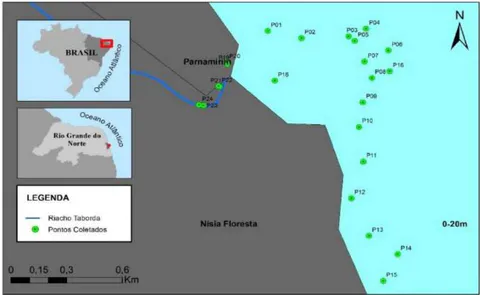
Data on water and sediment from 55 sediment sample stations in Pirangi Reef were previously studied in 2013 and 2014 and there was no mention of spotting of oil patches or other intrusions in the sediment or water at that time. Samples sites in 2013, 2014 and 2019 are showing on figure 2.
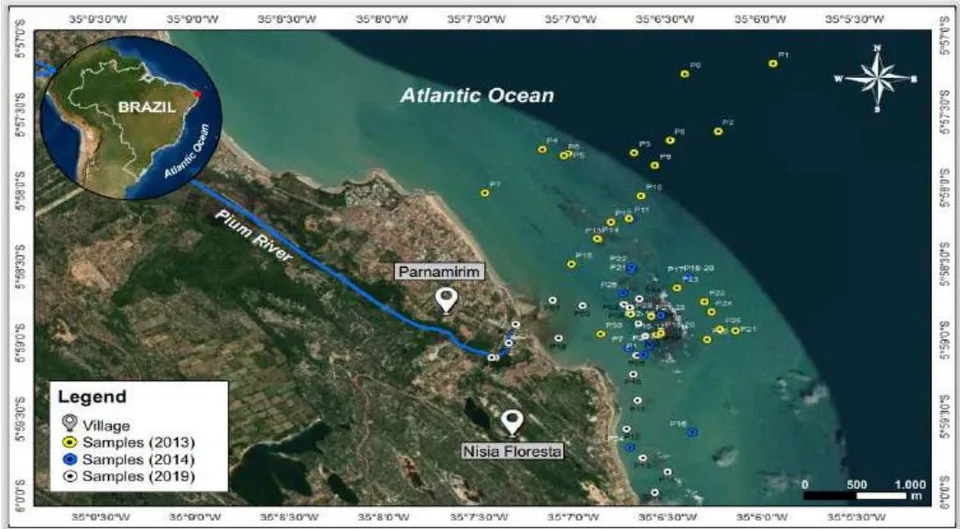
The uppermost 1 cm of each sample was subsampled for foraminiferal analysis. Samples were stored in a mixture of 1 g Rose Bengal diluted in I liter of ethanol for up to 72 hours to stain live specimens.
Processing of sediments followed standard procedures, where a fixed volume of of sediment was washed over a sieve. After drying in an oven at for 48 hours, samples were split using a micro splitter into subsamples of at least 100 living foraminiferal specimens. Species identification and counting of dry specimens were done under an optical microscope. Our methods follow Eichler et al. (2007) for benthic analysis and Eichler et al. (2019) on the sampling of coral reefs using scuba divers, and Hallock (1999) were used as a taxonomic reference for symbiont-bearing foraminifera. Our data are based on living counts, even though there is a belief that Rose Bengal method can overestimate the abundance of living foraminifera (Bernhard et al., 2006). Scanning electron micrographs were obtained to clarify identifications. Field recording of water temperature, salinity, and oxygen were performed using a multiprobeMetler Toledo, but, within either area, they did not show any noticeable variations or trends.
b) Numerical Analyses
Univariate Techniques: Univariate data of Pielou Evenness (J'), Shannon-Wiener Diversity (logo)}, and Simpson Dominance indices (Zar, 1984) were computed to assess changes in community structure.
Multivariate Analyses: Were applied to foraminiferal data [cluster analysis] producing a "map" of samples in which the placement of samples reflects the similarity of their biological communities and environmental patterns, rather than their simple geographical location.
The numerical procedures of diversity, dominance and evenness, and cluster were carried out using a University of Plymouth computer program PRIMER v6 (Plymouth Routines in Multivariate Ecological Research PRIMER-E Ltd., Plymouth) which is described in Clarke (1993), Clarke and Warwick (1994), and (Clarke and Ainsworth, 1993).
V. RESULTS
Table 1 show sampling positions and depth at the time of collection of samples in 2019.
| x (Lat) | y (Long) | Depth | |
| P01 | 265497,956 | 9338679,922 | 2 |
| P02 | 265790,030 | 9338613,538 | 2 |
| P03 | 266197,829 | 9338630,201 | 2 |
| P04 | 266348,202 | 9338700,632 | 2 |
| P05 | 266250,489 | 9338587,150 | 2 |
| P06 | 266543,889 | 9338498,682 | 2 |
| P07 | 266336,086 | 9338394,095 | 6 |
| P08 | 266400,144 | 9338242,385 | 7 |
| P09 | 266322,170 | 9338014,999 | 7 |
| P10 | 266287,690 | 9337786,426 | 10 |
| P11 | 266325,811 | 9337463,819 | 10 |
| P12 | 266221,874 | 9337123,382 | 10 |
| P13 | 266374,667 | 9336773,512 | 10 |
| P14 | 266623,363 | 9336603,181 | 10 |
| P15 | 266498,387 | 9336353,528 | 10 |
| P16 | 266554,696 | 9338304,682 | 1 |
| P17 | 266554,696 | 9338304,682 | 1 |
| P18 | 265557,710 | 9338217,410 | 1 |
| P19 | 265145,253 | 9338373,692 | 1 |
| P20 | 265138,139 | 9338388,991 | 1 |
| P21 | 265082,317 | 9338161,696 | 1 |
| P22 | 265070,261 | 9338165,785 | 1 |
| P23 | 264941,337 | 9337986,376 | 1 |
| P24 | 264900,930 | 9337991,013 | 1 |
| Pirangi 2019 (after oil spill) | P1 | P2* | P3* | P4 | P5 | P6 | P7* | P8* | P9* | P10 | P11 | P12* | P13 | P14* | P15 | P16 | P17 | P18* | P19 | P20* | P21* | P22* | P23 | P24 | P25 |
| Amphisorus hemprichii | 12 | 10 | 7 | 7 | 10 | 15 | 18 | 2 | 19 | 14 | |||||||||||||||
| Amphistegina gibbosa | 8 | 20 | 14 | 9 | 8 | 25 | 20 | 39 | 26 | 25 | 28 | ||||||||||||||
| Bolivina brevior | 6 | 5 | 15 | ||||||||||||||||||||||
| Borelis schlumbergeri | 7 | 7 | 7 | 14 | 26 | 9 | |||||||||||||||||||
| Carpenteria utricularis | 9 | 7 | 5 | 8 | 9 | 17 | |||||||||||||||||||
| Clibicides sp. | 9 | 4 | 3 | ||||||||||||||||||||||
| Cornuspira planorbis | 5 | 9 | 12 | 9 | 30 | 17 | 6 | 32 | |||||||||||||||||
| Dentalina sp. | 15 | 18 | 2 | 4 | 18 | 45 | 12 | ||||||||||||||||||
| Glomospyra gordialis | 8 | 5 | |||||||||||||||||||||||
| Hyperamina sp. | 18 | 16 | 7 | 12 | 7 | ||||||||||||||||||||
| Milliolinella subrotunda | 13 | ||||||||||||||||||||||||
| Nodosaria sp. | 19 | 9 | 16 | 4 | |||||||||||||||||||||
| Nonionoides grateloupii | 6 | ||||||||||||||||||||||||
| Peneropilis carinatus | 6 | ||||||||||||||||||||||||
| Quiqueloculina lamarckiana | 32 | 34 | 23 | 35 | 27 | 16 | 45 | 35 | 37 | 35 | 25 | 30 | 17 | 60 | 34 | 18 | 15 | 23 | 27 | 26 | 23 | 24 | |||
| Quiqueloculina patagonica | 9 | 11 | |||||||||||||||||||||||
| Spiroloculina antillarum | 7 | ||||||||||||||||||||||||
| Triloculina trigonula | 15 | 9 | |||||||||||||||||||||||
| Tubinella funalis | 14 | 18 | 16 | 10 | 16 | 14 | 13 | 15 | 32 | 10 | 70 | 9 | 17 | 18 | 21 | 17 | 20 | ||||||||
| TOTAL COUNTED | 99 | 84 | 75 | 98 | 86 | 60 | 95 | 148 | 105 | 113 | 69 | 70 | 51 | 142 | 71 | 72 | 104 | 69 | 84 | 0 | 0 | 0 | 73 | 65 | 72 |
| * oil spotted on shells |
Table 2 show that more than of the unconsolidated sediment samples, including some corals, had some evidence of oil in 2019 opposed to no evidence at all as previously studied 2013 and 2014. We have registered loss of 26 species including symbiotic species in 2019 if compared to 2013 and 2014. In according to Eichler et al (2019) and Eichler and Moura (2020) 44 foraminiferal species were recorded in 2013 and 2014, and in 2019 after the oil spill, only 20 species survived the effects of the accident, which includes loss of habitat and calcareous dissolution by the resulting acidic sediment contaminants. In addition, we observe that of all species did not tolerate the new environment and have disappeared, whereas of the symbiotic species were also extinct. This striking decrease in number of species after the oil spilling in 2019 shows that the scope of the contamination is much farther beyond what was previously assumed, since diversity decrease is very high among benthic species. It is important to notice that samples collected in the river mouth (20, 21, and 22) were barren, and were oil spotted. Samples 23, 24 and 25 also in the river realm presented very low numbers of individuals. For now, we have no estimate of the amount of oil that remains on marine sediments, estuaries or mangroves, or the amount that has infiltrated into the Brazilian sand beaches in this case.
| S | N | J' | H'(lode) | Lambda | ||
| P1 | 8 | 99 | 0.918213 | 1.909371 | 0.177431 | |
| P2* | 5 | 84 | 0.877876 | 1.412886 | 0.276927 | |
| P3* | 6 | 75 | 0.926268 | 1.65965 | 0.208889 | |
| P4 | 7 | 98 | 0.910543 | 1.771835 | 0.204082 | |
| P5 | 5 | 86 | 0.974801 | 1.568881 | 0.217685 | |
| P6 | 4 | 60 | 0.958272 | 1.328448 | 0.275 | |
| P7* | 7 | 95 | 0.827549 | 1.610337 | 0.275346 | |
| P8* | 12 | 148 | 0.946005 | 2.350735 | 0.112765 | |
| P9* | 5 | 105 | 0.871253 | 1.402227 | 0.271293 | |
| P10 | 6 | 113 | 0.964297 | 1.727788 | 0.191793 | |
| P11 | 3 | 69 | 0.988655 | 1.086149 | 0.341315 | |
| P12* | 4 | 70 | 0.745238 | 1.033119 | 0.400816 | |
| P13 | 6 | 51 | 0.901764 | 1.615744 | 0.222607 | |
| P14* | 5 | 142 | 0.629141 | 1.012563 | 0.424023 | |
| P15 | 3 | 71 | 0.958738 | 1.053281 | 0.365205 | |
| P16 | 3 | 72 | 0.819448 | 0.900256 | 0.46875 | |
| P17 | 7 | 104 | 0.931873 | 1.813341 | 0.185281 | |
| P18* | 4 | 69 | 0.985892 | 1.366736 | 0.260239 | |
| P19 | 3 | 84 | 0.956785 | 1.051136 | 0.364796 | |
| P20* | 0 | 0 | 0 | |||
| P21* | 0 | 0 | 0 | |||
| P22* | 0 | 0 | 0 | |||
| P23 | 3 | 73 | 0.995622 | 1.093802 | 0.336461 | |
| P24 | 3 | 65 | 0.988412 | 1.085881 | 0.341538 |
After the oil spill in 2019, the number of species (S) varies from 3 to 12, number of individuals (N) varies from 51 to 148, evenness (J') varies from 0.62 to 0.99, diversity (H') varies from 0.90 to 2.3, dominance (Lambda) varies from 0.1 to 0.46. Among stations which presented oil spots (P2, P3, P7, P8, P9, P12, P14, P18, P20, P21, P22) we observed that there of them are barren (P20, P21, P22) which had never happened in 2013 and 2014. With the exception of station P8 which presented the highest diversity, all other stations presented low numbers.
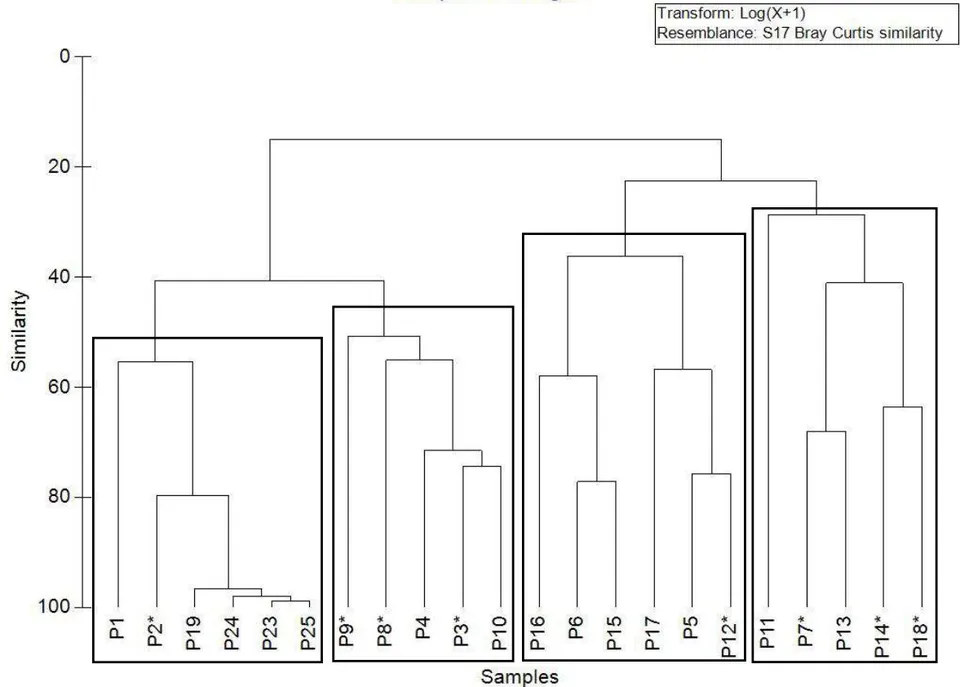
Cluster analysis revealed in 2019 the formation of 4 groups: Group I: P1, P2*, P19, P24, P23, P25; Group II: P9*, P8*, P4, P3*, P10; Group III: P16, P6, P15, P17, P5, P12*, and Group IV: P11, P7*, P13, P14*, P18*. Group I encompasses statios in the Pium River with the lowest diversities, Groups II and IV presents deeper stations with higher number of species and Amphisorushemprichii has higher proportions in those stations. Same result found in Pirangi 2013 and 2014 which groups were divided based on number of individuals and presence of symbionthic species SBS (Eichler and Moura, 2020).
VI. DISCUSSION
Local variables such as high hydrodynamic characteristics and other reworking processes are influencing the faunal distribution of foraminifers in this portion of the inner shelf. However, Eichler and Moura (2020) proposed that, at Pirangi Reefal area, where boats dock, and tourists walk upon the reefs, they observe the absence of well-preserved living Amphistegina, as well as higher diversity values from smaller taxa and opportunistic species rather than from SBF suggesting that coral communities in these areas may be at risk.
The occurrence of oil spots in several stations at the moment of sampling (P2, P3, P7, P8, P9, P12, P14, P18, P20, P21, P22) revealed that the spill reached the bottom and the sediment and had immediate consequences for the benthic fauna. We therefore believe that Foraminifera data acts as reliable proxy for water quality and reef health at Rio Grande do Norte State sites. In addition, barren zones formed by stations P20, P21, P22, with no organisms, together with low evenness, probably dissolved due to the acidity due to the oil spill reaching the bottom in that specific area are overcome the already low numbered environment due to the transport and selection of tests by bottom currents, which prevent foraminifer settlement, suggesting that wave energy and exchange with open ocean waters are also influencing foraminifera fauna, also seen by Narayan and Pandolfi (2010) in a similar subtropical estuarine environment.
Results from 2013 and 2014 show dominance of non-SBS Quinqueloculina, and SBS Amphistegina, and Archaias in shallow reef areas of Pirangi corroborated by Araújo and Machado (2008) that found low diversity and evenness at Abrolhos explained by dominance of Quinqueloculina, Amphistegina, and Archaias at shallow, low-energy stations. Quinqueloculina species have become the dominant taxa. After the oil spill in 2019 Archaias became extinct. The extinction of a genera is an acute response of the disaster that will continue to prevent healthy environment to reestablish for many decades. Also, a change from SBF to heterotrophic foraminifers such as Quinqueloculina lamarckiana like we have seen in 2019, after the spill, is also indicating of not well-developed ecosystem.
The already low frequency of stained foraminifers in Pirangireefal area that was determined by Eichler and Moura (2020) were described as related to the same factors listed by Bicchi et al. (2002), such as empty tests should be common in reef areas and/or most reef-dwelling foraminifers live attached to reefs, stalks and macro algae, and only empty tests should be found free in the sediment after a reproductive event. Thus, the assemblage, although modified by postmortem processes, is an averaged mosaic of spatially and temporally (at least the last year) varying communities, as shown by Wilson and Ramsook (2007) in the West Indies. In according to Eichler and Moura (2020), Pirangi has marginal environment for reef growth and is unsuitable for recovery after stress events according to the index interpretation proposed by Hallock et al. (2003).
This is true especially in areas with tourist activities; indicating stressed environments and that Pirangi is not suitable for coral reef growth, and the oil spill reached an already impacted area. The present study shows that Foraminifera can be used as good proxy of reef health and can contribute to the management plans of the Pirangi reefal area of the National Marine Park by applying knowledge of its foraminifer assemblage to the diagnosis of the region's environmental health, and by providing a first insight to the pattern in which organic matter is distributed in the sediment across depths.
By associating the foraminifer composition with the sedimentological data, we conclude that coarse and fine sand fractions are the controlling parameters on faunal composition at Pirangi, and that depositional energy plays an important role in the transportation and deposition of sediments and the foraminiferal habitat. The presence of reworked Quinqueloculina shows that changes besides the oil spill yet to be identified are occurring in the area and must be taken into consideration in further studies. These changes may be linked to erosion occurring at the beaches near the reefal area that is uncovering relict environments.
In the reef area close to the tourist sites and where oil reached the bottom there are low numbers of SBS individuals, and foraminiferal abundance; however, in non-reef areas, there are no individuals at all. Opportunists are dominant in coastal stations where people walk upon the reefs. This is the negative effect of trampling in the coral reefs and has been discussed by Kay and Liddle (1989), and similar consequences of anthropogenic changes are already seen at Pirangi (Eichler et al., 2019).
The dominance of smaller foraminiferal taxa, including stress-tolerant species, and minimal representation of BSB taxa, indicate unsuitable conditions in these reefal area. Anthropogenic disturbances in coastal marine environments are threatening marine life. Reefs in Pirangi that are trampled by tourists face an eminent coral and foraminiferal community death. Agricultural land use increases amount of sediment, nitrogen, phosphorus, and turbidity in nearby rivers. The oil spill happened on top of all of it.
The BSB Foraminifera Amphistegina gibbosa is present at both coastal and deeper stations, however, Amphistegina gibbosa is not found at sites where reefs are walked upon, whereas Amphisorus hemprichii is sometimes present because of its flattened morphology. If interpreted together with live observations, is a reliable tool to reconstruct changes in the coral reef's health in the past, and long-term assessments are needed in order to improve our knowledge regarding the distribution and ecological importance of Brazilian reef-dwelling foraminifers, as well as to extend the application of the Foraminifera science to large-scale monitoring of this and other reef ecosystems in the southwestern Atlantic. This is a proxy that can be used to evaluate coral reef health in the past, and in the present can be used to evidence areas where benthic communities are supposed to thrive.
Due to their proximity to the coast, the Pirangi reefs are vulnerable to anthropogenic effects. One of these is the trampling of the biological coverage by the visitors who frequent the reef each year with low to no consciousness. Thus, the data obtained in this study show that disturbances (natural or anthropogenic) can result in a different distribution of the benthic organisms in the reef area, as evidenced by the differences in foraminifera diversity and coverage percentage among the sampling stations. Moreover, these results allow us to infer that the area of Pirangi has undergone changes resulting from human activities and that the differences in biological composition can be used as an important indicator of the health of the Pirangi reef process and development.
VII. CONCLUSION
- Higher diversity values from smaller taxa and opportunistic species rather than from SBF suggests that coral communities are may be at risk.
- Oil spots in P2, P3, P7, P8, P9, P12, P14, P18, P20, P21, P22 revealed that the oil reached the bottom sediment with immediate consequences for the benthic fauna
- Barren zones formed by stations P20, P21, P22, are due to the acidity due to the oil spill reaching the bottom
- Quinqueloculina species have become the dominant taxa, and after the oil spill in 2019 Archaias became extinct.
- A change from SBS to heterotrophic foraminifers such as Quinqueloculina lamarckiana like we have seen in 2019, after the spill, is also indicating of not well-developed ecosystem.
- Pirangi has marginal environment for reef growth and is unsuitable for recovery after stress events, specially in areas with tourist activities; and the oil spill reached an already impacted area.
- The presence of reworked Quinqueloculina shows that changes besides the oil spill yet to be identified are occurring in the area and must be taken into consideration in further studies. These changes may be linked to erosion occurring at the beaches near the reefal area that is uncovering relict environments.
- The dominance of smaller foraminiferal taxa, including stress-tolerant species, and minimal representation of BSB taxa, indicate unsuitable conditions in these reefal area. Anthropogenic disturbances in coastal marine environments are threatening marine life.
- Reefs in Pirangi that are trampled by tourists face an eminent coral and foraminiferal community death. Agricultural land use increases amount of sediment, nitrogen, phosphorus, and turbidity in nearby rivers. The oil spill happened on top of all of it.
- Amphistegina gibbosa is not found at sites where reefs are walked upon, whereas Amphisorus hemprichii is sometimes present because of its flattened morphology.
- Due to their proximity to the coast, the Pirangi reefs are vulnerable to anthropogenic effects. Disturbances (natural or anthropogenic) can result in a different distribution of the benthic organisms in the reef area, allowing to infer that the area of Pirangi has undergone changes resulting from human activities and that the differences in biological composition can be used as an important indicator of the health of the Pirangi reef process and development.
ACKNOWLEDGEMENTS
The authors are grateful to the Marine Geology and Geophysical and Environmental Monitoring Laboratories (Laboratório de Geologia e Geofísica Marinha e Monitoramento Ambiental Coastal/GGEMMA), and to the Graduate Program in Geology and Geodynamics (PPGG) of the Federal University of Rio Grande do Norte (UFRN).
We are grateful to CAPES for funding support through Projects Special Visiting Professor (PVE 151-2012, AuxPe242-2013), and Ciências do Mar II (23038.004320/2014-1) that enabled a Pos Doc fellowship for P.P.B. Eichlerat Moss Landing Marine Laboratories of San Jose State University (MLML/SJSU), and at the Ocean Sciences Department of the University of California at Santa Cruz(UCSC) (88887.305531/2018-00, 88881.188496/2018-01 and 9999.000098/2017-05).
We want to thank the Technical Support to Strengthen National Palaeontology (Apoio Tecnico para Fortalecimiento da Paleontología Nacional, Ministerio da Ciência e Tecnologia MCTI/National Research Council CNPq N° 23/2011, N° 552976/2011-3).
This work was carried out under the scope of INCT Amb Tropic phase II (CNPq Process 465634/2014 1) linked to the Emergency Action to combat the 2019 oils pill of the MCTI (DTI-A 381360/2020-2 fellowship to PPB Eichler). We are grateful to the ANP- PRH 22 and the CAPES Project "Oceanographic process in the breaking of the continental shelf of northeastern Brazil: Scientific foundations for special marine planning" for the financial assistance granted, to the crews of the vessels used, and to all colleagues of GEMMA/UFRN. We are also thankful to CNPq for the research grants for co-author Gomes M.P (PQ 302483/2019-5) and for co-author Vital H (PQ311413/2016-1, PQ 315742/2020-8). We are especially thankful to the GGEMMA Lab team(PPGG/UFRN) that made possible to carry out this work. The authors also thank EcoLogic Project for supporting the publication of this research.