## I. INTRODUCTION
Electoral systems are often discussed... but not so decision-making. The former may be used to elect a single individual, as in a presidential election, or a large number of representatives, as in a congressional/parliamentary contest, and they vary from the simplistic binary vote used in North Korean elections, via many single-preference voting procedures as in first-past-the-post FPTP in the UK and USA, or the relatively unsophisticated forms of proportional representation PR such as the single-preference Dutch version, to the multi-preference systems of ranked choice voting $\mathsf{RCV}[^1]^1$ which is used in Ireland and Tasmania, and is becoming more popular in the USA. With sometimes the exception of binary voting, most or even all of these electoral systems – and there are over 300 of them – are regarded as democratic. They can however be compared and ranked from the unfair via the mediocre to the accurate.
This article is devoted almost entirely to decision-making, a subject all too rarely considered by politicians and/or political scientists. It first reflects on the history of binary voting, its inherent errors, and some of the consequences of the widespread application of this divisive, adversarial and often inaccurate voting mechanism. Asking a resident of Northern Ireland – "Are you Protestant or Catholic?" – or a citizen of Rwanda – "Are you Hutu or Tutsi?" – or anybody during the Cold War – "Are you communist or capitalist?" – was at least unwise. Indeed, "[s]imple majority decisions... cannot be fair in a democratic sense because the imposition of binary alternatives is itself unfair." (Riker 1988: 64.)
A further consequence of binary voting is the way many elected chambers divide into two. And because political parties also use this voting procedure, they too tend to split into opposing wings or factions. Now mathematically, a half of a half is a quarter; $51\%$ of $51\%$ is only $26\%$; and likewise, a majority of a majority might well be a minority. So majority rule, especially in countries like Israel where all too often the policies of government are those of the extremist wing, rarely exist. (See also para 4.1.) One notable exception is Switzerland, which enjoys all-party power-sharing.
Having critiqued (simple or weighted) majority voting, the text then considers and compares some of the other decision-making voting mechanisms – single preference systems like plurality voting and two-round voting; the non-preferential approval voting; and three preferential systems, AV, along with the Condorcet and Borda rules.[^3] It then presents a scientific analysis of the last named, which is a preferential points procedure. Finally, it discusses the potential benefits that might accrue from a world-wide adoption of this more sophisticated methodology: cooperation and compromise;[^6] both of which could help to facilitate the survival of our species.
## II. A LITTLE HISTORY
In Greece about 2,500 years ago, "sovereign power was held to reside in the Assembly, and was exercised by majority vote, by counting hands." (De Ste Croix 2004: 75.) Some 400 years later, binary voting was also used in China in "the Court Conference of the Former Han Dynasty, [202 BCE – 23 CE] and decisions were based on the opinion of the majority... [which] as a rule, were accepted by the Emperor," (Wang 1968: 176).
Though confined to the male gender, the developments in Greece were profound. Those involved "learned... the powers of the proposer, the rights of expressing an opinion... when to give way and when to stand firm, how long to speak and when to keep silence... how to introduce an amendment, in short the whole of senatorial procedure." (McLean and Urken 1995: 14).
And procedures there must be, of course, especially on contentious issues in which, initially at least, there may well be a majority against every proposal. Such was the case recently in the UK, when the British House of Commons was debating its relationship with the EU – the Brexit debate. In two so-called 'indicative votes,' the members of parliament voted on eight and then just four options; in both ballots, there were majorities against everything... but they varied, from over 300 members against the most unpopular option, to just six members against the least unpopular. So maybe the last named was the winner.
Let it be assumed that the 9 voters have the preferences shown in Table I.
That, after all, was how Slovenia resolved a three-option referendum in 1996: there were three options, and majorities against all of them... so the winner was judged to be the option with the smallest majority against. In Britain, however, there was only more wrangling, and at that time, no decision was taken.
If and when there is a majority against everything, there might also be a majority opposed to the final result. In theory. The conundrum is overcome by the fact that, as mentioned in the abstract, there are two types of majority vote: a singleton, "Option $X$ yes or no?" and a pairing "Option $X$ or option $Y$." With singletons, the outcome might indeed be in the negative; there could well be a majority against everything; with pairings, however, (unless, of course, it's a draw), there will always be a definite outcome. And this is how Britain's Brexit debate was 'resolved': Boris Johnston used a pairing, "Do you want 'his deal' or 'no deal'?" was the question. The latter 'no deal' was the most unpopular of all options, so 'his deal' won. But in a pairing, 'any deal' would have won.
### a) Binary Voting
Reducing complex problems to a stark choice of only two options may lead to unfortunate consequences. Consider, first, the theory, a situation in which 9 voters, all of whom don't like the status quo option $S$ very much, are in dispute as to what might be better: 4 of them propose option $X$ 3 seek to amend this to option $Y$, and 2 would prefer a different amendment, option $Z$. The procedure, as laid down by the Greeks of old and still in use today, is utterly dependant on binary voting... which was, after all, the only known voting procedure at that time. Suffice to say, however, that it is based entirely on pairings:
- choose the more preferred amendment;
- adopt or reject this preferred amendment to get the substantive;
- choose either this substantive or retain the status quo.
Table I: A Voters Profile \\begin{table}[htbp] \\centering \\begin{tabular}{I^ccI^cc|} \\hline \\textbf{Preferences} & \\multicolumn{3}{c|}{\\textbf{Number of Voters}} \\ \\cline{2-4} & 4 & 3 & 2 \\ \\hline 1st & X & Y & Z \\ 2nd & Y & Z & S \\ 3rd & Z & S & X \\ 4th & S & X & Y \\ \\hline \\end{tabular} \\end{table}
<table> <tr> <td rowspan="2">Preferences</td> <td colspan="3">Number of Voters</td> </tr> <tr> <td>4</td> <td>3</td> <td>2</td> </tr> <tr> <td>1st</td> <td>X</td> <td>Y</td> <td>Z</td> </tr> <tr> <td>2nd</td> <td>Y</td> <td>Z</td> <td>S</td> </tr> <tr> <td>3rd</td> <td>Z</td> <td>S</td> <td>X</td> </tr> <tr> <td>4th</td> <td>S</td> <td>X</td> <td>Y</td> </tr> </table>
Sure enough, there may be singleton majorities against every option: 5, 6, 7 and 9 against $X$, $Y$, $Z$ and $S$ respectively. When the pairings are considered, however, $X$ is more popular than $Y$ which is written as $X > Y$, and the full analysis is this:
$$
X: Y \quad = \quad 6: 3, \quad \text {s o} \quad X > Y
$$
$$
X: Z \quad = \quad 4: 5 \quad \text {s o} \quad X < Z
$$
$$
X:S = 4:5 so X < S
$$
$$
Y:Z = 7:2 \text{so} Y > Z
$$
$$
Y:S = 7:2 so Y > S
$$
$$
Z:S = 9:0 so Z > S
$$
According to those ancient and current procedures, the order of voting shall be as shown in Diagram I.
### Diagram I: The Order of Voting
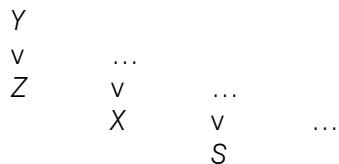
Therefore, if none of those concerned change their opinions, the vote will proceed as in Diagram II.
### Diagram II: The Vote
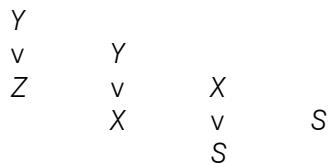
So having decided, initially, that they did not like option S, the 9 then decide, democratically, that they like option S? Something is wrong! Furthermore, if instead of the motion being for option X while the two amendments were options Y and Z, the motion moved was for option Y with $\mathsf{X}$ and Z as the two amendments, the outcome, as in Diagram III, would be different.
Diagram III: Another Equally Democratic Decision
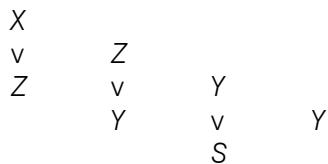
Or again, in another setting:
### Diagram IV: Yet Another Result
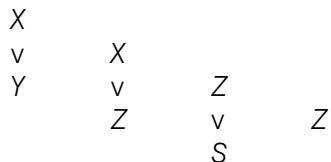
So something is definitely wrong. And that something is the binary vote. In a nutshell, binary voting is manipulable (and often manipulated), especially if, as is the case in this instance, there is a paradox:
$$
X > Y > Z > X \dots
$$
$$
\begin{array}{l} \mathrm {o r} \\X > Y > Z > S > X \dots \\\end{array}
$$
first noted by Le Marquis de Condorcet in 1793, and it goes round and round forever!
If there is such a paradox, the final outcome of any procedure can be determined by adjusting the order of voting; and when there isn't a paradox, if there is a majority in favour of an option which is not favoured by the chair, other options can be introduced in order to split that majority and create a paradox... and then the chair can continue to manipulate at will!
## III. A LITTLE MORE HISTORY
As implied earlier, majority voting worked fairly well both in Greece and in China – but there were no political parties in those days and no other voting procedures had yet been devised. One of the first to realise that this binary procedure had its limitations, however, was Pliny the Younger in the year 105. (McLean and Urken 1955: 15). In a murder trial in a Roman court of law, the jury had three options: A Acquittal, B Banishment and C Capital punishment. So if the question asked was a binary singleton such as "Execute, yes or no?" the A and B supporters would oppose the C crowd, and if asked "Innocent, yes or no?" B and C would oppose A, and so on. Therefore, if there was no majority in favour of any one option, there would be an impasse.
Some ones, somewhere, were bound to devise other decision-making methodologies such as plurality voting, for which credit goes to Pliny the Younger, and the first to use this in governance were the Chinese in 1197, during the Jurchen dynasty. The debate concerned the possibility of war with Mongolia, but of the 84 "highest officials" involved, "only 5 favoured an attack, 46 were for a defensive strategy and the rest [33] preferred alternating between attack and defence," (Franke and Twitchett 1994: 266).
In Europe meanwhile, in the Middle Ages, approval voting was quite widely used, (McLean and Urken 1955: 22). Then, in 1299, Ramón Llull first thought about preferential voting; a century and more later, in 1433, Nicholas Cusanus invented a preferential points system and, as a result of developments undertaken by Jean-Charles de Borda in 1770, this is now called the Modified Borda Count MBC. The $18^{\text{th}}$ Century also witnessed the emergence of AV and the Condorcet rule. The world's first multi-option referendum was held in 1894 in New Zealand, in a rather unique form of TRS, and a number of other countries have also held multi-option plebiscites. In their parliaments and councils, however, most countries continue to rely on binary ballots; most of the very few exceptions are in Scandinavia: Denmark's *Folketing* frequently uses plurality voting but only on three options; the Finnish and Swedish parliaments use serial voting when debating amendments; and the Norwegians used TRS, but only once.
# a) The Bind of the Binary Ballot
Majority voting, however, is ubiquitous: it is used in democracies, theocracies and autocracies, and the consequences have often been horrific. In 1903 the
All-Russian Congress of Social Democrats split into two on a majority vote: 19 to 17, with 3 abstentions (Deutscher 1966: 71); whereupon the winners – not the majority but only the largest minority – 'pretended' they were the majority (bolshinstvo) and called themselves the Bolsheviks, while the 17 whom they called the minority (menshinstvo) became the Mensheviks. (Later, when Mikhail Gorbachev, who did not speak English, came to power in 1985, western 'experts' advised him to adopt the western democratic norm of majoritarianism, without acknowledging that the Russian word for this polity is 'bolshevism'.4) In 1979, Iran became an Islamic Republic on the basis of a referendum, the Shi'a majority voting en bloc, a Sunni minority abstaining. China also uses majority voting. In 1989, with tens of thousands of students protesting in Tian'āmén Square, the CCP Standing Committee under Deng Xiaoping, is understood to have taken a majority vote on the question of military deployment, although Zhao Ziyáng disputes this; (Fenby 2012: 180 and Zhao 2010: 29); it passed, it is said, by one vote, (Emerson 2020: 167).
With the collapse of the USSR, democratisation spread to the countries of eastern Europe: Czechoslovakia split peacefully, but the Balkans exploded: indeed, "all the wars in the former Yugoslavia started with a [binary] referendum," (Oslobodjenje, 7.2.1999), as did today's conflict in Ukraine in 2014.
In 1994, the Interahamwe launched its genocide in Rwanda with the slogan, "Rubanda nyamwinshi," 'we are the majority,' (Prunier 1995: 83).
Despite this appalling history, let alone the above scientific proof of the divisive, adversarial inadequacies of binary voting, many politicians do not even try to embrace pluralism. Instead, they prefer to control things, and in binary voting, especially if the question asked is a singleton, they are in total control of the agenda. In congressional/parliamentary votes, where the powers that be usually command a majority, the question almost always becomes the answer – and binary voting in western if not universal decision-making is manipulable, just as it is in elections in North Korea (and the comparison goes no further); suffice to say that majority voting, both simple and weighted, is enshrined in Article 97 of Pyongyang's constitution. For better or worse, it's not used very often – Article 92 stipulates that parliament shall meet only once a year, (DPRK 2017: 21-2).
In a summary of the above, binary voting is inadequate; in a modern pluralist democracy, it is inappropriate; on contentious topics, it can be hopelessly inaccurate; and at worst, as noted, it can be and often is a provocation to violence.
### b) Multi-option Voting
Multi-option decision-making procedures include:
- plurality voting, where the voters cast just one preference and in which the outcome is the option with the most $1^{\text{st}}$ preferences, either a majority or maybe just the largest minority.
- TRS, which is a plurality vote followed if need be by a second-round majority vote between the two leading options from the first round.
- AV (RCV or STV); this is a series of plurality votes, the least popular option being eliminated and its votes transferred to its voters' subsequent preferences, until one option does get majority support; (NB: a TRS winner may not be the same as an AV social choice).
- approval voting, which I repeat is non-preferential; voters may 'approve' of as many options as they wish, and the winning option is that which wins the most 'approvals'. The intransigent voter will therefore tend to vote for his/her favourite option only. In analysing this procedure, either the top two 'preferences', $1^{\text{st}}$ and $2^{\text{nd}}$, may be analysed, or the top three, or even all of them... and of course, if a different counting procedure is adopted, there may well be different outcomes.
- the BC and MBC, both of which employ a preferential points system, and this, to a greater or lesser extent respectively, can be vulnerable to an irrelevant alternative, (see below).
#### And
- the Condorcet rule, which is an analysis of all the pairings: a Condorcet winner wins all of them; if there is no outright winner, the Copeland winner wins most of them; and in yet other scenarios, there might be a paradox.
Consider then the scenario in which 21 voters are bitterly divided, with the largest minority of 6 voters having the exact opposite set of preferences to the 5 in the next largest minority, while the other ten voters are split in their support for the other options, $B$, $C$, $D$ and $E$.
Their voters' profile is shown in Table II, and while most voters have cast all their preferences, 3 voters have cast only four preferences and 4 only a $1^{\text{st}}$ preference.
Table II:Another Voters' Profile
<table><tr><td rowspan="2">Preferences</td><td colspan="6">Number of Voters</td></tr><tr><td>6</td><td>5</td><td>4</td><td>3</td><td>2</td><td>1</td></tr><tr><td>\(1^{st}\)</td><td>A</td><td>F</td><td>B</td><td>E</td><td>C</td><td>D</td></tr><tr><td>\(2^{nd}\)</td><td>B</td><td>E</td><td></td><td>D</td><td>D</td><td>E</td></tr><tr><td>\(3^{rd}\)</td><td>C</td><td>D</td><td></td><td>C</td><td>E</td><td>C</td></tr><tr><td>\(4^{th}\)</td><td>D</td><td>C</td><td></td><td>B</td><td>B</td><td>B</td></tr><tr><td>\(5^{th}\)</td><td>E</td><td>B</td><td></td><td></td><td>F</td><td>F</td></tr><tr><td>\(6^{th}\)</td><td>F</td><td>A</td><td></td><td></td><td>A</td><td>A</td></tr></table>
With singleton majority voting, there is indeed a majority against every option: of 15:6 against option $A$, of 16:5 against option $F$, 17:4 against $B$, and so on. While with pairings – of which there are 15 – $A:B = 6:15$, so $B > A$, while $EF = 12:5$, so $E > F$, and so on. In this profile, the plurality vote social choice, option $A$, is actually less popular than all the others and loses every pairing in which it may be involved; all the other options, however, win one or more pairings: as noted, $F > A$; in addition, $B > F$, $C > B$, $E > C$ and $D > E$.
A comparison of the various methodologies here discussed is shown in Table III.
Table III: A Comparison
<table><tr><td colspan="2">Methodology</td><td>Social Choice</td><td colspan="6">Social Rankings</td></tr><tr><td colspan="2">Plurality voting</td><td>A</td><td>A-6</td><td>F-5</td><td>B-4</td><td>E-3</td><td>C-2</td><td>D-1</td></tr><tr><td colspan="2">TRS</td><td>F</td><td>F-8</td><td>A-6</td><td colspan="4"></td></tr><tr><td colspan="2">AV</td><td>E</td><td>E-11</td><td>A-6</td><td colspan="4"></td></tr><tr><td rowspan="3">Approval voting</td><td>\(1^{st}/2^{nd}\)</td><td>B</td><td>B-10</td><td>E-9</td><td colspan="2">A/D-6</td><td>F-5</td><td>C-2</td></tr><tr><td>\(1^{st}-3^{rd}\)</td><td>C</td><td>C-12</td><td colspan="2">D/E-11</td><td>B-10</td><td>A-6</td><td>F-5</td></tr><tr><td>All</td><td>B</td><td>B-21</td><td colspan="3">C/D/E-17</td><td colspan="2">A/F-14</td></tr><tr><td colspan="2">BC</td><td>B</td><td>B-77</td><td>D-69</td><td>E-68</td><td>C-67</td><td>A-44</td><td>F-42</td></tr><tr><td colspan="2">MBC</td><td>D</td><td>D-63</td><td>E-62</td><td>C-61</td><td>B-56</td><td>A-44</td><td>F-42</td></tr><tr><td colspan="2">Condorcet</td><td>E</td><td>E-5</td><td>D-4</td><td>C-3</td><td>B-2</td><td>F-1</td><td>A-0</td></tr></table>
In all, therefore, with this particular voters' profile (and many another) the outcome of a democratic vote could be anything at all! So in this (and other) instances, the result depends not upon the preferences of the voters but on the voting rule used!
Of the decision-making procedures listed, the two most accurate are the MBC and Condorcet; after all, they are the only two methodologies here analysed which always take all preferences cast by all voters into account. These two analyses may be compared to a sporting contest: in many tournaments, the champions are the team which wins the most matches (or pairings, for the Condorcet winner), rather than the team which gets the best goal difference (or points, the MBC social choice). Only rarely do sporting contests rely entirely on a binary procedure, and those that do, tennis for example, seed their competitors. Of the two best procedures, the MBC and Condorcet, the former is the more nuanced, and it has one other noteworthy characteristic: it can identify the option with the highest average preference, and an average, of course, includes every (voting) member of the given electorate. The methodology is inclusive, literally. It is non-majoritarian. It is also robust, colour-blind and very accurate.
As in electoral systems, so too in decision-making methodologies: politicians choose that which suits their vested interest. Furthermore, in any multi-optional setting, they are unlikely to support a methodology in which a vote for their $2^{\text{nd}}$ preference might detract from their $1^{\text{st}}$ preference – as is the case in approval voting.
### c) The Preferential Points System
When Jean-Charles de Borda proposed his methodology, he suggested a voter's least popular preference gets 1 point, his next least popular option gets 2 points, and so on. In mathematical terms, this may be described as follows:
in a ballot of $n$ options, the voter may cast $m$ preferences, and needless to say:
$$
n \geq m \geq 1.
$$
in the count, points shall be awarded to $(1^{\text{st}}, 2^{\text{nd}} \ldots \text{last})$ preferences cast, according to the rule:
$$
(m, m - 1 \dots 1).
$$
rule (i)
Accordingly, in a five-option ballot:
- he who casts only a $1^{\text{st}}$ preference gets his favourite just 1 point (and because he says nothing about the other options, they get 0 points);
- she who casts two preferences gets her favourite 2 points
(and her $2^{nd}$ choice gets 1 point);
and so on; therefore
- those who cast all five preferences get their favourite 5 points
their $2^{\text{nd}}$ choice gets 4 points, their $3^{\text{rd}}$ gets 3 points, etc.).
The option with the most points is the winner, the electorate's social choice.
Even during M de Borda's own lifetime, this $m$ rule was changed to
$$
(n, n - 1 \dots 1) \text {o r} (n - 1, n - 2 \dots 0)
$$
rules (ii) and (iii) which, for any one voters' profile, give exactly the same social choice and ranking of course. Unfortunately, these $n$ rules have come to be called the Borda Count. What Jean-Charles actually proposed, however, was the $m$ rule, (Saari 2008: 197), which today is called the MBC.
The $m$ formula encourages (but does not force) the voters to cast many if not all of their preferences; to state not only their $1^{\text{st}}$ preference but also their $2^{\text{nd}}$ and subsequent preference(s), their compromise option(s)... and if everyone does that, then of course it is relatively easy to identify the collective compromise. And that, of course, is what politics is all about. Or it should be.
In effect, a voter's $(\mathbf{x})^{\mathrm{th}}$ preference always gets just 1 point more than his/her $(\mathbf{x} + 1)^{\mathrm{th}}$ preference, regardless of whether or not they have cast that $(\mathbf{x} + 1)^{\mathrm{th}}$ preference. So in a five-option ballot, he who casts a full ballot exercises $5 + 4 + 3 + 2 + 1 = 15$ points, whereas she who casts only one preference exercises just 1 point. So it could be said that his influence is much greater than hers; there again, her influence is far greater than that of those who abstain. It must therefore be repeated, the difference is always just 1 point; the MBC is unbiased.
The $n$ rules, in contrast, tempt the voter to submit a truncated ballot and, at worst, on a really controversial topic, if everyone does submit just a $1^{\text{st}}$ preference so to give their $1^{\text{st}}$ preference an $(n-1)$ advantage over all the other options, the whole thing is not much better than approval voting or even a plurality vote.
It might also be noted that if the 4 voters who gave option $\pmb{B}$ their $1^{\text{st}}$ preference had submitted not just a partial ballot of one preference but a full ballot of six preferences, then their favourite option $\pmb{B}$ would probably have received a more favourable result. So the MBC encourages all to participate, and to the full.
### d) The Science of Social Choice
In nearly every field of human development, as new ideas have been tested and adapted, most inventions and devices have been modernised and improved. One glaring exception is in the science of decision-making, and despite the invention of more sophisticated voting procedures, the 2,500-year-old binary vote is still the basis of decision-making today, in law, business and politics. A knowledge of the science would doubtless help to promote change, yet "the theory of voting... appears to be wholly unknown to anyone concerned with its practical applications. It is certainly quite unknown to the politicians... [and] experts in political institutions..." (Dummett 1984: 5).
Needless to say, with binary voting, the voter (who does not abstain) has a choice of only two options: either 'yes' or 'no' in a singleton, or at best in a pairing, $A$ or $B$. In a three-option ballot, in contrast, the voter may cast a full set of preferences in any one of six ways: $A-B-C$, $A-C-B$, $B-A-C$, $B-C-A$, $C-A-B$ and $C-B-A$. With four options on the ballot paper, there are 24 different ways of voting, while with five options, up to 120 different opinions and nuances may be expressed; thus may societies relish the very natural diversity which is so fundamental to our species. "There's nought as queer as folks," as they say in England's Yorkshire.
## i. Single-peaked Preferences
The choice offered in a preferential ballot may be qualified somewhat in any poll in which the various options may be listed in, as it were, a logical spectrum. A debate on tax rates, for example, might consider various options, from the lowest to the highest; a tax rate of either $0\%$ or $100\%$ would probably be impractical, so the more normal debate could finish up with, say, five options, for example, 40, 45, 50, 55 and $60\%$. Needless to say, the list should be balanced and represent all the valid options proposed in the debate which precedes it.
Now he who has a $1^{\text{st}}$ preference for $40\%$ would probably have a $2^{\text{nd}}$ preference of 45, a $3^{\text{rd}}$ of $50\%$ and so on; so his full set of preferences would be 40-45-50-55-60. She whose $1^{\text{st}}$ preference was for 45 might have a set, as shown in Table IV, of 45-50-55-60-40, or something similarly logical, like 45-40-50-55-60. These sets are called single-peaked preferences.
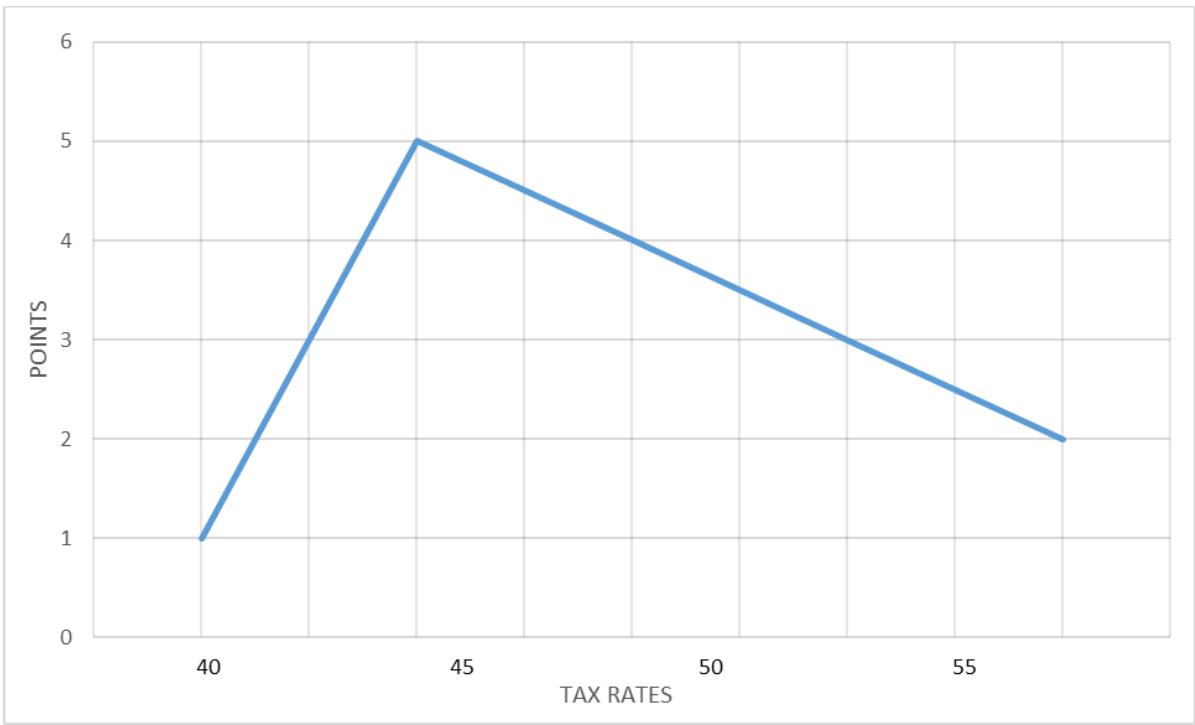 Table IV: A Single-peaked Set of Preferences
With five options, there are 14 different single-peaked sets of preferences, (Emerson 2022: 99-104). Furthermore, if (most or at best) every member submits a single-peaked set, the collective will of all the voters shall also be single-peaked, always! As too would be any consensus. The joys of science!
It would of course be highly unlikely for a politician to have a set of preferences with more than one peak, something like 45-55-40-60-50, as shown in Table V. In a Congress or Parliament where the votes of elected representatives shall be in the public domain, in many debates, most if not all sets of preferences cast will be single-peaked; if not, the members' constituents and/or the press may have some serious questions to ask!
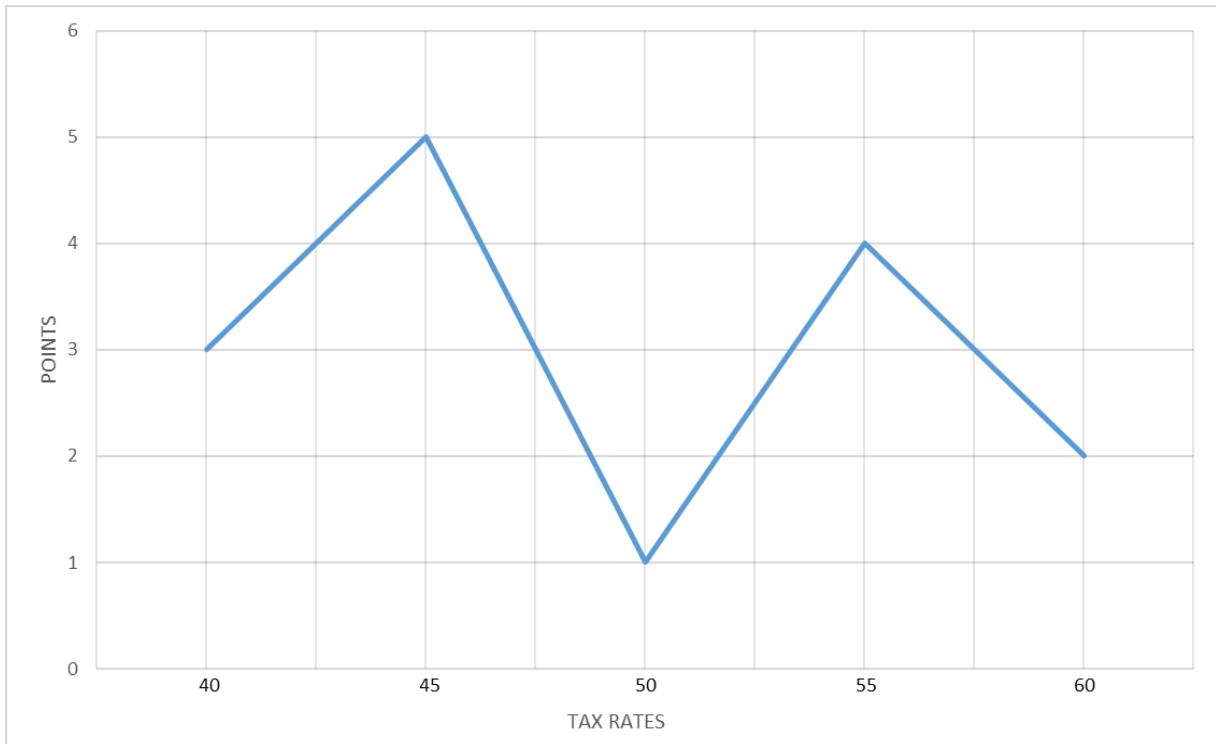 Table V: A Questionable Set
## ii. Consensus Coefficients
Admittedly, on some occasions, for reasons of conscience or whatever, some members may submit only partial ballots, casting not a full slate of five preferences but only some or, at worst, only one. In which case, calculating the options' average preference scores becomes difficult if not impossible. For this reason, and also to make the numbers a little more manageable, consensus coefficients are used. An option's consensus coefficient CC is defined as that option's total number of points received, divided by the maximum possible number of points which could have been received.
With 150 members voting in a five-option ballot, and with everyone casting all five preferences, the highest possible average preference score would be a result for let's say option A of 150 in number $1^{\text{st}}$ preferences:
$$
\mathrm {C C} _ {A} = \frac {1 5 0 \times 5}{1 5 0 \times 5} = 1. 0 0
$$
If everyone gives option $B$ their $5^{\text{th}}$ preference:
$$
\mathrm {C C} _ {\mathcal {B}} = \frac {1 5 0 \times 1}{1 5 0 \times 5} = 0. 2 0
$$
And if everyone gives option $C$ a $3^{\text{rd}}$ preference, or an equal number of $2^{\text{nd}}$ and $4^{\text{th}}$ preferences, or some other equally balanced combination of them all, like 50 each of $2^{\text{nd}}$, $3^{\text{rd}}$ and $4^{\text{th}}$ preferences:
$$
C C _ {c} = \frac {1 5 0 \times 3}{1 5 0 \times 5} = 0. 6 0
$$
or
$$
= \frac {5 0 \times 4 + 5 0 \times 3 + 5 0 \times 2}{1 5 0 \times 5} = 0. 6 0
$$
In any vote, if the final outcome gets a CC of less than 0.70, then there is no consensus and no decision should be taken. Instead, as in traditional decision-making in the barazas[^5] of Africa, the debate should be resumed at a later time, concentrating perhaps on those options which were albeit only slightly more popular. If however:
$$
0.7 0 \quad \leq \quad C C _ {\text{WINNER}} \quad < \quad 0.8 0
$$
it may be termed the best possible compromise. If
$$
0.8 0 \quad \leq \quad C C _ {\text{WINNER}} \quad < \quad 0.9 0
$$
it could be called the consensus. And if
$$
0.9 0 \leq C C _ {\text{WINNER}} \leq 1.0 0
$$
it might well be regarded as the collective wisdom.6
## IV. AN HISTORICAL REFLECTION
As noted, the MBC was developed by Jean-Charles de Borda at the same time as Le Marquis de Condorcet devised his Condorcet rule. After a debate between the two in l'Académie des Sciences, the former methodology was adopted in l'Académie where it worked fairly well. Unfortunately, some of those involved opted to truncate their ballots, which prompted M de Borda to say that his system, "was only for honest" voters. (McLean and Urken 1955: 40.)
These of course were traumatic times, revolution was in the air, and one politician in particular, the new boss of the now re-named l'Institut Français, did not like this preferential format, so he reverted to majority voting... for thus he could control things. Indeed, all too often, in majority voting, the question is then the answer, and "The vast majority of referendums have been sponsored by governments and have produced the voting outcomes desired by those governments" (Butler and Ranney 1994: 261). Shortly afterwards, in 1803, he held his third referendum: he chose the question, he chose himself, and so he became l'empereur, a 'democratic dictator' one might say. The vote in favour was $99.7\%$. The next dictator managed to improve on this performance, and he was an Irishman: Bernardo O'Higgins got $100\%$ when he became El Supremo in Chile in 1818. Other dictators soon followed: Adolf Hitler and Frances Duvalier, (Emerson 2012: 147), to name but two.
Not only he but almost all politicians – as noted earlier, democratic, theocratic and autocratic – like majority voting. As often as not, it means that they can choose the question and in many instances, not only in referendums but also in congresses/parliaments, that question is then the answer. Hence the calls by those who want their own particular constitutional settlement for referendums in Ireland, Scotland, Catalonia and Republika Srpska, and hence too the 'false flag' ballots in Crimea, Donetsk and Luhansk wanted by Vladimir Putin. In 2014, (which was also the year of Scotland's referendum), when Putin wanted the people of the two latter regions in Ukraine to be independent (of Ukraine), the word 'Shotlandya' was used by Russian separatists.[^7] 'Everything is connected,' to quote the Ukrainian philosopher, Vladimir Vernadsky. In 2022, he changed his mind: he how wanted these citizens to vote to be incorporated (into Russia)... and sure enough, we are told, the electorates had also changed their mind in exactly the same way!?
## V. A QUANTUM POLITY
A quantum polity is a political structure in which decision-making is based on a non-majoritarian, preferential points voting procedure. A major change would stipulate that, in any referendum and in any vote in the elected chamber, the choice of options on the ballot paper should always be taken by those independent of the executive. So how would it work?
In let us say a five-party congress or parliament, in a debate on, say, the nation's finances, the government of the day might propose its budget. If other parties wish for something different, then, similar in a way to a German constructive vote, (Federal Republic of Germany, 1949: Article 67), they may propose an alternative budget – not an amendment to this or that paragraph, but a complete package, albeit laid out in a similar format. The Speaker shall allow every relevant proposal (which complies with the UN Charter) to be 'on the table' and computer screen, if not too a dedicated website. Next, in the debate itself, participants may suggest amendments, a composite, or even a deletion. Such alterations, however, shall only be adopted if the original proposer(s) agree to such a change.
Thus, during the course of the debate, the number of options in contention may vary. If it all boils down to just the one policy, this may be deemed to be the verbal consensus. If not, the Speaker shall draw up a ballot of at least three or better still four, but seldom more than seven options, to represent the entire debate. Next, if all the proposers whose options are still on the table agree that their particular option has been included – either verbatim, amended or in composite – they may proceed to the vote. Then, if the winning option has passed the predetermined CC threshold, it may be enacted.
### a) Consensus
Binary voting is adversarial. So wherever binary voting is used – i.e., almost everywhere, although one notable exception is in the United Nations' Conferences of the Parties COP gatherings – politics is adversarial, and many elected chambers divide into two. It need not be so.
Since the Kyoto Climate Change Conference in 1997, the COPs have been meeting every year, to discuss the latest proposals to limit, for example, Global Heating, or the destruction of the rain forests, or the melting of the icecaps and the resulting rise in sea levels. Trying to get over 100 countries to agree on anything, however, is difficult. And yet, for reasons unknown, the COPs have thus far failed to even consider any of the above multi-option let alone preferential procedures.
As noted, the MBC can identify the option with the highest average preference. Now in every democracy, the people elect the congress/parliament and, if the electoral system is fair and accurate, the will of the elected chamber should approximate to the will of the people. Furthermore, in democratic theory, the elected representative should participate, not only in identifying the will of the House, but also in implementing this democratic will... even if it is not his/her $1^{\text{st}}$ preference.
In debate, every member shall respect the right of others to hold different legitimate viewpoints, all of which, if these opinions and/or aspirations are on the ballot paper, then they have already been recognised by the Speaker as being compliant with the UN Charter. Accordingly, in casting their preferences, members should be able to submit a full ballot, for all the options listed have been determined to be valid. Furthermore, because success in the vote will depend not only on $1^{\text{st}}$ but on all preferences received, every party campaigning for its own policy will have a vested interest in cooperation.
Now if every member does thus state not only their $1^{\text{st}}$ preference but also their individual compromise option(s), it is of course possible to identify the collective compromise (para 3.3): at best, (i.e., if everyone has cast a full ballot), this is the option with the highest average preference. Thus might the words 'majority' and 'minority' fade from the political lexicon. Instead, as is so necessary in these days of Climate Change, politics could be non-partisan, and governance could be real majority rule, that which, as was said above, pertains in Switzerland and which in conflict zones is called all-party power-sharing.
As has been seen in many European countries, choosing even just a majority administration can be problematic. In recent years, parliaments in Germany, the Netherlands and Belgium have often spent long periods behind closed doors, working to concoct an executive - 161 days in 2017 and 298 in 2021 in the first two, while Brussels holds the world records of 541 and 494 days in 2010/11 and 2019/20. In some countries, the resulting administration is not very wholesome: in the UK in 2017, the Tories joined forces with the extremist Protestants from Northern Ireland; in Austria in 1999, the extremist Freedom Party was a member of a right-wing coalition with the People's Party, both on 52 seats, while the bigger Social Democrats on 65 were left in opposition; the Netherlands had something similar in 2010, although its Freedom Party, the third member of a coalition, had no ministerial positions; perhaps the worst instances are in Israel where extremists often wag an already right-wing dog, sometimes as in 2015 with a majority in parliament of only one. (Emerson 2016: 31 et seq.)
Pluralism is possible. And maybe, in Israel for example, if the Arab List is sufficiently strong in parliament, it should by right be in government as well. Real majority rule demands all-party coalitions. Switzerland has enjoyed power-sharing since 1959, using what it calls 'a magic formula' so that the five most popular parties in parliament may appoint the seven members of its Federal Council according to the ratio 2:2:1:1:1 and, with one change in the formula to reflect emerging differences in the various parties' electoral fortunes, the magic seems to be working.
In conflict zones, any purely verbal procedure for forming an administration would be protracted at best, so in many instances, a formula has again been adopted: Northern Ireland relies on a d'Hondt interpretation of its Assembly elections, Bosnia shares power in a three-way presidency, and Lebanon ensures all the main religious groupings are in at least one influential position of power. Unfortunately but inevitably, these formulas tend to perpetuate the very sectarian divisions they were designed to mitigate.
A better polity would allow the said jurisdiction's general election to be followed by a second equally open and transparent contest in which the members of the newly elected chamber would (not select but) elect its executive in a voting procedure called the matrix vote. This involves a two-dimensional ballot paper – and hence the name 'matrix' – on which every member could choose, in order of preference, not only those whom they wanted to be in the executive, but also the department in which they wished each nominee to serve. A matrix vote is PR, so at best, the outcome would be an all-party executive in which every minister appointed would be regarded (albeit maybe only in the consensus of the House) as suitable for his/her portfolio, while every faction in the assembly would be represented in its proportional due. (Emerson 2022: 39-46.)
Given that the matrix vote is preferential PR, any party with $40\%$ of the seats in Congress could expect to get roughly $40\%$ of the seats on the executive and, as seen with RCV in the States and PR-STV in Ireland, this electoral procedure prompts every party to nominate only as many candidates as it thinks it can get elected. Therefore, in voting, there would be no point in any member of this $40\%$ party in voting only for members from just this one party. The vote is also based on the MBC, which means the member would be incentivised to submit a full ballot. Thus every member would be encouraged to cross not only the gender gap and the party divide, but also, in conflict zones, the sectarian chasm; this, it is suggested, is an essential feature of any good power-sharing polity.
## VI. CONCLUSION
The human race will not survive unless we learn to share this little planet in a sustainable way. As the COPs know all too well, reaching consensus decisions can be difficult. As implied above, with binary voting it is impossible, so the COPs have resorted to a purely verbal procedure which they call consensus... but this sometimes leads to protracted debates if not, at worst, to the application by one or more countries of a veto – the very opposite of consensus!
With preferential points voting, however, with the MBC, cooperation in decision-making become possible. In a real democracy, it could be argued, nothing should happen without consensus. If there is no consensus for oil exploration and extraction in the Arctic, Mr Trump, then there should be none. If there is no consensus for the further destruction of the rainforest, Mr Bolsonaro, then again there should be none. Consensus is not, however, a formula for inaction. These two individuals would find working in a non-partisan administration at least difficult. A structure in which ministers appointed to serve in the administration were those who won the most cross-party support; a structure in which in any dispute, the options to be voted on were not theirs alone but rather a selection chosen independently by the Speaker, would not be to their liking. Indeed, when the most powerful positions in the land were thus no longer to be in politics, ambitious politicians might well confine their goals to the marketplace (which if it too were no longer based on majority holdings and the like, might also not suit their lust for power).
At the moment, however, both in Ireland and Germany for example, there is huge opposition amongst the more established parties to working with the extremists, Sinn Féin and the Alternative für Deutschland respectively. Their reluctance continues, despite the fact that in Ireland for example, Sinn Féin is rising in the polls, and with the support of a few independents perhaps, might even command a majority after the next elections.
But that is almost by the way. The priority for humankind must be a comprehensive agreement on policies required to tackle Climate Change. Hence the need for the above preferential points system of voting. Furthermore, this consensus voting is part of an holistic policy: it can facilitate the resolution of problems both small and large. No majority has the right to dominate; no minority has the right to veto; instead, everyone has the responsibility to come to a collective decision. Nothing else is democratic. Nobody wins everything, but (almost) everybody wins something. Indeed, the MBC can be the very catalyst of consensus.
[^5]: The Kiswahili word denoting a meeting, often of the elders, in which those concerned sat in a circle to debate a dispute until, maybe days later, a verbal consensus was found. _(p.8)_
[^7]: The author, a Russian speaker, was an OSCE election observer in 2014, and in five earlier contests. _(p.8)_
[^1]: The European name is the single transferable vote, as in PR-STV; and in Australasia, this system is called preference voting PV. _(p.1)_
[^2]: This electoral system is often used in committees, not least at AGMs when choosing next year's officers. _(p.1)_
[^3]: Otherwise known as RCV or STV; (see also footnote 1). _(p.1)_
[^4]: Embarrassed somewhat, back in the 1980s, Moscow coined a new term, majoritarnost. _(p.4)_
[^6]: The Speaker may wish to adjust these thresholds, as Congress/ Parliament becomes more used to their deployment. _(p.8)_
[^8]: A party with three quotas of supporters should best nominate just three candidates. If it nominates six of them, each might get only half a quota of $1^{\text{st}}$ preferences and it would thus fail to get anyone elected, at least in the first stage of the count. _(p.10)_
Generating HTML Viewer...
References
16 Cites in Article
D Butler,A Ranney (1994). Conclusion.
De Ste,G Croix (2005). Athenian Democratic Origins.
Democratic People's 2017, Socialist Constitution of the Democratic People's Republic of, Republic of Korea Korea.
I Deutscher (1966). Pelican Lake, Manitoba.
M Dummett (1984). Voting Procedures.
Peter Emerson (2012). Majoritarian Democracy: The Catalyst of Populism.
J Fenby (2012). Tiger Head Snake Tails.
(1949). Basic Law for the Federal Republic of Germany.
H Franke (1994). The Cambridge History of China.
D Twitchett,Cambridge Unknown Title.
I Mclean (1995). Classics of Social Choice.
G Prunier (1995). The Rwanda Crisis.
W Riker (1998). Liberalism against Populism.
D Saari (2008). Disposing Dictators, Demystifying Voting Paradoxes.
Y.-C Wang (1968). An Outline of the Central Government of the former Han Dynasty.
No ethics committee approval was required for this article type.
Data Availability
Not applicable for this article.
How to Cite This Article
Peter Emerson. 2026. \u201cEvolving Decision-Making: Exploring the Shift from Binary to Preferential Voting\u201d. Global Journal of Human-Social Science - F: Political Science GJHSS-F Volume 23 (GJHSS Volume 23 Issue F4): .
Explore published articles in an immersive Augmented Reality environment. Our platform converts research papers into interactive 3D books, allowing readers to view and interact with content using AR and VR compatible devices.
Your published article is automatically converted into a realistic 3D book. Flip through pages and read research papers in a more engaging and interactive format.
Our website is actively being updated, and changes may occur frequently. Please clear your browser cache if needed. For feedback or error reporting, please email [email protected]
Thank you for connecting with us. We will respond to you shortly.