
Introduction
Existential questions are themes intrinsic to human nature. Throughout human history, people have questioned constantly the meaning of life. Anthropological evidence supports this idea of giving meaning to life, which is evident in the rock art and funeral rites of ancient civilizations, as markers of existential rather than necessarily utilitarian actions. Seeking the meaning of life appears to be a fundamental task experienced within this process.
But how might one go about seeking this meaning? From a religious perspective, by seeking mythical explanations or transcendental revelations that could be followed as unquestionable oracles? Or, perhaps, would it be better to be guided by the thread of reason, through which one could conduct a thorough analysis of arguments for or against the justification of the problem? Or might there be, through the channels of subjectivity, experiences, emotions and feelings, a more direct, sensitive and concrete path to finding meaning?
Such questions, originally of a philosophical nature, have spilled over into the field of psychology and, despite the vicissitudes, have become a focus of this field of scientific knowledge throughout its history. Along this journey, notions linked to the meaning of life and existential dilemmas have at times been more obscured, as in the birth of experimental psychology, and at other times more evident, as in the emergence of post-war humanistic psychology, depending on the context and the paths taken by psychology in its journey as both a science and a profession.
In the contemporary era, these have taken on specific contours with the advent of the Covid-19 pandemic (Yıldırım & Arslan, 2021; Lin, 2021; Tsibidaki, 2021), when the flow of everyday life was interrupted and the vertigo of uncertainties about existence became a reality. What seemed to be fictional literature – the spread of a lethal virus that would wipe out humanity – took on substance and became reality. This circumstance forced contemporary humanity to turn towards its existential situation, revealing its concerns about existence, beyond objective and pragmatic issues.
A systematic review of the literature previously conducted, focusing on the theme of existential issues in psychology and their treatment in articles published over the last 23 years, shows that, generally speaking, the literature produced during this period tends to prioritize discourse centered on logos (Alencar & Freitas, 2023a). There was a predominance of descriptive research, focusing on the distribution, scope and quantification of the phenomenon studied (e.g., Wilt, J. et al, 2018; Li & Wong, 2020; Yoon et al., 2020), prioritising the nomothetic and quantitative approach (72% of the articles retrieved, according to Alencar & Freitas, 2023).
Specifically, a gap was revealed in theoretical studies in psychology, accounting for only 17% of the results; among these, integrative reviews were found to be moderately explored, comprising 13% of the total, compared to literature reviews, which accounted for more than half of the sample. These integrative reviews focused on the study of the meaning of life in relation to other variables, such as human relationships (e.g., O’Donnell et al., 2014), life satisfaction (e.g., Sameer et al., 2023), spirituality (e.g., Silva et al., 2020), mental health in teachers (e.g., Santos & Silva, 2022), as well as the investigation of topics such as logotherapy and clinical supervision (e.g., Nassif et al., 2010) and the revitalisation of humanistic psychology (e.g., Wong, 2017).
In other words, most studies of this type, although scarce in general, have addressed the dimension of meaning in relation to other variables, whilst a small proportion have analysed epistemological attributions. Thus, through the observation of the prevailing paradigm in psychology, which bears echoes of the positivist tradition, certain gaps are revealed, signalling the need to further explore qualitative approaches that are in line with the object of study.
That is to say, for subjects of a dynamic nature, such as human beings and their need for meaning, there is a lack of approaches that capture this nature and offer consistent and creative alternatives for dealing with meaning. Therefore, this research aims to shed light on these gaps (the lack of qualitative research, with an integrative theoretical approach and epistemological focus) and to contribute to psychology and its treatment of existential issues, focusing on logotherapy. The aim is thus to gain a better understanding of the existential phenomenon and its meanings, in accordance with the concepts of existential void and the meaning of life, as well as its relationships with psychological distress and mental health, based on the studies reviewed.
Whether in the past or the present, the science of the psyche sometimes leans towards the language of logos, understood as objectivist and prioritising rationality*,* as seen, for example, in Behaviourism and Cognitive Psychology, and at other times, towards the language of mythos, understood as subjective and favouring intuitive reason*,* as seen in Analytical Psychology, Humanism, Existentialism and Phenomenology. The present study aims to conduct an integrative review of the psychological literature published between 2000 and 2023, focusing on the framework that leans towards the language of mythos, with an emphasis on logotherapy, to analyse how existential void and the meaning of life are addressed, highlighting epistemological contributions and practical applications for psychology in addressing these existential issues. In this article, the following are taken as parameters for the analyses: the theoretical core, indicating the concepts employed in the aforementioned studies; the relationships established between the meaning of life or existential void and other possible variables; the resources used to investigate or work with such themes in people’s lived experience and in psychological practice. Finally, we tend to list the main recommendations, contributions and limitations of this body of work, taking into account its constructs, methodological implications, techniques and practices derived from a critical assessment of this bibliographic landscape of logotherapy based research.
Method
This integrative review is derived from systematic reviews previously conducted in earlier studies (Alencar & Freitas, 2023a). The first systematic review provided an overview of the literature on the meaning of life and existential void in the contemporary context of psychology, employing a quantitative analysis to identify general trends, statistical data and predominant research approaches, revealing an emphasis on empirical research procedures. The second systematic review, derived from the first, was of a quantitative and qualitative nature, delving deeper into the theoretical frameworks used in the articles, as well as the concepts and themes employed in relation to existential void and the meaning of life, with particular emphasis on logotherapy as a theoretical framework and further discussions on the theme of meaning.
Therefore, the present integrative review was developed based on these previous studies, initially using the same procedures as a systematic review, gathering, organising, analysing and synthesising the results found in different studies. However, unlike the systematic review, which sought to map, in depth, different pre-established variables, using meta-analysis and statistical analysis, as well as categorising concepts and themes across the different articles, with a more qualitative-quantitative analysis of the data, this integrative review qualitatively analyses the available body of knowledge regarding existential issues from the perspective of logotherapy, focusing on the concepts of existential void and the meaning of life, aiming for a deep understanding of the phenomena studied.
Thus, as derived from the systematic review detailed previously (Alencar & Freitas, 2023a), this study covered five databases: the CAPES portal, APA PsycArticles, SCOPUS, SCIELO and PEPSIC. The selection of these databases followed the following criteria: a) geographical scope – national, Latin American and international; b) scientific relevance, considering the quality of the indexed sources and journals with a relevant impact factor in the field of Psychology; c) standing within the scientific community, particularly in Brazil, the location of this research; and d) inclusion of the fields of psychology and health in general, to ensure a diversity of studies in terms of scope and content.
The main search terms used were “existential void” and “meaning of life”, associated with the concepts of “mental health” and “psychology”, involving various combinations with related expressions, as detailed in the search protocol previously outlined in the first article (Alencar & Freitas, 2023a, p.8 ). As this process was rigorously detailed in previous studies, this review presents the stages described above succinctly, highlighting the inclusion and exclusion criteria for the present study, as follows.
Eligibility Criteria
As inclusion criteria, the preliminary screening involved: a) the theme of existential void and the meaning of life as the central focus of the research; b) the contemporary period spanning 2000 to 2023; c) restriction to articles published in Portuguese, English and Spanish; and d) the subject area of psychology, as strictly detailed in Alencar and Freitas (2023a, p.10 to 12). In this integrative review, the following inclusion criteria were also considered: d) articles with a qualitative and mixed-methods approach, detailed rigorously in Alencar and Freitas (2023b, p.9 to 10) and e) articles with theoretical framework influenced by phenomenological, existential and humanistic approaches, with a focus on logotherapy for this present article.
These approaches share common roots in sciences aimed at understanding phenomena, placing value on the individual’s subjective experience, although they exhibit fundamental distinctions. Phenomenology is based on the rigorous description of lived experiences, seeking to capture the essence of phenomena as they manifest themselves to consciousness, through the suspension of prior assumptions. The existential approach, in turn, focuses on the analysis of existence as an act of freedom, emphasising issues related to freedom, responsibility, anxiety, the search for meaning and finitude (Figueiredo, 2013). The humanistic approach, on the other hand, emphasises the capacity for agency, highlighting human potential, self-knowledge and self-actualisation. These approaches maintain epistemological and methodological links with phenomenology, sharing a focus on subjective experience and the description of phenomena as they are experienced by consciousness. Logotherapy, founded by Viktor Frankl (1978), is an approach with links to existential and phenomenological traditions and emphasises the search for meaning as the primary motivation in human life.
As exclusion criteria, we initially list those already considered in previous articles (Alencar & Freitas, 2023, p.9 to 11), namely: a) the theme of existential void and the meaning of life addressed only tangentially or secondarily; b) grey literature, that is, documents such as dissertations and theses published outside conventional publication channels; c) articles not available in full; and d) articles with a quantitative approach. To the criteria already established, the criteria of excluding articles that use theoretical frameworks other than those derived from logotherapy was added for the specific purposes of this article. It should be noted here that positive psychology, despite its humanistic foundations, was not included in the studies, as it has a more pragmatic than existential appeal, focusing on the promotion of the positive aspects of human experience. The initial focus on logotherapy aims to achieve a more comprehensive understanding of subjective experience, focusing on meaning in life, regardless of any prior judgment as to whether that experience is classified as positive or negative. At the same time, approaches from other fields, such as sociology and philosophy, although they also contribute to understanding the complexity of the phenomenon, were excluded, both for methodological reasons: as a narrower focus is necessary to conduct a more targeted analysis, and for reasons of delimiting the area of study, centring on the epistemology of psychology. Similarly, studies based on two theoretical orientations, such as psychoanalysis and existentialism (e.g., Ratto, 2014) and existential positive psychology (e.g., Vieira & Dias, 2021), were also excluded from the sample, as the aim was to identify therapies explicitly of an existential-phenomenological nature, with a focus on logotherapy, in order to limit the scope of the research. Although existential positive psychology engages with themes such as meaning, suffering, death and flourishing, its origins and epistemology stem from positive psychology, which constitutes a distinct epistemological field. According to Wong (2010, p.2), humanistic existential psychology “broadens the definition of Positive Psychology as the qualitative and quantitative study of what enables people to survive and flourish, individually and collectively, in all of life’s circumstances”. Furthermore, by also drawing on the traditional scientific paradigm, with quantitative empirical methods emphasising measurement and statistical evidence, this methodological commitment differs from the phenomenological- existential approach, which prioritises an in-depth description of subjectivity. As this study focuses on the phenomenological-humanistic tradition, which prioritises a qualitative understanding of lived experience, including positive psychology and existential positive psychology in the research would require broadening the scope to encompass distinct methods and concepts, thereby affecting the study’s internal coherence.
Selection of Studies and Data Processing
The criteria considered relevant to the selected sample were identified by reviewing the title, methodology and introduction of the articles, the section where the theoretical framework was predominantly presented.
In order to systematise this data identification process, the articles were organised into spreadsheets created in Excel, identifying the following variables: article title, theoretical framework or epistemological approach, variables studied, abstract and objective, theme, reference and year, as illustrated in Table 1. The reading and selection of the sample was carried out by the first author of this review, under the supervision of the co-author, including external searches for articles where the selected studies did not explicitly state the theoretical framework employed.
| Article title | Theoretical Framework | Variables studied | Abstract | Topic | Reference and Year |
| Talking about death and finitude in the school environment: a study in the light of the meaning of life. | Logotherapy | Meaning in life Death and finitude | The aim of this study was to identify adolescents’ conceptions of death and its implications for the meaning of life. To this end, an action research study was conducted to address the theme of finitude based on Viktor Frankl’s conception of the meaning of life and death... The results highlighted the importance of addressing the theme of finitude within the school setting. | Meaning in life and death | Aquino et al., 2014 |
Based on this process, only those articles that adopted the logotherapy framework were selected; following a full and exhaustive reading, these were classified and analysed according to the following categories, which are summarised in Table 2:
a) Theoretical core of the articles, comprising the following subcategories:
a1. philosophical anthropology, that is, the way in which the theoretical foundation of the articles conceives of human beings and their existential questions, and how it positions itself regarding human nature and the way in which it is constituted;
a2. conceptual structure, that is, how the main paradigmatic concepts of the theory adopted in the articles are defined and interrelated;
b) Variables related to existential void and/or the meaning of life, also divided into two subcategories:
b1. axiological categories: e.g., psychological distress, mental health, psychotherapies, amongst others.
b2. contexts investigated and associated with the theme of each article.
c) Resources to address existential issues.
The classifications used in the integrative analysis described here were inspired by Laurenti et al. (2016). In this work, different levels of conceptual analysis are described, among which the most restricted level was chosen, seeking to explore the core concepts of the theories and their meanings (Laurenti et al., 2016, p.43).
Furthermore, as psychological theory and the respective psychotherapies involve the study of humanity and are centred on humanity, it was also decided to include the category of philosophical anthropology, to better understand how psychological schools of thought conceive of the human being. Philosophical anthropology is a branch of philosophy that seeks to understand humanity in its entirety and its relationship with the world. It considers their bio-psycho-social-cultural dimensions and their differentiation from other living beings (Cassirer, 1997). It’s important to consider that philosophical anthropology underpins clinical practice, as all psychological practice, whether implicitly or explicitly, presupposes a conception of the human being with whom one is working, providing care for, or studying. When applying therapeutic resources or techniques, it is essential to ask oneself to which subject one is offering the possibility of care. Thus, philosophical anthropology offers a conception of the human being, and clinical psychology, in turn, grounded in this conception, proposes a therapeutic approach. For example, if we consider a conception of the human being determined by their biology, the patient will be viewed as an organism, for whom clinical strategies aimed at correcting and regulating symptoms will be sought. On the other hand, if the image of the human being centres on a self-determining perspective, with an intentional, situated, relational consciousness that seeks meaning, clinical practice will focus on strategies to understand how the individual lives and makes sense of their lived experience. From this perspective, clinical practice is not restricted to a set of technical procedures, but is rather a practice grounded in an anthropological and epistemological understanding of the human being.
Furthermore, an attempt was made to identify the variables related to existential issues, whether of an axiological or contextual nature, in order to map out what and how research is being conducted in this field of study. The research plan concludes by describing the resources employed in the work on existential issues. These resources were presented in the articles in at least three forms:
a) Described- where the research sets out the characteristics and details of the technique or other variant, as in the case of the study on Socratic clinical practice, in which the author details what the technique is, its guidelines and stages, as reproduced below:
The first instance of Socratic dialogue is characterised by the therapist adopting a position that is both naive and ironic; Frankl consistently recommended this approach (Freire, 2002). However, these positions must be used with caution to avoid appearing disrespectful to the client... Once a safe environment has been established, the therapist listens in silence so that the client can openly express their problems to the therapist. (Martinez & Florez, 2014, p. 5)
b) Employed- when the resource is presented in the form of practical application, as in the case of action research or experience reports. For example, in the study by Santos (2019), which aimed at a type of education that promoted personal and existential development, the strategy of literary expression was used with university students. Therefore, in the research, reading Viktor Frankl’s work Man’s Search for Meaning was employed as a resource*,* describing the respondents’ perceptions of the meaning of life.Table 2 presents the research plan.
c) Proposed- when, based on the scope of the research, the author presents proposals for addressing existential issues. For example, in the study by Bolmsjö et al. (2019), which aims to develop a definition of the concept of existential loneliness, methods are suggested that include existential dialogues in education and, as an additional proposal, creating space within the healthcare system to address existential issues.
Table 2: Research Plan
| Categories investigated for each approach | ||
|---|---|---|
| a | Theoretical framework | |
| 1 | Philosophical anthropology | |
| 2 | Conceptual framework | |
| b | Variables related to existential void and the meaning of life | |
| 1 | Axiological categories | |
| 2 | Contexts investigated | |
| c | Resources for addressing existential issues | |
| 1 | Described resources | |
| 2 | Employed Resources | |
| 3 | Proposed resources |
Findings
Following a preliminary search before this study (Alencar & Freitas, 2023a), a total of 264 articles were initially identified, focusing on existential void and the meaning of life, published over the last 23 years. From these articles, in a second stage (Alencar & Freitas, 2023b), a total of 73 articles employing qualitative and mixed-methods approaches were selected. Of these, applying the inclusion criteria adopted in this integrative review, a total of 34 articles were selected, comprising 10 on existentialism, 4 on phenomenology and 20 based on logotherapy, which is the focus of this study. The flowchart shown in Figure 1 briefly illustrates the search process.
Despite this systematic refinement, the relatively small number of articles focusing on logotherapy (only 20) highlights a limited sample size. This limitation may restrict the generalisability of the findings and the scope of contemporary phenomenological-existential psychology. Consequently, to gain a broader understanding of this field, future studies with more diverse samples are required. It should be emphasized, however, that this study focuses on understanding the existential phenomenon based on the concepts of existential void and meaning of life, as well as their relationship with mental health from the perspective of logotherapy, distancing itself from generalizations and the formulation of laws.
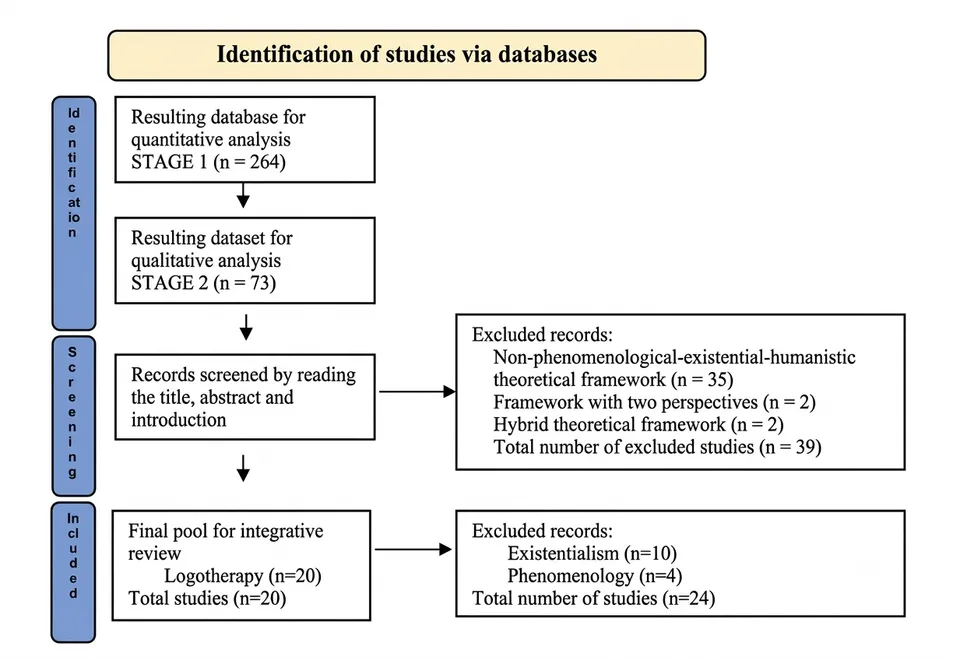
Note. Model adapted from the PRISMA flow diagram. (Page et al., 2020).
Table 3: Characterisation of the selected articles
| Logotherapy | ||
| Article | Title | Reference |
| L 1 | Spirituality and Health in Viktor Frankl’s Logotherapy | Carrara, 2016 |
| L 2 | Religion, spirituality and health: a logotherapy perspective | Aquino, 2021 |
| L 3 | Revisiting Viktor Frankl’s ideas on the centenary of his birth | Roehe, 2006 |
| L 4 | The contributions of Viktor Emil Frankl’s thought to the formation of evaluative consciousness | Telles et al., 2022 |
| L 5 | Clinical Supervision and Logotherapy: Discovering Meaning in the Supervisory Relationship | Nassif et al., 2010 |
| L 6 | Meaning-Centred Psychotherapy: A Socratic Clinical Practice | Martínez & Florez, 2015 |
| L 7 | Prostitution and the meaning of life: relationships of meaning | Corrêa & Holanda, 2012 |
| L 8 | Viktor Frankl’s contributions to the public health movement | Silveira & Gradim, 2015 |
| L 9 | Ways of being: the search for meaning in life. | Carneiro & Abritta, 2008 |
| L 10 | Meaning of life and mental health in teachers: an integrative review | Santos & Silva, 2022 |
| L 11 | Logotherapy: a perspective on psychotherapy. | Kroeff, 2011 |
| L 12 | Logotherapy: understanding the theory through a concept map | Santos, 2016 |
| L 13 | The meaning of life in accounts of discontinuity in criminal careers: a qualitative analysis of two cases | Jiménez-Ribera & García-Alandete, 2021 |
| L 14 | The meaning of life for the relatives of critically ill patients. | Lima & Rosa 2008 |
| L 15 | Talking about death and finitude in the school environment: a study in the light of the meaning of life. | Aquino et al., 2014 |
| L 16 | Evaluation of a proposal for the prevention of existential void among adolescents | Aquino et al., 2011 |
| L 17 | The meaning of life for mothers with children in the neonatal ICU | Silva et al., 2021 |
| L 18 | Description of the meaning of life among juvenile offenders in the city of Medellín | Horacio, 2011 |
| L 19 | Education for meaning in life and values: university students’ perceptions based on Viktor Frankl’s book “Man’s Search for Meaning” | Santos, 2019 |
| L 20 | Variables associated with the meaning of life | Noronha et al., 2018 |
Table 3 presents the list of articles found with a reference to logotherapy, followed by their analysis according to the three categories of analysis adopted in this study: a) theoretical core; b) variables related to existential void and the meaning of life; and c) resources for addressing existential issues.
Methodological Features of the Included Studies
This review found that the majority of the studies analysed adopt a theoretical qualitative approach, comprising procedures such as literature and documentary reviews of the works of Viktor Frankl and other relevant authors who discuss the Austrian psychologist’s work (e.g. Carrara, 2016; Aquino, 2021; Roehe, 2006; Telles et al., 2022; Nassif et al., 2010). In these studies, the concepts and constructs relating to the meaning of life, existential void and related phenomena were identified through conceptual reflections, literature reviews (e.g. Aquino, 2021; Corrêa & Holanda, 2012; Kroeff, 2011; Martínez & Florez, 2015; Silveira & Gradim, 2015), integrative reviews (e.g. Nassif et al., 2010; Santos & Silva, 2022) and concept mapping (e.g. Santos, 2016).
On the other hand, other empirical qualitative studies have predominantly used semi-structured interviews and interventions in specific contexts (e.g. Aquino et al., 2014), enabling values to be understood through the experiences reported by participants. The Life Story Interview II (McAdams, 2008) was also used for data collection, a model of semi-structured interview and content analysis (Bengtsson, 2016; Braun & Clarke, 2006; Herzog, 2016) (e.g. Jiménez-Ribera & García-Alandete, 202) and semi-structured interviews and content analysis in the style of Bardin (1977) (e.g. Lima & Rosa, 2008; Aquino et al., 2014).
Furthermore, studies employing a mixed-methods approach combine standardised instruments, such as the Purpose in Life Test, with quantitative analysis using the Statistical Package for the Social Sciences (SPSS) and qualitative analysis using discourse analysis (e.g. Horacio, 2011); also free association tests and analysis using the semantic networks technique (e.g. Silva et al., 2021); and reading reports and questionnaires using a likert scale for data collection and content analysis (Bardin, 2000), supported by NVivo 10 software (e.g. Barreto dos Santos, 2019). These studies combine statistical analyses with qualitative strategies, offering a more comprehensive understanding of values from the perspective of logotherapy.
Theoretical framework
As described in the methodology, the characterisation of the approach according to its theoretical framework was based on philosophical anthropology and conceptual structure, with an emphasis on how each article understands the ‘meaning of life’ and ‘existential void’. Consequently, the presentation of the analysis results will follow this same sequence, as set out below.
Philosophical Anthropology
Some articles emphasised the philosophical anthropology present in the approach, citing the concepts of freedom and responsibility as central to the logotherapeutic perspective (Roehe, 2006; Telles et al., 2022). From this perspective, the human being is seen as a free and responsible being capable of making their own decisions. However, this freedom has its limitations, as there are genetic-physiological and social constraints (culture, economy, education) (Jiménez-Ribera & García-Alandete, 2021). These variables influence, but do not determine the human beings. Viktor Frankl, the founder of logotherapy, rebelled against pan-deterministic perspectives, which viewed human beings as entirely determined by other reductionist factors, conceiving of humans solely in their biopsychic dimension; and against nihilistic views, which denied values such as freedom (Aquino, 2011). Thus, man is seen as a self-determining being, as it is he who responds to the conditions that arise. His consciousness (Rhoe, 2006), regarded by Frankl as the organ of meaning, with its characteristic of intentionality, is what guides him.
Another important point regarding the conception of man in Logotherapy and Existential Analysis relates to dimensional ontology. Its key distinguishing feature is the inclusion of a new dimension, termed noetic, in addition to the psychophysical (Rhoe, 2006; Correa & Holanda, 2012; Aquino et al., 2014; Silveira & Gradim, 2015; Santos & Silva, 2022; Telles et al., 2022; Nassif et al., 2010). The somatic dimension corresponds to physiological and biological aspects; the second, of a psychic nature, corresponds to emotions, perception and cognition; and the third, the noetic dimension - derived from ‘nous’, meaning spirit - refers to that which is strictly human. In other words, it encompasses all the creative activity of the spirit, the axiological dimension, with religious, ethical, moral and aesthetic values, as well as the awareness of finitude, given that man is a mortal being (Aquino et al., 2014). This includes “the possibility of going beyond oneself – self-transcendence - and distancing oneself from bio-psycho-social determinants - self-distancing” (Silveira & Gradim, 2015, p.154).
Conceptual framework
It is noted that logotherapy possesses a well-structured theoretical core, centred on two axes: the first focuses on the concept of the meaning of life, structured around a conceptual triad encompassing freedom of will, the will to meaning, and the meaning of life (Aquino, 2021; Nassif et al., 2010; Santos, 2019). The second axis, meanwhile, focuses on axiological categories, considering a second triad: values of creation, values of experience and values of attitude. (Santos, 2019; Santos, 2016; Noronha et al., 2018).
Freedom of the will implies that although human beings are influenced by existing conditions, they possess the potential to make decisions and shape their own history. The will to meaning is understood as the primary motivation of human beings, who tend to seek meaning. And the meaning of life is posited as something concrete, dynamic and present in every situation of human life, making it necessary to find it.
Concerning the second axis, it is through this triad of values that meaning in life is realised: whether by offering something to the world, such as a job or a work of art, signifying the value of creation; or by receiving or experiencing something with the world, such as a meaningful encounter with someone, love for a person, or even an aesthetic experience, signifying the value of experience; or by adopting an attitude towards adverse situations or suffering, corresponding to attitudinal values (Santos, 2016, 2019; Noronha et al., 2018).
Meaning of Life
In logotherapy, the concept of meaning takes on a specific semantic dimension: ‘meaning in life’. This assumes a dynamic character, from a perspective of becoming, as meaning changes according to the person, the time and the circumstances. In other words, it is understood as something changeable and as something concrete in the world. This differs from the expression ‘meaning of life’, which has a broader scope and a more universal character, signifying the meaning of existence as a whole (Frankl, 1946/2019). The Austrian psychiatrist’s conception is based on the assumption that meaning pre-exists and that it is up to man to seek and find it. He does not speak of a construction of meaning, but of a rediscovery (Frankl, 1983 cited by Horácio, 2011). In parallel, three expressions are frequently mentioned to distinguish different types of will identified in human beings by the three Viennese schools of psychotherapy: the will to pleasure, a hedonistic conception driven by human drives and instincts, coined by Freudian psychoanalysis; the will to power, coined by Adler’s individual psychology, denoting the will to social superiority; and the will to meaning, by the Franklian school, understood as a primary motivation that drives human beings in search of meaning in life (Aquino et al., 2014; Kroeff, 2011).
On the other hand, when this human will to meaning is not fulfilled and is therefore frustrated, a sense of meaninglessness emerges, which is termed existential vacuum. Other synonymous terms are also used to refer to this state, such as existential void and existential frustration (Horácio, 2011; Aquino, 2011; Carneiro & Abritta, 2008). It should be noted that existential void is not considered a pathology. Still, it can lead to a state of noogenic neurosis (Santos, 2016), understood as a neurosis that occurs in the dimension of the nous (spiritual). As such, it is not of instinctual origin, as Freud theorised, but is related to conflicts of ethical or moral values and existential issues (Horácio, 2011). Existential void is also identified in research as being at the root of problems or dysfunctions in contemporary society, such as drug addiction, alcoholism, violence, depression and even suicide: “Without generalising and with caution, it can be observed that the rise in depression has become the most evident symptom of existential void (Fizzotti, 2002, cited by Carrara, 2016, pp. 69–70; Silveira & Gradim, 2015).
Variables Related to Existential Void and Meaning of Life
This category of analysis aims to summarise information relating to research that has identified associations between meaning of life, existential void and other variables, whether axiological or contextual, as set out below.
Axiological Categories
a) Meaning of life, religiosity and spirituality – L1 and L2
Both studies presented the logotherapy perspective on the theme of religiosity and spirituality, with L2 seeking to verify the relevance of the proposal. L1 highlights the distinctive feature of logotherapy as an approach that fosters the relationship between psychology and religion, contrasting with schools of thought that hold a negative view of this relationship. Both articles highlight the spiritual dimension postulated by Frankl as having great therapeutic potential, since, by allowing religious and existential questions to emerge spontaneously, it enables a rehumanisation, contributing to psychological well-being and the promotion of mental health. The difference between theology and psychotherapy is emphasised, the former being focused on the study of metaphysical issues and the latter on the treatment of psychological issues, psychological dysfunction and/or the promotion of human potential.
b) Meaning of life and logotherapy - L3, L5, L6, L11, L12
All the studies that include logotherapy within their scope sought to explore its theoretical core, highlighting some constituent aspect of the theory. Study L3 focuses on a synthesis of Frankl’s theory, with an emphasis on the conception of man and the meaning of life. It highlights the anthropological distinction of this theory, which conceives of man as a free, responsible being with the autonomy to make his own choices. It situates the theory within the phenomenological and existential fields, rebelling against reductionism and against the idea of man as determined by his id. Study L12, for its part, also of a theoretical nature, aims to explore the theory of logotherapy conceptually, using a concept map. In it, the researcher presents the two core axes of logotherapy: one formed by the triad comprising freedom of will, the will to meaning and the meaning of life; and the other by the triad of values, including values of creation, experience and attitude. Additionally, he weaves a network of concepts, clarifying the relationships between them.
Studies L5, L6 and L11 correlate logotherapeutic principles with supervisory practice and clinical practice. L5 explores how logotherapeutic principles can enrich the supervisory relationship and concludes that the incorporation of these principles can enhance the relationship between supervisor and supervisee, regardless of their theoretical orientations. When dealing with issues of values, logotherapeutic principles can aid in understanding and managing conflicts of values. Study E6, meanwhile, focuses on clinical practice, aiming to provide concrete guidelines. In particular, it cites the Socratic dialogue technique as an important tool with therapeutic potential, facilitating the client’s progress. Similarly, study L5 also highlights the suitability of implementing logotherapeutic principles in various orientations and contexts, combining them with other perspectives, as this aids in the understanding of values and in a better visualisation and delineation of life projects. Study L11 outlines the central tenets of logotherapy and compares them with other perspectives such as psychoanalysis and individual psychology. It highlights that there is no standardised system for conducting psychotherapy, but that there is a desire to broaden the patient’s capacity to understand values, as well as to empower the individual beyond pleasure and work, enabling them to cope with suffering, given that this is an inherent dimension of human life.
c) Meaning of life and mental health – L8 and L10
Study L8 aims to reflect on the legacy and contributions that Viktor Frankl’s approach can bring to public health. It provides an overview of the themes proposed by Frankl, such as self-transcendence/self-distancing, the will to meaning, values, existential void, and noogenic neuroses, all of which are relevant to public health. The proposal is a call to medical anthropology, emphasising that establishing dialogue on these themes can aid in rehumanisation. In this way, it challenges the biomedical sterility present within the field of public health, which goes so far as to dismiss the patient’s subjectivity and experience.
As a practical approach to integrating logotherapy into the public health system, a relevant strategy would be to incorporate its trans-theoretical principles into public policies relating to mental health. In this regard, one option would be to provide training in the principles of logotherapy for healthcare professionals in general, including those within the traditional biomedical system and the field of psychology itself. Among these, the following may be mentioned: the therapist’s open attitude towards listening to the patient, in a spirit of acceptance and non-judgment; work with narrative psychology or bibliotherapy, utilising narratives or storytelling in interventions and the reconstruction of personal histories; as well as educating professionals to make space in consultations for existential questions such as the meaning of life. Another possibility at the social and community level would be the establishment of support groups focused on constructing meaning and reframing experiences. Such initiatives, grounded in logotherapeutic principles, can foster a more humanised approach to care, particularly within the biomedical sphere, where the focus is on treating the individual as a whole organism.
Additionally, the L10 study investigates the relationship between meaning in life and mental health in a specific population: teachers. It concludes that a lack of meaning is associated with burnout syndrome and perceived stress, just as meaning is associated with well-being and better psychological functioning. It also reiterates that analyses involving other professionals similarly conclude that meaning in life plays a preventive role in psychopathologies. Attention is drawn to the need to test theoretical models and interventional practices to validate theories, and to implement mental health practices in different contexts, which help people discover the meaning of existence, broadening their perspective to the possibilities of meaning and the perception of values.
Research Context
a) Meaning of life, existential void and education – L4, L18 and L20
The above studies converge in highlighting the role of education in promoting a sense of life. All emphasise the importance of education in also being oriented towards an axiological foundation, in addition to its traditional role of transmitting knowledge. There is a contemporary need to educate oneself in values, promoting a sharpening of consciousness for a better perception of the demands of each situation and of existential responsibilities. They highlight that the current reductionist model, focused solely on cognition, may contribute to existential void, given that the dimension of human phenomena is undermined by technique and the transmission of objective knowledge. Study L4 presents the contributions of logotherapy to the formation of a value-oriented consciousness, that is, one focused on the perception and categorisation of values. Research L18, on the other hand, taking a more practical perspective, uses bibliotherapy to promote awareness, encouraging the discovery of values, self-knowledge, and approaches to problems and the handling of adversity. Study L20, also of a practical nature, validates a proposal for the prevention of existential void in adolescents. It also utilises resources such as fables, poems, parables and metaphors to translate philosophical language into practical life. It is concluded that the intervention promoted a sense of meaning and a reduction in levels of despair and existential void.
Resources for Working on Existential Issues
In light of the above, it is evident that existential issues have come to the fore in the contemporary context, characterised by a sense of existential void, a view supported by various authors (e.g., Carrara, 2016; Silveira & Gradim, 2015; Santos, 2016). Having outlined the philosophical assumptions, based on the conception of man and the presentation of the conceptual framework, as well as having presented the correlation between the constructs and different variables, it is necessary to translate this theoretical framework into the practical sphere, with the goal of contributing concrete alternatives for clinical practice. Thus, this section presents some resources outlined in the analysed articles for managing and working with existential issues.
a) Techniques adopted in the therapist’s approach, presented in a descriptive manner: When spiritual and religious issues arise, the therapist must adopt an appropriate approach, without repressing or imposing guidance (L2), and remain open to the patient’s worldview (L3).
b) Techniques regarding the psychotherapeutic procedure, presented in the form of proposals: Within the therapeutic setting, broadening the scope of the work, going beyond psychological reconstruction, bringing the discussion of the meaning of life into the picture (L1); relate psychotherapeutic work to values (L3); and empower the individual beyond pleasure, leisure and work, enabling them also to cope with suffering (L11).
c) Socratic Dialogue: Described in study L6 and indicated both for the therapist-client relationship and in the individual interviews conducted in the research (L13), as well as in group discussions with researchers, termed ‘multi-dialogue’ (L16), being a resource employed in the last two studies. This is a logotherapeutic resource inspired by the Greek concept, when the philosopher Socrates, using a technique called maieutics, through an ironic stance and the formulation of questions, brought to light the ideas of the people with whom he was conversing. This technique is recommended for mobilising the client’s noetic or spiritual dimension (L6), stimulating the search for meaning (L20) and promoting a change in existential attitude (L13). According to Frankl (1994, cited by Martínez & Florez, 2014, pp. 5–6): “In logotherapy, the implementation of Socratic dialogue requires the establishment of a safe environment, a genuine encounter between the therapist and the client, and an attentive disposition to listen and discover meaning in the dialogue.”
d) Values Awareness Technique: This is a technique used to increase awareness of a person’s hierarchy of values, whether ethical, moral or personal. In the selected article, this technique was described and recommended for use in both supervisor-supervisee and supervisor-patient relationships, promoting the articulation and communication of values. It can be implemented through reflective dialogue, self-assessment, group discussions and personal narratives (L5).
e) Narrative psychology: This technique aims to reconstruct personal stories in a narrative form, fostering a connection between personal experiences and relationships with others. It can foster empathy, a deeper understanding of values, and consolidate identity (L13). In the selection, it was employed and exemplified as narrative criminology, which can bring benefits in the treatment of offenders by stimulating a sense of purpose in the reconstruction of narratives.
f) Bibliotherapy: This is a strategy that uses resources such as books, short stories, fables, poetry, parables, amongst others, to facilitate ontological understanding (L4, L16). It was mentioned as a resource both in the educational context, to broaden awareness of values (L4), being presented as a proposal, as well as in therapeutic interventions (L16), being employed in the research through fables and parables, aiming to adapt logotherapeutic philosophical language into a more accessible form. Through this strategy, it is possible to learn about values, overcoming adverse situations, resilience and adaptability through knowledge of others’ life experiences, as in the case of Viktor Frankl’s (1946/2019) work, Man’s Search for Meaning, in which the psychiatrist recounts his life experience in Nazi camps. Through allegorical narratives, parables convey higher realities, transmitting values and meanings, whilst fables, using fictional characters (inanimate, anthropomorphic beings), convey educational messages and moral lessons (Ferreira, 1975, cited by Aquino et al., 2011). In the educational context, the inclusion of education in human values is advocated as a strategy to prevent existential void, as a means of broadening awareness of values, learning about responsibility, developing an understanding of values, self-knowledge, and the development of skills such as adaptability and resilience in the face of adverse situations.
Discussion
The purpose of this integrative review was to present what has been published in the contemporary literature of psychology, with a focus on logotherapy, regarding existential void and the meaning of life, from 2000 to 2023. The aim was to ascertain how these studies are being conducted and how they might contribute to addressing existential issues.
Of the 34 articles retrieved, the research revealed that the logotherapy approach of the Austrian psychiatrist from the Third Viennese School, Viktor Frankl, stood out, with twenty recorded findings, that is, more than half of the studies found.
It is worth highlighting the seminal role of Viktor Frankl’s logotherapy regarding the construct of the meaning of life, which was mentioned in the majority of the studies, regardless of their theoretical orientations. It is evident that the complementary role of this approach, as proposed by its founder himself, truly fulfils this condition, as it can cooperate with various psychotherapeutic schools. It thus becomes apparent that logotherapy possesses a characteristic that could be termed ‘trans-theoretical’, due to its suitability for different perspectives. However, Frankl (1946/2019), whilst advocating the principle of cooperation, cautioned that it was necessary to exercise conscious eclecticism, always respecting the client’s uniqueness. It should be emphasised that, although it possesses this complementary characteristic, logotherapy also has autonomy and is employed as a central approach. The key distinguishing feature of this perspective, also known as ‘existential analysis’, was that it brought both ‘logos’ (understood as meaning) and existence into the therapeutic setting (Frankl, 1978, p.197). These are themes not explicitly addressed in the traditions that preceded it, such as: the meaning of life, which is not a focus of Freudian psychoanalysis; and existence, which is overlooked in behaviourism.
Logotherapy has a systemic theoretical core, with its own lexicon encompassing two central axes: a triad comprising freedom of will, the will to meaning and the meaning of life, and another triad of values, categorised as creation, experience and attitude (Frankl, 1946/2019). These ethical, moral and aesthetic values take on paramount importance in the current context, a hypermodern era witnessing an axiological crisis. Through the restoration of these values, meaning in life is realised and, in this way, it presents itself as an invitation to minimise existential pathologies. Another key aspect of this school of thought is its dimensional ontology. That is, it adds a dimension to the conception of man, termed the noetic or nous dimension (Frankl, 1994). It is within this dimension that those attributes exclusively human are found, distinguishing man from animals: religious, ethical, moral and aesthetic values, as well as consciousness. Based on this classification, Viktor Frankl leaps his conception of psychotherapy, as he views man as a self-determining rather than a determined being, forging his own path despite existing constraints. In this way, he differed from the premises proposed by Sigmund Freud and Alfred Adler (Figueiredo, 1991/2013), who conceived of man as the result of extrinsic and intrinsic forces, merely as a product of the environment.
Among the variables explored by logotherapy-oriented research, the relationships between the meaning of life and religiosity and spirituality, logotherapy as a form of psychotherapy, and mental health and education stand out. Logotherapy aligns itself with the spiritual dimension of the human being and fosters a reconciliation between psychology and religion. It posits this spiritual dimension as something healthy in the human being and sees in it great therapeutic potential, serving as a source for the maintenance of mental health. By incorporating the triad of values as one of its theoretical premises, logotherapy extends its applicability to the field of education, where researchers have argued for an education focused on teaching values and existential issues (Santos, 2019; Aquino, 2011, 2014). Such a practice would educate human beings for existence, broadening their consciousness and existential responsibilities, not limiting itself merely to the transmission of objective knowledge and cognition, a system currently in place. Thus, an invitation is extended to the community to educate for values.
Among the resources mentioned in the articles for addressing existential issues, the following can be listed: a) the therapist’s stance when religious and spiritual issues arise, demonstrating appropriateness and openness; b) the therapeutic procedure, including logos in therapy, preparing the individual for suffering and incorporating a forward-looking perspective; c) emphasis on Socratic dialogue in both research and clinical practice, as a form of dialogue that engages the interviewee in the search for meaning and in their existential attitude; d) raising awareness of values, to enable clients to appreciate them more fully; e) narrative psychology, using the reconstruction of stories to consolidate identity and values and strengthen bonds in personal relationships; and f) bibliotherapy, using reading as a means of learning about values, resilience, adaptability to adverse situations, and learning through the experiences of others. It is worth noting that the last two approaches rely on storytelling, whether oral or written, to engage with the dimension of meaning, through one’s own experience or that of others.
The results highlight the importance of the logotherapy approach in psychological practice, particularly due to its trans-theoretical nature, which allows it to engage with other theoretical frameworks in psychology, fostering a richer heuristic and broadening the scope of comprehensive and interventionist strategies. Thus, in this study, the systematisation of theoretical foundations stood out, such as the triad of values and the noetic dimension of the human being; alongside the identification of relevant variables associated with existential void and the meaning of life, such as the theme of spirituality and the context of education; as well as therapeutic resources, such as Socratic dialogue and bibliotherapy. This study fills an epistemological gap by offering a theoretical analysis within a landscape dominated by empirical research, providing a solid foundation for expanding research and clinical intervention in the existential dimensions of the individual.
Final Considerations
This integrative review highlighted current trends in contemporary psychological research regarding existential issues, viewed through the lens of logotherapy. A significant theoretical surge is observed in the field of research on this approach, indicating a greater need for the integration of this school of thought into the empirical realm and clinical practice. Considering the threefold human dimension, an imbalance is observed in terms of scientific investment, with a focus on the biological dimension. And whilst the psychic dimension has gained some ground since the last century, the noetic dimension - the third described by Viktor Frankl, relating to ethical and moral values, decisions, aesthetic creation and religiosity, demands greater attention. This is consistent with what Husserl (1936/2002) had already foreseen, when he drew the attention of the European intellectuals to the risks of advancing greatly in technological terms without a corresponding existential advancement.
The meaning of life, according to research guided by the lens of logotherapy, has been considered a construct that permeates many problems reported by clients/patients, being present in various contexts, such as health, school and family, amongst others, providing fertile ground for study, particularly in the field of psychotherapy. It can be inferred that the meaning of life lies at the root of all concerns, as its absence leads to psychological suffering, whilst the search for it leads to mental health.
Among the resources identified for addressing existential issues, those with a narrative focus stand out, such as narrative psychology and bibliotherapy. They attract attention for bringing expression and aesthetic experience into the picture, drawing upon a field of knowledge that is not objective but rather sensory. Narratives and expressions prove to be a fertile ground for directly addressing the question of meaning. Narrative is closely aligned with the premise of the South Korean philosopher Han (2018), who noted that data does not fill voids, but rather narratives or storytelling do, and with the anthropological conception of Homo narrans, viewing humans as storytellers and listeners. With this in mind, just as Frankl proposed bringing ‘logos’ and ‘existence’ into psychotherapy, it might also be appropriate to include ‘mythos’ in this perspective, thereby also providing a form of ‘mythotherapy’.
Like all research, this study also has limitations. One of these relates to its restriction to five databases, which, combined with the descriptors used, may have favoured the identification of records more focused on regions such as Latin America, the USA and Canada, as well as cultural issues, given that the records were restricted to Western culture. Broadening these criteria, thereby increasing the cultural diversity of the articles collected and analysed, could facilitate the identification of possible cultural differences regarding existential concerns. This is, therefore, a topic to be explored in future research.
In light of the above, and taking into account both the limitations and the contributions resulting from this integrative review, it is worth concluding with a few suggestions, already outlining possible future directions:
An invitation to the community to develop an education system that also focuses on the teaching of values, just as logotherapy is grounded in the study of values, being a key element in addressing existential issues;
An invitation to researchers to explore the field of logotherapy further and to examine the relationships or validation between theoretical and empirical techniques for addressing existential issues;
An invitation to clinical psychology to explore the foundations of logotherapy, which, owing to its trans-theoretical nature, as postulated by its founder Viktor Frankl, can contribute to enriching the psychotherapeutic repertoire, benefiting both psychologists and those in therapy.
Furthermore, for a more comprehensive analysis of the contemporary psychology landscape, which emphasises subjectivity and lived experience, it is necessary to consider the findings of phenomenological and existential approaches, to guide relevant discussions and contributions towards a more holistic and genuine understanding of this subject.