




I. INTRODUCTION
Fly ash is one of the most abundant & easily accessible waste product, produced by the geothermal power plants powering a country. It has been used to treat different concentration of metals in the water, conditioning of the wastewater sludge etc. for the past years. One of the most impressive property of fly ash is its adsorption and coagulation tendency due to high carbon, alumina and silica content. In general a fly ash sample will be having silica content as 44% by weight and alumina content as 20-25% by weight. [1] Fly ash and wastewater both contain certain pollutant level, especially heavy metals depending upon their characteristics and wastewater in addition may contain high concentration of pathogenic microorganisms which may produce foul and pungent smell. Keeping the environmental concern in mind the leachate from these waste product should not contaminate ground water, for survival of surrounding ecosystem.
The Nano Fe+ present in the fly ash would react to the magnetic field produced from the magnet which would lead to a faster rate of settlement. The adsorption property of fly ash will create flocks in water having high concentration of organic and inorganic waste due to Si and Al concentration. Fly ash exhibits strong ability to fix Cd, Cr, Cu, Ni and Zn. The three major heavy metal fixation mechanism are sorption, hydroxide and silicate precipitation. [1]
The fly ash compromising of approx. 25% Si and between 10 to 15% alumina in various samples tested for concentrations, with Ca and Fe concentration varying over a tenfold range. [2] Magnetic field has been adopted for treatment of metallic/ magnetic contents within various oil purification process and industries refining oil from heavy machineries. The utilization of the magnetic filtration with the help of fly ash having materials with magnetic properties in treatment of high sludge concentration wastewater for better economic and feasible treatment were never studied. The complete treatment process worked on basis on two fundamental principle of magnetic loading and gravitational loading settlement of solid matter with variables as time and solids concentration.
Fly ash is a residue predicted to increase significantly in the coming years. Only a small percentage of fly ash is used in concrete production, road base construction, soil amendment and zeolite synthesis; the large majority is still discharged into ash ponds, lagoons or landfills . In terms of chemical composition, fly ash consists of more than 70% silicon, aluminum and iron oxides (SiO2 + Al2O3 + Fe2O3). In recent years, other possible applications to pozzolans have been proposed, including wastewater treatment [4]. Many studies have shown that pozzolanic material can act as an adsorption substrate for phosphate, heavy metals and organic pollutants, indicating a potential application as a low cost adsorbent for wastewater treatment [5, 6, 7].
Scanning electron microscopy of fly ashes from different conditions were done and it was verified to the forms that the material particle can acquire. Spherical particles made up most of fly ash which are vitreous and transparent indicating the complete melting of the silicate minerals. These spheres could be of shapes such as hollow, solid or filled with other smaller spheres, amorphous particles or crystals . Magnetic technology is a method for the magnetization of matters by the magnetic field. It is widely used for wastewater treatment. In recent years, the effects of magnetic technology on activated sludge process have been studied .
Furthermore, the removal of particles from solution with the use of magnetic fields is more selective and efficient (and often much faster) than centrifugation or filtration . Lately there has been an increase of interest to use magnetic materials based on iron oxide (fly-ash) for magnetic filtration for organic, arsenic & phosphorous removal.
II. MATERIALS & METHOD
a) Fly ash
Fly ash type of class F was obtained from Gandhinagar thermal power plant for this study. The wastewater samples were collected from multiple universities to simulated a general undiluted random characteristic of water sample. Ideology behind using the Flyash as a medium is due to high concentration of Carbon, Alumina and silica presence which over the due course of study gave the characteristics of coagulative and adsorptive tendencies.
b) Alum stock solution
Aluminium Sulphate (Alum) Al2(SO4)3 used in this study was supplied by SDFCL(S Define chem. Ltd) Mumbai, India. A 2% solution of alum in distilled water was made (2 g of alum in 100mL of distilled water). The alum was entirely soluble at this concentration. The chemical leaves no residual color, offers very good turbidity removal. Further laboratory grade coagulant Potash Alum (Dodecahydrate) KAI(SO ) .12H O was used to get boundary range data for comparison purpose.
c) Coagulation
Coagulation was conducted using jar method with 2 different coagulant and at different dosages. The coagulants used are
Aluminium Sulphate (Alum) - Al2(SO4)3 - Fly ash (class F) – Composition of Si compounds + compounds
d) Magnetic Field Intensity
Due to presence of magnetic compounds in nano/ionic form in the Fly ash the experiment was conducted with and without the presence of a small magnetic field induced due to combination of permanent magnets. Gauss meter was used to check for the intensities of the different magnets used and their effect over the range to which settlement was happening. The permanent magnet used had their magnetic field intensities in uT (micro tesla).
Description of which is mentioned in Table 1 below:
| S. No. | Type of Magnet | Magnetic Intensity (uT) |
| 1 | Permanent Type 1 | 6.48* |
| 2 | Permanent Type 2 | 3.45* |
The experiment revolved around the theory based that Permanent magnets of different intensity such as 6.48uT and 3.45uT (taken in this study) will be used to increase the rate of solid (floc) settlement in wastewater with Fly ash media as a cogulant and magnetic field as motivating force for faster settlement.
e) Magnetic Filteration
For initiating the magnetic filtration process class F fly ash in required dosage is needed, different dosages will help optimize the weight by volume dosage for multiple variable of wastewater for potability/natural discharge. The fly ash concentration were taken on random basis of concentration in 1000ml of wastewater samples. The range varied from 1gm/l to 16gm/l.
The process for addition of dosage was done in 2 simultaneous process 1. Under the effect of magnetic field and 2. Under general gravitational forces. Both done such that the effect of Magnetic field intensity could be compared to general gravity settlement of the flock particles. The floc formation occurred naturally due to presence of and fine Carbon particles present in the Fly ash. As per previous studies undertaken by various researchers it has been proven that the Fly ash particles are of spherical shape with nano porous surface. As the particles interacts with the colloidal impurities present in the water they start making flocs and these flocs settle down under the forces taken in this comparison study.
Addition of Fly ash dosage in adequate amount will lead to the flock formation in highly turbid water and after wards the nano Fe+ particles present in the mix will be trapped in between the flocs which will start to settle under the gravitational loading/magnetic field intensity releasing water and concentrating sludge at the bottom of the tank/storage unit.
f) Atomic Adsorption Spectroscopy
Considering the ionic property of the nano iron particles present in the Flyash Samples. The concentration of Fe+ ions (Fe2+ & Fe3+) was checked before and after the treatment process. The sample analysis of the Raw water and the treated water was done through Atomic Adsorption Spectroscopy (AAS).
The data obtained as such is given below in Table 2:
| Type of water | Concentration(mg/l) |
| Raw sewage water | 3.556 |
| Treated water | 3.515 |
The data above validates that no extra Fe+ ion addition took place on adding Fly ash as a coagulant and that all the Fe+ionic compounds produced on adding Flyash for treating Wastewater is recovered as Sludge enriched with multiple minerals and organic compounds. This Data predicts the feasibility of using Fly ash as an coagulant for domestic water with high organic content and turbidity.
III. EXPERIMENTAL DATA & RESULTS
| Fly ash Dosage (gm) | Water Recovery Volume(ml)* | Organic Sludge Mix Recovered (ml)* | Ph Range | Turbidity (NTU)** | Gravitational Settlement Time (mins) | Magnetic Field Settlement Time (mins) | BOD5 (Ppm) |
| 1 | 360 | 640 | 8.05 | 33 | 62 | 38 | 6.28 |
| 2 | 380 | 620 | 8.03 | 186 | 47 | 30 | 5.42 |
| 4 | 400 | 600 | 8.13 | 476 | 53 | 10 | 5 |
| 6 | 430 | 570 | 8.14 | 690 | 10 | 4 | 3.8 |
| 8 | 420 | 580 | 8.04 | 974 | 3 | 2 | 1.4 |
| 10 | 450 | 550 | 8.08 | 957 | 2 | 1 | 0.7 |
| 12 | 410 | 590 | 7.75 | 979 | 1 | 0.83 | 0.6 |
| 14 | 440 | 560 | 7.95 | 980 | 1.01 | 0.76 | 0.2 |
| 16 | 432 | 569 | 7.90 | 995 | 0.98 | 0.84 | 0.18 |
| Charasteristic | Tolerance limit |
| BOD (5Days@20°C) | 3 mg/l |
| Ph Value | 6.5-8.5 |
| Turbidity | No tolerance Limits |
| Iron | 50 mg/l |
| Total Dissolved Solids | 1500 mg/l |
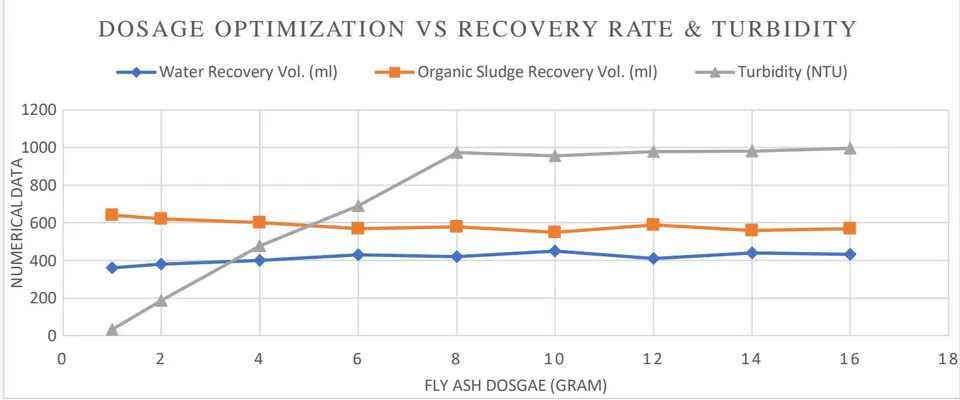
Analysis of above data keeping the tolerance criteria as presented in Table 4 above gave the conculsion that the range of Total solids was well within the premissable range of 1500 mg/l. The turbidity as a variable had no impact on the tolerance limit but increase in turbidity at higher dosage was an intermediate result of higher concentration of Carbon and silica particles present within the Flyash. Due to ionic seperation of compounds present in Fly ash and their coherence with the water molecules they stay in collidal state for a certain period of time. Leaving the Water to look like Greying white resembling texture like that in a river in plains.
Recovery of sludge was almost linear and spontaneous as compared with standard treatment process. With average Organic sludge volume of 586.5 ml per 1000ml of sample taken for study, representing heavy concentration of organic and inorganic pollutants in wastewater sample taken for study.
Turbidity on the contrary follows a linear scale from dosage 1mg to 8mg and then tends to remain constant around a range of 900 NTU. The high data value of turbidity is only due to the fine carbon compounds and silica compounds and not any organic or inorganic collateral suspension. The water on the text of touching gave a sandy smooth sensation same as that of sea waves on shores or a river in alluvial plain.
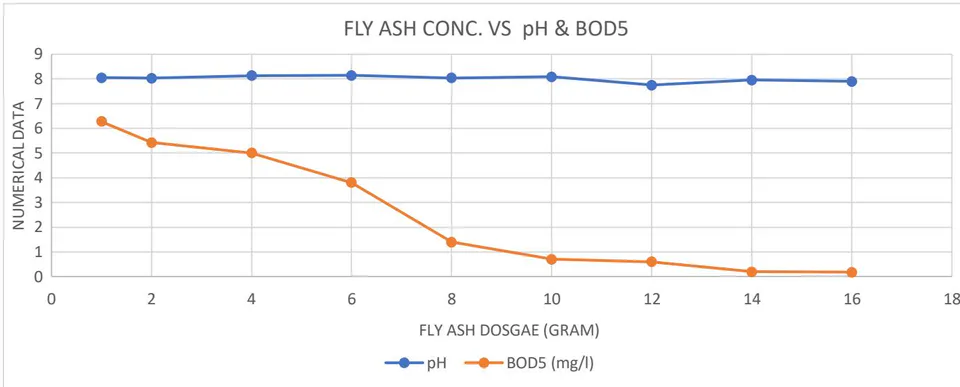
The concentration of Fly ash which varied accordingly to optimize the dosage for getting the max treatment efficiency lead to the observation and pattern, that though having multiple compounds present within the molecular & physical structure it kept the pH of the waste water within a constant zone ranging from 8.5-7.5. This range so obtained collided within the tolerance limit range for discharge of treated water in Inland Surface water bodies as presented in Table 4 above.
As per the nature of decrease of BOD5 value a significant decrease of 96%, than that of actual value obtained from the Raw water sample can be seen. Trending value of BOD5 predicted that over high dosgae of fly ash i.e. 14 gm and 16 gm, BOD5 value decreased below the tolerable limit of 5mg/l, which is for inland surface discharge of water. Hence proving that using Flyash will lead to effective decrease in BOD5 value even at lower dosage varying in a range of 6.5 – 0.15 mg/l.
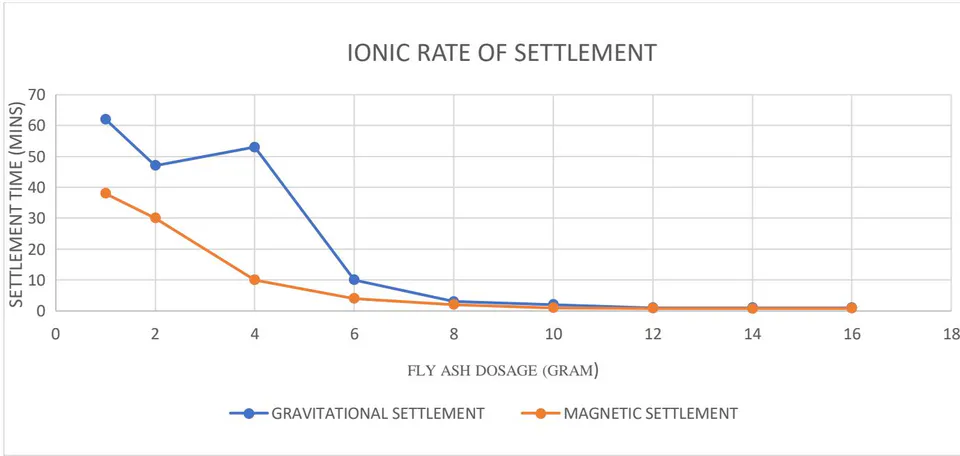
The settlement rate in presence of magnetic filed intensity of 6.48uT and 3.45uT based on the assumption that Fe+ ions will be entrapped between the colloidal flocs formed will be attracted towards the source of magnets spinning at the bottom of the container, presenting a faster settlement rate than that merely due to gravitational settlement. The combinataion of strong and relatively weak magnet sufficed the experiment as continuous fluctuation lead to rapid change on field intensity and which lead to faster rate of settlement in the flocs carrying Fe+ions post coagulation with Fly ash. Though a general idea based on the above representation of data predicts that at higher dosage of Fly ash, settlement rate didn't varied by much due to high weight to volume ratio of the sample. But in the initial range of data significant variation is to be seen under the magnetic field intensity, making the rate of settlement 3 times faster at different concentrations.
| Concentration(mg/l) | pH | Turbidity(NTU) | Time (mins) |
| 60 | 7.52 | 147 | 30 |
| 120 | 7.50 | 129 | 30 |
| 240 | 7.49 | 76.8 | 30 |
As per the representation of data in Table 5 above, the time variation could not be determined to exact minutes and had an average duration of 30 mins due to molecular interaction and slow rate of settlement of the colloidal impurities, with significant reduction in turbidity due to ionic Al3+ presence and neutralization of negative charges. The vartion of pH also remained negligible and presented a good output in terms of treatment process. In comparison to Magnetic Filtration with Fe+ ions entrapped within the flocs and their settlement under magnetic field intensity of above mentioned units. This process looks uneconomical and more time taking in comparison to the adopted magnetic filtration process, with Fe+ ionic floc settlement rate.
IV. CONCLUSION
As the assumption was produced and validated with the experimental analysis that on addition of Flyash as a media for treatment of Watewater for Inland Surface Discharge, the Fe+ ions played a significant role in rate of settlement under the influence of magnetic field intensity. Optimum dosage for the study was >=12 grams, because of multiple variable stayed within the tolerance limit parameter and even though the turbidity increased the nature of colloidal suspension was that of muddy water with no toxicity above tolerance limit. Also, the reduction of multiple variables as such BOD5 range(6.5 -0.15 ppm), pH (8.5 -7.5) and Sludge Volume(Total solids) (500 -700 ml per 1000ml sample taken) was seen and represented under observation in the result section. The research/study presented the utilization of Fly ash(Class F) a waste product of thermal power plant to be an effective treatment material for Coagulation and Magnetic Filtration in areas having high domestic wastewater characteristic of organic nature.
As compared with traditional Coagulant i.e. Aluminium Sulphate (Alum) - Al2(SO4)3, Fly ash presented a more economical and beneficial use, most abundant use of which could be adopted in rural sector producing heavy organic loading in the raw sewage discharge, and heavy contaminants of biodegradable nature. The process of magnetic filtration will treat the wastewater for permissible discharge parameters for release in Inland surface water bodies and further study on the dried sludge obtained from the treatment could be studied to check for its applicability as local fertilizer.
• Data Availability
All data, models, and code generated or used during the study appear in the submitted article.
ACKNOWLEDGEMENT
We would like to express our gratitude to our mentors Dr. T.S. Anantha Singh and Dr. Anurag Kandya for giving us the opportunity to utilize the environment lab of PDPU.
Watsonova 45, SK-04353 Kosice, Slovakia, [email protected]


