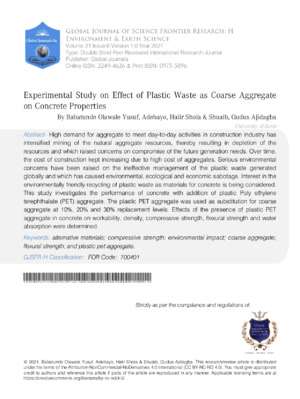
Experimental Study on Effect of Plastic Waste as Coarse Aggregate on Concrete Properties

Article ID

89QH7

High-resolution research on plastic waste effects on concrete aggregates and environmental impacts.

Experimental Study on Effect of Plastic Waste as Coarse Aggregate on Concrete Properties

Babatunde Olawale Yusuf
Adebayo
Adebayo
Shuaib
Shuaib
Qudus Ajidagba
Qudus Ajidagba
DOI

Abstract

High demand for aggregate to meet day-to-day activities in construction industry has intensified mining of the natural aggregate resources, thereby resulting in depletion of the resources and which raised concerns on compromise of the future generation needs. Over time, the cost of construction kept increasing due to high cost of aggregates. Serious environmental concerns have been raised on the ineffective management of the plastic waste generated globally and which has caused environmental, ecological and economic sabotage. Interest in the environmentally friendly recycling of plastic waste as materials for concrete is being considered. This study investigates the performance of concrete with addition of plastic Poly ethylene terephthalate (PET) aggregate. The plastic PET aggregate was used as substitution for coarse aggregate at 10%, 20% and 30% replacement levels. Effects of the presence of plastic PET aggregate in concrete on workability, density, compressive strength, flexural strength and water absorption were determined. The results showed that the workability increases as the proportion of PET plastic waste increases in the concrete matrix. In comparison with the control concrete, the compressive and flexural strength of concrete reduces as the content of plastic PET aggregate increases. Compressive and flexural strength reduction trends of 25%, 47% and 53% and 38%, 43% and 51% for concrete containing 10%, 20% and 30% of plastic PET aggregate respectively. The loss of strength can be attributed to the ineffective bonding between plastic PET aggregate and mortar due to the smooth surface of the plastic PET aggregate. Also, plastic PET aggregate has relatively no water absorption and which makes excess water in the concrete. Upon hydration, the excess water gets evaporated and which creates voids in the concrete and weak region around the aggregates in the concrete. However, improvement in water absorption capacity were observed. As the content of plastic PET aggregate increases, the water absorption capacity reduces. However, significant reduction in strength properties was obtained for concrete with 20% and 30% of PET plastic waste. Meanwhile, the water absorption capacity of the concrete composite gets higher as the proportion of the PET plastic waste increases. From the study, it can be said that sand can be substituted with PET plastic waste up to 10% replacement levels in concrete matrix.

Experimental Study on Effect of Plastic Waste as Coarse Aggregate on Concrete Properties

High demand for aggregate to meet day-to-day activities in construction industry has intensified mining of the natural aggregate resources, thereby resulting in depletion of the resources and which raised concerns on compromise of the future generation needs. Over time, the cost of construction kept increasing due to high cost of aggregates. Serious environmental concerns have been raised on the ineffective management of the plastic waste generated globally and which has caused environmental, ecological and economic sabotage. Interest in the environmentally friendly recycling of plastic waste as materials for concrete is being considered. This study investigates the performance of concrete with addition of plastic Poly ethylene terephthalate (PET) aggregate. The plastic PET aggregate was used as substitution for coarse aggregate at 10%, 20% and 30% replacement levels. Effects of the presence of plastic PET aggregate in concrete on workability, density, compressive strength, flexural strength and water absorption were determined. The results showed that the workability increases as the proportion of PET plastic waste increases in the concrete matrix. In comparison with the control concrete, the compressive and flexural strength of concrete reduces as the content of plastic PET aggregate increases. Compressive and flexural strength reduction trends of 25%, 47% and 53% and 38%, 43% and 51% for concrete containing 10%, 20% and 30% of plastic PET aggregate respectively. The loss of strength can be attributed to the ineffective bonding between plastic PET aggregate and mortar due to the smooth surface of the plastic PET aggregate. Also, plastic PET aggregate has relatively no water absorption and which makes excess water in the concrete. Upon hydration, the excess water gets evaporated and which creates voids in the concrete and weak region around the aggregates in the concrete. However, improvement in water absorption capacity were observed. As the content of plastic PET aggregate increases, the water absorption capacity reduces. However, significant reduction in strength properties was obtained for concrete with 20% and 30% of PET plastic waste. Meanwhile, the water absorption capacity of the concrete composite gets higher as the proportion of the PET plastic waste increases. From the study, it can be said that sand can be substituted with PET plastic waste up to 10% replacement levels in concrete matrix.

Babatunde Olawale Yusuf
Adebayo
Adebayo
Shuaib
Shuaib
Qudus Ajidagba
Qudus Ajidagba

No Figures found in article.

Babatunde Olawale Yusuf. 2022. “. Global Journal of Science Frontier Research – H: Environment & Environmental geology GJSFR-H Volume 21 (GJSFR Volume 21 Issue H6): .

Download Citation

Journal Specifications

Crossref Journal DOI 10.17406/GJSFR

Print ISSN 0975-5896

e-ISSN 2249-4626

Issue Cover
GJSFR Volume 21 Issue H6
Pg. 43- 51
Classification
GJSFR-H Classification: FOR Code: 700401
Keywords
Article Matrices
Total Views: 1729
Total Downloads: 778
2026 Trends
Research Identity (RIN)
Related Research
Our website is actively being updated, and changes may occur frequently. Please clear your browser cache if needed. For feedback or error reporting, please email [email protected]

Request Access

Please fill out the form below to request access to this research paper. Your request will be reviewed by the editorial or author team.
X

Quote and Order Details

Contact Person

Invoice Address

Notes or Comments

This is the heading

Lorem ipsum dolor sit amet, consectetur adipiscing elit. Ut elit tellus, luctus nec ullamcorper mattis, pulvinar dapibus leo.

High-quality academic research articles on global topics and journals.

Experimental Study on Effect of Plastic Waste as Coarse Aggregate on Concrete Properties

Babatunde Olawale Yusuf
Adebayo
Adebayo
Shuaib
Shuaib
Qudus Ajidagba
Qudus Ajidagba

Research Journals