I. INTRODUCTION. STATES, OBSERVABLES, MEASUREMENTS
Complementarity principle in physics says that a complete knowledge of phenomena on atomic dimensions requires a description of both wave and particle properties. The principle was announced in 1928 by the Danish physicist Niels Bohr. His statement was that depending on the experimental arrangement, the behavior of such phenomena as light and electrons is sometimes wavelike and sometimes particle-like and that it is impossible to observe both the wave and particle aspects simultaneously.
In the following it will be shown that actual weirdness of all conventional quantum mechanics comes from logical inconsistency of what is meant in basic definitions and has nothing to do with the phenomena scale and the attached artificial complementarity principle.
It will be explained below that theory should speak not about complementarity but about perfect splitting of measurement process into the operator ("state" in confusing conventional terminology, though "wave function is a little better) and the operand (observable) components.
a) General definitions
Unambiguous definition of states and observables, does not matter are we in "classical" or "quantum" frame, should follow general paradigm, [1], 1, [^3]:
- Measurement of observable by state is a map:
where is an element of the set of observables. is element of, generally though not necessarily, another set, set of states.
- The result (value) of a measurement of observable by state is a map sequence:
where is a set of (Boolean) algebra subsets identifying possible results of measurements.
Thus, state and observable are different things. Evolution of state should be considered separately, and then action of modified state will be applied to observable in measurement.
b) Classical kinematic illustration
The importance of the above definitions becomes obvious even from trivial examples.
Take a point moving along straight line. The definitions are pictured as (see Fig.1.1):
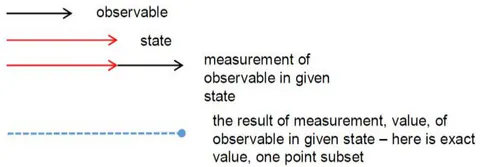
The above one-dimensional situation radically changes if the process entities become belonging to a plane, that's dimensionality of physical process increases, though we continue watching results in one dimensional projection (see Fig.1.2):
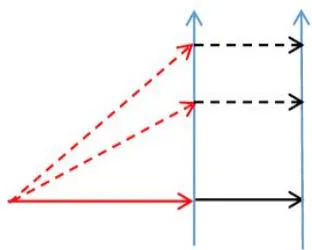
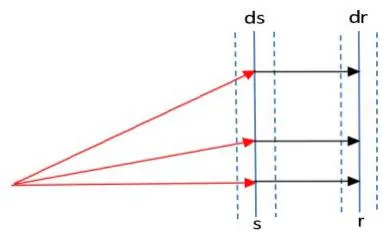
The option to expand, to lift the space where physical processes are considered, may have critical consequence to a theory. A kind of expanding is the core of the suggested formulation aimed at the theory deeper than conventional quantum mechanics.
II. WORKING WITH G-QUBITS INSTEAD OF QUBITS
A theory that is an alternative to conventional quantum mechanics has been under development for a while, see, [1], 1, 3, 4.
Its novel features are:
- Replacing complex numbers by elements of even subalgebra of geometric algebra in three dimensions, that's by elements of the form "scalar plus bivector".
- Elementary physical objects follow the structure: position in space plus explicitly defined object as the , geometric algebra in three dimensions, elements.
- Operators acting on those objects are identified as direct sums of position translation and points on the three-sphere defining rotations. Those points are connected, due to hedgehog theorem, by parallel (Clifford) translations.
- Evolution of the part of operators by Clifford translations is governed by generalization of the Schrodinger equation with unit bivectors in three dimensions instead of formal imaginary unit.
In the following the part of the operators will only be considered.
Qubits, identifying states in conventional quantum mechanics, mathematically are elements of the two-dimensional complex spaces:
, conditioned by , that is unit value elements of .
Imaginary unit is used formally with the property . In another accepted notations a qubit is:
In the suggested formalism complex numbers are replaced with elements of even subalgebra of - geometric algebra in three dimensions.
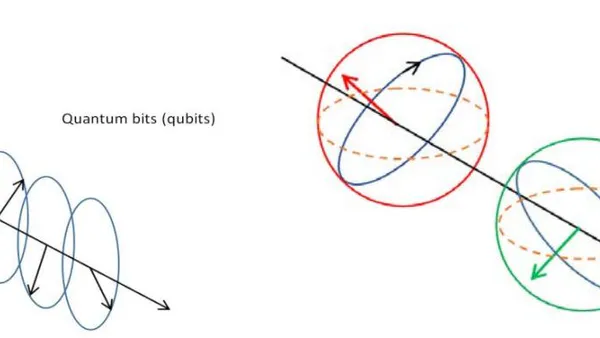
Even subalgebra is subalgebra of elements of the form , where and are (real) scalars and is some unit bivector arbitrary placed in three-dimensional space. Elements of can be depicted as in Fig. 2.1.
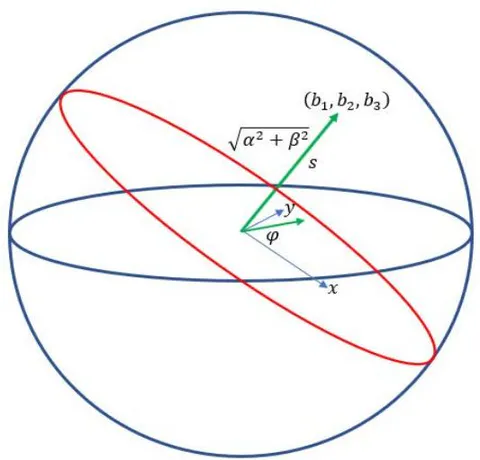
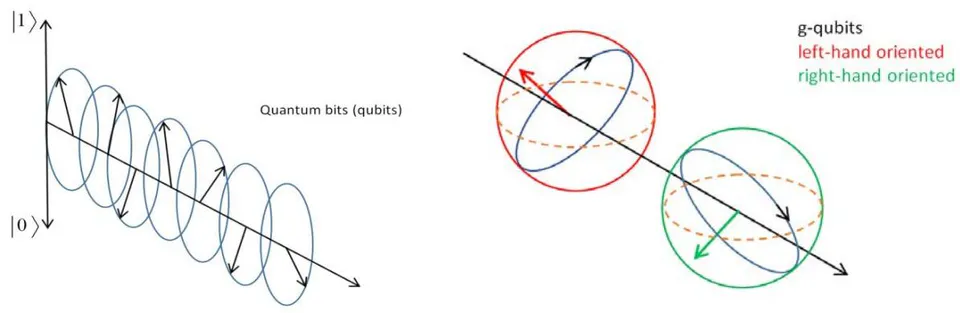
Unit value elements of , when , will be called g-qubits. The wave functions (states in the suggested approach) implemented as g-qubits store much more information than qubits, see Fig 2.2.
III. LIFT OF QUBITS TO G-QUBITS
a) Lift of quantum mechanical qubit states to -qubits
Take right-hand screw oriented basis of unit value bivectors, with the multiplication rules , , , (or equivalently ), where is oriented unit value volume, pseudoscalar, in three dimensions, see Fig.3.1.
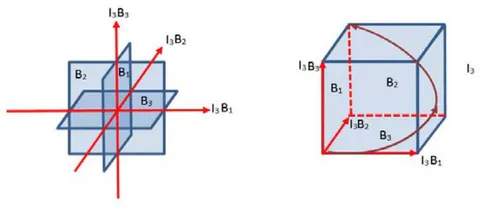
The quantum mechanical qubit state, , is linear combination of two basis states and . In the terms these two states correspond to the following classes of equivalence in , depending particularly on which basis bivector is selected as complex plane:
- If is taken as complex plane, then
- State has fiber (level set) of the elements (0-type states):
- State has fiber of the elements so (1-type states):
- If is taken as complex plane, then
- State has fiber (level set) of the elements (0-type states):
- State has fiber of the elements so (1-type states):
- If is taken as complex plane, then
- State has fiber (level set) of the elements so (0-type states):
- State has fiber of the elements so :
b) Implementation of definitions 1.1 in the -qubit state case
General definition of measurement in the suggested approach is based on:
- the set of observables, particularly elements of ,
- the set of states, normalized elements of , g-qubits,
- special case of measurement of a observable by g-qubit (wave function) is defined as
with the result:
Since g-qubit (state, wave function) is normalized, the measurement can be written in exponential form:
where
The lift from to needs a reference frame of unit value bivectors. This frame, as a solid, can be arbitrary rotated in three dimensions. In that sense we have principal fiber bundle with the standard fiber as group of rotations which is also effectively identified by elements of .
Suppose we are interested in the probability of the result of measurement in which the observable component does not change. This is relative measure of states
in the measurements:
That measure is equal to , that is equal to in the down mapping from to . Thus, we have clear explanation of common quantum mechanics wisdom on "probability of finding system in state ".
Similar calculations explain correspondence of to in the qubit when the component in measurement just got flipped.
Any arbitrary state can be rewritten either as 0-type state or 1-type state:
where 0-type, or
where 1-type.
All that means that any state measuring observable does not change the observable projection onto plane of and just flips the observable projection onto plane .
IV. EVOLUTION OF G-QUBIT STATES
Measurement of observable by a state is defined as . Evolution of a state is its movement on surface of .
Consider necessary formalism.
Multiplication of two geometric algebra exponents reads, see Sec.1.2 of [^5]:
It follows from the formula for bivector multiplication:
with vectors to which the unit bivectors and are duals: , . In the current case
and we get above formula for
The product of two exponents is again an exponent, because generally and , see Sec.1.3 of 4.
Multiplication of an exponent by another exponent is often called Clifford translation. Using the term translation follows from the fact that Clifford translation does not change distances between the exponents it acts upon when we identify exponents as points on unit sphere :
This result follows again from :
Assume the angle in Clifford translation is a variable one. Then in the case const:
If is dual to some unit vector , (this is the case of the matrix Hamiltonian map to , see 2), then and
that is obviously Geometric Algebra generalization of the Schrodinger equation.
If vector varies in time we get, assuming :
with, generally, .
Assume again constant and its unit length, . We see that displacement with along big circle, intersection of the unit sphere by plane , rotates lying on by angle in that plane.
Let us take two planes orthogonal to the plane of and comprising right-hand screw with it: and . Right-handedness means:
(See the earlier definition of the right-hand oriented triple of basis bivectors.) Then the three above formulas mean that the planes and rotate synchronically with , correspondingly in planes and . Thus, the triple of planes ro tates as solid while moving along big circle on .
V. DOUBLE-SLIT EXPERIMENT
Taking the set of g-qubits and projection of them onto : , we get fiber bundle. The projection depends on which basis bivector plane is selected as corresponding to formal imaginary unit plane. If we take, for example , the projection is:
Then for any the fiber in consists of all elements with an arbitrary triple of orthonormal bivectors satisfying multiplication rules. That particularly means that the standard fiber is a group of rotations of basis bivectors in the standard fiber . Thus, the fiber bundle is principal fiber bundle.
Let one first slit is only open, and the fiber, wave function, is some . For the only open second slit the fiber is different: . When both slits are open the corresponding fiber is defined by connection, parallel transport anywhere between fibers and .
Let we have a smooth curve , connecting points and , on three-dimensional sphere such that and . The easiest way to define parallel transport is .
For convenience purposes let us write and as exponents:
where
Angle is not uniquely defined since it can be any of where is, by definition, taken from interval . The angle will be denoted as .
where
As above, The angle will be denoted as
Measurement of an observable
by the wave function is:
Measurement by is:
Measurement by any intermediate parallel transport wave function then reads:
Let us make natural for double slit experiment assumption (that is the two wave functions, measuring states, are of 0-type with identical bivector planes.) Then we get the measurement result by the intermediate parallel transport wave function:
It is easily seen that the result of measurement is when and when .
Consider the following simplified scenario.
Assume we are only interested in the projections of and onto the plane of their rotations, , and . Then from the general formula
we get that up to some factors is rotated in by angle and is rotated in by angle .
Without loss of generality suppose that the angles and are equal by values but opposite in sign:
Then it follows that in Clifford translations the projection rotates in additionally by , and projection rotates in additionally by .
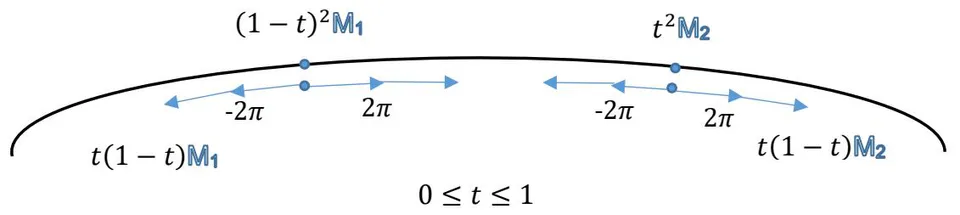
Thus, in addition to and , we get infinite number of copies of and multiplied every time by and separated by along the big circle of intersection of plane with the sphere , see Fig. 5.1.
VI. MODEL OF HYDROGEN ATOM
Let the state has the Hamiltonian type form:
where is vector in three dimensions. An observable it will act upon is something of a torsion kind, . Thus, at instant of time we have the following result of action of state (6.1):
The Hamiltonian type wave function (6.1) bears its origin from proton, while the observable represents electron.
The geometric algebra existence of the hydrogen atom can only follow from stable sequence of measurement results (6.2) with appropriate combination(s) of and . Let
Then , bivector part of (6.1) is and the scalar part of the wave function (6.1) is .
If initial bivector plane of observable is,, scalar part then is, thus. EXPLAINING SOME WEIRD QUANTUM MECHANICAL FEATURES IN GEOMETRIC ALGEBRA FORMALISM
Let us denote the plane . Then the sequence of transformations (6.2) reads:
If and assuming that does not depend on time, we get:
Angular velocity should be synchronized with Hamiltonian rotation by , though it can be integer times greater than .
Now assume that . Thus, the result of (6.2) is:
The vector of length rotates in plane with angular velocity while element rotates in plane . Again, for stability, angular velocity should be integer times greater than .
Take the general formula (3.1) and substitute , , , , where are components of in the basis , and , , are components of in the basis : . The result of measurement after multiple transformations reads:
Formula (6.3) gives stable rotation of observable (electron) due to action of the state (proton.)
VII. CONCLUSIONS
It was demonstrated that the geometric algebra formalism along with generalization of complex numbers and subsequent lift of the two-dimensional Hilbert space valued qubits to geometrically feasible elements of even subalgebra of geometric algebra in three dimensions allows, particularly, to resolve the double-slit experiment results with diffraction patterns inherent to wave diffraction. This weirdness of the double - slit experiment is milestone of all further difficulties in interpretation of conventional quantum mechanics. The approach also allows elimination of the Bohr's planetary model of the hydrogen atom.
Footnotes
One should say "by a state". State is operator acting on observable. (p.2) ↩ ↩2
Recall that fiber of a point in under a function is the inverse image of under . (p.3) ↩ ↩2
In the current formalism scalars can only be real numbers. "Complex" scalars make no sense anymore, see, for example, [2], [5]. (p.4) ↩
Rotation by the double of the exponential is known from rotational rules in three-dimensional geometric algebra, see, for example [3]. (p.13) ↩ ↩2