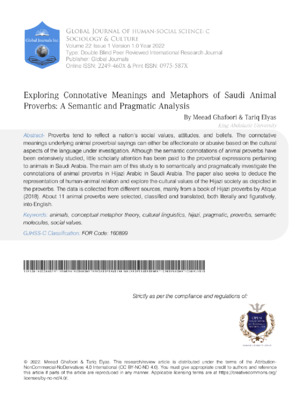
Exploring Connotative Meanings and Metaphors of Saudi Animal Proverbs: A Semantic and Pragmatic Analysis

α
Meead Ghafoori
Meead Ghafoori
σ
Tariq Elyas
Tariq Elyas
α King Abdulaziz University King Abdulaziz University

Send Message

To: Author

Exploring Connotative Meanings and Metaphors of Saudi Animal Proverbs: A Semantic and Pragmatic Analysis

Article Fingerprint

ReserarchID

19W5B

Exploring Connotative Meanings and Metaphors of Saudi Animal Proverbs: A Semantic and Pragmatic Analysis Banner

AI TAKEAWAY

Connecting with the Eternal Ground
  • English
  • Afrikaans
  • Albanian
  • Amharic
  • Arabic
  • Armenian
  • Azerbaijani
  • Basque
  • Belarusian
  • Bengali
  • Bosnian
  • Bulgarian
  • Catalan
  • Cebuano
  • Chichewa
  • Chinese (Simplified)
  • Chinese (Traditional)
  • Corsican
  • Croatian
  • Czech
  • Danish
  • Dutch
  • Esperanto
  • Estonian
  • Filipino
  • Finnish
  • French
  • Frisian
  • Galician
  • Georgian
  • German
  • Greek
  • Gujarati
  • Haitian Creole
  • Hausa
  • Hawaiian
  • Hebrew
  • Hindi
  • Hmong
  • Hungarian
  • Icelandic
  • Igbo
  • Indonesian
  • Irish
  • Italian
  • Japanese
  • Javanese
  • Kannada
  • Kazakh
  • Khmer
  • Korean
  • Kurdish (Kurmanji)
  • Kyrgyz
  • Lao
  • Latin
  • Latvian
  • Lithuanian
  • Luxembourgish
  • Macedonian
  • Malagasy
  • Malay
  • Malayalam
  • Maltese
  • Maori
  • Marathi
  • Mongolian
  • Myanmar (Burmese)
  • Nepali
  • Norwegian
  • Pashto
  • Persian
  • Polish
  • Portuguese
  • Punjabi
  • Romanian
  • Russian
  • Samoan
  • Scots Gaelic
  • Serbian
  • Sesotho
  • Shona
  • Sindhi
  • Sinhala
  • Slovak
  • Slovenian
  • Somali
  • Spanish
  • Sundanese
  • Swahili
  • Swedish
  • Tajik
  • Tamil
  • Telugu
  • Thai
  • Turkish
  • Ukrainian
  • Urdu
  • Uzbek
  • Vietnamese
  • Welsh
  • Xhosa
  • Yiddish
  • Yoruba
  • Zulu

Abstract

Proverbs tend to reflect a nation’s social values, attitudes, and beliefs. The connotative meanings underlying animal proverbial sayings can either be affectionate or abusive based on the cultural aspects of the language under investigation. Although the semantic connotations of animal proverbs have been extensively studied, little scholarly attention has been paid to the proverbial expressions pertaining to animals in Saudi Arabia. The main aim of this study is to semantically and pragmatically investigate the connotations of animal proverbs in Hijazi Arabic in Saudi Arabia. The paper also seeks to deduce the representation of human-animal relation and explore the cultural values of the Hijazi society as depicted in the proverbs. The data is collected from different sources, mainly from a book of Hijazi proverbs by Atique (2018). About 11 animal proverbs were selected, classified and translated, both literally and figuratively, into English. The analysis of data is based on Lakoff and Johnson’s (1980) Conceptual Metaphor Theory, the approaches involving Semantic Molecules proposed by Goddard (1998), and the theories of Cultural Linguistics introduced by Palmer (1996). The findings showed that human-animal interface is depicted through the conceptual mappings where animals function as a vehicle to express human characteristics, traits and behaviors. Moreover, the results revealed that all of the selected animal proverbs are evaluated negatively, except for one animal. Additionally, certain pragmatic functions were achieved using the proverbial expressions. There was also a variety of social and cultural underpinnings underlying these proverbs, which seem to have been transmitted from one generation to another.

References

45 Cites in Article
  1. N Alghamdi (2019). Socio-pragmatic representation of animal in Al-Bahah proverbs: An eco-linguistic analysis.
  2. A Al-Harahsheh,M Al-Rousan (2020). Animal names used to address people in Jordanian spoken Arabic.
  3. M Al-Salem,E Ali,I Alrashdan (2020). The Connotations of Bird Names in Arabic and English.
  4. J Austin (1962). How to do things with words.
  5. Wan Lee (2018). Structural Problems and Causes of Korean Local Publishing and Distribution Industry, and Alternatives.
  6. M Barasa,I Opande (2017). The use of animal metaphors in the representation of women in Bukusu and Gusii proverbs of Kenya.
  7. N Biyela (2003). Selected animal-and birdproverbs as reflectors of indigenous knowledge systems and social mores: A study from Zulu language and culture.
  8. I Budiarta,Ni Kasni (2017). The Concept of Animals in Balinese Proverbs.
  9. A Estaji,N Fakhteh (2011). Contrastive analysis of "Dog" expressions in English and Persian.
  10. A Estaji,F Nakhavali (2011). Semantic derogation in Persian animal proverbs.
  11. J Fu (2008). The conceptual motivation of animals' proverbs in English and Chinese.
  12. Raymond Gibbs (2001). Proverbial themes we live by.
  13. C Goddard (1998). Semantic analysis: A practical introduction.
  14. C Goddard (2012). Semantic molecules and semantic complexity: (with special reference to "environmental" molecules).
  15. A Khan,I Sardar,M Yousaf (2017). Gender representation through animal metaphors: An analysis of Urdu proverbs.
  16. R Kiełtyka,G A Kleparski (2005). The ups and downs of the Great Chain of Being: The case of canine zoosemy in the history of English.
  17. R Kiełtyka (2015). The theory of the Great Chain of Being (GCB) revisited: The case of CGB-level-conditioned animal terms.
  18. Z Kövecses (2010). Metaphor: a practical edition.
  19. Z Kövecses (2016). The Routledge Handbook of Metaphor and Language.
  20. Arvo Krikmann (2001). Proverbs On Animal Identity: Typological Memoirs.
  21. G Palmer (1996). Toward a theory of cultural linguistics.
  22. Roumyana Petrova (2015). 11 Contrastive Study of Proverbs.
  23. W Pfeffer (1997). Proverbs in Medieval Occitan Literature by Wendy Pfeffer (review).
  24. S Pourhossein (2016). Animal metaphors in Persian and Turkish proverbs: A cognitive linguistic study.
  25. G Lakoff,M Johnson (1980). Metaphors we live by.
  26. G Lakoff,M Turner (1989). More than cool reason: A field guide to poetic metaphor.
  27. Jianwen Liu (2019). A Comparative Study of English and Chinese Animal Proverbs—From the Perspective of Metaphors.
  28. W Mieder (2004). Proverbs: A handbook.
  29. N Muhammad,S Rashid (2014). Cat metaphors in Malay and English proverbs.
  30. M Nadim (2000). Inside the Proverbs: A Sociolinguistic Approach.
  31. H Nesi (1995). A modern bestiary: A contrastive study of the figurative meanings of animal terms.
  32. Thet Ni (2019). Cultural Awareness through Animal Proverbs in English and Myanmar.
  33. Neal Norrick (1985). How Proverbs Mean.
  34. A Riyanto (2018). Analysis of using Animal Elements in English Proverbs.
  35. I Rodríguez (2009). Explaining the Political Representation of Women—Culture.
  36. S Salamh,Z Maalej (2018). A cultural linguistics perspective on animal proverbs, with special reference to two dialects of Arabic.
  37. M Salman,H Amer (2020). A sociolinguistic study of the horse image in some English and Iraqi Arabic proverbs.
  38. I Sameer (2016). A cognitive study of certain animals in English and Arabic proverbs: A comparative study.
  39. Elza Saragih,Mulyadi Mulyadi (2020). COGNITIVE SEMANTICS ANALYSIS OF ANIMAL PROVERBS IN TOBA LANGUAGE.
  40. F Sharifian (2017). Cultural linguistics.
  41. M Talebinejad,H Dastjerdi (2005). A Cross-Cultural Study of Animal Metaphors: When Owls Are Not Wise!.
  42. A Taylor (1931). The Proverb.
  43. Anna Wierzbicka (2007). Bodies and their parts: An NSM approach to semantic typology.
  44. M Yakub (2019). The wisdom of our forefathers: Animal metaphors and imagery in Nzema proverbs.
  45. Y Yusuf (1997). English and Yoruba proverbs and the decline of marriage.

Funding

No external funding was declared for this work.

Conflict of Interest

The authors declare no conflict of interest.

Ethical Approval

No ethics committee approval was required for this article type.

Data Availability

Not applicable for this article.

How to Cite This Article

Meead Ghafoori. 2026. \u201cExploring Connotative Meanings and Metaphors of Saudi Animal Proverbs: A Semantic and Pragmatic Analysis\u201d. Unknown Journal GJHSS-C Volume 22 (GJHSS Volume 22 Issue C1): .

Download Citation

Exploring Connotative Meanings of Saudi Animal Proverbs.
Issue Cover
GJHSS Volume 22 Issue C1
Pg. 55- 66
Journal Specifications
Keywords
Classification
GJHSS-C Classification: FOR Code: 160899
Version of record

v1.2

Issue date

February 28, 2022

Language
en
Experiance in AR

Explore published articles in an immersive Augmented Reality environment. Our platform converts research papers into interactive 3D books, allowing readers to view and interact with content using AR and VR compatible devices.

Read in 3D

Your published article is automatically converted into a realistic 3D book. Flip through pages and read research papers in a more engaging and interactive format.

Article Matrices
Total Views: 1702
Total Downloads: 35
2026 Trends
Related Research

Published Article

Proverbs tend to reflect a nation’s social values, attitudes, and beliefs. The connotative meanings underlying animal proverbial sayings can either be affectionate or abusive based on the cultural aspects of the language under investigation. Although the semantic connotations of animal proverbs have been extensively studied, little scholarly attention has been paid to the proverbial expressions pertaining to animals in Saudi Arabia. The main aim of this study is to semantically and pragmatically investigate the connotations of animal proverbs in Hijazi Arabic in Saudi Arabia. The paper also seeks to deduce the representation of human-animal relation and explore the cultural values of the Hijazi society as depicted in the proverbs. The data is collected from different sources, mainly from a book of Hijazi proverbs by Atique (2018). About 11 animal proverbs were selected, classified and translated, both literally and figuratively, into English. The analysis of data is based on Lakoff and Johnson’s (1980) Conceptual Metaphor Theory, the approaches involving Semantic Molecules proposed by Goddard (1998), and the theories of Cultural Linguistics introduced by Palmer (1996). The findings showed that human-animal interface is depicted through the conceptual mappings where animals function as a vehicle to express human characteristics, traits and behaviors. Moreover, the results revealed that all of the selected animal proverbs are evaluated negatively, except for one animal. Additionally, certain pragmatic functions were achieved using the proverbial expressions. There was also a variety of social and cultural underpinnings underlying these proverbs, which seem to have been transmitted from one generation to another.

Our website is actively being updated, and changes may occur frequently. Please clear your browser cache if needed. For feedback or error reporting, please email [email protected]

Request Access

Please fill out the form below to request access to this research paper. Your request will be reviewed by the editorial or author team.
X

Quote and Order Details

Contact Person

Invoice Address

Notes or Comments

This is the heading

Lorem ipsum dolor sit amet, consectetur adipiscing elit. Ut elit tellus, luctus nec ullamcorper mattis, pulvinar dapibus leo.

High-quality academic research articles on global topics and journals.

Exploring Connotative Meanings and Metaphors of Saudi Animal Proverbs: A Semantic and Pragmatic Analysis

Meead Ghafoori
Meead Ghafoori King Abdulaziz University
Tariq Elyas
Tariq Elyas

Research Journals