## I. INTRODUCTION
The pandemic caused by the coronavirus brought the world to a halt, placing Brazil in social isolation since March 2020 and bringing repercussions in many areas of society. School Education is one of these areas, where in-person teaching ceased to occur in practically all countries, switching to a forced regime of Remote Education. This initiated an emergency transformation in teaching practices. Teachers found themselves obligated to reformulate their teaching practices, to adapt to technologies that were not necessarily part of their repertoire, and the use of the Internet became a major ally for educators at this time.
The pandemic scenario created a feeling of impermanence and insecurity. This moment ends up resembling the concept of liquid and light times mentioned by Bauman (2007). The author states that everything is light, molds, and dissolves very quickly. Thus, it is possible to associate this malleability of liquid times with the pandemic context where all changes in teaching are temporary, new announcements are made at record speed, where new guidelines arise to annul the previous ones and the only certainty is that until there is a definitive solution, no decision in educational terms will be permanent.
Thus, the teacher resorts to the use of network technologies as a fundamental part of their actions in these pandemic times. The professional seeks to understand and insert themselves in this new educational context, with all necessary inclusive aspects, the teacher will need knowledge that falls within the concept of "Digital Literacy," which is nothing more than the ability to execute the necessary digital skills for the proper use of digital resources.
In addition to using the internet to create their activities and generally conduct remote classes, the online navigation environment allows teachers to suggest activities that stimulate critical thinking. Just like the subjects of different disciplinary areas, such as Portuguese and Mathematics, the teacher has also made use of differentiated pedagogies that promote the development and learning of individuals.
But it is important to note that for these materials to be properly accessed and fulfill their proposal to stimulate critical thinking and learning, there are also some obstacles to be overcome. The first of them concerns Internet access. However, even though this is a severe problem to be considered, Brazil has greatly expanded in terms of access to the world wide web. The country is fourth in the world ranking of internet users, containing 120 million connected people, representing over $70\%$ of the country's population. This large number of connected people, added to the emergency situation caused by the pandemic, meant that many school activities suggested exercises using digital environments such as libraries and digital museums, for example.
Although Brazil is celebrating the great expansion of the number of people with Internet access, there is still a large number of individuals who do not participate in this growth. Thirty percent of Brazilians do not have internet access, which means that more than 60 million people simply cannot switch to a remote education system because they do not have the technical resources for it. This scenario has brought to light very specific problems of the class difference in Brazilian reality such as: lack of Internet access in the poorest communities, lack of equipment or even quiet places to study for poorer students, for example.
However, beyond these topics that have been a great source of debate in recent months, a new problem arises that is born in this forced remote teaching, and this concerns the lack of accessibility in different digital environments. Teachers have taken advantage of the digital context to suggest activities that explore content that goes beyond the different disciplinary areas. But how do students with some kind of disability fit into this context? How are digital environments prepared to receive students with disabilities and provide them with the same experience as other students?
Thus, a class activity that suggests online visiting to a museum may be completely impractical for a blind student if the museum's website is not prepared in terms of accessibility. And in light of this scenario, the proposal of this article arises from this problem: How are online museums implementing accessibility in their digital exhibitions?
In seeking to answer the problem presented, this article is based on the case study of the Louvre Museum, which has been widely cited on social media as an example of an extracurricular activity that students can do in pandemic times. On the museum's website, visitors can visit spaces and get to know works of art, in a 3D navigation scenario. The research aims to perform an accessibility verification at the Louvre based on the principles of WCAG (Web Content Accessibility Guidelines). The research hypothesis is that this analysis may enable the perception of strong points that the field of online museums has developed in terms of accessibility resources, and it will also be possible to identify gaps to be explored in this field, in order to reduce the exclusion rate of people with disabilities, so that they can actually participate in school activities that suggest visiting online museums. The methodology will involve a cross-reference between found presets and principles of accessibility and usability.
## II. DEVELOPMENT
This article aims to analyze the accessibility in 3D navigation virtual museums, but for this, it is necessary to specify some concepts that are important for this research. Thus, this item is divided into five parts: Virtual Museums, School Inclusion, Digital Literacy, Digital School Inclusion, and User Experience as the inclusion of students with disabilities, and Web Accessibility and Usability.
## III. VIRTUAL MUSEUMS
A museum, whether physical or digital, has a main mission which is to disseminate information, communicate, and thus educate the public. Therefore, it makes a lot of sense that visiting online museums has been of great importance to complement remote teaching activities. Stewart (2009) says that an online museum, by eliminating geographical barriers, has the ability to significantly expand the visiting public and, moreover, also has the potential to offer the user detailed exploration of the artifacts that interest them and deepening their contexts.
Henriques (2004) explains that museums have developed three different ways of demarcating their presence in the digital environment. These can be divided into: electronic brochures, museums in the virtual world, and truly virtual museums. These are different approaches and, consequently, offer different forms of approach and the public to relate to them.
Digital museum sites in the style of "electronic brochures" are the most used type by museums (HENRIQUES, 2004). Its objective is to disseminate basic information about the institution itself, such as location, opening hours, museum history, and more technical and bureaucratic information about the institution. The second type of digital space dedicated to museums would be: "museums in the virtual world" these are represented by sites that provide more detailed information about the collection of works itself. "The site ends up projecting the physical museum into virtuality and often presents temporary exhibitions that are no longer mounted in its physical space, making the Internet a kind of technical reserve for exhibitions" (HENRIQUES, 2004, p. 05).
Henriques (2004) explains that the third category of sites dedicated to museums would be that characterized by interactivity, where site navigation is thought considering the public, which he specifically calls "really virtual museums." The truly digital museum can only exist in the digital plane, not having the obligation to exist properly in the physical plane. If the site represents a museum that exists physically, it can also function as a complement to the physical museum. It can present digital exhibitions that are concurrent with the physical ones, reproducing their content, but beyond that, the truly digital museum has the ability to provide new approaches, present complementary exhibitions or even totally independent of those shown in the physical space.
## IV. SCHOOL INCLUSION
The process of school inclusion refers to an educational process that aims to maximize the ability of students with disabilities in regular school classrooms. Heidrich, Santarosa, and Franco (2012) say that this is a constant process that needs to be continuously reviewed. However, having students with disabilities in regular public and private school classes has not been an easy task.
For Sassaki (1997), school inclusion as it is known today was preceded by other phases. Thus, it is very necessary that these four categories mentioned by the author - exclusion, segregation or separation, integration, and inclusion - are always referred to whenever working with school inclusion, as it becomes very problematic to use the nomenclature of these to talk about the period we live in today. Camargo and Bosa (2009) point out that this lack of knowledge about the principles of inclusion constitutes one of the main teaching problems for the inclusion of students with disabilities. The authors say that "several difficulties were identified, pointed out by teachers, such as the lack of guidance, structure, and pedagogical resources. In addition, it was found that teachers tend to confuse the principles of inclusion and integration" (CAMARGO; BOSA, 2009, p. 69).
Thus, for the elaboration of this article, it is necessary to briefly describe each of the phases of school inclusion. The first phase corresponds to the period before the 20th century, which can be called the exclusion phase, in this period most people with disabilities did not receive any type of school education and private sphere spaces were reserved for them.
The second phase begins in the 20th century and is also known as: segregation. This began when people with disabilities began to be served within large institutions, which were not necessarily teaching environments. These had therapeutic and literacy purposes. In the second half of the century, movements were formed by parents of children who did not have the right to study in common schools.
The third phase is situated in the 1970s, and it is named the integration phase. This movement was directly driven by the movement of parents with children with disabilities who demanded that their children occupy regular teaching institutions in the 1950s and 1960s. Despite the great advance obtained in this new phase, there were still major problems. Although schools now accepted students with disabilities in regular classes, this only applied to students who could adapt to this class. No adaptation to the system was expected. Thus, integrated or integrative education required students to adapt to the school system and summarily excluded those who could not adapt or keep up with the pace of the other students. It is worth noting that this way one should avoid the term integration when referring to school inclusion. Although semantically the terms can be used as synonyms, in conceptual terms that constitute the history of inclusive school education they have many differences between them and should under no circumstances be used one because of the other.
The fourth phase refers properly to the inclusion phase. This emerged in the second half of the 1980s and increased in the 1990s. The main idea of this phase is to adapt the school system to the specific needs of each student. Inclusion, in this way, proposes a single educational system, with quality for all students, whether or not they have a disability. Heidrich, Santarosa, and Franco (2012) say that inclusion is based on principles such as: accepting individual differences as an attribute and not as an obstacle, valuing human diversity for its importance for the enrichment of all people, the right to belong and not be left out, the equal value of minorities compared to the majority. Thus, inclusive education depends on a series of factors to be successful, involving teachers, parents, principals, among others. In a collaborative way, they must seek solutions to the challenge that constitutes the presence of very different students in the same class.
## V. DIGITAL LITERACY
In light of the current situation experienced as a consequence of the coronavirus and the need for educational institutions to modify their pedagogical routine due to quarantine, leading schools and colleges to adapt to a new teaching formula, it became necessary for teachers from the face-to-face network to create new methodological proposals with the aim of developing educational possibilities that would make up for the time away from the regular classroom.
Therefore, teachers had to adapt to remote teaching, with the creation of activities that were possible for the cultural, cognitive, and sensory stimulation of students. In this way, they were compelled to create proposals that use the internet as one of the main resources for carrying out their activities, resorting to technologies to develop situations in which student stimulation was achieved.
However, to conduct a virtual activity or even develop the use of technologies as a source of learning, it is necessary for the teacher to have a critical understanding of the use of digital media. Likewise, it is also important that the education professional has the creative capacity to develop activities that reach the largest possible number of students, creating inclusive and accessible activities.
In this scenario, it is important to understand that to formulate relevant activities, taking into account all inclusive aspects, the teacher must have knowledge that refers to the concept of Digital Literacy, which is nothing more than the ability to perform the digital competencies necessary for the correct use of digital resources. For Alves (2014, p. 02), "Digital Literacy deals with the ability to access, analyse, understand, use and critically evaluate ICTs", that is, it is a way to use digital media correctly, enabling a broader understanding for all parties. Also, for the author:
[...] for the teacher to act deftly in this scenario, managing to select what will really favour the acquisition of cultural capital by their students, leading them to critical autonomy, a training adequate to the innovation required by digital society is demanded. (ALVES, 2014, p. 02).
That is, even before proposing any digital activity, the teacher must observe whether the existing activity significantly reaches all their students, taking care to build possibilities that are possible to be carried out by everyone, as by not taking this care, the teacher may end up excluding some students from the activity.
Digital literacy is linked to the digital competencies necessary for using the Internet, but critically. It is the way multimedia tools are used, taking advantage of the space to produce and learn.
Although the school generation today has enough capabilities to use computers, the internet, and digital media, this does not mean they have enough critical competence to use available resources safely and reliably.
Digital competencies are resources that must be developed by both teachers and students. Martins et al. (2019), in research conducted on "Digital Literacy as a competency for digital citizenship," emphasize that in school education it is necessary to "transmit information and communication, massively and effectively, adapted to cognitive knowledge, bases of the competencies of the future", besides, they also highlight that it is necessary to "find and highlight references that prevent citizens from becoming isolated with the large volume of information, more or less ephemeral, that invade public and private spaces" aiming at the use of competencies to "guide for individual and collective development projects".
In this way, not only to use digital resources but to filter the relevance and veracity of the information, the methods and uses of resources and the various perspectives that these activities can exert.
Another problem also found in the use of digital skills is in the outdated view of teachers, who for Prensky (2001 apud ALVES, 2014), these have difficulty and resistance in incorporating digital activities into their routines, a consequence of outdated and pre-digital language. In this way, when proposing virtual activities to their students, these teachers run the risk that the activities do not perform their main function, which is to stimulate the imagination, critical and cognitive sense of students and create knowledge. Consequently, often students do not perform the activities as proposed and do not achieve the set objectives because they do not understand what was requested or even because they do not have enough skill to perform such a task. According to Cardoso (2014, p. 47):
In the Brazilian case, many programs were created targeted at public school networks, aiming to facilitate access to computers and the internet, in an attempt to prepare young people to become proactive citizens in the so-called information and knowledge society.
As a consequence of forming digital competencies for teachers and students, the use of digital media would be carried out correctly, without educational prejudice as a result of the misuse of networks.
To avoid a mistake between a proposal based on an educational objective or an unfounded activity, it is necessary for the teacher to understand the basis of their proposal, filtering the various possibilities that can be offered as a digital activity and conducting tests of the activities in advance before proposing them to students. In this way, by having the ability to develop inclusive and relevant digital pedagogical plans, the teacher avoids situations where certain students cannot perform the suggested activity because they have some kind of cognitive or motor restriction. The best way to avoid situations like this is for the teacher to have adequate Digital Literacy for the type of function they perform.
In this sense, when analysing the navigation processes of the Louvre Museum, which was the basis of this study, it is noticeable that conducting a virtual tour, for example, could only be performed by those students who do not have any cognitive or physical barriers, as performing this activity presupposes that users have full capacity for implementation. Thus, it is up to the teacher to possess the necessary skills to create suitable activities before suggesting that students perform them.
In this context, the importance of investing in adequate digital qualification of teachers and students is reflected, which according to Oliveira and Giacomazzo (2017, p. 169):
[...] it is necessary that all people, especially children and young people, develop the qualifications needed for critical digital literacy, in order to interfere in a reflective and critical manner. Thus, it will be possible to build and constitute a digital citizenship that allows identifying forms of information manipulation, their origins, sources, and intentions.
That is, the development of Digital Literacy is synonymous with social inclusion and citizenship, as it can transform digital activities into moments of learning, where it is possible for all involved to achieve relevant results. By possessing digital literacy, the teacher can provide feedback regarding the educational centers of museums or spaces where there is the intention to conduct an activity, demonstrating flaws in the creation process and helping to make digital activities more inclusive.
## VI. USER EXPERIENCE AND THE INCLUSION OF STUDENTS WITH DISABILITIES
The internet has offered digital inclusion the possibility for students from different social classes to become acquainted with content from various mediums. From students of popular classes who can visit art exhibitions in different locations around the globe through the world computer network, to middle-class youths who can participate in soirees in slums, for example. However, none of these activities will be truly inclusive if the digital environment is not prepared for visitation by people with disabilities. Beyond simply receiving people with disabilities, a digital museum should provide a user experience equivalent to its visitors regardless of whether they have a disability or not.
Thus, at this moment it became necessary to bring the concept of user experience and the concept of experience itself. Bondía (2002, p. 21) states that: "experience is what happens to us, what happens to us, what touches us. Not what happens, not what happens, or what touches." Thus, the author establishes that experience is only relevant if it actually involves the subject, that is, if it is important to what they find pertinent. Therefore, it is up to the team that develops a truly virtual museum the task of designing website navigation, from the first sketches, programming, and tests, in order to make the online visit something that happens and touches those who honor it, thus characterizing what Bondía (2002) calls experience.
On the other hand, author Stull (2018) says that user experience includes aspects of cultural anthropology, human-computer interaction, engineering, journalism, psychology, and graphic design, and relates to enabling the user to experience a service or product satisfactorily, meeting their needs and expectations generated in relation to the product. In this aspect, a new impasse arises. People who use the internet are used to navigating digital environments and have specific expectations for certain environments. If the virtual museum presents its content in a way that resembles a digital magazine, where the works are listed for example, the user will not have an experience similar to the actual visitation of a museum, this will be more similar to that of a user of digital magazines. It is important to say that this work does not propose to make a comparison between user experiences of virtual museums and digital magazines. The purpose of this is to verify the experience of the blind user in virtual museums.
It is noticeable that many museums have tried to create a user experience for virtual museum visitors that is similar to the experience that a physical museum visitor would have. This is often done through the recreation of the physical environment in 3D digital, where the user can go at their own pace, getting to know the works as well as the physical space of the exhibition. The same concept is also explored through grouped photographs to simulate the 3D environment, with the same purpose of a digital recreation.
Thus, it is noticed that the navigation of virtual museums in a 3D environment makes the user experience closer to a physical visit to museums, but it can create a series of accessibility obstacles for people with disabilities, ranging from navigation using a mouse that can be a problem for people with a motor disability, to the total impossibility of navigation by blind people. Therefore, the objective of this article is to verify how these 3D navigation virtual museums are accessible to people with disabilities.
## VII. CASE STUDY: LOUVRE MUSEUM
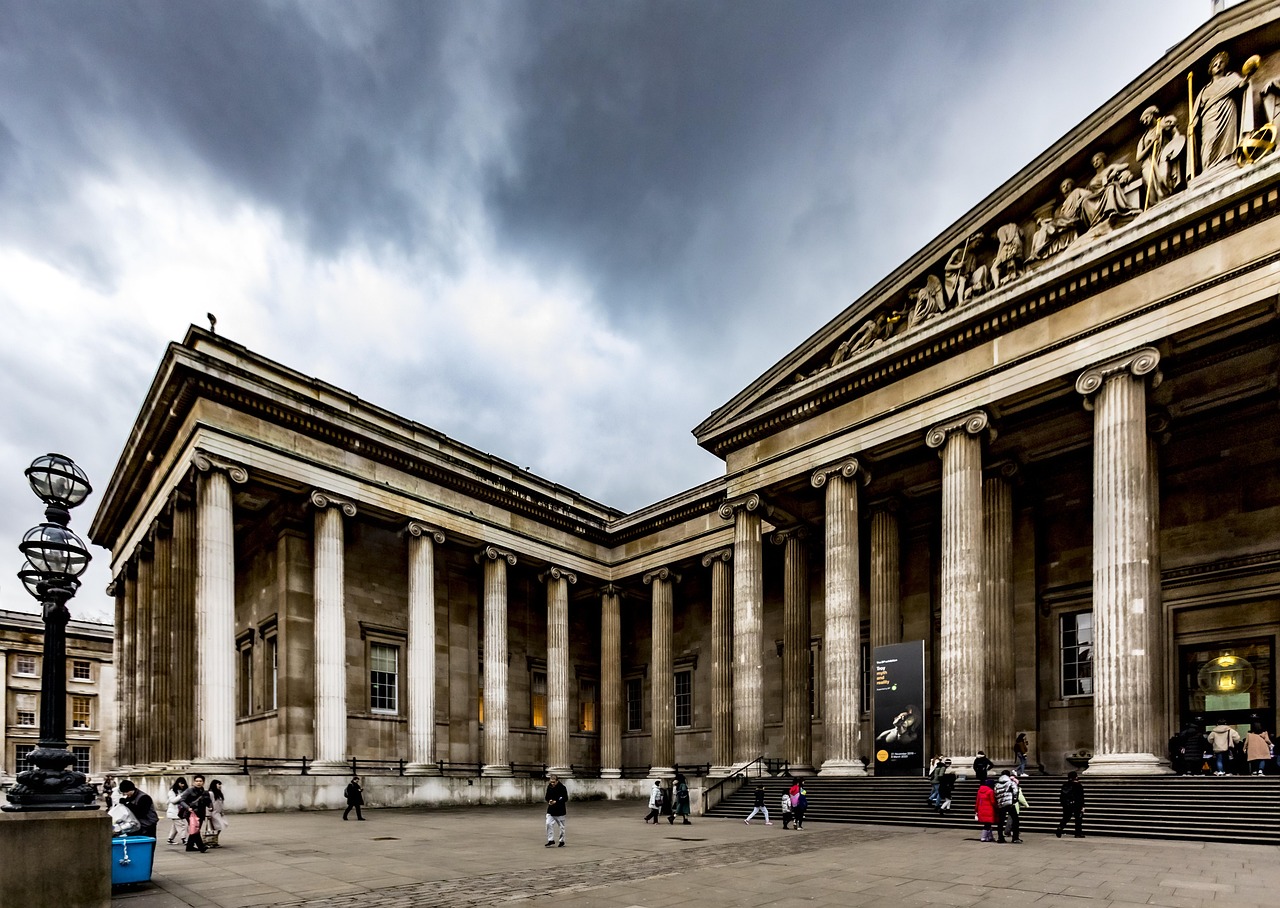
Brettell (2006) states there is a common understanding that the Louvre is the most well-known art museum in the world. According to the author, this museum has a collection that includes millions of works. This complex of buildings that covers acres in the centre of Paris attracts tourists from all over the world, making it the art capital of Europe. This author compares the millions of annual visitors the museum receives to a religious pilgrimage, where fervent devotion makes people stand for hours in endless queues, indifferent to the weather conditions just to have the chance to glimpse, often from afar, works that they will not be able to see for enough time.
In this account from Brettell (2006), the experience that most people have when visiting the Louvre is very clear. Even though it is possible to schedule less crowded visits, as shown on the institution's website, the author says that most visitors tour the museum in a single visit, so quickly that the memories relating to this day appear as a confusing blur of aesthetic sensations that are often difficult to classify or assess. Gardner (2020) comments on the painting of the Mona Lisa, by Leonardo da Vinci, which has almost become an icon of the Louvre museum, attracting a thirsty public that crowds in front of it, straining fiercely to see it from fifteen metres away.
In 1919, French artist Marcel Duchamp created a famous reinterpretation of Mona Lisa's portrait, writing "LHOOQ" which emits the sound of "look" in English. Dan Brown's book "The Da Vinci Code" (2003) sold over 80 million copies, giving a new dimension to the Mona Lisa and the Louvre museum in general, expanding its reach with the release of the eponymous film released in 2006. All of this serves to entrench the Louvre museum even more in common sense as a synonym for an important museum.
In view of this scenario, it can be said that although many museums around the world report low visitation and lack of interest from the population, the Louvre exhibits exorbitant visitor numbers, surpassing the annual millions, as pointed out by Brettell (2006). The Louvre's own website features a list of documentaries and fiction films that showcase it as a setting. All this movement and repetition makes the museum widely known to the general population. Even Brazilian soap operas share this interest in showing the Louvre as an important place for art and culture. The Gshow portal points to Paris as the top of the list of soap opera destinations and comments on a series of appearances of the Louvre in Brazilian dramaturgy (PARIS, 2015).
Gardner (2020) says that this interest that the media has dedicated to the Louvre directly impacts its audience numbers. The author adds that perhaps the biggest change that has occurred at the Louvre in the last thirty years has been the tripling of the public in the last three decades. The author says that in 1988 the annual visits did not reach three million, reaching the total number of almost nine million in 2011 and always remaining above eight million every year since then. This high number of visitors has moved a large amount of money. With tickets being sold for 15 Euros at the box office or on the Institution's website, which generates the value of 120 million Euros per year, only in tickets.
Thus, it was this immense popularity that motivated the choice for the virtual museum of the Louvre to be the object of study for the verification of accessibility, as it is imagined that an institution of such prominence would be a reference in matters of implementation of digital resources that require a large involvement of specialized labor and, consequently, a significant amount of financial resources.
## VIII. WEB ACCESSIBILITY AND USABILITY
According to Berners-Lee, director of the W3C and inventor of the World Wide Web, "the power of the Web is in its universality. Access by everyone, regardless of disability, is an essential aspect." As explained by Bassani et al. (2010), the W3C provides standards for web accessibility, considering that it was designed to work for all people, regardless of their hardware, software, language, culture, location, physical or mental ability. According to data extracted from the first report on disability and development conducted in 2018 by the UN, there are one billion people with disabilities in the world, representing at least one-eighth of the world's population. Thus, developing websites from the W3C standards can reduce the impact of disability, because the Web has the power to remove the barriers to communication and interaction that many people face in the physical world.
The document Web Content Accessibility Guidelines (WCAG) 2.1, or Guidelines for Web Content Accessibility, defines four principles that provide the foundation for Web accessibility. These aim to define how to make Web content more accessible to people with disabilities. These principles serve to guide guidelines aimed at developers so that they can make content more accessible to users with different disabilities.
Bassani et al. (2010) cite the four principles that provide the foundation for Web accessibility as:
a) Perceivable: Users must be able to perceive the information being presented (it cannot be invisible to all their senses);
b) Operable: Users must be able to operate the interface; the interface cannot require interaction that a user cannot perform;
c) Understandable: Users must be able to understand the information, as well as the operation of the user interface;
d) Robust: Users must be able to access the content reliably through a wide variety of user agents, including assistive technologies.
WCAG 2.1, in addition to developing these four principles, created a series of more specific guidelines that serve to create an accessibility score. According to the number of features available, the website can be categorized into three levels. These are A, AA, or AAA, and progressively represent how much accessibility a site has.
To better understand these criteria, it needs to be specified that there are 78 criteria divided by their criticality. The 30 "A" level criteria are considered the most critical and for this reason are the ones that have the most implementation needs. The second level of criticality would be the 20 "AA" requirements and these are considered the requirements of intermediate urgency, which are important for accessible navigation, but should only be considered after obeying the 30 requirements of the first level of criticality. Finally, the third level of criticality "AAA", composed of 28 accessibility requirements, is the level with the lowest criticality and should only be met when the other 50 items of levels one and two are fully met.
## IX. METHODOLOGY
As this research does not plan the application of its results in a specific product, its nature is established as basic, that is, it aims to generate new knowledge useful for the advancement of science without envisaged practical application. Prodanov and Freitas (2009) also state that this type of research involves universal truths and interests.
The approach to the problem of this study is qualitative, as it involves a selection made from the principle of data collection, fragmenting and extracting what is necessary and always analysing the value of each piece of information, but without necessarily requiring the use of statistical methods and techniques. Later, it will be possible to view a table with the accessibility features. In it, it is possible to count and relate these items, but no specific statistical technique is needed for this, which would characterise the work as quantitative.
The work has exploratory research purposes, thus providing greater familiarity with the problem and allowing the construction of hypotheses. This research adopts bibliographic and documentary procedures. Prodanov and Freitas (2009) state that the bibliographic procedure is characterised when a work is carried out from already published material, with the aim of putting the researcher in direct contact with the material already written about the research subject. In the case of this research, specifically, a search for academic articles was carried out by crossing the words: accessibility, digital games, and deafness, between the years 2013 and 2020. Through this research, seven academic works were found, in four different journals. After conducting a preliminary reading of their abstracts, it was decided to choose two of them for in-depth research, where the repetition of addressed concepts was observed and how the theoretical framework was divided.
The documentary procedure pertains to the use of digital games as objects of analysis. This type of research is based on materials that have not yet received analytical treatment or that can be reworked according to the objectives of the research. Prodanov and Freitas (2009, p. 56) cite as examples of documentary procedure the analysis of: "official documents, newspaper reports, letters, contracts, diaries, films, photographs, recordings, etc." The authors do not cite web pages among their examples, but as these are characterised by their aesthetic and technical proximity to films and recordings, it was decided to characterise them as such in terms of documentary procedure.
### Accessibility Analysis in Virtual Museums
For the analysis of virtual museums, a series of checks proposed by WCAG 2.1 were used, as the intention was to discern whether the Louvre was characterised as a virtual museum that offers accessibility options for people with disabilities. And whether these options were sufficient to categorise it as A, AA, or AAA in terms of accessibility.
For the verification of these items, a table developed by Yale University was used. However, although this table shows to be quite effective for analysis and contains columns to be filled with perceptions about navigating the specific object being studied, this table only has 50 of the necessary recommendations for a complete analysis. This is because Yale University only considered the 30 specifications of level A and the 20 of level AA. Thus, the 28 specifications of level "AAA" were disregarded by this table, so it was necessary to insert the missing specifications so that an analysis of the three levels of criticality could be performed. This table is already prepared for specific performance classifications of the site to be analysed. In the "Conformance" column, for example, it is possible to classify this item as: Meets, Does Not Meet, Meets with Exceptions, and N/A (Not Applicable). There is also a field for notes, where it was possible to point out preliminary perceptions for each item, which were fundamental for writing the analysis of the exhibition per se.
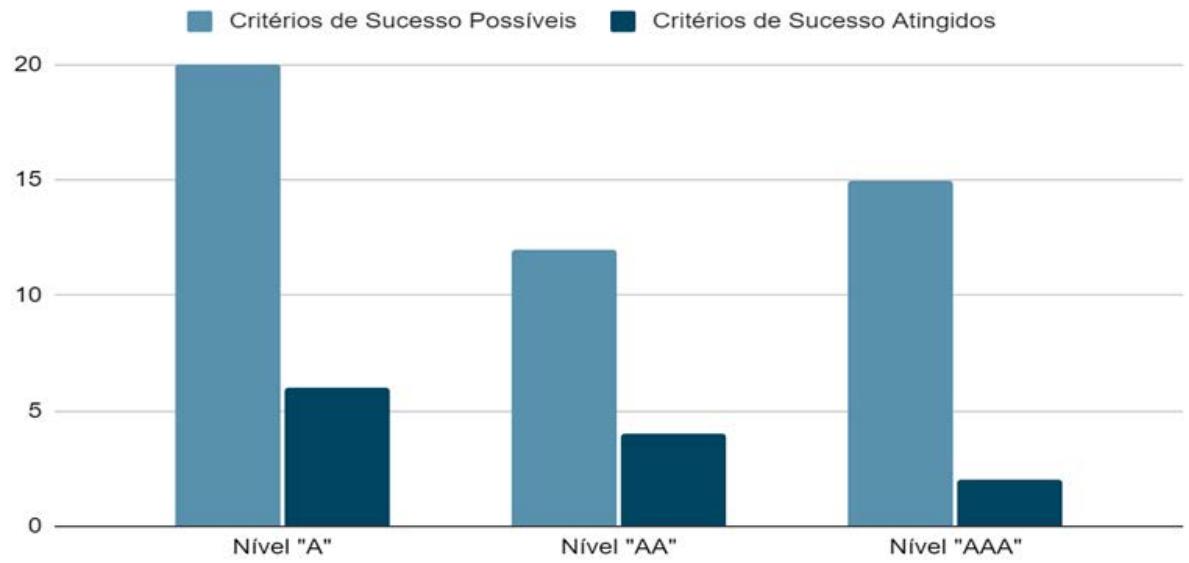 Recursos de Acessibilitad do Museu do Louvre Virtual Source: Chart developed by the authors (Translated to British English)
Graph 1: Accessibility Features of the Virtual Louvre Museum
The "Not Applicable" level refers to functionalities that do not pertain to the type of navigation proposed by the Louvre Museum, such as live audio and video, or form submission. In this case, for checking purposes, these items will not be counted. Therefore, as shown in the table below, in general aspects, the Louvre Museum and its virtual exhibition adhere to $30.00\%$ of the "A" level criteria, following 6 of the 20 recommendations that were applicable to its type of navigation. The AA level is followed in $33.33\%$ of the recommendations; it does not meet 8 of the 12 recommendations that would be applicable to its website.
Table 1: Accessibility Features of the Virtual Louvre Museum
<table><tr><td>Level</td><td>Total</td><td>N/A</td><td>Total Applicable</td><td>Meets</td><td>Meets with Exceptions</td><td>Does Not Meet</td><td>Percentage Met</td></tr><tr><td>A</td><td>30</td><td>10</td><td>20</td><td>6</td><td>0</td><td>14</td><td>30.00%</td></tr><tr><td>AA</td><td>20</td><td>8</td><td>12</td><td>4</td><td>0</td><td>8</td><td>33.33%</td></tr><tr><td>AAA</td><td>28</td><td>13</td><td>15</td><td>2</td><td>0</td><td>13</td><td>13.33%</td></tr><tr><td>Sum</td><td>78</td><td>31</td><td>47</td><td>12</td><td>0</td><td>35</td><td>25.53%</td></tr></table>
Finally, the "AAA" level is met in $13.33\%$, following 2 of the 15 recommendations that would be possible for its type of navigation. Considering that 13 of the proposed recommendations for the "AAA" level are not applicable, it is concluded that in reality there are a total of 13 WCAG 2.1 recommendations that are not followed by the Louvre virtual museum.
## X. FINAL CONSIDERATIONS
As one approaches the conclusion of research, it is always interesting to revisit the hypothesis and ponder how much one believed it would be possible to achieve certain results. The hypothesis held that through the analysis of the Louvre's accessibility resources, it would be possible to perceive the strengths that the field of online museums has developed in terms of accessibility resources, and also whether it was possible to identify gaps to be explored in this field, in order to reduce the exclusion rate of people with disabilities.
Upon concluding the analysis, it is perceived that there was a very optimistic view of the kind of scenario that would be found. The historical importance of the Louvre gives the idea that it would be the reference in terms of any type of technology that could be implemented. This causes perplexity when realizing that a museum like the Louvre only has a quarter of the "A" level accessibility resources that are considered the most basic by the WCAG.
In fact, when analyzing the accessibility resources implemented by the Louvre, it is thought that all of them may have been done by chance and there was not actually any planning for it. The Web usability and accessibility guidelines (WCAG) state that level A guidelines should be prioritized, then level AA guidelines should be sought, and so on, successively. The Louvre seems to have taken no care in this respect, since it has more success criteria at the second level than at the first. This oversight makes navigation of the virtual exhibition on the Louvre's website impossible for people who use screen readers.
It is noticeable that digital environment navigation aims to provide a user experience equivalent to a real physical visit. The problem with the type of navigation shown by the Louvre is that it is not guided by the WCAG accessibility standards. Turning on the screen reader did not provide any information about navigation. The Talkback user has no possibilities for spatial orientation. Therefore, this user cannot move in the direction of the exhibited works. In addition to not being able to move spatially, there are no descriptions of the works, author's name, and no type of information on screen, and these are only perceptible to sighted people.
An important factor that should be mentioned is the difficulty of conducting an accessibility analysis like the one proposed by WCAG 2.1 by people who do not have knowledge in programming. Although many of the resources can be perceived just by navigating, many of them require entering the page code, searching, and interpreting whether a particular guideline is being followed or not, procedures that could not be performed by someone who was not in the area.
The pandemic has brought new concerns to teachers, mainly regarding a forced adaptation to remote classes. In this context, virtual museums provide an alternative so that students can visit museums with a user experience similar to that of a physical environment. When this project began, there was a hypothesis that virtual museums were not fully accessible to people with disabilities.
The Louvre was chosen as a case study because it was thought that even if not in a perfect way, there would be at least some resources to be analyzed, but it was not expected that the Louvre's virtual museum would be unnavigable for blind people, or those with low motor skills, for example. These perceptions open questions for several issues.
The main one is to think that creating a user experience that simulates a physical exhibition in virtual museums, without thinking about accessibility, as is the case with the Louvre Museum, will expand the lack of inclusion of students with disabilities. It is also necessary to think that before teachers propose an activity of visiting virtual museums, they must have digital skills to check if it has navigability that is accessible to their students with disabilities.
Generating HTML Viewer...
References
19 Cites in Article
E Alves (2014). Literacia Digital de Professores: Competências e Habilidades para o uso das TDIC na docência.
Patrícia Bassani,Patricia Behar,Regina Heidrich,Alan Bittencourt,Eliane Ortiz (2010). Usabilidade e acessibilidade no desenvolvimento de interfaces para ambientes de educação à distância.
Z Bauman (2007). Tempos líquidos.
J Bondía (2002). Notas sobre a experiência e o saber de experiência.
R Brettell (2006). Museum Masterpieces: The Louvre. Virginia: The Great Courses.
Síglia Camargo,Cleonice Bosa (2009). Competência social, inclusão escolar e autismo: revisão crítica da literatura.
Ana Cardoso,Roberto Silva,Simone Alves Da Silva,Djenane Pio,Pedro Ruas Da Silveira (2014). FACIL: Modelo para avaliação da literacia digital e informacional.
O Código Da Vinci (2006). The Da Vinci Code directed by Ron Howard (review).
J Gardner (2020). The Most Famous Vasectomy in New York.
R Heidrich,L Santarosa,S Franco (2012). Inclusão escolar de aluno com paralisia cerebral, utilizando as tecnologias de informação e comunicação.
R Henriques (2004). Museus Virtuais e Cibermuseus: a internet e os museus.
S Martins,J Martins,F Alves (2019). Literacia digital como Competência para a Cidadania Global.
Michele Oliveira,Graziela Giacomazzo (2017). Educação e cidadania: perspectivas da literacia digital crítica.
Carminda Cavaco (2015). Resiliência dos destinos turísticos das praias frias: do Canal da Mancha ao Golfo da Finlândia.
C Prodanov,E Freitas (2009). Metodologia do Trabalho Científico: Métodos e Técnicas da Pesquisa e do Trabalho Acadêmico.
R Sassaki (1997). Inclusão: Construindo uma Sociedade para Todos.
Tekara Stewart (2009). Best practices of textile and clothing museum website development.
E Stull (2018). UX Fundamentals for Non-UX Professionals: User Experience Principles for Managers, Writers, Designers, and Developers.
No ethics committee approval was required for this article type.
Data Availability
Not applicable for this article.
How to Cite This Article
Franciele Amaral. 2026. \u201cExploring Digital Frontiers An Evaluation of Accessibility Tools and Educational Opportunities in the Louvres Virtual Museum\u201d. Global Journal of Human-Social Science - G: Linguistics & Education GJHSS-G Volume 23 (GJHSS Volume 23 Issue G11): .
Explore published articles in an immersive Augmented Reality environment. Our platform converts research papers into interactive 3D books, allowing readers to view and interact with content using AR and VR compatible devices.
Your published article is automatically converted into a realistic 3D book. Flip through pages and read research papers in a more engaging and interactive format.
Our website is actively being updated, and changes may occur frequently. Please clear your browser cache if needed. For feedback or error reporting, please email [email protected]
Thank you for connecting with us. We will respond to you shortly.