

Neural Networks and Rules-based Systems used to Find Rational and Scientific Correlations between being Here and Now with Afterlife Conditions
Neural Networks and Rules-based Systems used to Find Rational and

To: Author
Article Fingerprint
ReserarchID
7961W
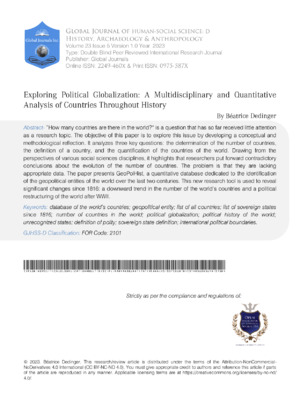
How many countries are there in the world?” is a question that has so far received little attention as a research topic. The objective of this paper is to explore this issue by developing a conceptual and methodological reflection. It analyzes three key questions: the determination of the number of countries, the definition of a country, and the quantification of the countries of the world. Drawing from the perspectives of various social sciences disciplines, it highlights that researchers put forward contradictory conclusions about the evolution of the number of countries. The problem is that they are lacking appropriate data. The paper presents GeoPolHist, a quantitative database dedicated to the identification of the geopolitical entities of the world over the last two centuries. This new research tool is used to reveal significant changes since 1816: a downward trend in the number of the world’s countries and a political restructuring of the world after WWII.
Béatrice Dedinger. 2026. \u201cExploring Political Globalization A Multidisciplinary and Quantitative Analysis of Countries Throughout History\u201d. Global Journal of Human-Social Science - D: History, Archaeology & Anthropology GJHSS-D Volume 23 (GJHSS Volume 23 Issue D5): .
Crossref Journal DOI 10.17406/GJHSS
Print ISSN 0975-587X
e-ISSN 2249-460X
The methods for personal identification and authentication are no exception.
Total Score: 131
Country: France
Subject: Global Journal of Human-Social Science - D: History, Archaeology & Anthropology
Authors: Béatrice Dedinger (PhD/Dr. count: 0)
View Count (all-time): 182
Total Views (Real + Logic): 1092
Total Downloads (simulated): 19
Publish Date: 2026 01, Fri
Monthly Totals (Real + Logic):
Neural Networks and Rules-based Systems used to Find Rational and
A Comparative Study of the Effeect of Promotion on Employee
The Problem Managing Bicycling Mobility in Latin American Cities: Ciclovias
Impact of Capillarity-Induced Rising Damp on the Energy Performance of
How many countries are there in the world?” is a question that has so far received little attention as a research topic. The objective of this paper is to explore this issue by developing a conceptual and methodological reflection. It analyzes three key questions: the determination of the number of countries, the definition of a country, and the quantification of the countries of the world. Drawing from the perspectives of various social sciences disciplines, it highlights that researchers put forward contradictory conclusions about the evolution of the number of countries. The problem is that they are lacking appropriate data. The paper presents GeoPolHist, a quantitative database dedicated to the identification of the geopolitical entities of the world over the last two centuries. This new research tool is used to reveal significant changes since 1816: a downward trend in the number of the world’s countries and a political restructuring of the world after WWII.
We are currently updating this article page for a better experience.

Lorem ipsum dolor sit amet, consectetur adipiscing elit. Ut elit tellus, luctus nec ullamcorper mattis, pulvinar dapibus leo.






























































