Self-isolation and social distancing is recommended by WHO to prevent the spread of COVID-19. By the mid of March, many procedures were done to achieve social distancing such as schools, shops, and malls closure. Most Schools shift their mode of teaching from face to face to distance learning. The purpose of this paper is to understand the effect of the sudden shift from face to face learning to distance learning to Design Students from University of Technology and Applied Sciences, Nizwa. It mainly shed light on challenges and opportunities that students faced during their distance studies and how they practiced the SRL. To reach a good understanding of this, a quantitative questionnaire from three parts was distributed electronically during distance learning. The questionnaire covers facilities and physical study atmosphere, psychological effect, and study performance. SRL theory is used to measure students’ learning control. The results showed that students had faced many challenges during their studies such as personal devices, software availability, a quiet place, a positive atmosphere, and family responsibilities.
## I. INTRODUCTION
The declaration of COVID-19 as a global pandemic included the Sultanate of Oman in March 2020 (WHO 2020). Since then, everything in Oman went under lockdown suddenly without previous notice, including all educational institutions. Many schools hoped to resume within a month, but the growing number of people affected by COVID-19 led to the start of distance learning to keep social distance as much as possible. Many schools, colleges, and universities resumed their studies online within a week. However, many other schools waited for regression, but unfortunately, that didn't occur. Therefore, they were forced to shift to fully distance learning.
The majority of universities in Oman continued their Spring Semester online, but some of them canceled their summer semester in 2020. When the Fall semester started, it was online as well. Neither students nor lecturers were ready for the prolonged college closure, and many difficulties were faced, especially by students.
At the University of Technology and Applied Sciences in Nizwa (UTAS-Nizwa), the Design Department was affected by the pandemic like any other department in the university. Being a program of an applied nature with courses that are practical more than theoretical Design, Lecturers, and students suffering during the period of lockdown. This study focuses on the difficulties that design students face in online studies at the University of Technology and Applied Sciences in Oman. These difficulties include the availability of main facilities for online studies, such as devices and networks, the learning environment, the psychological effect, and how all these difficulties affect their performance.
Many changes have been made to make it easier for students to cope with learning. Examples of these changes are improving the internet infrastructure and editing the courses' outline for distance learning. However, there are still questions regarding the facilities needed and the psychological and performance effects of such a pandemic on students that need to be answered. As lecturers, what can we do to make distance learning easier, more effective, and motivate students to achieve better outcomes? To what extent do these improvements and changes help Design Students for online studies?
## II. RESEARCH QUESTION
This study aims at understanding the effect of COVID-19 confinement on students' performance. Being part of the Design Department in UTAS-Nizwa, we aim at understanding how design students from UTAS-Nizwa practice self-regulated learning (SRL). In other words, the study investigates how students understand and control their learning environment and what barriers they face in order to do so. To reach a good understanding of this, a questionnaire was conducted regarding the students' home environment, learning facilities, and the online environment which affects the students' performance.
The following are the main research questions of this paper:
1. What are the main challenges faced by design students at UTAS-Nizwa during online learning due to the COVID-19 pandemic?
2. To what extent are design students at UTAS-Nizwa satisfied with online learning during the COVID-19 pandemic?
3. Is there a significant difference in the academic performance of design students at UTAS-Nizwa before and after the COVID-19 pandemic?
We aim at answering the research questions by collecting related data from a constructed questionnaire based on previously validated surveys that collect students' perceptions of three main dimensions. The first dimension is the facilities and study the atmosphere dimension; the second dimension is the psychological effect and the third dimension is the performance of students.
## III. LITERATURE REVIEW
### a) Online and Distance Learning
Since the invention of the World Wide Web in 1992, our lives have been changing dramatically. In recent years, online education has become increasingly accessible through the web. However, as L. Harasim (2000) noted, "our new understanding of the nature of learning has affected the definition, design, and delivery of education." Educators and learners worldwide have had to adapt to new methods of teaching and learning. According to Harasim (2000), there are three modes of educational delivery for online education: adjunct mode, which uses networking to enhance traditional education; mixed mode, which uses networking as a significant portion of a traditional classroom; and the totally online mode, which depends on networking as the teaching medium. Researchers believe that online learning is still in its beginning stages and needs further studies to determine whether it is a suitable method of learning or not. They also claim that blended or adjunct methods of learning that include physical and online presence are more acceptable than fully online approaches (Picciano, Seaman, and Allen, 2010).
### b) COVID-19 and Education
At the end of December 2019, a case of pneumonia of unknown cause in Wuhan City, China, was reported by the World Health Organization (WHO, 2020). By March 2020, the rapid increase in the number of cases outside China led the WHO to announce that COVID-19 is a global pandemic. By then, more than 118,000 cases had been recorded in 114 countries, and 4,291 people had lost their lives. Accordingly, most schools shifted from traditional education to remote learning to achieve the required physical distance between people. Research has shown that around 1.2
Billions of children are out of the classroom due to this pandemic, and education is continuing through digital platforms(Li & Lalani, 2020). Even before this catastrophe, some parts of the world had already started to adopt education technology, which has increased at an incredible rate(Wieland, 2020). However, many questions still arise, such as to what extent this situation affects the education sector and to what extent Oman's infrastructure can adopt this change.
A survey conducted by EducationData.org in April 2020 in the US found that training faculty was the biggest challenge to switching suddenly from face-to-face teaching to online, while about $50\%$ of them claimed that the main challenge was the lack of availability of technology (EdueGate, 2020). Even though there are some barriers to distance education, it is a lifeline of hope to continue the teaching and learning process during this pandemic.
In Oman, there are many regions between the mountains that do not have good internet connections to attend online lectures, but they are trying to solve the problem. The Telecommunication Regulatory Authority urges all service providers from all classes to upgrade their network with no fees and try to deliver the service to remote areas. This led to a $140\%$ increase in subscriptions per 100 individuals in the penetration rate from 2019 (TRA, 2020). In addition, the Ministry of Education broadcasted live classes for students from grades 4-12 since October 2020 (Oman-Edu, 2020). Moreover, due to the increased need for the Internet, the number of internet users in Oman according to its population has increased by more than $5.6\%$ between January 2020 and January 2021 (DataPortal, 2021).
Looking at higher education, distance learning, which is an approved Education System used in Oman (MOHERI) but was not popular. It was rarely used in universities, especially for undergraduate students. Almost all universities and higher education institutions have websites and platforms, but none is really ready for synchronous lectures even though they have been through some asynchronous lectures. For example: in 2007, the Omani Branch of Arab Open University started to offer an online open learning system for professional development to produce candidates who are able to embrace current and emerging new web technologies (AOU 2009).
### c) Online Learning in UTAS Nizwa
The closure of colleges and universities during the pandemic led to a suspension of studies for some institutions, such as SQU (SQU Twitter 2020). However, others like UTAS had already begun preparations for online studies from the first day of closing campus, allowing them to shift their studies fully online within a week. While different platforms were used depending on the department, this shift had a tremendous effect on students' learning experiences. Departments trained students on the chosen platforms that supported distance education, but there was still a need for more training and research to become accustomed to online learning. Lecturers had to replan their teaching schedules and design new assessment methods that were more suitable for online teaching. Other challenges included the low engagement of students during online classes.
Virtual learning requires a solid foundation to succeed, and the mere availability of a network is not enough (Al Musawi, 2009). Prior to the pandemic, some lecturers in the Design Department at UTAS Nizwa had already used Google Classroom for different learning and teaching purposes. However, none of them had ever taught synchronized online lectures using programs such as Zoom, Google Meet, or Microsoft Teams, making it a new experience for both students and lecturers.
90% of courses in design at UTAS Nizwa from semester two to semester eight are practice-based. Thus, shifting from the traditional learning process to distance learning for all courses was not easy. Lecturers had to modify some parts of the courses to adopt a new teaching model, while students had to learn how to regulate their learning environment and cooperate in their homes to study.
### d) Self-Regulated Learning
Self-regulated learning (SRL) is a framework that tests students' ability to learn independently (Carter et al. 2020). SRL involves planning, monitoring, and adapting one's thoughts, feelings, and actions in a cyclical process to attain a personal goal (Zimmerman 2000). In teaching online at UTAS, students are not asked to control all learning processes, but some parts of SRL capability link to the performance effect of distance learning. The SRL framework highlights three phases: planning, performing, and evaluating.
In an online learning environment, the need for SRL skills is critical because of the physical absence of the instructor, who was a major co-regulator in the traditional learning environment. Moreover, the lecturer has far less control over the environment around students (Archambault and Crippen 2009) compared to normal campus teaching. Therefore, students are asked to control their own learning environment to suit their demands while learning.
## IV. METHODOLOGY
The purpose of this study is to investigate the impact of college closure on design students in UTAS and how distance teaching affected their performance. The data collection method used to answer the research questions is a quantitative approach, specifically, an online questionnaire distributed to design students at UTAS via Google Classroom.
The questionnaire was created using Google Forms and consists of three dimensions, namely, facilities and study atmosphere, psychological effects, and performance. The first dimension comprises questions related to the devices used for distance learning, internet accessibility, availability of software, and the study environment. The second dimension focuses on psychological effects, including challenges, pressure, and enjoyment. The third and final dimension measures the performance of distance learning and whether it meets students' expectations.
Some of the survey questions were adopted from a previous survey conducted by EdugateData in 2020, which aimed to study students' perceptions of online learning in higher education during COVID-19. Additional questions were added to ensure the validity of the answers and address the research questions.
The survey questions were designed in a dichotomous format for general facility information and Likert scale format for measuring psychological and performance effects. The questionnaire was reviewed by two lecturers from the Communication Department and one colleague from the Design Department. Modifications were made based on their feedback, including changing the survey language from English to Arabic. Participation in this study was voluntary, and personal information was not collected.
In addition to the questionnaire, the experienced lecturers in the Design Department have a full understanding of what students need for a successful learning environment at home. This knowledge can help improve students' self-regulated learning skills and assist with the curriculum review process that occurs every five years, not only for the Design program but for all of UTAS.
## V. PARTICIPANTS
The population of the study comprised design students from the University of Technology and Applied Sciences in Nizwa, mainly from the College of Applied Sciences campus. The study utilized one online survey, which was delivered to participants in April 2021 during emergency distance learning to control the spread of COVID-19 in Oman. The survey was created using Google Forms and given to students by faculty members who posted the survey link in Google Classroom. A total of 53 students replied to the survey from different design majors and different batches. One male student and 52 female students answered the questionnaire. Sixteen students were in their fourth year, 30 students were studying in their third year, 11 were in their second year, and one was younger. There are only 200 students in the department and the majority of them are young and didn't have the chance to study design in campus yet.
## VI. RESULTS
This study occurred in the third consecutive semester taught online. Students have been through the new situation but already started to cope with it. The overall results show that most students were not comfortable with their study environment and many faced problems because of poor network or unavailability of software needed. Other students had many family chores having to stay with their families during the closure of universities, therefore, which affected their performance. Moreover, this study shows that Design Students at UTAS need more training to get better SRL and gain confidence while learning online. The following sections illustrate the detailed results of the survey according to the sections as the following,
### a) Facilities and Physical Study Atmosphere
This section measures the most demanded facilities for distance learning after nearly the third semester of studying online. It occurred in April 2021.
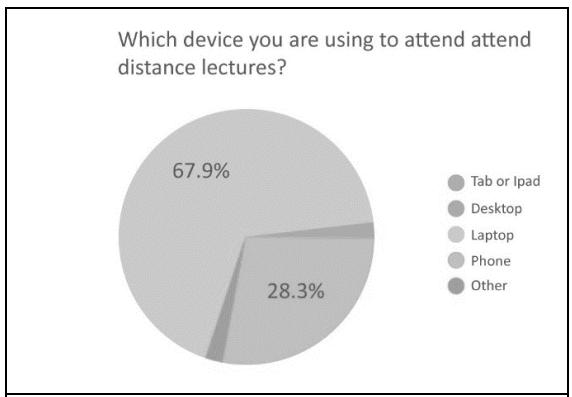 Figure 1: Device used for attending Distance Lecturers, Al Rawahi and Dr. Al Aamri
Out of the 53 students who answered the questionnaire, 36 students $(68\%)$ used laptops to attend online lectures and 15 students $(28\%)$ used mobile phones, while one of the students used a desktop and one used a tablet. This indicates clearly that about one-third of the students rely on their mobile devices to join the online classes which are not suitable for learning due to their small size, especially for design students who usually learn detailed aspects of design concepts and software. Although almost $70\%$ of students use their laptops to join lectures, this percentage needs to be improved.
Table 1: Facilities questions
<table><tr><td></td><td>Question</td><td>YES</td><td>NO</td></tr><tr><td>1</td><td>Do you easily get a laptop or desktop to complete your design projects?</td><td>62.2%</td><td>37.7%</td></tr><tr><td>2</td><td>Do you own a laptop or desktop?</td><td>81.1%</td><td>18.9%</td></tr><tr><td>3</td><td>Do you easily get design software for work in design projects?</td><td>39.6%</td><td>60.4%</td></tr></table>
62.3% of responded Design students stated that they handily own a personal device to work on their projects, but 37.7% claimed it was not easy to get the device to complete their required project. Moreover, 18.9% did not own a laptop or desktop and 81.1% did have their own device, but unfortunately, 60.4% didn't get the software easily worked on their devices.
This is an alarming indication which shows that many design students do not have access to suitable devices and suitable design software and raises the question of how they will be able to complete their projects from home!
Table 2: Atmosphere question
<table><tr><td></td><td></td><td>Extremely Uncomfortable</td><td>Somewhat Uncomfortable</td><td>Neutral</td><td>Somewhat Comfortable</td><td>Extremely Comfortable</td></tr><tr><td>1</td><td>Rate the atmosphere of your study environment at home while distance learning</td><td>13.2%</td><td>26.4%</td><td>37.7%</td><td>13.2%</td><td>9.4%</td></tr></table>
The study also covers the learning environment at home and the answers show that only $22.6\%$ of the students are somewhat comfortable and extremely comfortable with the atmosphere in their study environment at home, while $39.6\%$ of students feel uncomfortable when attending lectures, $37.7\%$ respond was neutral. Hence, more students feel uncomfortable studying online due to their home environment than students who feel comfortable.
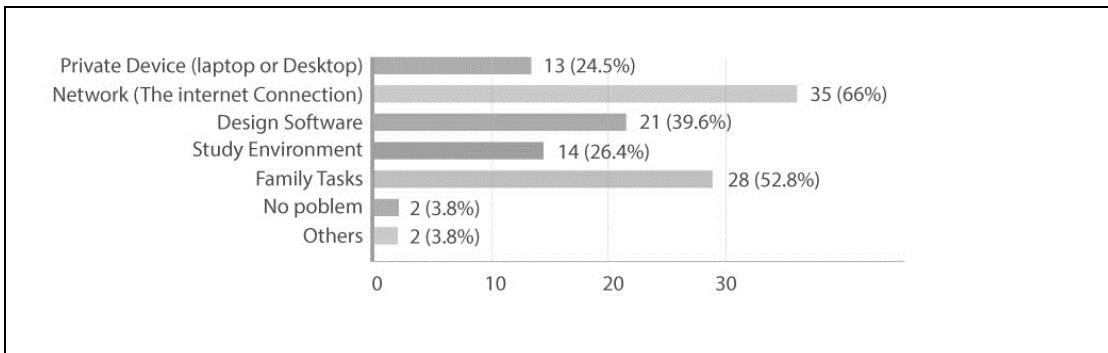 Figure 2: Al Rawahi and Dr. Al Aamri
In regard to the most challenges that students face while studying online, the majority of students indicated that internet connection was the most challenging that they encountered at home. The second most common challenge was family tasks that were given to students from their families to do at home. The third challenge was the issue of the availability of design software as many students do not have the software or
### b) Psychological Effect
In regard to the psychological effects of distance learning, six statements were included in the questionnaire to cover this dimension.
their laptops are not compatible with the new software they are learning at college. The issues of not having their own devices and other studying environments issues came as the least challenging issues. These challenges need further investigation to provide proper solutions that would help students succeed in their studies.
Table 3: Psychological questions
<table><tr><td></td><td>Question</td><td>Strongly Agree/Agree</td><td>Neutral</td><td>Strongly Disagree/Disagree</td></tr><tr><td>1</td><td>I believe in the efficiency of Online learning</td><td>18.1%</td><td>35.5%</td><td>45.3%</td></tr><tr><td>2</td><td>I am satisfied in Design online learning</td><td>20.7%</td><td>24.5%</td><td>54.7%</td></tr><tr><td>3</td><td>Design distance learning is effective</td><td>22.7%</td><td>45.3%</td><td>32.1%</td></tr><tr><td>4</td><td>Learning design online and remotely is stressful</td><td>60%</td><td>26.4%</td><td>13.2%</td></tr><tr><td>5</td><td>I have effective time management during Design Online learning</td><td>25.6%</td><td>34%</td><td>41.5%</td></tr><tr><td>6</td><td>Design distance learning is enjoyable</td><td>17%</td><td>41.5%</td><td>41.5%</td></tr></table>
The psychological effects caused by Covid-19 pandemic, which resulted in the transformation to a fully online study, resulted in many challenges. The first questions are general questions about the satisfaction of online learning in general, and especially in the design field. Only $15.1\%$ of responding candidates believed in the efficiency of online learning and only $3.8\%$ highly believed in the efficiency of distance learning. This proves the student's inability to accept and adapt distance learning easily.
On the other hand, about $45\%$ of students do not believe that distance learning is efficient for them. The remaining students are $35.8\%$ who have a neutral opinion about it. To be more specific about design distance studies, the results of the second question illustrate that more than $50\%$ of students are unsatisfied or highly unsatisfied with studying design online, while only $13.2\%$ are satisfied and $7.5\%$ are highly satisfied with it.
The third question is asked about the effectiveness of online design studies and responses showed that $20.8\%$ of students believed that studying design online was not effective, while only $5.7\%$ of students thought studying design online was very effective. highly satisfied. Investigating the stress in distance learning for candidates during the COVID-19 pandemic is the rolling finding of the second part. $43.4\%$ of the student's claimed that it was very stressful and $17\%$ stated that it was stressful. Only $1.9\%$ of the students responded that distance learning was very comfortable for them. This could be the result of the sudden shift to online learning and the unavailability of some basic distance learning tools.
The next statement measures students' time management ability in online learning. $5.7\%$ of students thought that they have excellent time control while more than $40\%$ have poor time management skills. This is a warning indicator that students' SRL skills need improvement. Assessing the enjoyment of distance learning was the last question in the psychological part and it seemed that $17\%$ of the respondents have some pleasure of studying online, but around $41\%$ have not enjoyed the online classes. Only $3.8\%$ of the students are absolutely enjoying their remote design courses.
### c) Performance
Table 4: Study performance questions
<table><tr><td></td><td>Question</td><td>Agree</td><td>Neutral</td><td>Disagree</td></tr><tr><td>1</td><td>Distance lectures affect my course understanding</td><td>49.1%</td><td>35.8%</td><td>15.1%</td></tr><tr><td>2</td><td>My grade affected negatively during distance learning</td><td>35.8%</td><td>28.4%</td><td>35.8%</td></tr><tr><td>3</td><td>I find time to talk and discuss with my colleagues</td><td>28.3%</td><td>35.8%</td><td>35.9%</td></tr><tr><td>4</td><td>I find time to talk and discuss with my Lecturer</td><td>35.8%</td><td>37.7%</td><td>26.4%</td></tr><tr><td>5</td><td>I believe that I will get better results if I study face-to-face on Campus</td><td>75.5%</td><td>13.2%</td><td>11.3%</td></tr></table>
The third section of the study aims to measure the achievement and success of this experience with design students in the University of Technology and Applied Sciences in Nizwa. Firstly, the potency of online teaching and the level of course understanding seems affected. Approximately $85\%$ of students replied that the understanding of the online courses was badly affected. Only $5.7\%$ assumed that they did not face any problems in the grasp of all different courses. In addition, the grades affected negatively for about $35.8\%$ of the participating students and $28.3\%$ of them remained at the same level while $35.8\%$ had increased their grade.
Social Interactions of students to students and students to lecturers were also interrupted through the closure of college due to this catastrophe. $5.7\%$ of students only communicated with their colleagues and interacted with them. About $15.1\%$ of students claimed that they never talked to their colleagues. On the other hand, in student-to lecturer interaction, $73.5\%$ say they are given good time to talk to the lecturers, while $7.5\%$ of them stated that they never talked to their lecturer.
At the end, the survey questioned if students believe that they will get better performance on campus and the results showed that about $75\%$ of them believed that they would get better results if they were on campus. This is a warning alarm for us as lecturers to try to make online teaching more effective, enjoyable, and engaging to students. Moreover, the course outline, content, and assessment methods need to be reviewed if this pandemic continues more semesters. As lecturers, we don't want to lose our Design students' motivation, therefore better solutions should be used until we reach the COVID-19 full recovery.
## VII. DISCUSSION
Distance learning has been implemented to control the spread of COVID-19 in Oman since March
2020 and has continued for three semesters. This study aimed to evaluate the impact of distance learning on design students in UTAS-Nizwa, measuring their perception, willingness for distance learning, self-regulated learning (SRL) practices, and how it affects their performance. The findings of this study shed light on the challenges and opportunities that distance learning can provide for the future.
The study identified that students had issues with owning devices (laptop or desktop) and getting the required software to accomplish their assignments and projects. Similarly, Al-Salman and Haider (2021) found that students in Applied Sciences Private Universitys in Jordan faced economic problems to acquire personal devices. However, most design students prefer using laptops to attend classes rather than phones or tablets as they need to open their projects during lecture time and share their screens with the lecturer for feedback. It is worth noting that using a laptop can be a disadvantage, as students may open any other screen during the lecture, potentially missing important information.
The surrounding physical environment of the learner is important for engagement and success. All physical barriers, such as inappropriate lighting, noise, and movement, can affect the learning process directly (Montreuil and Lippel, 2003; Solvbert and Rismark, 2012; Beckers et al. 2016). The study found that many UTAS Design students were uncomfortable about their study environments due to the large family size in Oman. This discomfort can directly affect their performance and ability to engage in SRL.
The sudden shift to online learning due to the pandemic has caused psychological stress among students. This finding is supported by Irawan et al. (2020), who argue that one of the main causes of students' stress is the pressure of online lecture tasks and the requirement to use new online media to comprehend course content and apply it to practical projects. Design is a project-based discipline with studio-based teaching as its core pedagogy (Fleischmann, 2019; Park 2011). The design of the courses in Design majors in UTAS may not be appropriate for distance learning, which can contribute to students' view of the ineffectiveness of distance design learning. Moreover, students' lack of experience in practicing SRL affects their study, which is crucial in distance learning. Therefore, time management workshops and personal advising sessions can be provided for students who face difficulties in managing their time and are falling behind.
Social interaction is essential for learning, motivation, engagement, and overall well-being, as it is one of the three basic psychological needs for human beings (Pelikan, Lüftenegger, and more 2021). The study found that designed UTAS-Nizwa students' interaction with each other is more affected by distance learning than their interaction with the lecturer. Although this indicates that lecturers are doing a great job communicating with students, they still need to encourage students to work in groups and connect with each other even online. Additionally, most design students at UTAS-Nizwa believe that they can perform better on campus, which is normal because online programs are generally less accepted by students than traditional face-to-face learning.
All in all, distance learning has presented challenges for design students at UTAS-Nizwa, such as device and software availability, physical environment barriers, psychological stress, lack of SRL practices, and reduced social interaction. However, the study also shows that distance learning can provide opportunities for the future with appropriate course design and teaching strategies that can enhance students' SRL practices, time management, and social interaction.
## VIII. OPPORTUNITIES
In general, everything has two sides - good and bad - including distance learning. There is no doubt that students face challenges in this new learning model, especially in design courses that require practical and studio-based teaching. Studies conducted in different countries such as Indonesia, Malaysia, Egypt, Jordan, and the US have emphasized that students with higher GPAs perform better in online courses, while students with poor GPAs perform worse in online learning (El Said, 2021; Enba et al, 2021; Thandearaj, 2021; Al-Salman & Haidar, 2021; Johnson, 2004; Simamora, 2020). We believe that this also applies to design students at UTAS-Nizwa. However, further investigation is needed to compare the performance of excellent students and low-performing students. If this is proven to be true, then the teaching faculty can organize programs that focus on low-performing students to motivate them and increase their online engagement.
Learning the design remotely resulted in many challenges, but this study showed that there are also some positive perceptions about it. A significant number of students believe in its effectiveness and enjoy it. This is not only true for UTAS-Nizwa, but also for interior design students from Prince Sultan University in Riyadh (Fallatah, 2020). They confirmed that distance learning gave them the chance to focus more on their projects by reducing interruptions from their colleagues. They also confirmed that distance learning helped them economically by eliminating the need to print their projects. Digital submission was accepted for their assignments and projects. We believe that we will have better perspectives of distance learning on time, as we as lecturers have learned from previous semesters and are working to improve our teaching and assessment methods. Moreover, basic amenities for students are now known and can be organized by both the university and parents for those students.
## IX. CONCLUSIONS AND RECOMMENDATIONS
The world has experienced a challenging period due to the rapid spread of COVID-19, which has affected all aspects of life, including education. This study aimed to evaluate the impact of emergency distance education on the perception of design students at UTAS-Nizwa regarding distance learning, SRL practices, and how this affected their performance. While this was a small-scale study and only the SRL theory was used, further studies with larger samples are needed to provide stronger evidence.
Design courses are typically practice and studio-based, and the transition to teaching these courses online requires a solid plan to prevent misunderstandings or incorrect implementation of design projects. It also requires students to have a strong sense of responsibility, good time management skills, self-reliance, and a conducive study environment. Reliable internet connections and adequate devices that can support design software are also critical factors that can affect students' motivation, enjoyment, and performance.
As experienced lecturers at UTAS-Nizwa with online teaching experience due to COVID-19 for more than two years, we see this new experience as an opportunity to evaluate distance learning for undergraduate design students in Oman. While most participating students still believe they can perform better on campus, many have developed independent learning capabilities, and developing SRL skills may benefit them in taking online courses during summer breaks or even after graduation. Therefore, distance learning can be a positive experience for many.
As UTAS continues to review and update their Design Program every five years, the lessons learned by the design faculty from this period will undoubtedly provide insights on how to improve learning experiences for different design majors.
Generating HTML Viewer...
References
28 Cites in Article
Dr. Muthuraman,Dr. Al Haziazi,Amani Al Balushi (2009). Influence of e-learning factors on student’s learning during Covid-19 in Sultanate of Oman.
A Al-Musawi (2010). E-Learning from an Omani Perspective.
Saleh Al-Salman,Ahmad Haider (2021). Jordanian University Students’ Views on Emergency Online Learning During COVID-19.
S Al-Salman,A Haider (2021). Online learning during COVID-19 pandemic: Challenges and opportunities in Jordanian higher education.
R Beckers,M Schmidt,J Wirth (2016). Digital Workspaces in a Home Environment.
Richard Carter Jr,Mary Rice,Sohyun Yang,Haidee Jackson (2020). Self-regulated learning in online learning environments: strategies for remote learning.
(2021). Digital Humanities in Oman: Logistics, Challenges and Opportunities.
G El Said (2021). How Did the COVID-19 Pandemic Affect Higher Education Learning Experience? An Empirical Investigation of Learners' Academic Performance at a University in a Developing Country.
J Enba,N Azizah,M Khalid (2021). A Review of Psychological Impact on Students Online Learning during Covid-19 in Malaysia.
Edugate (2020). Education Data Initiative.
Samaher Fallatah (1914). Senior Interior Design Students’ Perceptions about Distance Learning in the Shadow of Covid-19.
K Fleischmann (2019). Studio-based learning in higher education.
D Irawan,H Gunawan,Y Sunarya (2020). Effects of Online Learning in COVID-19 Pandemic on Students.
C Li,F Lalani (2020). Education responses to COVID-19: Embracing digital learning and online collaboration.
Moheri (nd) (0924). ST UD EN T S SP EAK : CA MP U S CULT UR E, ID EN TITY, A ND FA CEBOOK.
S Montreuil,K Lippel (2003). Telework and occupational health: A Quebec empirical study and regulatory implications.
(2020). Broadcasting Live Educational Lessons on Omani Channels.
A Olvbert,M Rismark (2012). Learning spaces in mobile learning environments.
Ji Park (2011). Design Education Online: Learning Delivery and Evaluation.
E Pelikan,M Lüftenegger (2021). Online teaching and social support: Associations with students' academic success and affective wellbeing during the COVID-19 pandemic.
Anthony Picciano,Jeff Seaman,I Allen (2010). Educational Transformation through Online Learning: To Be or Not to Be.
Roy Simamora (2020). The Challenges of Online Learning during the COVID-19 Pandemic: An Essay Analysis of Performing Arts Education Students.
Linda Wang (2020). 2020 ACS annual report available.
Natalie Wieland,Liz Kollias (2020). Online Learning Before, During and After COVID-19: Observations Over 20 Years.
Who (2020). Covid19-China.
Who (2020). Coronavirus Disease, (Covid-19) Pandemic.
Who (2020). WHO Director-General's Opening Remarks at the Media Briefing on COVID-19 -11.
No ethics committee approval was required for this article type.
Data Availability
Not applicable for this article.
How to Cite This Article
Fatema Al Rawahi. 2026. \u201cExploring the Challenges and Opportunities of Emergency Distance Learning for Design Students in UTAS-Nizwa During the COVID-19 Pandemic\u201d. Global Journal of Human-Social Science - G: Linguistics & Education GJHSS-G Volume 23 (GJHSS Volume 23 Issue G10): .
Explore published articles in an immersive Augmented Reality environment. Our platform converts research papers into interactive 3D books, allowing readers to view and interact with content using AR and VR compatible devices.
Your published article is automatically converted into a realistic 3D book. Flip through pages and read research papers in a more engaging and interactive format.
Self-isolation and social distancing is recommended by WHO to prevent the spread of COVID-19. By the mid of March, many procedures were done to achieve social distancing such as schools, shops, and malls closure. Most Schools shift their mode of teaching from face to face to distance learning. The purpose of this paper is to understand the effect of the sudden shift from face to face learning to distance learning to Design Students from University of Technology and Applied Sciences, Nizwa. It mainly shed light on challenges and opportunities that students faced during their distance studies and how they practiced the SRL. To reach a good understanding of this, a quantitative questionnaire from three parts was distributed electronically during distance learning. The questionnaire covers facilities and physical study atmosphere, psychological effect, and study performance. SRL theory is used to measure students’ learning control. The results showed that students had faced many challenges during their studies such as personal devices, software availability, a quiet place, a positive atmosphere, and family responsibilities.
Our website is actively being updated, and changes may occur frequently. Please clear your browser cache if needed. For feedback or error reporting, please email [email protected]
Thank you for connecting with us. We will respond to you shortly.