Extent, Levels and Suitability of ICT Usage for Agricultural Information Dissemination in Uganda: A Case of Rubanda, Mayuge Districts, and Mbarara City
The main source of livelihood in Uganda is smallholder farming. It is the most common type of agriculture practice supporting more than 70% of the population, thus a dire need to devise means to sustain and improve it towards poverty reduction and socio-economic development resulting from the agricultural sector. This study investigates the Level and Suitability of ICT Usage for Agricultural Information Dissemination in Rubanda, Mayuge Districts, and Mbarara City of Uganda. The study adopted the survey design of the cross-sectional and used structured questionnaires. Data collected were analysed using descriptive statistics of frequency counts and percentages.
## I. INTRODUCTION
The growth and development of the agriculture sector are achieved through the effective preparation of Information and Communication Technology (ICT). In line with the Food and Agriculture Organization (FAO, 2017), ICT has been a major contributor to the expansion and socio-economic development in countries and sectors wherever they're well deployed. The effective integration of ICT within the agriculture sector in developed and developing countries have done tremendous improvements in agriculture and its productivity. For example, traceability technologies like block chain, and frequency identification (RFID) have enabled transparency and potency throughout the organic phenomenon through the pursuit and tracing of food from farm to fork. This makes it doable to spot the supply of any food-related incident just in case a food safety issue happens. Such transformation is however required in most African countries' agricultural systems.
In recent years, efforts to transform the sector have led to the propagation of many mobile-based applications and services. A recent digitization report by the Technical Centre for Agriculture and Rural Cooperation (Tsan et al., 2019) discovered that thirty-three million farmers are presently reached by digital applications as of 2019 and this is often projected to achieve two hundred million by 2030. These applications are varying and target information and data services, market linkages, money access, and provide chain management, with information and data service dominating the market. Nejadrezaei et al. (2018) assert that ICT-based innovations will improve rural livelihoods and empower farmers in developing counties by enhancing their capacity and increasing access to correct and timely agriculture information. For instance, Esoko which is a technology platform in most African countries uses a mixture of mobile and internet services to boost access to extension services and market data. This reduces the prices of sorting out market data and provides weather and extension recommendations to farmers. Innovative ICT starting from computers, radio, television, and mobile phones to advanced technologies like block chain, computer science, cloud computing, Internet of Things (IoT), and big data are among these trends (Obschonka & Audretsch, 2019). Nejadreza ei et al. (2018) argue that these ICT trends hold the potential to contribute to sustainability transitions in agriculture by increasing efficiency, enhancing transparency, and traceability. Patel & Sayyed (2014) indicated that remote sensing exploitation satellite technologies and geographical data systems are opted to increase agricultural output. Furthermore, big data analytics can be used to provide predictive insights into farming operations, drive real-time operational decisions, and redesign business processes (Wolfert et al., 2017; Ahoa et al., 2020; Van Klompenburget et al., 2020). With ICT recognized as a major contributor to the expansion and development of agriculture, its application in recent years has gained increasing attention in several developing countries.
### a) ICT and Agriculture
Today's world is widely information-driven where Information and Communication Technologies (ICT) are increasingly becoming the underlying drivers of social and economic development including agriculture, not only in developed countries but across the globe (Sennuga et al., 2020). The role of ICTs in enhancing access and dissemination of agricultural information among smallholder farmers is paramount and it is also discovered that ICTs are usually very important tools for accessing relevant agricultural information if used effectively by targeted communities. The literature reviewed in this paper disclosed that there were varied ICT tools in agriculture but sadly, there was no clear proof of how the farmers significantly in rural settings were utilizing and gaining from these since most of these were found and set in urban areas with high internet penetration and usage(To & Trinh, 2021).
All in all, the approach which was employed in this study seeks to determine whether or not problems of adoption are the same as problems of information communication and persuasion. Aspects just like the inappropriateness of the innovation itself, or difficulties originating from the material conditions (as against temperament traits) of the potential adopter, were very little emphasized in previous studies. Also, the link that has been understood in previous studies between those striving to promote innovation and also the potential adopters is unequal and hierarchical; the adopters are considered as those having bigger information in the agricultural sector and the poor are seen as those that do not understand what's sensible for them (Morosan & DeFranco, 2016).
Various studies distinguish that the selections of users are oftentimes supported by rationality that is subject to economic, social as well as cultural specificities. These studies place major emphasis on the method by which the procedure itself is generated and developed, additionally on the demand to make sure of its appropriateness to the necessities of users. They highlight that the peculiarity between a generation of innovation and adoption could be a false one in which it is inconceivable to require innovation as exogenously given how it is to be developed/adapted within the field itself (Venkatesh et al., 2016). The foremost common feature of such studies is the emphasis that they place on the desirability of close interface with and participation of the ultimate user within the method of innovation itself. Where they vary is within the extent of involvement anticipated. This study was set to bring out confirmatory results to justify innovation adoption, implementation, and ICT usage among smallholder farmers in their localities. It is observed that sharing of agricultural information to and among the numerous smallholder farmers in remote areas does not adequately consider the necessary ICT tools that best suit the intended farmers for increased ICT adoption that can necessitate the actual, intended, and effective delivery of agricultural information in developing countries. There is therefore a need to investigate and understand the extent, levels, and suitability of ICT Usage for Agricultural Information Dissemination in Uganda using a case study of Rubanda, Mayuge Districts, and Mbarara City.
## II. METHODOLOGY
The study adopted cross-sectional design of survey research type and the instrument for this study consisted of structured questionnaires. The questionnaire was subjected to face and content validity and reliability test. Data collected were analysed using descriptive statistics of frequency counts, percentages, and mean and standard deviation. The target population of this study comprised all farmers in Rubanda District, Mayuge District, and Mbarara City where 374 farmers were randomly selected and made to participate in the study. Copies of the questionnaire were distributed to them and collected for analysis after they were completely filled.
## III. RESULT AND DISCUSSION
This section elaborates the findings of this study in relation to the extent of ICT usage, levels, and suitability of different types of ICT tools for agricultural information dissemination in developing countries particularly Uganda.
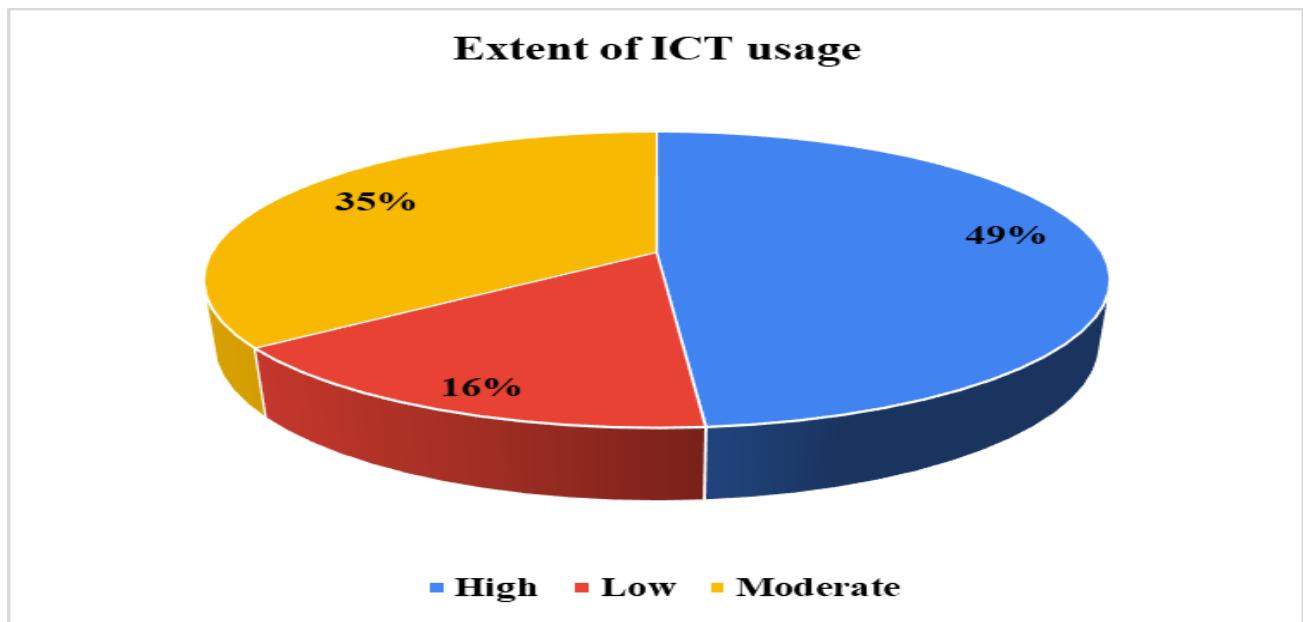 Figure 1: The extent of ICT usage for agricultural information dissemination
Source:Field Survey,2022
The results in Figure 1 show that a simple majority (49%) of the farmers moderately used ICT devices (Radios; Televisions, Mobile Phones, Computers) for agricultural information dissemination across all study areas. 35% of them only used the devices at a high rate and only 16% used the devices at a low rate. This finding further justifies how easily accessible the ICT devices are to farmers.
Farmers in Mayuge district used radios at the highest rate (80.35%) for agricultural information dissemination than farmers in the other two study areas. The majority (45.24%, 80.95%, and 56.86%) of the farmers in Mbarara city used Televisions, Mobile
Phones, and Computers respectively for the dissemination of agricultural information as indicated in Table 1 below.
Generally, the ICT device that was mostly used in the three districts was the radio with a response rate of $73\%$. This is because it's cheaper to acquire and user-friendly among the common subsistence farmers and this conforms with the study by Oyeyinka and Bello (2013) who indicated that radio continues to possess very wide penetration and reach, notably in Africa, South America, and elements of Asia that have rural areas, to produce and interpret information in an exceedingly relevant manner for its listeners.
Table 1: The Extent of ICT Usage for Agricultural Information Dissemination in Rubanda District, Mayuge District, and Mbarara City
<table><tr><td rowspan="3">ICT Devices</td><td colspan="9">CATEGORY</td><td colspan="3"></td></tr><tr><td colspan="3">Mayuge District (%)</td><td colspan="3">Mbarara City (%)</td><td colspan="3">Rubanda District (%)</td><td colspan="3">Overall (%)</td></tr><tr><td>High</td><td>Low</td><td>Moderate</td><td>High</td><td>Low</td><td>Moderate</td><td>High</td><td>Low</td><td>Moderate</td><td>High</td><td>Low</td><td>Moderate</td></tr><tr><td>Radio</td><td>80.35</td><td>1.16</td><td>18.5</td><td>77.38</td><td>8.33</td><td>14.29</td><td>61.04</td><td>14.29</td><td>24.68</td><td>73</td><td>8</td><td>19</td></tr><tr><td>Television</td><td>11.79</td><td>17.28</td><td>70.93</td><td>45.24</td><td>5.95</td><td>48.81</td><td>32.69</td><td>28.85</td><td>38.46</td><td>30</td><td>17</td><td>53</td></tr><tr><td>Mobile Phone</td><td>52.63</td><td>12.5</td><td>34.87</td><td>80.95</td><td>3.81</td><td>15.24</td><td>75.31</td><td>11.11</td><td>13.58</td><td>70</td><td>9</td><td>21</td></tr><tr><td>Computer</td><td>2.94</td><td>52.94</td><td>44.12</td><td>56.86</td><td>17.65</td><td>25.49</td><td>19.57</td><td>43.48</td><td>36.96</td><td>26</td><td>38</td><td>36</td></tr></table>
Results in Table 1 above indicate the findings of the study that Mayuge district had the highest percentage (80.35%) of radio usage for agricultural information dissemination, followed by 11.79% for television, $52.63\%$ for mobile phones, and $2.94\%$ for computer usage.
Table 2: The Overall Extent of ICT Usage for Agricultural Information Dissemination In Rubanda District, Mayuge District, and Mbarara City
<table><tr><td rowspan="3">Type of ICT</td><td colspan="8">Extent</td></tr><tr><td colspan="2">Do not Use</td><td colspan="2">Low</td><td colspan="2">Moderate</td><td colspan="2">High</td></tr><tr><td>f</td><td>%</td><td>f</td><td>%</td><td>f</td><td>%</td><td>f</td><td>%</td></tr><tr><td>Radio</td><td>25</td><td>6.7</td><td>13</td><td>3.5</td><td>69</td><td>25.4</td><td>241</td><td>64.4</td></tr><tr><td>Television</td><td>167</td><td>44.7</td><td>30</td><td>8.0</td><td>111</td><td>29.7</td><td>66</td><td>17.6</td></tr><tr><td>Mobile Phone</td><td>2</td><td>0.5</td><td>48</td><td>12.3</td><td>88</td><td>23.4</td><td>258</td><td>63.6</td></tr><tr><td>Computer</td><td>258</td><td>69.0</td><td>65</td><td>17.4</td><td>46</td><td>12.3</td><td>5</td><td>1.3</td></tr></table>
Source:Field Survey,2022
Results in Table 2 reveal the overall extent of ICT usage for agricultural information dissemination in Rubanda District, Mayuge District, and Mbarara City according to their percentage. Most of the respondents revealed that; $64.4\%$ have high usage of radio for agricultural information dissemination, followed by mobile phone $(63.6\%)$, then television $(44.7\%)$. Whilst, computer $(1.3\%)$ is the least type of ICT device used for agricultural information dissemination. This was justified by the nature of cost-effectiveness and affordability ranging from radio to computer respectively. Many of the respondents across the study areas reported that they always tune in to local radio stations particularly mornings before they leave for their farming activities and later on in the evenings after work which gives them ample time to attentively get the agricultural related information from the radio. These findings are in agreement with Galanakis (2020) who indicates how ICTs help to monitor the vehicles of agricultural transformation during restricted days of lockdown and issues of wider coverage and time saving by extension service providers versus the number of farmers in respective areas.
Table 3: Tabulation for the overall extent of ICT usage for agricultural information dissemination in Rubanda District, Mayuge District, and Mbarara City
<table><tr><td rowspan="4">District
[Radio]
[Television]
[Computer]
[Mobile Phone]</td><td>Pearson chi2 (6) = 60.9387</td><td>Pr = 0.000</td></tr><tr><td>Pearson chi2 (6) = 72.554</td><td>Pr = 0.001</td></tr><tr><td>Pearson chi2 (6) = 32.766</td><td>Pr = 0.001</td></tr><tr><td>Pearson chi2 (6) = 30.632</td><td>Pr = 0.001</td></tr><tr><td rowspan="4">Gender
[Television]
[Computer]
[Mobile Phone]
[Radio]</td><td>Pearson chi2 (6) = 1.191</td><td>Pr = 0.75</td></tr><tr><td>Pearson chi2 (6) = 10.124</td><td>Pr = 0.18</td></tr><tr><td>Pearson chi2 (6) = 0.538</td><td>Pr = 0.910</td></tr><tr><td>Pearson chi2 (6) = 17.814</td><td>Pr = 0.000</td></tr><tr><td rowspan="4">Marital Status
[Television]
[Computer]
[Mobile Phone]
[Radio]</td><td>Pearson chi2 (6) = 27.816</td><td>Pr = 0.001</td></tr><tr><td>Pearson chi2 (6) = 8.471</td><td>Pr = 0.487</td></tr><tr><td>Pearson chi2 (6) = 40.687</td><td>Pr = 0.000</td></tr><tr><td>Pearson chi2 (6) = 36.529</td><td>Pr = 0.000</td></tr><tr><td rowspan="4">Education Level
[Mobile Phone]
[Television]
[Computer]
[Radio]</td><td>Pearson chi2 (6) = 49.115</td><td>Pr = 0.000</td></tr><tr><td>Pearson chi2 (6) = 81.037</td><td>Pr = 0.000</td></tr><tr><td>Pearson chi2 (6) = 61.712</td><td>Pr = 0.000</td></tr><tr><td>Pearson chi2 (6) = 50.8386</td><td>Pr = 0.000</td></tr><tr><td rowspan="4">Age
[Computer]
[Mobile Phone]
[Television]
[Radio]</td><td>Pearson chi2 (6) = 22.382</td><td>Pr = 0.098</td></tr><tr><td>Pearson chi2 (6) = 50.433</td><td>Pr = 0.00</td></tr><tr><td>Pearson chi2 (6) = 38.050</td><td>Pr = 0.001</td></tr><tr><td>Pearson chi2 (6) = 71.036</td><td>Pr = 0.001</td></tr><tr><td rowspan="4">Monthly Income
[Television]
[Computer]
[Mobile Phone]
[Radio]</td><td>Pearson chi2 (6) = 92.097</td><td>Pr = 0.000</td></tr><tr><td>Pearson chi2 (6) = 72.385</td><td>Pr = 0.000</td></tr><tr><td>Pearson chi2 (6) = 46.559</td><td>Pr = 0.000</td></tr><tr><td>Pearson chi2 (6) = 51.027</td><td>Pr = 0.000</td></tr></table>
The tabulation tables run further report the overall extent of ICT usage for agricultural information dissemination in Rubanda District, Mayuge District, and Mbarara City, and the Chi-square tests across study areas and socio-economic factors for the extent of ICT adoption and usage for agricultural information dissemination show that at a $5\%$ level of significance, $p < 0.01$ implies that there is a significant association between the district of participants and their extent of use of radio. The vast majority $(78.7\%)$ of the people who have a high use of radio are domiciled in Mayuge district. Followed by Mbarara district $(61.1\%)$, followed by Rubanda $(54.5\%)$. The implication of this is that efforts aimed at improving agricultural information among farmers should consider the use of radio as the major ICT tool for Mayuge and Mbarara districts.
The highest percentage $(35.2\%)$ of the people who use television are from the Mbarara district, followed by those who are from the Rubanda district with $19.3\%$ of farmers who were using television for agricultural information, while Mayuge accounted for the least $6.2\%$ of farmers who were using television for agricultural information purposes. The implication is that any effort aimed at improving ICT usage among the farmers in these districts should first ensure accessibility to television with an enabling environment for its usage for agricultural information among farmers. Thus, a chi-square statistic shows that at a $5\%$ level of significance, $p < 0.00$ implies that there is a significant association between the district of participants and their extended use of television.
The highest percentage $(3.4\%)$ of the people who use a computer was from the Rubanda district, followed by those who are from the Mbarara district with $1.9\%$ of farmers who were using a computer for agricultural information, while none of the farmers from Mayuge were using a computer for agricultural information purposes. The implication is that any initiative aimed at improving ICT usage among the farmers in these districts should first ensure training, retraining, and accessibility to a computer with an enabling environment for the application of computers for agricultural information among farmers. And at a $5\%$ level of significance, $p < 0.00$ implies that there is a significant association between the district of participants and their extended use of the computer.
The vast majority (78.7%) of the people who have a high use of mobile phones are domiciled in Mbarara district followed by those from Rubanda district (72.7%), followed Mayuge (50.0%). The implication of this is that efforts aimed at improving agricultural information among farmers should consider the use of the mobile phone as the major ICT tool for Mbarara and Rubanda districts. At a 5% level of significance, $p < 0.00$ implies that there is a significant association between the district of participants and their extended use of the mobile phone.
The highest percentage of the farmers $(44.7\%)$ were not using Television for agricultural information purposes. However, out of the $17.6\%$ of the total respondents who use Television, analysis shows that females had a higher percentage of $19.5\%$ usage of television for agricultural information purposes. The implication of this is that any initiative towards improving agricultural information dissemination should be more targeted at female farmers as the said gender was more comfortable with the usage of Television than their male counterparts. At a $5\%$ level of significance, $p < 0.75$ implies that despite the higher percentage of female usage of television for agricultural information purposes; the Chi-Square result shows there is no significant association between the gender of participants and their extended use of Television for agricultural information purposes.
The highest percentage (69.0%) is not using computers for agricultural information purposes. However, out of the 1.3% of the people who use a computer, analysis shows that males had a higher percentage of 2.1% usage of computers for agricultural information purposes. The implication of this finding can be viewed in two ways; firstly, it is obvious that most of the farmers do not know how to operate the computer system. Secondly, the financial implication of having a personal computer may be on the high side for many poor farmers. Thus, any effort aimed at improving the use of computers among the farmers should first consider training and re-training in the use of computers and if possible, agricultural grants should be made available to encourage the farmers financially. At a 5% level of significance, $p < 0.01$ implies that there is a significant association between the gender of participants and their extent of use of Computers for agricultural information purposes.
The highest percentage (63.6%) of the respondents were found using mobile phones for agricultural information purposes. The analysis also shows gender differences of a higher percentage (64.6%) of male farmers' usage of mobile phones for agricultural information purposes compared to a lesser percentage (61.8%) of their female counterparts. The implication of this is efforts to improve agricultural information dissemination should first identify the choice of ICT tools that are most suitable gender-wise and take better advantage of mobile phones to reach the male. Females had oftentimes been found dumping their phones inside their handbags for several hours and sometimes throughout the whole day, thus, missing several urgent and timely pieces of information, unlike their male counterparts who oftentimes held their mobile in their hands as they go about their daily activities. At a 5% level of significance, $p < 0.75$ implies that despite the higher percentage of male usage of mobile phones for agricultural information purposes; the Chi-Square result shows there is no significant association between the gender of the participant farmers and their extended use of the mobile phones for agricultural information purposes.
The married farmers' respondents recorded a higher $(32.2\%)$ percentage usage of television for agricultural information purposes, followed by the single farmers who accounted for $28.6\%$, followed by the farmers who were divorced which accounted for $25.0\%$. The implication of this is that married people are more settled and stable, and they tend to have equipped the home with some electronics among which is television unlike their singles counterparts who are less settled and less stable and often time do not have a television set thus, efforts aimed at improving agricultural information disseminations should consider Television for a better reach of the married farmers with agricultural information. The chi-square test shows that at a $5\%$ level of significance, $p < 0.01$ implies that there is a significant association between the marital status of participants and their extended use of Television for agricultural information purposes.
The single farmers' respondents recorded a higher (19.7%) percentage usage of Computers for agricultural information purposes, followed by the farmers who were married which accounted for 11.7%, followed by the farmers who were widowed which accounted for 5.3%. The implication of this is that the younger farmers who were mostly singles were vaster in ICT-related skills and more comfortable with the use of computers for agricultural information thus, efforts aimed at better information dissemination on agricultural matters should consider the computer to reach the single/younger farmers. At a 5% level of significance, $p < 0.48$ implies that despite the disparity in marital status towards the usage of Computers for agricultural information purposes; the Chi-Square result shows there is no significant association between the marital status of the participant farmers and their extended use of Computer for agricultural information purposes.
The single farmers' respondents recorded a higher $(31.6\%)$ percentage usage of the Mobile phone for agricultural information purposes, followed by the farmers who were married which accounted for $24.0\%$, followed by the farmers who were widowed which accounted for $19.6\%$. While the respondents' farmers who were divorced accounted for the remaining $18.8\%$. The implication of this is that the younger farmers who were mostly singles were more comfortable with the use of the mobile phone for agricultural information thus; efforts aimed at better information dissemination on agricultural matters should consider the mobile phone as one of the best platforms to reaching the single/younger farmers. Thus, at a $5\%$ level of significance, $p < 0.01$ implies that there is a significant association between the marital status of participants and their extended use of the mobile phone for agricultural information purposes.
That the farmers' respondents with Master's degrees recorded a higher (50.0%) percentage usage of television for agricultural information purposes, followed by the farmers who were bachelor's degree holders which accounted for 34.9%, followed by the farmers who were O 'level holders which accounted for 17.8%. The implication of this is that the more educated farmers were more comfortable with the use of television for agricultural information thus; efforts aimed at better information dissemination on agricultural matters should consider television to reach the advance and highly educated farmers. At a 5% level of significance, $p < 0.00$ implies that there is a significant association between the educational level of participants and their extended use of television for agricultural information purposes.
The farmers' respondents with Master's degrees recorded higher (16.7%) percentage usage of computers for agricultural information purposes, followed by the farmers who were bachelor's degree holders which accounted for 34.9%, followed by the farmers who were O 'level holders which accounted for 17.8%. The implications of these are that the most educated farmers were vaster in ICT-related skills and more comfortable with the use of computers for agricultural information thus, efforts aimed at better information dissemination on agricultural issues should consider the computer to reach the more educated farmers. A chi-square was also run to further confirm the claims above and it reveals that at a 5% level of significance, $p < 0.00$ implies that there is a significant association between the marital status of participants and their extended use of computer for agricultural information purposes.
The farmers' respondents who were Bachelor's degree holders recorded a higher (83.5%%) percentage usage of mobile phones for agricultural information purposes, followed by the farmers who were Master's degree holders which accounted for 83.3%, followed by the farmers who were O 'Level holder which accounted for 68.9%. Others were accounted for by farmers who primary schools were leaving certificate holders and others probably who do not have any formal educational qualification. The implication of this is that the well-educated farmers were also having better use of mobile phones resulting from their vastness in ICT-related skills and can comfortably use mobile phones for agricultural information thus; efforts aimed at better information dissemination on agricultural matters should also consider mobile phone to reaching the more educated farmers and at a $5\%$ level of significance, $p < 0.00$ implies that there was a significant association between the educational level of participants and their extended use of mobile phones for agricultural information purposes.
The farmers' respondents' age range of 34-44 recorded a higher (33.6%) percentage usage of television for agricultural information purposes, followed by farmers who were age range of 45-54 who accounted for $31.4\%$, followed by farmers who were below 25 which accounted for $27.3\%$, followed by the farmers who were 55-64 which accounted for $26.7\%$. The implication of this is that middle-aged to older farmers were more comfortable with the use of television for agricultural information thus; efforts aimed at better information dissemination on agricultural-related issues should consider television to reach the older farmers. At a $5\%$ level of significance, $p < 0.01$ implies that there is a significant association between the age range of participants and their extended use of television for agricultural information purposes.
The farmers respondent's age range of 25-34 recorded a higher (18.5%) percentage usage of computer for agricultural information purposes, followed by farmers who were age range of 35-44 which accounted for $15.5\%$, followed by the farmers who were 55 and above which accounted for $14.3\%$, followed by the farmers who were below 25 and those of 45-54 which accounted for $9.3\%$ and $9.1\%$ respectively. The implication of this is that middle-aged to younger farmers were more comfortable with the use of computers for agricultural information thus; efforts aimed at better information dissemination on agricultural-related issues should consider the computer to reach the younger farmers. More so, at a $5\%$ level of significance, $p < 0.09$ implies that despite the differences in age usage of Computers for agricultural information purposes; the Chi-Square result shows there is no significant association between the age of the participant farmers and their extended use of computers for agricultural information purposes.
The farmer's respondents age range 45-54 recorded higher (32.6%) percentage usage of mobile phones for agricultural information purposes, followed by farmers who were age range 65-54 which accounted for $28.0\%$, followed by the farmers who were below 25 years old which accounted for $27.3\%$, followed by the farmers who were 35-44 and those of 65 and above which accounted for $19.8\%$ and $19.0\%$ respectively. The implication of this is that middle-aged farmers to older farmers seem to be having better usage of the mobile phone thus; efforts aimed at better information dissemination on agricultural-related issues should consider reaching the older farmers via mobile phones. Furthermore, at a $5\%$ level of significance, $p < 0.00$ implies that there is a significant association between the range of participants and their extended use of the mobile phone for agricultural information purposes.
The farmers' respondents whose monthly income falls within 1.5-2M (million Uganda shillings) recorded higher $(50.0\%)$ percentage usage of television for agricultural information purposes, followed by the farmers whose monthly income was above 2M which accounted for $23.1\%$, followed by the farmers whose monthly income falls within 500k-1M which accounted for $22.8\%$ usage of television for agricultural purposes. The implication of this is that the farmers with average to higher monthly income seem to be comfortable with television for catching up with agricultural information. At a $5\%$ level of significance, $p < 0.00$ implies that there is a significant association between the income level of participants and their extent of use of television for agricultural information purposes.
The farmers' respondents whose monthly income ranges from 1.5M-2M recorded higher (12.5%) percentage usage of computer for agricultural information purposes, followed by the farmers whose monthly incomes were above 2M which accounted for $7.7\%$, followed by the farmers whose monthly income were within 500K-1M which accounted for $2.1\%$. The implication of this is that the farmers with average to higher monthly income seem to be more conversant with computers for assessing agricultural information. And at a $5\%$ level of significance, $p < 0.00$ implies that there is a significant association between the income level of participants and their extent of use of computers for agricultural information purposes.
The farmers' respondents whose monthly income ranges from 1.5M-2M recorded higher (100.0%) percentage usage of mobile phone for agricultural information purposes, followed by the farmers whose monthly income were 1M-1.5M which accounted for $100.0\%$, followed by the farmers whose monthly income were above 2M which accounted for $76.9\%$, followed by those whose monthly income was within 500K-1M which accounted for $75.2\%$ usage of mobile phone as ICT tool/s for information dissemination. The implication of this is that the farmers with average to higher monthly income seem to be more comfortable with the mobile phone for catching up with agricultural information. A chi-square confirmation further shows that at a $5\%$ level of significance, $p < 0.01$ implies that there is a significant association between the marital status of participants and their extent of use of Television for agricultural information purposes in the study areas since married couples tend to involve in agricultural activities more than the other categories of marital statuses.
## IV. CONCLUSION AND RECOMMENDATIONS
Mobile phone devices and Radio are the leading types of ICT usage for agricultural information dissemination in Rubanda district, Mayuge district, and Mbarara city. It is recommended that agricultural information dissemination can be reiterated using other newer and more complex ICT devices and platforms but the priority and emphasis must be placed on mobile phones and radio being the leading types of ICT used for agricultural information dissemination in Rubanda district, Mayuge district, and Mbarara city.
Efforts aimed at improving agricultural information among farmers should consider the use of radio as the major ICT tool for Mayuge and Mbarara districts. Efforts aimed at improving ICT usage among the farmers in these districts should first ensure accessibility to television with an enabling environment for its usage for agricultural information among farmers.
Initiatives aimed at improving ICT usage among the farmers in these districts should first ensure training, re-training, and accessibility to the computer with an enabling environment for the application of computers for agricultural information among farmers. Efforts aimed at improving agricultural information among farmers. Should consider the use of the mobile phone as the major ICT tool for Mbarara and Rubanda districts. Initiatives towards improving agricultural information dissemination should consider the use of Television for female farmers than their male counterparts
Efforts aimed at improving the use of computers among the farmers should first consider training and retraining in the use of computers and if possible, agricultural grants should be made available to encourage the farmers financially. Efforts to improve agricultural information dissemination should first identify the choice of ICT tools that are most suitable gender-wise and take better advantage of mobile phones to reach the male. Females had oftentimes been found dumping their phones inside their handbags for several hours and sometimes throughout the whole day, thus, missing several urgent and timely pieces of information, unlike their male counterparts who oftentimes held their mobile in their hands as they go about their daily activities.
Efforts aimed at improving agricultural information dissemination should consider Television for a better reach of married farmers with agricultural information. Efforts aimed at better information dissemination on agricultural matters should consider the computer to reach the single/younger farmers. Efforts aimed at better information dissemination on agricultural matters should consider mobile phones as one of the best platforms to reach single/younger farmers.
Efforts aimed at better information dissemination on agricultural matters should consider television to reach advanced and highly educated farmers. Efforts aimed at better information dissemination on agricultural issues should consider the computer to reach the more educated farmers. Efforts aimed at better information dissemination on agricultural matters should also consider the mobile phone to reach the more educated farmers.
Efforts aimed at better information dissemination on agricultural-related issues should consider television to reach older farmers. Efforts aimed at better information dissemination on agricultural-related issues should consider computers to reach younger farmers. Efforts aimed at better information dissemination on agricultural-related issues should consider reaching older farmers via mobile phone.
### a) Conflict of Interest
The authors declare no conflict of interest in this publication and have the right for any changes and adjustments throughout the entire manuscript.
### b) Source of Funds
This was self-sponsored research as one of the objectives for PhD research project.
Emmanuel Ahoa,Ayalew Kassahun,Bedir Tekinerdogan (2020). Business processes and information systems in the Ghana cocoa supply chain: A survey study.
Fao (2017). Information and communication technology (ICT) in agriculture: A report to the G20 agricultural deputies.
Charis Galanakis (2020). The Food Systems in the Era of the Coronavirus (COVID-19) Pandemic Crisis.
C Morosan,A Defranco (2016). It's about time: Revisiting UTAUT2 to examine consumers' intentions to use NFC mobile payments in hotels.
Nima Nejadrezaei,Mohammad Allahyari,Mina Sadeghzadeh,Anastasios Michailidis,Hamid El Bilali (2018). Factors affecting adoption of pressurized irrigation technology among olive farmers in Northern Iran.
M Obschonka,D Audretsch (2019). Artificial intelligence and big data in entrepreneurship: A new era has begun.
R Oyeyinka,R Bello (2013). Farmers Use of Icts for Marketing Information Outlets in Oyo State, Nigeria.
Hetal Patel,Dharmendra Patel (2014). Survey of Android Apps for Agriculture Sector.
S Sennuga,J Conway,M Sennuga (2020). Impact of information and communication technologies (ICTS) on agricultural productivity among smallholder farmers: Evidence from sub-Saharan african communities.
A To,T Trinh (2021). Understanding behavioral intention to use mobile wallets in vietnam: Extending the tam model with trust and enjoyment.
M Tsan,S Totapally,M Hailu,B Addom (2019). Executive summary.
Thomas Van Klompenburg,Ayalew Kassahun,Cagatay Catal (2020). Crop yield prediction using machine learning: A systematic literature review.
Viswanath Venkatesh,James Thong,Xin Xu (2016). Unified Theory of Acceptance and Use of Technology: A Synthesis and the Road Ahead.
Sjaak Wolfert,Lan Ge,Cor Verdouw,Marc-Jeroen Bogaardt (2017). Big Data in Smart Farming – A review.
No ethics committee approval was required for this article type.
Data Availability
Not applicable for this article.
How to Cite This Article
Byamukama Willbroad. 2026. \u201cExtent, Levels and Suitability of ICT Usage for Agricultural Information Dissemination in Uganda: A Case of Rubanda, Mayuge Districts, and Mbarara City\u201d. Global Journal of Science Frontier Research - D: Agriculture & Veterinary GJSFR-D Volume 23 (GJSFR Volume 23 Issue D2): .
Explore published articles in an immersive Augmented Reality environment. Our platform converts research papers into interactive 3D books, allowing readers to view and interact with content using AR and VR compatible devices.
Your published article is automatically converted into a realistic 3D book. Flip through pages and read research papers in a more engaging and interactive format.
The main source of livelihood in Uganda is smallholder farming. It is the most common type of agriculture practice supporting more than 70% of the population, thus a dire need to devise means to sustain and improve it towards poverty reduction and socio-economic development resulting from the agricultural sector. This study investigates the Level and Suitability of ICT Usage for Agricultural Information Dissemination in Rubanda, Mayuge Districts, and Mbarara City of Uganda. The study adopted the survey design of the cross-sectional and used structured questionnaires. Data collected were analysed using descriptive statistics of frequency counts and percentages.
Our website is actively being updated, and changes may occur frequently. Please clear your browser cache if needed. For feedback or error reporting, please email [email protected]
Thank you for connecting with us. We will respond to you shortly.
Lorem ipsum dolor sit amet, consectetur adipiscing elit. Ut elit tellus, luctus nec ullamcorper mattis, pulvinar dapibus leo.
Extent, Levels and Suitability of ICT Usage for Agricultural Information Dissemination in Uganda: A Case of Rubanda, Mayuge Districts, and Mbarara City