


I. BACKGROUND
Banking sector of Bangladesh is one of the most important service sectors of Bangladesh which is also a highly regulated industry in the world. In recent years, private banks of Bangladesh are increasing in a geometric rate with new services like mobile banking. Bangladesh Bank is the central bank and is responsible for managing all other banks of the country. It oversees the banking system and implements the government's financial and monetary policies. Bangladesh's banking system was government-owned until 1982 except some foreign banks. Due to the liberation of financial policy, the government of Bangladesh allowing more private commercial and investment banks to increase competition in the financial market of the country. In 2001, there were 52 licensed banks, among them 4 were nationalized commercial banks, 5 were specialized banks, 30 were private commercial banks, and 13 were foreign banks in Bangladesh. Now, there are 57 scheduled banks in Bangladesh who operate under the full control and supervision of Bangladesh Bank that is empowered to do so through Bangladesh Bank Order, 1972 and Bank Company Act, 1991. According to that act, banks are categorized under schedule banks that include state-owned commercial banks, private commercial banks, Islamic commercial banks, and foreign commercial banks. Banks established for distinct and specific objectives fall under non-schedule banks in Bangladesh.
Now, both private and public banks are operating with the use of latest technologies and are adopting highly aggressive marketing strategies. These latest technologies have a significant impact in banking service. This has helped the customers to access their banks at anytime through Internet or mobile banking system. Mobile banking refers to the use of a smartphone or other cellular device to perform online banking tasks while away from the home computer, such as monitoring account balances, transferring funds between accounts, bill payment and locating an ATM . Consumers are attracted to these technologies because of the convenience in use, increasing ease of use, and in some instances cost savings, etc. However, customers are also experiencing some problems such as, security in transaction, authentication risks, reliability, connectivity problem between bank and its customers, application security, etc. Therefore, this study aims at identifying the factors concerning the experience of mobile banking users in Bangladesh.
II. OBJECTIVES OF THE STUDY
The main objective of this study is to identify the factors affecting the customers' experience in mobile banking of Bangladesh. The specific objectives are as follows.
To describe the mobile banking systems in the private commercial bank of Bangladesh;
To identify the factors concerning the experience of mobile banking customers in Bangladesh;
To provide some suggestions for the improvement of the mobile banking services in Bangladesh.
III. LITERATURE REVIEW
Mobile banking is the key for the socio-economic development of the country at large. It has brought services closer to the people thus making it easy to transact without delays and restrictions of time limits Makongoro, 2014). Mobile banking is a relatively new service adopted by the private and government commercial banks in Bangladesh. However, there are some unknowns to the mobile bank service users that sometimes give them negative experience regarding the services. This experience is concerned with the use of the mobile banking services. Study (Islam, & Hossain, 2014) shows that the infrastructural facility updates user friendly technology and its availability in Bangladesh towards mobile banking. Service quality as a whole is a strong antecedent of customer satisfaction, but only three dimensions have a positive influence on satisfaction such as reliability and responsiveness, efficiency and convenience. (Sagib, & Zapan, 2014).
Study (Kabir, M. R. 2013) shows that the factors like performance risk, security/privacy risk, time risk, social risk and financial risk are negatively related with the usages of mobile banking as perceived risk make the users confused about their security in using mobile banking. While the factors like ability, integrity, benevolence, perceived usefulness, perceived ease of use relative cost and time advantages are positively related with the intention to use mobile banking services. It is also found that, the security and trust factor is the most influential factor where ineffective advertisement has negative influence on the customer satisfaction of mobile banking (Ahmed, & Jannat, 2015). The results of structural equation modeling (SEM) indicate that perceived financial cost, perceived risk and subjective norm are the most influencing factors that affect people's behavioral intention to adopt or continue to use mobile banking (Siddik,. Sun,. Yanjuan, & Kabiraj, 2014).
Findings who suggest that internet mobile banking use increases if the banks' customers' perceive that it is not risky, the credibility of the bank is good, and it is easy to use that, lead to increased acceptance of internet banking (Shahriar, 2014). Study (Hossain, & Hossain, 2015) shows that the correlation and regression analysis in the examination endow with full support for the hypothesis which are related to reliability, responsiveness, trust, switching costs and demographic environment. The findings advocate that the executives of the banks should put more focus on escalating switching cost, developing more creative activities to grow trust among clients to increase loyalty. Research also shows that action loyalty, customer satisfaction has positive relationship with the use of mobile banking. The main factors which determine customer experience in digital banking are service quality, functional quality, perceived value, employee-customer engagement, perceived usability and perceived risk. There is a significant relationship among customer experience, satisfaction and loyalty, which are related to financial performance of the banks (Mbama, & Ezepue, 2018). The analysis also explored the predictors as good core service, sufficient security and privacy policy and fair pricing and cost saving play the key role to retain the online customers of the banks (Jahan, & Khan, 2018).
Consumers' behavioral intention is also a factor related to the mobile banking. The study results reveal that driving factors of consumers' behavioral intentions to adopt mobile banking at the static, interaction, and transaction service phases are significantly different, providing important theoretical and practical contributions (Shareef,. Baabdullah,. Dutta,. Kumar, & Dwivedi, 2018). The results also suggested that perceived risk, relative advantage and convenience are the determinant factors in influencing consumers' adoption decisions of mobile banking. It's been recommended that banks in Tanzania should invest massively in mobile banking and other information technology innovations in order to further promote efficient service delivery and increase adoption of mobile banking services (Makongoro, 2014)
The analysis of the workshop's results shows that customer's trust in security for mobile banking will be increased by finger print mechanism. To promote mobile banking, it is necessary to improve customer trust in terms of security (Bilal, & Sankar, 2011). There is a positive relationship between four independent variables (Security & Privacy, Customer Loyalty, Service Quality, and Convenience) with the dependent variables (Customers' Satisfaction towards Online Banking) which is consistent with the mobile banking systems (Lee,. Chia,. Choong,. & Foo, 2017). The research also indicates that trust has a positive effect on the adoption of Internet banking. Moreover, there are many factors related to trust in electronic services. The majority of the research has been conducted in the context of Internet banking (Goudarzi,. Ahmad,. Soleymani,. & Mohammad hosseini, 2013).
Perceived benefits and ease of use are also important factors for mobile banking. The study reveals that perceived benefit and ease of usage significantly influence and determine the behavioral intention of customers to adopt mobile banking. The finding also discloses that perceived risk and monetary cost do not help customers from adopting mobile banking (Anyanwu,. Ubi, & Ananwude, 2017). The study also revealed that, each factor measured had some level of significant effect on consumer intention to adopt and use mobile banking services. Additionally, the study unveiled that, perceived credibility and perceived financial cost were the major setback with regards to customers adoption of mobile banking services and as a result of this, Ghanaians have formed a negative behavioral pattern towards mobile banking (Cudjoe,. Anim,. & Nyanyofio, 2015).
The service awareness is another factor concerned with mobile banking. The results show that service awareness has a direct effect on performance and effort expectancy, but not on perceived risk. As anticipated, performance expectancy, effort expectancy, and perceived risk have direct and significant effects on behavioral intentions to use m-banking (Alkhaldi, 2017). The study explores that the reliability, responsiveness and assurance have more contribution to satisfy the customers of e-banking in Bangladesh (Nupur, 2010).
Quality factors and assurance have also relationship with the mobile banking. The findings suggest that quality factors and structural assurance have significant and direct effect on both trust and customer satisfaction. Trust is shown to fully mediate the interrelationships of information quality, system quality and company reputation on customer satisfaction (Yousuf, 2017). The study indicated that the major barriers Ethiopian banking industry faces in the adoption of Electronic banking are: security risk, lack of trust, lack of legal and regulatory frame work, lack of ICT infrastructure and absence of competition between local and foreign banks (Bultum, 2014). Hence, mobile banking experience is concerned with some important factors. The important issues related to mobile banking concerning the customers experience are shown in Table 1.
| Convenient | Easy to use | Secured service | Cost effective | Time saving | Trustworthiness | Infrastructure | Regulatory Constraint | Reliability | Responsiveness | Efficiency | Assurance | Self Efficacy | Risk & Security | |
| (Bhuiyan & Rahman, 2013) | √ | √ | √ | √ | ||||||||||
| (Islam, 2013) | √ | √ | √ | √ | √ | √ | √ | |||||||
| (Sagib & Zapan, 2014) | √ | √ | √ | √ | √ | √ | √ | |||||||
| (Rahman, Hasan & Mia, 2017) | √ | √ | √ | √ | ||||||||||
| (Islam & Hossain,2015) | √ | √ | ||||||||||||
| (Dewan,2010) | √ | √ | √ | |||||||||||
| (Bank, B. 2012) | √ | √ | √ | √ | √ | √ | √ | |||||||
| (Islam & Karia, 2017) | √ | √ | √ | √ | √ | |||||||||
| (Islam & Hossain, 2014) | √ | √ | √ | √ | √ | √ | ||||||||
| (Ahmed, Kader,Rashid & Nurunnabi, 2017) | √ | √ | √ | √ | √ | √ | √ | √ | ||||||
| (Siddik, Sun, Yanjuan & Kabiraj,2014) | √ | √ | √ | √ | √ | √ | √ | |||||||
| (Hossain &Hossain,2015) | √ | √ | √ | √ | √ | √ | ||||||||
| (Parvez,Islam &Woodward,2015) | √ | √ | √ | √ | √ | √ | √ | √ | ||||||
| (Reyan,2014) | √ | √ | √ | √ | √ | √ | √ | |||||||
| Nisha, Idrish& Hossain, 2017) | √ | √ | √ |
IV. METHODOLOGY
This section discusses participants and procedures, questionnaire design and test of reliability, determination of sample size, data collection, normality of data, analytical tools, test of reliability and validity, etc.
a) Participants and Procedures
This study used 231 data collected from the mobile banking users of nine private commercial banks in Bangladesh. Out of 231 respondents, 49.4% are 21-30 years, 24.2% are 31-40 years and 5.6% are 50 years and above age group (Table 2).
| Variables | Scale | Frequency | Percentage | Cumulative Percentage |
| Age | Less than 20 | 27 | 11.7 | 100 |
| 21-30 | 114 | 49.4 | ||
| 31-40 | 56 | 24.2 | ||
| 41-50 | 21 | 9.1 | ||
| Above 50 | 13 | 5.6 | ||
| Education status | No Education | 2 | .9 | 100 |
| Secondary School | 1 | .4 | ||
| igher Secondary School | 53 | 22.9 | ||
| Bachelor | 145 | 62.8 | ||
| Diploma/Pass | 30 | 13.0 | ||
| Marital status | Married | 86 | 37.2 | 100 |
| Unmarried | 145 | 62.8 | ||
| How many years are you using mobile banking systems? | Less than 1 Year | 75 | 32.5 | 100 |
| 1-3 years | 93 | 40.3 | ||
| 4-6 years | 48 | 20.8 | ||
| More than 6 years | 15 | 6.5 |
b) Questionnaire Design and Test of Reliability
This study interviewed 235 respondents from 9 leading private commercial banks such as, AB Bank Limited, City Bank Limited, Dhaka Bank Limited, Dutch-Bangla Bank Limited, Eastern Bank Limited, IFIC Bank Limited, Mercantile Bank Limited, Mutual Trust Bank Limited, Jamuna Bank Ltd. and Prime Bank Limited of Bangladesh that have mobile banking services. A structured questionnaire with 23 items was used to collect the data. The data were collected through surveying the customers of mobile banking users with the help of a structured questionnaire which was developed through literature review. This structured questionnaire with the 5-points scale was developed for the items related to the customers' experience regarding the mobile banking in Bangladesh.
c) Determination of Sample Size
To determine the sample size of the mobile banking users by using the formula published by University of Florida was used as a reference. This study used formula for taking sample data from population suggested by Yamane (1967).
Where, -Sample Size, -Population, =Level of Precision, in calculating number of sample the following assumptions were made to determine, , if Population Size is more than 100000; Level of precision is . However, this study finally used 231 data at the screening process.
d) Data Collection
The sample respondents were selected by using the convenience sampling method. After collecting 235 data through direct interview, incomplete, biased, and abnormally answered data were discarded through scrutinizing process and finally accepted 231 data which were used in the analysis of this study. The reliability of 23 items in the questionnaire has been tested by using SPSS software (Table 5).
e) Normality of Data
According to Tabachnick and Fidell (2001), the value of Skewness and Kurtosis statistic lies between -4 to +4 that is deemed to be acceptable. Table 3 shows that all the data met the acceptable range indicating the normal distribution of data.
| Descriptive Statistics | |||
| Variables | N | Skewness | Kurtosis |
| Statistic | Statistic | Statistic | |
| 1. Mobile Banking is easy to use | 231 | -.207 | -1.338 |
| 2. Transaction speed in mobile banking is good | 231 | -.198 | -1.319 |
| 3. Transaction process is accurate | 231 | -.160 | -1.340 |
| 4. Mobile Banking is a Cost effective process | 231 | -.230 | -1.198 |
| 5. Mobile Banking is a Low cost transaction process | 231 | -.457 | -.982 |
| 6. Mobile Banking is a Responsive System | 231 | -.876 | -.252 |
| 7. Mobile Banking is convenient to use | 231 | -.945 | -.040 |
| 8. Mobile Banking can be accessible from any mobile | 231 | -.451 | -.941 |
| 9. Mobile Banking provides quick service | 231 | -1.222 | 1.120 |
| 10. Apart from parent bank, mobile banking can be used in other banks system | 231 | -.525 | -.422 |
| 11. Mobile Banking provides 100% assurance in transaction process | 231 | -.220 | -1.176 |
| 12. Unavailability of fund is not prominent in mobile banking | 231 | -.029 | -.198 |
| 13. Mobile Banking Service is reliable | 231 | -.541 | -.761 |
| 14. Mobile Banking System is available 24/7 | 231 | -.658 | -.883 |
| 15. Network overload has been reduced in mobile banking in Bangladesh | 231 | .090 | -.648 |
| 16. Technological difficulty is still prominent in Mobile Banking | 231 | -.497 | -.878 |
| 17. People are not well accustomed to mobile banking due to ineffective marketing | 231 | .059 | -1.003 |
| 18. Security threat is the main barrier for gaining people trust in mobile banking | 231 | -.235 | -1.107 |
| 19. People's unwillingness towards mobile banking is due to confidentiality concern | 231 | -.455 | -.903 |
| 20. People are more secured in doing transaction through ATM Booth | 231 | -.482 | -.668 |
| 21. Educational Gap regarding mobile banking is decreasing among the people | 231 | -.644 | -.888 |
| 22. Considering above factors, do you think customer experience in mobile banking in Bangladesh is continuously increasing? | 231 | -1.286 | 2.215 |
f) Analytical Tools
Both descriptive and inferential statistics were used to analyze the data. Descriptive statistics like mean, standard deviation, a simple percentage was used to describe the customers experience about the mobile banking in Bangladesh. Along with descriptive statistics , inferential statistical techniques such as, Factor Analysis and Multiple Regression Analysis,
Source: Survey
Structural equation Modeling (SEM) were used to analyze the data. A Principal Component Analysis (PCA) with an Orthogonal Rotation (Varimax) using the SPSS (Statistical Package for Social Sciences) was performed on the survey data. Multiple Regression Analysis was run to identify the relationships between the dependent and independent variables of the model. Inferential statistics like Factor Analysis (FA) was used to separate the factors related to the customers' experience in mobile banking. Multiple Regression Analysis (MRA) was used to identify the significant factors from the factors identified through factor analysis. Confirmatory Factor Analysis (CFA) and Structural Equation Modeling (SEM) were conducted to identify the significant factors concerning the customers' experience regarding the mobile banking in Bangladesh.
g) Test of Reliability and Validity
To analyze the reliability of the data, this study used Cronbach's alpha, composite reliability, average variance extracted from the data which are shown in Table -5 is at the acceptable limit as per Nunnally and Berstein (1994), Hair et al. 1998, Fornell & Larcker, (1981); Henseler, Ringle, & Sinkovics, (2009) respectively.
For checking the discriminant validity, this study followed Fornell Larcker's (1981) criterion that compares AVE Value with corresponding correlation values with other variables. The square-root value of AVE needs to be greater than the corresponding correlation values with other variables (Hair et al., 2014). The Discriminant Validity of the factors is shown in Table 4.
| Factors | Descriptive Statistics | Correlations | Alpha | |||||
| Mean | SD | 1 | 2 | 3 | 4 | 5 | ||
| Factor 1: Convenient and Responsive System | 3.01 | 1.01 | 0.77 | 0.85 | ||||
| Factor 2: Transaction Speed and Accuracy | 3.14 | 0.84 | .475 | 0.86 | 0.92 | |||
| Factor 3: Reliability | 3.92 | 0.71 | .171 | .165 | 0.77 | 0.74 | ||
| Factor 4: Transaction Security in ATM Booth | 3.74 | 0.7 | .165 | .140 | .346 | 0.71 | 0.69 | |
| Factor 5: Technological Difficulty | 3.53 | 0.75 | 0.06 | .123 | .289 | .277 | 0.70 | 0.63 |
h) The Coefficient of Determination
The analysis shows that the R square value of the model is 0.332 (Table 7). That means, all five independent factors like (i) convenient and responsive system, (ii) transaction speed and accuracy, (iii) reliability, (iv) transaction security in ATM booth and (v) technological difficulty factors explained 33.32% of the variance in the overall customers' experience about the mobile banking in Bangladesh.
V. RESULTS AND DISCUSSIONS
This section describes the results of Exploratory Factor Analysis (EFA), Results of Confirmatory Factor Analysis (CFA), and Structural Equation Model (SEM).
a) Results of Factor Analysis (EFA & CFA)
To assess EFA, four commonly used assumptions were followed in this study (Hair et al., 1998; Field, 2000) such as, (i) sampling adequacy (Kaisers – Mayesolkin) measure greater than 0.5; (ii) the minimum eigenvalue for each factor; (iii) considering the sample size, factor loading of 0.50 for each item considered as the threshold for retaining items to ensure greater confidence; and (iv) varimax rotation was used since it is a good general approach that simplifies the interpretations of the factors (Field, 2000).
Table 5 shows the results of Exploratory Factor Analysis and Confirmatory Factor Analysis. Hair et al.
(2010) suggested that the factor the analysis can be performed when Kaiser-Meyer-Olkin (KMO) Test and Bartlett's Test of Sphericity are significant. An index of Kaiser's measures of sampling adequacy (Overall MSA= 0.809) and Bartlett's Test of Sphericity suggested that the factor analysis is appropriate for analyzing the data (Table 5). After examining the pattern matrix of EFA, this study found that all the items had factor loadings greater than 0.50 (Table 5).
This result indicates that the factor analysis is appropriate. After confirming research constructs, Principal Component Analysis (PCA) and the Varimax Rotation Method (VRM) were used to extract factors from 23 items. Hair et al. (2010) recommended that each item factors loading must be more than 0.50 values that are considered highly significant. Based on eigenvalue greater than 1, a five-factor model was identified that explains 65.31% of the total variance of the data set. As a whole, 20 items were grouped (based on eigenvalue) into five different factors like (i) convenient and responsive system, (ii) transaction speed and accuracy, (iii) reliability, (iv) transaction security in ATM booth and (v) technological difficulty factors by the analysis. The EFA result also showed 0.594 as the lowest and 0.961 as the highest factor loadings of the variables. The result of the factor analysis showed that all the factors, as a whole, are acceptable for further analysis (Table 5).
The results of Confirmatory Factor Analysis (CFA) confirmed the five factors identified through EFA. Through confirmatory factor analysis, factors like (i) mobile banking provides quick service, (ii) apart from parent bank, mobile banking can be used in other banks system, (iii) unavailability of fund is not prominent in mobile banking, and (iv) educational gap regarding mobile banking is decreasing among the people were excluded from the analysis (Table 5). The reasons can be attributed by the low factors loadings of the variables.
| Factors | EFA | CFA | AVE | CR | |
| Factor 1: Convenient and Responsive System (Total variance=5.693,% of Variance=28.46, Cumulative% =28.46) | |||||
| 1. | Mobile Banking is a Low cost transaction process | .665 | 0.60 | 0.59 | 0.85 |
| 2. | Mobile Banking is a Responsive System | .882 | 0.85 | ||
| 3. | Mobile Banking is convenient to use | .845 | 0.89 | ||
| 4. | Mobile Banking can be accessible from any mobile | .756 | 0.71 | ||
| 5. | Mobile Banking provides quick service | .662 | Deleted | ||
| 6. | Apart from parent bank, mobile banking can be used in other banks system | .709 | Deleted | ||
| Factor 2: Transaction Speed and Accuracy (Total variance=2.38,% of Variance=11.89, Cumulative% =40.36) | |||||
| 1. | Mobile Banking is easy to use | .870 | 0.78 | 0.735 | 0.916 |
| 2. | Transaction speed in mobile banking is good | .961 | 0.96 | ||
| 3. | Transaction process is accurate | .937 | 0.92 | ||
| 4. | Mobile Banking is a Cost effective process | .594 | 0.75 | ||
| Factor 3: Reliability (Total variance=2.12,% of Variance=10.58, Cumulative%=50.94) | |||||
| 1. | Mobile Banking provides 100% assurance in transaction process | .594 | 0.74 | 0.595 | 0.814 |
| 2. | Unavailability of fund is not prominent in mobile banking | .775 | Deleted | ||
| 3. | Mobile Banking Service is reliable | .839 | 0.84 | ||
| 4. | Mobile Banking System is available 24/7 | .625 | 0.73 | ||
| Factor 4: Transaction Security in ATM Booth (Total variance=1.596,% of Variance=7.98, Cumulative% =58.92) | |||||
| 1. | Security threat is the main barrier for gaining people trust in mobile banking | .616 | 0.65 | 0.51 | 0.737 |
| 2. | People's unwillingness towards mobile banking is due to confidentiality concern | .735 | 0.76 | ||
| 3. | People are more secured in doing transaction through ATM Booth | .825 | 0.67 | ||
| 4. | Educational Gap regarding mobile banking is decreasing among the people | .630 | Deleted | ||
| Factor 5: Technological Difficulty (Total variance=1.28,% of Variance=6.39, Cumulative% =65.31) | |||||
| 1. | Technological difficulty is still prominent in Mobile Banking | .867 | 0.65 | 0.51 | 0.629 |
| 2. | People are not well accustomed to mobile banking due to ineffective marketing | .795 | 0.70 | ||
| Kaiser-Meyer-Olkin Measure of Sampling Adequacy=0.809, df=190, Significant value=0.000 | |||||
b) Model Fit Indices (CFA)
The purpose of CFA analysis was to confirm the unidimensionality of the measurement that is resulted from the EFA. The relative Chi-Square for this model was 2.331 that were smaller than 5.0 recommended by Marsh and Hocevar (1985). Other fit indexes also showed a good fit for the measurement model. The GFI is of the model is 0.904 which is equal to the recommended value of 0.90 (Joreskog & Sorbom (1993). Furthermore, the non-incremental fit index, such as the Comparative Fit Index (CFI) is 0.930 that exceeds the recommended cut-off level of 0.90 (Bentler, 1990). Finally, the Root Means Square Error of Approximation (RMSEA) is 0.076, which is also less than the suggested good fit to the data (Browne & Cudeck, 1993). The summary result of the analysis is shown in Table 6. The fit indices showed good model fit to the data.
| Goodness of Fit Indices | Value | Level of acceptance | Reference |
| Chi-square/df | 2.331 | < 5.0 | Marsh and Hocevar (1985) |
| CFI | .930 | >0.90 | Bentler (1990) |
| GFI | .904 | >0.90 | Joreskog & Sorbom (1993) |
| RMSEA | .076 | <0.08 | Browne & Cudeck (1993) |
In sum, the measurement model exhibited a fairly good fit for the data collected. The measurement model was further assessed for construct reliability and validity. Construct reliability can be interpreted as the resultant coefficient that is similar to that of Cronbach's alpha, except that it also takes into account the actual factor loadings rather than assuming each item to be equally weighted in the composite load determination. The construct reliability for all the factors is above 0.70 in the measurement model, which can be identified as an acceptable threshold (Hair et al. 1998).
c) Results of Structural Model (SEM)
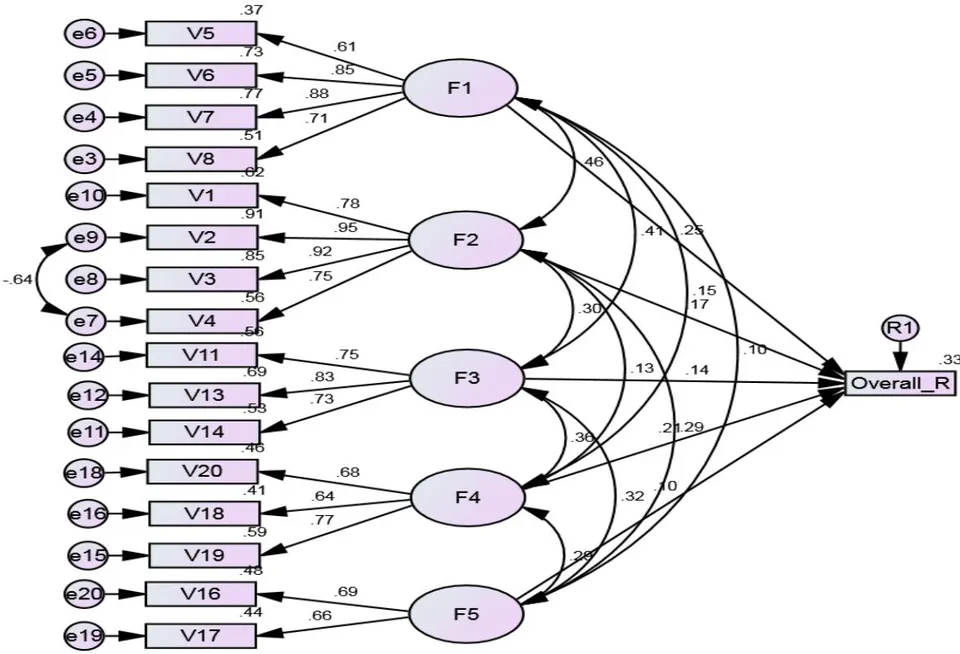
A multivariate analysis technique like covariance-based structural equation modeling was used to identify the significant relationships between overall factor concerning customers' experience about mobile banking in Bangladesh and the factors identified through factor analysis like convenient and responsive system, transaction speed and accuracy, reliability, transaction security in ATM booth and technological difficulty. Table 7 lists the structural parameter estimates and hypothesis testing results. This study examines the impact of convenient and responsive system, transaction speed and accuracy, reliability, transaction security in ATM booth and technological difficulty factors on the overall customers' experience about the mobile banking in Bangladesh.
The path diagram of this study revealed that only three factors like convenient and responsive system ( , p=.000), transaction speed and accuracy ( , p=.013), and transaction security in ATM booth ( , p=.006) positively influence the overall experience of the customers' about the mobile banking in Bangladesh (Table 7). But reliability ( , p=.074), and technological difficulty ( , p=.224) are not significantly related to the overall customers' experience of mobile banking in Bangladesh. Structural Model of the Customers' Experience about the Mobile Banking in Bangladesh is shown in Figure 1.
| Estimate | S.E. | C.R | P | Decisions | |
| Overall <- Convenient and Responsive System | .175 | .053 | 3.318 | .000 | Significant |
| Overall <- Transaction Speed and Accuracy | .110 | .044 | 2.495 | .013 | Significant |
| Overall <- Reliability | .090 | .050 | 1.789 | .074 | Not Significant |
| Overall <- Transaction Security in ATM Booth | .140 | .051 | 2.752 | .006 | Significant |
| Overall <- Technological Difficulty | .077 | .063 | 1.217 | .224 | Not Significant |
| R-square | .332 | ||||
d) Multi-Group Analysis of Data
This study also identified the differences in experience with mobile banking between the male and female respondents which are discussed in the following sections.
i. Multi-Group Analysis for Male
The results of the analysis show that for the factors concerning male respondents' like convenient and responsive system, transaction speed and accuracy and transaction securities in ATM booth are significant. Reliability and technological difficulty factors are not significant for the male users of mobile banking in Bangladesh (Table 8).
| Estimate | S.E. | C.R. | P | Label | |
| Overall_R<-Convenient and Responsive System | .195 | .063 | 3.100 | .002 | Significant |
| Overall_R<--Transaction Speed and Accuracy | .119 | .049 | 2.430 | .015 | Significant |
| Overall_R<--- Reliability | .084 | .061 | 1.375 | .169 | Not Significant |
| Overall_R<-Transaction Security in ATM Booth | .142 | .069 | 2.038 | .042 | Significant |
| Overall_R<--- Technological Difficulty | .077 | .087 | .877 | .381 | Not Significant |
ii. Multi-Group Analysis for Female
The analysis also shows that for the female respondents, the only significant factor is transaction security in ATM booth. On the other hand, convenient and responsive system, transaction speed and accuracy, reliability, and technological difficulty are not significant for the female users of mobile banking in Bangladesh (Table 9). Female mobile banking users have only concern with the transaction security and ATM booth.
| Estimate | S.E. | C.R. | P | Label | |||
| Overall_R<-Convenient and Responsive System | .127 | .113 | 1.119 | .263 | Not Significant | ||
| Overall_R<--Transaction Speed and Accuracy | .087 | .106 | .821 | .412 | Not Significant | ||
| Overall_R<--- Reliability | .130 | .118 | 1.100 | .271 | Not Significant | ||
| Overall_R<-Transaction Security in ATM Booth | .175 | .089 | 1.971 | .049 | Significant | ||
| Overall_R<--- Technological Difficulty | .063 | .092 | .688 | .491 | Not Significant | ||
VI. CONCLUSIONS AND RECOMMENDATIONS
This study was designed to identify the factors concerning the experience of the mobile banking users in Bangladesh. Factor analysis identified five factors related to the experience in mobile banking of Bangladesh. The factors are: convenient and responsive system, transaction speed and accuracy, reliability, transaction security in ATM booth, and technological difficulty. The results of Confirmatory Factor Analysis (CFA) also confirmed these five factors. The GFI is of the model is 0.904 which is equal to the recommended value of 0.90. Furthermore, the non-incremental fit index, such as the comparative fit index (CFI) is 0.930 that exceeds the recommended cut-off level of 0.90. Finally, the Root Means Square Error of Approximation (RMSEA) is 0.076, which is also less than the suggested good fit to the data. These all fit indices show good model fit to the data and the model is acceptable.
A multivariate analysis technique like covariance-based structural equation modeling was used to identify the significant relationships between overall customers' experience about mobile banking and the factors identified through factor analysis like convenient and responsive system, transaction speed and accuracy, reliability, transaction security in ATM booth and technological difficulty. This study examines the impact of convenient and responsive system, transaction speed and accuracy, reliability, transaction security in ATM booth and technological difficulty factors on overall customers' experience about mobile banking in Bangladesh. Results show that the convenient and responsive system, transaction speed and accuracy, and transaction security in ATM booth are positively and significantly related to the overall experience of the customers' about the mobile banking in Bangladesh. However, factors like reliability and technological difficulty are not significantly related to the overall customers' experience of mobile banking in Bangladesh.
This study also identified the differences in experience between the male and female respondents. The results of the analysis show that for the male respondents' factors like convenient and responsive system, transaction speed and accuracy and transaction security in ATM booth are significant. Reliability and technological difficulty factors are not significant for the male users of mobile banking in Bangladesh. The analysis also shows that for the female respondents, the significant factor is transaction security in ATM booth. On the other hand, convenient and responsive system, transaction speed and accuracy, reliability, and technological difficulty are not significant for the female users of mobile banking of Bangladesh. Female mobile banking users have only concern with the transaction security and ATM booth. This study only covered the mobile banking customers of nine private commercial banks in Bangladesh. However, there is an ample scope to conduct further study by taking more banks and more customers into account for more precise results in future.