
I. INTRODUCTION
Choosing a college major is one of the most important decisions to be made by a college student (Begs, Bentham & Tyler, 2008; Burchett, 2002). Most institutions provide information to guide them in making correct decisions to an area of specialisation (Begs, Bentham & Tyler, 2008; and Schuster & Costantino, 1986). The Guidelines and Regulations for Colleges Affiliated to the University of Swaziland (2002) indicate that there are three teacher training public institutions offering Primary Teachers' Diploma (PTD) in Eswatini: Ngwane Teacher Training College, William Pitcher Teacher Training College and Nazarene Teacher Training College (currently known as Southern Africa Nazarene University). The choice of a subject specialisation is done either at the end of the second year or just before the commencement of the third year in these teacher training institutions. Student teachers choose from four options: Applied Sciences; Languages; Pure Sciences and Social Studies.
Soria and Stebleton (2013) observed that external/extrinsic motivations for selecting a major tend to be negatively associated with students' satisfaction and sense of belonging while intrinsic/internal extrinsic motivations tend to be positively related. Intrinsic factors were reported as the reasons for pursuing a programme of study and enrolling in tertiary institutions in Swaziland (1993). Similarly, Tsikati (2014) found that student interest, attitude and impression, related exposure, and the nature of subject specialisation were the influential factors for student's choice of a specialisation prior to enrolment into a teacher training institutions in Swaziland.
Wilhelm (2004) reported that subject instructors have significant influence on how students perceive the usefulness of a particular subject. Such instructor's influence is associated with students' subject preference (Curran & Rosen, 2006) and instructional style (Babad & Taybe, 2003). Similarly, Omodi (2013) found that the teachers and schools were the main responsible for students' choice of Science subject in Kenya. On the other hand, in Nigeria students' attitudes influenced the choice of Geography subject (Akintade, 2012). While in Eswatini, attitudes and beliefs were reported having an influence on the success of the Pre-vocational programme (Mndebele & Dlamini, 1999; National Curriculum Centre, 2010).
Different studies reported the following as factors influencing the choice of a specialisation in agriculture or agricultural Education: curriculum (subject combination) offered for a subject specialisation (Dube & Habedi, 1989), job consideration (Wildman & Torres, 2001), student's interest (Cannon & Broyles, 2002), prior student exposure (Donnermeyer & Kreps, 1994), student's grade(Whiteley & Porter, 2000), nature of subject specialisation (Wildman & Torres, 2001), professionals (Jackman & Smith-Attisano, 1992), significant others (Wildman & Torres, 2001), beliefs and attitudes (Sutphin & Newsom-Stewart, 1995), and background information and demographic characteristics (Begs, Bantham & Tylor, 2008; Dlamini, 1993). Rampold (2015) observed that parents/guardian, professionals and college or departmental factors were influence the students' choice on agriculture academic major.
Bathemi (2010) found that sex was influential on student choice in Home Economics. Similarly, Samela (2010) reported that sex influence the enrolment of students in Physics or Physical Science. Sex was also influential in the choice of Accounting major at college (Begs et al., 2008). Dalc, Arasl, Tümer and Baradarani (2013) revealed that financial, employment and referent factors were the determinants of Iranian students' decision to choose accounting major. Student's location, and parental education and occupation status are also considered factors when choosing a subject specialisation (Begs et al., 2008; Mokalake, 2005; Whiteley & Porter, 2000).
Tsikati, Dlamini and Masuku (2016) revealed that students' interest, department's image, sex and professionals were predictors for the choice of an Agriculture option offered by the colleges in Swaziland. Owino and Odundo found that in selection of History was determined by personal interests, parental guidance, career guidance and influence of lecturers. Tsikati (2019a) conducted a similar study on the "Factors influencing choice of a subject specialisation by prospective teachers at teacher training college in Eswatini." Tsikati (2019b) published another study on the "Factors influencing the changing of subject specialisation by students at teacher training institutions in Eswatini." However, the existing literature is silent on the factors influencing the choice of subject specialisation by students at teacher training institutions in Eswatini. Thus, there was a need to investigate factors influencing the choice of subject specialisation by students at teacher training institutions in Eswatini.
a) Theoretical and Conceptual framework
The study was framed by the Classification Schema model developed by Hodges and Karpova
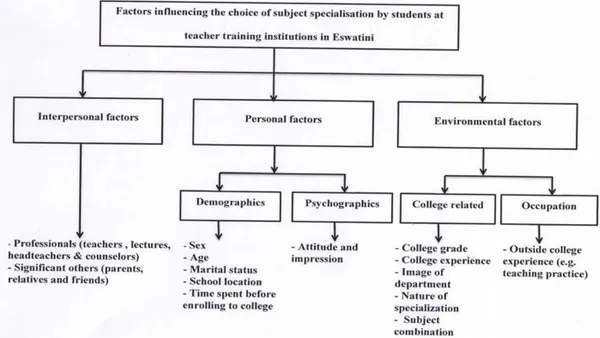
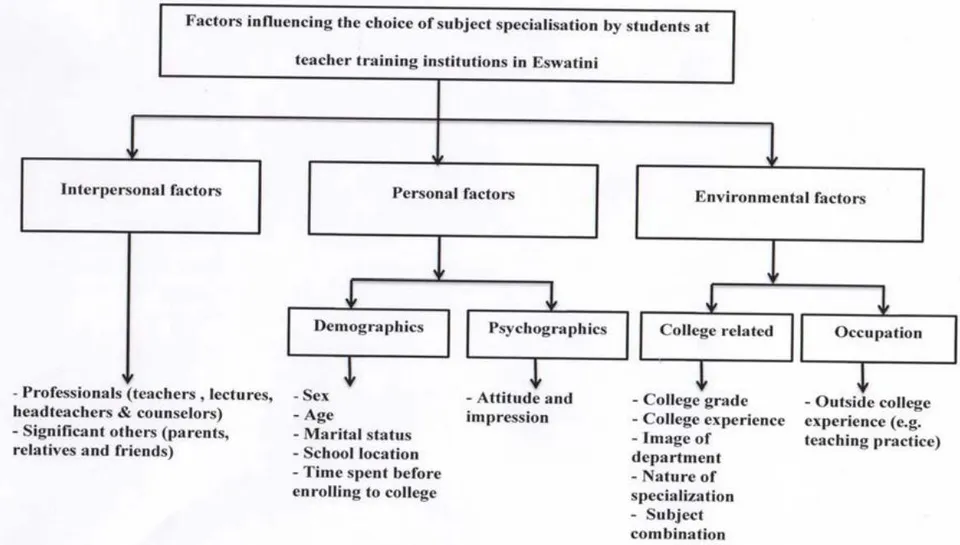
(2010). Initially, this model was designed for fashion, but fit in this study as caters for the job related factors. It is an extension of the Self-determination Theory which defines intrinsic and varied extrinsic sources of motivation (Deci & Ryan, 1985, 2000). Self-determination theory distinguishes between two different types of motivation—intrinsic and extrinsic (Deci & Ryan, 1985). Thus researchers have used the theory to describe the career decision making of undecided students (Gordon 2007; Guay, Mageau, & Vallerand, 2003). The Classification Schema model opines that the choice of a college major rest of three variables: inter-personal, personal and environmental variables. The personal factors correspond to the intrinsic factors while the interpersonal and environmental factors correspond to the extrinsic factors of the Self-determination theory. The inter-personal factors refer influence from parents/guardian, friends/peers, high school teachers and college instructors. The personal characteristics factors relate to objective/demographic variable (e.g. sex, age, race and socio-economic status) and subjective/psychographic variables (e.g. interest, aptitude, personality traits and work values). Lastly, the environmental factors entail the influence college related (e.g. class size, quality of instruction and reputation of programme/department) and occupational variables (e.g. employment opportunities, earnings potential, and occupation dynamics. Thus, Figure 1 presents the conceptual framework of the study adapted from the Classification schema model and the self-determination Theory.
b) Purpose and objectives of the study
The purpose of the study was to identify factors influencing the choice of subject specialisation by students at the teacher training institutions in Eswatini. The specific objectives of the study were to:
Describe student teachers enrolled in a Primary Teachers' Diploma programme by subject specialisation.
Describe student teachers enrolled in a Primary Teachers' Diploma programme by factors influencing the choice of a subject specialisation.
Describe student teachers enrolled in a Primary Teacher Diploma programme by their background and demographic characteristics.
Compare the choice of a subject specialisation by selected background and demographic variables.
II. METHODOLOGY
The study was a descriptive survey research. A triangulation of desk review, modified Delphi technique and a survey questionnaire were used for data collection. The outcomes from the desk review and modified Delphi technique were used to develop the survey questionnaire. The questionnaire was used for data collection to determine factors for the choice of subject specialisation by PTD student teachers.
The target population was a census of the 2012/2013 final (third) year PTD students from Ngwane Teacher Training College; Southern Africa Nazarene University (previously known as Nazarene
Teacher Training College) and William Pitcher Training College. An up-to-date population frame was obtained from the administrative offices of the three teacher training institutions to control frame error. Selection error was controlled by thoroughly checking of the register of students to avoid duplication of names. The instrument was validated by educators involved in the teaching of the PTD who were used during the Delphi process. The overall reliability coefficient of the study was found to be.83 which effectively means the instrument was reliable. Self-administered questionnaires were used to collect data. Non-response error was controlled by comparing the means of early and late respondents (Miller & Smith, 1983). The data were analysed using descriptive statistics (such as means, standard deviations, frequencies and percentages) and non-parametric statistics such as chi-square.
III. RESULTS AND DISCUSSION
a) Distribution of respondents by subject specialisation
Table 1 depicts that a majority of the respondents specialized (29.5%) in Social Studies. Almost a quarter of the respondents (24.6%) specialized in Applied Sciences. Then Pure Science and Languages had 23.7% and 22.2% specialists respectively. Similar findings were reported by Tsikati (2014) that Social Studies dominate the other areas of subject specialisation in terms of student teacher enrolment at the teacher training institutions.
| Subject Specialisation | NTTC N=149 | SANU N=135 | WPC N=58 | Total N=342 | ||||
| f | % | F | % | f | % | f | % | |
| Applied Sciences | 36 | 24.2 | 48 | 35.6 | 17 | 29.3 | 101 | 29.5 |
| Languages | 39 | 26.2 | 27 | 20.0 | 9 | 15.5 | 75 | 21.9 |
| Pure Sciences | 39 | 26.2 | 36 | 26.7 | 16 | 27.6 | 91 | 26.6 |
| Social studies | 35 | 23.5 | 24 | 17.8 | 16 | 27.6 | 75 | 21.9 |
b) Factors influencing choice of subject specialisation
Table 2 indicates that student interest was the major factor for the choice of subject specialisation for final year PTD students at the teacher training institutions. These findings on interest affirmed numerous studies on the choice of subject specialisation. Houser and Yoder (1992) concluded that interest was important in the selection of a specialisation in a college or university. Stokes (2007) studying factors influencing the decisions of university students to choose a specialisation to teach at high school found that interest was the main factor. Most students claimed that interest on a specialisation was aroused by many a factor amongst which was an interesting job. Interest was of course, very personal, and two people may be interested in the same activity for quite different reasons (Sutphin & Newsom-Stewart, 1995). Dlamini (1993) believed that opportunities for further training aroused student interest towards a specialisation. Interest as a factor for the choice of subject specialisation was reported by Tsikati (2019a) and Tsikati et al. (2016) when studying the factors influencing the choice of subject specialisation by prospective teachers for Primary Techers Diploma at teacher training institutions and factors influencing the choice of an Agriculture specialisation by college student teachers in Eswatini.
Attitudes and impressions ( , ) held by the respondents towards lecturers and the specialisation was another variable influential on the choice of a subject specialisation by PTD students at teacher training institutions. Mndebele and Dlamini (1999) reported that parent's attitude could either enhance or discourage the choice of a specialisation in a Pre-vocational programme in Swaziland. The findings on the influence of attitude on the choice of a specialisation was also reported by Akintade (2012) when studying factors the determinants of selecting Geography in Nigeria.
| Factors | μ | σ |
| Student interest | 4.51 | .81 |
| Student grades | 3.31 | 1.28 |
| Outside college experience | 3.95 | 1.19 |
| Nature of specialisation | 3.51 | 0.92 |
| Professionals | 2.80 | 1.26 |
| Significant others | 2.31 | 1.22 |
| Attitude and impressions | 4.29 | 1.27 |
c) Respondents' background information and demographic characteristics
Table 3 presents the background and demographic variables of the respondents. About two thirds (n=219 or ) of the respondents were females. Most of the respondents were aged between 20-25 years (n=166, ). Similarly, a majority of the student teachers (56.1%) spent less than four year before they enrolled into the teacher training institutions. A majority of the respondents (84.5%) were not married and were living in rural areas. Few respondents had done short term teaching contract before enrolling into the teacher training institutions. A majority of the student teachers were influenced by the subject combination in choosing a specialisation at the teacher training institution. Similar, findings that a majority of student teachers female, single and had not done teaching practice were reported by Tsikati, Dlamini and Masuku (2016).
| Variables | Institutions | |||||||
| NTTC(N=149) | SANU(N=135) | WPC(N=58) | Total(N=342) | |||||
| f | % | f | % | f | % | f | % | |
| Sex | ||||||||
| Female | 93 | 62.4 | 92 | 68.1 | 34 | 58.6 | 219 | 64.0 |
| Male | 56 | 37.6 | 43 | 31.9 | 24 | 41.4 | 123 | 36.0 |
| Age | ||||||||
| 20-25 | 78 | 52.3 | 65 | 48.1 | 23 | 29.7 | 166 | 48.5 |
| 26-30 | 51 | 34.2 | 57 | 42.2 | 31 | 53.7 | 139 | 40.6 |
| 31 -35 | 17 | 11.4 | 12 | 8.9 | 3 | 5.2 | 32 | 9.4 |
| 36-40 | 3 | 2.0 | 1 | 0.7 | 1 | 1.7 | 5 | 1.5 |
| Range | 17 | 18 | 20 | 20 | ||||
| Mean | 26.0 | 26.4 | 26.4 | 26.2 | ||||
| SD | 3.39 | 3.30 | 3.36 | 3.35 | ||||
| Marital status | ||||||||
| Single | 132 | 88.6 | 109 | 80.7 | 48 | 82.8 | 289 | 84.5 |
| Married | 17 | 11.4 | 26 | 19.3 | 10 | 17.2 | 53 | 15.5 |
| Home location | ||||||||
| Urban | 27 | 18.1 | 30 | 22.2 | 10 | 17.2 | 67 | 19.6 |
| Rural | 122 | 81.9 | 105 | 77.8 | 48 | 82.8 | 275 | 80.4 |
| Father's highest level of education | ||||||||
| Uneducated | 41 | 27.5 | 29 | 21.5 | 14 | 24.1 | 84 | 24.6 |
| Primary | 16 | 10.7 | 15 | 11.1 | 7 | 12.1 | 38 | 11.1 |
| Secondary | 19 | 12.8 | 23 | 17.0 | 11 | 19.0 | 53 | 15.5 |
| Certificate | 25 | 16.8 | 25 | 18.5 | 8 | 13.8 | 58 | 17.0 |
| Diploma | 26 | 17.4 | 27 | 20.0 | 8 | 13.8 | 61 | 17.8 |
| First Degree | 17 | 11.4 | 8 | 5.9 | 8 | 13.8 | 33 | 9.6 |
| Masters | 5 | 3.4 | 5 | 3.7 | 2 | 3.4 | 12 | 3.5 |
| Doctorate | 0 | 0.0 | 3 | 2.2 | 0 | 0.0 | 3 | 0.9 |
| Mother's highest level of education | ||||||||
| Uneducated | 42 | 28.2 | 27 | 20.0 | 12 | 20.7 | 81 | 23.7 |
| Primary | 19 | 12.8 | 20 | 14.8 | 10 | 17.2 | 49 | 14.3 |
| Secondary | 32 | 21.5 | 32 | 23.7 | 14 | 24.1 | 78 | 22.8 |
| Certificate | 23 | 15.4 | 21 | 15.6 | 9 | 15.5 | 53 | 15.5 |
| Diploma | 17 | 11.4 | 11 | 8.1 | 9 | 15.5 | 37 | 10.8 |
| First Degree | 11 | 7.4 | 16 | 11.9 | 3 | 5.2 | 30 | 8.8 |
| Masters | 3 | 2.0 | 8 | 5.9 | 1 | 1.7 | 12 | 3.5 |
| Doctorate | 2 | 1.3 | 0 | 0.0 | 0 | 0.0 | 2 | 0.6 |
| Father's occupation status | ||||||||
| Unemployed | 63 | 42.3 | 54 | 40.0 | 18 | 31.0 | 135 | 39.5 |
| Self-employed | 32 | 21.5 | 22 | 16.3 | 14 | 24.1 | 68 | 19.9 |
| Part time employed | ||||||||
| 7 | 4.7 | 5 | 3.7 | 4 | 6.9 | 16 | 4.7 | |
| Full-time employed | ||||||||
| 47 | 31.5 | 54 | 40.0 | 22 | 37.9 | 123 | 36.0 | |
| Mother's occupation status | ||||||||
| House wife | 91 | 61.1 | 69 | 51.1 | 35 | 60.3 | 195 | 57.0 |
| Self-employed | 17 | 11.4 | 20 | 14.8 | 5 | 8.6 | 42 | 12.3 |
| Part time employed | ||||||||
| 4 | 2.7 | 5 | 3.7 | 1 | 1.7 | 10 | 2.9 | |
| Full-time employed | ||||||||
| 37 | 24.8 | 41 | 30.4 | 17 | 29.3 | 95 | 27.8 | |
| Number of years spent between completing high school and college entry | ||||||||
| 0-4 | 88 | 59.1 | 68 | 50.4 | 36 | 62.1 | 192 | 56.1 |
| 5-9 | 52 | 34.9 | 49 | 36.3 | 17 | 29.3 | 118 | 34.5 |
| 10-14 | 9 | 6.0 | 16 | 11.9 | 4 | 6.9 | 29 | 8.5 |
| 15-19 | 0 | 0 | 2 | 1.5 | 1 | 1.7 | 3 | 0.9 |
| Range | 14 | 15 | 15 | 15 | ||||
| Mean | 4.11 | 4.96 | 4.43 | 4.50 | ||||
| SD | 2.73 | 3.36 | 3.01 | 3.06 | ||||
| Short-term teaching contract/temporary teaching | ||||||||
| No | 122 | 81.9 | 112 | 83.0 | 48 | 82.8 | 282 | 82.5 |
| Yes | 27 | 18.8 | 23 | 17.0 | 10 | 17.2 | 60 | 17.5 |
| Influenced by subject combination | ||||||||
| No | 56 | 37.6 | 37 | 27.4 | 21 | 36.2 | 114 | 33.3 |
| Yes | 93 | 62.4 | 98 | 72.6 | 37 | 63.8 | 228 | 66.7 |
d) Differences between the choice of subject specialisation and selected background and demographic variables
A Chi-square test was conducted to compare the frequencies between the teacher training institution specialisation and selected demographic and background variables (Table 4). A statistical significant difference existed between teacher training institution specialisation and sex (chi-square , ); and teacher training specialisation and number of years between completing high school (Grade 12) and teacher training (chi-square , ). The same findings were reported by Tsikati (2019a) when studying factors influencing the choice of subject specialisation by prospective teachers for Primary Techers Diploma at the teacher training institution in Eswatini.
| Variables | X2 | df | p |
| Sex | 21.39 | 3 | .00 |
| Age | 3.29 | 9 | .95 |
| Marital status | 3.65 | 3 | .30 |
| Home location | 7.76 | 6 | .25 |
| Institution | 2.64 | 3 | .45 |
| Father's education | 36.02 | 21 | .02 |
| Mother's education | 34.66 | 21 | .03 |
| Father's occupation | 14.52 | 9 | .11 |
| Mother's occupation | 10.02 | 9 | .35 |
| Subject combination | 3.77 | 3 | .29 |
| Short-term teaching contract | 4.42 | 3 | .22 |
| Interval between grade 12 and college | 7.67 | 3 | .05 |
IV. CONCLUSIONS AND RECOMMENDATIONS
Student teachers' interest and attitudes and impressions were the main factors influencing their choice of subject specialisation at the teacher training institution in Eswatini. Another conclusion drawn was that choice of a subject specialisation differed in terms of student's sex and number of years between completing high school (Grade 12) and teacher training institution. The findings of the study provide support for using the classification schema developed by Hodges and Karpova (2010) to summarize and systematize the various factors influencing the choice of a subject specialisation at teacher training institutions in Eswatini. Therefore, study recommended that administration at the teacher training institutions should always put student interest first in choosing a specialisation. Also, the subject combination making-up a subject specialisation should be reviewed to cate for the interest of the student teachers.