



I. INTRODUCTION
As we all know, education is considered the backbone of a nation. Without education, a country cannot be developed. With a large percentage of uneducated nations, developing countries like Bangladesh will not be participated in the race of development. It has been broadly accepted that education is the important aspect of poverty alleviation. Education plays essential role of development and has an unforgettable impact on all aspects of human life. It is investment for human life and countries' economy.
Though Bangladesh has gone steps forward in basic education, primary and secondary education, still dropout rate is high.
Students' dropout from school is a problem for Bangladesh. Drop out children from school means discontinuing schooling without completing a high school education or equivalent certificate exam. Commonly, dropout determines the situation when a student departure from school before completing their high school education. Child dropout of school means leaving school without completing their early education as well as their secondary education. And it is a common scenario faced by almost all of the developing countries and even in developed countries in the world. This rate is remarkably high in developing countries. A large number of students in developing countries are dropping out school by leading cause poverty.
II. LITERATURE REVIEW
There are many hidden causes behind school dropouts. People of Bangladesh will not be able to walk towards growth and prosperity without concentrate on education or without making sure of the full attendance of students in school.
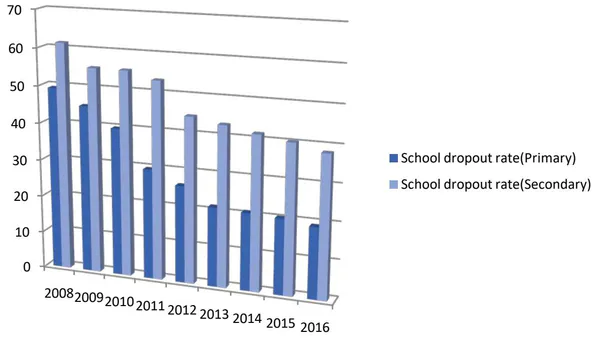
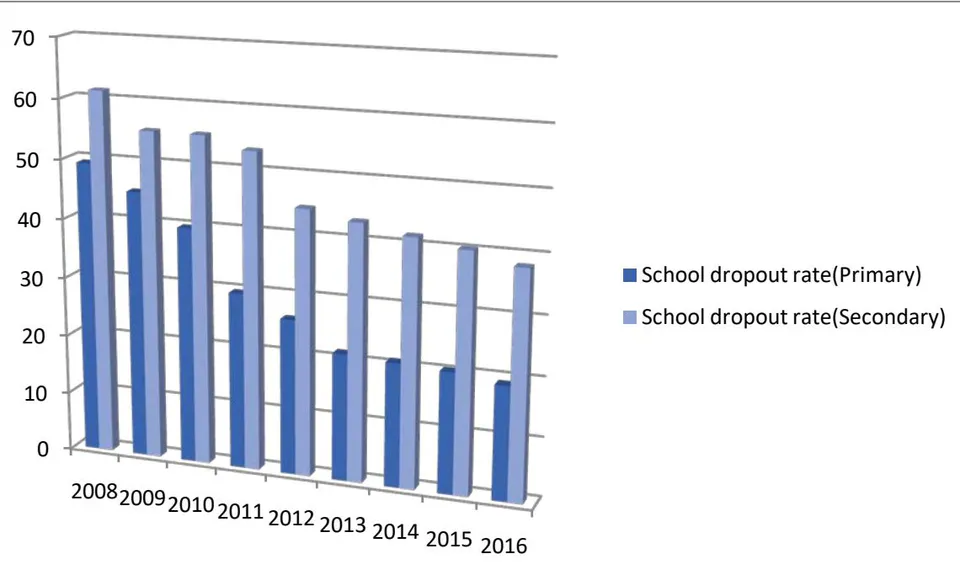
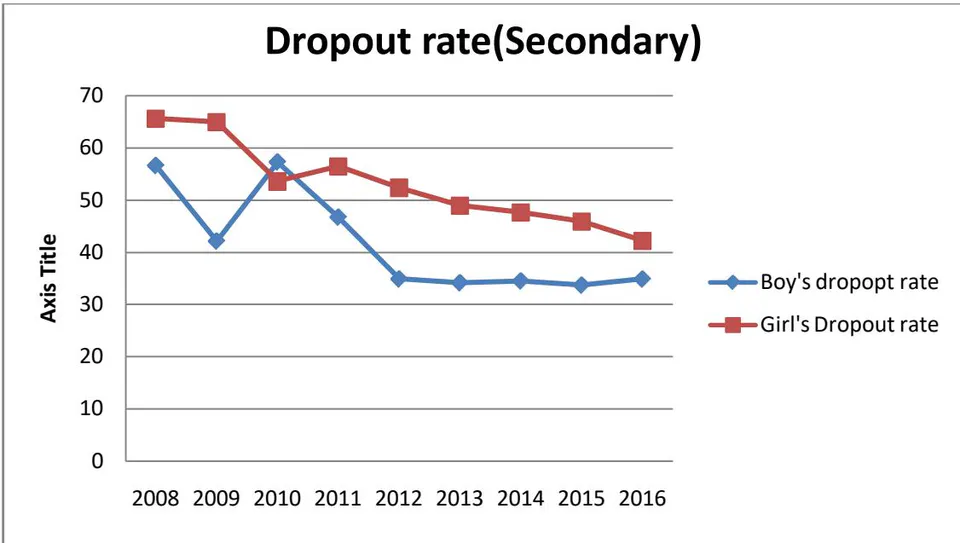
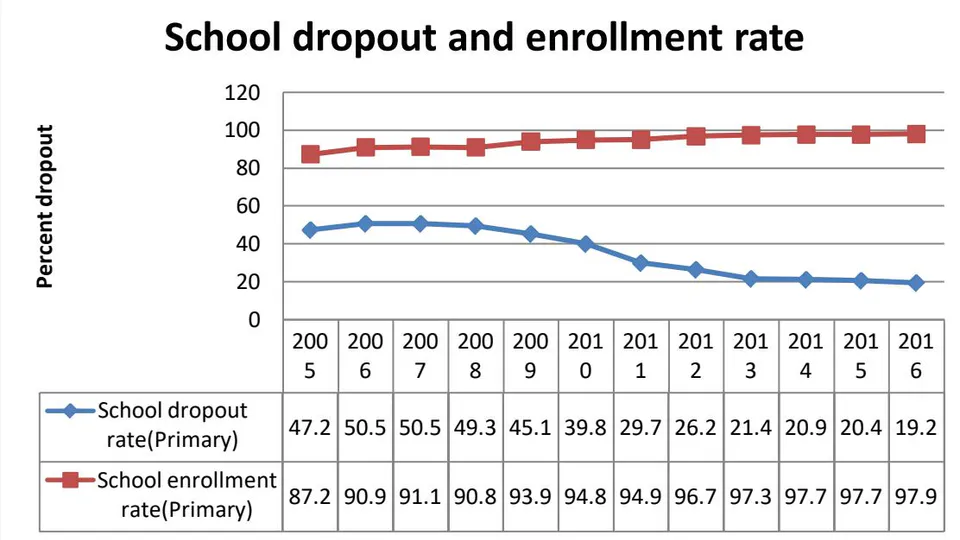
In 2016, the school dropout rate in secondary level among girls was 42.19 percent, while the school dropout rate in the secondary level among boys was 33.80 percent, according to the report of the Bangladesh Bureau of Educational Information and Statistics. The enrollment of students in the secondary was 67.84 percent, in which girls were 73.10 percent and boys were 63.85 percent. The enrollment and the school dropout both are higher among girls than boys. It suggests that girls are more likely to drop school than boys. But the school dropout rate at the primary level was 19.2 percent in 2016 which is less than the secondary level. In 2015 school dropout rate in secondary level among girls was 45.9 percent, while the school dropout rate in secondary level among boys was 33.72 percent. That is, girls are more likely to drop school than boys.
It is an unbelievable fact that more than one million students dropped out each year in the United States. Even in the USA, almost seven thousand students left their school in a day.
III. OBJECTIVES
The main objectives of the study are as follows:
a. Compare the rate of enrollment and dropout.
b. Find out the socio-economic contribution to school dropout.
c. Girls are more likely to drop out than boys.
d. School dropout is higher in secondary schools than in primary schools.
e. Specify the measures that the Bangladeshi government has been taken to enhance school enrollment.
f. Identify whether there is any positive association between government incentives and school enrollment.
g. Recommended policy to overcome this problem.
IV. RESEARCH METHODOLOGY AND DATA SOURCE
Both qualitative and quantitative analyses have been done to achieve the objectives.
The data have been collected from primary and secondary sources. The educational statistics published, are the main sources of the secondary data used in this study. Some data has been collected from the industrial area of Tongi named Tetul-tola Slum, Kolabagan, Tongi to get insight into the matter of school dropout.
In the first stage, the population (adolescents) have been divided in two strata, one continues school stratum another is the dropout school stratum. From the dropout stratum, some boys are, and girls are randomly selected and interviewed. Several FGDs with both parents and students have been conducted to find out the determinants of school dropout.
There are some common reasons and surprising causes of school dropout come out through the interviews and FGDs, such as- Poverty, Distance of school, Security problem of girls in school, Teacher's performance and quality of education, Teacher's behaviors towards students, Gender discrimination, Parents unwillingness to education and parents education level, Even student's unwillingness to go to school, Earning money in early age.
V. DATA ANALYSIS
In Bangladesh, the education system has been separated into three levels. The first, five years of schooling are called the primary level includes ranging from grade 1 to grade 5. The second level starts from 6 to grade 10. And the completion of secondary, the Secondary Board Examination S.S.C. (School Secondary Certificate). The third level of public education ends at grade twelve with the exam named HSC (Higher Secondary Certificate). The Compulsory Primary Education Act was been passed in 1990, which legalizes primary education free and compulsory for all children up to Grade 5. The Government of Bangladesh has been recognized education as a means of reducing poverty and improving the quality of life. The Government of Bangladesh, with assistance from development partners, has made positive steps towards fulfilling children's rights to education, according to the Education for All and Millennium Development Goals. As a result, the country has been made significant progress towards achieving universal primary education and gender parity in schools. After quite a satisfactory achievement of Millennium Development Goals (MDG), the government of Bangladesh is planning its strategies for meeting Goal 4 of Sustainable Development Goals (SDG).
a) Girls are more likely to drop school than boys
Though dropout is reducing it is still high for girls than boys. According to the report of the Bangladesh Bureau of Educational Information and Statistics, the school dropout is higher among girls than boys. In 2016, secondary level among girls school dropout rate was 42.19 percent among boys was 33.80 percent. Their mothers work as day labor. Both of them have to stay at home for cooking, doing household chores, and looking after their younger brothers and sisters. That is why they could not be able to continue their education and dropped school. This situation at both the primary and secondary levels.
b) Government incentives
Since the 1995s, Bangladesh government have been trying to implement many incentives and opportunities for students to minimize dropout from school such as offering scholarships, Compulsory education by an act, Free Education, Establishing new school in remote places, a safety measure for girls, distributing textbooks, subsidizing public transport for students. The best known is Food-for-Education in Bangladesh. The goals of these incentive programs are to remain students in school and to compensate families for the lost value of their children's labor. After taking Govt. incentive enrollment rate is increasing day by day.
VI. FINDING
a. To meet the Millennium Development Goal (MDG), which demanded to "Achieve Universal Primary Education," countries took initiatives for a higher enrollment rates in elementary schools while investing a significant amount of GDP for educational purposes. Quality education, which has become a buzzword since the targets of SDG, is quite impossible without connecting the curricula to real-life experiences.
b. In Bangladesh, poverty is one of the main reasons for school dropout. Their economic condition keeps students away from school, and they cannot continue school. Sometimes it becomes too hard to survive, and there is no option of education.
c. For different social issues, girls are more likely to drop out of school than boys, such as religious beliefs, early marriage, and household chores, look after younger brothers and sisters, especially when their mother is working outside the home.
d. Location of school, lack of quality education, teacher's performance, and behaviors towards students and teachers' irregularity causes high school dropouts.
e. Lack of quality education students are being dropped out. Teacher absenteeism and poor quality education is a frequent scenario in Bangladeshi primary level education scenario.
f. Earning at an early age seems more profitable to both the students and parents. When a student becomes old enough to join the workforce, the parents take them out of school and make them join somewhere to earn. They do not feel interested in investing money or time for getting fruits in the future. Most of the parents of the working-class families emphasize an immediate income of their children.
g. Lack of parental interest and engagement with schooling is often the case that parents cannot understand school-related work and hinder causes of the parents step behind from sending their daughters to school.
h. Parents create gender discrimination and allow their sons to go to school than their daughters if they have to choose between sons and daughters in studying. Parents think that boys need more education than a girl for future livelihood.
i. Sometimes students are unwilling to go to school. Their parents are also uneducated never told them to go to school. Both students and parents are uninterested to study.
VII. SUGGESTIONS AND RECOMMENDATION
To overcome the worse satiation of students' dropouts from school Govt. should take some counteractive measure, such as
Government should ensure the attendance of teachers in schools and trained the teachers to compete with the global level of education.
Community awareness seminar and counseling of students' and parents' could be initiated to develop an interest towards the study and not to avoid school.
Government could take the initiative to establish evening school or night school for the working children who are want to continue study but have to work as well.
VIII. LIMITATIONS
This study also faces some limitations, such as time constraints and budget constraints. Due to these constraints, this study cannot include all the dropout cases of the slum. Only a few of them are randomly selected and not able to conduct empirical testing.
IX. FUTURE RESEARCH
Comparative analysis of causes of students' dropouts in rural and urban areas and comparative analysis among girls and boys students dropout can have been conducted. Elaborate research on evening school or night school programs for the working children can have been conducted from a Bangladeshi perspective.
X. CONCLUSION
Education always plays a significant role in all aspects of human life. Education is a backbone of a nation and a key element of economic development. It is an essential investment for the human as well as economic development. The purpose of this research is to discern the identical issues that work behind high enrollment in primary schools and higher secondary schools followed by uncontrolled dropouts in Bangladesh. When a student struggles with poverty as well as drops out from school, society will neglect them. Even they are being sometimes neglected by their home. As a result, they become a burden to society and could not become the human capital for the country.
Dropout is not due to a single reason, there are different reasons for this problem. Girls are more likely to drop out from the school than boys. The data demonstrate that not the economic background only, parents' education, location, school mechanisms, gender discrimination, even student's unwillingness to go to school, earning money at in early age are the key reasons children drop out from school. And many other factors are liable for school dropout. So policy makers have to give more attention to these dropout situations because, with a large percentage of uneducated nations, a country's economic development cannot be been accelerated.


