I. INTRODUCTION
The study of methods of early diagnosis, rates of spread and clinical features of urolithiasis in epidemiological research will help to develop guidelines for the prevention and treatment of the disease in different regions and groups, to reduce disability and mortality, socio-economic losses.
Analysis of available scientific sources confirms these ideas and testifies that this disease is one of the most common diseases [1,2,3].
Another conclusion from the research is that in urolithiasis-related treatment and prophylaxis programs and scientific directions, high-tech-based activities and practices are given more prominence than screening approaches. Based on them, most of the conclusions and recommendations are in the form of "sessile" medical guidelines. In other systemic diseases, it began to develop the opposite, and thus, it was proved that significant and guaranteed positive results could be obtained [4, 5, 6, 7]. It has been proven by many researchers that the foremost effective method in large-scale examinations among the population living in different regions and conditions is to rescue patients from urinary stones and then carry out active prophylaxis [8, 9, 10]. Such scientific and practical activity allows to effectively prevent a large number of complications and recurrent course of urolithiasis [11, 12].
The aim of the study was to study and evaluate the clinical features of urinary stone disease in the farming population in the Fergana Valley of Uzbekistan.
II. RESEARCH MATERIAL AND METHODS
In the Pakhtaabad climatic zone of the Fergana Valley, 2,478 17-year-olds and 18-70-year-old farmers were involved in a one-time epidemiological study and were fully screened. Questionnaire, clinical, biochemical, instrumental and special urological examinations were used in the screening. The questionnaire used was approved by the Ethics Committee of the Ministry of Health of Uzbekistan and approved for use in epidemiological surveys (Kayumov UK, 2020). It provides an opportunity to make a complete epidemiological diagnosis of noncommunicable diseases, in particular, urolithiasis and its risk factors (XO).
Ultrasound examinations for the detection of urolithiasis at the prenosological and nosological stages in Toshiba-SAL-32V, ultrasound scanning of urinary tract organs in the SAL-50 ultrasound scanner of the Japanese company "Aloka", 12 connections in ECG mode using electrography "6-NEK", Exo-KG and chest radiography and anthropometric measurements (according to the formula Kettle index = body weight height ).
In the examined population, general analysis of blood and urine, and biochemical parameters were analyzed and studied. Their examination (indicators of total cholesterol, triglycerides, glycemia, uricemia, water-salt and mineral metabolism/blood electrolytes in the blood plasma, indicators of protein metabolism) was carried out using traditional methods widely used in treatment and prevention facilities. Based on international clinical and epidemiological recommendations, urolithiasis risk factors, general urinalysis, and sediment microscopy were studied, evaluated, and used as diagnostic criteria [13].
The following were accepted as the basic diagnostic criteria for urolithiasis or urolithiasis diagnosis was made when they were available [UAE, 2014; Yuldashev F.Yu., 1994]:
- Kidney and urinary tract stones diagnosed by Ultrasound method in the kidneys and upper urinary tract;
- Anamnestic data;
- Renal succulent detection detected by Ultrasound, salt crystals located in the cavities of the pelvic system, and again, salt crystals (SC) found in urine microscopy.
The farmer population found in SC constituted a risk group.
a) Statistical verification methods
The statistical analysis used Epi Info and Excel 2021 from the Microsoft Office suite. In the study, the effectIn assessing the relationship between the causal factor and the consequence, the risk ratio of biostatistics, a confidence interval to extrapolate the detected risk ratio, was calculated as and R on the Pearson criterion in order to determine the statistical significance of the data obtained. As a result of the single-factor analysis, all influencing factors found to be statistically significant were studied in Mantel-Henszel's multivariate analysis and based on extrapolation. All detected risk ratios and confidence intervals were compared at the logarithmic growth rate in the Forest Plot diagrams.
III. RESULTS AND DISCUSSION
Undoubtedly, the study of the regional features of the clinical course of urolithiasis in the farming population in the context of the new Uzbekistan is important. The reason is that such research has not been done at the population level. This topical scientific problem has also been the 'target object' of our study, and we have concluded that the main and specific urological symptoms of urolithiasis have a number of specific features in the farming population. Table 1 and Figure 1 show the prevalence of the main symptoms of urolithiasis in the farming male and female populations.
It turns out that the prevalence of the main symptoms of urolithiasis, with a difference in urolithiasis in male farmers and women, is recorded as follows (Table-1):
sudden renal puncture -13.1% and 4.1% (R ; R ), low back pain - from and , severe pain - from and , dyspeptic symptoms - from and , hematuria - from and , dysuria - from and , oligoanuria - from and , dizziness - from and , obmorok - from and , bradycardia - from and and increased pain on palpation of the lumbar region - from and .
Table-1: Epidemiological characterization of the prevalence of the main symptoms of urolithiasis in the farmer population
| The main clinical signs of urolithiasis | The farmer is a man | R | Farmers are women | The general population of farmers | ||||||
| n | urolithiasis | n | urolithiasis | n | urolithiasis | |||||
| Absolute number | Percentage | Absolute number | Absolute number | Absolute number | Percentage | |||||
| Acute renal colic | 54 | 412 | 13.1 | >0.005 | 16 | 387 | 4.1 | 70 | 799 | 8.8 |
| Location of pain in the lumbar region | 290 | 412 | 70.4 | >0.005 | 223 | 387 | 57.6 | 513 | 799 | 64.2 |
| Extreme pain | 38 | 412 | 9.2 | >0.005 | 27 | 387 | 7.0 | 65 | 799 | 8.1 |
| Dyspeptic symptoms | 82 | 412 | 19.9 | >0.005 | 39 | 387 | 10.1 | 121 | 799 | 15.1 |
| Hematuria | 46 | 412 | 11.2 | >0.005 | 32 | 387 | 8.3 | 78 | 799 | 9.8 |
| Dysuria | 339 | 412 | 82.3 | >0.005 | 290 | 387 | 74.9 | 629 | 799 | 78.7 |
| Oligoanuria | 113 | 412 | 27.4 | >0.005 | 61 | 387 | 15.8 | 174 | 799 | 21.8 |
| Dizziness | 252 | 412 | 61.2 | >0.05 | 273 | 387 | 70.5 | 525 | 799 | 65.7 |
| Obmork | 168 | 412 | 40.8 | >0.005 | 142 | 387 | 36.7 | 310 | 799 | 38.8 |
| Bradycardia | 20 | 412 | 4.9 | >0.05 | 20 | 387 | 5.2 | 40 | 799 | 5.0 |
| Increased pain on palpation of the lumbar region | 223 | 412 | 54.1 | >0.005 | 162 | 387 | 41.9 | 385 | 799 | 48.2 |
The main symptoms of urolithiasis are divided into three groups according to the frequency of prevalence in the general population of farmers: "symptoms with very high prevalence", "symptoms with moderate prevalence" and "rare symptoms with reliable differentiation". The symptoms of the first group include the following, ie they are noted with high frequencies: dysuria - , dizziness - and the location of pain in the lumbar region - . The symptoms of the second group and the percentage of their recording are as follows: increased pain on palpation of the lumbar region - , rheumatism - , oligoanuria - and dyspeptic symptoms - . The symptoms of the third group are 4 and are confirmed by the following percentages: bradycardia - , hematuria - , severe pain - and acute renal failure - .
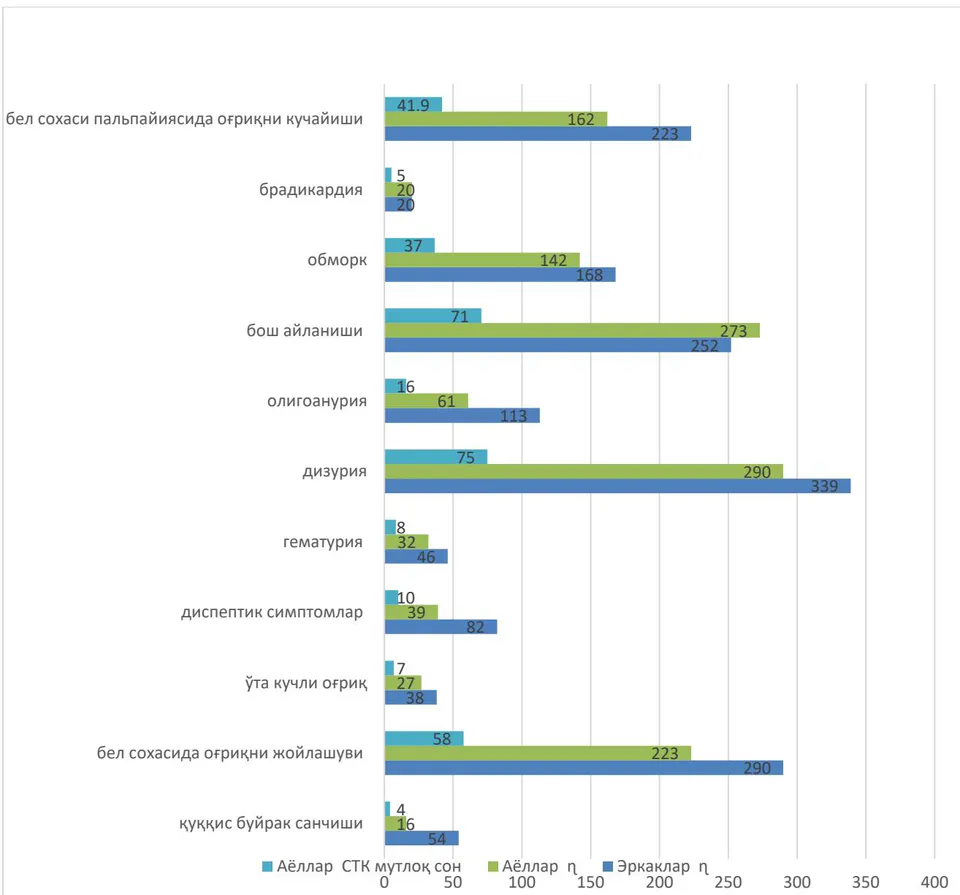
Table 2 and Figure 2 describe the epidemiological characterization of the prevalence of major urological symptoms in the farmer population with urolithiasis (STOP) and without urolithiasis (STSP). It follows that in the STOP-male population and in the STSP-male population, the main urological symptoms of urolithiasis are determined by significant differences:
- sudden renal colic - from and (R < 0.05);
- location of pain in the lumbar region - 70.4% and 32.2% (R < 0.05);
- severe pain - from and (R < 0.05);
- dyspeptic symptoms - from and (R < 0.05);
- hematuria - from and (R < 0.05);
- dysuria - from and (R < 0.05);
- oligoanuria - from and (R < 0.05);
- dizziness - from and (R < 0.05);
- obmorok - from and (R < 0.05);
- bradycardia - from and (R < 0.05);
- increased pain on palpation of the lumbar region - from and (R < 0.05).
Table-2: Epidemiological characteristics of the prevalence of urological symptoms in the population of farmers with urolithiasis (STOP) and non-STP (STSP)
| Basic urological symptoms | STOP male population | R | STS male population | STOP female population | R | STS female population | ||||||||
| n | urolithiasis | n | urolithiasis | n | urolithiasis | n | urolithiasis | |||||||
| Mut-loq son | % | Mut-loq son | % | Absolute number | % | Mut-loq son | % | |||||||
| Acute renal colic | 54 | 412 | 13.1 | <0.05 | 13 | 823 | 1.6 | 16 | 387 | 4.1 | <0.05 | 12 | 790 | 1.6 |
| Location of pain in the lumbar region-vi | 290 | 412 | 70.4 | <0.05 | 265 | 823 | 32.2 | 223 | 387 | 57.6 | <0.05 | 254 | 790 | 32.2 |
| Extreme pain | 38 | 412 | 9.2 | <0.05 | 10 | 823 | 1,2 | 27 | 387 | 7.0 | <0.05 | 10 | 790 | 1,2 |
| Dyspeptic symptoms | 82 | 412 | 19.9 | <0.05 | 18 | 823 | 2.2 | 39 | 387 | 10.1 | <0.05 | 17 | 790 | 2.2 |
| Hematuria | 46 | 412 | 11.2 | <0.05 | 6 | 823 | 0.7 | 32 | 387 | 8.3 | <0.05 | 6 | 790 | 0.7 |
| Dysuria | 339 | 412 | 82.3 | <0.05 | 35 | 823 | 4.3 | 290 | 387 | 74.9 | <0.05 | 34 | 790 | 4.3 |
| Oligo-anuria | 113 | 412 | 27.4 | <0.05 | 22 | 823 | 2.7 | 61 | 387 | 15.8 | <0.05 | 21 | 790 | 2.7 |
| Dizziness | 252 | 412 | 61.2 | <0.05 | 82 | 823 | 10.0 | 273 | 387 | 70.5 | <0.05 | 79 | 790 | 10.0 |
| Obmork | 168 | 412 | 40.8 | <0.05 | 39 | 823 | 4.7 | 142 | 387 | 36.7 | <0.05 | 37 | 790 | 4.7 |
| Bradycardia | 20 | 412 | 4.9 | <0.05 | 19 | 823 | 2.3 | 20 | 387 | 5.2 | <0.05 | 18 | 790 | 2.3 |
| Increase d pain on palpation of the lumbar region | 223 | 412 | 54.1 | <0.05 | 29 | 823 | 3.5 | 162 | 387 | 41.9 | <0.05 | 28 | 790 | 3.5 |
In conclusion, the journal is published by Global Journals.
6paДиКарДи
06mopK aaihaHnHn
OliroaHypnia
Dn3ypna rMaTpyra
CMMTOMIap
YTa KaYHnOfPnK
Да оригкни коюlaшУВи
KyKKNC6yIpaKa caHUnFN
CTCAeJnap n
CTONaennap
0 50
CTCəpkaK n
100 150
CTOπəpkak n
200 250
300 350 400
Figure-2: Features of the expression of urological symptoms in the population of patients with urolithiasis (WUL) and non-uroolithiasis (NUL).
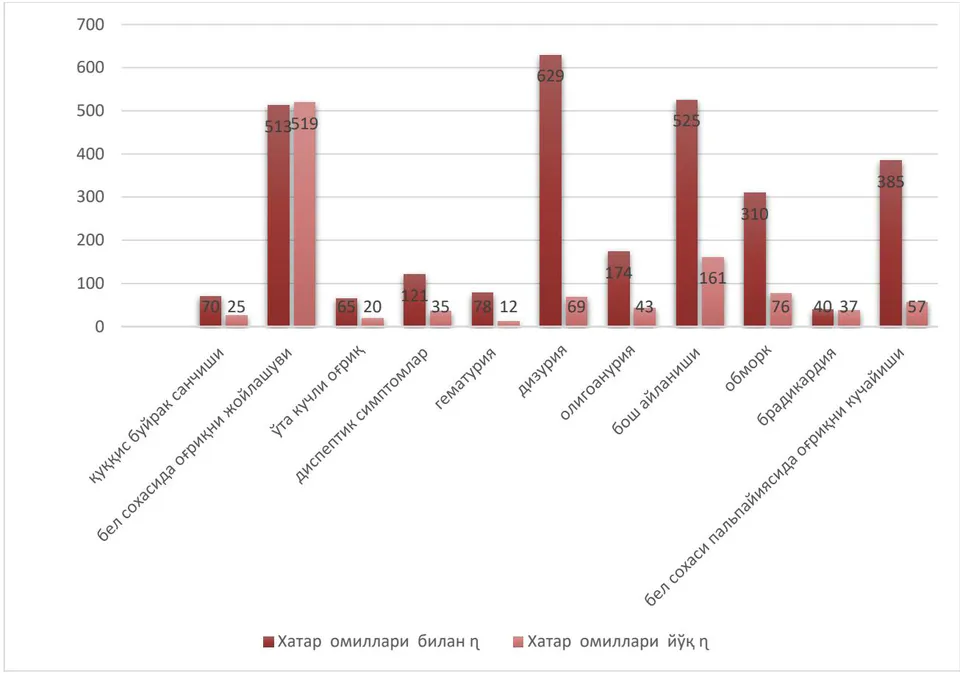
In our subsequent analyzes, the contributions of the main risk factors to the onset and exacerbation of clinical symptoms of urolithiasis were studied and evaluated (shown in Table 3 and Figure 3).
According to the results of the analysis, against the background of risk factors, the onset and exacerbation of the total symptoms of urolithiasis increases.
Table-3: Comparative description of the main risk factors contributing to the onset and exacerbation of symptoms of urolithiasis in the farmer population
| No | Urolithiasis of basic symptoms | Inspection teams (XO available) | R | Inspection teams (no XO) | R | ||||
| XO+ urolithiasis (absolute number) | XO total number | Percentage | urolithiasis without risk factors (absolute number) | XO total number | Percentage | ||||
| 1. | Acute renal colic | 70 | 79 | 8.7 | >0.005 | 25 | 1613 | 1.5 | <0.001 |
| 2. | Location of pain in the lumbar region | 513 | 799 | 64.2 | >0.005 | 519 | 1613 | 32.1 | <0.001 |
| 3. | Extreme pain | 65 | 799 | 8.1 | >0.005 | 20 | 1613 | 1,2 | <0.001 |
| 4. | Dyspeptic symptoms | 121 | 799 | 15.1 | >0.005 | 35 | 1613 | 2.2 | <0.001 |
| 5. | Hematuria | 78 | 799 | 9.7 | >0.005 | 12 | 1613 | 0.7 | <0.001 |
| 6. | Dysuria | 629 | 799 | 78.7 | >0.005 | 69 | 1613 | 4.3 | <0.001 |
| 7. | Oligoanuria | 174 | 799 | 21.7 | >0.005 | 43 | 1613 | 2.7 | <0.001 |
| 8. | Dizziness | 525 | 799 | 65.7 | >0.005 | 161 | 1613 | 9.9 | <0.001 |
| 9. | Obmorok | 310 | 799 | 38.7 | >0.005 | 76 | 1613 | 4.7 | <0.001 |
| 10. | Bradycardia | 40 | 799 | 5.0 | >0.005 | 37 | 1613 | 2.2 | <0.001 |
| 11. | Increased pain on palpation of the lumbar region | 385 | 799 | 48.1 | >0.005 | 57 | 1613 | 3.5 | <0.001 |
For example, in the population examined for the presence and absence of XO, the clinical symptoms of urolithiasis are determined by the following prevalence:
- sudden renal puncture - from and (R < 0.001),
- location of pain in the lumbar region - from and (R < 0.01),
- severe pain - from and (R < 0.001),
- dyspeptic symptoms - from and (R < 0.001),
- hematuria - from and (R < 0.0001),
- dysuria - from and (R < 0.001),
- oligoanuria - from and (R < 0.001),
- dizziness - from and (R < 0.001),
- obmorok - from 38.7% and 4.7% (R < 0.001),
- bradycardia - from and (R < 0.01) and
- increased pain on palpation of the lumbar region - from and (R < 0.05).
When there is more than 1 or 2 risk factors in the client population with urolithiasis, its clinical severity increases to 12.8 times. Hence, emergency and planned therapy require that priority be given to both primary and secondary prevention of urolithiasis. Adaptation of risk factor correction to the treatment process, in patients with urolithiasis, is appropriate.
It was also found from our analysis that urolithiasis occurs in most cases on the background of comorbidity (simultaneous involvement of more than two diseases) (our research in this area is numerically described in Figure 3 and Table 4.
Comorbidity is determined by a 45.7 percent prevalence in the general population of 18-70-year-old farmers (Table 4) and exhibits age-dependent formation characteristics. It is noted in different ages with a specific distribution:
- 18-30 years old - 20.0%;
- 31-49 years - 49.9% (with a 2.5-fold increase; R <0.01);
- 50-69 years - 27.9% (with a 1.3-fold increase; R < 0.05);
- ≥At the age of 70 - 2.2% (with a decrease of 10 times; R <0.001).
Table-4: Epidemiological characterization of comorbidity in the farming population
| Inspection groups | Age groups | |||||||||
| 18-30 years old | 31-49 years old | 50-69 years old | ≥70 years old | ≥18-70 years old | ||||||
| In the absolute number | Percentage | In the absolute number | Percentage | In the absolute number | Percentage | In the absolute number | Percentage | In the absolute number | Percentage | |
| Farmers are men | 38 | 52.1 | 98 | 74 | 5 | 215 | 58.9 | |||
| R | <0.005 | <0.005 | <0.005 | <0.005 | <0.005 | |||||
| Farmers are women | 35 | 47.9 | 84 | 28 | 3 | 150 | 41.1 | |||
| The general population of farmers | 73 | 20.0 | 182 | 102 | 8 | 365 | 45.7 | |||
With age, comorbidity is detected at different frequencies or observed with a difference. This epidemiologically specific gender view is evident in the following percentage frequencies in male farmers and women:
- 18-30 years - from 52.1% and 47.9% (R < 0.005);
- 31-49 years - 53.9 percent (increased by 1.8 percent, ) and 46.2 percent (decreased by 1.7 percent, ), ;
- 50-69 years - 72.6 percent (increased by 20.5 percent, R < 0.05) and 27.5 percent (decreased by 20.4 percent, R < 0.05), R < 0.005;
- ≥At the age of 70 - 62.5% (increased to 10.4%, R < 0.05); R > 0.005;
- 37.5 percent (with a decrease of 10.4 percent, ); .