I. INTRODUCTION
Since the program for painting an Orthodox church can reflect not only the historical and cultural situation that has developed in a particular geographical region, but also the spiritual needs of society at a given time stage, periods of spiritual revival are marked by an increase in interest in ancient Christian traditions in church paintings, the enrichment of iconographic plots with symbols, depicting the events of church history, while periods of decline in spiritual life are characterized by some formality and stereotypes in monumental church painting. This phenomenon is especially revealed when studying the reflection of the dedication of an Orthodox church in the program of its painting.
According to the Orthodox tradition, churches can be consecrated in honor of the Lord's or Mother of God feasts, miraculous icons, saints. The names of the ancient Sophia Cathedrals are of Greek origin (for example, Sophia of Constantinople, Sophia of Kyiv), these churches are dedicated to St. Sophia the Wisdom of God and glorify Jesus Christ.
It is interesting to note that the Church of Hagia Irene in Turkey (tur. Aya Irini, Greek Αγία Εἰρήνη, Agia Irini) is one of the earliest surviving churches in Constantinople, dedicated to the "Holy Peace", and not Saint Irene. The first Christian basilica on this site was erected at the beginning of the 4th century on the site of the ruins of the ancient temple of Aphrodite under the Roman emperor Constantine and was the main temple of the city before the construction of Hagia Sophia. Both temples were named after deified abstract concepts - Peace and Wisdom, respectively.
The main theme in the painting programs of the first Eastern Christian churches was the Incarnation. In particular, it is known that the mosaic decoration of Sophia of Constantinople under Justinian II (565-578) consisted of a plot cycle revealing the theme of the Heavenly glory of Jesus Christ, emphasizing His Divine dignity, in connection with the victory over the heretics Arius and Nestorius at the First Ecumenical Council.
The painting program of the temple, which is dedicated to the saint, can depict the cycle of life, sometimes the disciples of the saint, scenes from church history associated with this saint.
There is an assumption that the chapel of St. Clement in the Church of the Tithes in Kyiv was painted with scenes from his life, the iconography of which was formed after the glorification of St. Cyril and Methodius and is known from a number of monuments of the 9th-11th centuries1. It is known from history that the remains of St. Clement were laid in the Church of the Tithes, and Clement himself began to be revered as an enlightener and heavenly patron of Russia. His veneration was so great that in the German Chronicles of Titmar, Bishop of Merseburg (circa 1018), the Church of the Tithes is called the temple of Pope Clement2.
Over the following centuries, the church glorified new saints, to whom temples were dedicated, temple construction developed, introducing new elements into the architecture of the temple, both in the internal space and in the external appearance. As a result, the dedication of the temple, its architecture and painting became completely independent of each other. In the
20th century, the church painting program acquired a formal character: many churches were painted according to one program, regardless of its dedication.3
II. SIGNIFICANCE OF THEThemeOF THE DEDICATION OFAMODERN CHURCH FOR THE PROGRAM OF ITS PAINTING
Church painting programs of the 20th century period are characterized by the predominance of gospel subjects (mainly the passionate cycle) and images of saints. In part, this can be explained by the impoverishment of the spiritual needs of society, the fading of interest in church art, in particular, monumental church painting, which was facilitated by the period of persecution during the years of communism. It is possible that due to the lack of masters and means, preference in monumental painting was given to the most important themes, revealing the Orthodox dogma.
Among the churches painted in the 20th century (in the East of Ukraine), one can observe the absence of the theme of the dedication of the temple in the program of its painting, for example, in the Holy Assumption Cathedral of the Svyatogorsk Lavra (the cathedral was partly painted at the beginning of the 20th century before the revolution, the restoration of the painting was carried out at the end 80s of the XX century), in the temple in honor of the Ozeryanskaya Icon of the Mother of God (painted in the 1920s) in Kharkov, in the Holy Assumption Cathedral in Kharkov, in St. George's Church in the village. Georgievka (1990s) of the Maryinsky district of the Donetsk region, in the churches in honor of St. Basil the Great and St. Nicholas the Wonderworker with. Nikolsky, Donetsk region (painted in the late 1990s - early 2000s), in the Church of the Holy Great Martyr and Healer Panteleimon in Kharkov.
At the beginning of the 21st century, due to the change in the cultural and political situation in Ukraine, the acquisition of state independence, the spiritual demands of society also changed: interest in theological issues, spiritual life, church art, and Byzantine traditions increased. The theme of the dedication of the temple became one of the dominant ones in the program of its painting. This is especially expressed in churches dedicated to saints.
For example, in the East of Ukraine, the "life cycle" is included in the program of painting the church in honor of the holy princes Boris and Gleb in the city of Chasov Yar, Donetsk region (on the western wall, painting in 2012), the cathedral in honor of the holy Prince Alexander Nevsky in the city of Chasov Yar. Slavyansk, Donetsk region (in the aisle of St. Nicholas and in the aisle of St. Alexis, painted in the early 2000s), a church in honor of St. Sergius of Radonezh, the female skeete of the Svyatogorsk Lavra in the village. Mother of God (painted in 2006).
The theme of dedication is reflected in the painting programs of other churches: St. Vladimir's Church in the city of Pokrovsk (where scenes of the Baptism of Rus are depicted, images of St. Prince Vladimir Equal-to-the-Apostles and St. Olga Equal-tothe-Apostles), Holy Trinity Cathedral in the city of Kramatorsk (where eight Lord's feasts, of which the image of the Holy Trinity occupies a central place on the east side), and the church of St. Martyr John the Warrior, the Holy Assumption Church of the city of Kramatorsk, the cathedral in honor of All Saints in the village of Georgievka, Maryinsky district, Donetsk region, the church in honor of the Nativity of the Blessed Virgin of the village New Economic, Holy Spirit Church in the village of Karlovka, Volnovakhsky District, Donetsk Region, the Church in Honor of the Kazan Icon of the Most Holy Theotokos in Kharkov, the Holy Ascension Cathedral in the city of Izyum, the Holy Exaltation Church in Severodonetsk, the Holy Intercession Church of the Svyatogorsk Lavra (2012.), Church of the Resurrection of Christ in Slavyansk (2006-2010), a church in honor of the Nativity of the Blessed Virgin Mary (2009-2017) in the village of Novy Svet, Kramatorsk, a church in honor of All Saints in the city of Bakhmut, a church of the Intercession of the Most Holy Theotokos in the village Boyevoye, Donetsk region.
Among the churches of the Holy Assumption Nikolo-Vasilevsky monastery in the village. Nikolsky, the theme of the dedication of the temple is reflected in the program of painting the Holy Dormition Cathedral (2010- 2012), the refectory church in honor of All Saints in the Russian Land Resplendent (2004-2007), the church in honor of the Iberian Icon of the Mother of God (2005- 2013).
As an example of the program for painting an Orthodox church, in which the theme of its dedication dominates, we can consider the church in honor of St. Sergius of Radonezh, the female skete of the Svyatogorsk Lavra, which is located in the village of Bogorodichnoye, Donetsk region. This temple is a "lower" temple, therefore, in terms of its internal architecture, it is quite simple, its "upper" (heavenly world) is represented by a flat ceiling depicting the Heavenly Forces (Cherubim), the image of the Lord "King of Glory" is written in the altarapse, the "lower" of the temple (earthly world) is represented by a hagiographic cycle St. Sergius of Radonezh (6 scenes from his life) and images of saints - disciples and followers of the monk, depicted in medallions and occupying one level of painting. Among them are St. Theodore of Rostov, St. Roman of Kirzhachsky, St. Athanasius of Serpukhov, St. Demetrius of Prilutsky, St. Sava of Storozhevsky, Stefan of Makhrishchsky, St. Nikon of Radonezh and others. The temple was painted by the icon painter Alexander Chashkin in the period from 2002 to 2006.
As we can see from the description of the painting program of this temple, its main theme is the dedication of the temple, moreover, this is the only theme presented in the "lower" (earthly world). The murals occupy only one level; there are no images of holidays, the Blessed Virgin Mary, plots of the Holy History, Passion or Easter cycles. The painting in the altar also occupies one level, the "upper" of the temple (heavenly world) is indicated by the image of Cherubim.
As another example of a program for painting a church with a similar internal architecture, consider the program for the gate church of the Holy Dormition Nikolo-Vasilevsky monastery with. Nikolsky, Donetsk region. The temple is dedicated to the Iberian Icon of the Mother of God. The architecture of the temple dates back to the "under the bells" type, since the central temple dome is the dome above the bell tower. In the internal architecture of the Holy Iberian Church, there is no dome, as in the previously considered temple in honor of St. Sergius of Radonezh. The altar also depicts the Lord the King of Glory, on both sides of which the Most Holy Theotokos and St. John the Baptist are depicted, then two angels. On the northern and southern altar walls there are images of saints in medallions. In the central part of the temple, the murals occupy two levels: in the upper part, 4 twelfth feasts of the Theotokos are depicted, respectively, on 4 sides: the Nativity of the Most Holy Theotokos on the northern wall, the Annunciation of the Most Holy Theotokos on the eastern side, the Entry into the Church of the Most Holy Theotokos on the southern wall, the Assumption of the Most Holy Theotokos on the western wall. The bottom row is represented by images of saints (mostly Iberian saints) presented both in medallions and in full growth. In the upper corners of the central part of the temple there are architectural details resembling sails, but relatively small in size; they depict 4 evangelists (Matthew, Mark, Luke and John). In the altar part in the vim there is an image of an icon of light, in the central part of the temple on a flat ceiling there is a decorative ornament and a starry sky, referring to the events of the night of the Nativity of Christ and the night of the Last Judgment.
The temple was painted in the period from 2004 to 2013. icon painters Vladislav Yushkov and Pavel Nifontov in the Byzantine (Paleologian) style, that is, in the same period as the church of St. Sergius. The painting takes 2 levels. The central theme of this temple is also its dedication - it is dedicated to the Most Holy Theotokos, which is especially emphasized in the program of its painting.
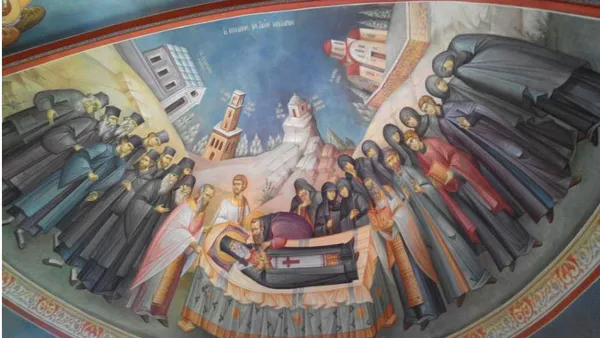
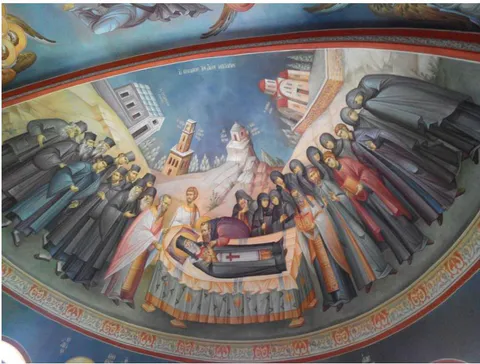
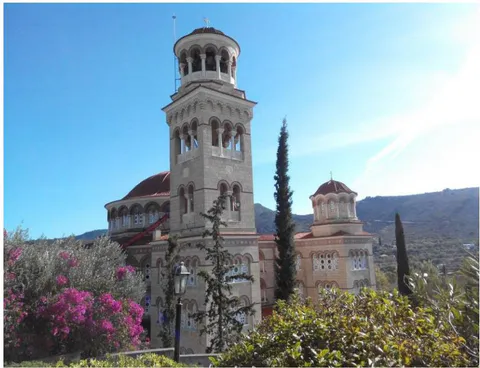
Not only in Ukraine, but also in other Orthodox countries during this historical period, the theme of dedication also becomes dominant in the programs for painting new churches. For example, in the temple of St. Nektarios of Aegina on the island of Aegina in the conch of the apse, i.e. the Assumption of St. Nektarios (2020) is written in the "higher", which, on the one hand, contradicts the canons of constructing the church painting program, on the other hand, is explained by the desire to emphasize the significance of the personality of the saint in whose honor the church was consecrated (Fig.1, 2).
As a characteristic feature of our time, one can consider the veneration of saints on a par with incorporeal forces, if not more. In the prayer life of believers, the reading of akathists to saints becomes more widespread and more significant than the reading of the Holy Scriptures, the Psalter and the Canon.
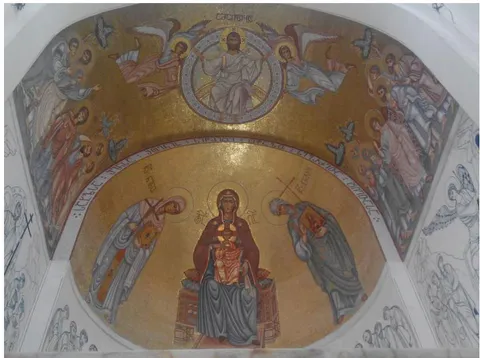
A similar trend is observed in modern churches in Georgia. For example, in the church of St. Equal-to- the-Apostles Nina of the monastery of the same name, the altar of which was painted in 2021, in the conch of theapse to the right and left of the throne image of the Most Holy Theotokos, instead of the traditional images of the Archangels Michael and Gabriel, St. Equal-to-the-Apostles Nina and St. Andrew are painted (Fig.3).
The dedication of the temple is also emphasized in the programs of painting modern churches in Estonia, for example, in the church of the Narva Icon of the Mother of God in the city of Narva: the painting of this church includes scenes from the great
Akathist to the Most Holy Theotokos, images of the Old Testament prophets who foreshadowed the birth of the Savior from the Virgin; the prophet David is written in the "higher", which emphasizes its axiological significance, perhaps because the Mother of God was from the "family of David". The dedication is also marked with a blue background, which is considered to be the color of the Most Holy Theotokos.
The inclusion of the theme of the dedication of the temple in the program of its painting is always a creative process, in which both the customer and the artist participate. The glorification of new saints by the church and the consecration of new churches in their honor requires the creation by icon painters of new iconographic plots that make up the "life cycle" of the saint. The saturation of the temple painting program largely depends on the spiritual needs of society in a particular historical period.
III. THE POSSIBILITY OF A CREATIVE APPROACH IN DRAWING UP A PROGRAM FOR PAINTING AN ORTHODOX CHURCH
A common feature for the programs of murals of Orthodox churches, painted in the 21st century, both in Ukraine and in other countries, is the possibility of a creative approach to the creation of new programs of murals and new artistic solutions, which was practically impossible in the 19th and 20th centuries.
The question of the admissibility of making changes to the iconographic programs of Orthodox churches remains relevant in the 21st century. On the one hand, it is necessary to preserve the tradition of temple painting, without departing from its main purpose, on the other hand, church art should not turn into a craft and stereotyped copying of ancient samples.
Compromises in resolving this issue regarding the iconographic program can most often be found in monastic churches. As the researcher Olga Smolina notes, monastic art is always relevant for the historical period of its creation, plot, composition, color is associated with the solution of socially and/or state significant problems, corresponds to the tastes and artistic styles of the era, performs the functions of illustration, education, decoration4.
New architectural solutions and the dedication of churches to newly glorified saints require the creation of new programs for murals, without departing from church canons. However, while working on the painting of the temple, the icon painter does not set himself the goal of creating a masterpiece or conquering the parishioners praying in the temple with his skill.
Analyzing the features of monastic art and culture, Doctor of Cultural Studies Olga Smolina emphasizes that «art should play a service role here, it acts as a conductor of Christian religious ideas and values, it is strict, restrained, ascetic, "laconic". Achieving a high artistic level in icon painting and architecture may not only not be set as a goal, but it may not be welcome either .
IV. A FEW WORDS ABOUT STYLES IN TEMPLE PAINTING
One of the pronounced trends in the modern painting of Orthodox churches in Eastern Ukraine is the use of the Byzantine style. It cannot be overlooked that Orthodox churches in the East of Ukraine, built (or restored) and painted during the period of state independence, were painted either in the style of academic painting or in the Byzantine style. Moreover, the style of academic painting is more characteristic of churches painted in the 90s of the 20th century - the beginning of the 21st century, and in the last two decades, customers and icon painters prefer the Byzantine style of painting. First of all, this trend is due to the fact that the period of independence of Ukraine was marked by a special revival of the spiritual self-consciousness of the people, an important component of which was the appeal to religious sources.
In the dissertation of A.
V. Simonova, it is emphasized that, despite the diversity of trends within Byzantine art, uniform artistic principles are preserved within its framework5.
Byzantine monumental church painting adopted the classical traditions of antiquity, which were transformed by masters who gave (iconographic) images spirituality. Artists were able to convey through visible images the invisible, spiritual, mystical.
The Byzantine icon-painting style is characterized by an emphasis on the internal, and not on the external, abstract abstract forms are not inherent in it. The images convey joy, light, Easter festive mood, they lack tragedy and even drama. Images painted in the Byzantine style are characterized by contemplation, concentration of the mind, calmness, lack of dynamism, self-absorption, withdrawal into the inner world. They reflect the divine presence, so they are often motionless, pillar-shaped, candle-shaped6.
In the iconographic compositions of the Byzantine style, there are no sharp movements, intense gestures, since the eternal, not the momentary, was valued in everything. The images are timeless and extra-spatial.
The main feature of the canonical (Byzantine) style of temple painting is that these images represent a person who has already been transformed by divine grace and a transformed world. In the Byzantine cultural tradition, sacred monumental painting was formed and reached the highest aesthetic, artistic and spiritual development, which became a reflection of the Eastern Christian cosmos.
The reverse perspective is inherent in the Byzantine style in monumental church painting as a religious art, it is thanks to its perception that the invisible, the background becomes the main one, that is, the sacred manifests itself, which by its nature is invisible. Thanks to the reverse perspective, consciousness begins to capture what cannot be clearly and logically understood. The main goal of icon painting is to transform reality, to reorganize space, bringing it to a higher level of integrity, characteristic of a work of art. At the same time, the very essence of the work, the integrity of a higher order, is here connected not with the individuality of the artist, but with the representation of the transpersonal sacred, which alone can stand behind the perfection of the created form7.
It is worth paying attention to the article "Mikhail Boychuk and Svyatoslav Hordinsky: to the problem of artistic influence", in which the author says that "the Neo-Byzantine artists set themselves the goal of preserving intact the traditions of the religious art of Ukraine." "... In Byzantium, the artist saw the national roots of Ukrainian art", and also because of the prohibition of the Ukrainian Church on the family, they felt obliged to reproduce icon painting, "national iconography" as one of the factors of Ukrainian identity. That, the period of Ukraine's independence was marked by the search for the national and cultural identity of the Ukrainian people, which is also reflected in religious art.
It should be noted that among the temples considered in the study, the Byzantine style is characteristic to a greater extent in monastic and Scythian temples, which can be explained by the desire of the abbots (customers of the painting) to follow the statutes of the ancient Byzantine traditions both in external and internal monastic life.
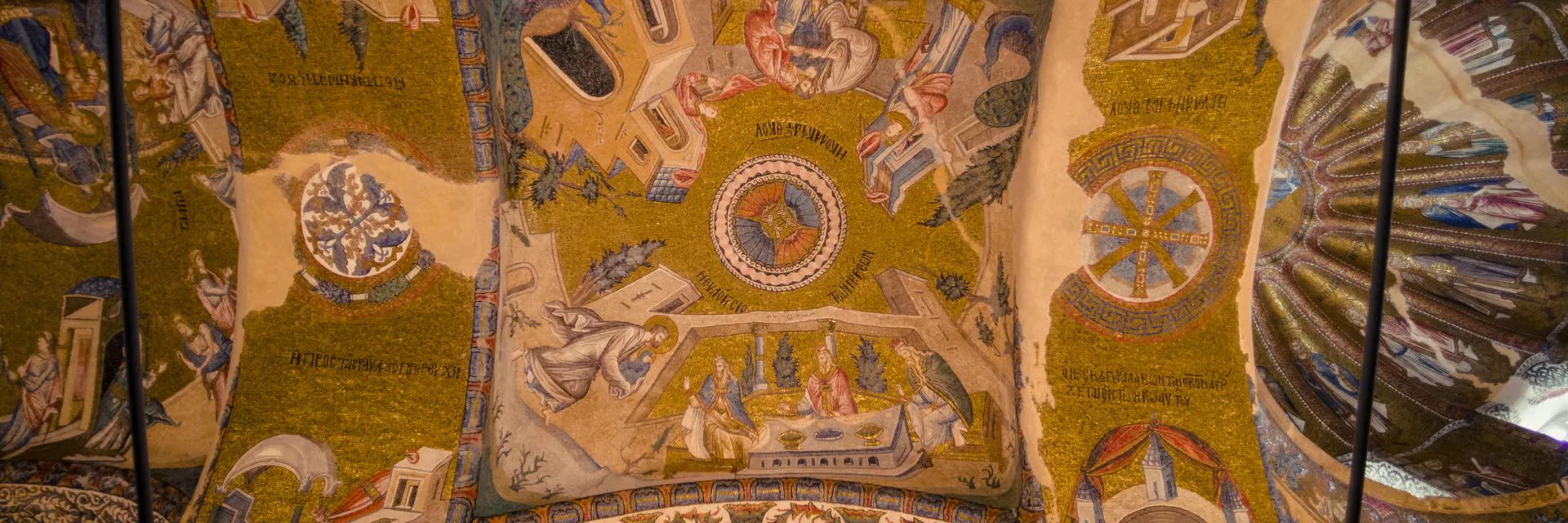
The return to the Byzantine style in the monumental church painting of Ukraine in the mid-2000s was also facilitated by the rapid development of religious tourism and the exchange of experience between masters. And in ancient times, pilgrimages to the shrines of Byzantium, Palestine, and Greece played an important role in the development of church art. According to icon painter Vladyslav Yushkov, Venerable Andrey Rublyov was in the Chora Monastery in Constantinople, and the style of his icon painting was primarily influenced by his visit to this monastery.
The development of the Internet and social networks contributed to the availability of information, the exchange of experience between masters and the opportunity for icon painters to follow any artistic pattern, both ancient and modern.
V. REVIVAL OF INTEREST IN THE FRESCO TECHNIQUE
Despite the fact that most Orthodox churches in Ukraine at the end of the 20th and beginning of the 21st century were painted on dry plaster, during this period there is a revival of interest in a real fresco, which involves painting on wet plaster. After the moisture evaporates, the lime contained in the plaster forms a thin transparent calcite film, which makes the fresco durable. You can damage the fresco only by destroying the wall. In the fresco technique, for example, the Church of the Intercession of the Most Holy Theotokos in the Svyatogorsk Lavra is painted. Hieromonk Agapit was engaged in fresco painting in the Donetsk region.
Icon painter Vladislav Yushkov, in one of his interviews, said that in the period of the late 20th - early 21st centuries, the fresco was especially widespread in the Balkan countries (Serbia, Bosnia). On the territory of Ukraine, he met a rural temple in the Zaporozhye region, painted in fresco technique.
VI. THE INFLUENCE OF THE VISUAL TURN ON THE TEMPLE PAINTING
The emergence of new trends in modern monumental church painting was influenced by visual culture. The culture of the beginning of the 21st century is predominantly described as visual. Modern visual research is a new field for studying the cultural construction of the visual in art, media and everyday life.
Despite the fact that culture has always had a visual component, the shift in emphasis towards the growing importance of the "visual" is due to the hyperdevelopment and intensification of visual technologies, the spread of photography and television, and at the turn of the 20th-21st centuries, the emergence of new digital technologies and the Internet. The interpenetration of various types of fine arts and new digital technologies have provided new opportunities for expression in culture8.
The visual turn was also reflected in modern monumental church painting: in the 21st century, murals of Orthodox churches in the 3D style began to appear, including on the territory of Ukraine (for example, the St. The temple is painted in the Baroque style, iconographic images are given volume, so people and the world are presented in three-dimensional space.
It should be noted that the 3D effect is used to increase the space, but the saints are not depicted in volume, but in the canonical Byzantine style. Thus, the painting remains canonical, modern innovations in monumental art concern the form, but do not affect the essence.
Analyzing the phenomena of visual culture, William Mitchell interprets the influx of images inherent in modernity as a "pictorial turn" and notes that the bias towards the visual, there is some return to the mythology of technologically advanced cultures9. Roland Barthes, in turn, believes that mythology is created by man in order to give meaning to the world around him10.
As a result, the dominance of new means of communication changes the essence of perception, which ultimately leads to a change in ideas about reality. In other words: "The essential effects of technology are not reduced to direct sensory influences, but affect our entire perception of the world"12. Plotinus quite insightfully said about this: "Every soul is and becomes what it contemplates" (Plotinus IV 3, 8, 15)13.
On the significance of the iconic turn for the perception of reality, Valery Savchuk writes that, surrounding ourselves with images, «We are "numb before the image", we communicate with images, we finally think in images, "forgetting" about the linguistic nature of reality»11.
According to the results of a study of visual rotation conducted by V.
V. Savchuk, "the iconic rotation shifts the focus of attention from what the image represents besides itself, or rather through itself, to what it represents. In other words, the image has a structure, construction, it has cultural mechanisms of formation and conditions of existence12. The study by A. S. Reutov states that the significance of the visual turn lies in "the fundamental role of the visual image in the construction of reality and the increasing theoretical interest in the latter"13.
Thus, in the modern world, visuality becomes a formative basis in culture. The consequence of the visual turn was the reorientation of the study of various kinds of phenomena associated with the visual in culture. The visual turn was reflected in the monumental church painting. Based on the conclusions made by
Roland Barthes and V.
V. Savchuk, it can be assumed that the reason for the emergence of monumental church painting in the 3D style is the desire to attach special (greater) importance rather to the visual iconographic images themselves than to the ideas to which these images refer. The iconographic plots used in the painting of an Orthodox church are largely based not only on the texts of the Holy Scriptures, but also on hymnography (liturgical texts). Since a person concentrates on the image itself, here too one can speak of a transition from a linguistic turn to an iconic one.
The transition from two-dimensional to three-dimensional space in church painting can be interpreted as emphasizing the importance of the inner space of the Orthodox church itself and a greater sacralization of this space. That is, there is a certain transition from the perception of the temple as a symbol of "heaven on earth" to the approval of its sacralization, to some extent there is also a "transfer" of the object of faith from the invisible world to the visible. The use of 3D in temple murals, on the one hand, is due to the desire to give greater meaning to iconographic images and plots, on the other hand, it ties the viewer's attention to these images themselves, transferring from the speculative to the visual.
VII. CONCLUSION
Among the modern trends inherent in the monumental painting of the churches of the East of Ukraine, painted in the late XX - early XXI century, there are general trends characteristic of the painting of Orthodox churches of this historical period, built both on the territory of Ukraine and on the territory of other countries (the emphasized importance of the dedication of the temple, interest in the Byzantine icon-painting style and fresco, the influence of the visual turn on church art), and the individual characteristics inherent in the temples of this region, associated primarily with the creative decisions of icon painters and customers in the preparation of murals programs.
The examples of programs for painting modern Orthodox churches that we have considered made it possible to determine how their formation is influenced by the following factors: the dedication of the temple, the cultural and historical situation, liturgical texts, the features of the internal architecture of the temple, the wishes of the customer, the desire to highlight the most revered saints. Since periodically new saints glorified by the church appear, this is reflected in the temple painting. In this regard, it is permissible to somewhat change the old iconographic plots, adding to them the newly glorified saints. The unusual architecture of the temple, which forms its internal space, can serve as a source for a creative approach to drawing up a program for its painting. The art of an icon painter is not an end in
- itself, it is designed to incite a person to prayer and repentance, since a temple is a place where the earthly connects with the heavenly.
- The main object of modern research is the regional features of church painting, which indicates an understanding of the importance of analyzing artistic aspects on the basis of regional material. At the same time, it seems relevant to study the creativity and various components of the creativity of individual Ukrainian artists, in particular icon painters.
- The main task of monumental painting, as well as other types of church art, is the upbringing and formation of a person, bringing his soul into a prayerful contemplative state. The Byzantine style in temple painting is designed to help a person "rest in God."
- The use of the 3D style in temple murals, on the one hand, is due to the desire to give greater meaning to iconographic images and plots, on the other hand, it ties the viewer's attention to these images themselves, transferring from the speculative to the visual, which ultimately can contribute to a return to pagan perception temple.
Footnotes
P.31. (p.7) ↩
Popova O.S., Sarabyanov V.D. Painting of the End of the X - the Middle of the XI Century. p. 185. (p.1) ↩
pages. (p.5) ↩
Smolina. O.O. The specificity of "monastic" and "monastic" in the Orthodox Christian culture. // Culture and civilization. (1) 2011, pp. 44-46. (p.5) ↩
Simonova A. V. Byzantine traditions in modern paintings of Orthodox churches of Ukraine (end of the 20th - beginning of the 21st century) Kharkiv. 2015. (p.5) ↩
Popova O. S. Ways of Byzantine Art. M. GAMMA-PRESS, 2013. (p.5) ↩
Tsugorka O. P. The sacred art of painting: a national scientific reflection // Bulletin of the National Academy of Managerial Personnel of Culture and Arts No. 4'2016. P. 118. Berehovska H. Mykhailo Boychuk and Svyatoslav Gordynskyi: to the problem of artistic influence / H. Berehovska // Ukrainian Studies. - 2012-2013. - No. 13 (p.6) ↩
New visual culture in the media space / New visual culture in the media space URL: https://age-info.com/2019/06/new-visual-culture-inmediapro/ (accessed 04/17/2021). (p.6) ↩
Mitchell, W.J.T. Picture Theory. Chicago: University of Chicago Press. 1994. P. 76. (p.7) ↩
Bart R. Camera lucida. Commentary on the photo. Moscow: AD Marginem Press. 2011, p. 53. (p.7) ↩
P. 289-296. - Access mode: http://nbuv.gov.ua/jpdf/Us_2012-2013_13-14_33.pdf (p.6) ↩
Savchuk V. V. Philosophy of photography. St. Petersburg: Academy of Cultural Research. 2015. p. 50. (p.7) ↩
Reutov A.S. Visual studies of modern culture: a phenomenological aspect: Abstract of the thesis. cand. dis. N. Novgorod. 2018. p. 23. (p.7) ↩