


Financial Modeling with Geometric Brownian Motion

Article ID

C: FINANCE05DK0

Accurate, innovative financial modeling methods for academic research. Improve financial forecasts with geometry-based models.

Financial Modeling with Geometric Brownian Motion

Chelsea Peng
Chelsea Peng
DOI

Abstract

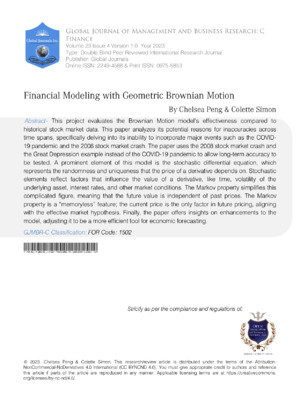
This project evaluates the Brownian Motion model’s effectiveness compared to historical stock market data. This paper analyzes its potential reasons for inaccuracies across time spans, specifically delving into its inability to incorporate major events such as the COVID-19 pandemic and the 2008 stock market crash. The paper uses the 2008 stock market crash and the Great Depression example instead of the COVID-19 pandemic to allow long-term accuracy to be tested. A prominent element of this model is the stochastic differential equation, which represents the randomness and uniqueness that the price of a derivative depends on. Stochastic elements reflect factors that influence the value of a derivative, like time, volatility of the underlying asset, interest rates, and other market conditions. The Markov property simplifies this complicated figure, meaning that the future value is independent of past prices. The Markov property is a “memoryless” feature; the current price is the only factor in future pricing, aligning with the effective market hypothesis. Finally, the paper offers insights on enhancements to the model, adjusting it to be a more efficient tool for economic forecasting.

Financial Modeling with Geometric Brownian Motion

This project evaluates the Brownian Motion model’s effectiveness compared to historical stock market data. This paper analyzes its potential reasons for inaccuracies across time spans, specifically delving into its inability to incorporate major events such as the COVID-19 pandemic and the 2008 stock market crash. The paper uses the 2008 stock market crash and the Great Depression example instead of the COVID-19 pandemic to allow long-term accuracy to be tested. A prominent element of this model is the stochastic differential equation, which represents the randomness and uniqueness that the price of a derivative depends on. Stochastic elements reflect factors that influence the value of a derivative, like time, volatility of the underlying asset, interest rates, and other market conditions. The Markov property simplifies this complicated figure, meaning that the future value is independent of past prices. The Markov property is a “memoryless” feature; the current price is the only factor in future pricing, aligning with the effective market hypothesis. Finally, the paper offers insights on enhancements to the model, adjusting it to be a more efficient tool for economic forecasting.

Chelsea Peng
Chelsea Peng

No Figures found in article.

Chelsea Peng. 2026. “. Global Journal of Management and Business Research – C: Finance GJMBR-C Volume 23 (GJMBR Volume 23 Issue C4): .

Download Citation

Journal Specifications

Crossref Journal DOI 10.17406/GJMBR

Print ISSN 0975-5853

e-ISSN 2249-4588

Issue Cover
GJMBR Volume 23 Issue C4
Pg. 57- 63
Classification
GJMBR-C Classification: FOR Code: 1502
Keywords
Article Matrices
Total Views: 898
Total Downloads: 16
2026 Trends
Research Identity (RIN)
Related Research
Our website is actively being updated, and changes may occur frequently. Please clear your browser cache if needed. For feedback or error reporting, please email [email protected]

Request Access

Please fill out the form below to request access to this research paper. Your request will be reviewed by the editorial or author team.
X

Quote and Order Details

Contact Person

Invoice Address

Notes or Comments

This is the heading

Lorem ipsum dolor sit amet, consectetur adipiscing elit. Ut elit tellus, luctus nec ullamcorper mattis, pulvinar dapibus leo.


High-quality academic research articles on global topics and journals.

Financial Modeling with Geometric Brownian Motion

Chelsea Peng
Chelsea Peng

Research Journals





























































