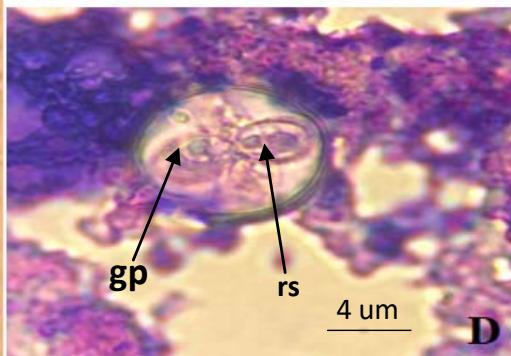
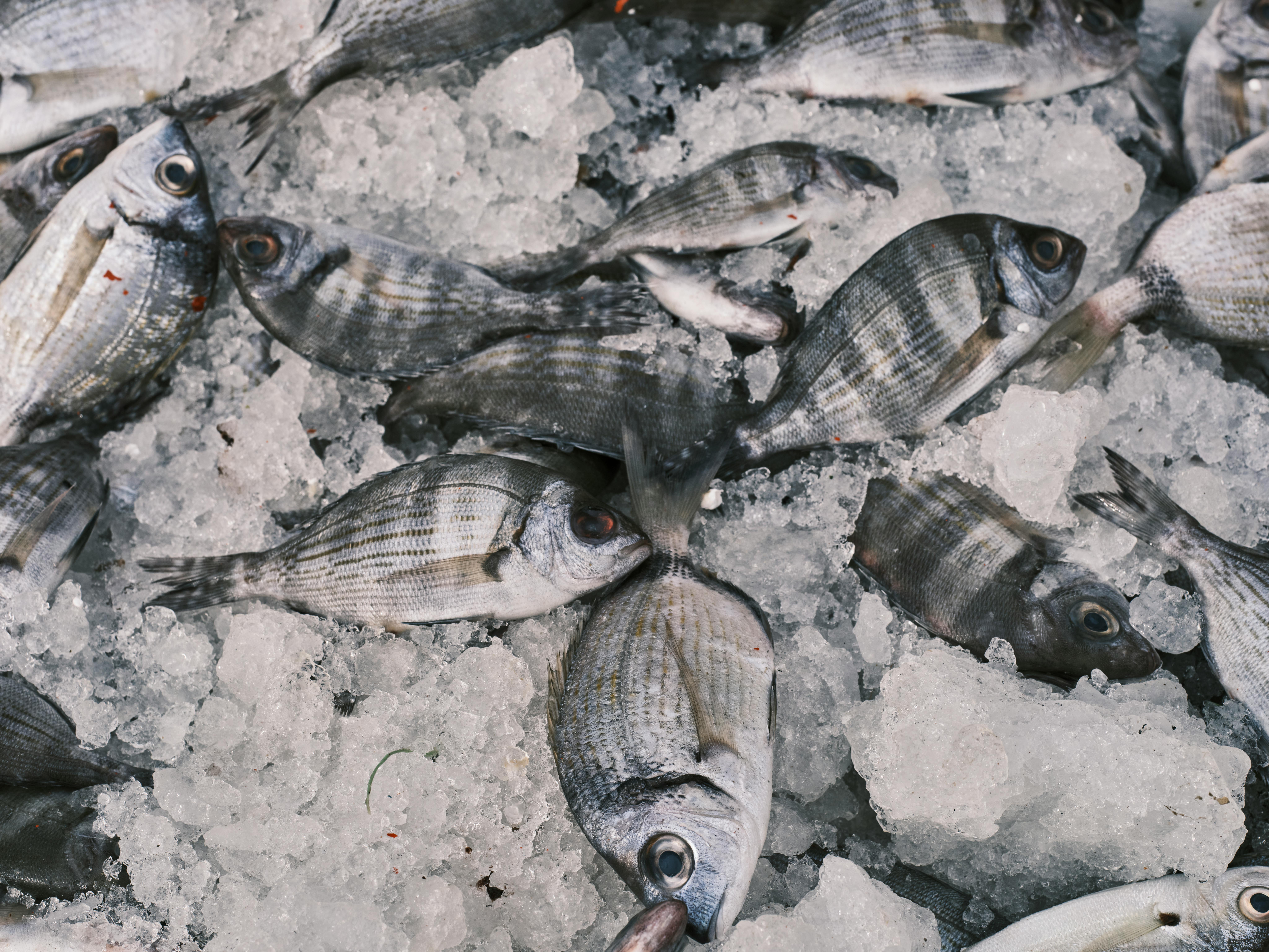
The objective of this work is to develop and optimise the ESSP841/CRP999 real-time PCR targeting the 18S ribosomal rRNA of Eimeridae (Eimeria spp) found in Mugil cephalus from the east coast of Algeria and to determine their pathogenicity and the risk of contamination of consumers. Mugilidae from the east coast of Algeria were captured in search of parasites that could infect them. In the laboratory 816 Mugil cephalus were weighed, dissected and eviscerated. In our study we found 378 samples positive for Eiemeria sp (46.3%) out of 816 fish samples, i.e. a prevalence of 46.3%, the average intensity was 1.6. The results of the direct examinations are confirmed by real-time PCR using the primer pair ESSP841 CRP999 which was positive for all samples tested. We obtained curves with variable TCs.
S Aarthi,G Dhinakar Raj,M Raman,S Gomathinayagam,K Kumanan (2010). Molecular prevalence and preponderance of Eimeria spp. Among chickens in Tamil Nadu, India.
L Belova,M Krylov (2000). Eight new species of coccidia (Sporozoa, Coccidia) from fishes of the continental waters of Russia.
C Costa,R Gomes,M Melo,M Ribeiro (2001). Eimeria parasites of domestic fowl: genetic relationships of different isolates estimated from random polymorphic DNA.
P Damer,Qin Blake; Zonghua,Cai Jianping,L Adrian,Smith (2008). Development and validation of realtime polymerase chain reaction assays specific to four species of Eimeria.
A Daugschies,M Najdrowski (2005). Eimeriosis in cattle: current understanding.
I Dykova,J Et,Lom (1983). Fish coccidia: an annotated list of described species.
D Duszynski,P Wilber (1997). A guideline for the preparation of species descriptions in the Eimeriidae.
S Fernandez,A Pagotto,M Furtado, Katsuyama,A Madeira,A Gruber (2003). A multiplex PCR assay for the simultaneous detection and discrimination of the seven<i>Eimeria</i>species that infect domestic fowl.
W Johnston,M Shirley,A Smith,M Gravenor (2001). Modelling host cell availability and the crowding effect in Eimeria infections.
Marek Kirs,David Smith (2007). Multiplex Quantitative Real-Time Reverse Transcriptase PCR for F <sup>+</sup> -Specific RNA Coliphages: a Method for Use in Microbial Source Tracking.
A Labbé (1896). Recherches zoologiques, cytologiques et biologiques sur les Coccidies.
L Léger,A Et,Hollande (1922). Coccidie de l'intestin de l'anguille.
A Lew,G Anderson,C Minchin,P Jeston,W Jorgensen (2003). Inter- and intra-strain variation and PCR detection of the internal transcribed spacer 1 (ITS-1) sequences of Australian isolates of Eimeria species from chickens.
Y Lien,S Sheu,H Liu,S Chen,M Tsai,S Luo,K Wu,S Liu,H Su (2007). Cloning and nucleotide sequencing of the second internal transcribed spacer of ribosomal DNA for three species of Eimeria from chickens in Taiwan.
J Lom,I Dykova (1992). Protozoan parasites of fishes.
J Lom,I Et,Dykova (1981). New species of the genus Eimeria from marine fishes.
J Lom,I Dyková (1982). Some marine fish coccidia of the genera Eimeria Schneider, Epieimeria Dyková & Lom and Goussia Labbé.
P Long,L Joyner (1984). Problems in the Identification of Species of Eimeria.
P Long,W Reid (1982). A guide for the diagnosis of coccidiosis in chickens.
Kálmán Molnár,Györgyi Ostoros,Detiger Dunams-Morel,Benjamin Rosenthal (2012). Eimeria that infect fish are diverse and are related to, but distinct from, those that infect terrestrial vertebrates.
G Morris,R Gasser (2006). Biotechnological advances in the diagnosis of avian coccidiosis and the analysis of genetic variation in Eimeria.
Sukayna Mushattat (2013). Parasitology and Immunology study of Gastrointestinal parasites in Chickens. Athesis Submitted to the council of college of edu.
Aditi Sharma,Sven Behrens,Yury Chernoff,Andreas Bommarius (2018). Modulation of the Formation of Aβ- and Sup35NM-Based Amyloids by Complex Interplay of Specific and Nonspecific Ion Effects.
Martin Shirley,Adrian Smith,Fiona Tomley (2005). The Biology of Avian Eimeria with an Emphasis on their Control by Vaccination.
Beate Schnitzler,Per Thebo,Jens Mattsson,Fiona Tomley,Martin Shirley (1998). Development of a diagnostic PCR assay for the detection and discrimination of four pathogenic<i>.Eimeria</i>species of the chicken.
P Thélohan (1892). Sur quelques nouvelles Coccidies parasites de Poissons.
Joseph Ogedengbe,D Hunter,John Barta (2011). Molecular identification of Eimeria species infecting market-age meat chickens in commercial flocks in Ontario.
Yvonne Qvarnstrom,Cleve James,Maniphet Xayavong,Brian Holloway,Govinda Visvesvara,Rama Sriram,Alexandre Da Silva (2005). Comparison of Real-Time PCR Protocols for Differential Laboratory Diagnosis of Amebiasis.
R Williams (1998). Epidemiological aspects of the use of live anticoccidial vaccines for chickens.
Xiaomin Zhao,Donald Duszynski (2001). Phylogenetic relationships among rodent Eimeria species determined by plastid ORF470 and nuclear 18S rDNA sequences.
No ethics committee approval was required for this article type.
Data Availability
Not applicable for this article.
How to Cite This Article
Racha Boubekeur. 2026. \u201cFirst Detection and Molecular Characterisation of Eimeria spp on Mugilidae fish Mugil cephalus Linnaeus, 1758 in Algerian Coast\u201d. Global Journal of Science Frontier Research - C: Biological Science GJSFR-C Volume 23 (GJSFR Volume 23 Issue C1): .
Explore published articles in an immersive Augmented Reality environment. Our platform converts research papers into interactive 3D books, allowing readers to view and interact with content using AR and VR compatible devices.
Your published article is automatically converted into a realistic 3D book. Flip through pages and read research papers in a more engaging and interactive format.
The objective of this work is to develop and optimise the ESSP841/CRP999 real-time PCR targeting the 18S ribosomal rRNA of Eimeridae (Eimeria spp) found in Mugil cephalus from the east coast of Algeria and to determine their pathogenicity and the risk of contamination of consumers. Mugilidae from the east coast of Algeria were captured in search of parasites that could infect them. In the laboratory 816 Mugil cephalus were weighed, dissected and eviscerated. In our study we found 378 samples positive for Eiemeria sp (46.3%) out of 816 fish samples, i.e. a prevalence of 46.3%, the average intensity was 1.6. The results of the direct examinations are confirmed by real-time PCR using the primer pair ESSP841 CRP999 which was positive for all samples tested. We obtained curves with variable TCs.
Our website is actively being updated, and changes may occur frequently. Please clear your browser cache if needed. For feedback or error reporting, please email [email protected]
Thank you for connecting with us. We will respond to you shortly.